Return to The Lord

Have you ever felt like your relationship with God wasn’t what it should be? I think if we’re honest, we’ve all had seasons in our lives where we knew we weren’t quite right with God. Some of us are going through that right now. Sometimes we know what put that distance in our relationship with Him, sometimes we’re not quite sure how we drifted away. We just know we need to get back.

The Jews and Messianic believers say the month leading up to Yom Teruah (Feast of Trumpets) and the 10 Days of Awe between Trumpets and Yom Kippur (Day of Atonement) are a season of teshuva. This word literally means “return.” It is derived from the word shub (H7725), which is the form used in scripture. When the Old Testament talks about people turning away from their sins, this is the word typically used (examples: 1 Kings 8:47; Eze. 14:6; 18:30). We also translate shub and teshuva as repentance.Shabbat Shuvah | marissabaker.wordpress.com

  • (Side Note: the English word “repent” in the KJV Old Testament is usually translated from nacham (H5162), to be sorry, and is most often used of God. However, our modern understanding of repentance is better expressed by shub or teshuva.)

The Theological Wordbook of the Old Testament says that all the “idioms describing man’s responsibility in the process of repentance … are subsumed and summarized by this verb shub. For better than any other verb it combines in itself the two requisites of repentance: to turn from evil and to turn to the good” (entry 2340).

Four Steps

Today is the Sabbath between Trumpets and Atonement. It’s traditionally known as Shabbat Shuvah, the Sabbath of Return. While repentance is something we do year round, this is a fitting season to think more deeply about where we stand with God and in what ways we need to turn back to Him. Read more
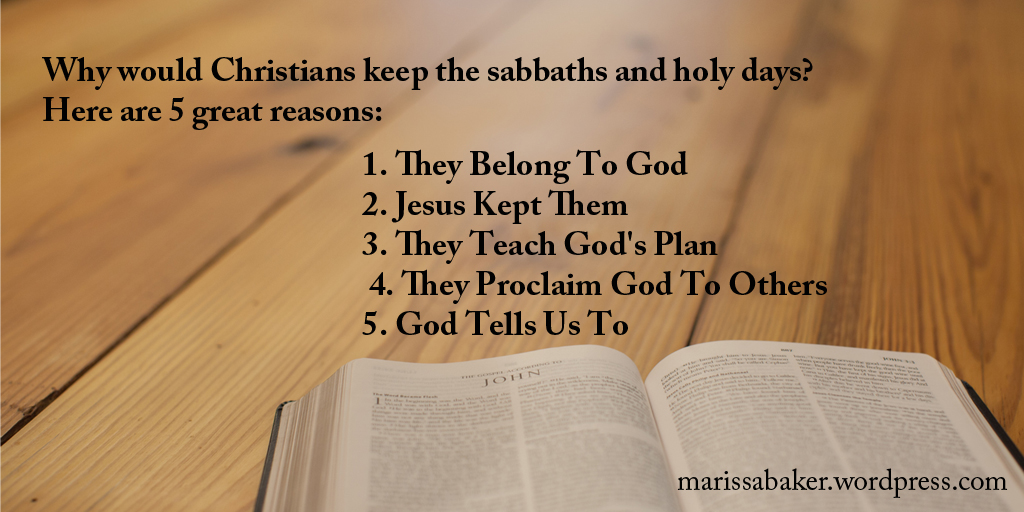
Top 5 Reasons for Christians to Keep God’s Holy Days

Today we celebrate Yom Teruah, also called Feast of Trumpets and Rosh Hashanah. But why? After all, I’m Christian and most people think of this as a Jewish holiday. Same goes for Yom Kippur/Day of Atonement, which we’ll observe 10 days from now, and Sukkot/Feast of Tabernacles that starts in two weeks.

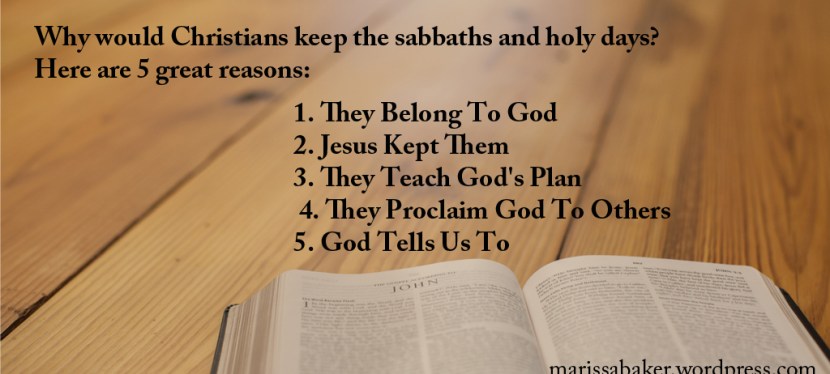
I believe these festival observances, along with others already completed this year, are for Christians today. When Jesus came to this world, it wasn’t to set up a new religion. He was the next step in God’s plan for the world and these days are part of the covenant He makes with His family. He’s still inviting us to gather for “reunions” at certain times of the year.Top 5 Reasons for Christians to Keep God's Holy Days | marissabaker.wordpress.com

1. They Belong To God

And the Lord spoke to Moses, saying, “Speak to the children of Israel, and say to them: ‘The feasts of the Lord, which you shall proclaim to be holy convocations, these are My feasts.” (Lev. 23:1-2)

The holy days aren’t Jewish or exclusively Old Testament. They belong to God Himself. We talk about Leviticus 23 as the chapter where God gives Israel the Feasts, but that’s not quite accurate. God doesn’t say, “Here are your holy days, Israel.” He says, “These are the feasts of the Lord, holy convocations which you shall proclaim at their appointed times” (Lev. 23:4). Read more

Crash Course In Romans

We’re going to talk about all of Romans in one blog post. That looks like a crazy idea as I type it, but I think sometimes when we zero-in on just one section of Paul’s letters we miss the bigger picture of what he’s trying to say. Perhaps there’s merit in studying overall messages as well as minute details.

Romans is a confusing letter, especially when you read pieces out of context. To really get a sense of what Paul is trying to say in any given chapter or verse, we have to read the entire letter. That’s true of any book in the Bible, but I think it’s more true for Romans since Paul connects his arguments so closely. Especially in the first half of the letter, he frequently makes a statement that could lead readers to make an incorrect assumption, then he asks that assumption as a rhetorical question and refutes it.click to read article, "Crash Course In Romans" | marissabaker.wordpress.com

Also, even though we’ll stay mostly in Romans, it’s important to remember Paul wasn’t writing in a void. Reading Romans (or any other book of the Bible) by itself can lead to misinterpretation. We must frame our understanding of this letter in light of the Old Testament (the only scriptures around for Paul to reference) and the teachings of Jesus (for Paul would never contradict our Lord’s words). Doing that well would take a book instead of a blog post, but last week’s post serves as an good introduction to this one.

Doing The Law

Romans opens with a discussion of “ungodliness and unrighteousness” which brings people under the judgment of God (Rom. 1:16-32). This applies to all people since even if they didn’t receive a special revelation from God (as ancient Israel received God’s Law) they still can see evidence of Him in creation and can be held accountable for aligning with general moral principles God built into the world. Paul then takes his readers to task not, as some assume, for keeping the Law but rather for teaching it and then acting in a way that dishonors God (Rom. 2:1-29). Paul indicates that the more you know about God’s law, the more accountable you are to do things God’s way.

After saying, “not the hearers of the law are just in the sight of God, but the doers of the law will be justified,” Paul shifts to explaining that even if you do keep the Law you’re still “under sin” because we’re not perfect. He also says it is righteous with God to judge the world, which is guilty before Him because the Law gives knowledge of sin and cannot justify us in God’s sight (Rom. 3:1-20).

Read more

Walking In The Spirit: God’s Character In Us

One of the biggest problems in modern Christianity is an extreme either-or mentality. We lack balance, straying from one ditch to the other. Consider the Christian’s relationship with the Law. Some will say we must keep the whole law slavishly and seek part of our salvation in it (legalism), while others reject it entirely and say God doesn’t care if we keep His commands as long as we have Jesus (license). Both views miss the point.

click to read article, "Walking In The Spirit: God's Character In Us" | marissabaker.wordpress.com
photo credit: Cassidy Kelley via StockSnap

Most arguments that the Law isn’t relevant today start with Paul. But Paul’s letters contain things “hard to understand” which people who aren’t well-grounded in the entirety of scripture can “twist to their own destruction” (2 Pet. 3:15-16). When we’re going to study a complex subject like this, we have to start somewhere more straight-forward. I can think of nowhere better than words directly from Jesus’ own lips.

Using The Law Rightly

When Jesus came to this earth, He didn’t tell people He was done with the Law. Instead, He said, “I did not come to destroy but to fulfill” (Matt. 5:17). This word, pleroo (G4137), means to fill to the fullest extent. Or, as Thayer’s says, “to cause God’s will (as made known in the law) to be obeyed as it should be, and God’s promises (given through the prophets) to receive fulfillment.” Read more

Perseverance In Spiritual Growth

Hebrews 11 shows that it’s possible to live a life of faith by reminding us of people who’ve done just that. Abel, Enoch, Noah, Rahab, and scores of people there’s no time to name all walked by faith. They compass us about as a great “cloud of witnesses” inspiring us to “run with endurance the race that is set before us” with our eyes fixed on Jesus (Heb. 12:1-2).

click to read article, "Perseverance In Spiritual Growth" | marissabaker.wordpress.com
Photo credit: Alex Wong via StockSnap

I didn’t realize until attending church last Shabbat how well my post that week fit in with the season we find ourselves in now. We’re in the month leading up to God’s fall holy days. Traditionally, as the Rabbi in my Mesisanic group pointed out, this is a season of reflection, self-examination, and teshuva (repentance). We need a determination to pursue godliness if we’re to move forward in our walk with God. Along with that goes a perseverance to use our time on this earth wisely, as the minister in my afternoon church spoke on.

The gift of salvation is freely offered to those who take it. Accepting the gift bring us into a covenant relationship with God. One of the things we’re expected to do as “heirs of the kingdom which He promised to those who love Him” (Jam. 2:5) is grow toward spiritual maturity.

Leaving Sin Behind

We’re not meant to stagnate nor to continue in sin after receiving God’s grace. After opening his letter to the Romans with a discussion on the wickedness of man, Paul shifts his focus from those who’ve rejected God to those readers who think they’re right with God but aren’t. Read more

Determined to Pursue Godliness

Too many of us are lazy Christians. I’m including myself in this, too. We think we’re not doing too bad at following God. We avoid big sins, we pray a couple times a day, carve out 1/2 an hour for Bible study, and go to church. We may even do something particularly virtuous and pat ourselves on the back certain that God’s pleased with us. But perhaps our expectations of ourselves are too low.

When the apostles asked Jesus to increase their faith, He asked them a question. “Which of you, having a servant plowing or tending sheep, will say to him when he has come in from the field, ‘Come at once and sit down to eat’?” The implication is that none of them would. Instead, they’d expect the servant to make them dinner and serve them before eating his own supper (Luke 17:5-8)

Does he thank that servant because he did the things that were commanded him? I think not. So likewise you, when you have done all those things which you are commanded, say, ‘We are unprofitable servants. We have done what was our duty to do.’” (Luke 17:9-10)

Doing the bare minimum of what’s expected doesn’t earn us praise and it doesn’t do much to increase our faith. True faith before God doesn’t rest in simply doing what we’re told. It involves pursuing a higher standard.

click to read article, "Determined to Pursue Godliness" | marissabaker.wordpress.com
photo credit: David Marcu via StockSnap

In the book Misreading Scripture With Western Eyes, Brandon J. O’Brien and E. Randolph Richards talk about a tendency in Western Christianity “to restrict the Christian life to avoiding vices.” However, “In scripture, the godly life is portrayed as a lifelong work, not a list of don’ts.” It’s not enough to avoid vices. We also have to put on virtues and cultivate right living as a habit instead of seeing virtues as spontaneous acts (p. 182). Read more