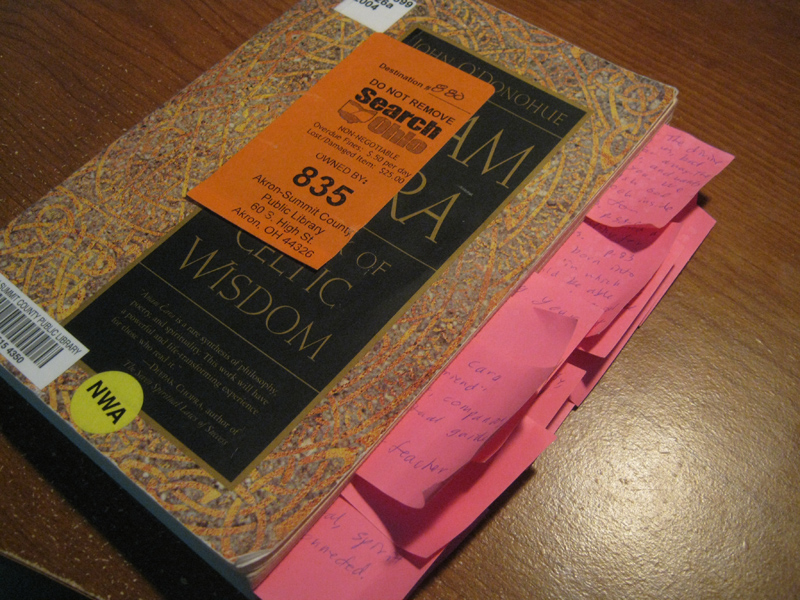
I recently read a little book called Anam Cara: A Book of Celtic Wisdom by John O’Donohue. A blog reader mentioned the idea of an anam cara, or “soul friend,” in a message, and I simply had to look it up. You can usually tell how interesting I found a non-fiction book by the number of sticky notes poking out by the time I’m done reading. Case in point:

It’s not that I agreed with everything in the book, but rather that I found its musings on the nature of life and connection between people fascinating. The first quote I placed a note next to was also one that I’d read in the article that initially pointed me toward this book.
Anam is the Gaelic word for soul and cara is the word for friend. So anam cara in the Celtic world was the “soul friend.” In the early Celtic church, a person who acted as a teacher, companion, or spiritual guide was called an anam cara. It originally referred to someone to whom you confessed, revealing the hidden intimacies of your life. With the anam cara you could share your inner-most self, your mind and your heart. (p.13)
I love this idea, which comes from Chapter 1: The Mystery of Friendship. I’ve been toying with the idea of incorporating it into a new title for this blog. Perhaps “Soul Teacher”? I’m not sure yet.
A couple pages after this quote, the writer takes this discussion in a direction dear to my heart. He describes Jesus as “the secret anam cara of every individual” (p. 15). Isn’t that a beautiful picture? Jesus is our “soul friend,” our most intimate companion, teacher and spiritual guide, the One to whom you can reveal your most hidden self.
Consequently, love is anything but sentimental. In fact, it is the most real and creative form of human presence. Love is the threshold where divine and human presence ebb and flow into each other. (p.15)
Can We Heal Ourselves?
I loved the first chapter of this book. It was in later chapters that I became frustrated with aspects of O’Donahue’s ideology. In Chapter 3: Solitude Is Luminous, he talks about healing wounds in a way that really resonates with me, but I feel his solutions don’t go deep enough.
 It’s true we often seem “destructively addicted to the negative” because confronting it seems to difficult. “If we maintain our misery at this surface level,”O’Donohue writes, “we hold off the initially threatening but ultimately redemptive and healing transfiguration that come through engaging with our inner contradiction.” I’d agree with this — we have to get to know ourselves before we can learn, grow and change ourselves. But O’Donohue isn’t advocating change so much as self-acceptance though befriending “the negative” and recognizing “that it is not destructive. It often seems that morality is the enemy of growth” (p. 115).
There are simply some things in our lives that shouldn’t be accepted. It’s not healthy or safe to befriend the dark side, and we can’t always turn negatives into something benign just by being nice to them. I have to believe it’s possible to grow and remain moral at the same time.
And yet, O’Donohue has a point that we must beware going to the other extreme of spending too much time analyzing and dragging up our pasts. Searching for your problems over and over again won’t help you overcome them, and self-knowledge is only useful if you can act on it in some way to heal and grow. He compares people who go through endless cycles of self-analysis to gardeners who dig up their potatoes every day and replant them a different way.
People in our hungry modern world are always scraping at the clay of their hearts. They have a new thought, a new plan, a new syndrome, that now explains why they are the way they are. …. Negative introspection damages the soul. It holds many people trapped for years and years, and ironically, it never allows them to change (p. 122).
The very next line is where he lost me: “It is wise to allow the soul to carry on its secret work in the night side of your life” (p. 122). Much like he suggests befriending our negativity is the best way of dealing with it, he believes our wounds can heal themselves if we give our souls space and approach our ” hurt indirectly and kindly” (123). But our souls aren’t designed to heal themselves. They’re healed by God.
I feel this idea of self-healing is connected to the writer’s idea of the divine residing inside our souls. Though he references Christianity heavily, that’s not the only theology O’Donohue draws on — the theology of this book is a mishmash of Irish Catholicism, Celtic paganism, and mysticism. He’s not comfortable with the idea of a “faraway divinity,” and so adopts the idea that the divine is within us. He’s missing a third option, though.
Biblicaly, the divine is outside us, but He’s not far away. “The word is very near you, in your mouth and in your heart,” and the living Word wants to dwell inside us (Deut. 30:14; Rom. 10:8). I suppose you could say the divine resides inside us after we submit ourselves to Christ, but we have to ask Him in — not start out looking inside our own souls for the answers.
You Have A Purpose
I want to share with you a passage in this book that I found hugely encouraging. It’s also from Chapter Three.
To be born is to be chosen. No one is here by accident. … Your identity was not offered for your choosing. In other words, a special destiny was prepared for you. But you were also given freedom and creativity to go beyond the given, to make a new set of relationships and to forge an ever new identity, inclusive of the old but not limited to it. … Destiny sets the outer frame of experience and life; freedom finds and fills its inner form. …
You were sent to a shape of destiny in which you would be able to express the special gift you bring to the world. Sometimes this gift may involve suffering and pain that can neither be accounted for nor explained. There is a unique destiny for each person. Each one of us has something to do here that can be done by no one else. If someone else could fulfill your destiny, then they would be in your place and you would not be here. … When you begin to decipher this, your gift and giftedness come alive. Your heart quickens and the urgency of living rekindles your creativity. (83-84)
 This past Shabbat, the speaker at my Messianic congregation talked about Leah. She was not as pretty as her younger sister Rachel and she was unloved by her husband. She probably thought she didn’t make much of an impact on the world. And yet, her example of faith is recorded in the Bible for everyone to read, and her children founded the priestly lineage of Levi and the royal lineage of Judah, among other nations. She’s a direct ancestor of notable personages like Moses, David and Jesus Christ Himself. Her life matters more than she ever knew.
You also have a purpose in this world, even if you can’t see it. This isn’t to perpetuate an idea that you’re a “special unicorn” who is better than other people. Rather, it’s to say that of us has a unique gift that’s of real value, and you have a hand in shaping how it impacts the world.






 Like An Anchor