You might have read that title and wondered if I’ve lost my faith or my mind. But I wanted an attention-grabbing title to talk about something that I think of whenever I’m reading isolated quotes from the book of Job.
This book records dialog between Job, his three friends (Eliphaz the Temanite, Bildad the Shuhite, and Zophar the Naamathite), a young man named Elihu, and God Himself. At the end of the book, God rebukes the three friends, saying, to Eliphaz,”My wrath is kindled against you, and against your two friends; for you have not spoken of me the thing that is right, as my servant Job has” (Job 42:7, WEB). Here, we see God pointing out that the things these three men said about him were not right. Their words are recorded in the Bible, but those words don’t reflect a correct view of the world or a proper understanding of God.
For those of us who believe that the Bible is the inspired word of God, we often assume that if we’re studying a topic and look up all the verses using a specific keyword or we read a scripture that someone quotes, then whatever that individual verse says must be true. That is often the case, but we can get into trouble if we don’t read the context. Sometimes a verse might be part of a larger argument that changes how we understand a specific phrase (this happens a lot in Paul’s writings). Sometimes the verse might be part of a recorded dialog where the speakers says things that aren’t true. The Bible contains the Truth, but if we take pieces of it out of context or misunderstand what’s going on, we can still take things away from reading the Bible that are not true.
Image by Ben White from Lightstock
A Wrong Conclusion About Suffering
Sometimes, the Bible records incorrect assumptions people made about God. If we read the rest of the story these incorrect assumptions are corrected, but if we just read the person’s incorrect statement and think, “Well, it’s in the Bible so it must be true,” then we can make the same mistakes they did. When we lift a quote from the book of Job, for example, we need to check who said it, what the larger context is, and if it fits with the rest of scripture. We don’t want to risk making the same mistakes Job’s friends did. For example, these men assumed that people who suffer must have sinned and are being punished by God. It’s a mistake people in Jesus’s time were making (John 9:2-3) and it’s one you’ll still hear some people today repeating. They can even trot out some scriptural evidence for it.
Call to mind now: Who, being innocent, ever perished? And where were upright people ever destroyed?
Job 4:7, NET (Eliphaz the Temanite speaking)
If your children sinned against him, he gave them over to the penalty of their sin. …
Surely, God does not reject a blameless man, nor does he grasp the hand of the evildoers.
Job 8:4, 20 NET (Bildad the Shuhite speaking)
These are a couple arguments that Job’s friends used to try and persuade him that he must be guilty of some great sin that caused God to kill his children, take away his wealth, and strike him with a horrible sickness. However, we readers know that something entirely different was going on behind the scenes: Job was “a blameless and upright man” who became the central player in a wager between Yahweh and Satan. Even without that highly unusual circumstance, the rest of the Bible reveals suffering does not just happen because you did something wrong and good people often suffer even while doing what is right.
Limiting God In Our Minds
Another example of how we can arrive at a wrong conclusion based on taking a Biblical person’s mistaken words out of context comes from the book of Habakkuk. When God told Habakkuk, “Look, I am about to empower the Babylonians” to sweep violently across the earth (Hab. 1:6, NET; see Hab. 1:5-11), Habakkuk had concerns. He protested, “You are too just to tolerate evil; you are unable to condone wrongdoing. So why do you put up with such treacherous people?” (Hab. 1:13, NET). God responded that He would certainly do exactly as He’d said (Hab. 2). It seems that Habakkuk had an idea of what God couldn’t or wouldn’t do, and God corrected his misunderstanding.
The whole book of Habakkuk is only 3 chapters long; you can easily read it all in one setting. But we can still take Habakkuk’s words out of context and make his same mistake today. I’ve actually heard people use Habakkuk’s words, “Thou art of purer eyes than to behold evil, and canst not look on iniquity” (Hab. 1:13, KJV) to say that God can’t be in the presence of sin. That’s an incorrect assumption that contradicts much of the rest of the Bible (for example, God let Satan come before Him in Job and he’s as sinful as you can get). And yet, people take this misconception and create whole doctrines, such as saying the Father must have forsaken Jesus and turned His face away when His Son hung on the cross because Jesus took on the world’s sins and God can’t be in the presence of evil. The Bible doesn’t say that! Such an assumption is based on us turning Habakkuk’s misconception into a rigid rule to the point that we place limits on what God can and can’t do that don’t actually exist.
Ask For Understanding
Image by Anggie from Lightstock
It is good to question the things we read. We should also keep in mind, though, that our goal isn’t to disprove the Bible or dismantle correct doctrines. We question, examine, and study in order to learn what is true and correctly understand God’s words.
The brothers sent Paul and Silas off to Berea at once, during the night. When they arrived, they went to the Jewish synagogue. These Jews were more open-minded than those in Thessalonica, for they eagerly received the message, examining the scriptures carefully every day to see if these things were so. Therefore many of them believed, along with quite a few prominent Greek women and men.
Acts 17:10-12, NET
The Bereans are often held up as a good example of examining the scriptures, and rightly so. Notice, though, that their response to hearing the gospel was not to search through the scriptures trying to prove their own idea but “to see if these things were so.” They studied to figure out what was true.
God’s word is Truth, but we must be cautious in how we read it and ask God to guide us to a proper understanding. If we take things out of context or misunderstand what’s being said in a scripture, we might come away from Bible reading with ideas that are not true. It requires God’s spiritual intervention to open our minds to understand the scriptures (Psalm 119:18; Luke 24:45; 1 Cor. 2:6-16). We should approach His word with humility, a willingness to learn, and commitment to understanding God’s word rather than just picking out bits that sound good.
One of the major turning points in my life involved taking a class on the English Bible as literature in my second semester of college for my undergraduate degree. The English Bible class helped me realize I can study the Bible as a scholarly project, I can defend my faith intelligently to other people, and how deeply the Bible in translation influenced the Western literary tradition. It also (along with a Shakespeare class and, more significantly, the Shakespeare professor) helped inspire me to pursue an English degree.
The Bibles that we read in English support this type of scholarly work. The format of pretty much every Bible you can pick up is designed for study and reference. “The addition of chapter breaks in the 13th century and verse numbers in the 16th century” made the standard Bible format “fragmented” into tidbits for cross-referencing different sections and pulling out isolated passages to preach about (“Three Bad Ways We Read the Bible and Three Tips to Improve“).
This is very different from the way we read most books. The only books that typically have similar layouts, references, and annotations are scholarly publications of texts like Shakespeare’s plays or The Iliad. This makes sense in some ways; the Bible is an ancient text and modern readers benefit from notes explaining context. But if you ever had to read a scholarly edition of a literary work, you probably realized that the notes and layout can also get in the way of your reading. For example, by the time you figure out what’s going on with Shakespeare’s language, you might have lost the plot thread.
In contrast, books that we read for enjoyment rarely have cross references and notes. Even non-fiction that is properly cited tucks the notes away in discreet footnotes or endnotes. Fiction may use glossaries at the back for historic context and pronunciation guides, but there’s rarely anything to interfere with the text itself. These books are designed for immersive reading. You can even read older texts immersively if you familiarize yourself with the writing style. For example, when I first started reading 17th and 18th century English literature, I read the introduction and all the notes. Now that I know more about the historical context and the language the writers used, though, I just dive right into the story.
What if we could read the Bible that way? Like it’s a story that we’re eager to lose ourselves in, without verse numbers and center notes getting in the way?
For context, when I say “story” I mean “an account of people and events, real or imaginary.” I am not suggesting that the Bible is fictional when I say that it is written as a story. I mean that this book has a narrative structure. More specifically, there are several metanarratives (overarching stories or big themes) that you can see when reading the whole Bible. I write about one, “A Story of Battle and Victory,” in my new Armor of God Study Guide. We have a harder time seeing those narrative themes if we’re only reading isolated chunks of the Bible.
Bible reading rates are shockingly low among Christians. Part of this is lack of time, but part is also because we’re not sure how to read it or we don’t really want to (more on this later, with data). And when we do read it, often we go to specific parts that make us feel better or which we think will offer guidance when we’re making decision.
The Bible is a book we can turn to for comfort and it does contain vitally important instructions, but it’s not just an instruction manual, a list of laws, or a collection of reassurances. The Bible is how God tells us about Himself, and when we read the whole thing together, we see He’s revealing Himself through a story with central themes of creation and redemption, love, building a family, and founding a kingdom. And I think maybe if we realized that, it would be easier to read the Bible more.
Image by Ben White from Lightstock
How Jesus Read The Bible
In Jesus’s time, if you wanted to read the Bible you’d have to go to a synagogue and unroll scrolls (assuming you were one of the people allowed to touch those scrolls). There weren’t chapter and verse breaks; only breaks between books. Scripture text was meticulously copied by hand and, as the text is sacred, great care was taken not to introduce mistakes into the text (“The Torah Scroll: How the Copying Process Became Sacred“). The lengthy copying process meant that owning a copy of scripture was out of reach of most individuals or families. Synagogues had copies that rabbis could read aloud to people. We can see an example of reading this type of scroll in the gospels.
Now Jesus came to Nazareth, where he had been brought up, and went into the synagogue on the Sabbath day, as was his custom. He stood up to read,and the scroll of the prophet Isaiah was given to him. He unrolled the scroll and found the place where it was written,
“The Spirit of the Lord is upon me, because he has anointedmeto proclaim good newsto the poor. He has sent meto proclaim releaseto the captives and the regaining of sightto the blind, to set freethose who are oppressed, to proclaim the yearof the Lord’s favor.”
Then he rolled up the scroll, gave it back to the attendant, and sat down. The eyes of everyone in the synagogue were fixed on him. Then he began to tell them, “Today this scripture has been fulfilled even as you heard it being read.”
Luke 4:16-21, NET (bold italics a quotation from Isa 61:1-2a)
Jesus hadn’t memorized that He’d need to turn to Isaiah 61 to read this verse. He was familiar enough with the whole scroll of Isaiah that He knew were to find this part within a much larger passage near the end of the scroll. And He didn’t only know where to look up passages and read them; He had large sections of scripture memorized. Just in the recorded gospels, we have evidence of Jesus quoting from “parts of the Scripts from all of the books of Law, most of the prophets, and some of the Writing – altogether 23 of the 36 books of the Modern Hebrew Bible” (Evans, 2006b, quoted in Metsämuuronen, 2019). It’s very possible that He had the entire Torah and large portions of the rest of the Old Testament (if not the whole thing) committed to memory.
Most of Jesus’s students and listeners were also Biblically literate, and when He referenced one part of a scripture they likely filled in the context automatically. Jewish children of the day grew up steeped in their religion, keeping the Sabbath and laws, learning from their parents, and frequently hearing scripture. Boys and girls started formal schooling around age six, and likely knew how to read before that (Metsämuuronen, 2019, “How Jesus Learned the Scriptures?”). Everyone learned Torah up to age 13, but only the most accomplished (male) students would go on to deeper studies with rabbis. It’s very likely that Jesus wasn’t one of the students chosen for advanced education since “the Jewish leaders were astonished” by the way He taught “and said, ‘How does this man know so much when he has never had formal instruction?'” (John 7:15, NET).
We don’t really have anything equivalent to this type of learning today. We’re so used to being able to look things up in books or on our phones that we don’t memorize much information. But imagine if you’d spent seven years of your childhood studying the first five books of the Bible. You’d know them as well as you know colors, shapes, multiplication tables up through 10, how to put a sentence together in your native language, and the controls for your favorite video game.
Image by Jantanee from Lightstock
Balancing Bible Reading and Bible Study
To be clear, I’m not saying it’s wrong to study the Bible in sections or by topic. In fact, since the Bible is such a big book, having center cross-references can help us appreciate the connections between different parts of scripture more easily. The chapter and verse numbers make it much easier for people to make sure they’re on the same page (quite literally) when having a Bible discussion, or for someone to follow along with and double-check a teacher. I usually choose to study the Bible thematically/topically, and I share those studies here.
One of the primary ways I relate to the Bible (e.g. my spiritual temperament) is intellectually. But I also sometimes wonder if I approach the Bible too academically and lose touch with the wonder of being in a relationship with God. That’s another aspect of my spiritual temperament: worshiping God with contemplation and adoration. The reference/study format for Bibles doesn’t really support that sort of immersive, story-reading Bible interaction, though.
Several years ago, a Kickstarter caught my eye. “Bibliotheca is an elegant, meticulously crafted edition of the Bible designed to invite the reader to a pure, literary experience of its vast and varied contents,” without any verse numbers or chapter breaks (bibliotheca.co). It was far outside my price range at the time and so I did not back the Kickstarter, but I desperately wanted to. I was reminded of that this past week when I read “Three Bad Ways We Read the Bible and Three Tips to Improve” on Tyndal.com. This article suggests using “a reading Bible” rather than a study Bible, finding a reading group so you’re not studying in isolation, and establishing a “reading rhythm” so you’re regularly reading the Bible.
This article recommends the Immerse Bible, which I was excited about at first but not so much after I checked up on the NLT translation by reading several chapters of Romans (my favorite book to look at when checking the quality of a translation). I think I’ll stick to the Tree of Life version as my reading Bible. The print copy I have still has chapter and verse numbers, but the verse numbers at least are minimized to reduce their impact on the text. Maybe someday I’ll try out Bibliotheca or find another reading Bible I like.
I think it’s important to balance reading straight through the Bible as if it’s a story you love so much you can’t put it down, and studying the Bible deeply like it’s the most important academic research you’ve ever done. By reading through the whole Bible, you gain vital context and the overarching stories/themes. By studying the Bible carefully and reading supportive texts, you can learn historical context, what the words used originally mean, and deepen theological understanding. Both support you in deepening your understanding of the scriptures that God breathed into existence and that He uses to teach us about Himself, what He expects of us, and how He relates to His people.
But evil people and charlatans will go from bad to worse, deceiving others and being deceived themselves.You, however, must continue in the things you have learned and are confident about. You know who taught youand how from infancy you have known the holy writings, which are able to give you wisdom for salvation through faith in Christ Jesus. Every scripture is inspired by God and useful for teaching, for reproof, for correction, and for training in righteousness, that the person dedicated to God may be capable and equipped for every good work.
2 Timothy 3:13-17, NET
The Bible is without doubt the most important book ever written. As followers of God, we’re blessed to know how important this book is and that the text comes straight from Him (through human writers, copiers, and translators). And yet, many people calling themselves Christians aren’t reading the book very much or at all.
Engaging With Something Epic
Image by Creative Clicks Photography from Lightstock
According to the Pew Research Center, about 63% of Americans currently identify as Christians (“How U.S. religious composition has changed in recent decades“). Yet according to the American Bible Society’s 2023 State of the Bible report, only 39% “of Americans said they used the Bible three or more times per year” (“State of the Bible 2023,” p. 6). Three or four times a year isn’t all that much. For more frequent users, “about 63 million American adults (24%) use the Bible—on their own, outside of a church service—at least once a week” (“State of the Bible 2023,” p. 7). Assuming most of the Bible-readers also identify as Christian, that means less than half the Christians pick up their Bibles at least once every week.
Interestingly, when American Bible Society’s survey asked people if they wanted to read the Bible more, 52% said “yes” (“State of the Bible 2023,” p. 12). When asked what challenges kept them from Bible reading more, relatively few said the layout was difficult or that they found the stories confusing (“State of the Bible 2023,” p. 11). The top reasons were, “Not enough time,” “Don’t know where to start,” and “Lack of excitement about reading it.” I don’t know this for sure, but I wonder if we spent more time talking about the story of the Bible and the big metanarrative themes it might be easier for people to pick up the book, start at the beginning, and get excited about reading the Bible.
One of the theories for why modern people find video games so engaging is because immersive adventures make us feel like we’re part of something bigger than ourselves; we long for “epic meaning” and to be part of an “epic story” (McGonigal, “Gaming can make a better world”). Now, I’m a gamer. I get why games are so engaging and I think the right kinds of games can be encouraging and educational as well as fun. But I don’t go to games for meaning, and I think it’s heartbreaking that as a society, we have lost touch with real-world things that welcome us to be part of something bigger than ourselves.
Do you like epic stories of great battles with good versus evil? God’s calling you to fight alongside Him in one (Eph. 6:10-18).
Do you like sweeping tales of daring and epic romance? Jesus conquered death to ransom His bride, and He wants that bride to include you (2 Cor. 11:2; 1 Tim. 2:5-6; Rev. 19:6-8).
Do you want to be involved in something on a world-saving, eternity-mattering scale? God offers you a position in His kingdom that will last forever, which He’s been preparing since the foundation of the world (Mat. 25:34; Rev. 1:5-6).
I remember the first time I read a Bible, it was a children’s Bible with very simple text and cute illustrations. The authors boiled everything down to big ideas and the main story beats. God created everything. Man fell. God asked people like Noah, Abraham, and the nation of Israel to be in relationship with Him. God rescued Israel from Egypt. Israel rebelled and God sent prophets. Jesus came to save us all, died, and rose again. The New Covenant church is what we’re part of now. Jesus is coming back.
Maybe that’s where we should all start. Not necessarily by reading a Bible for toddlers, but reading with an understanding of the main things that happen in the Bible and what that reveals to us about God. The details are vitally important, but we need the big picture if we’re going to make sense of them. We need the narrative God uses to reveal Himself, His values, and His purpose to understand how we fit into it all and what He expects from us when we’re in a relationship with Him.
I’ve been going back and forth on making a post like this for quite some time now. There isn’t one right formula for studying your Bible, and I’m not saying there is. As long as you’re reading God’s word, praying for His guidance, and working to know Him better then you can have a productive study. I don’t want to imply the way I study is the “right” or “best” way. But a few people have asked me to recommend Bible study resources, and I also realized that some of the study tools I use to help me understand the Greek and Hebrew behind our English translations aren’t familiar to everyone.
In this post, I’ll go through resources I use frequently and highly recommend. If you have other resources that you like to use, I’d love to learn about them. Please leave a comment so everyone reading can benefit from the recommendations 🙂
Disclaimer: Some of the links on this page are affiliate links (marked with an *). This means that if the resource I mention is available for purchase on Amazon, I provide a link and if you use that link to make a purchase I will receive a commission (at no additional cost to you).
Background Reading
Whenever I’m reading a text, I like to ask myself contextual questions. When was this written? Who was it written for? What culture(s) influenced the writer? When reading the Bible, the ultimate author behind the text is God, but He used human beings who were influenced by the world they lived in. Modern, Western Christians often think of Christianity as a Western/European religion and either don’t think about or misunderstand the ancient Eastern cultural context. This can lead to misinterpretations of the Bible and misunderstandings about underlying concepts such as how language works.
Misreading Scriptures with Western Eyes (coupled with attending a Messianic congregation for several years) fundamentally changed how I read the Bible, I think very much for the better. The modern world, particularly modern Western culture, is not very similar to the Biblical world. While God’s message is simple enough for a child to understand and His word can speak to everyone where they are, it’s also full of riches so deep we’ll never reach the bottom. Familiarizing yourself with the cultural context is key to understanding the Bible on a deeper level. These are my two favorite books I’ve found so far on that topic:
There are three free digital resources that I use to support a deeper study of God’s word. These tools provide a variety of Bible translations, the ability to compare those translations, resources for studying the Greek and Hebrew behind our English translations, and a variety of commentaries. I use all of these tools to varying degrees, depending on exactly what I’m trying to study.
MySword app–this is a free-to-download Android app. I use this app on my phone as my Bible when at church, traveling, and often when studying at home. It makes it easy to compare translations, look up words in a dictionary, and do pretty robust word studies all in the palm of your hand. It’s also a great supplement to the language tools I’ll talk about in the next section.
The search tool for MySword is pretty good, and you can search for Greek and Hebrew words by searching for the Strong’s number in translations that include those. However, the free version of MySword doesn’t include all the search tools that eSword has and it limits you to 100 results.
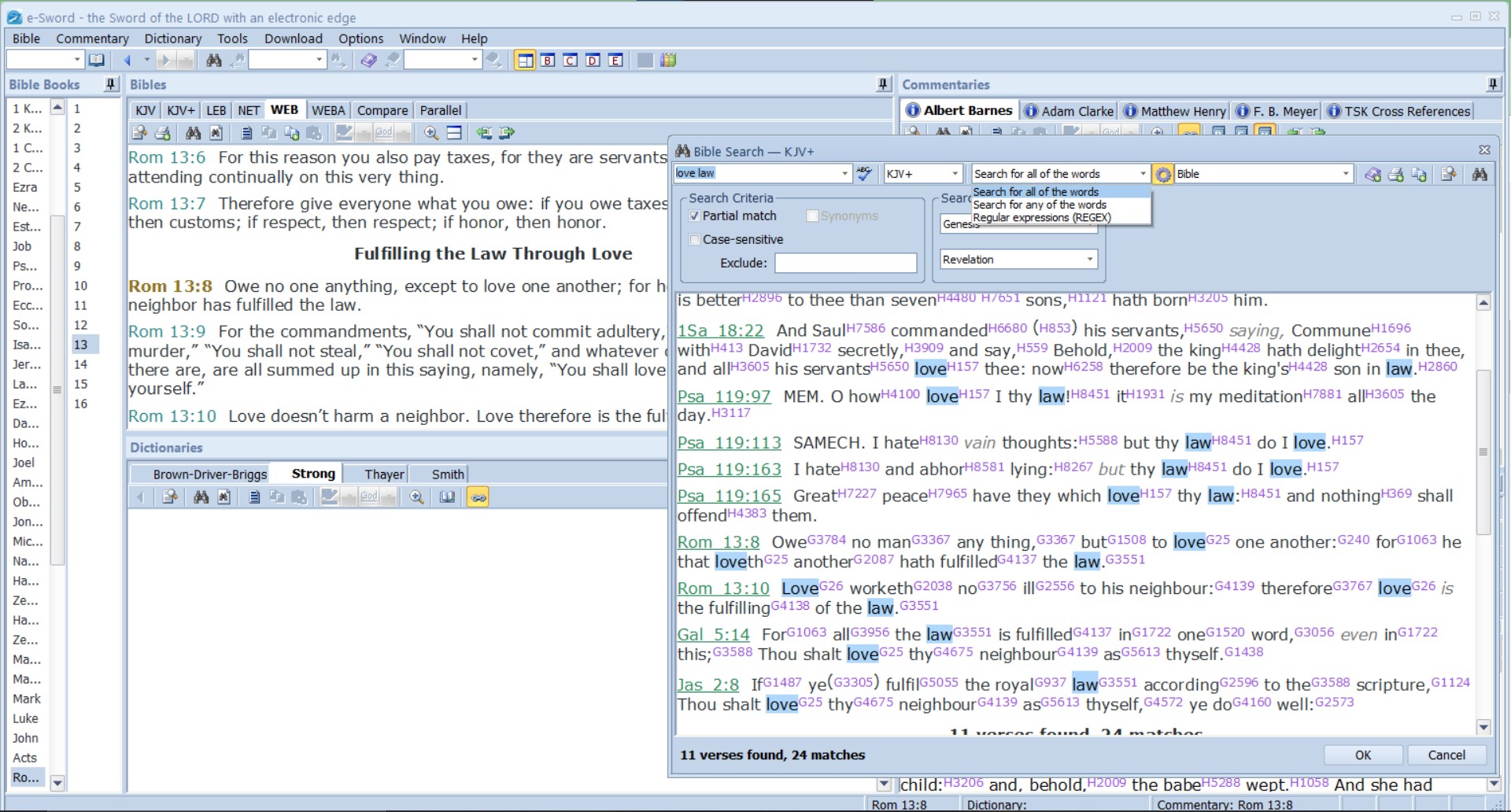
eSword for PC–a free-to-download Bible study program. I mostly use this one if I want to search for specific words or topics in the Bible. The search tools are robust (even more so than MySword) and make it easy to search for parts of words, whole words, and Greek and Hebrew words (by searching for the Strong’s number). You can also have a Bible, dictionary, commentary, and your own notes all open on the same screen.
BibleGateway–an online resource that makes comparing Bible translations very simple. It’s the easiest tool I’ve found for looking at multiple translations side-by-side and doing full text searches of more than one translation at the same time. I use it all the time when writing my blog posts for this site. One thing I like about this website compared to MySword or eSword is that it includes full footnotes (very handy with translations like NET).
Screenshot showing eSword search tool
Language Tools
I’ve done some formal study of Greek–enough to recognize words, understand basic grammar, and read it a little–but not much for Hebrew. The tools I use to study the Bible’s original languages aren’t a perfect substitute for really learning the languages, but I think they do make it easier for someone with a basic understanding of how language works (something any of us can learn relatively easily) to get a deeper look into the nuances of the Bible without devoting their lives to a study of ancient languages.
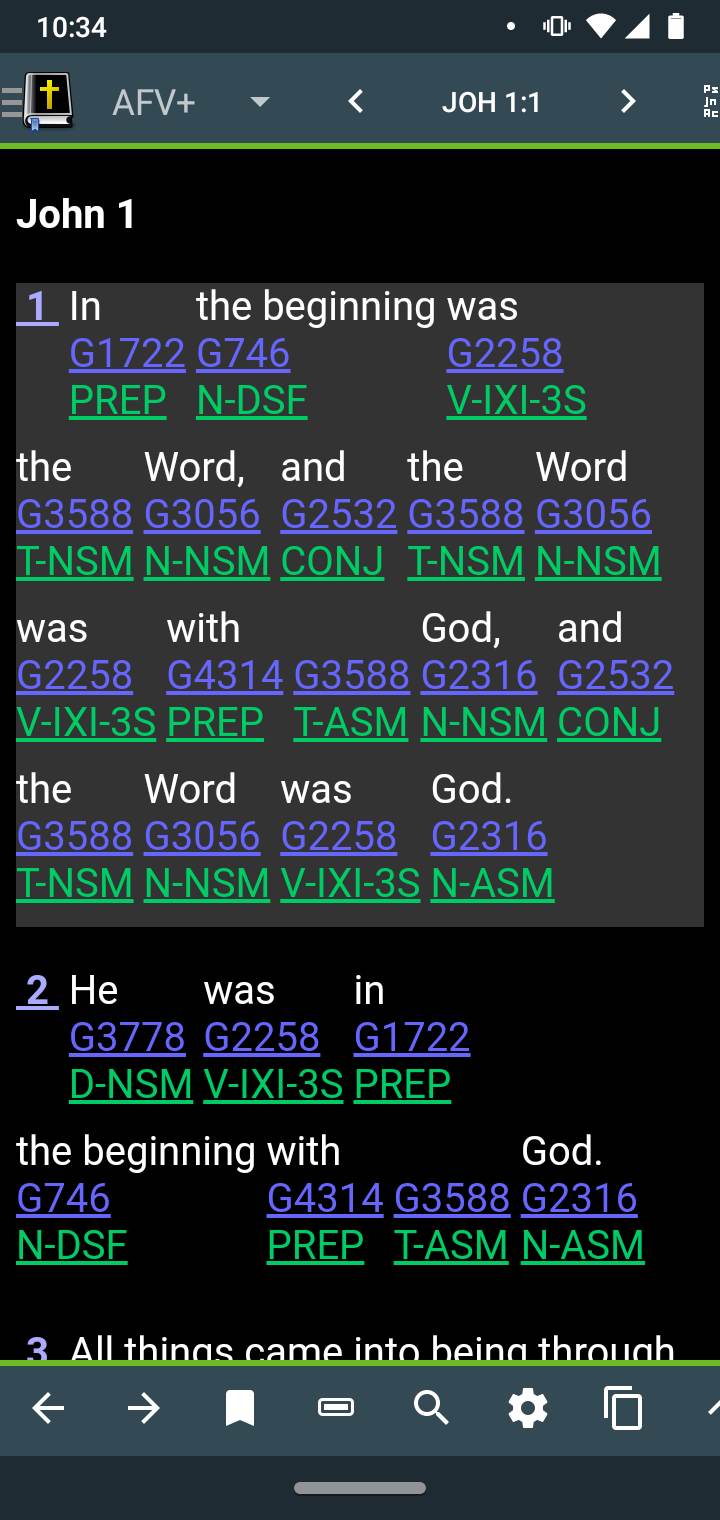
In both eSword and MySword, I recommend Thayer’s Dictionary for Greek and Brown-Driver-Briggs (BDB) for Hebrew. Both of these digital tools offer downloadable modules that link those dictionaries to Strong’s numbers. For any Bible translation that includes Strong’s numbers, you can click on that number and go right to the dictionary. Some of the translations also offer codes that give you more insight into how the word is used. For example, here’s what John 1:1 looks like in the MySword module for A Faithful Version with Strong’s numbers and Morphology (AFV+) if you click on more detail for the word translated “Word.”
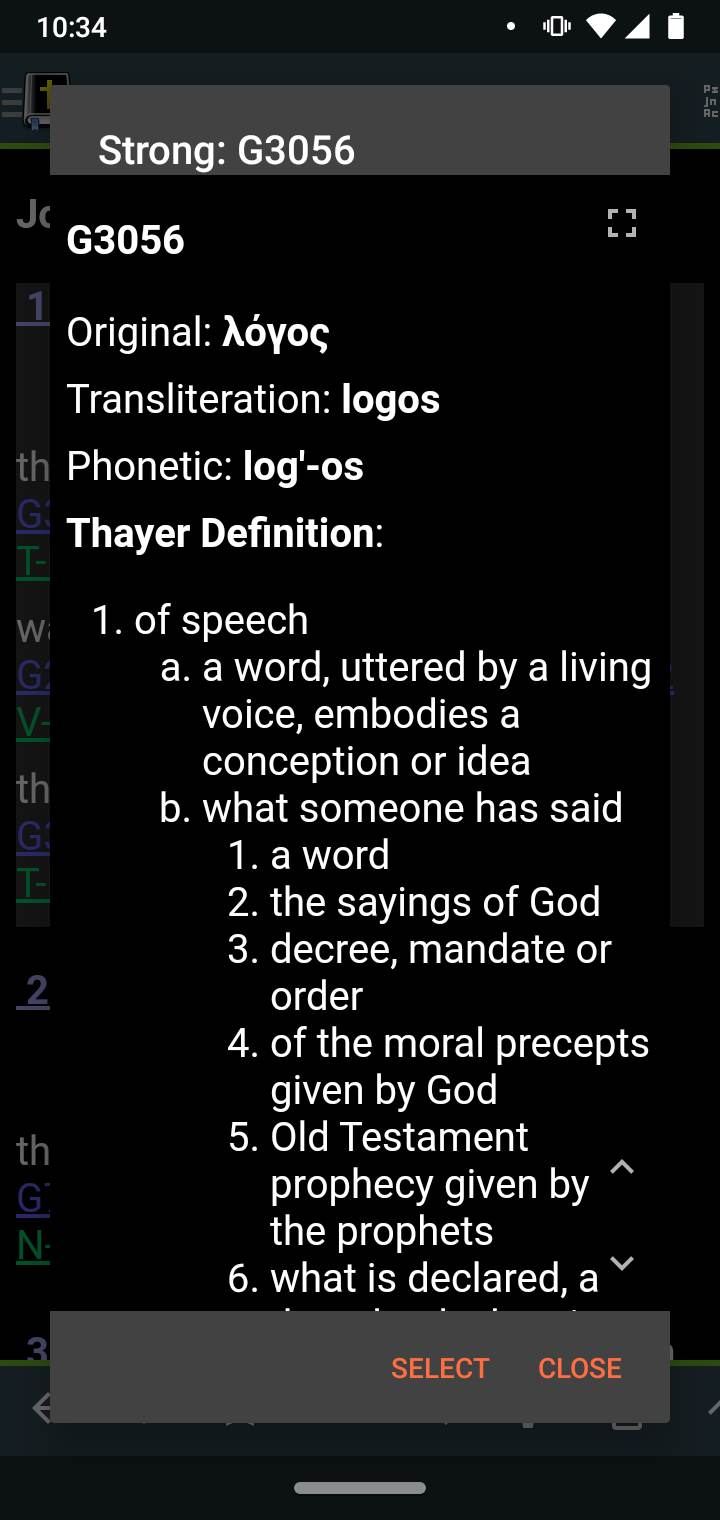
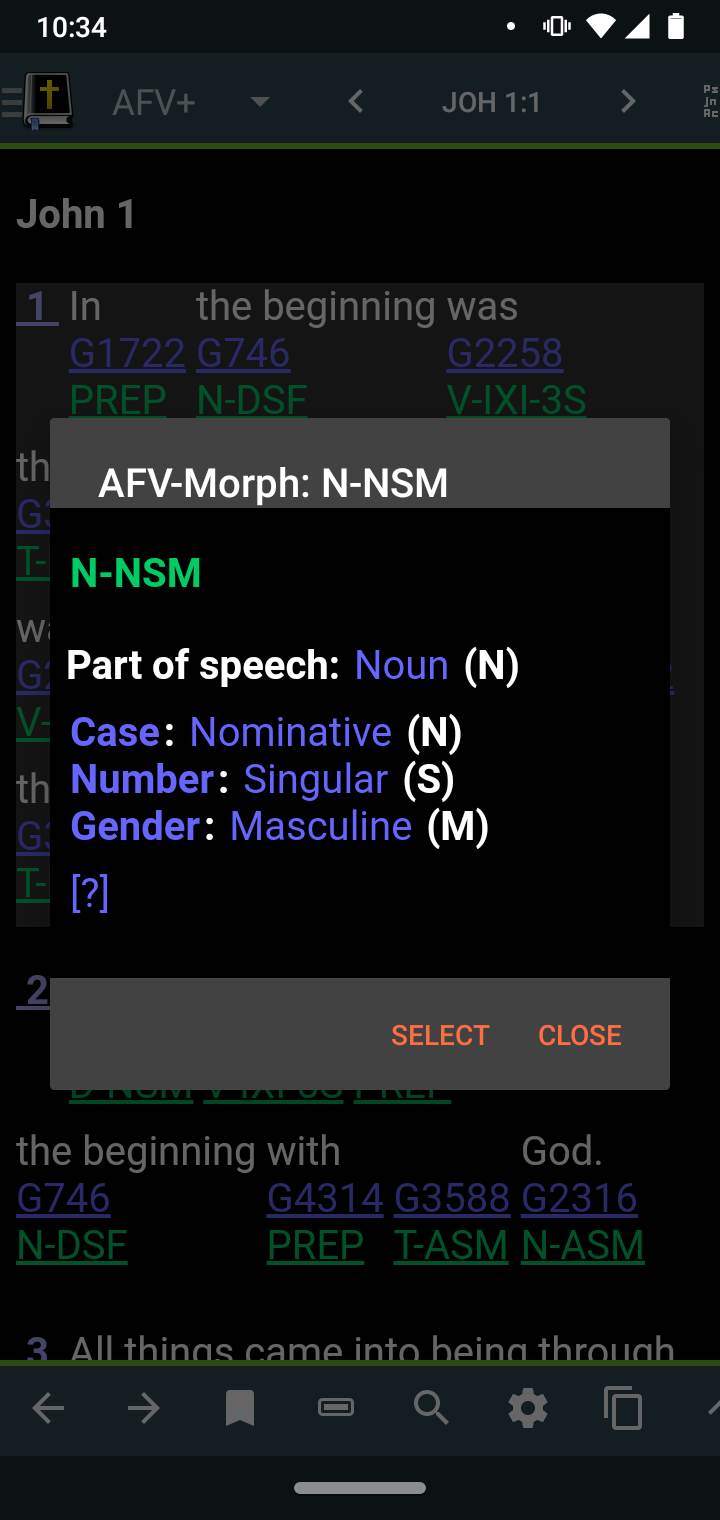
Screenshot of MySword AFV+ translationScreenshot of MySword Thayer’s DictionaryScreenshot of AFV+ morphology
I don’t read AFV+ much just because all those codes can get confusing to look at, but it is great for looking up the nuances behind a translation. If you click on the Strong’s number (G3056), it takes you to Thayer’s dictionary. I don’t have this in the screenshot, but if you scrolled down it would also provide Strong’s definition and a list of all the places this word is used in the New Testament (you could also search for G3056 in the AFV+ or other Strong’s coded translation to see all the places its used).
If you click on the morphology link (N-NSM) this translation shows you linguistic information for the word. Logos is a noun, and here it’s in the nominative case (identifying logos as the subject of the sentence), singular in number, and masculine gender (Greek has gendered nouns much like French or German). I use this tool most often to look up whether a word is singular or plural since you can’t always tell in English (e.g. when Paul says “you are the temple of God,” “you” is plural in the Greek but ambiguous in English).
Hebrew and Greek Dictionaries
In addition to these digital language tools, I also have two print dictionaries that I really like. These provide more complete definitions than the tools in eSword or MySword and also help you understand how different words relate to each other.
Theological Wordbook of the Old Testament* (TWOT) by Laird R. Hariss, Gleason L. Archer, Jr., and Bruce K. Waltke — my favorite Hebrew dictionary. Rather than being tied to Strong’s numbers, this dictionary groups Hebrew words by their root, which provides a much deeper look at the nuances of the Hebrew language. The different numbering system can make this one a bit more challenging to use, but in MySword the BDB dictionary module makes things easy by telling you where to look up the word in TWOT.
Google Is Your Friend
Another general tool that I use a lot is a simple Google search. Don’t know what the Genitive Case is in Greek? There are language-learning tools to help you understand Greek grammar. Partly remember a verse but can’t find it in eSword, MySword, or BibleGateway? Try Googling the words you remember with the word “Bible” and it’ll help you figure out if it’s in a translation you hadn’t thought of or if it’s a quote from something else. Suddenly need an interlinear version of the Septuagint? I recently found one on StudyLight.org. We’re fortunate to live in a time when we have access to Bible Study tools people even just a few decades before could only dream about or could only access in specialized print books.
Most of my Bible studies end up on this blog. That means I’m usually looking at specific topics when I study, so being able to search the Bible effectively, look up Hebrew and Greek words, and compare translations is super helpful. It’s also helpful to be listening to and reading things that prompt Bible-related ideas that can turn into studies which then show up here on my blog. Here are some of my favorite Christian resources for inspiring new studies:
“Truth Be Told” podcast–a thoughtful and thought-provoking “theology and apologetics podcast born out of a love of God‘s word, a hope to find common ground with those who study it, and a desire to outline truth as the Bible tells it.”
Listening to Sermons–usually I don’t go out of my way to listen to extra messages, but I hear ones very much like those I link to for this point every week at my local church. So many of my ideas for Bible studies and then blog posts come from a phrase or scripture that catch my ear in a message someone else is giving, often on a completely different topic.
As I mentioned before, not everyone Bible studies the same way, and that’s okay. We have different spiritual temperaments and different ways we most easily connect with God and His word. Some might spend more time reading whole books rather than focusing on topics. Some might find the most value in picking one verse and meditating on it for their whole study time. Others could read, then search for ways to put those lessons into real-world action. And I’m sure there are way more study styles than I could list here.
I like Gary Thomas’s book Sacred Pathways* as a tool to describe those temperaments (you can read my full review by clicking here). I most closely align with what he calls the “Contemplative” and “Intellectual” temperaments, and I suspect others with similar ways of relating to God will be the ones that find this post most useful (if they haven’t already tracked down similar resources of their own). Still, I hope some of these tools and resources will be helpful for you whatever your spiritual temperament. And I hope you’ll share some of your own favorite resources in the comments.
Most of us want to think of ourselves as reasonable people. When need be, we can think logically and rationally about things and come to reasonable conclusions. We know at the least the basics of how to recognize fallacies in other people’s arguments and how to put our own thoughts together.
For those of us living in Western nations (and I’m guessing some other locations that have been influenced by Western ideas), the education we received in relation to logical reasoning is based in Grecian and Roman philosophies. This system of reasoning and logic laid the groundwork for our scientific method and our ideas about how to figure out if something makes sense.
When we apply our modern human reasoning to the Bible, sometimes there are things which seem odd to us. We might notice contradictions in the text. We might wonder why God would tell people to do certain things, or why He makes some of the choices He does. We might look at some of the connections New Testament writers make to the Old Testament and think their conclusions seem far-fetched. And when we look at the Bible and it doesn’t make sense, we might become frustrated with our own limitations or we could become skeptical of God’s word.
The first of those problems has a fairly simple answer: pray for wisdom and understanding. James says that if anyone asks for wisdom in faith, God will give it to them (James 1:5-6). Paul adds that if we’re off-the-mark in our views, God can reveal the truth to us (Phi. 3:14-16). When we’re in a relationship with God, He also gives us His holy spirit that Jesus said “will guide you into all truth” (John 16:13, WEB). When we’re frustrated with our own lack of knowledge or understanding, we can take those frustrations to God. He might not give us the exact answer we’re looking for right away, but He will always help those who keep asking and seeking (Luke 11:9-10).
It can also help to keep in mind the things that I’ll suggest people consider if they think God’s word doesn’t make sense. There’s a dangerous sort of arrogance in thinking there’s something wrong with God just because He doesn’t make sense to us. Similarly, there’s danger in dismissing God’s word because we’re not sure how to wrap our heads around it or we think it’s just a good book rather than His divine revelation. There’s a lot we could say on this subject, but for today’s post I want to focus on just two things we can think about if we’re struggling with the idea that things in the Bible don’t make sense.
Image by José Roberto Roquel from Lightstock
The Wrong System of Measurement
Suppose you come across a woodworking project, like a little birdhouse, at a resale shop. You like the way it looks so you take it home and plan to use it as a pattern for your next project. You get out your tape measure and start making notes. The roof is just shy of 7-7/8 inches long, and not quite 4-3/4 inches wide. You keep taking measurements and it gets more and more frustrating. Why didn’t the builder use nice, even, sensible numbers instead of all these not-quite-right fractions?
Then suppose you turn the tape measure around to the side with centimeters. Suddenly, the roof is exactly 20 by 12 cm. The problem wasn’t with the person making the birdhouse. The problem is you didn’t understand what system of measurement they used in the first place.
This is very similar to what happens when people approach the Bible with a cultural mindset different than the one the original writers use. The Bible is a text from the ancient Middle East. Even though we believe God is the ultimate author of the Bible, He still used people in that culture to write His word. When Jesus spoke to people of His day, He used examples and analogies they could understand. Those of us who are far removed from that original context (in terms of both time and cultural philosophies) often have a hard time figuring out the Bible. That’s not because there’s something wrong with the Bible or we’re incapable of understanding; it’s just that we need more contextualizing information.
For example, in Western culture we like having reliable rules and we think they ought to apply to everyone in the same way. If a rule is bent or broken for one person and not others, we call that “unfair” and complain about a lack of justice. If we see what looks like a rule in the Bible and then God does something different, we might think He’s unjust or that there’s some kind of hidden rule system that He’s unfairly keeping from us. But things are different in non-Western cultures where “rules apply except when the one in charge says otherwise. Westerners might consider this arbitrary; many non-Western Christians consider this grace (Richards & O’Brien, p. 174). That’s how Paul can (arguably) call Junia an apostle in Rom. 16:7 even though women don’t typically hold that office (p. 172).
That example comes from Misreading Scripture with Western Eyes–a book I highly recommend to anyone who wants to understand the Bible better. Reading the Bible with Rabbi Jesus is also a great help with that. These books are excellent “tools” for making sure you’re using the right system of measurement when interpreting God’s word. You might be able to find one or both of these books in your local library, and here are the Amazon links if you want to check them out:
*please note that these are affiliate links, which means I’ll earn a small commission (at no extra cost to you) if you purchase one of these books after clicking the links.
There’s another truth that we need to acknowledge if we want to work through parts of scripture that don’t make sense to us. God is smarter than us. And when someone is a lot smarter than you, plus they have a perfectly clear perspective on everything going on, sometimes you won’t be able to make sense of what they’re doing.
For some people, it’s easy to admit that they’re not the smartest person in the room. For others, our intellect can be a stumbling block that gets in the way of a close relationship with God. This latter one is something I can struggle with. I get prickly when someone insults my intelligence or implies that I don’t understand what I’m talking about. I rely heavily on my ability to research things thoroughly and find good answers. I preen inside when a professor complements my writing or calls me an “academic.”
However, an academic understanding of scripture isn’t how we have a relationship with God. Our spiritual temperament might lean more on logic, reason, and knowledge (as Gary Thomas discusses in “Sacred Pathways”), but intellect isn’t enough to have a relationship with God. We also need humility and love. We need to admit that no matter how much we study, we’re not going to learn everything about God because the depths of His knowledge are unfathomable. We need to humbly marvel at–and love–the God who is way smarter than us, and ask Him for help when we’re struggling to understand something in His word.
My brothers and sisters, consider it nothing but joy when you fall into all sorts of trials,because you know that the testing of your faith produces endurance. And let endurance have its perfect effect, so that you will be perfect and complete, not deficient in anything. But if anyone is deficient in wisdom, he should ask God, who gives to all generously and without reprimand, and it will be given to him. But he must ask in faith without doubting, for the one who doubts is like a wave of the sea, blown and tossed around by the wind. For that person must not suppose that he will receive anything from the Lord, since he is a double-minded individual, unstable in all his ways.
James 1:2-8, NET
Sometimes, the “testing of our faith” is an internal struggle rather than an external trial. We might wrestle with our own doubts, questions, or fears related to God’s word. We’re not abandoned during those struggles, though. Sometimes I think we worry if our trials are doubt-related then we don’t deserve to ask for God’s help, but the truth is that He’s is eager to help everyone seeking His kingdom to understand and know Him more fully. Even the tiniest spark of faith is enough for Him work with if only we’ll come to Him and say, “I believe; help my unbelief!” (Mark 9:24, WEB).
Shifting Our Focus
Image by MarrCreative from Lightsock
There are still parts of the Bible that don’t quite make sense to me. But I think now I’ve reached a point where I trust that God knows what He’s doing even if I don’t understand it. I can also trust that someday He’ll help me understand those things, even if that “someday” doesn’t happen in this physical life.
I can also shift my focus off trying to make sense of everything and onto following Christ’s example. When Paul and Peter say we should have Christ’s mind, they aren’t focused on knowledge so much as on peaceful relationships (Rom. 15:5), God’s wisdom inside us (1 Cor. 2), service (Phil. 2:5-7), suffering, and freedom from sin (1 Pet. 4:1-2). There are far more important things to focus on than trying to make sense of everything in the Bible or put God into neat little categories. There is great value in knowing the Bible and understanding doctrine, but that’s all secondary to knowing God.
“Don’t let the wise man glory in his wisdom. Don’t let the mighty man glory in his might. Don’t let the rich man glory in his riches. But let him who glories glory in this, that he has understanding, and knows me, that I am Yahweh who exercises loving kindness, justice, and righteousness in the earth, for I delight in these things,” says Yahweh.
Jeremiah 9:23-24, WEB
Paul quotes these verses at the beginning of 1 Corinthians when he’s counseling his readers not to let disputes and pride get in the way of peaceful relationships in the church or following Christ. Even the smartest among us don’t have anything to boast of when we compare ourselves to the wisdom, goodness, and glory of God. With this shift in mindset, we can pursue a closer relationship with God and eagerly learn more about Him while also humbly admitting that we don’t yet know everything (and that’s okay).
There’s a fascinating relationship between God’s grace and the covenants He makes with people. Until the 5th century (when theologians brought Neo-Platonic philosophy into their interpretation of scriptures), Greek and Roman literature and early Judeo-Christian writings saw charis (grace) as something both relational and reciprocal (Schmidt, p. 201-202). The idea of “grace” as a free gift that God is obligated to give without having any expectations of the recipients was not originally part of the Greek language or of Christianity. Rather, there was a fuller, richer meaning to charis that Jesus, Paul, and other Bible writers used.
I’ve been reading a book on this topic by Brent J. Schmidt, who holds a PhD in classics, called Relational Grace: The Reciprocal and Binding Covenant of Charis(2015). His scholarship on the original meaning of charis is fascinating, but even without that background we can still see that grace comes with expectations. For example, Jesus said the one who “endures to the end will be saved” (Matt. 10:22, WEB) and that “unless your righteousness exceeds that of the scribes and Pharisees, there is no way you will enter the kingdom of heaven” (Matt. 5:20, WEB). We’re saved by God’s grace, and then He expects us to act in a certain way (with His power supporting us, of course).
The Bible talks about Christian conversion as a process and tells us that relationships with God require continued faithfulness. Yet the popular definition of grace in many modern churches still says grace is unmerited favor that God gives without expectation of anything in return. Trying to make these two ideas fit together is confusing, and it’s a problem first-century Christians didn’t have to deal with because they had a different definition for grace.
Ancient Understandings of Charis
Several centuries before Christ’s first coming and until at least the 4th century after, charis was understood as something that involved obligation and reciprocity (Schmidt, ch. 2 and 3). This meaning infused Greek, Roman, Jewish, and later Christian society to the point that everyone knew “receiving charis implied entering into reciprocal covenantal relationships” (p. 63).
Jews knew about covenantal relationships from the Bible. Every commandment was a covenant with God. Several stories, including Joseph, Moses, and David, associate the concepts of grace and mercy with covenants. Greek-speaking Jews lived in a culture that depended heavily on reciprocal relationships and understood what charis meant. When Paul taught them using the words charis, they would have understood that by accepting God’s grace they were making covenantal obligations.
Brent Schmidt, Relational Grace, p. 64
When Jesus Christ came to earth, one of the things that He did was establish a New Covenant on better promises and with a different sort of sacrifice. The Old Covenant was “completely unable … to perfect those who come to worship” (Heb 10:1, NET). In contrast, Jesus took away sin completely, giving us an incredible gift for us that we could never deserve nor repay. When we accept this “charis,” we enter a covenant with Him and His Father.
For by one offering he has perfected for all time those who are made holy. And the Holy Spirit also witnesses to us, for after saying, “This is the covenant that I will establish with them after those days, says the Lord. I will put my laws on their hearts and I will inscribe them on their minds,” then he says, “Their sins and their lawless deeds I will remember no longer.” Now where there is forgiveness of these, there is no longer any offering for sin.
Hebrews 10:14-16, NET (OT quotes bolded in this translation)
Grace is so closely connected with covenants that treating “the blood of the covenant ” as “an unholy thing” means someone has “insulted the Spirit of grace” (Heb. 10:29). Covenants and laws don’t vanish after Christ’s sacrifice–they move to a heart and spirit level. We can see this in Jesus’s Sermon on the Mount, where He talks about the deeper, spiritual, enduring applications of God’s law. Paul also talks about this shift from flesh-level to spirit-level in detail when he’s talking about law and covenants.
Shifting our definition of grace to align with the one Paul and his audience would have used gives us a better idea of how to properly interpret Paul’s letters. One of the best places to see that is in Romans 6. Here, Paul talks about how we are “not under law but under grace” (v. 14, NET). This verse and others like it are often read out of context, but if you read the surrounding text the reciprocal and obligatory aspects of charis are easy to see. This is a very long quote, but I think it’s important to look at the whole thing to get enough context to understand Paul’s words.
Therefore do not let sin reign in your mortal body so that you obey its desires, and do not present your members to sin as instruments to be used for unrighteousness, but present yourselves to God as those who are alive from the dead and your members to God as instruments to be used for righteousness. For sin will have no mastery over you, because you are not under law but under grace.
What then? Shall we sin because we are not under law but under grace? Absolutely not! Do you not know that if you present yourselves as obedient slaves, you are slaves of the one you obey, either of sin resulting in death, or obedience resulting in righteousness? But thanks be to God that though you were slaves to sin, you obeyed from the heart that pattern of teaching you were entrusted to, and having been freed from sin, you became enslaved to righteousness. (I am speaking in human terms because of the weakness of your flesh.) For just as you once presented your members as slaves to impurity and lawlessness leading to more lawlessness, so now present your members as slaves to righteousness leading to sanctification. For when you were slaves of sin, you were free with regard to righteousness.
So what benefit did you then reap from those things that you are now ashamed of? For the end of those things is death. But now, freed from sin and enslaved to God, you have your benefit leading to sanctification, and the end is eternal life. For the payoff of sin is death, but the gift of God is eternal life in Christ Jesus our Lord.
Romans 6:12-23, NET
Many translations use the word “servant” instead of “slave,” but doulos is best translated either as “bondservant” or “slave.” Being bound to serve the Lord in this way was seen as an “honor and a privilege” in the Jewish mindset (NET footnote on Rom. 1:1). It’s a very different sort of thing than slavery in the modern sense. In fact, at the time Paul was writing, the “asymmetrical social relationships between patron and client and between master and salve were founded on the reciprocal notion of charis” (Schmidt, p. 95). When Paul talks of slavery, he’s talking about us being obligated to God for His gifts and bound in a covenant with Him that has expectations.
When Jesus healed a man in Bethesda who’d been sick for 38 years, He told the man, “Behold you are made well. Sin no more, so that nothing worse happens to you” (John 5:1-14, WEB). It’s similar to what He told the woman caught in adultery (a story that’s not in the earliest manuscripts but is traditionally included with John’s gospel): “Neither do I condemn you. Go your way. From now on, sin no more” (John 8:11, WEB). In one case, Jesus provided physical healing and in the other He freed her from being condemned to death. After giving these gifts, He told both people that they should respond by doing something specific: stop living a life of sin.
There is therefore now no condemnation for those who are in Christ Jesus. For the law of the life-giving Spirit in Christ Jesus has set you free from the law of sin and death. For God achieved what the law could not do because it was weakened through the flesh. By sending his own Son in the likeness of sinful flesh and concerning sin, he condemned sin in the flesh, so that the righteous requirement of the law may be fulfilled in us, who do not walk according to the flesh but according to the Spirit.
Romans 8:1-4, NET
The Father and Son have given us incredible gifts. They’ve saved us from sin, adopted us into their family “with full rights of inheritance” (NET footnote on 8:15), and offer continued forgiveness so long as we do our best to follow Them and repent when we miss the mark. In response, “we are under obligation” to live a life lead by God’s spirit (Rom 8:12-14, NET). Being in a reciprocal covenant of grace is not about earning salvation or trying to pay back an impossible debt. It’s about having the right response of thankfulness to the incredible things God has done for us by welcoming us into His family. The more we can learn about that, the deeper relationship we can have with Him.
Thus far, the armor of God we’ve been studying has all been defensive. The girdle, breastplate, footwear, shield, and helmet all protect us. They’re essential in battle, but they’re not something we can use to attack and (with the exception of the shield) they’re not actively defensive either. This next piece of armor, though, is a weapon.
receive … the sword of the Spirit, which is the word of God (Eph. 6:17, LEB)
Paul tells us exactly what we’re given as the only weapon included in this Armor of God. It’s called the Sword of the Spirit and it is the Word of God. Now it’s up to us to learn how to use the word as a sword.
There are two words in Greek for “word,” and we have to start by defining them if we want to avoid confusion. Just looking at the English, we would connect Eph. 6:17 with Heb. 4:12, which says, “the word of God is living and active, and sharper than any two-edged sword, piercing even to the dividing of soul and spirit” (WEB). But these versus aren’t talking about the same thing.
In Hebrews, it’s talking about the logos (G3056). This word refers to a spoken word of intelligence, and it’s what’s used as a name for Jesus in John 1:1, 14. Reading on in Hebrews makes it clear that He’s being talked about in this passage as well (Heb. 4:13-16).
In Ephesians, on the other hand, the word is rhema (G4487). It refers to the spoken or written sayings of God, but isn’t used as a title for the speaker. So in Hebrews, the Word as a sword refers to Jesus cutting into people’s spirits and knowing them deeply. Ephesians is talking about wielding the word, or scriptures, of God as a weapon. Read more →












 Like An Anchor