Where Is Your Name Written?

I started this post partway through writing last week’s about God never forgetting His covenant with us. One of the verses I quoted in that post was Isaiah 49:16, where God says, “Look, I have inscribed your name on my palms.” I really wanted to study that, but knowing I’d probably not get back to the other post if I went off on a tangent, I saved it for this week.

One reason this verse caught my eye is that we’re in the midst of the fall holy day season. When I got the idea for this post, we were between Yom Teruah (Day of Trumpets) and Yom Kippur (Day of Atonement). A common Jewish greeting during the Days of Awe between Trumpets and Atonement is, “May your name be inscribed in the Book of Life!” The Jewish people see these days as a time of repentance, reconciliation, and reconnection with God. They hope that on Yom Kippur, God will choose to write their names in His book of life for one more year.

Yom Kippur was a key moment of yearly atonement; the only day when the high priest could enter the holiest part of the temple and present a sacrifice to cover the sins of all God’s people that year (Lev. 16). It wasn’t the only time for repentance, though, and the book of life isn’t explicitly connected with this day in scripture. Today, Yom Kippur is a reminder of His atoning sacrifice, a day to humble ourselves and recommit to God. It also looks forward to the day when Satan is put away and there are no barriers between God and His people.

I don’t think scriptures indicate that God decides on Yom Kippur whether or not your name is “safe” in His book for the rest of the year. He’s more dynamic and responsive than that–He’ll accept repentance and give salvation any time during the year. For believers today, Jesus’s sacrifice and the security that comes with being in covenant with Him is a constant thing. However, God does talk about writing our names (usually in a book rather than on His hands) and He does have a book of life. Now, with Yom Kippur a few days behind us and Sukkot (Feast of Tabernacles) beginning soon, this seems a good time to study how and where God writes our names.
The Lord’s Book

As I began this study, I started by searching for the phrase “book of life” in three different English translations: WEB, NET, and KJV. This particular phrase only appears once in the Old Testament, where David prays his enemies would be “blotted out of the book of life” (WEB) or “deleted from the scroll of the living” (NET). The NET translators suggest that this phrase (which appears nowhere else) likely refers to a census scroll listing the living members of a community, rather than a reference to God’s Book of Life as discussed in the New Testament.

When we think of God’s book where He writes righteous people’s names, we immediately think of the Book of Life. That phrase has become so closely associated with this book that it even shows up in traditional Jewish greetings. I can’t confirm this, but I assume this had become a well known name for God’s book in the Jewish community by the time Jesus came along, and that’s why His disciples use “Book of Life” in the New Testament writings. The Jewish people didn’t just come up with the idea of a book of life on their own, though; they got it from the scriptures.

The first reference we find to God writing someone’s name comes from Moses. After the golden calf incident, Moses went back to God to beg for mercy.

Moses returned to Yahweh, and said, “Oh, this people have sinned a great sin, and have made themselves gods of gold. Yet now, if you will, forgive their sin—and if not, please blot me out of your book which you have written.”

Yahweh said to Moses, “Whoever has sinned against me, I will blot him out of my book. Now go, lead the people to the place of which I have spoken to you. Behold, my angel shall go before you. Nevertheless, in the day when I punish, I will punish them for their sin.”

Exodus 32:31-34, WEB

This is a fascinating exchange. I’m guessing Moses must have had some unrecorded conversations with God about this book to even know it exists. From this conversation, we learn that Moses knew 1) his name was in this book and 2) his name could be removed. We also learn that God won’t blot one person’s name out in exchange for forgiving someone else–if He removes someone’s name, it’ll be because that person “has sinned against me.” We could also add to that “sinned without repenting,” since we know God is eager to offer forgiveness. An everlasting covenant with people who He’ll give everlasting life is His end-goal.
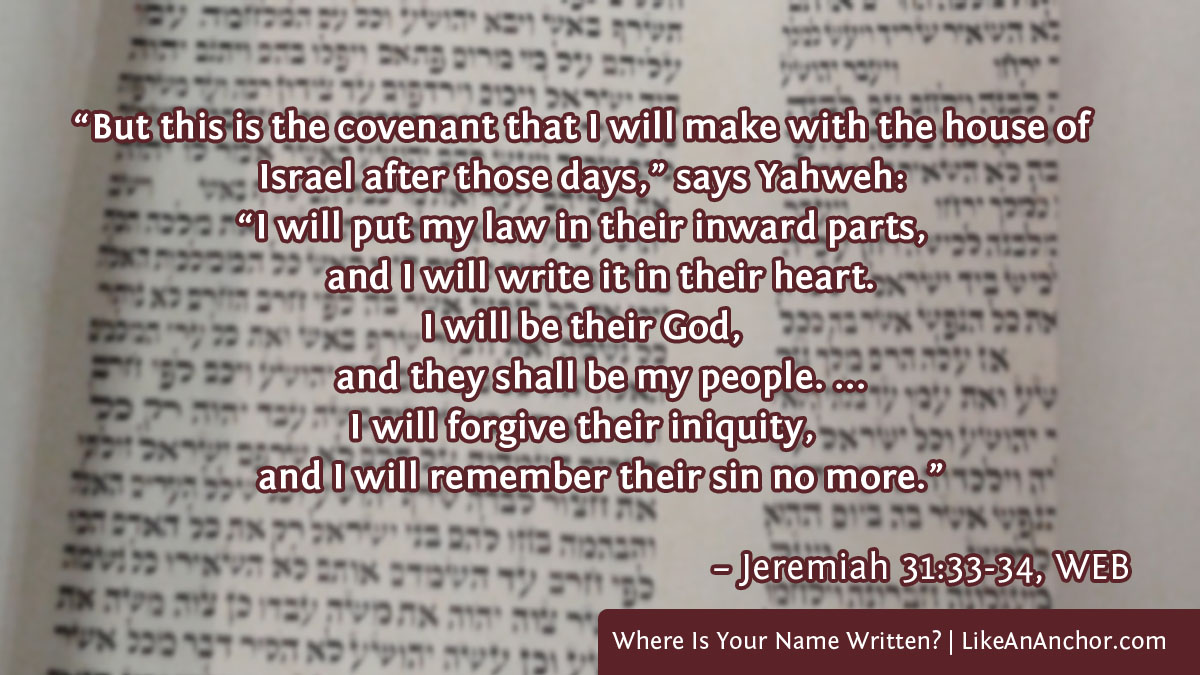
Image of a Hebrew scroll, with text from Jer. 31:33-34, WEB version: “But this is the covenant that I will make with the house of Israel after those days,” says Yahweh: “I will put my law in their inward parts, and I will write it in their heart. I will be their God, and they shall be my people. ... I will forgive their iniquity, and I will remember their sin no more.”
Image by me

Writing Those Who Belong

If you’re searching for information about books in the Bible, there are only a few tantalizing tidbits that speak of books God keeps and/or places where He writes down names. For example, Psalm 87:6 tells us that God “writes up the peoples” ( WEB), like He’s keeping a “census book of the nations” (NET). This seems to hint at two books God keeps–one where He records everyone and another (I assume the same one Moses talked about) where He writes the names of the righteous.

My frame wasn’t hidden from you,
when I was made in secret,
woven together in the depths of the earth.
Your eyes saw my body.
In your book they were all written,
the days that were ordained for me,
when as yet there were none of them.

Psalm 139:15-16, WEB

Then those who feared Yahweh spoke one with another; and Yahweh listened, and heard, and a book of memory was written before him, for those who feared Yahweh, and who honored his name. They shall be mine,” says Yahweh of Armies, “my own possession in the day that I make, and I will spare them, as a man spares his own son who serves him.”

Malachi 3:16-17, WEB

One thing we can clearly tell from these verses is that being written in God’s book is a good thing. It’s connected to God knowing you intimately. It’s where the names of people God calls “mine” are written. We also see hints at some of the things people who are written in God’s book do and who they are. They’re God-fearing, honor His name, and they speak with other believers. This is similar to how Jesus talks about the church in Sardis.

But you have a few individuals in Sardis who have not stained their clothes, and they will walk with me dressed in white, because they are worthy. The one who conquers will be dressed like them in white clothing, and I will never erase his name from the book of life, but will declare his name before my Father and before his angels.

Revelation 3:4-5, NET

Last week, we talked about a verse where Moses says God “cannot forget the covenant with your ancestors that he confirmed by oath to them” (Deut. 4:31, NET). There aren’t many things that God can’t do, but forgetting about the people He’s engraved in His palms and written in His book is one of them. While we are cautioned that it’s possible for a name to be “blotted out” or “erased” from God’s book, we’re also assured of God’s continuing commitment to those who do their best to follow Him. It takes perseverance and the humility to ask God for help since we can’t do this on our own, but we can overcome and walk with Jesus in the white clothing of righteous deeds (Rev. 19:6-8).
The Book of Life

The New Testament is where we start seeing the phrase “book of life.” Paul mentions it once, urging one of this readers to assist those “in the gospel ministry … whose names are in the book of life” (Phil. 4:3, NET). I wish we had records of Paul’s other teachings on the book of life. It sounds here like it’s common knowledge among his audience, though from our perspective this is the first time it’s mentioned in the New Testament. All the other information about it is in Revelation.

We already quoted one of the book of life verses from Revelation. Two others contrast those who will worship the beast power with those who are written in “the book of life belonging to the Lamb” and will stay faithful to God (Rev. 13:7-9; 17:7-9). The final verses look forward to a time beyond Jesus’s second coming, even after the Millennium and Satan’s final defeat (Rev. 19-20). These verses align closely with a verse from Daniel. Let’s look at all three of those verses.

“At that time Michael will stand up, the great prince who stands for the children of your people; and there will be a time of trouble, such as never was since there was a nation even to that same time. At that time your people will be delivered, everyone who is found written in the book. Many of those who sleep in the dust of the earth will awake, some to everlasting life, and some to shame and everlasting contempt. Those who are wise will shine as the brightness of the expanse. Those who turn many to righteousness will shine as the stars forever and ever.”

Daniel 12:1-3, WEB

Then I saw a large white throne and the one who was seated on it; the earth and the heaven fled from his presence, and no place was found for them. And I saw the dead, the great and the small, standing before the throne. Then books were opened, and another book was opened—the book of life. So the dead were judged by what was written in the books, according to their deeds. The sea gave up the dead that were in it, and Death and Hades gave up the dead that were in them, and each one was judged according to his deeds. Then Death and Hades were thrown into the lake of fire. This is the second death—the lake of fire. If anyone’s name was not found written in the book of life, that person was thrown into the lake of fire.

Revelation 20:11-15, NET

Now I saw no temple in the city, because the Lord God—the All-Powerful—and the Lamb are its temple. The city does not need the sun or the moon to shine on it, because the glory of God lights it up, and its lamp is the Lamb. The nations will walk by its light and the kings of the earth will bring their grandeur into it. Its gates will never be closed during the day (and there will be no night there). They will bring the grandeur and the wealth of the nations into it, but nothing ritually unclean will ever enter into it, nor anyone who does what is detestable or practices falsehood, but only those whose names are written in the Lamb’s book of life.

Revelation 21:22-27, NET

I feel woefully inadequate when it comes to writing about prophecy, but that’s where we find ourselves for these three verses. They’re talking about the resurrections that happen after Jesus’s second coming, in particular the resurrection after the Millennium when all the dead will come back to life and God opens the books (plural in Rev. 20:11). There are a few ways you could interpret this. The one I hear most often in my faith tradition is that God will open the books of the Bible so that people who’ve been resurrected can understand His law, then some time will pass so they have an opportunity to show Him how they’ll live with this new knowledge before the final judgement.

One thing we can say for sure is that God plans on deliverance, life, and light to come out of this. There’s an end for the wicked who refuse to live aligned with God’s way of life, but there’s also mercy and goodness and life for those who follow God. Here, we have a realization of God’s justice rewarding good and putting a merciful end to evil. These are sobering passages, but they also speak of a good future.

Writing God Inside Us
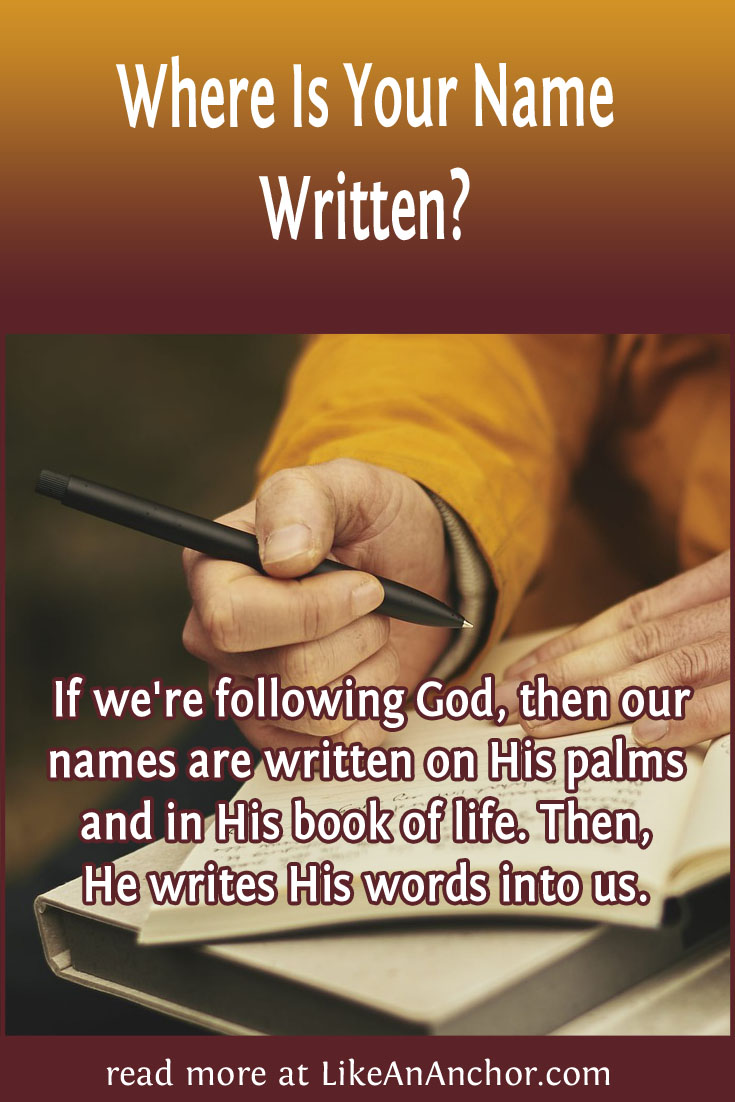
So where are our names written? If we’re following God, then they’re written on His palms and in His book of life. And it seems that’s where we’re going to stay unless we do something to get ourselves erased and then don’t repent. God deeply desires to give everyone eternal life (1 Tim. 2:3-4; 2 Pet. 3:9). He even writes Himself into us to help make sure that happens.

For if that first covenant had been faultless, no one would have looked for a second one. But showing its fault, God says to them,
“Look, the days are coming, says the Lord, when I will complete a new covenant with the house of Israel and with the house of Judah.
“It will not be like the covenant that I made with their fathers, on the day when I took them by the hand to lead them out of Egypt, because they did not continue in my covenant and I had no regard for them, says the Lord.
“For this is the covenant that I will establish with the house of Israel after those days, says the Lord. I will put my laws in their minds and I will inscribe them on their hearts. And I will be their God and they will be my people.
“And there will be no need at all for each one to teach his countryman or each one to teach his brother saying, ‘Know the Lord,’ since they will all know me, from the least to the greatest.
“For I will be merciful toward their evil deeds, and their sins I will remember no longer.”

Hebrews 10:7-12, NET

God’s law is an expression of His character; a guide for how we can be in a relationship with Him. And He’s writing it inside of our hearts at the same time He’s forgiving and forgetting our sins. We also have a role to play in this; in Proverbs, we’re told, “Don’t let kindness and truth forsake you,” “Keep my commandments and live! … write them on the tablet of your heart” (Prov. 3:3; 7:2-3). Just as we want God to write our names and keep them close to Him, so we should also “write” His words inside us as part of internalizing His character.

Featured image by Andrys Stienstra from Pixabay
Isaiah Study: Doing A New Thing

Today’s article is the fifth blog post since I started studying Isaiah 40-66. In the first post, I made a list of key themes that I want to study more extensively in this section of scripture. The list included (among other things) the message that God is doing and making something new. This theme is very closely connected to the one we discussed in last week’s post about looking toward the Messiah. It’s also connected with another point we touched on a few weeks ago; that one way God proves He is God is by revealing His new plans to the prophets before they happen.

I can only imagine how awed Isaiah must have been to receive this revelation. How encouraging it must have been to learn that God has such an amazing plan to set things right; to realize that a Messiah would soon come to usher in the salvation of the world! I wonder how much of the timing he understood. Did Isaiah know we’d still be reading these words thousands of years later, joining him in marveling at all that God has done in the past and will do in the future? Peter seems to think he did.

Concerning this salvation, the prophets sought and searched diligently. They prophesied of the grace that would come to you, searching for who or what kind of time the Spirit of Christ, which was in them, pointed to, when he predicted the sufferings of Christ, and the glories that would follow them. To them it was revealed, that they served not themselves, but you, in these things, which now have been announced to you through those who preached the Good News to you by the Holy Spirit sent out from heaven; which things angels desire to look into.

1 Peter 1:10-12, WEB

Here, Peter tells us that people like Isaiah did know they were speaking to us–we who know the Messiah and have received His salvation. Peter was also among those to whom Jesus said “many prophets and kings desired to see the things which you see, and didn’t see them, and to hear the things which you hear, and didn’t hear them” (Luke 10:24, WEB; see also Matthew 13:14-17). The prophets didn’t see everything as clearly as we do know. God has revealed to us things so glorious that the angels desire to look into them. We see His future plan for “glories that would follow” more clearly, particularly as we look back on the prophets’ words about the new things God still has in store for us.

Declaring a New Way to Save

At the end of the first Servant Song prophecy, God says, “Behold, the former things have happened and I declare new things. I tell you about them before they come up” (Is. 42:9, WEB). That’s one of the main things that God is doing in this section of Isaiah. There’s so much emphasis on the Messiah and on the new things God will do through Him. Jesus’s coming changed things dramatically for God’s people. Once we were sinners condemned to death, now we’re redeemed from that penalty. Once we were under the Law as a “guardian” of our conduct; now we keep the Law from the heart on a spiritual level (Gal. 3:23-25; Rom. 8:1-14). Once we saw God’s plan only dimly, now He’s revealed it to His people more clearly (Matt. 13:10-11; 1 Cor. 2:9-10; Eph. 3:4-6; 1 Pet 1:10-12).

When Isaiah’s original readers heard God “declare new things” about the Messiah, Jesus’s first coming was still in the future. At this time, God told Israel “from this point on I am announcing to you new events” (Isa. 48:6, NET). Knowing there’s a Messiah bringing a new way to save isn’t news for us anymore–from our perspective, He arrived here on earth nearly 2,000 years ago. However, we can still get excited for what His coming meant for us and for other new things that God is planning.

Look, I am about to do something new.
Now it begins to happen! Do you not recognize it?
Yes, I will make a road in the wilderness
and paths in the wastelands.
The wild animals honor me,
the jackals and ostriches,
because I put water in the wilderness
and streams in the wastelands,
to quench the thirst of my chosen people,
the people whom I formed for myself,
so they might praise me.

Isaiah 43:19-21, NET

The context for this passage is redemption. God is revealing that He will rescue Israel from the Babylonians, but then the language shifts to declaring a future redemption as well. The “road in the wilderness” and God’s work with the wild animals foreshadows Millennial imagery in Isaiah 65 (which we’ll get to later in this post). God began His new work of bringing peace to earth with Jesus’s first coming, and He’s still working on that exciting project today as we–and all of creation–await Jesus’s second coming.

For I consider that our present sufferings cannot even be compared to the coming glory that will be revealed to us. For the creation eagerly waits for the revelation of the sons of God. For the creation was subjected to futility—not willingly but because of God who subjected it—in hope that the creation itself will also be set free from the bondage of decay into the glorious freedom of God’s children.

Romans 8:19-21, NET

Something New For Us

In addition to God’s new revelations about how He plans to save and transform the world, He also revealed something new that’s happening in each of us. He promises He’ll give His people new names as He does the part of His new work that takes place inside each of them.

For the sake of Zion I will not be silent;
for the sake of Jerusalem I will not be quiet,
until her vindication shines brightly
and her deliverance burns like a torch.
Nations will see your vindication,
and all kings your splendor.
You will be called by a new name
that the Lord himself will give you.
You will be a majestic crown in the hand of the Lord,
a royal turban in the hand of your God.
You will no longer be called, “Abandoned,”
and your land will no longer be called “Desolate.”
Indeed, you will be called “My Delight is in Her,”
and your land “Married.”
For the Lord will take delight in you,
and your land will be married to him.

Isaiah 62:1-4, NET

Here, we’re told two of the new names God gives to the people He’s working with. We’re also told “you will be called by a new name that the Lord himself will give you.” If we were just looking at this verse on its own, we might think that refers to the new names Hephzibah (“My Delight is in Her”) and Beulah (“Married”). However, we also learn more about other new names in the book of Revelation. Jesus mentions two of His letters to the seven churches.

To the angel of the church in Pergamum write the following: … The one who has an ear had better hear what the Spirit says to the churches. To the one who conquers, I will give him some of the hidden manna, and I will give him a white stone, and on that stone will be written a new name that no one can understand except the one who receives it.’

Revelation 2:12, 17, NET

To the angel of the church in Philadelphia write the following: … The one who conquers I will make a pillar in the temple of my God, and he will never depart from it. I will write on him the name of my God and the name of the city of my God (the new Jerusalem that comes down out of heaven from my God), and my new name as well.

Revelation 3:7, 12, NET

The first new name mentioned is highly individual; only the person who receives the name even knows what it is. The second new name is one that we’ll share with Jesus Christ. I don’t want to get too off-track from today’s topic, so we’ll keep this discussion about names brief. For now, let’s remember that names in Hebrew thought are closely tied to a person’s reputation and character. When God puts His name on us, He’s trusting us with His family’s reputation and claiming us as people who are like Him.

God also has a long history of giving new names to people He works closely with, including Abraham, Sarah, Israel, Peter, James, John, and Paul (Genesis 17:4-5, 15-16; 32:28; Mark 3:16-17; Acts 13:9). There’s something very special about getting a new name from God, and it seems that it has to do with receiving a new position in life. New names come with a new way of living or a new attainment of something that God is working on in us. It’s fitting, then, that we’re told we’ll get new names when God is handing out rewards to faithful people after Jesus returns to this earth. That’s also when we’ll be revealed as the glorious children of God (Rom. 8:18-24).

New Heavens and New Earth

Isaiah has a lot to say about the Millennial reign of Jesus Christ and the new earth which will follow. In Revelation 20, we’re told that after Jesus’s second coming Satan will be locked away for a thousand years, the faithful will rise from the dead, and they’ll “be priests of God and of Christ, and will reign with him one thousand years” (Rev. 20:6, WEB). Then in Revelation 21-22, we learn of “a new heaven and a new earth” that will come after that. We don’t get many details about what the Millennium or the world after that will look like here in Revelation, but we learn more through God’s descriptions through Isaiah of His future holy mountain (Isaiah 2:1-4; 11:1-10).

“For, behold, I create new heavens and a new earth;
    and the former things will not be remembered,
    nor come into mind.
But be glad and rejoice forever in that which I create;
    for, behold, I create Jerusalem to be a delight,
    and her people a joy.
I will rejoice in Jerusalem,
    and delight in my people;
and the voice of weeping and the voice of crying
    will be heard in her no more.
    “No more will there be an infant who only lives a few days,
    nor an old man who has not filled his days;
for the child will die one hundred years old,
    and the sinner being one hundred years old will be accursed.
They will build houses and inhabit them.
    They will plant vineyards and eat their fruit.
They will not build and another inhabit.
    They will not plant and another eat:
for the days of my people will be like the days of a tree,
    and my chosen will long enjoy the work of their hands.
They will not labor in vain
    nor give birth for calamity;
for they are the offspring of Yahweh’s blessed
    and their descendants with them.
It will happen that before they call, I will answer;
    and while they are yet speaking, I will hear.
The wolf and the lamb will feed together.
    The lion will eat straw like the ox.
    Dust will be the serpent’s food.
They will not hurt nor destroy in all my holy mountain,”
    says Yahweh.

Isaiah 65:17-25, WEB

Isn’t this an incredible picture of the future? This is what we have to look forward to after Jesus returns to earth. It’s this future that we’ll be picturing when we observe Sukkot (the Feast of Tabernacles) in just a few months. Given the connection between Sukkot and the Millennial reign of Jesus Christ, it’s fitting that the last thing the Lord says in Isaiah about His new heavens and new earth relates to God’s holy calendar and His Sabbath days. This verse also connects to our post about Sabbath-keeping in Isaiah 40-66.

“For just as the new heavens and the new earth I am about to make will remain standing before me,” says the Lord, “so your descendants and your name will remain. From one month to the next and from one Sabbath to the next, all people will come to worship me,” says the Lord.

Isaiah 66:22-23, NET

These verses promise that in the midst of all this newness, there will also be a reliable stability. God is still on His throne. His character and the way He wants to do things are not going to change. We’ll still have patterns of worship to follow. We’ll still have relationships with Him, though they will then be closer than ever before.

We know Jesus is coming back, but it’s easy to let that slip our minds as we go through our day-to-day lives. But if we hold onto the vision in Isaiah and other future-pointing passages of scripture, we can also hold onto the excitement of being part of the “new thing” God is doing. And that can help us stay encouraged and joyful as we move forward into the future.

Featured image by Inbetween from Lightstock

Song Recommendation: “The Holy City” by Stanford Olsen and The Tabernacle Choir

Bonus song I found while searching for a different “New Heaven, New Earth” song: “Новое небо” by Simon Khorolskiy

I’m Going On An Adventure!

So … I’m going to France this fall.

If you’re reading that and staring at the screen like this 😮 you’re not alone; I’m pretty shocked, too.

My family has always traveled for Sukkot/Feast of Tabernacles. It’s an 8-day festival and there are groups meeting to celebrate it all over the world, so that’s a perfect time to travel. This year, though, my parents are meeting with a local group and my sister suggested we take off with our brother for a more distant location than usual.

Considering the farthest from home I’ve been up until this point is Rapid City, South Dakota the Mediterranean coast of France is quite a bit more adventurous. Both my siblings will have visited Europe before by the time we leave for France, but this will be my first trip overseas and only my second trip in an airplane.

I'm Going On An Adventure! | LikeAnAnchor.comOn a side note, I now want to re-read The Hobbit after picking Bilbo’s words for the title of this post title. Not planning on facing any dragons while in France, but a girl can always dream.

I’m really excited about this trip. Truly I am. I’m fascinated by European history and French is one of the very few languages I’ve put any effort into learning. We’ll get to do things like visit a museum housed in a 12-century church and go horseback riding along the Mediterranean coast. It’s a dream come true! Several, in fact.

But I’m also experiencing some mild panic. It’s not the most prudent financial decision I’ve ever made. I don’t like committing to things this far in advance, even though I do like to plan ahead. And the wide variety of first experiences and unknowns provide plenty of fuel to power my anxious imagination.

So one of my main goals in prepping for this trip over the next several months is to not panic. There’s no reason my imagination has to get stuck on all the terrifying “what if?” questions. I’ve used my mind to come up with whole fantasy worlds and people who exist nowhere else but my imagination the printed page. Surely I can use it to imagine all the good things that can (and will) happen on a trip to France with my brother and sister.

Do any of my readers who deal with anxiety have travel tips you’d like to share?

How Should We Honor The Days God Sets Apart For Him?

Practicing righteousness. Learning to love. Developing the mind of God. Following Christ. Those are all essentials of the Christian life, and there are many “tools” God has given us to help us succeed in these goals. These include prayer, Bible reading and study, the Holy Spirit inside us, and fasting.

God’s Sabbaths and holy days are also vital, and often overlooked, gifts given to help us align with God and His ways. Keeping these days as God commanded helps line us up with His will, reinforces His plan, and deepens our relationship with Him. Just as responding to an invitation to get together with your physical family lets you build relationships with them, so does responding to our heavenly Father’s invitations help us build relationships with Him, our Bridegroom, and the other children in His family.

For many Christians, keeping God’s holy days is a foreign concept because they’ve been (incorrectly) told “that’s just a Jewish/Old Testament thing. But when you start to recognize there’s lasting value in the days God calls holy to Him, you come up against the question, How do you keep the Sabbaths in a way that honors God?

Even if you have been keeping these days for a while, you know this isn’t always an easy questions to answer. There are certain rules and guidelines in scripture, but they don’t answer all our questions. Plus, knowing what to do, and what not to do, in keeping the holy days is about more than a list of rules. It’s about honoring God’s instructions on how to come before Him. So let’s take a look at what God says to do for these days and how we can obey those commands in the spirit and from our hearts. Read more

Understanding The Days That God Calls Holy To Him

Did you know that there are certain days in the Bible that God calls holy? One of these holy times happens every 7 days and we call it the weekly Sabbath. The other 7 holy days happen at set times in the spring, early summer, and fall.

If you’re reading this when it was posted, the fall holy days ended a couple weeks ago and the spring ones won’t start again for 6 months. This in-between time seems to me like the perfect opportunity for those of us who do keep the holy days to reflect on their meaning, along with how and why we keep them. And if you’ve never observed God’s holy days before, I hope you’ll find value in learning about them and maybe even join us in keeping them.

All the holy days are outlined in Leviticus 23, and then expounded on in other passages as well. In this chapter they’re all called “set feasts” (mo’ed) and “holy convocations (miqra). This identifies them as appointments that God has set at specific times for specific reasons. We talked about these Hebrew words, and others that describe God’s holy days, in last week’s post (click here to read it).

Sabbath

“The children of Israel shall keep the Sabbath, to observe the Sabbath throughout their generations, for a perpetual covenant. It is a sign between me and the children of Israel forever; for in six days Yahweh made heaven and earth, and on the seventh day he rested, and was refreshed.”

Exodus 31:16-7, WEB

As spiritual Israel (Rom. 9:6-8; Gal. 3:29; Eph. 2:12-13), this is part of God’s eternal law that is transferred to us (see post “Inheriting Covenants“). The author of Hebrews talks about this topic from 3:7 to 4:9 and concludes, “There remains therefore a Sabbath rest for the people of God.” The Greek word sabbatismos literally means “keeping Sabbath” (G4520, Thayer’s dictionary).

The Sabbath (which happens every week from sunset on Friday until sunset on Saturday) is a time when we stop doing work and other things that clutter our weeks and enter God’s rest. It’s a time to gather with other believers in God’s presence, to learn from Him, and take on His delights as our own. The Sabbath reminds us of His plan, purpose, and presence, and let’s us practice His rest.

Further study: “Delighting In The Sabbath” by Brian Shaw and Isaiah Study: Joy in the Sabbath Covenant With God

Passover

When the hour had come, he [Jesus] sat down with the twelve apostles. He said to them, “I have earnestly desired to eat this Passover with you before I suffer.”

Luke 22:14-15, WEB

The Passover (Pesach in Hebrew) observance was instituted in Exodus 12, and Israel was told they should keep it and the Feast of Unleavened Bread that followed “throughtout your generations by an ordinance forever” (Ex. 12:14, WEB). Jesus changed/added to (depending on your interpretation) the symbols associated with Passover, but still told his followers to continue keeping it “in remembrance of me” (Luke 22:19; 1 Cor. 11:23-26).

For New Covenant believers, Passover reminds us of God’s deliverance and Jesus’ sacrifice. Drinking the wine and eating the bread symbolize our commitment to and participation in the New Covenant. Passover also lets us “proclaim the Lord’s death until he comes” (1 Cor. 11:26, WEB). It is a way for us to keep in mind of, and remind others, that Jesus died for our sins and that He will return.

Further study: “Passover Questions: Am I Ready To Hear What God Says?” and “Why I’m Keeping Passover On Nisan 14

Feast of Unleavened Bread

Purge out the old yeast, that you may be a new lump, even as you are unleavened. For indeed Christ, our Passover, has been sacrificed in our place. Therefore let us keep the feast, not with old yeast, neither with the yeast of malice and wickedness, but with the unleavened bread of sincerity and truth.

1 Corinthians 5:7-8, WEB

Beginning the day after the Passover, the Feast of Unleavened Bread (Chag HaMatzot) lasts for 7 days. The first and last days are both holy convocations and days when we do no work. For all 7 days, we eat nothing with leavening in it and we eat unleavened bread (Lev. 23:6-8; Ex. 23:15).

As we can see in this quote from Paul’s letter, the early New Testament church was still keeping this Feast. They were doing so in the spirit as well as the letter, recognizing that there’s a purpose behind the symbolism of putting leaven out and taking in unleavened things. These days are a yearly reminder to keep putting off sin and putting on Christ’s nature.

Further study: “Rhythms of Worship” and “Exodus To Corinthians: A Passover Message For The New Testament Church

Feast of Weeks

Now when the day of Pentecost had come, they were all with one accord in one place.

Acts 2:1, WEB

On the Sunday after Passover, ancient Israel performed a ceremony called Firstfruits or Wavesheaf (Lev. 23:9-14). From that day, you count seven Sabbaths plus one day to get 50 days, then o-bserve the Feast of Weeks (better known today as Pentecost or, in Hebrew, Shavuʿoth).

Pentecost is a fascinating holy day. It’s connected with the story of Ruth and our role as firstfruits in God’s harvest. It’s the day Jesus and His Father gave the precious gift of their Holy Spirit to the church. It’s also the only single day called by the Hebrew word a chag (the other holy days designated “Feasts” are the 7-day long Unleavened Bread and Tabernacles). There’s a great deal of significance in this day, and it’s there for us today as well as for earlier believers.

Further study: “Firstfruits from the Rejects” and “The Bridegroom’s Pledge

Day of Trumpets

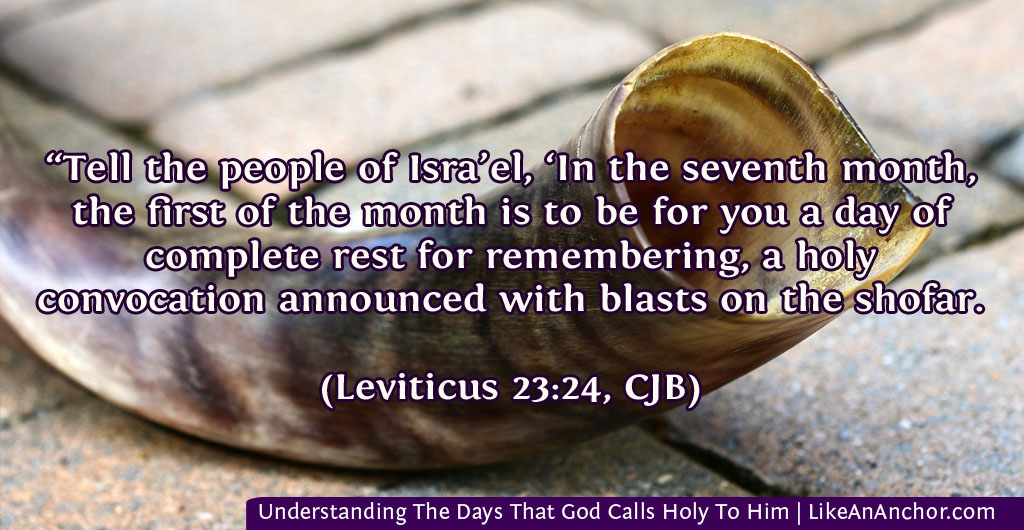
Speak to the children of Israel, saying, “In the seventh month, on the first day of the month, shall be a solemn rest to you, a memorial of blowing of trumpets, a holy convocation.”

Leviticus 23:24, WEB

There’s not nearly as much information in scripture about the Day of Trumpets/Shouting (Yom Teruah) as for the other holy days, but that doesn’t mean it’s any less important. Many believers (and I think rightly so) see it as the holy day which points to Christ’s return because of the connection with trumpet blasts (1 Thes. 4:16; Rev. 11:15). It’s one of the “shadows” speaking to us of Christ’s reality (Col. 2:16-17).

Further study: “Preparing For The Bridegroom To Come Back” and “With The Sound of Trumpets

Understanding The Days That God Calls Holy To Him | LikeAnAnchor.com
Photo credit: slgckgc via Flikr

Day of Atonement

Yahweh spoke to Moses, saying, “On the tenth day of this seventh month is the day of atonement: it shall be a holy convocation to you, and you shall afflict yourselves; and you shall offer an offering made by fire to Yahweh. … It shall be a Sabbath of solemn rest for you, and you shall deny yourselves. In the ninth day of the month at evening, from evening to evening, you shall keep your Sabbath.”

Leviticus 23:26-27, 32, WEB

The Jews consider the Day of Atonement (Yom Kippur) as the most solemn and holy time of the year. It was the only day a human being could enter the Holy of Holies inside the temple, and even then only the high priest. There was also a ceremony of two goats — one killed for the sins of the people as a picture of Jesus Christ and the other banished as picture of what will happen to Satan (Lev. 16; Heb. 2:17; Rev. 20:1-3).

Today, Atonement reminds us of Christ’s sacrifice, looks forward to a time when Satan is removed from the picture, and invites us to think deeply about our High Priest Jesus Christ. It’s also the only specific day we’re commanded to fast, which in itself has a whole host of spiritual benefits. Exactly how to “fast” is debated, but most people I know (including me) believe it’s a fast of no food or drink for 24 hours. This holy day is briefly mentioned in the New Testament (Acts 27:9).

Further study: “Clean Temples For Yom Kippur” and “Fasting

Feast of Tabernacles

And then every survivor from all those nations coming against Jerusalem will go up year after year to worship the king, Yahweh of hosts, and celebrate the Feast of Booths.

Zechariah 14:16, LEB

The Feast of Tabernacles or Booths (Sukkot) is a week-long feast with an 8th day, the Last Great Day, on the end (Lev. 23:33-36; 39-44). It was a Feast that Jesus kept (John 7:1-10; 37-39), and this prophecy in Zechariah shows it will still be celebrated in the future. It’s a time when we’re told to stay in temporary shelters. Most people I know celebrate this Feast by traveling to a “Feast site” hosted by a church group, staying in a hotel (a place we live temporarily) or camping in a tent (a temporarily set-up shelter), and attending daily church services.

This Feast is a season of great rejoicing, followed on the 8th day by a solemn observance called an atsarah (click here to go to last week’s post on Hebrew words associated with the holy days). Tabernacles reminds us that we’re strangers and pilgrims on this temporary earth, but that a time is coming when God will establish His kingdom here and all people will live in His peace.

Further study: “Tabernacles and Temples” and “Do You Value The Gifts From Your Bridegroom?

Conclusion

This is a long post, but it’s just the briefest overview of the days God calls holy to Him. These days offer a weekly (in the Sabbath) and yearly (in the annual Feasts) rehearsal of God’s plan. He invites — and commands — us to keep these days with Him on His set appointed times because they matter.

“You shall keep my Sabbaths, and have reverence for my sanctuary. I am Yahweh.”

Leviticus 26:2, WEB

We keep His Sabbaths because He is Yahweh — the eternal Lord and the only true God. These days mean something to God, and therefore should mean something to His children. The Sabbaths and Feasts are appointments that God has set at specific times for His people to gather together for specific reasons. God places a high value on these days, calling them “holy” or set-apart for Him. As His children, we should value these days as well.

Free resource! Click here to download a chart summarizing these holy days, including the Hebrew words used for each, when and how they were observed, and New Covenant applications:


Featured image credit: tihanyitom via Pixabay

What Are God’s Holy Days and Why Would We Care?

Prayer is a time we can choose to come before God however we are, whenever we want, and whatever we need. In these cases, we’re sort of “in control” of the interaction. There are also times when God commands/invites us to come before Him on His terms. Those times when God “hosts” us are His weekly Sabbath and the yearly holy days.

Though I’ve been keeping the holy days outlined in Leviticus 23 my whole life, I hadn’t thought about them quite like this before. My family and I kept the Feast of Tabernacles (Sukkot) with a group in West Virginia this year, and one of the Bible studies there was called “Keeping A Holy Convocation.” It’s one of the best, most thought-provoking messages I’ve ever heard and it’s what prompted today’s post (click here to listen to that Bible study).

I won’t take the time here to address the question of whether or not modern believers should keep these holy days, but you can check out my posts “Top 5 Reasons for Christians to Keep God’s Holy Days” and “Rhythms of Worship” if you’re curious. One reason these days are important to us is that they teach us about God’s plan and His priorities, including who we’re meant to be in Him. They’re part of our identity as God-followers, which makes them a key part of our faith and it also relates to this blog’s theme of finding our true selves in God.

This is probably going to be the first post in a series, since there is so much to explore in this topic and I don’t want today’s post to become unreadably long. So for now, let’s just take a look at the ways God describes His holy days. There are 5 key Hebrew words that give us a picture of what these days are and why we should care about them.

Mo’ed

The word mo’ed (Strong’s number H4150) means an appointed time and/or place, as well as an assembly or congregation. The word is used 223 times in the Bible. It’s also translated “season,” as in its first use in Genesis:

God said, “Let there be lights in the expanse of sky to divide the day from the night; and let them be for signs to mark seasons, days, and years” (Gen. 1:14, WEB)

Mo’ed is used of the time for a baby to be born, the right season to keep a commanded Feast day, and for the place of a gathering and/or the people gathered. The Rabbi at my Messianic congregation defines mo’ed as the right person/people, in the right place, at the right time, for the right reason.

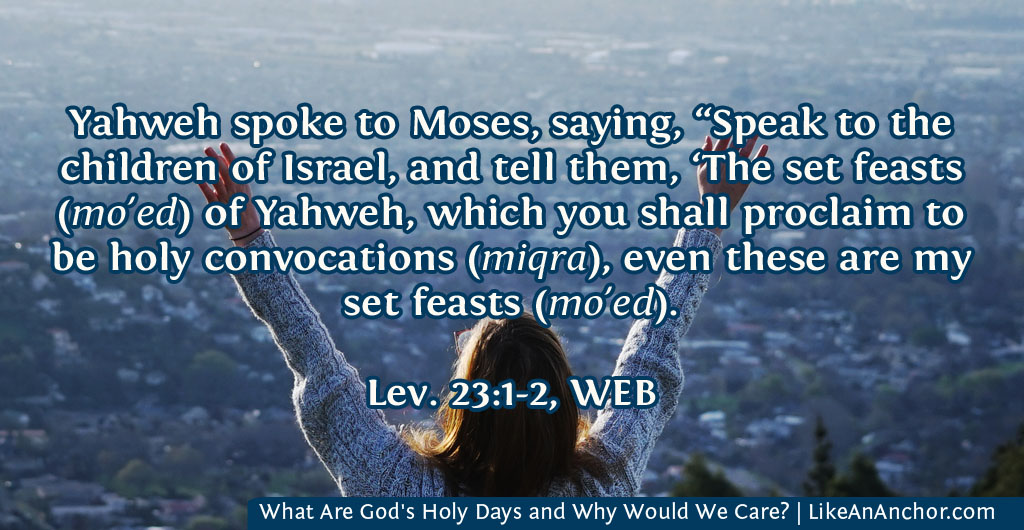
Yahweh spoke to Moses, saying, “Speak to the children of Israel, and tell them, ‘The set feasts (mo’ed) of Yahweh, which you shall proclaim to be holy convocations, even these are my set feasts (mo’ed). … These are the set feasts (mo’ed) of Yahweh, even holy convocations, which you shall proclaim in their appointed season (mo’ed). (Lev. 23:1-2, 4 WEB)

The root word of mo’ed is ya’ad (H3259), which means to appoint, assemble, meet, or betroth. The betrothal translation isn’t used much, but I find it interesting given how much the analogy of Christ as our bridegroom is tied-in with the holy days.

Miqra

Miqra (H4744) is considered a synonym for mo’ed and it’s used 23 times in the Bible. It refers to a rehearsal, assembly, or convocation (which means to call together, as for a meeting). God’s feast days are called “holy convocations,” marking them as meeting times set apart for His purposes.

Yahweh spoke to Moses, saying, “Speak to the children of Israel, and tell them, ‘The set feasts of Yahweh, which you shall proclaim to be holy convocations (miqra), even these are my set feasts. … These are the set feasts of Yahweh, even holy convocations (miqra), which you shall proclaim in their appointed season. (Lev. 23:1-2, 4 WEB)

Miqra can also mean reading aloud. Its root word qara (H7121) means to call, cry out, recite, or enunciate a specific message. In some cases, it means calling by or calling on a name.

They read in the book, in the law of God, distinctly; and they gave the sense, so that they understood the reading (miqra). Nehemiah, who was the governor, and Ezra the priest the scribe, and the Levites who taught the people, said to all the people, “Today is holy to Yahweh your God. Don’t mourn, nor weep.” For all the people wept, when they heard the words of the law. (Neh. 8:8-9, WEB)

The use of miqra to mean readings or callings is often connected to the Feasts. Here in Nehemiah, the people had just rediscovered the fall holy days and were devastated to learn how much they’d lost. As the story continues, we see them overjoyed at the chance to keep the Feast of Tabernacles (Neh. 8:11-18).

What Are God's Holy Days and Why Would We Care? | LikeAnAnchor.com
Photo credit: Ruby-Rose via Lightstock

Chag

The previous two words apply to all the holy days of God. This one, chag (H2282), is used more specifically. It means festival or feast, and refers to the three pilgrim feasts of God: Unleavened Bread, Pentecost, and Tabernacles. Chag appears 62 times in the Old Testament.

Three times in the year all of your males shall appear before Yahweh your God at the place that he will choose, at the Feast (chag) of Unleavened Bread and at the Feast (chag) of Weeks and at the Feast (chag) of Booths, and they shall not appear before Yahweh empty-handed. Each person shall give as he is able, that is, according to the blessing of Yahweh your God that he has given to you. (Deut. 16:16-17, LEB)

These holy festival seasons are described with a different word than the other holy days, and there are some differences in how they’re kept. For example, individuals are told to bring offerings during these days, but not on the other holy days. We’re also told to “keep” these days, which is the word chagag (H2287). Chagag is the root word of chag, and it means to hold or keep a feast. It can also be translated “dance” or “reel,” which connects to other instructions to rejoice in these days.

Shabbat

Shabbat and the closely related word shabbaton (H7676 & H7677) refer to a Sabbath observance. These words show up 122 times in the Old Testament. They are used of the weekly Sabbath and of the fall holy days (Lev. 23:24, 32, 39).

Six days shall work be done, but on the seventh day is a Sabbath (shabbat) of solemn rest (shabbaton), a holy convocation; you shall do no kind of work. It is a Sabbath (shabbat) to Yahweh in all your dwellings. (Lev. 23:3, WEB)

The root word is shabbath (H7673), which means to cease, desist, or rest, and that’s something we do on all the holy days. Though shabbat is not used of the spring holy days or Pentecost, instructions about these days still include the command to not work, so we tend to describe them as Sabbaths as well.

Atsarah

This last word only shows up 11 times in the whole Bible. Atsarah (H6116) means an assembly or sacred/solemn meeting of a company or group. The atsarah that belonged to God are among the things that Israel profaned.

When you come to appear before me, who has required this at your hand, to trample my courts? Bring no more vain offerings. Incense is an abomination to me; new moons, Sabbaths, and convocations: I can’t bear with evil assemblies (atsarah). My soul hates your New Moons and your appointed feasts. They are a burden to me. I am weary of bearing them. (Is. 1:12-14, WEB)

In a positive sense, atsarah is only used specifically of the Last Day of Unleavened Bread (Deut. 16:8) and the 8th day concluding the Feast of Tabernacles (Lev. 23:36). Its root word, atsar (H6113), means to restrain, retain, withhold, close up, or refrain. Apparently, these are two most solemn holy days that God commands.

Why So Much Repetition?

What Are God's Holy Days and Why Would We Care? | LikeAnAnchor.com
Photo credit: Pearl via Lightstock

I’ve heard it said that we should listen closely even when God says something once, but when He says something two or more times then we know it’s something to pay extra attention to. Not only does He talk about these holy days more than once, He uses five different words to explain over and over again how special they are.

The God who cared so much about these days in the Old Testament is the same God that we worship today, which should be reason enough for us to care about these days as well. I’m very much looking forward to studying deeper into His holy days, including how He talks about us keeping them and why He wants so much to share them with His people. I hope you’ll join me 🙂

Free resource! Click here to download a chart summarizing these holy days, including the Hebrew words used for each, when and how they were observed, and New Covenant applications: