I was thinking the other day about the topic of prophecy. Specifically, about how attached some people get to their ideas of how Biblical predictions for the future are going to play out. They want to figure out (or think they already know) when Jesus will return, what the mark of the beast is, which modern nation correspond to names used in prophecy, and other specifics. But I think we need to get comfortable accepting that there are some things we simply don’t know. For some future events, Jesus told His disciples that we are “not permitted to know” the details (Acts 1:6-7). For other things, even though we are permitted to “know the mysteries/secrets of the kingdom of heaven” (Matt. 13:11), it takes time to learn the “deep things of God” and we will never fully understand all there is to know in this human life (Rom. 11:33; 1 Cor. 2:10). With that in mind, I think it is healthy to hold our pet interpretations of prophecies loosely.
I have often wondered how people who are absolutely, 100% sure that God will do things a certain way will react if they’re wrong. Will they miss what God is doing because they are looking somewhere else? Will they get upset with Him if He comes back on a day they weren’t expecting? Will they be so focused on figuring out prophecy that they’ll neglect something more important? And as I wonder these things about other people, I also have to turn these questions back on myself and see if there are any areas where I am doing something similar. For me, it’s not so much about prophecy, but about interpretations of more complex scriptures or less clear points of doctrine. I need to remember that my speculations and pet theories might be wrong.
We must be very careful that the knowledge we (think) we have doesn’t blind us to the reality that we have so much more still to learn (1 Cor. 8:2; 10:12). For things that are speculative, unclear, and/or unrevealed it is the mark of a humble and teachable mind to admit that we don’t really know. We can have ideas that we think are true, and they may even be good ideas solidly grounded in Biblical reasoning, but there are some things that we simply can’t know with 100% certaintly. We should hold those ideas loosely, willing to reconsider them and to give them up if we learn something that tells us we were wrong.
At the same time, there are prophecies, commands, and doctrines that are clearer than others. God gives us promises that He has not yet fully fulfilled, and we can be 100% certain that He will keep those promises. Those are things that we should hold onto tightly, never letting them go or permitting our faith to be shaken. For example, the timing for Jesus’s return is something that we cannot know. If we have ideas for when that might happen, we should hold those ideas loosely. But we so know for certain that Jesus will return and that He will set up God’s kingdom on earth. That is a promise that we should hold close and let it make a home in our hearts.
Image by Matt Vasquez from Lightstock
Things to Hold Fast, and Things To Let Go
Depending on which English translation of the Bible you’re reading, the phrase “hold fast” is used multiple times in scripture. There are some things that we are told to hold fast to, and there are others things that people are warned against holding onto. On the negative side, the people of ancient Israel were warned not to “hold fast” to the pagan nations living around them (Joshua 23:8-13). Later in ancient Israel’s story, God asked why the people “continually turn away from me in apostasy” and “hold fast to their deception” (Jer. 8:5, NET). By Jesus’s time, the Jewish people had rejected the ways of pagan nations around them, but some were still holding onto a different type of deception.
The Pharisees and the experts in the law asked him, “Why do your disciples not live according to the tradition of the elders, but eat with unwashed hands?”He said to them, “Isaiah prophesied correctly about you hypocrites, as it is written:
‘This people honors me with their lips, but their heartis far from me. They worship me in vain, teaching as doctrine the commandments of men.’
Having no regard for the command of God, you hold fast to human tradition.”
Mark 7:3-8, NET (bold italics mark a quotation from Isa 29:13)
The Pharisees Jesus spoke with here held tightly to the wrong things. They should have held on tight to God’s commandments, but instead they held fast to human traditions and let the commandments slip away. We need to be careful that we don’t do the same thing by holding so tight to human traditions or ideas (including our own) that we let the most important things slip. Some of the key things that the Bible tells us to hold fast to are
Holding fast to the right things has a lot to do with staying faithful. No matter what people say or weird ideas that pop into our heads, we need to hold tight to God, to His clear instructions, to His promises, and to our commitment to Him. We must not let any of the less certain things draw us away from that. There’s nothing wrong with studying prophecy and having ideas for how things might happen, or with studying difficult scriptures and doctrinal topics and having thoughts on how we should interpret those. We just need to make sure we are holding on to the right things, keeping a tight hold on things that God has made sure and certain and a loose hold on our own ideas and theories.
The more I study the Bible, its historic context, and the languages it was originally written in, the more I realize that native English speakers are not well equipped to wrap our minds around Hebrew. I’ve been writing quite a bit about this recently as I look at specific topics like “Waiting in Hope” and “Putting ‘Spare the Rod’ In Context.”
I’ve heard a lot of people, especially those who love the KJV Bible translation, express that they want as close as possible to a 1-to-1 translation of the Bible. They think it’s most accurate if there’s a Hebrew or Greek word directly translated to an English word without anything taken away or added in the number of words. I lean that way with most of my translation preferences, too, but I’m starting to think that while that might be a fairly good way to translate Greek, it’s not all that helpful for Hebrew.
Painting With Words
If you don’t count proper names, Biblical Hebrew has about 7,000 distinct words. Modern Hebrew has about 33,000 words, which is a much expanded vocabulary pool but still significantly smaller than English. Webster’s dictionary currently includes about 470,000 entries for English words and some estimates place the number of English words close to 1 million. That doesn’t mean that Hebrew is a more limited language, though. One of the things that it means is there are a lot of Hebrew words where one word represents concepts that English splits up into multiple words (e.g. “wait” and “hope” are distinct in English, but they’re both valid translations of a single Hebrew word).
Hebrew is full of desert browns and burnt umbers of a nomadic, earthy people who trekked through parched deserts and slung stones at their enemies. Overall its palette only contains a small set of colors … Because of its small vocabulary, each word has a broader possible meaning.
The Hebrew of the Bible … expresses truth by splashing on rich colors with a thick brush, like Van Gogh. … even though the details are quite rough, you mentally fill them in, inferring them from the context. Your mind is used to doing this – figuring out meaning from context. Even when you communicate in English, you rely on common experience to fill in the gaps. You sketch out a scene with a few word-strokes, and let people figure out the rest. Hebrew simply relies on this much more than we do.
I really like Lois Tverberg’s comparison of languages to painting styles. Hebrew uses broader brush strokes and a more limited color pallet while English uses a fine-tipped brush, different colors, and more colors. No English translation will ever be perfect because Hebrew and English are so different; that’s one reason it’s helpful to look at multiple translations when studying. It’s also helpful to learn at least a few important Hebrew words even if you can’t devote the time needed to learn the whole language.
Image by Matt Vasquez from Lightstock
An AI-Assisted Case Study on Exodus 20:7
As I’ve been pondering this topic again recently, I keep mulling over a specific question: If there isn’t a 1-to-1 correlation for most Hebrew-to-English translations, would it be helpful to think of key Hebrew words as multiple English words. For example, in English we have “You shall not take the name of the Lord your God in vain” for Exodus 20:7 (NET). But would it be more accurate to say “You shall not take/carry/use the name/reputation of Yahweh your Elohim in [a] vain/empty/worthless [way]”?
I thought I was on the right track, but I wasn’t sure who to ask about it. I don’t have access to a Biblical Hebrew scholar that I’m aware of, or the time to devote years to really learning the language. Then I remembered I’d been reading about and listening to podcasts on Artificial Intelligence (AI) recently, and one of the things people agree it’s a good tool for is research (some saying it’s a better search engine than Google now). I had been in the “I’m a real writer; I don’t use AI!” camp but the more I read about it, the more I’m convinced of two things: 1) ignoring it won’t make AI go away, and 2) there are some situations where it can be a helpful tool. In this particular case, an AI model can process vast amounts of information on Biblical Hebrew in a matter of seconds that would take me months or even years to work through.
Now, there is something we need to keep in mind as we look at the AI response. AI models like ChatGPT (the one that I used) can “hallucinate,” or make up information. That’s why I asked it about Exodus 20:7 and Proverbs 29:15. These are two verses that I’ve already studied quite a bit, so I’d be more likely to recognize if there was something wrong with the AI response. The AI response matched everything I’ve found in my own studies, so I’m reasonably confident that the additional information it provided is also accurate. Here is the link to my full chat if you want to check it out for yourself, and here are some highlights from the AI response:
Biblical Hebrew is a compact, context-dependent language with far fewer words than English. A single Hebrew word often holds multiple layers of meaning, depending on context, syntax, and cultural backdrop. English, by contrast, tends to slice meanings more finely, distributing them across many distinct words. So, when translating Hebrew to English, it’s not just about replacing words — it’s about reconstructing meaning.
This is why your suggestion — to think of Hebrew words as mapping onto multiple English possibilities — is both linguistically sound and theologically wise.
Image by Pearl from Lightstock
After unpacking my specific example, the AI model suggested two possible expanded translations of Exodus 20:7.
A Fuller Rendering: “You shall not lift up or invoke the name/reputation of Yahweh your Elohim in a false, empty, or worthless manner.” …
This approach does not clutter the meaning — it actually recovers the ethical and relational weight of the command. It’s not just about speech. It’s about how we represent God’s character in our lives, words, oaths, and actions.
I was honestly surprised that ChatGPT gave me such a nuanced, thorough response to my question. It was eerily similar to talking with a knowledgeable, personable professor or scholar who genuinely takes pleasure in helping other people broaden their understanding. It didn’t really tell me something brand new, but it was nice to get confirmation that I’m on the right track as I try to wrap my head around Biblical Hebrew. I hope it gave you some food for thought too.
Over the past couple weeks, I’ve been pondering a topic that I’ve had such a difficult time writing about that I skipped one of my regular posting weeks and then picked another topic for my end of May post. It all started when my husband pointed out a Bible commentary that condemned Rahab for her lie even though it saved the lives of the two spies, and maintains there is never any acceptable reason for a lie (see Beyond Today Bible Commentary: Joshua 2). This stance comes down absolutely on the subject of sin and lies: lies are always a sin and never excusable under any circumstances. Then just a few days later, I read about Christians online sharing made up statistics and excusing it because the lie might encourage people to pray (see “Lying for Jesus: When Did Truth Become UnChristian?” by Sheila Wray Gregoire). This is a completely opposite view, one that approaches truth lackadaisically without any respect for the Bible’s teachings on truth and lies.
The Bible is very clear that lying is a sin and God hates it when people deal falsely. Framed in more positive wording, God’s people ought to follow the Truth and speak only truthful things. And yet we have that example of Rahab, where it seems that a good thing came from her lie, and also the example of the midwives who defied Pharaoh’s command to kill baby boys then concealed the truth, whom God rewarded for their actions. Does that mean they didn’t actually lie? Or that God is sometimes okay with lying? Or might there be some thing else going on, something that hits on a deeper topic of how we approach God’s rules and–more importantly–how God wants us to see His rules and understand His grace.
Image by MarrCreative from Lightstock
The Midwives In Egypt
Rahab is probably the most famous Biblical example of a lie that makes us question whether or not God approved of the deception. In that situation, though, the story does not explicitly state either way what God thought of the lie. It is probable that God did consider this a sin and that it would have been better to find another way to redirect the soldiers, but that because she did the best she could and because she was learning to fear the Lord, God extended grace. There’s one other story, though, where it’s harder for us to condemn the lie.
The king of Egypt spoke to the Hebrew midwives, of whom the name of the one was Shiphrah, and the name of the other Puah, and he said, “When you perform the duty of a midwife to the Hebrew women, and see them on the birth stool, if it is a son, then you shall kill him; but if it is a daughter, then she shall live.” But the midwives feared God, and didn’t do what the king of Egypt commanded them, but saved the baby boys alive. The king of Egypt called for the midwives, and said to them, “Why have you done this thing and saved the boys alive?”
The midwives said to Pharaoh, “Because the Hebrew women aren’t like the Egyptian women; for they are vigorous and give birth before the midwife comes to them.”
God dealt well with the midwives, and the people multiplied, and grew very mighty. Because the midwives feared God, he gave them families.
Exodus 1:15-21, WEB
Only one of the commentaries I looked at comes down on the view that this was a lie and dogmatically says, “Their disobedience in this was lawful, but their deception is evil” (Geneva Study Bible). Commentaries on this passage tend to hedge the midwives’ response by saying it “was probably true; but it was not the whole truth” (Ellicott’s Commentary for English Readers; see also Jamieson-Fausset-Brown Bible Commentary, Pulpit Commentary, and Matthew Poole’s Commentary). However, the commentaries’ justification for saying it’s a half truth smacks of racism or at least incomplete information (i.e. European writers in the 1800s saying Arabic women are reported to deliver babies easily). It’s also countered by the text itself saying the midwives, “didn’t do what the king of Egypt commanded them, but saved the baby boys alive,” which heavily implies that they were there for the births or at the very least could have obeyed the king if they so chose. If they were, in fact, present for the births then saying that the Hebrew women “give birth before the midwife comes to them” was not true. Yet despite this untruth, we are told very clearly, “God dealt well with the midwives” and “Because the midwives feared God, he gave them families.”
In this particular situation, it seems that the midwives had a choice between concealing the truth or participating in murder. I suppose they did have a third choice of telling the king that they disobeyed his command, but that would have also lead to death (and possibly not just for them). This sort of situation is rare, but it’s not unheard of. If someone’s life is in your hands and you’re talking to someone who wants to kill them, telling the whole truth could very easily mean you’ve betrayed someone to death (which is not looked on well in Matt. 24:10). It sounds almost heretical to type this, but it seems from this situation that there was at least one time when God was flexible with His command against lying. At the very least, He extended grace to cover the lie and it was neither condemned nor held against the midwives.
Image by Pearl from Lightstock
Is There Ever A Lesser Evil?
As I’m pondering the midwives’ situation, I wonder if the person who asked Jesus about the greatest commandment might have had similar questions as I do about what to do when you’re stuck in a situation where you can’t clearly see a good choice. If you’re in a situation like the midwives where you have to choose between obeying God’s commands to respect human authority, not commit murder, and to tell the truth, how do you decide which command is most important?
“Teacher, which commandment in the law is the greatest?” Jesus said to him, “‘Love the Lord your God with all your heart, with all your soul, and with all your mind.’ This is the first and greatest commandment. The second is like it: ‘Love your neighbor as yourself.’ All the law and the prophets depend on these two commandments.”
Matthew 22:36-40, NET
The Hebrew midwives never read this verse, but it might give us a clue to their thought process. We can’t obey human authority if they tell us to disobey God; God is a higher authority and we must love Him and follow Him will all our heart, soul, and mind. We cannot commit murder, firstly because God tells us not to but it is also completely incompatible with loving your neighbor as yourself. In the midwives’ situation, it seemed that telling the whole truth had to take a backseat to following the greatest commands. Could they have handled it in a more truthful way and still had a good outcome? Possibly, but whether it’s the case that they didn’t sin at all or they sinned in lying because they didn’t know what else to do, God still rewarded them for their actions. He has the right to extend grace in whatever situation He wants.
On a cosmic, eternal scale, there are not levels of severity to sin. If you keep every command except one, “you have become a violator of the law” and have “become guilty of all of it” (James 2:10, 11, NET; see James 2:8-13). The law gives us “the knowledge of sin” and ensures that “the whole world may be held accountable to God” by clearly showing how God defines sin (Rom. 3:19-20, NET). We’re all guilty in God’s eyes, no matter how “small” our sins might seem, and we all need Jesus’s sacrifice. Paul says that this truth helps show the righteousness and justice of God, who holds all accountable yet freely offers forgiveness and grace through Jesus Christ (Rom. 3:19-26).
No matter which of God’s laws you violate, “the payoff of sin is death” on an eternal timescale and you need “the gift of God [which] is eternal life in Christ Jesus our Lord” (Rom. 6:23, NET). But on an earthly level, we also know that some sins are less destructive than others and God’s laws for ancient Israel reflected that. Every sin would earn you an eternal death penalty (i.e. you can’t live forever unless you accept Jesus’s Christ’s sacrifice on your behalf) but not every sin earned you a physical death penalty when living in a nation ruled by God’s law. For example, murder was a death-penalty sin (Lev. 24:17; Num. 35:30-31) but theft required you pay back more than you stole (Ex. 22:1). If someone lied in a court of law, then the false witness was punished the same way “he had intended to do to the accused” (Deut. 19:19, NET; see Deut. 19:16-19). God didn’t order the same legal penalty for every sin; there was more nuance than that.
We should never think, “I can get away with breaking this one of God’s laws because it’s not a big deal,” but if we’re legitimately in a position where we have to choose between participating in murder or lying about something, I think the choice is clear. You would still need to repent of the lie, but God has a great deal of mercy for people, especially when they are not flagrantly defying Him because they think His laws don’t matter or that they can get away with it.
Maintain Careful Respect For God
Image by WhoisliketheLord Studio from Lightstock
Scripture is clear that God’s laws are very important and He acts justly at all times. We can rely on Him not to go around changing His laws willy-nilly. He has the sovereign right to deliver and enforce laws, and when we agree to live in relationship with Him, part of our covenant obligation is obedience. At the same time, one of the consistent things we know about His character is that He extends lots of mercy and grace to people who slip, and that He reserves the right to amend His plans in response to human behavior (e.g. withholding destruction from Nineveh after the city repented).
For lying in particular, we’re told in no uncertain terms that it originates with the devil and that those who live untruthful lives are abominable to God (Prov. 12:19, 22; John 8:44; 1 John 2:21). We can count on Him to cover that sin in some very specific circumstances, like for Rahab and the midwives, but we ought not take the grace that He shows to people who lied to save a life as license to lie for anything we think is a good cause. This is where those people we mentioned who spread false research even after knowing it was fabricated made a mistake.
Absolutely not! Let God be proven true, and every human being shown up as a liar, just as it is written: “so that you will be justifiedinyour words and will prevail when you are judged.”
But if our unrighteousness demonstrates the righteousness of God, what shall we say? The God who inflicts wrath is not unrighteous, is he? (I am speaking in human terms.)Absolutely not! For otherwise how could God judge the world? For if by my lie the truth of God enhances his glory, why am I still actually being judged as a sinner? And why not say, “Let us do evil so that good may come of it”?—as some who slander us allege that we say. (Their condemnation is deserved!)
Romans 3:4-8, NET (bold italics mark a quotation from Ps 51:4)
The Bible does not give us license to lie whenever we think we have a good reason. Here, Paul specifically addresses a situation where people thought to forward the gospel by lying, and shows that you are still a sinner if you violate God’s law thinking to do good. We need to obey God the way He tells us to. But it is also worth mentioning here if you lied for what you thought was a good reason, you can still realize your mistake and repent. God is always ready to respond to sincere human repentance with forgiveness and grace.
I almost didn’t share this post because it’s such a tricky thing to write about, but I think it’s good to have these types of conversations because they do come up in hypotheticals and sometimes in real-life. I have heard people say that they worry about being in a situation like Europeans who hid Jews during the Holocaust because they’re concerned that God would condemn them as sinners if they lied when asked, “Are there Jews hiding here?” I don’t think we need to worry about that so much. God is not up there waiting to pounce on us, watching for us to fail if we’re in an impossible situation and can’t think of a better way out.
To directly address the title of this post, “Is There Ever A Good Reason To Lie?” I think the answer is both no and yes. “No” in the sense that lying is always a sin, but “yes” in the sense that there are rare situations where you can’t see any other way to obey another of God’s commands (e.g. “love your neighbor as yourself”) than to conceal the truth. God always looks on our hearts, and there’s a big difference between lying because you can’t think of any other way to save a life (and then repenting of the lie) and lying because you’re too proud to admit your were wrong (especially if you then convince yourself you don’t need to repent).
You might have read that title and wondered if I’ve lost my faith or my mind. But I wanted an attention-grabbing title to talk about something that I think of whenever I’m reading isolated quotes from the book of Job.
This book records dialog between Job, his three friends (Eliphaz the Temanite, Bildad the Shuhite, and Zophar the Naamathite), a young man named Elihu, and God Himself. At the end of the book, God rebukes the three friends, saying, to Eliphaz,”My wrath is kindled against you, and against your two friends; for you have not spoken of me the thing that is right, as my servant Job has” (Job 42:7, WEB). Here, we see God pointing out that the things these three men said about him were not right. Their words are recorded in the Bible, but those words don’t reflect a correct view of the world or a proper understanding of God.
For those of us who believe that the Bible is the inspired word of God, we often assume that if we’re studying a topic and look up all the verses using a specific keyword or we read a scripture that someone quotes, then whatever that individual verse says must be true. That is often the case, but we can get into trouble if we don’t read the context. Sometimes a verse might be part of a larger argument that changes how we understand a specific phrase (this happens a lot in Paul’s writings). Sometimes the verse might be part of a recorded dialog where the speakers says things that aren’t true. The Bible contains the Truth, but if we take pieces of it out of context or misunderstand what’s going on, we can still take things away from reading the Bible that are not true.
Image by Ben White from Lightstock
A Wrong Conclusion About Suffering
Sometimes, the Bible records incorrect assumptions people made about God. If we read the rest of the story these incorrect assumptions are corrected, but if we just read the person’s incorrect statement and think, “Well, it’s in the Bible so it must be true,” then we can make the same mistakes they did. When we lift a quote from the book of Job, for example, we need to check who said it, what the larger context is, and if it fits with the rest of scripture. We don’t want to risk making the same mistakes Job’s friends did. For example, these men assumed that people who suffer must have sinned and are being punished by God. It’s a mistake people in Jesus’s time were making (John 9:2-3) and it’s one you’ll still hear some people today repeating. They can even trot out some scriptural evidence for it.
Call to mind now: Who, being innocent, ever perished? And where were upright people ever destroyed?
Job 4:7, NET (Eliphaz the Temanite speaking)
If your children sinned against him, he gave them over to the penalty of their sin. …
Surely, God does not reject a blameless man, nor does he grasp the hand of the evildoers.
Job 8:4, 20 NET (Bildad the Shuhite speaking)
These are a couple arguments that Job’s friends used to try and persuade him that he must be guilty of some great sin that caused God to kill his children, take away his wealth, and strike him with a horrible sickness. However, we readers know that something entirely different was going on behind the scenes: Job was “a blameless and upright man” who became the central player in a wager between Yahweh and Satan. Even without that highly unusual circumstance, the rest of the Bible reveals suffering does not just happen because you did something wrong and good people often suffer even while doing what is right.
Limiting God In Our Minds
Another example of how we can arrive at a wrong conclusion based on taking a Biblical person’s mistaken words out of context comes from the book of Habakkuk. When God told Habakkuk, “Look, I am about to empower the Babylonians” to sweep violently across the earth (Hab. 1:6, NET; see Hab. 1:5-11), Habakkuk had concerns. He protested, “You are too just to tolerate evil; you are unable to condone wrongdoing. So why do you put up with such treacherous people?” (Hab. 1:13, NET). God responded that He would certainly do exactly as He’d said (Hab. 2). It seems that Habakkuk had an idea of what God couldn’t or wouldn’t do, and God corrected his misunderstanding.
The whole book of Habakkuk is only 3 chapters long; you can easily read it all in one setting. But we can still take Habakkuk’s words out of context and make his same mistake today. I’ve actually heard people use Habakkuk’s words, “Thou art of purer eyes than to behold evil, and canst not look on iniquity” (Hab. 1:13, KJV) to say that God can’t be in the presence of sin. That’s an incorrect assumption that contradicts much of the rest of the Bible (for example, God let Satan come before Him in Job and he’s as sinful as you can get). And yet, people take this misconception and create whole doctrines, such as saying the Father must have forsaken Jesus and turned His face away when His Son hung on the cross because Jesus took on the world’s sins and God can’t be in the presence of evil. The Bible doesn’t say that! Such an assumption is based on us turning Habakkuk’s misconception into a rigid rule to the point that we place limits on what God can and can’t do that don’t actually exist.
Ask For Understanding
Image by Anggie from Lightstock
It is good to question the things we read. We should also keep in mind, though, that our goal isn’t to disprove the Bible or dismantle correct doctrines. We question, examine, and study in order to learn what is true and correctly understand God’s words.
The brothers sent Paul and Silas off to Berea at once, during the night. When they arrived, they went to the Jewish synagogue. These Jews were more open-minded than those in Thessalonica, for they eagerly received the message, examining the scriptures carefully every day to see if these things were so. Therefore many of them believed, along with quite a few prominent Greek women and men.
Acts 17:10-12, NET
The Bereans are often held up as a good example of examining the scriptures, and rightly so. Notice, though, that their response to hearing the gospel was not to search through the scriptures trying to prove their own idea but “to see if these things were so.” They studied to figure out what was true.
God’s word is Truth, but we must be cautious in how we read it and ask God to guide us to a proper understanding. If we take things out of context or misunderstand what’s being said in a scripture, we might come away from Bible reading with ideas that are not true. It requires God’s spiritual intervention to open our minds to understand the scriptures (Psalm 119:18; Luke 24:45; 1 Cor. 2:6-16). We should approach His word with humility, a willingness to learn, and commitment to understanding God’s word rather than just picking out bits that sound good.
I recently read a social media discussion centered on the issue of women in ministry. Without going into too much detail, the original post criticized the idea of “women pastors,” and subsequent comments went in the direction of debating whether or not women had any authority roles in the church. As I read these comments, I started feeling uncomfortable. It’s not as if I’m unfamiliar with this topic or I don’t have my own ideas on whether women are “allowed” to teach, speak, pray, prophecy, or lead in churches (one example: my post “Women Who Speak in Scripture”). But the focus on who gets to have authority struck me as wrong. If we focus discussions like this on who is in charge, I think we’re missing one of the New Testament’s big points about how all Christians are supposed to relate to one another.
Jesus’s Take on Authority
Authority is not a bad thing. Jesus taught with authority, used the authority His father gave Him for good (such as to forgive sins), and currently has “all authority in heaven and on earth” (Matt. 7:29; 9:6; 28:18; John 5:27; 10:18). He also clarifies that His authority comes from God–it’s legitimate authority conferred upon Him by the highest authority (John 12:49). As someone with authority, He could and did give His disciples certain authority, such as over unclean spirits (Matt. 10:1).
In these verses, the Greek word translated “authority” is exousia (G1849). Thayer’s dictionary lists several primary meanings: “1. power of choice, liberty of doing as one pleases … 2. physical or mental power … 3. the power of authority (influence) or right (privilege) 4. the power of rule or government.” Like the English word “authority,” it can refer to legitimate, well-wielded authority or it can have a darker side. We see that in a discussion Jesus had with His disciples at least twice: once after James and John asked for authority in His kingdom and once at the Passover when all the disciples debated who would be the greatest after Jesus died.
Now when the other ten heard this, they were angry with the two brothers. But Jesus called them and said, “You know that the rulers of the Gentiles lord it over them, and those in high positions use their authority over them. It must not be this way among you! Instead whoever wants to be great among you must be your servant, and whoever wants to be first among you must be your slave—just as the Son of Man did not come to be served but to serve, and to give his life as a ransom for many.”
Matthew 20:24-28, NET
A dispute also started among them over which of them was to be regarded as the greatest.So Jesus said to them, “The kings of the Gentiles lord it over them, and those in authority over them are called ‘benefactors.’Not so with you; instead the one who is greatest among you must become like the youngest, and the leader like the one who serves.For who is greater, the one who is seated at the table, or the one who serves? Is it not the one who is seated at the table? But I am among you as one who serves.
Luke 22:24-27, NET
“Authority” in these verses is exousia (or it is in Luke 22; Matthew 20 uses katexousiazo, a derivative meaning “to exercise authority, wield power” [G2715, Thayer]). In this case, it’s talking about people among the nations who have worldly authority. The phrase “lord it over” is another word: kurieuo in Luke 22, which means “to be lord of, to rule, have dominion over” (G2961, Thayer) and katakurieu in Matthew, a related word meaning “to bring under one’s power … to hold in subjection to be master of, exercise lordship over” (G2634, Thayer). It’s definitely not a good thing in this context, and Jesus clearly tells his disciples not to act this way. If you want to be great in His church, then you serve.
When I saw people arguing things like, “How dare women try to get authority over men?” or “I can’t stand that only men get authority, why can’t women like me be in charge?” I thought about these verses. There are certain kinds of authority given to people in the church (and legitimate roles instituted by Jesus or those He taught directly, such as apostle, pastor, and deacon), but if we’re concerned about who gets to lord it over other people then we’re missing the point. No one is supposed to be lording it over other people or coveting a position where they could do that. We’re supposed to be humble and focus on service.
Image by José Roberto Roquel from Lightstock
Who Can Serve and How?
Maybe instead of asking, “Can women have authority in the church?” we should ask, “Can women serve in the church?” The answer to that is a resounding “Yes!” supported by the examples of many women in the Old and New Testaments. What gets more to the heart of the original debate, though, is the question, “How do women serve in the church?” We have examples to answer that question as well. We know for certain that women in the Bible served God’s people in these ways:
Worker/laborer (Mary, Rom. 16:6; Tryphena, Tryphosa, and Persis Rom. 16:12).
There may even have been a woman apostle, Junia (Rom. 16:7), but her exact role is so hotly debated that I didn’t put “apostle” on my list (scholars pretty much agree that she was a woman, but not on whether the phrase used in this verse indicates she could have been an apostle). Clearly, women were heavily involved in the church, both in what we think of as “behind the scenes” roles and (apparently more rarely, though female prophets are relatively common) in the more public leading, serving, teaching, preaching roles. When God uses a woman to do something in scripture, we really can’t argue that the church shouldn’t allow women to do those same things today.
Things Women (Probably) Don’t Do
It’s worth noting some of the roles that we don’t see examples of women in. If we look at the lists of ministry gifts/roles in 1 Corinthians 12:28 and Ephesians 4:11, we see “first apostles, second prophets, third teachers, then miracles, gifts of healing, helps, gifts of leadership, different kinds of tongues” (1 Cor. 12:28, NET) and “some as apostles, some as prophets, some as evangelists, and some as pastors and teachers” (Eph. 4:11). Let’s use those lists as a guide for examining women’s possible roles in the church.
We might have one possible example of a woman as an apostle, but no specific examples of them as pastors (from the same Greek word translated “shepherd”) or evangelists (Greek word only used 3 times). However, “evangelist” is a title that comes from the Greek verb euaggelizo (G2097), “to bring good news” or preach the gospel (Thayer). It is likely that women did participate in that activity (Acts 8:1-4; Phil 4:2-3). We also don’t have specific examples of women performing miracles or healings. But we know for certain that women can be prophets, that women teach even if not called “teacher” as a title, that they fill helper roles, that they can have leadership-related gifts, and that those at Pentecost spoke in different languages just like the apostles and other men (Acts 1:14; 2:1-4).
It seems, then, that we can say women did not serve as pastors/shepherds in the Bible and that they were not typically apostles or evangelists. The only other church “authority” roles I can think of in the New Testament are elder, bishop/overseer, and deacon/servant. We have a concrete example of a woman as a deaconess/servant, but no women in the overseer role. “Elder” seems to refer to men most of the time, but the feminine version of the Greek word is used in 1 Tim. 5:2. I suspect that when “elder” is used to refer to respected older people in the church it often includes men and women, but when it’s used to refer to an ordained role in the church it typically or exclusively refers to men. That said, we also don’t have any verses directly saying, “women cannot be pastors.”
You might be uncomfortable with how ambiguous I’m being here, but it is deliberate. The need to have hard rules defining what women and men can and cannot do is a product of Western cultural mindset being applied to the Biblical text. We want specific and inflexible rules for things, but Eastern cultures (like those of Biblical writers) see rules differently: “rules apply except when the one in charge says otherwise. Westerners might consider this arbitrary; many non-Western Christians consider this grace” (Misreading Scripture With Western Eyes, Richards & O’Brien, p. 174). As an example, one of the authors of this book recounts a time when he was invited to speak to a group of pastors in Indonesia. He was shocked, knowing the group’s bylaws say pastors must be male, to see a few women in the audience. When he asked about it, he was calmly told, “Yes, and most of them are [male]” (p. 169). The Indonesian man he spoke with saw nothing strange about an exception to the rule. Perhaps Christians at the time Paul wrote Romans would have heard us say, “Women can’t be apostles,” and responded by saying, “That’s right, except for the times when they are apostles.”
Image by Pearl from Lightstock
But What About 1 Timothy 2?
Because we’ve been talking about authority, we need to address 1 Timothy 2:12, where Paul wrote, “I don’t permit a woman to teach, nor to exercise authority over a man” (WEB). Seems straightforward enough, until we start looking at the context and Greek words. Paul doesn’t use any of the typical words for authority here, but rather the incredibly rare word authenteō. This word may refer to wrongly used authority and/or could be connected to astrology practiced by some pagan women at the time, but it’s hard to say for sure since this is the only time it’s used in the Bible and it’s rarely used in contemporary writings (“The Strangeness of 1 Timothy 2:12,” Andrew Bartlett). Paul also uses a different phrase, “I don’t permit,” than he typically uses when laying down rules for the churches.
We also should take note of the fact that Timothy was in Ephesus when he received this letter, a church that Paul specifically brought Priscilla and Aquilla into and where he left them to serve (including teaching Apollos when they arrived [Acts 18:18-28]). It makes a whole lot more sense to interpret this as a prohibition against women usurping (KJV), dominating (ASV), or lording it over (TLB) a man (note that “man” is singular in the Greek, not the plural “men”) rather than a general rule that women never speak or have any authority, particularly given how involved some women were in ministry in the New Testament.
This analysis might seem pedantic or as if we’re trying to “get around” this scripture, but when you come across something in Paul’s writings that is hard to understand (and a lot of things are [2 Pet. 3:16-17]) we need to look at how it fits with the rest of scripture. Our interpretation of what he says has to match other things in the Bible. In this case, if scripture shows women consistently involved in various types of ministry work–including, occasionally, what we’d think of as “authority” roles like prophet or church host–then Paul’s words here can’t be a prohibition on women serving in the body of believers. It would go against precedent in the entire Bible–including Jesus’s radical treatment of women as equals and Paul’s own writings about how God views converted men and women on a cosmic scale (1 Cor. 11:11-12; Gal. 3:28)–if Paul were making a blanket declaration against women serving in the church. It is much more likely that he is telling Timothy not to let women in Ephesus do things that men wouldn’t be allowed to do either (e.g. lord it over others in the church or teach things related to astrology).
It seems very strange to me that we pull out a few isolated phrases Paul uses (1 Cor. 11:3; 14:34; 1 Tim. 2:12) and come up with this whole doctrine that women can’t ever teach, speak, or have public roles in the church. What about the whole rest of the Bible? What about how Jesus treated women? It seems just as misguided to me as those who take Paul’s statement, “you are not under law but under grace” (Rom. 6:14, NET) to mean that New Covenant Christians don’t have to obey God. We need to be careful about things like this, and test our assumptions (even if they’ve been assumptions for centuries of church history) to make sure they actually fit what God teaches through His word.
Motivated by Service and Humility
Image by Anggie from Lightstock
As we look at the roles we see women in the Bible filling or not filling, we need to be careful how we conceptualize authority related to those roles. The point isn’t to figure out who is most important (e.g. is it the male pastor or the female prophet?) but to serve God with the gifts He provides in the role He supplies. If God calls a woman to host the church in her home, that’s what she does. If He gives a woman the gift of prophecy, then she’s supposed to prophecy.
Likewise, if He chooses not to place women in the role of ordained pastor, elder, or overseer, that is God’s choice and the New Testament makes it seem like this is indeed the case (at least most of the time). Most men don’t fill those roles either; other roles are more commonly needed in the church. We’re not supposed to be jealous of or resent people who have roles that we think of as more authoritative than us any more than Jesus resents His Father for being greater than Him (to be clear, there is no resentment or competition between Jesus and the Father [John 10:29-30; Phil. 2:5-11]).
Instead of being motivated by selfish ambition or vanity, each of you should, in humility, be moved to treat one another as more important than yourself. Each of you should be concerned not only about your own interests, but about the interests of others as well.You should have the same attitude toward one another that Christ Jesus had,
who though he existed in the form of God did not regard equality with God as something to be grasped, but emptied himself by taking on the form of a slave
Philippians 2:3-7, NET
No one in God’s church is supposed to seek authority roles for the prestige or the power. We should seek to serve with humility, the same way that Jesus modeled. In a healthy church following God’s lead, we’ll filter into the roles most suited to the gifts He has given us (ideally without doctrinal misinterpretation or other people’s “selfish ambition or vanity” blocking someone from what they’re supposed to be doing). It doesn’t always work that way because the church is composed of people–redeemed people working on becoming more like God, but still people who can make mistakes. We need to have patience with each other in that. For example, it is not wrong for me to want churches I’m involved with to let me exercise my teaching gifts (and other women to exercise their gifts), but it is wrong when I feel as if I deserve more recognition and responsibility than I get or when I resent other people who have the opportunity to use their gifts differently than I do.
Two of the things that we’re called to do is submit “to one another out of reverence for Christ” (Eph. 5:21, NET) and “through love serve one another” (Gal. 5:13, NET). We’re not called to seek authority or argue about who gets to be in charge. Ultimately, Jesus is the one in charge as head of the church (Eph. 1:22; Col. 1:18). The rest of us are here to serve in a variety of different capacities, but all of them characterized by encouragement, love, and humility (see, for example, John 13:35; 2 Cor. 1:24; Eph. 4:1-3; Col. 3:12-13). If we think any of this is about being in charge, claiming authority over others, or getting what we think we’re owed, then we’ve missed the whole point.
We all know John 3:16. Even non-Christians know this verse. It’s displayed and quoted perhaps more than any other part of the Bible.
But do you know where it is, contextually? I’m fairly good at remembering where scriptures are, but it’s easy to get your memories mixed up and if I’d had to guess, I might have said it’s in one of Jesus’s many addresses to crowds of people. It’s actually part of his answer to a question Nicodemus asked when he came to Jesus privately, at night after the crowds were gone.
Knowing the context doesn’t change the profound truth that “God so loved the world, that he gave his one and only Son, that whoever believes in him should not perish, but have eternal life” (John 3:16, WEB). But it does enhance our understanding of Jesus’s point if we know what else Jesus said when He made this statement.
Image by Inbetween from Lightstock
Setting the Stage
Unlike other gospel writers, John begins not with Jesus’s human birth but with pre-Creation. He establishes Jesus’s divinity before anything else (John 1:1-18), then goes into John the Baptist’s testimony about Jesus (John 1:19-26), and the first disciples gathering to Jesus (John 1:27-51). Then he records Jesus’s first miracle (John 2:1-11), then the first Passover during Jesus’s ministry, when He cleared those buying and selling out of the temple and began attracting attention from the religious leaders (John 2:12-25). Then, while Jesus is in Jerusalem for Passover, we come to the conversation we’re studying today.
Now a certain man, a Pharisee named Nicodemus, who was a member of the Jewish ruling council,came to Jesus at night and said to him, “Rabbi, we know that you are a teacher who has come from God. For no one could perform the miraculous signs that you do unless God is with him.” Jesus replied, “I tell you the solemn truth, unless a person is born from above, he cannot see the kingdom of God.”Nicodemus said to him, “How can a man be born when he is old? He cannot enter his mother’s womb and be born a second time, can he?”
John 3:1-4, NET
We learn several things about Nicodemus in this introduction. First, he was a Pharisee, a member of an influential religious and political group whose members “were strict and zealous adherents to the laws of the OT and to numerous additional traditions” (NET footnote on John 1:24). In addition, he was “a member of the Sanhedrin, the highest legal, legislative, and judicial body among the Jews” (NET footnote on John 3:1). He was an expert in the scriptures and how to interpret them. It was enough to recognize Jesus as a teacher sent by God, based on the miracles He performed, and to prompt him to come to speak with Jesus privately to learn more. I have to wonder if he might have suspected Jesus to be the Messiah, but came privately because he didn’t want others to know what he was thinking.
As is often the case, Jesus jumped right in with a statement that doesn’t seem like a logical reply to the other person’s remark, but which starts the conversation that they need to have with Him. In this case, one of the words He uses has a double meaning in Greek. When Jesus says, “unless a person is born from above,” the word translated “from above” (anōthen) can also mean “again” (NET footnote on John 3:3). Nicodemus seems to assume Jesus meant the second meaning, since he asks if a man can be born from his mother a second time.
Jesus answered, “I tell you the solemn truth, unless a person is born of water and spirit, he cannot enter the kingdom of God. What is born of the flesh is flesh, and what is born of the Spirit is spirit. Do not be amazed that I said to you, ‘You must all be born from above.’ The wind blows wherever it will, and you hear the sound it makes, but do not know where it comes from and where it is going. So it is with everyone who is born of the Spirit.”
Nicodemus replied, “How can these things be?”Jesus answered, “Are you the teacher of Israel and yet you don’t understand these things?”
John 3:5-10, NET
I often marvel at how much people in New Testament times knew based just on reading the Old Testament. I’m not sure if I could have read those scriptures and realized what signs to look for to recognize the promised Messiah (of course, the main thing it would have depended on is if God decided to open my eyes). But here, Jesus is marveling at the fact that Nicodemus was a “teacher of Israel” and didn’t understand that someone would need to be born of the spirit. He should have known this already, at least in part, just like he should have been able to recognize from the law, prophets, and psalms that Jesus is the promised Messiah (Luke 24:44; John 5:39). Jesus doesn’t hold Nicodemus’s lack of knowledge against him, though. He continues the conversation and reveals more of God’s amazing plan.
Image by Shaun Menary from Lightstock
Earthly and Heavenly Things,
Jesus answered, “Are you the teacher of Israel and yet you don’t understand these things?I tell you the solemn truth, we speak about what we know and testify about what we have seen, but you people do not accept our testimony. If I have told you people about earthly things and you don’t believe, how will you believe if I tell you about heavenly things?No one has ascended into heaven except the one who descended from heaven—the Son of Man.Just as Moses lifted up the serpentinthe wilderness, so must the Son of Man be lifted up,so that everyone who believes in him may have eternal life.”
John 3:10-15, NET (italics mark an allusion to Num 21:5-9)
I find this part a little confusing. When Jesus said, “we speak,” who is “we”? I’m not sure if He’s referring to Him and His disciples or to Him and His Father. And what did He mean, “I have told you people about earthly things and you don’t believe?” Their conversation up to this point is about spiritual rebirth and resurrection, but is that an earthly thing? Or is He referring to something that happened earlier during Passover, like rebuking people for making the temple a marketplace?
We’re not the first to ask these questions. The NET translators have an extensive footnote on John 3:12. They suggest that, since it’s most logical to assume Jesus is speaking of what He just told Nicodemus, that “earthly things are not necessarily strictly physical things, but are so called because they take place on earth, in contrast to things like v. 16, which take place in heaven.” This would make “the necessity of a regenerating work from above, by the Holy Spirit” an “earthly thing,” but God’s love motivating His plans a “heavenly thing.”
Maybe we could think about it like this: the “earthly things” are related to what God is doing here on earth. Being “born of water and spirit” sounds like something that begins with baptism. The process of being born into God’s family as spirit beings starts now, during the physical lives of those who commit to following Him. It’s a process initiated by something God in heaven chose to do, a “heavenly thing” that’s described in the next part of this conversation.
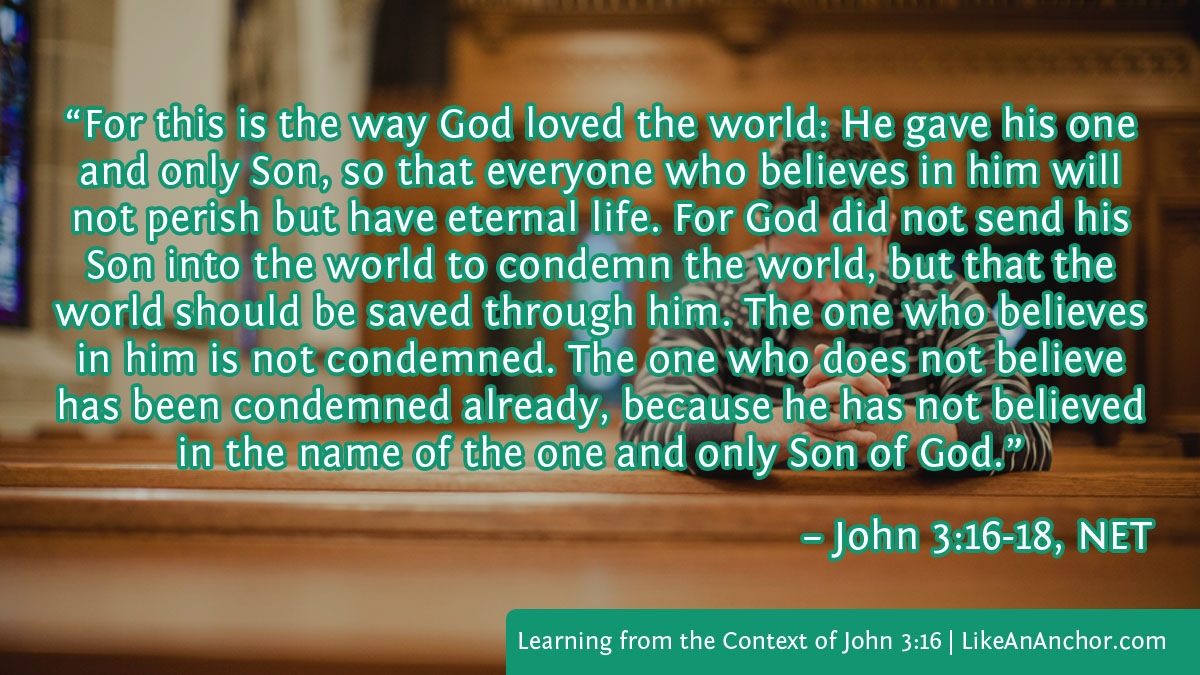
“For this is the way God loved the world: He gave his one and only Son, so that everyone who believes in him will not perish but have eternal life.For God did not send his Son into the world to condemn the world, but that the world should be saved through him. The one who believes in him is not condemned. The one who does not believe has been condemned already, because he has not believed in the name of the one and only Son of God.”
John 3:16-18, NET
We don’t have record of Nicodemus saying anything after verse 9, but I have to wonder what he was thinking at this point. Was he struck with awe at the revelation that God had sent His own Son to earth as the promised Messiah? Did he understand what Jesus was telling him here? Or did he walk away confused, unsure what it meant for God to give His son to save the world? We don’t know, but he does speak up for Jesus when other Pharisees tried to arrest Him (John 7:45-52) and he helped Joseph of Arimathea bury Jesus after His crucifixion (John 19:38-40). It seems logical to assume Nicodemus became one of Jesus’s disciples, though perhaps not very openly.
Life in the Son
Image by Lamppost Collective from Lightstock
We’re here to look at John 3:16, one of the most famous Bible verses. It shows up near the middle of Jesus’s conversation with Nicodemus. We’ve already looked at the lead-up to this verse and the discussion of being born from above/again. Now, let’s look at how Jesus concludes this discussion.
“For this is the way God loved the world: He gave his one and only Son, so that everyone who believes in him will not perish but have eternal life.For God did not send his Son into the world to condemn the world, but that the world should be saved through him. The one who believes in him is not condemned. The one who does not believe has been condemned already, because he has not believed in the name of the one and only Son of God. Now this is the basis for judging: that the light has come into the world and people loved the darkness rather than the light, because their deeds were evil. For everyone who does evil deeds hates the light and does not come to the light, so that their deeds will not be exposed. But the one who practices the truth comes to the light, so that it may be plainly evident that his deeds have been done in God.”
John 3:16-21, NET
It might seem a little weird to read about judgement and condemnation right after reading that Jesus came to save the world. But it really does fit very neatly into a whole-Bible understanding of the plan of God. When people choose sin (as all do [Rom. 3:23]) the natural consequences of that is death (Deut. 30:15-19; Rom. 5:12-15; 6:23). God’s justice and righteousness specifies that there is a consequence for sins. He also has the right to judge His creation. Now that the Light has come into the world, it is time for people to repent and change before the judgment (Acts 17:30-31).
When God judges, He doesn’t want to condemn. That’s one possible outcome, but that’s not His goal. God loves (agape) everyone and wants them to come to repentance, receive salvation, and gain eternal life (1 Tim. 2:1-4; 2 Pet. 3:8-9). That is made possible through Jesus and because of His and the Father’s love: “for God so loved the world, that he gave his one and only Son, that whoever believes in him should not perish, but have eternal life” (John 3:16, WEB). This incredible truth ought to prompt us to believe in Jesus, practice the truth, and come to the light to walk with our God.






![Image of a man studying the Bible overlaid with text from Ex. 20:7, AMP version: “You shall not take the name of the Lord your God in vain [that is, irreverently, in false affirmations or in ways that impugn the character of God]; for the Lord will not hold guiltless nor leave unpunished the one who takes His name in vain [disregarding its
reverence and its power]."](https://likeananchor.com/wp-content/uploads/2025/07/bibilical-hebrew-1.jpg)






 Like An Anchor