Focusing On Authority Misses the Point (How Do Women Serve in the Church?)

I recently read a social media discussion centered on the issue of women in ministry. Without going into too much detail, the original post criticized the idea of “women pastors,” and subsequent comments went in the direction of debating whether or not women had any authority roles in the church. As I read these comments, I started feeling uncomfortable. It’s not as if I’m unfamiliar with this topic or I don’t have my own ideas on whether women are “allowed” to teach, speak, pray, prophecy, or lead in churches (one example: my post “Women Who Speak in Scripture”). But the focus on who gets to have authority struck me as wrong. If we focus discussions like this on who is in charge, I think we’re missing one of the New Testament’s big points about how all Christians are supposed to relate to one another.

Jesus’s Take on Authority

Authority is not a bad thing. Jesus taught with authority, used the authority His father gave Him for good (such as to forgive sins), and currently has “all authority in heaven and on earth” (Matt. 7:29; 9:6; 28:18; John 5:27; 10:18). He also clarifies that His authority comes from God–it’s legitimate authority conferred upon Him by the highest authority (John 12:49). As someone with authority, He could and did give His disciples certain authority, such as over unclean spirits (Matt. 10:1).

In these verses, the Greek word translated “authority” is exousia (G1849). Thayer’s dictionary lists several primary meanings: “1. power of choice, liberty of doing as one pleases … 2. physical or mental power … 3. the power of authority (influence) or right (privilege) 4. the power of rule or government.” Like the English word “authority,” it can refer to legitimate, well-wielded authority or it can have a darker side. We see that in a discussion Jesus had with His disciples at least twice: once after James and John asked for authority in His kingdom and once at the Passover when all the disciples debated who would be the greatest after Jesus died.

Now when the other ten heard this, they were angry with the two brothers.  But Jesus called them and said, “You know that the rulers of the Gentiles lord it over them, and those in high positions use their authority over them. It must not be this way among you! Instead whoever wants to be great among you must be your servant, and whoever wants to be first among you must be your slave—just as the Son of Man did not come to be served but to serve, and to give his life as a ransom for many.”

Matthew 20:24-28, NET

 A dispute also started among them over which of them was to be regarded as the greatest. So Jesus said to them, “The kings of the Gentiles lord it over them, and those in authority over them are called ‘benefactors.’ Not so with you; instead the one who is greatest among you must become like the youngest, and the leader like the one who serves. For who is greater, the one who is seated at the table, or the one who serves? Is it not the one who is seated at the table? But I am among you as one who serves.

Luke 22:24-27, NET

“Authority” in these verses is exousia (or it is in Luke 22; Matthew 20 uses katexousiazo, a derivative meaning “to exercise authority, wield power” [G2715, Thayer]). In this case, it’s talking about people among the nations who have worldly authority. The phrase “lord it over” is another word: kurieuo in Luke 22, which means “to be lord of, to rule, have dominion over” (G2961, Thayer) and katakurieu in Matthew, a related word meaning “to bring under one’s power … to hold in subjection to be master of, exercise lordship over” (G2634, Thayer). It’s definitely not a good thing in this context, and Jesus clearly tells his disciples not to act this way. If you want to be great in His church, then you serve.

When I saw people arguing things like, “How dare women try to get authority over men?” or “I can’t stand that only men get authority, why can’t women like me be in charge?” I thought about these verses. There are certain kinds of authority given to people in the church (and legitimate roles instituted by Jesus or those He taught directly, such as apostle, pastor, and deacon), but if we’re concerned about who gets to lord it over other people then we’re missing the point. No one is supposed to be lording it over other people or coveting a position where they could do that. We’re supposed to be humble and focus on service.

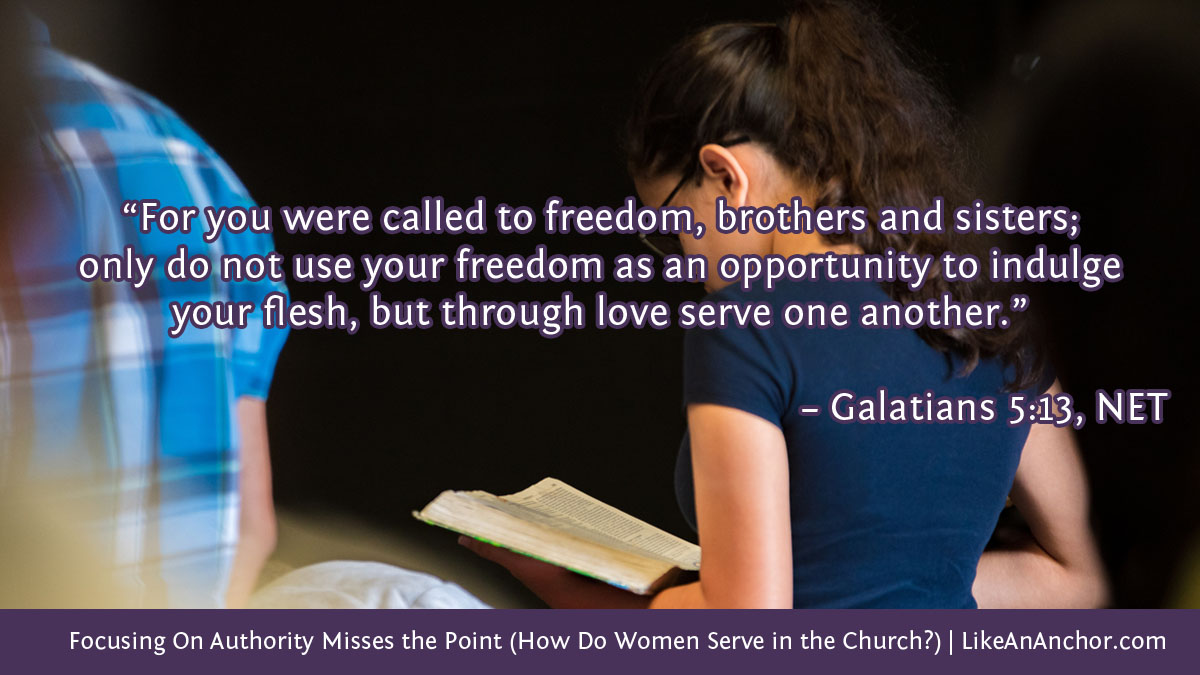
Image of a young woman standing in church reading the Bible overlaid with text from Gal. 5:13, NET version:  “For you were called to freedom, brothers and sisters; only do not use your freedom as an opportunity to indulge your flesh, but through love serve one another.”
Image by José Roberto Roquel from Lightstock

Who Can Serve and How?

Maybe instead of asking, “Can women have authority in the church?” we should ask, “Can women serve in the church?” The answer to that is a resounding “Yes!” supported by the examples of many women in the Old and New Testaments. What gets more to the heart of the original debate, though, is the question, “How do women serve in the church?” We have examples to answer that question as well. We know for certain that women in the Bible served God’s people in these ways:

There may even have been a woman apostle, Junia (Rom. 16:7), but her exact role is so hotly debated that I didn’t put “apostle” on my list (scholars pretty much agree that she was a woman, but not on whether the phrase used in this verse indicates she could have been an apostle). Clearly, women were heavily involved in the church, both in what we think of as “behind the scenes” roles and (apparently more rarely, though female prophets are relatively common) in the more public leading, serving, teaching, preaching roles. When God uses a woman to do something in scripture, we really can’t argue that the church shouldn’t allow women to do those same things today.

Things Women (Probably) Don’t Do

It’s worth noting some of the roles that we don’t see examples of women in. If we look at the lists of ministry gifts/roles in 1 Corinthians 12:28 and Ephesians 4:11, we see “first apostles, second prophets, third teachers, then miracles, gifts of healing, helps, gifts of leadership, different kinds of tongues” (1 Cor. 12:28, NET) and “some as apostles, some as prophets, some as evangelists, and some as pastors and teachers” (Eph. 4:11). Let’s use those lists as a guide for examining women’s possible roles in the church.

We might have one possible example of a woman as an apostle, but no specific examples of them as pastors (from the same Greek word translated “shepherd”) or evangelists (Greek word only used 3 times). However, “evangelist” is a title that comes from the Greek verb euaggelizo (G2097), “to bring good news” or preach the gospel (Thayer). It is likely that women did participate in that activity (Acts 8:1-4; Phil 4:2-3). We also don’t have specific examples of women performing miracles or healings. But we know for certain that women can be prophets, that women teach even if not called “teacher” as a title, that they fill helper roles, that they can have leadership-related gifts, and that those at Pentecost spoke in different languages just like the apostles and other men (Acts 1:14; 2:1-4).

It seems, then, that we can say women did not serve as pastors/shepherds in the Bible and that they were not typically apostles or evangelists. The only other church “authority” roles I can think of in the New Testament are elder, bishop/overseer, and deacon/servant. We have a concrete example of a woman as a deaconess/servant, but no women in the overseer role. “Elder” seems to refer to men most of the time, but the feminine version of the Greek word is used in 1 Tim. 5:2. I suspect that when “elder” is used to refer to respected older people in the church it often includes men and women, but when it’s used to refer to an ordained role in the church it typically or exclusively refers to men. That said, we also don’t have any verses directly saying, “women cannot be pastors.”

You might be uncomfortable with how ambiguous I’m being here, but it is deliberate. The need to have hard rules defining what women and men can and cannot do is a product of Western cultural mindset being applied to the Biblical text. We want specific and inflexible rules for things, but Eastern cultures (like those of Biblical writers) see rules differently: “rules apply except when the one in charge says otherwise. Westerners might consider this arbitrary; many non-Western Christians consider this grace” (Misreading Scripture With Western Eyes, Richards & O’Brien, p. 174). As an example, one of the authors of this book recounts a time when he was invited to speak to a group of pastors in Indonesia. He was shocked, knowing the group’s bylaws say pastors must be male, to see a few women in the audience. When he asked about it, he was calmly told, “Yes, and most of them are [male]” (p. 169). The Indonesian man he spoke with saw nothing strange about an exception to the rule. Perhaps Christians at the time Paul wrote Romans would have heard us say, “Women can’t be apostles,” and responded by saying, “That’s right, except for the times when they are apostles.”

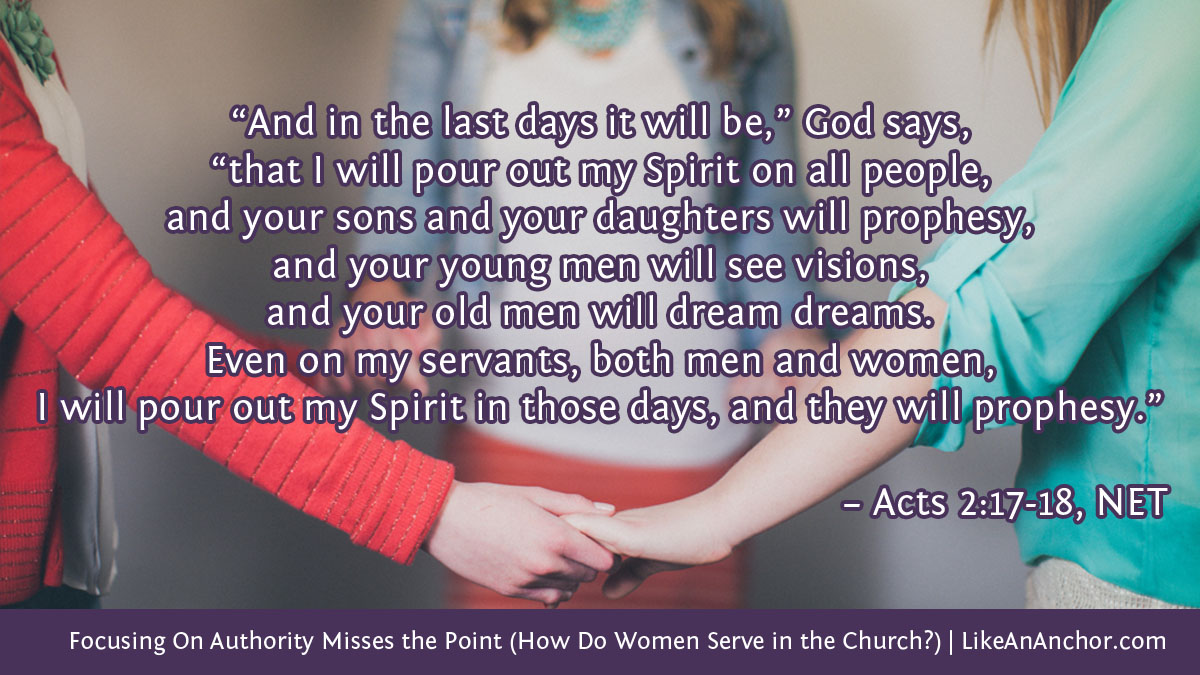
Image of three women holding hands to form a circle and pray, overlaid with text from Acts 2:17-18, NET version: “And in the last days it will be,” God says, “that I will pour out my Spirit on all people, and your sons and your daughters will prophesy,
and your young men will see visions, and your old men will dream dreams. Even on my servants, both men and women, I will pour out my Spirit in those days, and they will prophesy.”
Image by Pearl from Lightstock

But What About 1 Timothy 2?

Because we’ve been talking about authority, we need to address 1 Timothy 2:12, where Paul wrote, “I don’t permit a woman to teach, nor to exercise authority over a man” (WEB). Seems straightforward enough, until we start looking at the context and Greek words. Paul doesn’t use any of the typical words for authority here, but rather the incredibly rare word authenteō. This word may refer to wrongly used authority and/or could be connected to astrology practiced by some pagan women at the time, but it’s hard to say for sure since this is the only time it’s used in the Bible and it’s rarely used in contemporary writings (“The Strangeness of 1 Timothy 2:12,” Andrew Bartlett). Paul also uses a different phrase, “I don’t permit,” than he typically uses when laying down rules for the churches.

We also should take note of the fact that Timothy was in Ephesus when he received this letter, a church that Paul specifically brought Priscilla and Aquilla into and where he left them to serve (including teaching Apollos when they arrived [Acts 18:18-28]). It makes a whole lot more sense to interpret this as a prohibition against women usurping (KJV), dominating (ASV), or lording it over (TLB) a man (note that “man” is singular in the Greek, not the plural “men”) rather than a general rule that women never speak or have any authority, particularly given how involved some women were in ministry in the New Testament.

This analysis might seem pedantic or as if we’re trying to “get around” this scripture, but when you come across something in Paul’s writings that is hard to understand (and a lot of things are [2 Pet. 3:16-17]) we need to look at how it fits with the rest of scripture. Our interpretation of what he says has to match other things in the Bible. In this case, if scripture shows women consistently involved in various types of ministry work–including, occasionally, what we’d think of as “authority” roles like prophet or church host–then Paul’s words here can’t be a prohibition on women serving in the body of believers. It would go against precedent in the entire Bible–including Jesus’s radical treatment of women as equals and Paul’s own writings about how God views converted men and women on a cosmic scale (1 Cor. 11:11-12; Gal. 3:28)–if Paul were making a blanket declaration against women serving in the church. It is much more likely that he is telling Timothy not to let women in Ephesus do things that men wouldn’t be allowed to do either (e.g. lord it over others in the church or teach things related to astrology).

It seems very strange to me that we pull out a few isolated phrases Paul uses (1 Cor. 11:3; 14:34; 1 Tim. 2:12) and come up with this whole doctrine that women can’t ever teach, speak, or have public roles in the church. What about the whole rest of the Bible? What about how Jesus treated women? It seems just as misguided to me as those who take Paul’s statement, “you are not under law but under grace” (Rom. 6:14, NET) to mean that New Covenant Christians don’t have to obey God. We need to be careful about things like this, and test our assumptions (even if they’ve been assumptions for centuries of church history) to make sure they actually fit what God teaches through His word.

Motivated by Service and Humility

Image of two clasped hands, overlaid with blog's title text and the words, "When God uses a woman to do something in scripture, we really can't argue that the church shouldn't allow women to do those same things today. It’s not about who has authority; it’s about serving where God wants us to."
Image by Anggie from Lightstock

As we look at the roles we see women in the Bible filling or not filling, we need to be careful how we conceptualize authority related to those roles. The point isn’t to figure out who is most important (e.g. is it the male pastor or the female prophet?) but to serve God with the gifts He provides in the role He supplies. If God calls a woman to host the church in her home, that’s what she does. If He gives a woman the gift of prophecy, then she’s supposed to prophecy.

Likewise, if He chooses not to place women in the role of ordained pastor, elder, or overseer, that is God’s choice and the New Testament makes it seem like this is indeed the case (at least most of the time). Most men don’t fill those roles either; other roles are more commonly needed in the church. We’re not supposed to be jealous of or resent people who have roles that we think of as more authoritative than us any more than Jesus resents His Father for being greater than Him (to be clear, there is no resentment or competition between Jesus and the Father [John 10:29-30; Phil. 2:5-11]).

 Instead of being motivated by selfish ambition or vanity, each of you should, in humility, be moved to treat one another as more important than yourself. Each of you should be concerned not only about your own interests, but about the interests of others as well. You should have the same attitude toward one another that Christ Jesus had,

who though he existed in the form of God
did not regard equality with God
as something to be grasped,
but emptied himself
by taking on the form of a slave

Philippians 2:3-7, NET

No one in God’s church is supposed to seek authority roles for the prestige or the power. We should seek to serve with humility, the same way that Jesus modeled. In a healthy church following God’s lead, we’ll filter into the roles most suited to the gifts He has given us (ideally without doctrinal misinterpretation or other people’s “selfish ambition or vanity” blocking someone from what they’re supposed to be doing). It doesn’t always work that way because the church is composed of people–redeemed people working on becoming more like God, but still people who can make mistakes. We need to have patience with each other in that. For example, it is not wrong for me to want churches I’m involved with to let me exercise my teaching gifts (and other women to exercise their gifts), but it is wrong when I feel as if I deserve more recognition and responsibility than I get or when I resent other people who have the opportunity to use their gifts differently than I do.

Two of the things that we’re called to do is submit “to one another out of reverence for Christ” (Eph. 5:21, NET) and “through love serve one another” (Gal. 5:13, NET). We’re not called to seek authority or argue about who gets to be in charge. Ultimately, Jesus is the one in charge as head of the church (Eph. 1:22; Col. 1:18). The rest of us are here to serve in a variety of different capacities, but all of them characterized by encouragement, love, and humility (see, for example, John 13:35; 2 Cor. 1:24; Eph. 4:1-3; Col. 3:12-13). If we think any of this is about being in charge, claiming authority over others, or getting what we think we’re owed, then we’ve missed the whole point.


Featured image by Shaun Menary via Lightstock

Song Recommendation: “Way Maker” by Mandisa

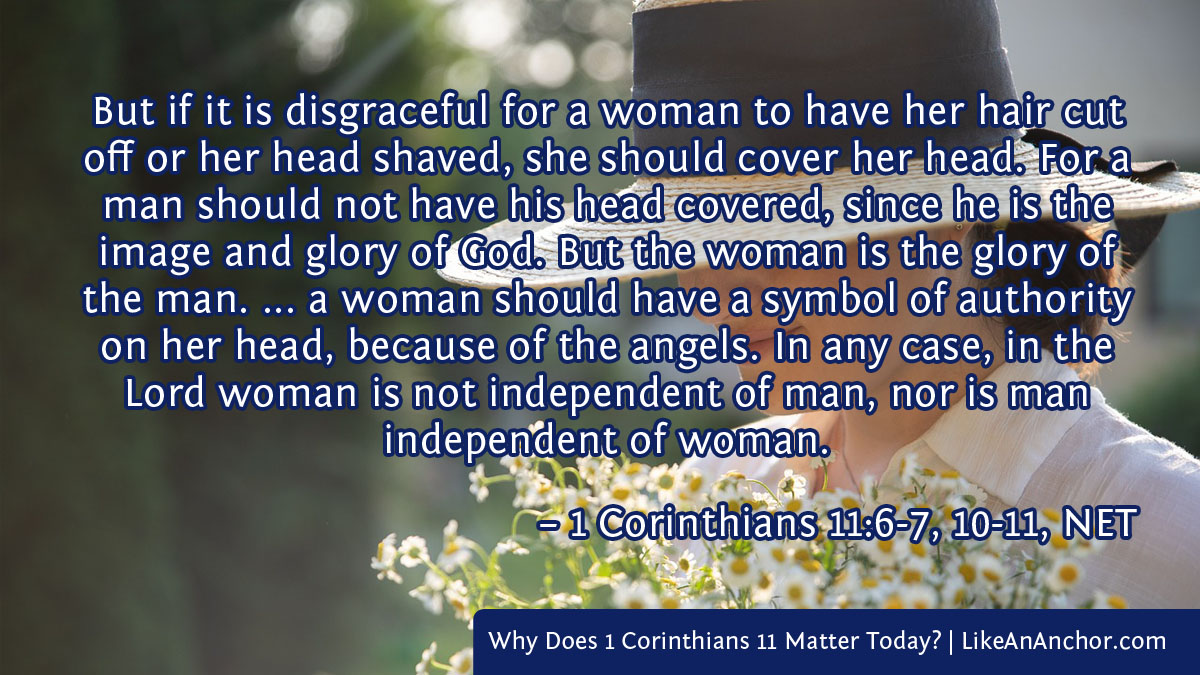
Why Does 1 Corinthians 11 Matter Today?

In the first letter we have that Paul sent to the Corinthians, he wrote to address some specific things. Firstly, there were serious issues in this church. They were divided, arguing, and following different human teachers. They also had a big issue with tolerating sin, even priding themselves on how forbearing they were toward a man in their congregation living and sleeping with his stepmother. Paul had to set them right, and he did so by comparing them to ancient Israel and explaining how the Passover and Festival of Unleavened Bread apply to the New Covenant church.

In the midst of all this, Paul also talked about proper conduct within a church community. One of those passages is labeled in the chapter and verse model of our modern Bibles as 1 Corinthians 11:1-16. It’s a passage most people skip over because it has to do with headcoverings and hair length for men and women. It’s the only place in the New Testament where this topic comes up, and it’s one that generates a lot of debate, offense, and division so we tend to ignore it completely. But we miss something important if we skip this passage, even if we don’t agree on how to interpret it.

The Headcovering Passage

People often approach this passage as just being about women’s headcoverings, but it’s addressed just as much to men. Paul opened this discussion by saying, “Be imitators of me, just as I also am of Christ” and praising the Corinthians for maintaining “the traditions just as I passed them on to you” (1 Cor. 11:1, 2, NET). He then made a statement about authority in the churches (the ecclesia, or called-out ones) of God.

But I want you to know that Christ is the head of every man, and the man is the head of a woman, and God is the head of Christ. Any man who prays or prophesies with his head covered disgraces his head. But any woman who prays or prophesies with her head uncovered disgraces her head, for it is one and the same thing as having a shaved head. 

1 Corinthians 11:3-5, NET

In my studies on this topic, I learned that culturally, Jewish men and women covered their heads with scarves or prayer shawls while Greek/Gentile men and women tended not to cover (though they could, mostly as a fashion choice). This passage would have involved a change for Jewish men as well as Gentile women. Men who covered their heads while praying needed to stop, and women who didn’t cover their heads while praying needed to start. Full disclosure, I do cover my head when at a church gathering or praying and studying at home. You can click here to learn more about why and the research I did into the topic.

Context For Paul’s Next Commands About Women

So why can’t we just skip over this divisive passage? For one thing, it’s part of the Bible and if we admit the Bible is the inspired word of God, then there is value in every part of it even if we’re not yet sure what to make of it. This is a significant reason to pay attention to 1 Corinthians 11:1-16, but it’s not the one that we’re going to focus on today. In this post, I want to focus on the important context clues this passage provides for interpreting other parts of the letter.

As the letter continued, Paul covered instructions for keeping Passover correctly (1 Cor. 11:17-34), spiritual gifts and unity in the body (1 Cor. 12), the “more excellent way” of agape love (1 Cor. 13), the use of prophecy or “inspired speaking” in the church (1 Cor. 14:1-25), and proper, orderly conduct during a church meeting (1 Cor. 14:26-40). Paul didn’t address the topic of women again directly until chapter 14, but since he started out this part of the letter by addressing how men and women properly pray and prophecy in the church (men with their heads uncovered, women with their heads covered), we can assume the discussions about keeping Passover, having spiritual gifts and using them properly, and love are addressed equally to men and women in the church. The NET even uses the phrase “brothers and sisters” when Paul addresses believers, because the whole church group is included when Paul uses the word “brethren” (adelphoi in Greek). We all have key roles to play, and very similar responsibilities and gifts.

Then, we come to a place where Paul again addressed women and men separately, with different instructions for each. It’s one of the infamous passages about women being silent in church.

What should you do then, brothers and sisters? When you come together, each one has a song, has a lesson, has a revelation, has a tongue, has an interpretation. Let all these things be done for the strengthening of the church. … Two or three prophets should speak and the others should evaluate what is said. … For you can all prophesy one after another, so all can learn and be encouraged. Indeed, the spirits of the prophets are subject to the prophets, for God is not characterized by disorder but by peace.

As in all the churches of the saints, the women should be silent in the churches, for they are not permitted to speak. Rather, let them be in submission, as in fact the law says. If they want to find out about something, they should ask their husbands at home, because it is disgraceful for a woman to speak in church.

1 Corinthians 14:26, 29, 31-35, NET

If you read Paul’s statement about women being silent by itself, it sounds like women shouldn’t say a word the whole time they’re at a gathering of believers. This doesn’t make sense in the context of other scriptures, which show women were deeply involved in the churches. This is where 1 Corinthians 11 can provide much-needed context to help us figure out what Paul is likely saying in this passage.

“In light of 11:2-16, which gives permission for women to pray or prophesy in the church meetings, the silence commanded here seems not to involve the absolute prohibition of a woman addressing the assembly. Therefore (1) some take be silent to mean not taking an authoritative teaching role as 1 Tim 2 indicates, but (2) the better suggestion is to relate it to the preceding regulations about evaluating the prophets (v. 29). Here Paul would be indicating that the women should not speak up during such an evaluation, since such questioning would be in violation of the submission to male leadership that the OT calls for (the law, e.g., Gen 2:18).”

NET study note on 1 Cor. 14:34

Whether you think women should cover their heads today or not, the fact is that 1 Corinthians 11 addresses the proper way for women to pray and/or prophecy. Obviously women can, and frequently do throughout the scriptures, pray and prophecy outside of church meetings. But the context of this section of scripture is how to do things in the churches, when believers are gathered together, as for a formal church service. It follows, then, that Paul talks about how women can properly pray and prophecy in church in 1 Corinthians 11, then addresses a time when silence is more appropriate in 1 Corinthians 14.

Culture Adds More Context

It also helps to take the cultural context into account when looking at Paul’s writings. Now, there are right and wrong ways to do this. Sometimes, people say that Paul just had a backwards view of women because he was influenced by his culture and so we don’t need to listen to him anymore. But in reality, some of his writings indicate he was pretty radical compared to the culture of his day.

Likewise the women are to dress in suitable apparel, with modesty and self-control. Their adornment must not be with braided hair and gold or pearls or expensive clothing, but with good deeds, as is proper for women who profess reverence for God. A woman must learn quietly with all submissiveness. But I do not allow a woman to teach or exercise authority over a man. She must remain quiet.

1 Timothy 2:9-12, NET

We read this today and we might feel offended that he’d say women have to be quiet and submissive and can’t teach. People of Paul’s day, though, would have read “a woman must learn” and been shocked by that. This statement “was a radical and liberating departure from the Jewish view that women were not to learn the law” (NET footnote on 1 Tim. 2:12). Some Jewish girls received Torah instruction while they were young and if they had a good family they might have learned a little more, but women weren’t generally taught very much and they certainly weren’t selected for advanced study with respected rabbis.

Jesus’s interactions with women as spiritual equals was unusual, and Paul continued His practice. He also assured his readers, though, that women serving in the church, preaching the gospel, and learning God’s words did not mean that women were suddenly going to start taking over roles that God entrusted to men. Women are to learn, yes, but they will also be submissive in the sense that God expects. Women can pray and prophecy, but they won’t (or shouldn’t) be disrupting church meetings or usurping male roles.

We often miss it today with our modern perspectives, but Paul isn’t advocating for either the subjugation of women or for doing away with gender roles in 1 Corinthians and 1 Timothy. It’s actually a more balanced view than we often find in churches today, which in many cases either try to follow society in doing away with different roles for men and women entirely, or follow traditional (mis)interpretations of Paul that bar women from being involved. However you interpret the passage on hair length and headcoverings, it provides much-needed context assuring us that women were deeply involved in the New Testament church and they still can be in the churches today.


Featured image by StockSnap from Pixabay

Song Recommendation: “This Girl” by Lauren Daigle

The Women At Pentecost: Valuing The Contributions of Unnoticed People In Church

We’re in the midst of the countdown to Pentecost, which this year falls on May 28 (just one week before my wedding!). Last weekend, I woke up very early Saturday morning and as I lay there staring toward the ceiling, Acts 1 and 2 started running through my head. I thought about all the women who were there at that first Pentecost after Jesus’s death, and I felt a need to write about them. And if you wake up at 4:00 am with a fully-formed Bible study idea in your head, it doesn’t seem right to just ignore it. I didn’t know where the study was going until I was polishing it up yesterday morning, but as you’ll see this isn’t just about women.

There were actually quite a few people there at that first New Covenant Pentecost, but we usually focus only on Peter and those listening to his sermon. To take note of the other people there, we need to do some close reading. Let’s begin in the first chapter of Acts. Here, Jesus spoke with his eleven remaining disciples before ascending to heaven and told them, “Do not leave Jerusalem, but wait there for what my Father promised, which you heard about from me. For John baptized with water, but you will be baptized with the Holy Spirit not many days from now” (Acts 1:4-5, NET). We pick up the story after they return to Jerusalem.

 When they had entered Jerusalem, they went to the upstairs room where they were staying. Peter and John, and James, and Andrew, Philip and Thomas, Bartholomew and Matthew, James son of Alphaeus and Simon the Zealot, and Judas son of James were there. All these continued together in prayer with one mind, together with the women, along with Mary the mother of Jesus, and his brothers.

Acts 1:13-15, NET

They were there “together with the women.” It’s plural, so there were more women there beyond Mary the mother of Jesus. We know it was “a gathering of about 120 people” (Acts 1:16, NET), but we don’t know who most of those people were or how many of those gathered were women. It’s interesting too see there are women there, but it shouldn’t be surprising; Jesus spoke with and included women throughout His ministry.

The next order of business was to appoint someone to take Judas Iscariot’s place as the 12th apostle. “The lot fell on Matthias” (Acts 1:26, WEB), and then they all continued waiting for Pentecost. Let’s jump back into the story at the start of chapter 2.

Now when the day of Pentecost had come, they were all together in one place. Suddenly a sound like a violent wind blowing came from heaven and filled the entire house where they were sitting. And tongues spreading out like a fire appeared to them and came to rest on each one of them. All of them were filled with the Holy Spirit, and they began to speak in other languages as the Spirit enabled them.

Acts 2:1-4, NET

There’s a chance that the “all” and “each of them” spoken of here only refers to the 12 apostles, but I don’t think that’s the case. There is no mention of the remaining 120 disciples leaving the gathering. And just because it’s “Peter, standing up with the eleven” (Acts 2:14, WEB) who addresses those in Jerusalem that questioned this miracle doesn’t mean there’s no one else there. In fact, by using a prophecy from Joel to explain what’s going on, Peter indicates that the “all with one accord” who received the spirit “on each of them” did include women and unmentioned men as well.

But this is what was spoken about through the prophet Joel:

And in the last days it will be,’ God says,
that I will pour out my Spirit on all people,
and your sons and your daughters will prophesy,
and your young men will see visions,
and your old men will dream dreams.
Even on my servants, both men and women,
I will pour out my Spirit in those days, and they will prophesy.
And I will perform wonders in the sky above
and miraculous signs on the earth below,
blood and fire and clouds of smoke.
The sun will be changed to darkness
and the moon to blood
before the great and glorious day of the Lord comes.
And then everyone who calls on the name of the Lord will be saved.

Acts 2:16-21, NET (bold italics are a quote from Joel 2:28-32)

God’s gift of the Holy Spirit was poured out on sons and daughters; on both men and women. This isn’t a revolutionary concept, but it’s amazing how many people throughout the years have overlooked women’s inclusion in the church as prophets and servants. I wrote last year about Christian women in the 17th century arguing for the right to teach using many of the same arguments I still use today to defend my ability to write this blog.

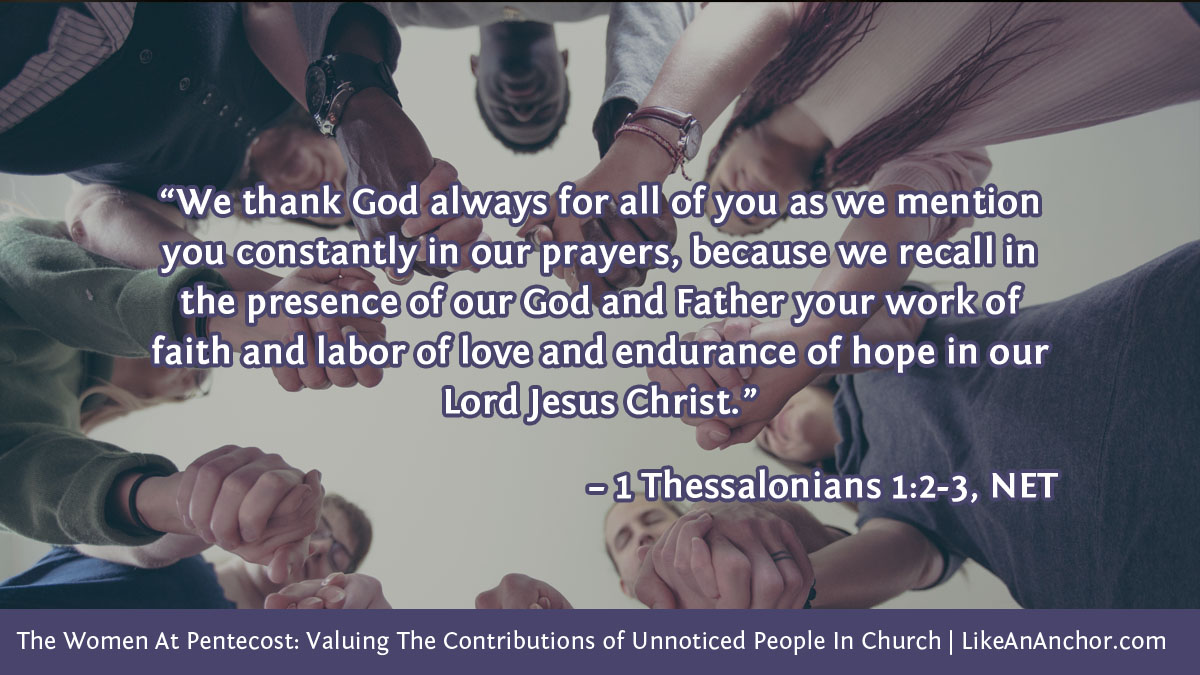
Image of a people holding hands and praying in a circle overlaid with text from 1 Thes. 1:2-3, NET version: “We thank God always for all of you as we mention you constantly in our prayers, because we recall in the presence of our God and Father your work of faith and labor of love and endurance of hope in our Lord Jesus Christ.”
Image by Claudine Chaussé from Lightstock

Women in Acts

As the book of Acts continues, we see women intimately involved in the early church. The apostles continued preaching, and “More and more believers in the Lord were added to their number, crowds of both men and women” (Acts 5:14, NET). When Philip shared “the good news about the kingdom of God and the name of Jesus Christ, they began to be baptized, both men and women” (Acts 8:12, NET). When prominent women in a city began following Jesus, it was worth writing down in the Acts account (Acts 17:4, 12). Some of the believing women were mentioned by name, including Tabitha who “was full of good works and acts of mercy which she did,” “Lydia, a dealer in purple cloth,” and “a woman named Damaris” (Acts 9:36; 16:13-15; 17:33-34).

Some of the women took an active role in preaching the gospel. Lydia, whom we’ve already mentioned, provided a safe place for believers to rest and gather (Acts 16:14-15, 40). Priscilla and her husband Aquila worked together to share God’s word (Acts 18:2, 18-19, 26; Rom. 16:3). “Philip the evangelist … had four unmarried daughters who prophesied” (Acts 21:9, NET). And they’re just a few examples of the women who speak in scripture.

Just as women participated in the early church as disciples, servants, and teachers, so they had a share in the hardships as well. When persecution arose, Saul “dragged off both men and women and put them in prison” and asked for letters granting him permission to keep searching other cities “if he found any who belonged to the Way, either men or women, he could bring them as prisoners to Jerusalem” (Acts 8:3; 9:2, NET). Saul (who later became the apostle Paul) certainly thought the believing women were just as involved in this “new” religion as the men. Evidently he didn’t change his mind about that later, since Paul’s letter to Rome highlighted women who served in the church congregation (Rom. 16:1-7).

And you know what? There are a lot of “overlooked” men here in Acts as well; it’s not just women who might disappear into the background of the stories. We have records of “crowds of both men and women” converting to the faith and Paul dragging unnamed men and women to prison, but most of these men don’t show up joining the ranks of the apostles or mentioned as key teachers. There were a lot of people who don’t make it into the Bible accounts by name, but that doesn’t mean God didn’t notice them or that they didn’t play key roles in their local church gatherings.

God is Not Unjust

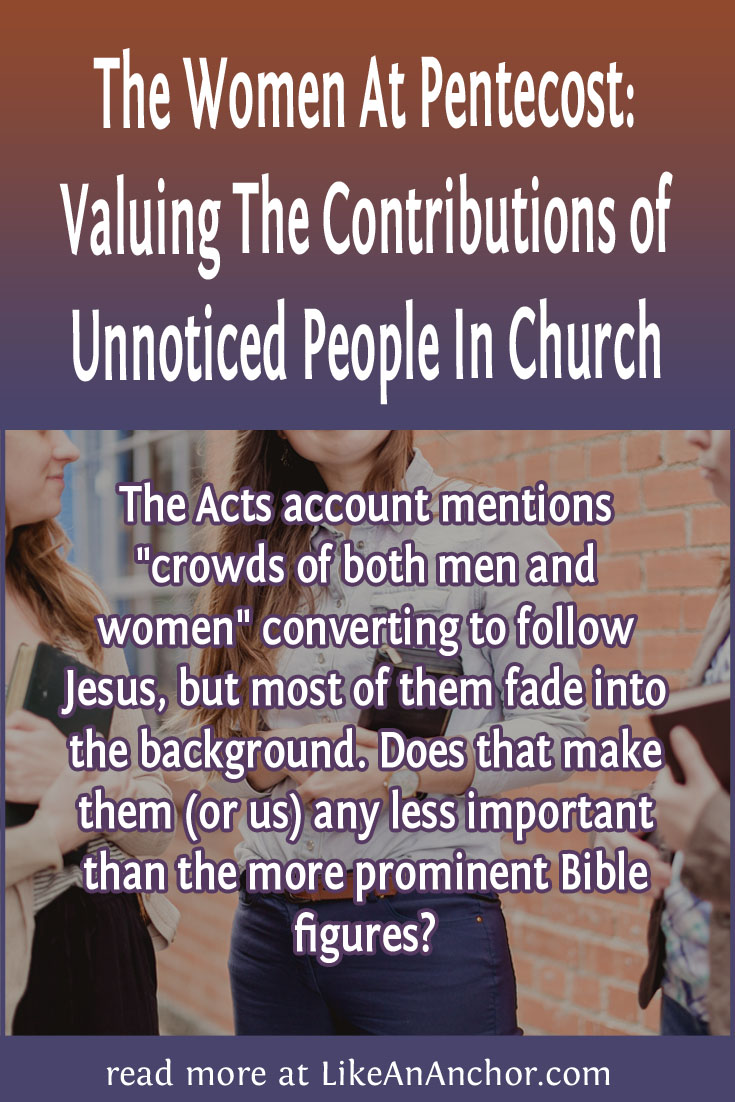
Image of a couple women holding Bibles with the blog's title text and the words, "The Acts account mentions "crowds of both men and women" converting to follow Jesus, but most of them fade into the background. Does that make them (or us) any less important than the more prominent Bible figures?"
Image by Shaun Menary from Lightstock

When I began this post, I wasn’t sure what my concluding point for this post should be; just that I needed to write and share it. However, as I kept pondering and praying about it I realized it isn’t just about women. What I’m taking away from this reflection is to remember that God values, notices, and involves the people who seem to fade into the background behind someone who’s more famous and gregarious like Peter (1 Cor. 1:18-31). They’re there, they matter, but they only occasionally show up later in other accounts as people teaching and serving in church.

For God is not unjust so as to forget your work and the love you have demonstrated for his name, in having served and continuing to serve the saints. But we passionately want each of you to demonstrate the same eagerness for the fulfillment of your hope until the end, so that you may not be sluggish, but imitators of those who through faith and perseverance inherit the promises.

Hebrews 6:10-12, NET

As I write this final section, I’m realizing this is a message for everyone in the church who doesn’t do the showy things. It’s for those who quietly run the sound system and go unnoticed unless something goes wrong. It’s for those who set things up before services start and put things away after others go home. It’s for those who quietly visit widows during the week. It’s for those who don’t serve in a role with a title, but show up every week to “rejoice with those who rejoice, weep with those who weep” and contribute to the community with their faithful presence.

God doesn’t forget this sort of service because He’s not unjust. If we wish to imitate Him in being Just, we also will not forget the people who serve like this nor undervalue the hidden or “little” ways that we ourselves serve.


Featured image by José Roberto Roquel from Lightstock

Song Recommendation: “City on the Hill” by Casting Crowns

What if the Proverbs 31 Woman Was Less Intimidating?

When I’m in a group of church ladies and someone mentions the Proverbs 31 woman, there’s often a collective groan. She’s such a high standard of Biblical womanhood that she seems intimidating–like we’ll never measure up to something like her and even suggesting we should is a scary thought. But is that really why she’s here at the end of Proverbs? To make us feel bad about ourselves or to show us exactly what a godly woman looks like? Maybe there’s a way that we can find her encouraging rather than threatening.

I will be addressing this post mostly to the women reading, and using words like “we” throughout. I apologize to the guys this leaves out. I hope you might still find some value in reading this, though. Perhaps you’ll think of it next time you read Proverbs, or the Proverbs 31 woman comes up in conversation, or one of the women in your life is feeling discouraged.

Translating Chayil

When we first start reading about the Proverbs 31 woman, we see a question. In the familiar King James it reads, “Who can find a virtuous woman?” (Prov. 31:10, KJV). I wrote about the translation choice here years ago in a post called “Mighty Women.” The Hebrew word translated “virtuous” is chayil (Strongs H2428). According to the Theological Wordbook of the Old Testament, this word basically means “strength,” which leads to translations like “power,” “might,” “valiant,” “army,” and “wealth” depending on how the word is used in context. Chayil is used of God’s power about 20 times, and of “valiant men,” “able men,” or “mighty men of valor” about 85 times (TWOT, 624a). Now look at how the word is translated in the KJV when used of women:

And now, my daughter, fear not; I will do to thee all that thou requirest: for all the city of my people doth know that thou art a virtuous woman. 

Ruth 3:11, KJV

A virtuous woman is a crown to her husband: but she that maketh ashamed is as rottenness in his bones. 

Proverbs 12:4, KJV

Who can find a virtuous woman? for her price is far above rubies … Many daughters have done virtuously, but thou excellest them all. 

Proverbs 31:10, 29, KJV

Now, to be fair, “virtue” originally meant “force; strength; vigor; moral strength” (Online Etymology Dictionary). However, by the 1590s (before the 1611 release of the KJV), it had taken on the meaning of “especially (in women) ‘chastity, sexual purity.'” The KJV translators only used “virtue” for chayil when it’s used for women. Modern translations often opt to soften the sex-based translation choice by using “worthy,” “noble,” and occasionally “valiant” in these verses (see Ruth 3:11; Prov. 12:4; 31:10, 29 in WEB and NET).

Fixing the translation probably doesn’t make her any less intimidating of a role model, though. “Virtuous” carries some historical baggage, but noble, worthy, and valiant are still high standards to live up to. I find the more accurate translation a little more inspiring, though. And maybe clarifying how to translate chayil is a good starting point for approaching the whole Proverbs 31 passage differently than we may have in the past.

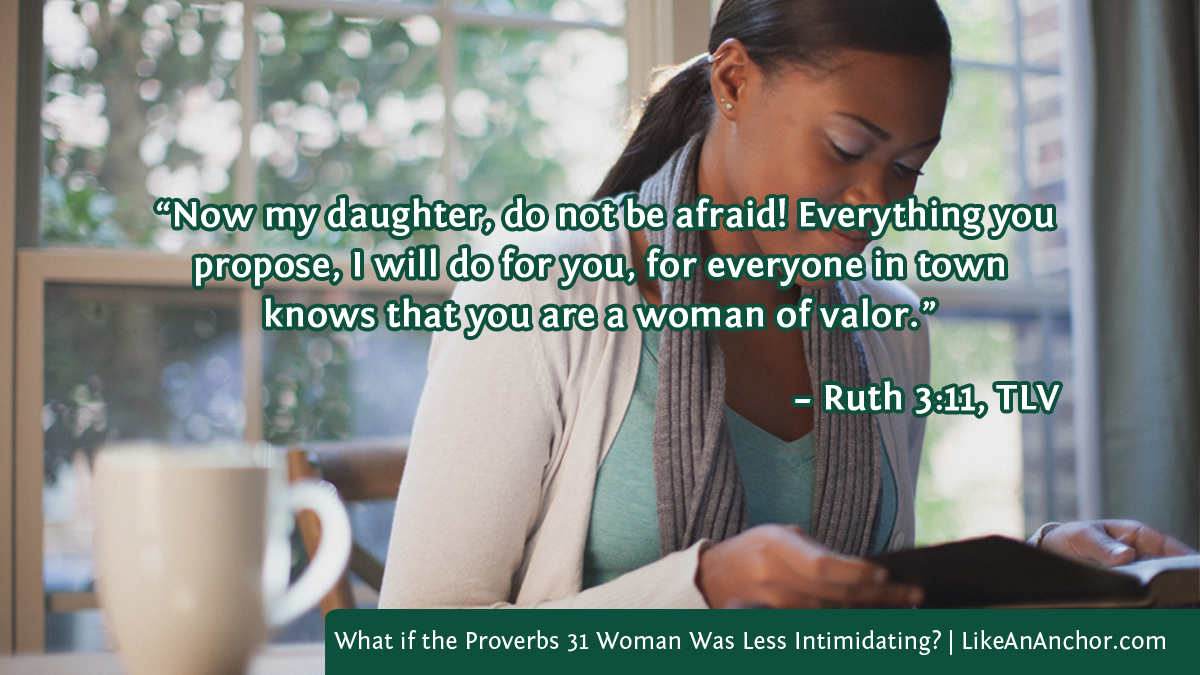
Image of a woman reading a Bible overlaid with text from Ruth 3:11, TLV version: "Now my daughter, do not be afraid! Everything you propose, I will do for you, for everyone in town knows that you are a woman of valor.”
Image by Pearl from Lightstock

A Mother’s Advice

It had been a while since I’d read through Proverbs, but not long ago I found myself back there reading Proverbs 31. (I think it was for one of the scripture writing studies our ladies’ group is doing at church.) This was the first time I’d read it since I’d started thinking about planning a wedding. I was also reading it, I think for the first time, in the NET translation. I’ll just quote the whole passage here so we can look at it together:

1 The words of King Lemuel, an oracle that his mother taught him: …

10 Who can find a wife of noble character?
For her value is far more than rubies.
11 Her husband’s heart has trusted her,
and he does not lack the dividends.
12 She has rewarded him with good and not harm
all the days of her life.
13 She sought out wool and flax,
then worked happily with her hands.
14 She was like the merchant ships;
she would bring in her food from afar.
15 Then she rose while it was still night,
and provided food for her household and a portion to her female servants.
16 She considered a field and bought it;
from her own income she planted a vineyard.
17 She clothed herself in might,
and she strengthened her arms.
18 She perceived that her merchandise was good.
Her lamp would not go out in the night.
19 She extended her hands to the spool,
and her hands grasped the spindle.
20 She opened her hand to the poor,
and extended her hands to the needy.
21 She would not fear for her household in winter,
because all her household were clothed with scarlet,
22 because she had made coverings for herself;
and because her clothing was fine linen and purple.
23 Her husband is well-known in the city gate
when he sits with the elders of the land.
24 She made linen garments then sold them,
and traded belts to the merchants;
25 her clothing was strong and splendid;
and she laughed at the time to come.
26 She has opened her mouth with wisdom,
with loving instruction on her tongue.
27 Watching over the ways of her household,
she would not eat the bread of idleness.
28 Her children have risen and called her blessed;
her husband also has praised her:
29 “Many daughters have done valiantly,
but you have surpassed them all!”
30 Charm is deceitful and beauty is fleeting.
A woman who fears the Lord—she makes herself praiseworthy.
31 Give her credit for what she has accomplished,
and let her works praise her in the city gates.

Proverbs 31:1, 10-31, NET

I like starting with the beginning of chapter 31 because that clarifies the context for this passage. This whole chapter is advice from a mother to her son. It’s about the type of woman he should want to marry and how highly he ought to value that woman.

That’s an important piece of information. It clarifies that the stated purpose of this passage is not to say, “Here’s the type of woman that all women should be.” We can use Proverbs 31:10-31 as an example of a good woman who follows the Lord, but it’s not a prescriptive list for everyone. It’s also specifically about married women; there are aspects which can relate to singles but not the whole thing.

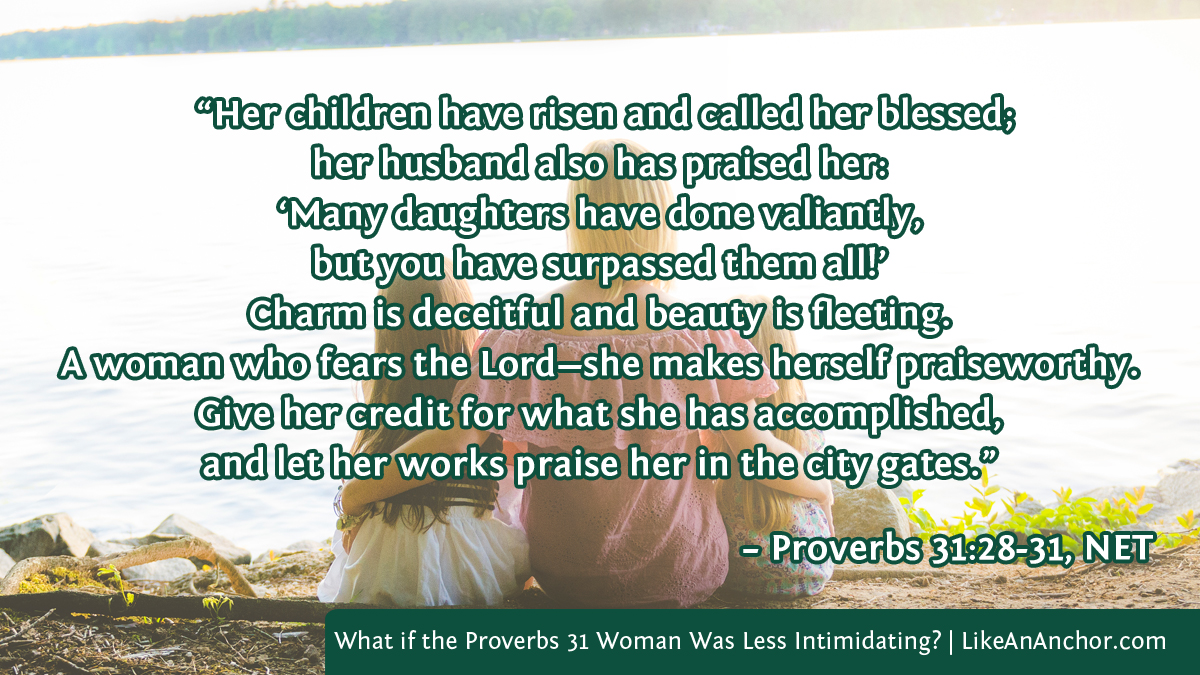
Image of a woman with her arms around two little girls overlaid with text from Proverbs 31:28-31, NET version: “Her children have risen and called her blessed; her husband also has praised her: ‘Many daughters have done valiantly,
but you have surpassed them all!’
Charm is deceitful and beauty is fleeting. A woman who fears the Lord—she makes herself praiseworthy. Give her credit for what she has  accomplished, and let her works praise her in the city gates.”
Image by David Clark Photography from Lightstock

Qualities of the Proverbs 31 Wife

As I read through the description of the Proverbs 31 wife, it seems like many of the specific descriptions could be summed up in general character traits. For example, “She perceived that her merchandise was good … She made linen garments then sold them, and traded belts to the merchants” shows us that she makes quality things and sells them. If we’re going to model her behavior, we don’t need to craft clothing; we need to do something productive with our time and make sure the things we’re producing are good quality. Here are the other qualities that stand out to me while reading:

  • Chayil–noble, strong, valiant
  • Trustworthy
  • Industrious and hardworking
  • A provider for her family and those working for her
  • Creator of quality goods, which she sells
  • Generous to the poor and needy
  • Fearless because she’s prepared
  • Wise and able to instruct
  • God-fearing
  • Accomplished, and given credit and praise for those accomplishments

Depending on when and where you grew up, you might have been told women shouldn’t work a job or get an education. You might have felt like your accomplishments should be hidden lest you appear too intelligent, too proud, or too intimidating. But the exact opposite is happening here.

King Lemuel’s mother supports the idea of a wife who works a job (specifically, her own business that she runs from her house while also caring for her family), manages and invests her own money, has wisdom and knowledge that she teaches to others, and who is publicly praised for her accomplishments. And that’s the kind of woman that she tells her son he should hope to find in a wife. (Perhaps the person who said no Christian guy would marry me after I got my bachelor’s degree should reread this chapter.)

We’re All Still Growing

Image of three women holding Bibles and talking with the blog's title text and the words "Becoming a valiant woman of strength, virtue, and courage is a process. The Proverbs 31 woman isn’t a standard to judge you against, but a friend you can imitate as you grow."
Image by Shaun Menary from Lightstock

When I read the Proverbs 31 woman passage most recently, I realized I didn’t find her all that intimidating. I wanted to mimic her, but in a good way rather than like I was under a weight of pressure. I want to be a wife for my soon-to-be husband who improves his life by being with him. And this passage reassures me I can do that with my talents, gifts, accomplishments, and knowledge.

Also, as I read this passage, I remember that God calls people “perfect” as long as they’re following Him and working toward perfection. Maybe the same is true here. If you’re working on following the Lord and growing as a woman of noble character, then perhaps you too can be described in the glowing terms of praise used here. I know many women–my mother, ladies at church, friends–who I’d say line up with this description of the Proverbs 31 woman pretty much exactly even though I know they’d say they’re far from perfect.

Reading passages like this, where we’re given an ideal to strive toward, should inspire us to keep doing our best and keep growing. Remember, our goal is “to build up the body of Christ, until we all attain to the unity of the faith and of the knowledge of the Son of God—a mature person, attaining to the measure of Christ’s full stature.” (Eph. 4:12-13, NET). That doesn’t all happen at once, and that’s okay. There’s a reason the Christian life is described as one of growing and building. It’s a process, and becoming a valiant woman of strength, virtue, and courage is no exception to that rule. So maybe next time you read Proverbs 31, think of her not as a standard to judge you against, but as a friend you can imitate as you grow.


Featured image by Shaun Menary from Lightstock

Song Recommendation: “Overcomer” by Mandisa

Helper: One Way Women Reflect God’s Image

There’s an infamous verse in the King James Version of the Bible with phrasing that sets some people’s teeth on edge. Here, God says, “It is not good that the man should be alone; I will make him an help meet for him.” We’ve sometimes read this as “help-meet” as if it’s all one word and is somehow demeaning women as nothing more than an assistant or something. Really, though, “help” and “meet for him” are two separate words and they mean something different than you might htink.

“Help” comes from the Hebrew word ezer, which we’ll be spending most of our time with in this study. “Meet for him” is an old Englishy phrase that means comparable to or suitable for. It’s from the Hebrew word neged, which speaks of something conspicuously placed before someone, as well as something beside or parallel to something else (Theological Wordbook of the Old Testament [TWOT] 1289a; Brown-Driver-Briggs H5048). For example, God commanded “read this law before all Israel in their hearing” (Deut. 31:11, WEB) once every seven years during the Feast of Tabernacles. His law is important, and so He wanted it placed before His people to regularly remind them of what to focus on.

Setting negad aside for now, let’s go back to the word translated “helper.” The really interesting thing about the word ezer is that with just one exception, it’s only used to describe women and God. The word shows up 21 times in the Hebrew Bible. Twice it’s used in Genesis 2 to describe women. Once it refers to God scattering away anything else His people might try to rely on for help (Eze. 12:14). All the other times, ezer describes God.

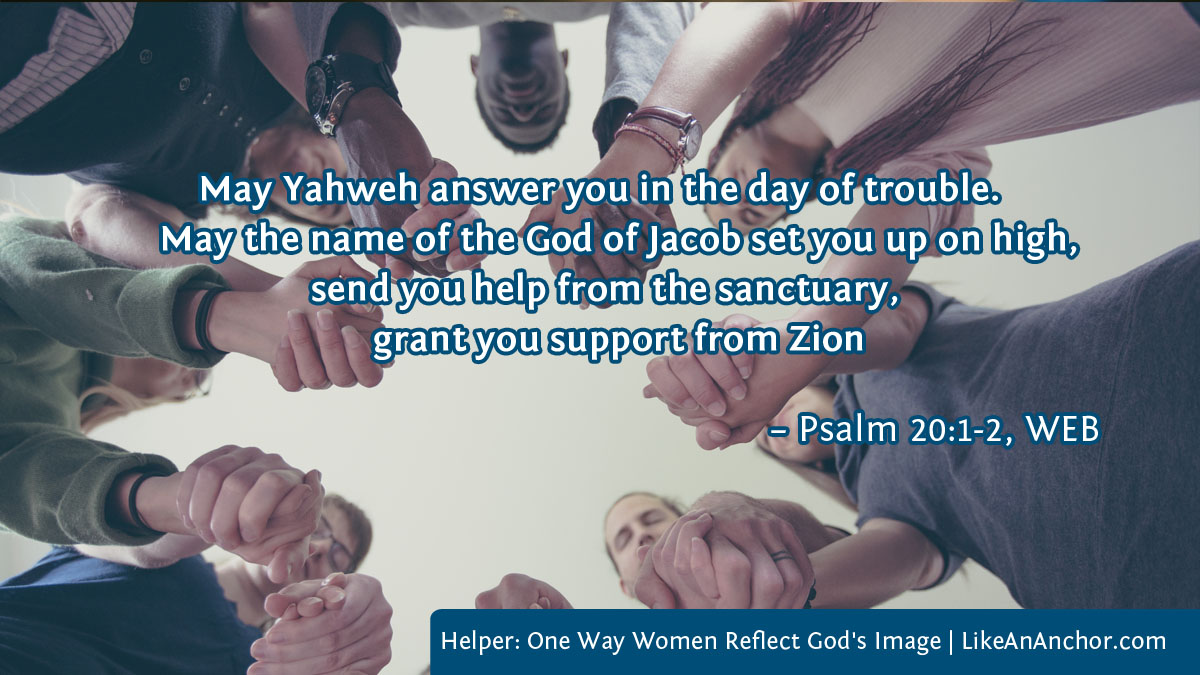
Image of people holding hands and praying, with text from Psalm 20:1-2, WEB version: "May Yahweh answer you in the day of trouble. May the name of the God of Jacob set you up on high, send you help from the sanctuary, grant you support from Zion"
Image by Claudine Chaussé from Lightstock

Reflecting God’s Image

Right from the get-go, God makes it clear that He created both man and woman in His image. Though God is consistently described as masculine, both men and women bear His image and reflect who He is. We also have the same spiritual potential as “fellow heirs of the grace of life” (1 Pet. 3:7, NET).

Then God said, “Let us make humankind in our image, after our likeness, so they may rule over the fish of the sea and the birds of the air, over the cattle, and over all the earth, and over all the creatures that move on the earth.”

God created humankind in his own image,
in the image of God he created them,
male and female he created them.

Genesis 1:26-27, NET

In addition to being made in God’s image, we’re also supposed to grow into reflecting His character. We don’t look or act exactly like God right now, but He wants us to in the future (1 John 3:1-3). God the Father wants us “to be conformed to the image of his Son” and “put on the new man who has been created in God’s image—in righteousness and holiness that comes from truth” (Rom. 8:29 Eph. 4:24, NET). We’ve “borne the image of the man of dust”–we’re human, just like Adam and Eve– and now we should “also bear the image of the man of heaven” (1 Cor. 15:49, NET).

One of our main goals as Christians is to become like God the Father and Jesus Christ. We’re already like them in a few ways since we’re made in their image, but we’re supposed to become more and more like them the longer we’re in a covenant relationship with them. Studying God’s character traits helps us understand Him better and it also helps us understand what we’re supposed to be like.

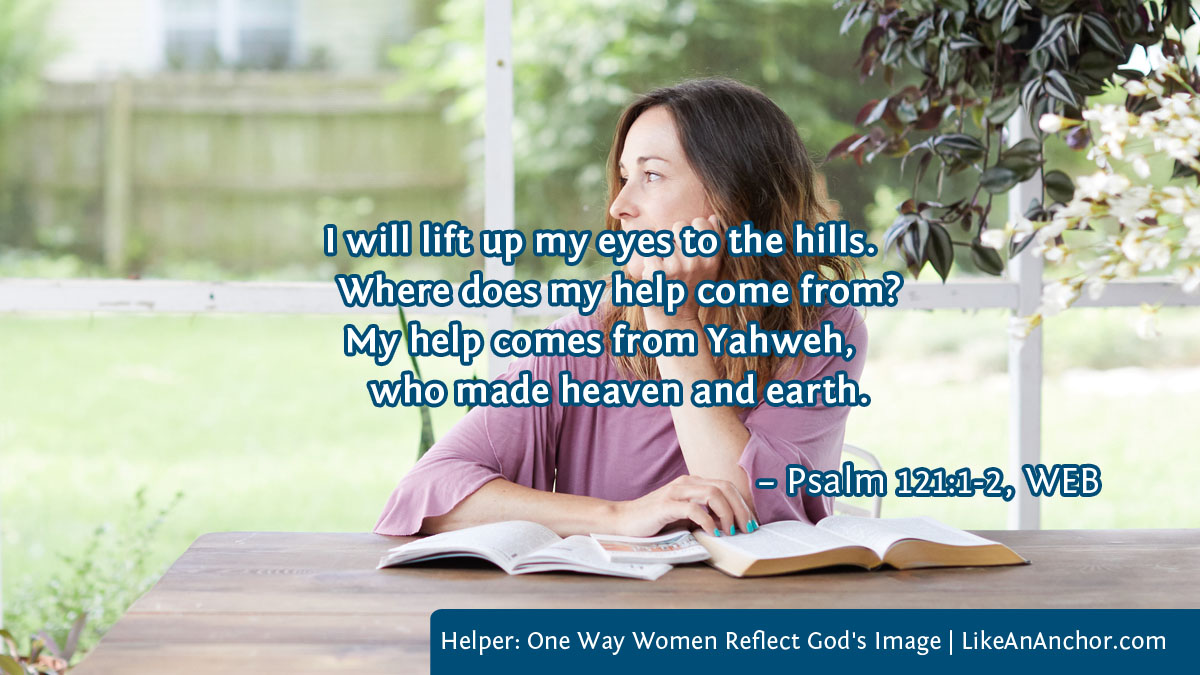
Image of people holding hands and praying, with text from Psalm 121:1-2, WEB version: "I will lift up my eyes to the hills. Where does my help come from My help comes from Yahweh, who made heaven and earth."
Image by Prixel Creative from Lightstock

The Lord As Our Helper

Most of the 21 uses of ezer are found in the Psalms . Here, the writers talk about God as their help. Often, He’s described as help and shield. He shows up as a helper when we need a deliverer to protect and save us.

Our soul has waited for Yahweh.
He is our help and our shield.

Psalm 33:20, WEB

But I am poor and needy.
Come to me quickly, God.
You are my help and my deliverer.
Yahweh, don’t delay.

Psalm 70:5, WEB

You who fear Yahweh, trust in Yahweh!
He is their help and their shield.

Psalm 115:11, WEB

There’s a lot of martial imagery here. It makes sense; the root word for ezar “generally indicates military assistance” (TWOT 1598). Yahweh is our shield and deliverer. The connection between helper and battle is even more pronounced when God describes Himself to Israel as “your help.” All of us who are honest will admit we need help, particularly the sort of help God provides. And look at what a powerful sort of help this is:

“You are happy, Israel!
    Who is like you, a people saved by Yahweh,
    the shield of your help,
    the sword of your excellency?
Your enemies will submit themselves to you.
    You will tread on their high places.”

Deuteronomy 33:29, WEB

In addition to God’s role as help being linked with protecting and fighting, it’s linked with happiness. When He’s talking to His people, He says they are a happy “people saved by Yahweh, the shield of your help” (Deut. 33:29, WEB). When they turn away from Him, He tells them, “You are destroyed, Israel, because you are against me, against your help” (Hos. 13:9, WEB). If we go against God, our help, then we face destruction. But when we stay close to Him, we’re safe and happy (Ps. 146:5).

Image of a smiling woman with her hand raised in worship with text from Psalm 146:5, WEB version: "Happy is he who has the God of Jacob for his help, whose hope is in Yahweh, his God"
Image by Pearl from Lightstock

Deborah’s Example

If we were just reading those verses that talk about God as help, shield, sword, and protector, we’d likely link ezer with God as a Warrior and assume helper is a masculine role. But God uses it for women at creation (Gen 2:18, 20). It’s not used to describe human beings in a positive way again, but we can’t dismiss this verse lightly. This is how God describes His intention when creating women. We weren’t afterthoughts because He forgot to create a female version of the human animal. No! He carefully sculpted man in His own image, then carefully sculpted woman from man (also in His own image).

We don’t usually think of women in the Bible as offering military assistance. One notable exception is Deborah, so let’s take a look at how she modeled God’s image as a help to those around her. You’ll find her story in Judges 4-5. She led Israel when King Jabin of Canaan was oppressing Israel. He’d been a problem for 20 years before God called someone to do something about it.

Now Deborah, a prophetess, the wife of Lappidoth, judged Israel at that time. … the children of Israel came up to her for judgment. She sent and called Barak the son of Abinoam out of Kedesh Naphtali, and said to him, “Hasn’t Yahweh, the God of Israel, commanded, ‘Go and lead the way to Mount Tabor, and take with you ten thousand men of the children of Naphtali and of the children of Zebulun? I will draw to you, to the river Kishon, Sisera, the captain of Jabin’s army, with his chariots and his multitude; and I will deliver him into your hand.’”

Barak said to her, “If you will go with me, then I will go; but if you will not go with me, I will not go.”

She said, “I will surely go with you. Nevertheless, the journey that you take won’t be for your honor; for Yahweh will sell Sisera into a woman’s hand.” Deborah arose, and went with Barak to Kedesh.

Judges 4:4-9, WEB

Deborah and Barak went to war together, along with 10,000 men. It doesn’t look like she strapped on armor and fought, but she was there to help. King Jabin’s military commander Sisera met them with 900 chariots and an unnamed number of other fighters described as “all the army.” Israel won the battle decisively. Only Sisera escaped, and then only for a short time. He took shelter in Jael’s tent since he knew her husband had a peace treaty with Jabin, and Jael killed him by driving a tent peg through his head. Deborah and Barak’s victory song celebrates Jael for her military assistance (though I recommend not following her model today if you’d like to help someone). Also in this song, we learn more about Deborah’s role.

Warriors were scarce;
they were scarce in Israel,
until you arose, Deborah,
until you arose as a motherly protector in Israel.”

Judges 5:7, NET

There are some questions about how to translate this section, but it looks like Deborah arose as a leader and protector in Israel to fill a gap when other warriors and rulers were scarce. God used her as a help that the whole nation needed.

Women As Helpers

Image of two women's clasped hands with the blog's title text and the words "r we aid someone facing a spiritual battle, encourage someone to keep going, or stand up for what's right, we're modeling God's role as 'help.'"
Image by Jantanee from Lightstock

What about us today? Deborah is an Old Testament example, and the idea of women as leaders, protectors, and warriors might not seem like it shows up in the New Testament at first glance. But there’s actually quite a bit of evidence for women teaching, leading, and protecting in the church. Paul mentions several at the end of his Romans letter.

Now I commend to you our sister Phoebe, who is a servant of the church in Cenchrea, so that you may welcome her in the Lord in a way worthy of the saints and provide her with whatever help she may need from you, for she has been a great help to many, including me.

Greet Prisca and Aquila, my fellow workers in Christ Jesus, who risked their own necks for my life. Not only I, but all the churches of the Gentiles are grateful to them. Also greet the church in their house. Greet my dear friend Epenetus, who was the first convert to Christ in the province of Asia. Greet Mary, who has worked very hard for you. Greet Andronicus and Junia, my compatriots and my fellow prisoners. They are well known to the apostles, and they were in Christ before me.

Romans 16:1-7, NET (emphasis added)

Here, Paul mentions four women who played a key role in the church. Phoebe was “a great help to many” in her role as a servant or possibly a deaconess (“servant” here is the same word that’s translated “deacon” in 1 Tim. 3:8, 12). Prisca, also called Priscilla, and her husband worked alongside Paul, hosted a church, and taught God’s way accurately (Acts 18:2-3, 24-26; 1 Cor. 16:19). Mary worked hard enough for the church that Paul noted her in this letter. Junia is a prisoner for her faith, just like Paul was at this time. The Greek wording used here is ambiguous; either the apostles took note of her or she was considered an apostle (Misreading Scriptures with Western Eyes, p. 172).

We could turn to other examples as well, but that seems sufficient to show that women in the New Testament still help in powerful ways. In addition, we’re involved with fighting spiritual battles, just like every follower of God throughout history. For both men and women, you’re a warrior even if you never pick up a physical sword or strap on armor. God puts His own armor on you and arms you with the Shield of Faith and the Sword of the Spirit. Whenever we aid someone facing a spiritual battle, encourage someone to keep going, or stand up for what’s right, we’re modeling God’s role as a help.

Featured image by Jantanee from Lightstock

Song Recommendation: “Onye-Inyeaka (My Helper)” by Mr. M & Revelation (lyrics translation in comments on YouTube)

Women Who Speak In Scripture

One of the things I hoped for when I began a Master’s degree in Rhetoric and Writing at a Christian-founded university was that I’d get a chance to study some Biblical rhetoric. This semester, I’m taking classes on Classic and Contemporary rhetoric. In one of them, we read texts by women written during the Renaissance where they used rhetorical strategies to prove that women have a role in teaching scripture.

It was both fascinating (and a little discouraging) to read Sor Juana Inés de la Cruz using the exact same arguments to defend her ability to teach the scriptures in 1691 that I’ve used in the 21st century. I agree with her that when Paul calls for women to remain quite in church (1 Cor 14:34; 1Tim 2:12), his “prohibition applied only to public speech from the pulpit” not to writing or even to teaching (The Rhetorical Tradition, 2nd ed., p. 788). It’s absurd to think that Paul meant women should never speak or teach when he also gives instructions for how and when it’s appropriate for women to pray and prophecy in church (1 Cor. 11:1-16) and since he directly instructs women to teach other women (Titus 2:3).

Stepping away from Paul’s writings for a moment, we see examples of women speaking, leading, and teaching throughout scripture. Deborah, the Queen of Sheba, Abigail, Ester, Rahab, and Hannah are all mentioned by de la Cruz, and she could have added Miriam, Ruth, Huldah, Anna, Philip’s daughters, and Priscilla as well. We also read another text in my class from 1666 written by Margaret Fell–one of the earliest Quakers and a highly influential teacher. She points out that there’s no indication in scripture that the apostles despised or rebuked women like Priscilla for teaching (The Rhetorical Tradition, 3rd ed., p. 860). Furthermore, God Himself said that His daughters would prophesy (Acts 2:14-18), so who are human beings to say women should not speak when they’re inspired by the Lord?

Fell also points out something I hadn’t thought of before. Women’s words are recorded throughout scripture and men often base sermons on their words. Fell accused men in the churches of her day of hypocrisy in this area, saying, “you will make a Trade of Women’s words to get money by, and take Texts, and Preach Sermons upon Womens words; and still cry out, Women must not speak, Women must be silent; so you are far from the minds of the Elders of Israel” (The Rhetorical Tradition, 3rd ed., p.865). Even if ministers today aren’t profiting off their work the same way the priests Fell criticizes were, many will still use Biblical women’s words as a sound foundation for teaching while telling modern women not to teach.

Last week, I wrote about a woman from the Bible named Hannah in my post “What Potential Does God See In You?” She’s one of the women whose example and words–including her recorded prayer–are still used to teach people today. God saw her and regarded her with favor though she was initially judged harshly by the priest. And Hannah is far from being the only example of women whom God takes notice of and whom He gives a key role in His plan. Let’s look at some others today.

Huldah

King Josiah was one of the very few righteous kings in the years following David’s reign over Israel. He became king at just eight years old, and when he was 26 he asked his scribe to make sure the priests had the funds needed to repair the temple in Jerusalem (2 Kings 22; 2 Chr. 34). While working in the temple, the priests found a book of the Law. They read it to Josiah, and he tore his clothes in grief when he realized how badly his nation had strayed from following God. He told his advisers, “Go inquire of Yahweh for me, and for the people, and for all Judah, concerning the words of this book that is found.”

So Hilkiah the priest, Ahikam, Achbor, Shaphan, and Asaiah, went to Huldah the prophetess, the wife of Shallum the son of Tikvah, the son of Harhas, keeper of the wardrobe (now she lived in Jerusalem in the second quarter); and they talked with her.

She said to them, “Yahweh the God of Israel says, ‘Tell the man who sent you to me, “Yahweh says, ‘Behold, I will bring evil on this place, and on its inhabitants, even all the words of the book which the king of Judah has read. Because they have forsaken me, and have burned incense to other gods, that they might provoke me to anger with all the work of their hands, therefore my wrath shall be kindled against this place, and it will not be quenched.’” But to the king of Judah, who sent you to inquire of Yahweh, tell him, “Yahweh the God of Israel says, ‘Concerning the words which you have heard, because your heart was tender, and you humbled yourself before Yahweh, when you heard what I spoke against this place, and against its inhabitants, that they should become a desolation and a curse, and have torn your clothes, and wept before me; I also have heard you,’ says Yahweh. ‘Therefore behold, I will gather you to your fathers, and you will be gathered to your grave in peace. Your eyes will not see all the evil which I will bring on this place.’”

2 Kings 22:14-20, WEB

Though this group included the high priest, he didn’t ask God for advice directly. Prophets and priests had different roles–the priests served in the temple and a prophet or prophetess delivered God’s messages to people. At this time, the go-to person for making inquiries of God was a prophetess named Huldah. She delivered God’s message, and King Josiah listened (2 Kings 23:1-30). There was no question of whether or not God could speak through her because she was a woman; He simply did, and that was that.

Priscilla

The first time in the Bible that we hear of Priscilla and her husband Aquilia is when Paul went to Corinth (Acts 18). They were tentmakers like Paul, and so he stayed with them to practice his trade while he preached Jesus Christ. When Paul left, Priscilla and Aquilia went with him to Caesarea. They stayed in that region while Paul went on to preach in Galatia, and they were there in the city of Ephesus when Apollos showed up.

Now a certain Jew named Apollos, an Alexandrian by race, an eloquent man, came to Ephesus. He was mighty in the Scriptures. This man had been instructed in the way of the Lord; and being fervent in spirit, he spoke and taught accurately the things concerning Jesus, although he knew only the baptism of John. He began to speak boldly in the synagogue. But when Priscilla and Aquila heard him, they took him aside, and explained to him the way of God more accurately.

Acts 18:24-26, WEB

Here, both Priscilla and Aquilia explained the way of God. She was teaching alongside her husband. In his letters, Paul sends greetings to them both and describes them as his “fellow workers” (Rom. 16:3-4; 1 Co. 16:19-20; 2 Tim. 4:19). Not once does he tell Priscilla to stay silent or stop teaching and let her husband do all the talking. That’s particularly worth noting because sometimes people will argue that Paul’s instruction for women to be silent applies only to wives (the Greek word could be translated either way), but both Priscilla and Huldah were married when they acted as teacher and prophetess. The more evidence we look at, the clearer it becomes that silence for women is situational (e.g. they shouldn’t disrupt church services, and typically don’t hold public/authority roles in the church).

Thoughts for Further Study

There are so many more examples we could look at. We could go to Exodus 15 where Moses’s sister Miriam is called a prophetess. We could turn to Judges 4-5 and read about Deborah the prophetess, a judge and leader of Israel. We can read in 1 Samuel 25 of how Abigail’s words and actions turned King David away from vengeance. Or we could travel in the New Testament to Luke 2 where Anna the prophetess proclaims Jesus to those looking for redemption. Then we could go to Acts and read about Philip’s four daughters who prophesied. We can also look at the end of Paul’s letter to the Romans and see how many women he mentions helping forward the gospel including Junia, who is “notable among the apostles,” and Phoebe who is “a servant of the church in Cenchrea” (the word translated “servant” is the same as the one translated “deacon” in 1 Tim. 3).

One of the things I appreciated about both Sor Juana’s and Margaret Fell’s writings is that they were careful about how they used scripture. Rather than saying Paul was wrong or that his words could be dismissed as outdated, they argued from scriptures that Paul’s letters were misinterpreted. That misinterpretation led to hundreds of years of women needing to fight for the roles in modern churches which God already gave us in His Bible. Thankfully, women are far more fully involved churches today than they were several centuries ago. Even so, I still occasionally hear things like, “Is it okay for you to have a blog where you’re teaching? Women shouldn’t do that, you know.”

There are ways that God has different roles for men and women to play (see, for example, Paul’s words on how marriage pictures Christ and the church). This includes some differences in how they serve in the church. Women in the Old Testament didn’t serve as priests in the temple, but they did serve as prophetesses and they continued that role into the New Testament. And while we don’t see women spoken of as pastors or church leaders in the New Testament, they are clearly serving in the congregations and sharing the gospel. It makes sense that there’d be plenty of areas where our serving roles overlap. We’re all children of God and we’re all one in Christ Jesus (Gal. 3:26-28). God pours out His spirit on all of us alike, and gives us gifts and roles to serve and build up the church congregations (Acts 2:17; 1 Cor. 12).

Women have always been closely involved in God’s church and in His plan. They prayed, taught, sang, preached, and followed Jesus. In His time here on earth, He interacted with women as equals in a way that shocked His disciples (John 4:27). He included women in the gospel and pointed out that their actions should be recorded (Mark 14:3-9, for example). Women traveled with Him during His ministry, and they’re the ones He appeared to first after His resurrection and entrusted with taking the news to His disciples (click here to read that account across gospels). In Acts, women and men both received the gospel, got baptized, and endured persecutions together (Acts 5:14; 8:3, 12; 9:1-2; 17:4, 12). God even uses feminine imagery for the church as a whole, calling it calling it a Bride fully involved in serving alongside her Bridegroom, Jesus Christ. He doesn’t have a problem with women being fully involved in His church; He thinks it’s a good thing.


Want to study this subject further?

Download my free month-long scripture writing program, “Women Who Speak.”


Featured image by Ben White from Lightstock