Tall Ships

The Unicorn, Tall Ships Festival
The Unicorn

Last weekend, I had the opportunity to attend the Tall Ships Festival. I have loved ships for as long as I can remember. As a child, my mother and sister and I toured a reproduction of the Santa Maria, but since then the closest I’d been to tall ships has been seafaring stories, films, and paintings.

I love a good pirate story, or pretty much anything set on a ship in the 17th or 18th Centuries. Raphael Sabantini’s novels (which I highly recommend). James Fenimore Cooper’s Red Rover. Linda Chaikin’s Buccaneers series. Myriads of teen novels. Errol Flynn films. Pirates of the Caribbean (I suppose the setting more than anything else is why I’ve seen all four).

Though I rarely paint anymore, ships have been a reoccurring motif in my art for some time. Ships in the sky, on the ocean, surrounded by hostas, worked in relief on clay, and sailing through a psychological self-portrait. Strangely, I’ve never written a story with ships. Perhaps that will change now that I’ve been on board a ship.

There were eight ships at the festival, and we toured three: the Denis Sullivan, The Niagara, and The Unicorn. We didn’t leave the dock or see them under sail (that cost a lot more than we were prepared to spend), but it was so cool to be on the deck of a sailing ship and, in The Niagara’s case, below deck. I was surprised how short the space below deck was — I’m only 5′ 6″ and I had to bend over to walk around down there.

The Niagara, Tall Ships Festival
The Niagara

The Niagara  is a training ship used to preserve “the skills of square-rig seamanship.” You can pay to become a trainee on board the ship, learning the art of sailing hands-on for a minimum of three weeks. It costs a little more than I can afford while looking for a car (mine died about a month ago), but part of me wonders if putting up with the authentic/spartan living conditions would be worth it for the chance to go to “sea” (on the Great Lakes).

The Windy, Tall Ships Festival
The Windy

I’m not sure what make tall ships so appealing to me. Perhaps it is the romance of the sea and idea of adventure. Maybe its my obsession with water. Part of it could be the way the ships look, like so many old things they are elegant and beautiful as well as useful. Whatever the reason, I’m glad I had the chance to tour these ships and hope someday I’ll be able to actually sail on one.

Writing Heroines

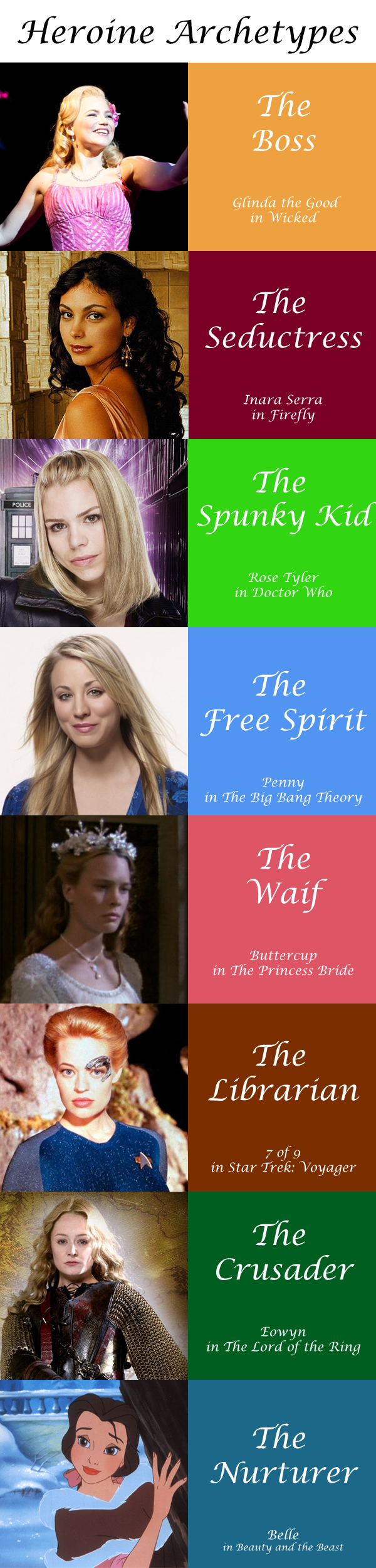
Last week, I wrote a post about the eight hero archetypes listed in The Complete Writer’s Guide to Heroes and Heroines: Sixteen Master ArchetypesI’ve used this book extensively since I discovered it in the library, and I’ve found it a great help in crafting dynamic characters. Characters I wrote before reading it even fit in the archetypes, which I’m taking as a sign that I was on the right track with character development. For these characters, the descriptions have helped me edit them to be stronger and more consistent.

If you’re a writer and you can find a copy of the book, I highly recommend using it. If not, here’s a brief overview of each description for the eight female archetypes. All the quotes below are from the descriptions in the book.

Heroine Archetypes

Heroine ArchetypesThe Boss

This is a strong, tough character who wants to win at all costs. Typically, such a character always got her own way growing up and wants that to continue. “She will shade the truth in order to gain her objective and she is not above manipulating circumstances to make things go her way.”

The Seductress

Assertive, strong, and clever, this type of character learned at a young age she could charm people into doing what she wanted. She is cynical, driven, manipulative. “Her true desires and motives are carefully concealed behind a sensual smile. Knowledge is power, so she makes sure no one knows her” and instinctively distrusts people.

The Spunky Kid

This is the “heroine underdog.” She has a sense of humor and is reliable, supportive, unassuming, and skeptical. Sometimes, she “hides behind her sarcastic wit, and her lack of confidence may make her play down her best attributes, but she is spirited, cheerful and the most loyal of friends.”

The Free Spirit

Sincere, upbeat, and imaginative, this type of character can also be impulsive, meddling, and undisciplined. They have a strong sense of individuality and never plan anything, but always seem to land on their feet.  She is a natural entertainer, and “may be a handful for anyone who has to deal with her, but she makes the experience worthwhile in her zany, high-spirited way.”

The Waif

This character is trusting, easily influenced, kind, and insecure. She inspires others to want to save her, and is generally content to let herself be rescued. “Her delicate fragility makes her an easy target … [and] she adapts to any situation she falls into without complaint.” You’re far less likely to see her in fiction of today than the other archetypes, but that does not mean she should be avoided.

There is something refreshing about a heroine who does not talk back or fight every battle, but rather, allows a man to be a man and believes that if left well enough alone, situations will resolve themselves.

The Librarian

This type of character likes to organize everything. She is efficient, serious, dependable, rigid, repressed, and a perfectionist. She assumes she has all the answers and, “more often than not, she is right, but she can be a bit stubborn about considering other opinions.” She is also portrayed as having a passionate side when she “lets her hair down.”

The Crusader

“This is a heroine in the truest sense — deeds of valor are right up her alley.” She is courageous, resolute, and persuasive. Her flaws include obstinacy, rashness, and being outspokenly opinionated. She wants to set the word straight and “has no faith in the intrinsic merit of human nature; no belief that all will end well if left alone.”

The Nurturer

A character of this type needs to be needed. She is optimistic, capable, idealistic, self-sacrificing, and willing to compromise so she won’t hurt anyone’s feelings. Before thinking of herself, “she makes sure that all her loved ones are happy and content … Her serene, capable and patient manner invariably soothes troubled souls or hurting hearts.”

Writing Characters

There are three approaches to using these archetypes to create characters. A character could be a “core archetype,” fitting into a singe archetype and remaining consistent through the course of the story. Characters can also evolve, changing from one archetype to another because of the events of the story. Layered characters have elements of two archetypes, which may take turns being dominant but will not change over the course of the story.

An example of evolving archetypes is the Beast in Beauty and the Beast, who changes from a Lost Soul into a Chief as a result of Belle’s nurturing character. Layered characters include MacGyver (Warrior and Professor), Eliza Doolittle in My Fair Lady (Waif and Spunky Kid), and Princess Leia (Boss and Crusader).

I hope you’ve enjoyed reading about these character types, and that it sparks an idea for your own writing (or at least provided some interesting reading while procrastinating from writing 😉 ).

Still No Oven / Hero Archetypes

Since I am still without an oven, I’m going to depart from my schedule and post something other than a recipe today. The repairman is supposed to come this afternoon so, in lieu of writing about food, I’m going to write about writing.

Over on MarisMcKay.com, I’ve been working on a series of blog posts about character archetypes. I’ve spent too much time on the accompanying images not to try and broaden the audience, so this post will be devoted to heroes and I’ll dedicate Monday’s post to heroines. While collecting the examples of each type, I noticed sci-fi/fantasy may be overrepresented, but that’s what I’m most familiar with and I’ve decided not to apologize for it.

This theory of character development is contained in a book titled The Complete Writer’s Guide to Heroes and Heroines: Sixteen Master Archetypes. The ideas are based on Jung’s theory of collective unconscious. He identified major archetypes that arise from memories of shared human experience and serve as models for personalities.  For this book, the authors suppose that

 At the very core of a character, every hero can be traced back to one of eight major archetypes, as can every heroine. The core archetype tells the writer the most basic instincts of heroes or heroines — how they think and feel, what drives them and how they reach their goals.

Hero Archetypes
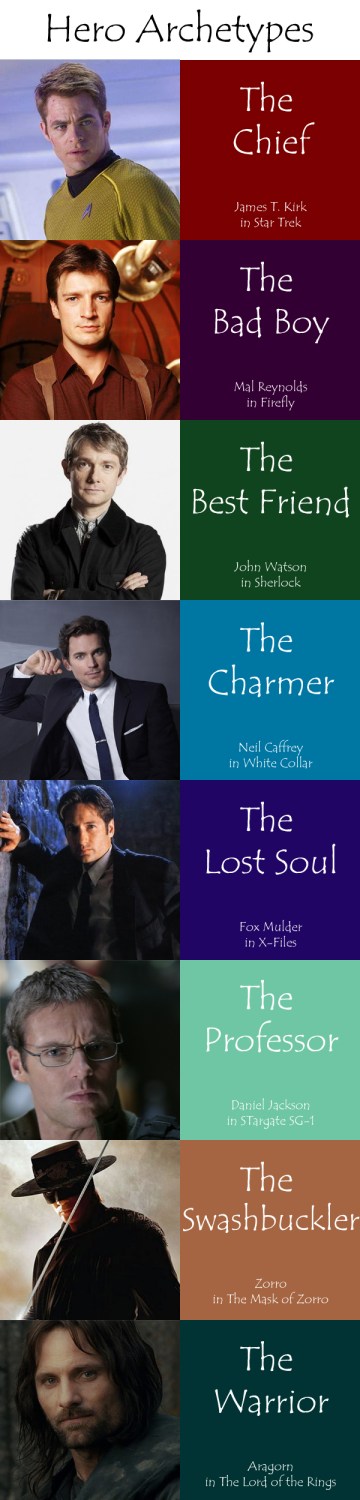
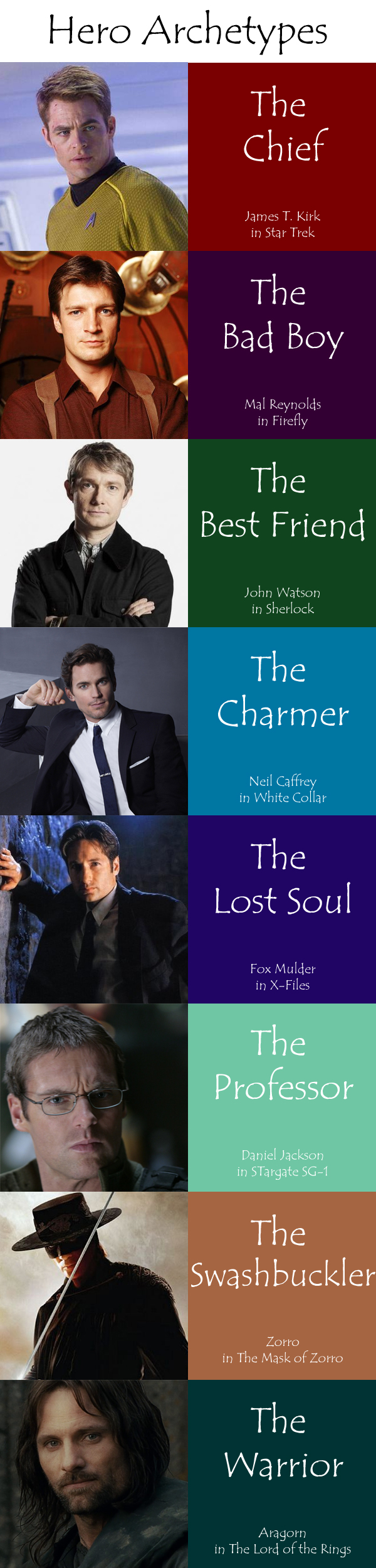
Eight hero archetypesThe Chief His major virtues are that he is goal-oriented, decisive, and responsible. He can also be stubborn, unsympathetic, and dominating. “He is a man who seizes control whenever possible. Active, dynamic, and strong-willed, he urgently needs to fix problems and produce results.” This type of character is not discouraged by challenge, and is typically a born leader or a conqueror type of character.

The Bad Boy This type is succinctly described as “every schoolgirl’s fantasy and every father’s nightmare.” He is typically charismatic, street smart, and intuitive, but is also pessimistic, bitter, and volatile. This character “struts into every room, daring one and all to knock the chip from his shoulder. … All his life, he has been pointed out as a bad example, so he does his best to maintain that reputation.”

The Best Friend “Decent, kind and responsible … He fits in everywhere and is universally liked. Whether he operates out of a sense of duty or genuinely enjoys giving of himself, he is always there.” His main virtues are stability, a supportive nature, and tolerance. His flaws are that he can be complacent, myopic, and unassertive.

The Charmer This is the likable rogue type who can “make you believe in fairy tales” but “is not always there in the ever-after”. He is creative, witty, and smooth, but also manipulative, irresponsible, and elusive.  “Exuding enormous charisma, he showers the people in his life with gifts of laughter and happiness. He is always fun, often irresistible, and frequently unreliable.”

The Lost Soul This character is devoted, vulnerable, discerning, brooding, unforgiving, and fatalistic. He is defined by an isolating event from his past. He “drifts through life with a heavy heart and a wounded spirit. He is dramatic, intriguing, and secretive. … This man has a poet’s voice, an artist’s creative genius, and a writer’s grasp on emotions.”

The Professor Some of my favorite characters — Daniel Jackson, Spock, Sherlock Holmes — share this type. They are “used to being the smartest man in the room,” are experts in their field, and can be absent minded or highly organized. They are analytical and genuine, but also insular, inhibited, and inflexible.

The Swashbuckler This character is an explorer or a daredevil,  fearless and foolhardy. He is exciting but unreliable, capable of finding a solution to any problem, but selfish in pursing his goals. “He loves to leave his mark on every exploit, so he chooses the most rash and flamboyant method of achieving his aim. Impulsive and creative, this man lives for the next adventure.”

The Warrior Tenacious, principled, and noble, this character type is compelled to see justice done. They can be self righteous, relentless, and merciless with their enemies. A character of this type “believes evil cannot go unpunished. He cannot allow the bad guys to walk away, so trouble seems to follow him wherever he goes.” He defends the weak and is the perfect protector.

Writing With Archetypes

I’ve found this book helpful in coming up with ideas for strong characters. For one character, who was disappearing into the background of my finished novel, it’s helped me flesh him out so much that the sequel will be his story. He is a Warrior, and I’m going to layer on some Lost Soul characteristics to make him even more unique.

There is a wide variety within each type, so even if you don’t combine them there is plenty of room for character development. As the writers of this book said, Henry Higgins from My Fair Lady is a chief, like Captain Kirk, but you wouldn’t want him commanding a Starship. If you’re a writer and you can find a copy (the book is out of print, so I use one from the library), I highly recommend this resource.

So Much Cooler Inside

Like many introverts (and a goodly number of extroverts, if some of my friends are any indication), I have an active imagination and “a rich inner life.” I’m daydreaming most of the time, even when it’s not readily apparent. I do let my musings out sometimes, here on this blog and over on my Pinterest boards, for example. The fact that I’m more comfortable expressing myself this way than in person reminds me of Brad Paisley’s song “Online,” except I’m telling the truth online and often masking my real self when I meet people in person. (Watch the music video if you haven’t yet — William Shatner is in it.)

This image by Gene Mollica makes me wonder how many fantastic things people hide behind their masks.

But even my online persona isn’t as “cool” as the me that stays inside my head. She joins the fellowship of the ring, travels with The Doctor, serves as an exopsychologist on the starship Enterprise, rules the world with Peter the Hegemon (if you don’t get this reference, you’re not reading enough Orson Scott Card), moves to a lake-side yurt to write books, marries Prince Charming, and adopts a couple of kids (just not all at the same time).

I spend a large (unreasonable?) amount of time thinking, daydreaming, and imagining. Sometimes I wonder if there’s something wrong with me — why don’t I spend more time making my real life interesting instead of constructing fantasies? As a fiction writer, I can call some of it research and story plotting, but I wouldn’t have to be in the stories myself if that were entirely the case. And I can only think of two such daydreams which have become full-fledged stories that can stand on their own.

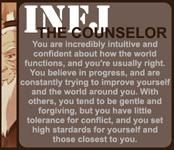
INFJs hate conflict
Things You Should Know About INFJs

Partly because I spend so much time in my head, I often wonder what people think of me in real life. For someone who picks up on other people’s emotions intuitively, you’d think this would be easy. But I get so nervous when I think I’m under scrutiny that it’s hard to get past my own emotions enough to pick up on what other people think (unless their emotions are negative, in which case it’s time to flee the room). And then it’s easier to hide out in my head than spend time with “real” people, and the whole cycle begins all over again.

Well, I’m off to write a post for a different blog while talking over the direction of a novel with a couple of my characters (in my head of course — I’m sure my family would start worrying if such conversations were carried on out-loud).

Fairy Tales

I love fairy tales. When I was little, my exposure to fairy tales was mostly through Disney films (my favorite is Beauty and the Beast, just in case anyone is wondering). I started seriously reading fairy tales just a few years ago, when my favorite English professor loaned me a collection of Celtic Fairy Tales. Since then, I’ve read all the Brothers Grimm tales, many of Andersen’s fairy tales, more Celtic folklore, and collections of French fairy tales including Perrault’s writings.

I’ve been reading some of C.S. Lewis’s essays collected in the book “Of Other Worlds.” I’ve enjoyed reading his fiction (Narnia and the Space Trilogy), as well as Mere Christianity, so it was nice to get insight into his mind and writing process. For the blogt I wrote to post on my writing website tomorrow (yes, I write under a pen name), I turned to one of these essays for inspiration. I liked writing it so much, that I decided to post it here as well.

C.S. Lewis on Children’s Writings

By tracking down a quote on Pinterest, I came across C.S. Lewis’s essay “On Three Ways of Writing For Children” (full text online here). Though I don’t write specifically for children, I like to think that my fantasy novels would appeal to (and be appropriate for) some young people. After all, I can’t be the only child who was reading Jules Verne by age 10 and searching for other stories of the fantastic.

The essay becomes most interesting to me when Lewis addresses the question of what kinds of stories are worth reading as children. Since he wrote children’s fantasy — not because he set out to write for children, but “because a children’s story is [sometimes] the best art-form for something you have to say” — he spends much of the essay defending fairy tales.

If I have allowed the fantastic type of children’s story to run away with this discussion, that is because it is the kind I know and love best, not because I wish to condemn any other. But the patrons of the other kinds very frequently want to condemn it. About once every hundred years some wiseacre gets up and tries to banish the fairy tale. Perhaps I had better say a few words in its defence, as reading for children.

Just as when Lewis was writing (in 1952), modern parents have been banning classic fairy tales. Hansel and Gretle and Little Red Riding Hood are not read because they are “too scary,” but there are other reasons as well. More than 50% of parents wouldn’t “read their kids Cinderella because the heroine spends her days doing housework. Many felt that this theme of female domesticity didn’t send a good message.” The politically incorrect word “dwarves” disqualifies Snow White from polite society. Rapunzel’s kidnapping and imprisonment is “too dark” a theme (actually, it is darker than they think– in the Grimms version she’s not actually kidnapped. Her father gives her to a witch to save his own life).

Whether or not to read fairy tales (and which ones to read) to children is a choice that will vary from parent to parent and also depends on the child. There are plenty of fairy tales I wouldn’t read to a very young or sensitive child (like The Little Mermaid, where she is in agony the entire time she has legs and dies at the end). But on the whole, I tend to agree with Lewis when he said,

Since it is so likely that they will meet cruel enemies, let them at least have heard of brave knights and heroic courage. Otherwise you are making their destiny not brighter but darker. Nor do most of us find that violence and bloodshed, in a story, produce any haunting dread in the minds of children. As far as that goes, I side impenitently with the human race against the modern reformer. Let there be wicked kings and beheadings, battles and dungeons, giants and dragons, and let villains be soundly killed at the end the book. Nothing will persuade me that this causes an ordinary child any kind or degree of fear beyond what it wants, and needs, to feel. …

It would be nice if no little boy in bed, hearing, or thinking he hears, a sound, were ever at all frightened. But if he is going to be frightened, I think it better that he should think of giants and dragons than merely of burglars. And I think St George, or any bright champion in armour, is a better comfort than the idea of the police.

As a child who was deeply afraid of things that go bump in the night, I can wholeheartedly support Lewis’s claim that a “bright champion in armour” is a far better comforter than the police. And if my mind had not been filled with fairy tales, fantasy, and knights in shining armor I would never have dreamed up Jamen and Karielle or Bryant and Aelis (who now live in my in-progress and finished novels) or invented Ves’endlara.

Which fairy tales would you read, or not read to children? As an adult, do you enjoy reading fairy tales?

God’s Love Story — PDF online

For this cause shall a man leave his father and mother, and shall be joined unto his wife, and they two shall be one flesh. This is a great mystery: but I speak concerning Christ and the church. - Ephesians 5:31-32The final version of what I’m going to call an “e-booklet” is now online. You can download “God’s Love Story” and read a chapter outline at this link.

Here are a couple excerpts. This first is from the introduction.

One reason we gravitate towards tales of heroism, rescue, and love is that there is a basic need in our souls for a relationship with God and His Son. Stories where the handsome prince rides up and rescues the fair princess speak to our longing to know the Prince of Peace, Who laid His life down to rescue His bride from captivity to sin. Jesus Christ is the most powerful, most loving, and most perfect hero-lover to ever exist, far surpassing even the most ambitious human attempts to fashion a story’s hero. The Bible is a living, dynamic book that includes instruction, history, prophecy, and a revelation of the plan of God which reads like a story. My personal theory as to why the Bible reads like a story is because our idea of what makes a good story comes from the sequential narrative God uses to reveal His plan.

This paragraph is from a discussion in Chapter 5 about the Greek words translated “love.”

While agape is a higher kind of love, I think there is something amazing in recognizing that it is not the only love God has towards us. Before His crucifixion, Jesus told His disciples that after His resurrection, “ye shall ask in My name: and I say not unto you, that I will pray the Father for you: for the Father Himself loveth you, because ye have loved Me, and have believed that I came out from God.” (Joh. 16:26-27). The Father has phileo for those who have phileo for His son. This means the Father Himself has common interests and friendship with those who love and believe in His Son. In this context, it is certainly not a lesser love than agape. Philos is an incredible kind of love to share with the creator of the universe.

I hope those of you who choose to download and read the full e-booklet find it edifying and encouraging. I would love to hear your feedback.