
There are a few verses in the New Testament that tell us we “are not under the law” (Rom. 6:15; Gal. 5:18). Though some use this as permission to act however you want so long as you’ve confessed Jesus, most Christians realize that God’s commandments are still in effect. Jesus did not come “to destroy the law or the prophets … but to fulfill” (Matt. 5:17, WEB), and Paul said his own writings “establish the law” rather than repeal it (Rom. 3:31, WEB).
So why do these passages tell us we’re not under the law? I’ve heard many explanations, and touched on some myself, but none of them really answered the question of why Paul would use this phrase. They focused more on trying to say “that’s not really what he meant” than on trying to figure out why Paul chose these words to argue his point. Recently, though, I came across the best analysis of the phrase “not under the law” that I’ve ever seen. It was just a short passage in a little book called Fill These Hearts: God, Sex, and the Universal Longing by Catholic writer Christopher West.
Freed from Bondage to Sin
In Fill These Hearts, West writes about our desires, saying that we can either deny them and go on a “starvation diet,” indulge them in this life like “fast food,” or direct them toward God and partake in His “banquet gospel.” When addressing the idea of freedom in relation to desire, he says,
The Apostle Paul writes that those who “are led by the Spirit .. are not under the law” (Gal. 5:18). They’re free from the law — not free to break it (that’s license); they’re free to fulfill it because they don’t desire to break it. Christ didn’t come into this world to shove laws down our throats. He came into the world to align the desires of our hearts with the divine design so we would no longer need the laws
West, Fill These Hearts, p. 140
This isn’t just West’s own particularly theory; it’s a solid reading of the Biblical text. Basically, he’s just summarizing in modern English what Paul was explaining in Galatians 5 and putting the phrase “not under the law” in its proper context.
This verse in Galatians is preceded by a discussion of two covenants. The Old Covenant is described as one that “gives birth to bondage” (Gal. 4:24, NKJV). When the people broke that covenant, they bought a death penalty on themselves. Jesus paid the price of that broken covenant and freed us from sin with His sacrifice, then mediated and established the New Covenant (Heb. 8:6).
Stand firm therefore in the liberty by which Christ has made us free, and don’t be entangled again with a yoke of bondage
Galatians 5:1, WEB
Paul is telling us that if we go back to studiously keeping every aspect of the law as if that will save us “Christ will profit you nothing … You are alienated from Christ, you who desire to be justified by the law. You have fallen away from grace” (Gal. 5:2, 4, WEB). We can’t treat the Old Covenant as our way to salvation. That does not, however, grant license to sin.
For you were called to freedom, brothers and sisters; only do not use your freedom as an opportunity to indulge your flesh,but through love serve one another. For the whole law can be summed up in a single commandment, namely, “You must love your neighbor as yourself.”
Galatians 5:13-14, NET (bold italics mark a quotation from Lev 19:18)
“Love” in this verse is agapao–the divine, selfless love of God. When we start becoming love as God is love, we will keep His laws from the heart instead of by compulsion to an external system.
But I say, live by the Spirit and you will not carry out the desires of the flesh. For the flesh has desires that are opposed to the Spirit, and the Spirit has desires that are opposed to the flesh, for these are in opposition to each other, so that you cannot do what you want. But if you are led by the Spirit, you are not under the law.
Galatians 5:16-18, NET
That is, we’re no longer held in bondage to a cycle of sin and death. Christ pulled us out of that and set us on a path of walking in the Spirit. If you keep reading verses 19 through 21 you get a list of the “works of the flesh.” All these works are sins under the Old Covenant and under the New Covenant “those who practice such things will not inherit the kingdom of God!” (Gal. 5:21, NET). Someone walking in Jesus won’t act like this. They will shun things prohibited by God’s law because those things are anathema to God’s character. We get a list of God’s character traits and the “fruit” He’s looking for in our lives in verses 22 through 25.
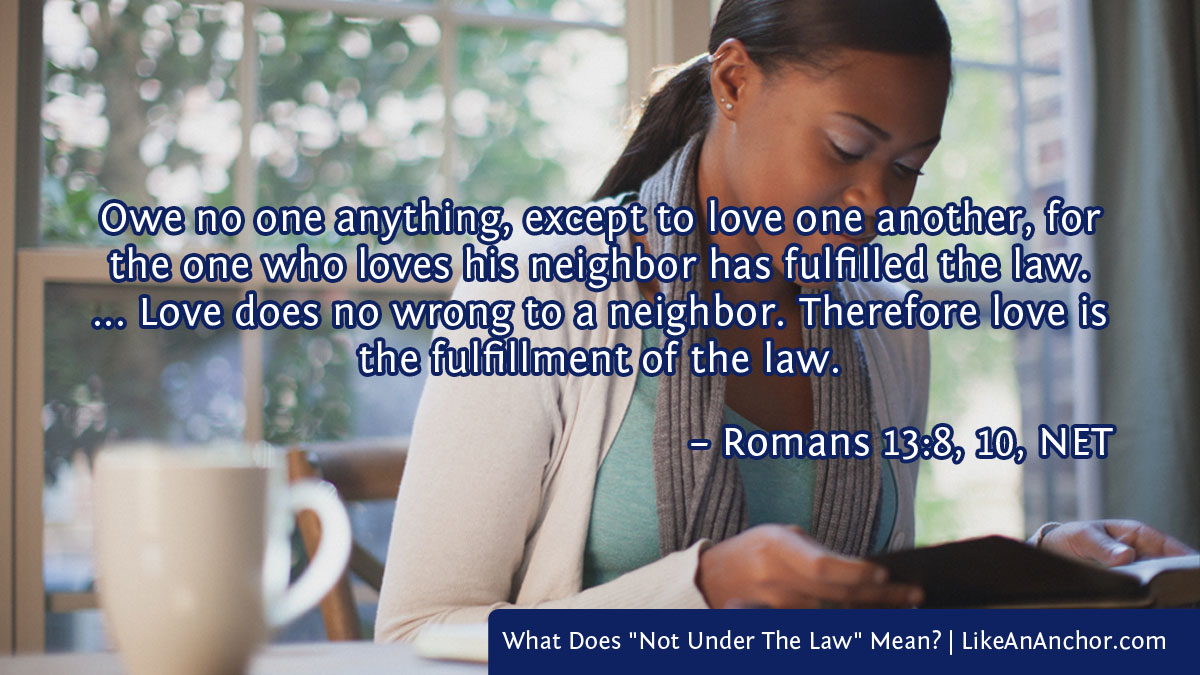
Freed to to Fulfill the Law Through Love
The early chapters of Romans discuss this same subject with slightly different wording. First, Paul sets up a connection between sin and the law. He explains that “all have sinned” (Rom. 3:23), but we wouldn’t know that without the law to tell us about sin (Rom. 4:15; 5:13; 7:7). The law let us know we were enslaved to sin.
We know that our old man was crucified with him so that the body of sin would no longer dominate us, so that we would no longer be enslaved to sin. … So you too consider yourselves dead to sin, but alive to God in Christ Jesus. Therefore do not let sin reign in your mortal body so that you obey its desires.
Romans 6:6, 11-12, NET
When Jesus died, He paid the penalty for all sin, which was exposed by the law. When we accept Him, are baptized, and commit to walking in relationship with God, we also “die” in a figurative sense. We’re freed from sin. It’s not supposed to shackle us anymore, and we don’t have to obey its pulls.
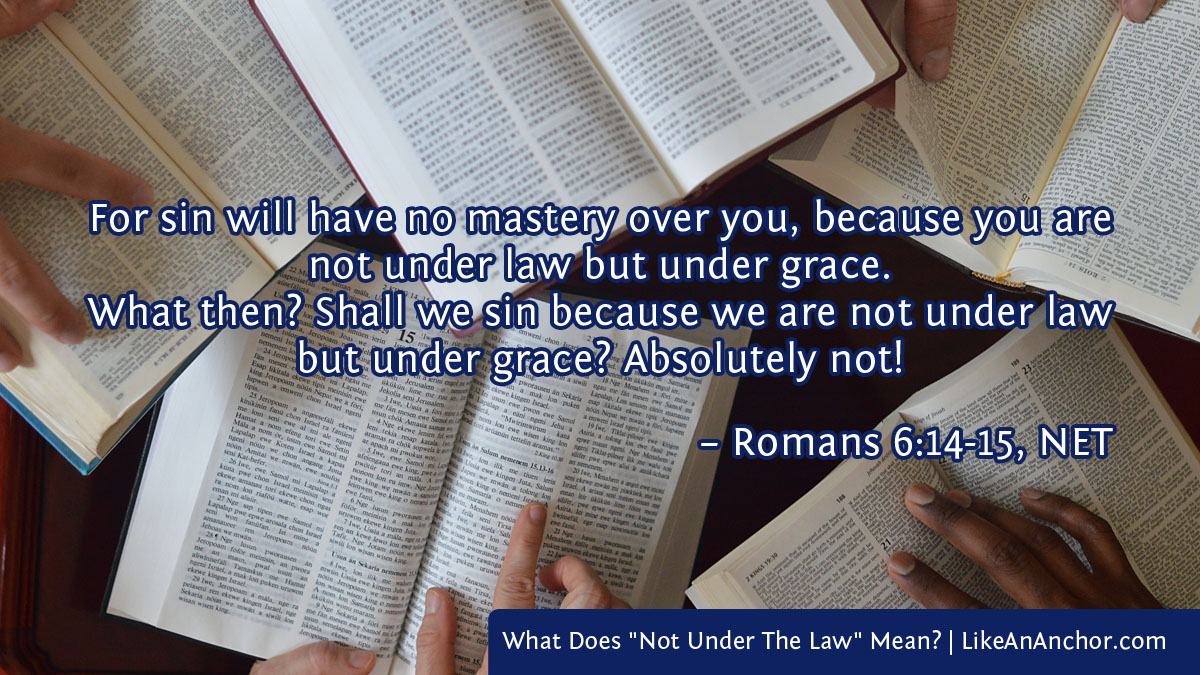
For sin will not have dominion over you. For you are not under law, but under grace. What then? Shall we sin, because we are not under law, but under grace? May it never be!
Romans 6:14-15, WEB
Here’s Paul saying the same thing West was about freedom not being license to sin. Those who are “not under the law” still aren’t allowed to break the law. In fact, the more we become like God the less we’ll want to break His rules.
In Romans 7, Paul draws an analogy between being under Old Covenant law and a marriage. Marriages end when one of the married people dies (Rom. 7:1-3). The Old Covenant represented the first marriage between God and His people. That Covenant ended at Christ’s death and, through Him, we died to it as well.
So, my brothers and sisters, you also died to the law through the body of Christ, so that you could be joined to another, to the one who was raised from the dead, to bear fruit to God.
Romans 7:4, NET
Now, we are betrothed in marriage to Jesus Christ. We’re being transformed on the inside to become like Him and our heavenly Father. We’re not “under the law” because we’re becoming like the Lawgiver (Is. 33:22; Jas. 4:12; 1 Jn. 3:1-3). We’re marrying the One who fills the law to its fullest extent.
God is love. As we become like God we learn to “be love” as well, and that leads us toward fulfilling the law (Rom. 13:8-10). We’re not freed from the law so we can do whatever our fleshly nature urges, but rather so that we can live-out the fullest expression of God’s divine law by imitating His character. The law isn’t how we receive eternal life, but because we love God we still keep His law on our way to eternity.
Featured image by Chris Mainland from Lightstock

 Like An Anchor
I really like what you had to say, and I have attempted to wrap my brain around this very essential understanding. But every time I go through the principles, I feel like it gets confusing all over again. But I wonder if when we are obedient and walking with G.d in relationship, if this just ends up becoming clearer…as if the act of walking in step with Y.shua somehow makes it devinely clear. That may sound lofty, but I have been finding that the longer I walk with him and seek after his truths in scripture, the more things begin to unravel in there understanding. Thank- you for another excellent lesson!
LikeLike
“the act of walking in step with Y.shua somehow makes it divinely clear” — I love this observation. I do think that the longer we spend seeking our Lord, the more He’ll reveal to us. I remember telling one atheist who challenged me on a few points of Christian faith, “I can’t explain everything, but I believe God and that’s enough for me to keep going.” That was four years ago and some of the things I was shaky on then are clearer now. I’ve also discovered other things that I don’t understand yet — and I’m sure there are more things that I don’t even know yet that I’m missing. But I trust that if we stay faithful to God, He’ll stay faithful to us and keep building-up our faith and understanding. Thank you so much for commenting!
LikeLike
While I agree with you that in Christ God seeks to align our hearts to his will, I disagree with you that this is intended to be without the agency of his laws. No sir. We cannot be without law. This is not what not being under the law means. Paul himself realized that his readers could fall prey to this error of thinking that not being under the law meant either not being required to keep God’s law or not being in need of guidance by God’saw, hence when he spoke of himself live as without law towards those without law, he noted immediately after that this dis not mean that he was not UNDER LAW towards God. In other words, not being under the law does not imply not being under the guidance of laws in relating with God.
It is impossible for us not to be under the guidance of laws. Even Jesus was under the guidance of God’s laws. God’s word is his law. As long as we have need for God’s word we will have need for God’s law. To say we will have no need for God’s law is to say we will have no need for God’s word.
Being led of the Spirit is very scarcely expounded to believers. It is regularly spoken but never broken down. It just stays aloof as some mysterious command. Many envision it as being led supernaturally by an invisible force and voice. This has led many into error. For if that’s what it means then why bother reading the Scripture?
Being led of the Spirit was Paul’s way of speaking of being guided by the words of God. When we submit to God’s word we are invariably submitting to his Spirit. God’s word is the gospel. His word is found in Scripture. His word is Christ. Submitting to him through any and all of these avenues is what being led of the Spirit is about. It is not about some special, secretive, invisible and non-physical leading.
Being under the law simply means being under the rule of Jewish laws or regulations. Not being under the law therefore means not being under the rule of Jewish regulations.
Jews were those under the law. Non-Jews were those without the law or not under the law.
To no longer be under the law means to no longer be under the rule of Jewish regulations or customs. It is a reality applicable to Jews who embrace faith in Christ. Gentiles never were under the law so talking of them as no longer under the law is redundant.
God bless
LikeLike
When I read your comment, my first reaction was surprise that you thought I was saying “God seeks to align our hearts to his will … without the agency of his laws.” But I went back and reread this post, and I can understand how you read it that way.
The point I was (trying) to make in this post is that our relationship with the Law changes when we’re under the new covenant. Rather than God’s commandments only being an external thing that points out our sin, they become part of our character as we become more and more like Him. Our relationship with the Law changes from us being under the Law (and by “under” I mean having Law imposed externally and trying to keep it to the letter) to the Law being inside us (so we’re keeping it from the inside-out at a higher, spiritual level). Ideally, we’ll be keeping God’s law more successfully now than we did before.
I wrote this post in 2016, and there’s a newer one on the same topic from 2019 where I think I explain myself better and I also talk about that difference between Jewish tradition and God’s law. That post is called “Putting the Law in Its Spiritual Context: What Did Paul and Jesus Teach about the Law of God?”
Thanks for your comment, and may the Lord bless you!
LikeLiked by 1 person
Gal 3:22-29 was the daily reading today (Catholic). So, when I read scripture that I understand, but not completely to counter my unfortunate mistrusting nature (Doubting Thomas Syndrome-, lol), I always search the internet to find an explanation (backed biblically) that will help me wrap my brain around the matter. Anywho, I came across your article, and wouldn’t you know it, your explanation & references were perfect to turn the light bulb on between my ears. Just wanted to let you know that 8 years after you posted your article, it’s still being read and it helped someone. May God bless you in all ways!
LikeLike
Thank you for leaving a comment! It makes me so happy to know that this post is still helping people, and I’m glad you found it useful!
LikeLike