There’s been a big push culturally to erode traditional gender roles; to prove that men and women are equal and equally capable of filling roles that were once assigned to just one sex. For example: that women can pursue successful business careers and men can care for children. Or that women can display strong logic and men can be emotional and nurturing.
But somehow this has backfired on us and cultural expectations of gender are just getting more rigid. That statement probably raised a few eyebrows. We’ve come a long way, many will argue. Women are now accepted in traditionally masculine professions. They don’t have to just stay at home and raise children any more. We have freedom, equality! Besides, gender is just a cultural construct and we can redefine it however we want so those roles aren’t so confining.
That’s not what we’ve done though. Take, for example, the problem of people pushing young children to identify as transgendered (which the American College of Pediatricians defines as “child abuse”). If a child displays traits outside the gender associated with their biological sex, they’re encouraged to get their sex changed. Instead of making it acceptable for a little girl to embrace femininity and enjoy “boy things” like superheroes and tractors, she’s told she’s not really a girl. She’s a boy. In a fit of mass cultural insanity, we’re making social constructions of gender more rigid while trying to make a person’s biological sex something that’s flexible.
Stranger Things’ New “Mom”
I started thinking about this topic (at least in the context of this blog post) when I came across this image while scrolling through Pinterest:Like many Stranger Things fans, Season 2 turned Steve Harrington into one of my favorite characters. For those of you not watching the show, Steve was a stereotypical character in the first season but in Season 2 he got some spectacular character development. He grew from a standard jock into a hero who has a great relationship with the younger main characters. And for some reason that gets him labeled as their “mom” by the Internet.Read more →
When we go to school or a lecture or seminar, we’re typically looking to find out what the teacher knows. And it’s rare for most of us to have a continuing relationship with a single teacher, unless you’re in an apprenticeship situation. We tend to think of teachers as people you get information from, not necessarily someone you mimic or have a relationship with (though it’s great when that does happen).
These assumptions color how we respond to the Bible’s description of Jesus as Teacher or Rabbi (Matt. 19:16; John 1:38, for example). Being a student of this type of teacher goes beyond just listening to what he has to say. The relationship between a rabbi and their disciples, or talmidim in Hebrew, went deeper.
those who leave family to study and follow the ways of their teacher [rabbi]. They study not only to learn what their teacher knows but to become the type of man their teacher is.” (Psalm 11918.org)
Being taught in this sense isn’t just about taking in knowledge. It’s about changing who you are and how you think.
We’re not just pulling this idea that disciples of Jesus should become like Him out of Jewish tradition. It comes straight out of the Bible. Jesus said, “A disciple is not above his teacher, but everyone when he is fully trained will be like his teacher” (Luke 6:40, WEB). That’s our goal — to become exactly like our Teacher. And while this title is usually applied to Christ, it also includes God the Father.
It is written in the prophets, ‘They will all be taught by God.’ Therefore everyone who hears from the Father, and has learned, comes to me. (John 6:45, WEB)
Both member of the God-family are closely involved with teaching us. And as we learn from them, we’re to become like them. The idea that we can become like God is so incredible it’s almost unbelievable, but that really is our ultimate goal (1 John 3:1-2). They mean for us to become part of their family and even share in their oneness (John 17:20-23).
Patterned After God
In his first letter to the Corinthians, Paul talks about how we need God’s spirit in us to learn the things God gives us. God’s truths don’t make sense to “the natural man … because they are spiritually discerned” (1 Cor. 2:9-15, WEB). We need God’s spirit to unlock our minds and transform them. And this process results in us developing “the mind of Christ” (1 Cor. 2:16, KJV).
Let this mind be in you, which was also in Christ Jesus (Phil. 2:5, KJV) Read more →
I’d been excited to read Ann Radcliffe’s The Mysteries of Udolpho (1794) since I first came up with my Classics Club Book List a few years ago. I haven’t read much Gothic fiction, but when I do I tend to enjoy it. And I knew this was one of the main inspirations for Jane Austen’s Gothic satire, Northanger Abbey (and you know how much I love Austen), so of course I was intrigued. Strangely, what surprised me most about Radcliffe’s most famous “classic work of Gothic fiction” is how much of it isn’t very Gothic at all.
The book is 223 years old, but still … spoiler warning.
The Mysteries of Udolpho opens with a pastoral travelog detailing the main character, Emily St. Aubert, and her father’s journey through picturesque Italy. There are a couple scenes with a harrowing flavor in the first of four volumes, but not many. Even after Emily’s father dies and she goes to live with her aunt in volume 2 there’s very little about the novel that feels “Gothic.” The setting isn’t gloomy, decaying, or haunted. There aren’t any supernatural elements. And there are only a few hints at a larger mystery. The heroine is a damsel and she’s in a bit of distress, but not much yet. The only hallmark of Gothic fiction that you see from start to finish in this novel is a focus on intense emotions (you know, the sort that inspire fainting fits and romantic swoons).
The novel becomes recognizably Gothic only after we arrive at the Castle Udolpho on page 226 (out of 672 in the edition I read). And now, suddenly, it’s very Gothic. We have a creepy house that becomes almost a character in its own right. We have mysterious rooms, whispered histories of possible murder, unbridled villains (who still manage not to physically harm the heroine), secret passageways, dead bodies, and rumors of ghosts.
This was my favorite part of the novel because it’s what I’d been expecting. But it doesn’t last even half the book, since Emily escapes on page 451 and has no further contact with the villain, Montoni, who conveniently dies off-page before making any further trouble. It’s also a hallmark of Radcliffe’s writings that she leaves nothing with a supernatural hint unexplained, so before the story ends all the ghosts, murders, and mysteries are explained in such a mundane or outlandish fashion that it robs the story of a spine-tingling emotional pay-off.
For example, in the Blake Veil incident Emily lifts a curtain and swoons because what she saw behind it was so dreadful. That happens shortly after arriving at Udopho, but it isn’t until the end of the novel that readers learn she thought she saw the body of a murdered woman. Emily is left under that illusion. For us, Radcliffe explained that it was actually a wax figure molded to resemble a decaying corpse that a previous owner of Udolpho was assigned to look at every day as penance to remind him of his mortality. He put it in his will that all future owners of Udolpho should do the same or forfeit a good chunk of their land to the church, but they just hung a curtain over it ans locked the room. Mystery solved! (though honestly the idea that Montoni left a murder victim in the room would have been less fantastic).
Illustration from The Mysteries of Udolpho (1806 edition)
I haven’t mentioned the romance yet because honestly there isn’t much to tell. Valancourt is a character throughout most of the novel but he doesn’t really do much. He befriends Emily and her father then spends most of his time after the father’s death moping around Emily’s home hoping she’ll step into the garden so he can declare his passionate love for her. While she’s in Udolpho he’s in Paris ruining his reputation. And when she returns, they get so tangled in miscommunication that they almost don’t get married. I found the romance incredibly frustrating because they were always so emotional that they wouldn’t just talk with each other.
In case it’s not clear by now, I didn’t really like this book. If you want to give Radcliffe a try I’d recommend The Romance of the Forest (which I read in college for my research project). It’s much shorter and, in my opinion, a more enjoyable read. So why was The Mysteries of Udolpho a best-seller in it’s day and now Radcliffe’s most famous work?
Perhaps the answer lies in an observation made in the introduction to my Oxford World’s Classic’s edition. This intro points out that while Radcliffe rationalizes the supernatural in the outside world of her novel, she “presents the mind itself as a kind of supernatural entity.” It is the characters’ perceptions of what is going on in the world around them that adds a magical, mysterious flavor to the story. Radcliffe gave the novel’s first readers “a fantasy about the mind itself” being haunted.
For modern readers this idea isn’t anything new. We live in a post-Freud world where we’re accustomed to thinking of our minds as having layers that we don’t fully understand and reading stories that explore how a character’s psyche unravels under stress. But for Radcliffe’s readers it was a new kind of thrilling, escapist reading even when the plot was a mess. The way she accomplished this psychological character exploration isn’t what we’re used to today and it feels sloppy to me an I suspect other modern readers. I usually find 18th and 19th century literature very accessible, but in this case I just couldn’t connect with the story.
Click here to get a copy of The Mysteries of Udolpho. Please note that this is an affiliate link. This means that, at no additional cost to you, I will receive a commission if you click on the link and make a purchase.
Those are the kinds of self-affirming advice we often hear. The basic argument is that most of us are pretty good people and if we listen really closely to our inner guiding light, then we’ll make good decisions.
But as Christians, we’re not supposed to do what’s right in our own minds. We’re supposed to do what God thinks is right. To some, this might just seem like a subtle shift in semantics. Of course what I think is right and God thinks is right are the same thing. Aren’t they?’
Not necessarily. While the holy spirit is transforming us to “have the mind of Christ,” we’re not all the way there yet. That’s one reason why it’s so important to spend time studying scripture — to make sure we know how God thinks and line-up with Him.
What God Has To Say About Your Heart
When God made the choice to destroy everyone but Noah and his family in a flood, He did so after seeing “that every imagination of the thoughts of man’s heart was continually only evil” (Gen. 6:5, WEB). Even though we are made in God’s image, every single person has sinned and we’re corrupted by the fallen world we live in. And yet even in this state, human’s tend to trust that they know what’s right. But we’re often very wrong.
Yahweh says: Cursed is the man who trusts in man, and makes flesh his arm, and whose heart departs from Yahweh. … The heart is deceitful above all things, and it is exceedingly corrupt: who can know it? I, Yahweh, search the mind, I try the heart, even to give every man according to his ways, according to the fruit of his doings. (Jer. 17:5, 9-10, WEB)
Human being can’t trust their hearts. You might get some things right, but you can’t even really know yourself unless you ask God to share His perspective on you. But that verse in Jeremiah is addressed to the person who’s heart departs from the Lord. What about once you are in relationship with God and making Him the one your trust? What does that do to your heart? Read more →
Disclaimer: some of the links in this post are affiliate links. This means that, at no additional cost to you, I will receive a commission if you click on the link and make a purchase on that website.
INFJ personality types* often live with ridiculous amounts of guilt. We feel guilty about things we did and didn’t say or do. We feel guilty about how the people around us feel and how they react to us, about our own short comings, and even about our successes.
Everyone experiences a certain amount of guilt. But it does seem like one of the more common struggles for INFJs. Most people attribute this propensity for guilt to INFJ perfectionism, saying that if we fail to make something “perfect” we’ll feel guilty about it. But it’s a bit more complex than that (a fact which, I’m sure, will surprise no one familiar with INFJs).
The INFJ mind is very good at coming up with reasons we should feel guilty. Our Introverted Intuition seeks out patterns in our own behavior. Our Extroverted Feeling picks up on how we make others feel and evaluates our actions in light of how people “should” be. Our Introverted Thinking is quite happy to analyze our faults to death. And that pesky Extroverted Sensing adds even more guilt by whispering that all this shouldn’t matter and we could just go have fun. Read more →
When we’re trying to become more like God there are typically four scriptural tools people talk about using: prayer, study, meditation, and fasting. Today, let’s take a closer look at studying. Even though I do study my Bible (as these blog posts will attest), I don’t think I’ve ever studied the topic of studying.
So I ran a search for the word “study” in the New Testament and it didn’t show up in the WEB translation at all. The two uses in the KJV are both translated from different Greek words and neither means what we associate with the English word “study.” But just becasue that English word isn’t used much doesn’t mean the concept behind saying we should study God’s word isn’t correct. Miriam-Webster’s dictionary for students defines “study” as “the act of making an effort to learn by reading, practicing, or memorizing.” So I guess our question for today become whether or not that’s the sort of relationship God wants us to have with His word.
In his second letter to Timothy, Paul tells him what knowing God’s holy writings can do in a person’s life. That seems a good place to start our study:
From infancy, you have known the holy Scriptures which are able to make you wise for salvation through faith, which is in Christ Jesus. Every Scripture is God-breathed and profitable for teaching, for reproof, for correction, and for instruction in righteousness, that the man of God may be complete, thoroughly equipped for every good work. (2 Tim. 3:15-17, WEB)
We could pretty much end this blog post right here. If you want to become “wise for salvation through faith” and be “complete, thoroughly equipped for every good work” then you need to get to know God’s word. Paul makes it very clear that a person who is committed to following God needs to make themselves familiar with the Scriptures that we now call the Bible.
This passage also establishes that scriptures comes straight from God, not human beings (see also 2 Pet. 1:19-21). As such, it’s profitable for us. These writings teach, reprove, correct, and instruct us in righteousness. And we need righteousness, becasue “the unrighteous will not inherit the kingdom of God” (1 cor. 6:9, WEB). Clearly, effort put toward learning, practicing, and memorizing God’s word is going to pay-off. And this isn’t the only scripture that says so. Read more →
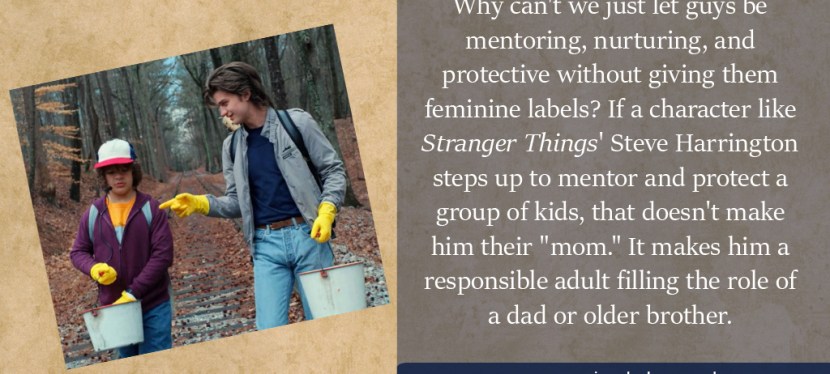
 Like many Stranger Things fans, Season 2 turned Steve Harrington into one of my favorite characters. For those of you not watching the show, Steve was a stereotypical character in the first season but in Season 2 he got some spectacular character development. He grew from a standard jock into a hero who has a great relationship with the younger main characters. And for some reason that gets him labeled as their “mom” by the Internet. Read more




 . Please note that this is an affiliate link. This means that, at no additional cost to you, I will receive a commission if you click on the link and make a purchase.





 Like An Anchor