Send Me Your Stories: Christianity and MBTI Types

I have a blog post (or more likely series) that I’d really like to write and I need your help.

When I started this blog, I worried it would seem like an awkwardly smooshed together amalgam of INFJ blog and Christian blog. You’re supposed to find a niche or theme of some kind and focus your blogging there. Not start two blogs on the same site and post one on Mondays and one on Saturdays. But I felt this what what I should do and so I did. And it’s been wonderful.

I’ve heard from so many INFJs who find my blog through the Myers-Briggs posts and then comment because they discovered I’m Christian. I’ve also heard from other types. Most surprisingly, quite a large number of NTs want to talk about their faith. It’s been fascinating to hear from the types stereotyped as the least religious. Many talk about the challenges they face, especially in connecting with other Christians or in feeling like their faith walk doesn’t follow the “normal” pattern.Send Me Your Stories: Christianity and MBTI Types | marissabaker.wordpress.com

That has me wondering: if Christianity is a faith meant for all people then why aren’t we doing a better job of connecting with all personality types? It’s a very broad generalization, but most Christians in the United States seem to be Sensing types and/or Feeling types. And that’s who many churches cater toward. They’re focusing on the sort of traditions that make SJ types comfortable, or trying to engage SP types in sensory worship experiences, or appealing to the spiritual interests of a few NF types.

I firmly believe God created personality variations for a reason and that He longs for a relationship with all people. There are already Christians of every personality type who have strong walks with God. But they’re not all equally valued and understood in the churches. And I’d very much like to start changing that.

List of Finished Posts:

As this project continues, I’ll post links to the finished posts here. If you see your type on the list, you’re welcome to head over to that post to read what your fellow believers wrote about their faith and leave your perspective in the comments section. I’m hoping to turn this project into a book eventually, and I greatly value your perspective even if I’ve already published a post on your type.

My Questions For You

Here’s where you guys come in. I want to hear from Christians of as many different personality types as possible. If you want to contribute and don’t know your personality type yet, please check out my post Finding Your Real Myers-Briggs Type (if you can’t narrow it down to a single type or just want to take one online test instead of researching typeology in-depth, that’s okay. I’d still love to hear from you).

I’m asking you to please share your personality type and answer some (or all, if you like) of these questions:

  • Which Bible characters and/or stories do you most identify with?
  • Do you have gifts or talents that you feel are not appreciated or that you don’t have an opportunity to use in the church?
  • Do you have gifts or talents that are particularly encouraged and supported in the church?
  • Are there expectations from other Christians that you have a hard time meeting because of how your mind naturally works?
  • Which teaching/preaching styles connect with you best? How do you like to hear and learn about God and His word?
  • In what ways could the church better connect with someone like you when preaching the gospel?
  • What’s one of the biggest challenges you face as a Christian?
  • Why are you a Christian? In other words, what makes you believe this faith is the right one?

You can either leave a comment here or send me a private message through my Contact Me form. Unless you tell me otherwise, I’ll assume that by getting in touch you agree I can quote you directly and credit you by first name (or screen name) and Myers-Briggs type.

Please spread this around! The more people sending in their ideas and perspectives the better. Hopefully we’ll get enough feedback for several posts. Maybe it will even grow into an ebook. I can’t wait to read what you all have to say!

Save

Save

Save

Save

Save

Save

Save

Save

Too Proud To Follow God

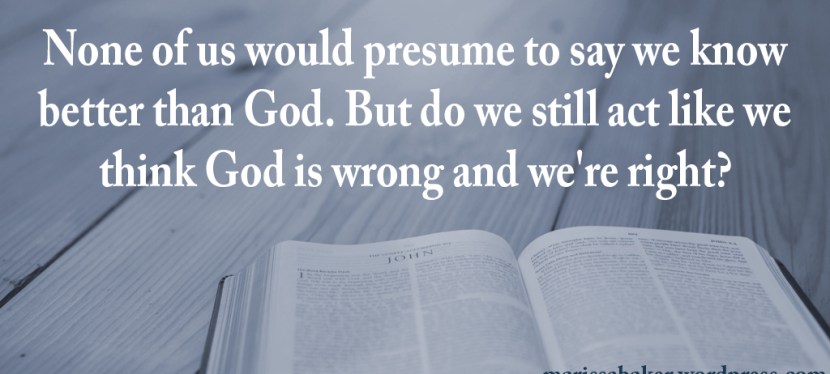
I’ll bet none of us would just come out and say, “I know better than God” or “God’s wrong and I’m right.” We recognize that as arrogant, inaccurate, and fool-hardy. But far too often, we act like that’s what we think even if we’re not saying or even consciously thinking those words. We come up with reasons why we don’t have to keep His commands, or decide we have a better idea for how to obey than what’s instructed in scripture. We try to come figure out what being Christian means to us rather than seeking what it means to God.

The stories of Israel’s first two kings perfectly illustrate the different ways we humans can approach following God. Saul did what was right in his own eyes while pretending to follow God, and God wasn’t impressed. He took the kingdom away from Saul and his family to set up David, someone who would truly follow after God’s heart and listen to His commands.

click to read article, "Too Proud To Follow God" | marissabaker.wordpress.com

Saul’s Prideful Disobedience

God chose Saul out of all the people, just as He later would David. It wasn’t His intention that Saul fail. But just two years into his reign, Saul found himself facing an army so terrifying his own troops ran and hid in caves. He waited seven days for Samuel the priest to come and offer sacrifice to God, but Samuel didn’t show.

That’s when Saul committed a sin that cost him the kingdom (1 Sam. 13). He made the decision to offer the sacrifice himself, showing a presumptuous disregard for God’s instructions. When Samuel showed up, Saul had all sorts of arguments to justify his actions but they didn’t change the fact that he’d ignored God’s will. Read more

Personality Types in Star Wars Rebels

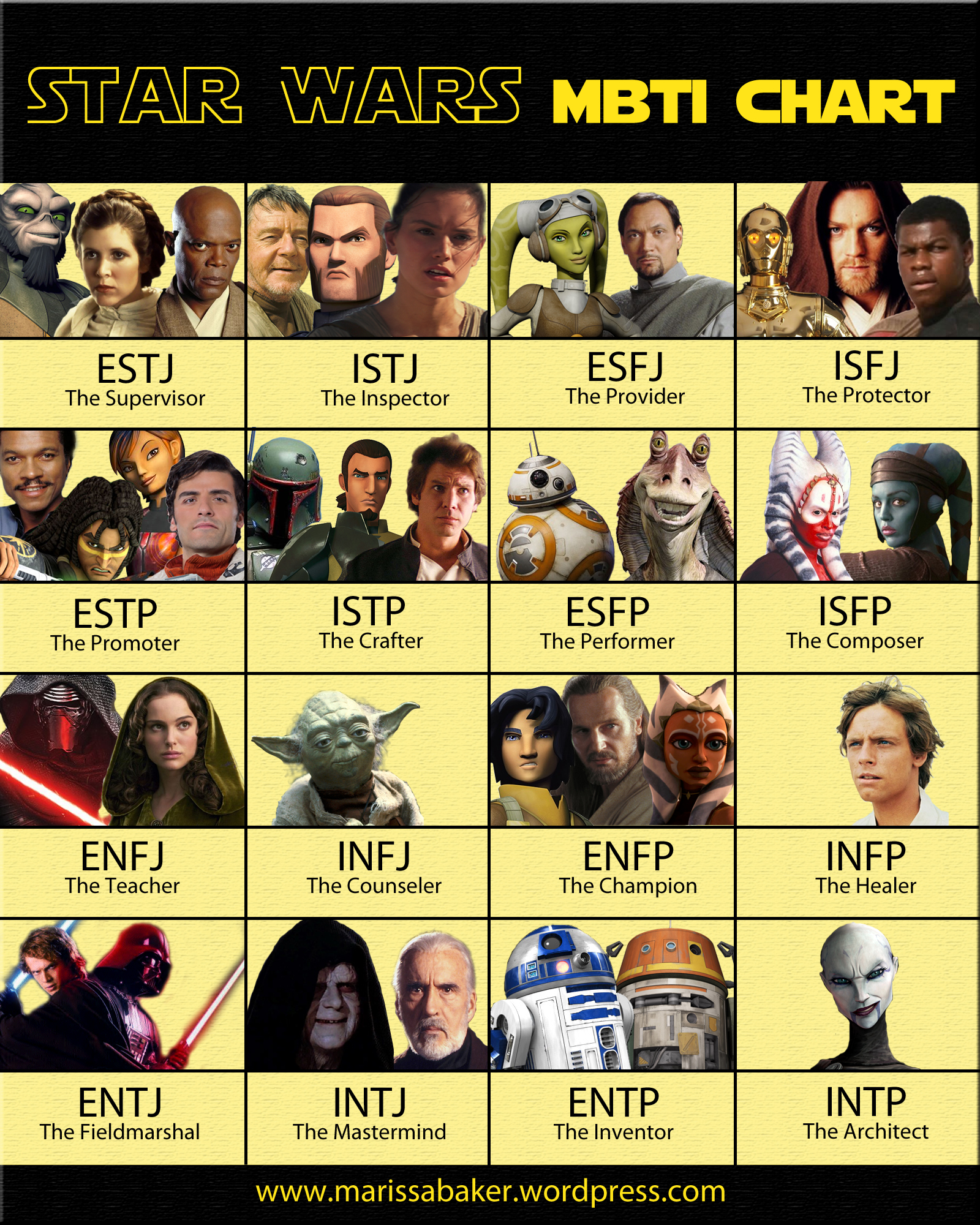
Note: an updated version of this chart and expanded discussions about Star Wars characters’ Myers-Briggs types can now be found on my other blog Star Wars Personalities.

Star Wars Rebels is my new favorite TV show. It’s been around since 2014, but I just started watching it last month. Now I’m caught up and eagerly awaiting the rest of season 3. Being an Myers-Briggs enthusiast as well as a Star Wars fan, my thoughts naturally turned toward analyzing the main characters’ personality types and updating my Star Wars MBTI chart.

Like The Clone Wars, Rebels is an animated series set in the Star Wars universe. While I enjoyed The Clone Wars (especially Ahsoka’s story line and Anakin’s character development), there are plenty of filler episodes, most of the humor is aimed at a young audience, and it’s a bit daunting at 121 episodes. Rebels, on the other hand, has a much tighter story arc and it’s aimed at a more mature audience (still a kids show, but fewer things that will have adults wincing or rolling their eyes).

click to read article, "Personality Types in Star Wars Rebels" | marissabaker.wordpress.com

After The Force Awakens came out last year I published a Star Wars MBTI Chart, which I present again here with Rebels characters added. For this post, I’m focusing on the Ghost‘s crew with one recurring character thrown in (Ahsoka also appears in Rebels, but she’s already been typed). I’d love to include Grand Admiral Thrawn, but I think I’ll wait until his new in-canon novel is released later this year.

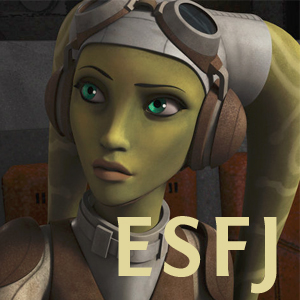
Hera Syndulla – ESFJ

Hera Syndulla - ESFJ. Visit marissabaker.wordpress.com for more Star Wars Rebels personality typesHera is a fantastic example of an SFJ type. She has that Si-Fe blend of prioritizing other people’s good while working to maintain social order. As an extrovert, she’s a talkative, people-focused character who teaches Ezra “if all you do is fight for your own life then your life is worth nothing.” It’s a belief she lives by as well.

SFJ characters are stereotyped at the “mother” figure and we get to see why in the way Hera leads and cares for her crew, especially in the first two seasons. As is typical of a dominant Extroverted Feeling type, she puts extra effort into maintaining harmony among her crew (such as sending Zeb and Ezra on a wild meiloorun chase so they can bond in S1E2).

After Hera’s rebels become more involved with the rebellion, we see that she’s the only one who’s really concerned with working in a larger movement. If you read A New Dawn, you see her focus from the very beginning has been on working to save the entire galaxy. This is partly an SJ’s commitment to order, partly an Fe type’s concern for people. But I think it’s also a little bit of her tertiary Extroverted Intuition looking at the larger picture and future implications of their actions. Read more

Healthy Christian Boundaries and Loving People You Don’t Like

It’s easier to follow the second great commandment “You shall love your neighbor as yourself” when you like your neighbor. But Jesus didn’t say “love the people you like” or that this great command only applies to people who are easy to be around.

For if you love those who love you, what reward do you have? Do not the tax collectors also do the same? And if you greet only your brothers, what are you doing that is remarkable? Do not the Gentiles also do the same? Therefore you be perfect as your heavenly Father is perfect. (Matt 5:46-48, LEB)

God is perfect in every way. In this case, however, Jesus is specifically talking about His perfect impartiality. Leading up to these verses, He said,

 But I tell you, love your enemies, bless those who curse you, do good to those who hate you, and pray for those who mistreat you and persecute you, that you may be children of your Father who is in heaven. For he makes his sun to rise on the evil and the good, and sends rain on the just and the unjust. (Matt. 5:44-45, WEB)

If we want to be like God, we have to love the way He loves. God is love. It “is the sum and harmony of all His attributes, His essence” (Expositor’s Dictionary of Texts on 1 John 4:8-9). Love isn’t just something God does. It’s His nature; the motivation driving every choice He makes. The chief example of this is that while “we were still sinners, Christ died for us” (Rom. 5:8, LEB).

click to read article, "Healthy Christian Boundaries and Loving People You Don't Like" | marissabaker.wordpress.com
photo credit: “Argument?” by Jules Minus, CC BY via Flickr

Clearing Up What Love Is

But things get complicated when dealing with humans. We run into questions, not because we’re trying to wiggle out of the command to love others but because we’re not sure what it means. Consider these scenarios:

  • Does love that “bears all things” mean I let my abusive parents/spouse/etc. keep hurting me?
  • Does love that “covers a multitude of sins” mean I always have to trust people again after forgiving them?
  • Does love that “does not behave rudely” stay friends with people who creep you out?

Read more

Let’s Talk About How Our Personalities Develop

Traditionally, Myers-Briggs theorists have taught that people develop their primary function first, followed by their secondary function up until their 20s, then their tertiary function in their 30s and 40s, and sometimes they’ll go on to start using their inferior function later in life. It’s a neat, orderly formula. Too neat for my tastes. (If you felt lost when I started talking about functions, click here to read a post explaining that aspect of Myers-Briggs personality types.)

When you start talking about type development in more depth, though, Myers-Briggs experts will add that environment and an individual’s commitment to personal growth does influence when our functions develop and how well we learn to use them. They’ll also talk about life-long type development and offer tips for dealing with your less developed functions before the age you’re “supposed” to develop them. And I’ve also talked with people who feel like they developed their tertiary before their secondary function, or had to go back later in life and become comfortable with their dominant function because they’d been suppressing it. Clearly, there’s more going on than a neat developmental progression from one function to another.

click to read article, "Let's Talk About How Our Personalities Develop" | marissabaker.wordpress.com
photo credit: “Learning To Walk” by Tela Chhe, CC BY via Flickr

Personality Hacker proposes a different look at how we develop functions, or “mental processes.” I’ve not seen them directly address the question of type development from childhood on, but they do see our secondary function as our growth position. We’re most comfortable using our dominant function and (baring some kind of trauma) it’s typically also the one you’ve spent the most time developing. This function is either introverted (i.e. focused on our inner world) or extroverted (i.e. focused on the outer world). Your secondary function is focused in the other direction — if you’re a dominant introvert, your secondary mental process it extroverted (and vice versa). But your tertiary function matches your primary one in terms of introvert-extrovert, so it can be more comfortable (though not as healthy) for us to spend time in that one rather than cultivate our secondary function.

What About Culture and Family?

I think our early experiences and upbringing have quite a bit to do with which mental processes we develop and when. For example, an introverted child leads with an inward-focused mental process. How their society and family treats their introversion will have a huge impact on their development. They might develop their extroverted side more quickly as a defense mechanism for fitting into an extroverted world. On the other hand, the same thing (developing their secondary extroverted function early) could also happen if given support for their introverted development as well as encouragement to stretch themselves in the outer world.

Alternately, our hypothetical introvert might reject the push to be more extroverted and end up developing their tertiary process more quickly than their secondary process. That could be a reaction against the external push to be something they’re not, or in response to a particular subculture that values their introverted traits. If no one’s telling you to cultivate a less comfortable aspect of your personality, then why bother?

The same can hold true for extroverts. Many cultures, including the United States, have historically held extroverted traits up as more desirable. If you’re constantly being admired for your outgoing personality, social skills, and ability to navigate the outer world, why focus on developing your un-cool introvert side in high school? Or maybe you’re an extrovert growing up in a family of introverts who constantly ask you to give them alone time or be quiet, and you suppress your dominant function’s development until you’re older. I’ve seen both happen.

click to read article, "Let's Talk About How Our Personalities Develop" | marissabaker.wordpress.com
photo credit: “Learning …” by Eric Fleming, CC BY via Flickr

There are other factors in play as well. An ExTJ guy would typically find encouragement for his dominant function, where a woman with the same personality type could face criticism for not “acting like a girl.” An ExFJ girl would fit more easily into what society expects from young women, while a guy with the same type might be told to “man up.”

Messy, Beautiful Variations In Type

Personally, I feel I developed my dominant function first (as an INFJ, that’s Introverted Intuition/Ni), stunted my own secondary function’s growth by being incredibly shy (Extroverted Feeling/Fe), ended up using my tertiary function trying to make sense of things (Introverted Thinking/Ti), and was completely blind to my inferior function (Extroverted Sensing/Se). That described me pretty much until age 19 or 20. At that point, I’d been in college for about a year and started working to overcome my shyness. That finally gave my secondary Fe a chance to develop into a healthy version of that function. At the same time, I started using Ni in a healthier way, too, while still occasionally tapping into Ti. As I started learning more about my personality type, I’ve also started trying to develop my Se (though I’ll admit it’s with little success so far). But since I’m not even 30 yet, I “shouldn’t” be consciously using either my tertiary or inferior function yet.

I’m certainly not trying to argue that Myers-Briggs gets everything (or even most things) wrong about type development. The MBTI is a fantastic tool for describing how people’s mind’s work, how we typically learn information, and the ways we interact with our worlds. And the typical type development model has lots of truth in it, including the fact that our primary and secondary functions are the ones we develop most fully. It’s just that there’s more influencing the nuances of type development than how old we are.

These variations are one reason why no two people who share a personality type will be exactly the same. We all have different circumstances that shape our type development, different levels of comfort with our type’s functions, and different ways of expressing how our minds work. If you feel like you didn’t follow the standard model of type development, don’t worry — you haven’t missed out on your chance to grow and there isn’t anything wrong with you. Our personality types aren’t boxes we fit in neatly or hoops of development we jump through. They’re a way of describing how your mind works and a tool we can use to accelerate personal growth, including developing all facets of our personality type more fully.

Save

Save

Save

Save

Animating Your Faith

There’s a statement in James that we’re all familiar with: “faith without works is dead.” While we can all agree James makes this statement, we don’t always agree on what it means. Citing other scriptures that say we’re justified by faith without works, some argue that a faithful Christian isn’t obligated to do things like obey God’s law or perform good deeds.

But “faith without works is dead” isn’t a statement James makes casually. It’s part of a larger teaching he’s sharing and it’s also part of an analogy that goes like this: “For just as the body without the spirit is dead, so also faith without works is dead (James 2:26, LEB).

In this analogy, faith is like our bodies and works are like our spirits. James is telling us that works give life to our faith in the same way the spirit in man gives life to our bodies. This is in response to a rhetorical question he asked earlier in the epistle: “Can we be saved by faith without works?” The answer he gives is “no.”click to read article, "Animating Your Faith" | marissabaker.wordpress.com

Believing Isn’t Enough

Faith is essential. It’s impossible to please God without faith, “for he that cometh to God must believe that He is, and that He is a rewarder of them that diligently seek Him” (Heb. 11:6, KJV). But it’s not the only thing God is looking for in His people. Read more