“If You Love Me”

A comment on my “Heart of Worship” post has had me thinking about the importance of keeping God’s commandments. The comment noted that “worship is also connected to commandment keeping and is not only praise and emotion.” This reminded me of something I noticed while studying love in the Old and New Testaments.

In John 14:15, Jesus Christ said, “If you love Me, keep My commandments.” This clearly states that that we cannot claim to love Christ if we are not obeying Him, and is not an isolated verse. The idea of loving God and keeping His commandments is paired at least eleven times in the Old Testament and nine times in the New Testament (Ex. 20:6. Deu. 5:10; 7:9; 11:1, 13, 22; 19:9; 30:16. Josh. 22:5. Neh. 1:5. Dan. 9:4. Matt. 22:38-39. Mark 12:30. John 14:15, 21; 15:10. 1st John 4:21; 5:2, 3. 2nd John. 1:6).

Keeping the Lord’s commandments is vital to having a loving relationship with Him. From the beginning, God expected obedience from His people. This is made very clear when He established the Old Covenant with ancient Israel.

See, I have set before thee this day life and good, and death and evil; in that I command thee this day to love the LORD thy God, to walk in His ways, and to keep His commandments and His statutes and His judgments, that thou mayest live and multiply: and the LORD thy God shall bless thee in the land whither thou goest to possess it (Deuteronomy 30:15)

Jesus connected this ancient commandment with the New Covenant when He answered the question “which is the great commandment in the law?” He quoted Deuteronomy 6:4 by saying:

And Jesus answered him, The first of all the commandments is, Hear, O Israel; The Lord our God is one Lord: and thou shalt love the Lord thy God with all thy heart, and with all thy soul, and with all thy mind, and with all thy strength: this is the first commandment (Mark 12:29-30)

This love goes much deeper than just loving God to fulfill a commandment. Our God wants a relationship with us. He wants us to love Him, because He first loved us (1 Jn. 4:19). Just a few verses after Christ said, “If you love Me, keep My commandments” in John 14, He added this:

He that hath My commandments, and keepeth them, he it is that loveth Me: and he that loveth Me shall be loved of My Father, and I will love him, and will manifest Myself to him (John 14:21)

If we love Him and keep His commandments, we will be loved by both Jesus Christ and God the Father. And not only loved – Jesus Christ says He will manifest Himself to us. “Manifest” is from the word emphanizō, and means that Christ will let Himself “be intimately known and understood” (G1718 ἐμφανίζω; Zodhiates). To know our Creator personally is an incredible promise, one we can claim if we love God and attach ourselves strongly to Him by keeping His commandments.

Just a note … the ideas in this post, particularly the second paragraph, are part of a larger study I’ve been doing on love in the Bible. I’m not sure yet if it’s going to be more of a long-ish paper or a short booklet, but I’m planing to finish revising it and have a PDF available on this blog by Pentecost (May 19th) for anyone who would be interested in reading it.
More Cheesecake, No Sugar

Between writing about cheesecake yesterday and baking one today, I have cheesecake on my mind. Ergo, here’s another recipe, this time sugar-free. I came up with this recipe for a friend who loves cheesecake but can’t eat sugar or artificial sweeteners (which I refuse to use anyway).

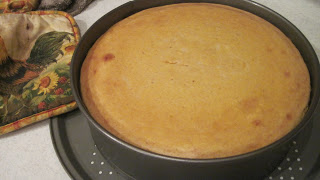
The entire cake is sweetened with honey. This crust can be a little hard to work with, but the taste is worth the extra effort. The first time I baked this, the crust stuck to the bottom of the pan and people were scraping it off to eat by itself. The filling has a really nice texture, even smoother than a regular cheesecake, and the honey taste isn’t overpowering.

honey cheesecake carleene federer
A honey cheesecake from Carlene Federer

Unfortunately, I don’t have a photograph of this cheesecake. I found a picture on Google, though, which looks similar to mine. Most other recipes top honey cheesecakes with honey or caramel before serving, but I’ve never done that with mine. I think it would be way too sweet.

Honey Cheesecake

Crust

  • 1 cup walnuts, ground
  • 2 Tablespoons honey
  • ¼ cup butter
  • ¼ tsp. ground cinnamon
  • add flour as needed to hold it together (about 1/2 cup)

Mix crust and press into 9-inch spring-form pan. (crust is sticky, so I line the pan with aluminum foil). Bake at 325°F for 5-10 minutes.

Filling

  • 3 (8-oz.) packages cream cheese, softened
  • ¾ cup honey
  • 3 eggs, at room temperature
  • ¼ cup heavy cream
  • 2 teaspoons vanilla extract
  • 1 tablespoon all-purpose flour
  • ½ teaspoon ground cinnamon

While crust is baking, beat cream cheese and ¾ cup honey with a mixer in large bowl at medium speed until smooth, scraping down bowl’s sides occasionally, about 3 minutes. Beat in eggs one at a time; beat in cream and vanilla. Beat in flour, cinnamon and salt. Pour into crust.

Bake at 325°F for about 1 hour or until lightly browned and a little puffed. Cheesecake will jiggle in the center but will set as it cools. Cool on a wire rack 2 hours. Once cool, you should be able to lift the cake and peal off the aluminum foil. Cover and refrigerate.

The Way To A Man’s Heart …

I may have discovered compelling Biblical evidence to support the old saying, “The way to a man’s heart is through his stomach.”

While reading Song of Solomon this morning, I noticed that my study Bible had a note that “Thou hast ravished my heart” (Song 4:9) could also be translated “Thou hast taken away my heart.” I thought oh, that’s so cute, and looked up the Hebrew word. According to the lexical aids in my Bible, lâvav (H3823) can also mean “to be wise, be intelligent (Job 11:12); to make cakes (2Sam. 13:6, 8).”

So, what I’m getting from this is that it is wise to bake cakes and thereby capture a man’s heart.

I have tried this approach in the past, to no avail. I comfort myself by thinking this is due to the lack of single men in the local church areas rather than a flaw in my cooking, and still have high hopes for my cheesecakes.

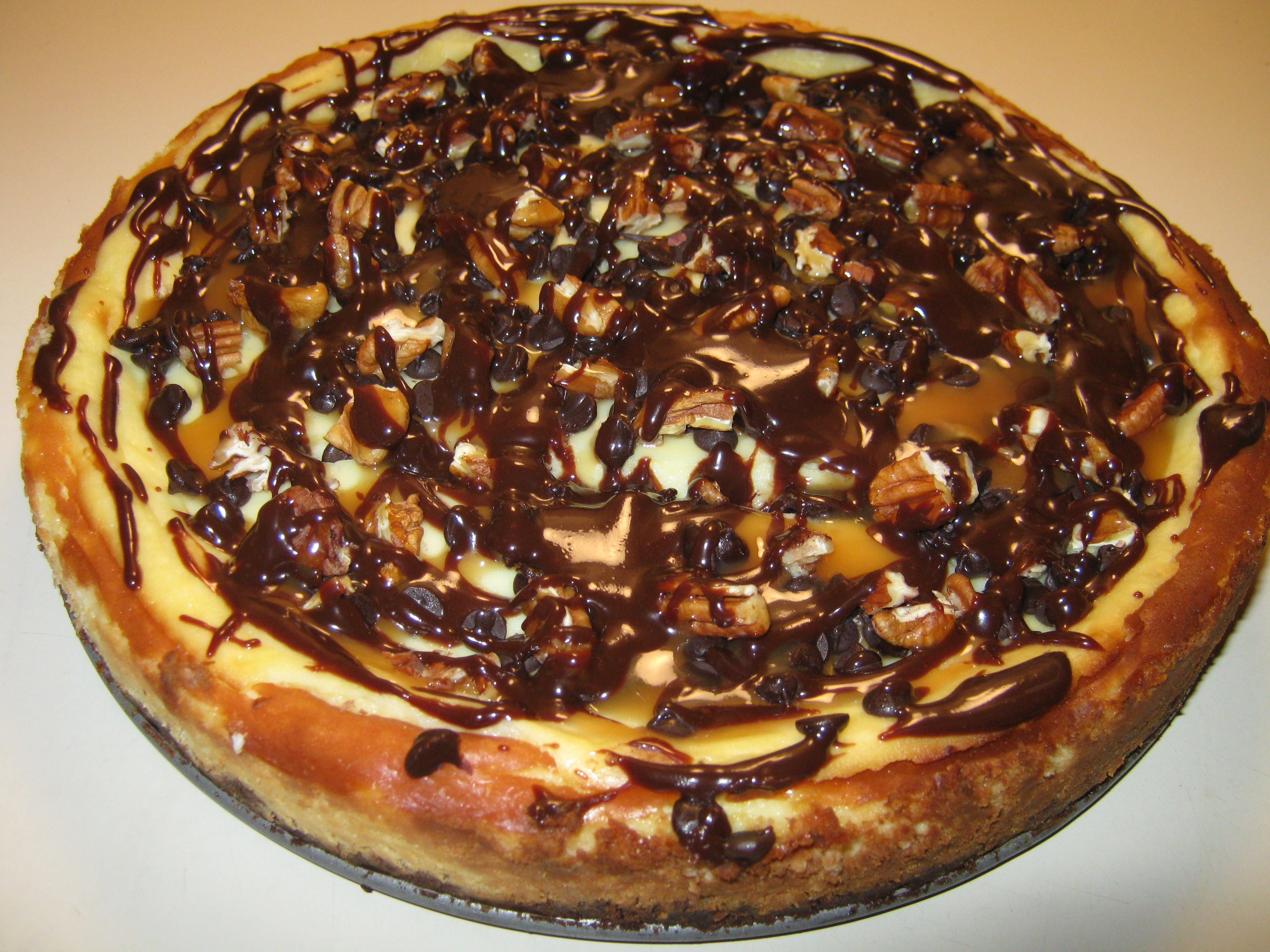
I’m particularly proud of this turtle cheesecake. You won’t find this particular recipe anywhere else, because it’s one of my own. A friend of mine talked me into trying Fazoli’s turtle cheesecake, and I promptly went online to try and find a similar recipe. After browsing recipe sites unsuccessfully for an hour, I decided I’d just come up with my own.

 Turtle Cheesecake

Turtle Cheesecake
Turtle Cheesecake

 Crust

  • 1 cup chocolate graham cracker crumbs
  • ¼ cup melted butter
  • 3 tablespoons caramel ice cream topping

Mix cracker crumbs and butter. Press into a greased 9-inch spring-form pan. Drizzle caramel over crust.

Filling

  • 3 (8 oz) packages cream cheese, softened
  • ¾ cup sugar
  • 1 ½ teaspoons vanilla
  • 3 eggs

Beat cream cheese, sugar and vanilla with mixer until well blended. Add eggs, 1 at a time, mixing on low speed after each just until blended. Pour over caramel layer in crust.

Bake at 350°F for 40 minutes or until center is almost set. Run knife around rim of pan to loosen cake; cool before removing rim.

Topping

  • 3 tablespoons hot fudge
  • 3 tablespoons caramel syrup
  • ¼ cup chopped pecans
  • ¼ cup semi-sweet chocolate morsels

Melt hot fudge and drizzle with caramel syrup over cooled cheese cake. Sprinkle with pecans and chocolate morsels. Refrigerate 4 hours.

Fortuitous Fabric Shopping

Yesterday, my brother and I went fabric shopping. This in itself is momentous, considering he suffers from an allergy to all shopping that does not involve food or manly building projects. But he wants a Medieval costume for SCA events and I told him I’d sew it if he picked out the pattern and fabric.

I stumbled upon the Society for Creative Anachronisms a few years ago, but didn’t join because I didn’t want to be by myself when I went to the meetings. Now that my brother is older, he thinks full armored combat sounds amazing and can’t wait to join me in pretending we live in pre-17th-century Europe.

While we were getting our chosen fabric cut at Jo-Anne’s, the woman who was waiting on us asked what the costume was for. We told her, and lo-and-behold she was a member of our local SCA group. She invited us to the meetings, told us what to expect, said there were a couple people close to my brother’s age there, and (best of all) that they have people in the group who practice Medieval painting. As in, illuminated manuscripts. As in, I-CAN-BARELY-CONTAIN-MY-EXCITEMENT.

I got to see a collection of illuminated manuscripts at the Cleveland Museum of Art a couple years ago. “The Glory of the Painted Page,” it was called, and it was indeed glorious. I love books, and have a great deal of admiration for those long-dead artists who hand wrote and carefully illustrated manuscripts from the Medieval period. To have the opportunity to learn that art is incredibly exciting.

I <3 Yurts

So, I realized that I subtitled this blog “Thoughts about everything from cooking to yurts to Jesus” and I haven’t yet mentioned yurts at all. I’ve been talking to so many people about them in person that I keep forgetting to write something.

Yurts: Living In The Round by Becky Kemery
A book about yurts

For those of you who don’t know (as I didn’t just a few months ago), a yurt is a round structure based on several types of houses used by nomads in Asia. The basic design is a circular lattice all with a door frame topped by roof beams that attach to a center ring. Traditionally, the wood frame is covered by felts. Modern yurts use architectural fabrics and NASA-inspired insulation, or permanent walls.

I’ve always been drawn to round spaces: Hobbit holes, gazebos, outdoor spaces with curved hedges or plants for “walls.” Looking back though one of my sketch books, I realized I was dreaming about yurts even before I had any idea that’s what they were called. This sketch is from a dream I had and features a little fairy house topped by a hibiscus flower.

sketch of a fairy yurt on shelf fungus with hibiscus roof
Fairy yurt on shelf fungus

Why yurts? Maybe it has something to do with what yurt designer Morgan Reiter said in the book I just finished reading.

Shortly after I started to build yurts as a business, we did a home show where we set up a demonstration yurt. People would walk in, look around, and then comment on how good it felt. I remember a woman leaning over to her husband and saying, ‘I love the way this feels!’ it was the first time I’d ever seen a building produce an emotional reaction.

When we’d do a home show with rectilinear models, people would make comments like ‘love your work, nice lines’ or ‘nice trim work,’ but we’d never get an emotional response. I realized that conventional construction can look nice, but with the yurt there is a ‘feel.’ an epiphany of sorts.

Maybe people really do feel more comfortable in places with curves instead of angles. After all, God didn’t create many things with harsh angles in nature. Rivers curve, trees have round trunks, even the earth is a sphere. Rocks and mountains can have sharp angles, but I don’t really think they feel very cozy.

Heart of Worship

In my last post on worship, I talked about blowing kisses to God, from the Greek word proskuneō. This time, I want to write about a more sobering verse, contained in one of Christ’s discussions with the scribes and Pharisees.

Ye hypocrites, well did Esaias prophesy of you, saying, This people draweth nigh unto me with their mouth, and honoureth me with their lips; but their heart is far from me. But in vain they do worship me, teaching for doctrines the commandments of men. (Matt 15:7-9; Mark 7:6-7)

This word for worship is sebomai (G4576 σέβομαι), which Zodhiates lists as a synonym of proskuneō. It means to fall before, worship, adore. The word translated “in vain” is matēn (G3155 μάτην). It can also mean, “In a casual sense, meaning groundless, invalid” (Zodhiates). Used together, it means worship that is a vain and idle show of adoration rather than the real thing.

Trying to understand what invalidates a person’s worship of God, I went to the verse Christ was quoting from Isaiah. It reads, “this people draw near me with their mouth, and with their lips do honour me, but have removed their heart far from me, and their fear toward me is taught by the precept of men ” (Is. 29:13).

The state of our hearts is extremely important when we consider what genuine worship involves. It is clear from statements throughout the Old and New Testaments that “the LORD looketh on the heart” (1 Sam. 16:7) and expects His people to be pure on the inside. The last thing we should do is remove our hearts from God.

Keep thy heart with all diligence; for out of it are the issues of life. (Prov. 4:23)

And I will give them an heart to know me, that I am the LORD: and they shall be my people, and I will be their God: for they shall return unto me with their whole heart. (Jer. 24:7)

Blessed are the pure in heart: for they shall see God. (Matt 5:8)

It is equally clear that we cannot fool Him with worship that is not genuine. Read Psalm 139. God knows us to the very center of our being. He is the one who searches the heart and discerns our thoughts and intents (Jer. 17:10; Heb. 4:12). An idle show of adoration certainly will not fool our God, nor will He accept such worshipers when He is seeking those who worship in spirit and in truth (John 4:23-24).

I want to close with a lovely song, from which I have borrowed the title for this post.