“I Feel There Is Something Missing in Me” — The Wounding Message of Enneagram 4s

I’ve been trying to study the Enneagram for several years now. I’ve read highly recommended books by Helen Palmer, Don Richard Riso, and Russ Hudson but for some reason none of them really made sense. I mean, I got what they were saying and it seemed like a useful system but I didn’t feel like I understood it well enough to actually use it in my life and especially not in relating to other people.

This latest Enneagram book I’ve tried is one that my first counselor recommended over a year ago. I’ve finally been able to get it through a digital library (didn’t want to buy it if it would just sit unused on the shelf like all my other Enneagram books). I haven’t quite finished it yet, but what I’ve read is enough to know The Road Back to You: An Enneagram Journey to Self-Discovery by Ian Morgan Cron and Suzanne Stabile is the best Enneagram book I’ve read (please note this is an affiliate link, which means if you click on the book title and make a purchase I’ll receive a small commission at no additional cost to you).

I’ll be talking in more general terms about the Enneagram in later posts, but today I wanted to share a personal story. I know my enneatype is 4w5, but until now that knowledge as been more depressing than helpful. Myers-Briggs® types tell you how your mind works. We can talk about healthy and unhealthy versions of each type, but overall it’s usually a fairly neutral description. Your Enneagram tells you how you’re broken. It talks about your deadly sin, your childhood wounding message, and your core fears. To me, it seemed overwhelmingly negative. Read more

A Time For Discernment and Standing For What’s Right

We’re going through a pandemic right now, and it has given us the opportunity to ask ourselves some interesting and challenging questions. Take, for example, the issue of closing churches. Here in Ohio, churches are exempt from the order to limit public gatherings to 10 people or less. This is a right and proper application of the separation between church and state. Most churches here moved online, however, following the recommendation of medical and legal counsel. This was also right and proper, for the Bible tells us to respect governing authority (Rom. 13:1-2; Tit. 3:1-2; 1 Pet. 2:13-17) and quarantine the sick (Lev. 13:46; Num. 5:1-3). Just in the last couple weeks, some churches are starting to reopen with social distancing and other precautions in place.

Things didn’t go so well everywhere. New York City Mayor Bill de Blasio threatened to permanently close churches and synagogues if they continued to hold any services. In Mississippi, attendees of a drive-in church services were ticketed $500 for sitting in their cars listening to the pastor on the radio (the DOJ has stepped in on behalf of the church). Some consider churches “essential services,” some do not. Some try to use the crisis to discriminate against religious institutes, others work alongside and defend them.

Jesus warned there will be those who persecute His church. There will be people who try to stop us from meeting, preaching and worshiping rightly. It has already happened throughout history in various places around the world. To be clear, I am not saying encouraging churches to temporarily suspend in-person services during a pandemic is persecution. But this does give us a reminder that we need to be watchful and exercise discernment. This is a good time to ask ourselves questions like, How would we respond if churches were asked to close for a different reason? Or ordered to stay closed, as threatened in New York? What if we were told we could no longer own Bibles, as has happened in other countries?

I don’t bring up these sorts of questions to panic us, but to prepare us. We are told to watch and be ready, and it’s hard to do that if you’re not thinking of things that might happen in the future. We are living in the end times (as humanity has been since the first century per 1 John 2:18). This is a time for discernment and preparedness, and the current crisis can serve as a wake-up call for any of us who may have been growing complacent in the safety and freedom we’ve enjoyed for so long. Read more

Great Changes Begin Great Stories

Think about your favorite novel, movie, or TV show. It probably begins with the main characters going about their ordinary lives. Bilbo Baggins lives peacefully in his hobbit hole (The Hobbit). Elizabeth Bennet is socializing with her sisters and putting up with a mother eager to marry her off (Pride and Prejudice). Luke Skywalker is moisture farming on Tatooine (Star Wars). A pastor is sailing with his family to a colony in the South Pacific (The Swiss Family Robinson).

Then Gandalf arrives with a party of dwarves. Mr. Bingley moves to Netherfield. Droids arrive carrying secret plans that must be delivered to the Rebellion. The ship crashes on an uncharted island. Something changes, acting as an inciting incident to push the main character out of their normal life and into the events of the story.

We’re currently living in a time of great change. People are talking about what the “new normal” will look like and speculating about how much things will change now that there’s Covid-19 in the world. There have been many other times of great change throughout history — pandemics, the industrial revolution, natural disasters, colonization by European powers, terrorist attacks, the falls of empires, the birth of Jesus Christ. Some are terrible, some depend on your point of view, and a very few are spectacularly good.

We have very little control over how the world changes. But we do have some control over if and how we change in response to those changes. In many ways, we get to decide whether the effects of this pandemic will be an inciting incident for personal growth, a speed bump as we continue on much the same as before, or something that derails our path.

Great Changes Begin Great Stories | LikeAnAnchor.com
Photo credit: RÜŞTÜ BOZKUŞ via Pixabay

We would not have had a story if Bilbo stayed home, Elizabeth refused to speak with Darcy a second time, Luke didn’t follow R2-D2 into the desert, or the Swiss family had been rescued after only a week on the island. Now, I’m not saying you should ignore social distancing guidelines and go running off on a grand adventure. For us today I’m talking more about an internal adventure and a commitment to positive change.

Some of the greatest journeys we can go on are those of self-discovery, and they’re often prompted by change. The biggest moments that stand-out in my mind as times that sparked personal growth were starting college, beginning a dating relationship with a man I’d been friends with for years, and then the breakup which ended that relationship. Maybe this pandemic will be another one for me, and for many other people.

Whether you’re stuck at home and have some extra time on your hands or not, the changes in the world around us can serve as a reminder to look inwards and evaluate ourselves. We might ask questions like, “What impact am I having on the people around me for good or ill?” or “How can I become a healthier individual mentally, emotionally, and physically?” or “What do I want the next part of my story to look like?”

We can’t control when quarantine restrictions lift, who gets sick, or most other things associate with this pandemic. But we can control how we respond to the changes that are happening in our lives and the world around us. Let’s commit to making sure the great changes we’re going through now spark great next chapters in the stories of our own lives.


If you’re looking for some ideas for where to start working on personal growth, I’ve finally found an Enneagram book that I like. It’s called The Road Back to You: An Enneagram Journey to Self-Discovery by Ian Morgan Cron and Suzanne Stabile (please note this is an affiliate link, which means if you click and make a purchase I’ll receive a small commission at no additional cost to you).

I haven’t quite finished it yet, but even just reading the introduction and chapter on my enneatype has given me some additional clarity on a couple issues I’ve been struggling with for a while. You might want to check this book out if you’ve been curious about the Enneagram or want some ideas for personal growth. I borrowed it from a digital library, so that might be an option for those who (like me) prefer to try out a book before buying it.


Featured image credit: js j via Pixabay

The Central Question of Job: A Broader Perspective On Suffering

Suffering, and questions about why God allows it, are the main thing Job and his friends talk about through the majority of the Bible book that bears Job’s name. We often say that it is a book about suffering. Since reading Philip Yancey’s book The Bible Jesus Readhowever, I’ve realized Job’s story is actually about a whole lot more than suffering.

Yancey says that if you’d asked him what Job was about, he would have once said, “It’s the Bible’s most comprehensive look at the problem of pain and suffering” (p. 46). But then he took a closer look. Job asks all the questions we want God to answer about suffering, but then the book points us to a completely different way of looking at the problem.

The Stage Is Set

The book of Job begins by setting the stage for a dramatic story. We’re introduced to Job, a man who “was blameless and upright, and turned away from evil” (Job 1:1, quotes from WEB translation unless otherwise noted). He had ten children and exceedingly great wealth, as we’d expect such a good man to have in light of God’s promises to bless those who follow Him. And then something happened.

Unbeknownst to Job, he becomes the central figure in a wager between Yahweh (God’s proper name, see Ex. 3:14-15) and Satan (which means adversary). The “god of this world,” who actively opposes all Yahweh’s plans, comes before Yahweh and issues a challenge in response to a question.

Yahweh said to Satan, “Have you considered my servant, Job? For there is no one like him in the earth, a blameless and an upright man, one who fears God, and turns away from evil.”

Then Satan answered Yahweh, and said, “Does Job fear God for nothing? Haven’t you made a hedge around him, and around his house, and around all that he has, on every side? You have blessed the work of his hands, and his substance is increased in the land. But stretch out your hand now, and touch all that he has, and he will renounce you to your face.” (Job 1:8-11)

God holds up Job as an example of a faithful person. Satan challenges that Job only follows God because he gets something out of it. This begins what Yancey calls “a cosmic drama in heaven — the contest over Job’s faith” (p. 49). Satan has attacked God’s character, alleging that He basically bribes people to follow Him. God gives Job the opportunity to prove otherwise (p. 52). Read more

Don’t Settle for Less Than the Best You

I recently reread one of my favorite books, Mere Christianity by C.S. Lewis. And I found that he spends quite a bit of time talking about the theme of my blog—finding our true selves in the people God created us to be. I didn’t purposefully have Lewis in mind when I wrote that tagline, but I’d read Mere Christianity before and I’m sure that’s partly where the idea came from.

Yesterday, I was struggling to come up with an idea for today’s post. It’s hard to go wrong talking about C.S. Lewis, so I thought I’d share some of what he has to say about finding the truest versions of ourselves. Of course, given the sort of man that he was, it is impossible for him to talk about such a topic without pointing readers to God.

“The more we get what we now call ‘ourselves’ out of the way and let Him take us over, the more truly ourselves we become. There is so much of Him that millions and millions of ‘little Christs,’ all different, will still be too few to express Him fully. He made them all. He invented—as an author invents characters in a novel—all the different men that you and I were intended to be. In that sense our real selves are all waiting for us in Him. It is no good trying to ‘be myself’ without Him. The more I resist Him and try to live on my own, the more I become dominated by my own heredity and upbringing and surroundings and natural desires. … I am not, in my natural state, nearly so much of a person as I like to believe: most of what I call ‘me’ can be very easily explained. It is when I turn to Christ, when I give myself up to His Personality, that I first begin to have a real personality of my own.”

Mere Christianity, C.S. Lewis

It’s an interesting concept to think that that no matter how hard we might try on our own to be an individual, authentic self we will actually be moving away from our real personalities if we are not moving toward God. As the inventor of personality, God is the one best qualified to tell us what we are meant to be. It’s the potter and clay analogy—that God is the potter who decides what sort of vessel He is making us to be (Is. 29:15-16; Jer. 18:1-6).

A choice to be different

Perhaps the idea of needing to turn to God to find ourselves sounds like it goes against free will. It does not. The very fact that we can reject God and try to be something other than what He intends attests to Him giving us a choice. But choosing anything other than Him just means we’re crippling our self-expression and rejecting the greatest path to personal growth. Finding ourselves shouldn’t be our focus, though. In fact, getting too caught-up in the self is a good way to lose track of our truest personality.

“At the beginning I said there were Personalities in God. I will go further now. There are no real personalities anywhere else. Until you have given up your self to Him you will not have a real self. Sameness is to be found most among the most ‘natural’ men, not among those who surrender to Christ. How monotonously alike all the great tyrants and conquerors have been; how gloriously different are the saints.”

Mere Christianity, C.S. Lewis

There’s so much fullness in Christ that becoming like Him does not mean we all turn into little carbon-copies of each other. He made us to be gloriously different, and we learn exactly how to do that when we lose ourselves in Him. As Jesus said, “He who seeks his life will lose it; and he who loses his life for my sake will find it” (Matt. 10:39, WEB).

“But there must be a real giving up of the self. You must throw it away ‘blindly’ so to speak. Christ will indeed give you a real personality; but you must not go to Him for the sake of that. As long as your own personality is what you are bothering about you are not going to Him at all. The very first step is to try to forget about the self altogether. Your real, new self (which is Christ’s and also yours, and yours just because it is His) will not come as long as you are looking for it. It will come when you are looking for Him.”

Mere Christianity, C.S. Lewis

Transformation, not just improvement

Don't Settle for Less Than the Best You | LikeAnAnchor.com
Photo credit: Pexels via Pixabay

One of the points that Lewis makes quite eloquently is that the work Jesus is doing in us involves a whole lot more than simply making us better people. A lot of us come to Jesus and think we can basically stay as we are. We try to become “good” (well, good-ish) when in fact God as a much higher plan for us. He wants us to be perfect, and that means a deeper change.

“The terrible thing, the almost impossible thing, is to hand over your whole self—all your wishes and precautions—to Christ. But it is far easier than what we are all trying to do instead. For what we are trying to do is to remain what we call ‘ourselves,’ to keep personal happiness as our great aim in life, and yet at the same time be ‘good.’ We are all trying to let our mind and heart go their own way—centered on money or pleasure or ambition—and hoping, in spite of this, to behave honestly and chastely and humbly. And that is exactly what Christ warned us you could not do. As He said, a thistle cannot produce figs. If I am a field that contains nothing but grass-seed, I cannot produce wheat. Cutting the grass may keep it short: but I shall still produce grass and no wheat. If I want to produce wheat, the change must go deeper than the surface. I must be ploughed up and re-sown.” — Mere Christianity, C.S. Lewis

This sounds drastic, and it is. It may also sound impossible, but don’t despair. God knows what raw material you’re working with and He’s not worried about how far you are from perfection when you first come to Him. In fact, He does some of His best work with the people who the world would describe as the most hopeless (though of course He can work with anyone who is willing to let Him).

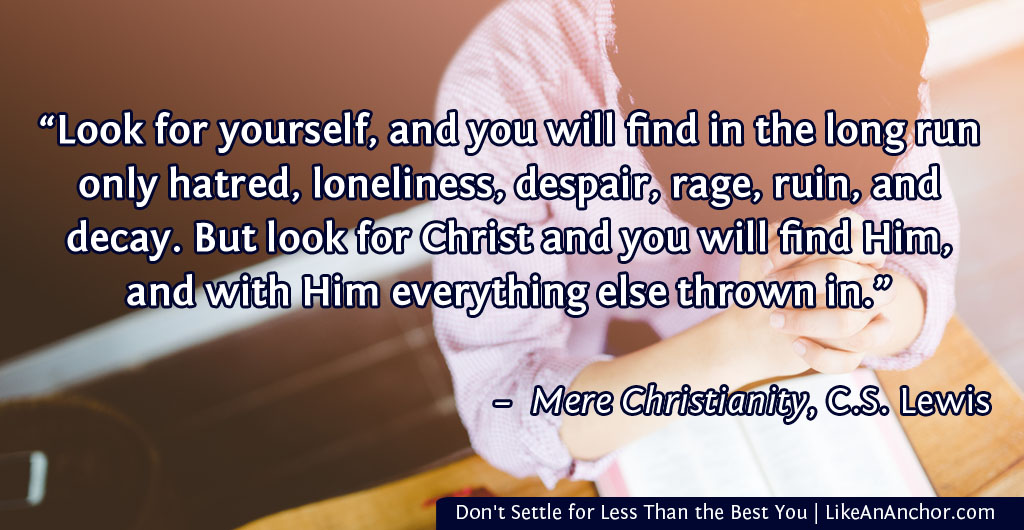
If we try to do things on our own, we’re settling for less than the best. That includes settling for a version of ourselves that is missing something essential from our Creator. If we go through life focused on self, even if that simply means trying to be good apart from God, we will not find happiness. But, to quote the final line of Mere Christianity, “look for Christ and you will find Him, and with Him everything else thrown in.”


The quotes I took from Mere Christianity are all found near the end of the book (several from the final chapter). If you’d like to read everything leading up to them, I highly recommend this book. Here’s a link where you can buy it. (Please not that this is an affiliate link, which means if you click and make a purchase I’ll receive a small commission at no additional cost to you.) If you’d like to read Mere Christianity without buying it, the full text is available online.

Featured image credit: Ruby-Rose via Lightstock
Don’t Give Up! Keep Running Your Race of Faith Without Looking Back

Do you ever feel stuck in the past and discouraged by how hard it is to move forward? You’re a Christian and you know that’s supposed to give you hope, but somehow that just doesn’t seem to be the case.

It’s disheartening to feel as if you can’t move forward from your past or that there is no way out of your present. Especially if you feel like you’ve done something so wrong or your circumstances are so hopeless that there’s no point trying to fix things. These sorts of worries weigh us down emotionally and spiritually. They can make us feel heavy, foggy, and hopeless (and may lead to other symptoms of depression as well).

Jesus never promised that life as a Christian would be without trials. He only promised to help us through those trials, and since He has all power and authority in heaven and earth this is an incredible promise (Matt. 28:18). It can be easy, though, to lose sight of the big picture and get distracted by all sorts of nasty things that cling to us, weighing us down and making it hard to keep moving forward. We might wonder how to get unstuck, or even if it’s possible.

The Cage Door Is Open

One thing I’ve realized is that most of the things that are holding onto me are also, at least to some extent, things that I’m holding onto right back. Jesus promises to make us free and to wash us clean of any sin. If we stay in a cage or keep rolling in the dirt, then it’s not because He has failed in some way. It’s because we’re still susceptible to the attacks of the enemy and the pulls of the world.

I don’t say this to make us feel guilty or ashamed (that’s another thing that weighs us down, and shame is not a productive emotion). I want to encourage you to shift your perspective. Instead of seeing yourself as a victim trapped in a locked cage made from whatever’s holding on to you (fear, past sins, personal shortcomings, etc), you can picture yourself as someone in an open cage where God is holding the door and asking you to come out. He knows it’s hard. He knows it’s frightening. He knows there are often circumstances outside your control that keep pulling you backwards. But He isn’t giving up and He’ll be there patiently helping you for as long as it takes. Read more