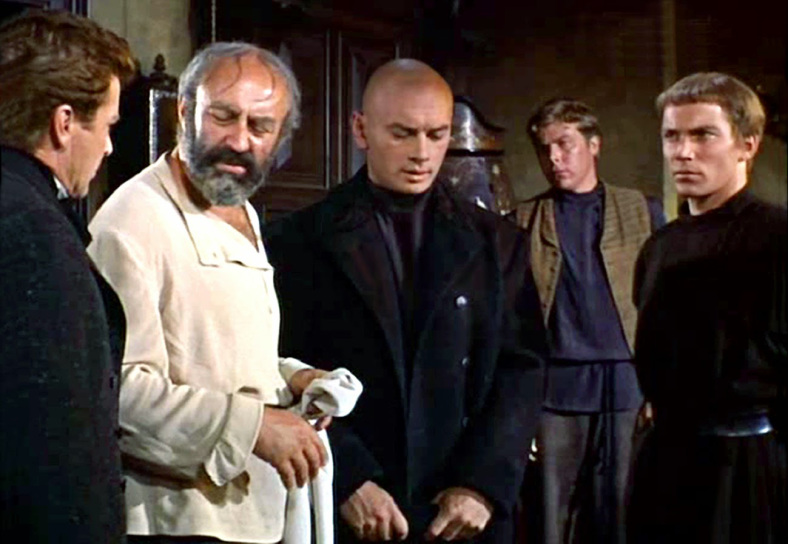
Today we’re going to talk about INFJ heroes in fiction, especially male heroes. But before we get to that, let’s talk about Russian literature for a moment. The Brothers Karamazov by Fyodor Dostoevsky opens with an apologetic explanation from the narrator about his hero, Alexei Fyodorovich Karamazov. Here are a few highlights:
“While I do call Alexei Fyodorovich my hero, still, I myself know that he is by no means a great man …
One thing, perhaps, is rather doubtless: he is a strange man, even an odd one. But strangeness and oddity will sooner harm than justify any claim to attention …
If I, that is, the biographer himself, think that even one novel may, perhaps, be unwarranted for such a humble and indefinite hero, then how will it look if I appear with two; and what can explain such presumption on my part?”
p.3-4, Pevear/Volokhonsky translation
As you may have guessed from the title of this post, Alyosha is an INFJ (most characters and the narrator use this nickname throughout the novel. In the Cyrillic alphabet, Alyosha is two letters shorter than Alexei, which makes this something like calling a man named Robert “Bob”). And I suspect that it’s his personality type that makes the narrator so worried about how people will respond to his hero.
It’s not that there aren’t other INFJ heroes in fiction. Just take a look at my post about 10 Stories You’ll Relate To If You’re An INFJ if you want some examples. Jane Eyre, Amélie, Yoda, and Atticus Finch are all INFJs in fiction who play a hero role. But even though there are male characters on this list, I’m going to go out on a limb here and say that if Alyosha was a woman with all the same personality characteristics the narrator wouldn’t have felt the need to apologize for her.
FJ-type men
A large percentage of women in real-life are FJ types. There’s a much smaller percentage of FJ-type men. ENFJ and INFJ men are particularly rare, each only making up 1% to 3% of the population. Because of this many FJ qualities are stereotyped as “feminine” (even though they really shouldn’t be exclusive to one sex) and FJ guys don’t always fit with society’s idea of how men “should” act.
I’ve talked with several ENFJ and a few INFJ men about this issue, and I know it comes up for ESFJs and ISFJs as well (though to a lesser extent, since Sensing types make up about 70% of the population and they tend to “fit in” better). Because FJ types interact with the world using a function called Extroverted Feeling, they tend to show up as more relational and emotional than Western culture typically considers “manly.”
In her TED talk “Listening to Shame” Brené Brown talks about how shame is “organized by gender.” For men, shame is tied up in one expectation: “do not be perceived as weak.” She talks about one man who told her, “when we reach out and be vulnerable we get the shit beat out of us.” But that’s exactly what FJ types are hardwired to do — to reach out and connect with people in a vulnerable, empathic way.
FJ types are deeply relational people who seek to create harmony in human relationships. I know it takes incredible strength to make peace instead of sow discord, but society at large doesn’t see it like that. If you’re a woman you might get away with preferring harmony to conflict, but it’s perceived as weakness in men if they choose peace instead of standing up for themselves.
He was “already very strange”
Let’s go back to Alyosha. The narrator takes considerable time to introducing his character in chapter 4 and his backstory reads like a textbook example of an INFJ. As the rarest personality type, INFJs often seem strange or out of place compared to the people around them and Alyosha (who enters a monastery early in the book) is no exception.
Alyosha, was not at all a fanatic, and, in my view at least, even not at all a mystic. I will give my full opinion before hand: he was simply an early lover of mankind. … However, I do not deny that he was, at that time, already very strange, having been so even from the cradle. …
In his childhood and youth he was not very effusive, not even very talkative, not from mistrust, not from shyness or sullen unsociability, but even quite the contrary, from something different, from some inner preoccupation … But he did love people; he lived all his life, it seemed, with complete faith in people, and yet not one ever considered him either naive or a simpleton.
p. 18, 19
Though I don’t particularly like the phrase, INFJs are often described as “old souls” because they tend to have a different perspective on the world than other people their age. Indeed, Alyosha is only 19 when the novel starts out and already people much older than him seek him for advice. Even his father, a self-described buffoon who doesn’t respect anyone, treats Alyosha well. In fact, it seems almost impossible to dislike Alyosha. He was never bullied by peers for being weird (something many real-life INFJs will, I’m sure, envy) and the few people who resent or dislike him as an adult are clearly an exception to the rule. They see him almost as other-worldly and above the common concerns, vices, and pitfalls of humanity as a whole (a description which reminds me of how Rochester sees Jane Eyre, another fictional INFJ).
A sensitive hero
Perhaps some of my readers will think that my young man was a sickly, ecstatic, poorly developed person, a pale dreamer, a meager, emaciated little fellow. On the contrary, Alyosha was at that time a well-built, red-cheeked nineteen-year-old youth, clear-eyed and bursting with health. He was at that time even quite handsome … it seems to me that at that time Alyosha was even more of a realist than the rest of us … to say that he was slow or stupid would be a great injustice
p. 25-26
It’s a sad fact that humans tend to think in stereotypes, but the narrator for The Brothers Karamazov is having none of that. After spending a whole chapter convincing us that Alyosha is a strange young man devoted to a faith that makes little sense to those around him, he next makes sure that readers won’t assume Alyosha is “unmanly” in appearance or in any way intellectually deficient.
This is an important point to make because Alyosha is going to continually defy the idea that a male hero has to be decisive, unemotional, or never weak. We see Alyosha dreading conflict with a loathing that I think all INFJs (and the other FJ types as well) can relate to. We see him weeping when others are hurting. We see him making social blunders in an effort to make everyone happy and at peace. We see him struggling to define his own ideas of a situation because he would like to accept what others say as true, but realizes that’s not always a good idea. He’s sensitive, emotional, undecisive on certain things (though quite decisive in others), and isn’t afraid to appear weak so long as he’s being true to his beliefs.
Why we need FJ men in fiction
INFJs often seem like a (barely) functioning bundle of contradictions. We’re conflict-avoidant, but will stand up passionately to defend someone we love or a belief that’s very dear to us. We can be among the most intellectual of the types, but also demonstrate spectacular naivete in certain areas. We want to build deep relationships, but we’re scared to peel back all the layers that would let you to get to who we really are.
When cast as fictional heroes, the contradictions can all show up in ways that might make an author feel the need to justify why such an odd creature should be given the main character role. I’m glad that they are, though. The ISTP action hero or charismatic ENTP genius can be wonderful characters, but if their stories are the only ones we tell then we’re missing something.
I think it’s especially important that we tell stories of thinking-type women and feeling-type men. A lot of traits that we assume are gender-based are actually associated more with Thinking and Feeling in personality types (though not all — I do believe God created men and women with some innate differences in how we bear His image). I don’t want to go into too much detail on this here, since I have a whole post on “Thinking” type women and “Feeling type men, but in many cases cultural expectations of gender cause more stress for women with a “T” and men with an “F” in their Myers-Briggs type.
One of the things that can help with this is seeing possessive portrayals of people with your type in fictional stories. That’s why it’s sad that there are so few Thinking-type Disney princesses. For male characters, we need nurturing, supportive ESFJs and ISFJs like Leonard McCoy and Samwise Gamgee (and more which you can read about in “7 Fictional Characters You’ll Relate To If You’re An ISFJ“). We need ENFJs who are mentors and leaders like Mufasa in The Lion King, and also ones like Neil in Dead Poet Society who force us to question the practice of shaming people for having a personality that doesn’t perfectly fit what society wants. And we need INFJ men like Alyosha Karamazov and Atticus Finch who prove you can be a hero by sticking to your convictions and fighting on behalf of the people around you.




 Like An Anchor