Crunchy Chicken Breasts with Honey Garlic Sauce

"Crunchy Chicken Breasts with Honey Garlic Sauce" by marissabaker.wordpress.comI found this amazing recipe here: Double Crunch Honey Garlic Chicken Breasts. I thought it would be harder to make, but it’s really very simple. To make it even easier, I’ve found that you can just use chicken tenders instead of slicing chicken breasts in half or pounding them thin.

The original Honey Garlic Sauce was a bit too sweet for our tastes, so I amended the recipe slightly. That’s the version I’m posting here.

Crunchy Chicken Breasts with Honey Garlic Sauce

print this recipe

"Crunchy Chicken Breasts with Honey Garlic Sauce" marissabaker.wordpress.com
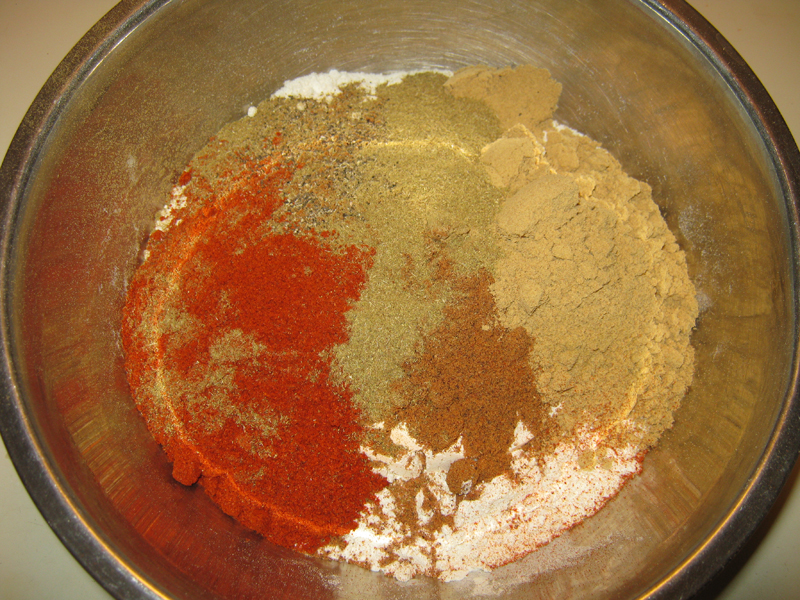
Mixing the breading

2-3 boneless skinless chicken breasts, cut or pounded into half-inch thick pieces. (I typically use chicken tenders and cook two for each person.)

canola oil for frying

Breading

2 cups flour

3 teaspoons salt

4 teaspoons black peppercorns

3 Tablespoons ground ginger

2 teaspoons ground nutmeg

"Crunchy Chicken Breasts with Honey Garlic Sauce" marissabaker.wordpress.com
This chicken smells so good frying

2 teaspoons ground thyme

2 Tablespoons paprika

Wash

1 egg

2 Tablespoons water

Sauce

2 Tablespoons olive oil

3-4 cloves garlic, minced

"Crunchy Chicken Breasts with Honey Garlic Sauce" marissabaker.wordpress.com
Put the sauce in a deeper pan than you think you’ll need, or it might boil over

¾ cup honey

¼ cup rice wine

¼ cup soy sauce-free

1 Tablespoon tapioca starch

1 teaspoon black pepper

Sift together the breading ingredients. (Note: This flour and spice mix is enough for two or three batches of this chicken. Leftover mix can be stored in a Ziploc bag in the freezer).

Whisk together the eggs and water. Dip chicken tenders in the flour and spice mixture. Dip chicken into the egg wash and then again into the flour and spice mix, pressing the mix into the meat to get good contact.

"Crunchy Chicken Breasts with Honey Garlic Sauce" marissabaker.wordpress.com
I let the chicken drain on a wire rack over a glass cutting board for easy clean-up

Heat a skillet on the stove with about a half inch of canola oil covering the bottom. Carefully regulate the temperature so that the chicken does not brown too quickly (just below medium heat works well). Fry them gently for about 4 or 5 minutes per side until golden brown and crispy. The chicken is thin enough that this should cook it through. Once cooked, drain on a wire rack for a couple of minutes.

In a medium saucepan add the 2 tbsp olive oil and minced garlic. Cook over medium heat to soften the garlic but do not let it brown. Add the honey, soy sauce and black pepper. Simmer the Honey Garlic sauce together for 5-10 minutes, being careful not to let it foam up over the edges. Remove from heat and allow to cool for a few minutes.

Dip the cooked chicken in Honey Garlic Sauce and serve over rice or noodles.

What Makes Us Remarkable

After healing a lame man in Acts 3, Peter and john are brought before the Jewish leaders to explain their actions. After hearing from Peter “that by the name of Jesus Christ of Nazareth … this man stands here before you whole,” the leaders marveled at them.

Now when they saw the boldness of Peter and John, and perceived that they were uneducated and untrained men, they marveled. And they realized that they had been with Jesus. (Acts 4:13)

When looking at Peter and John, the only exceptional thing the Jewish leaders noticed about them was that they had been with Jesus. Even the people working against Christ’s teachings could recognize that being in His presence had changed these fishermen who would otherwise be considered unremarkable.

Wisdom of the Poor Man

Not surprisingly, a similar thing happened to Jesus. He was not what people expected the Messiah to be, and some people rejected Him because He seemed so ordinary.

And when the Sabbath had come, He began to teach in the synagogue. And many hearing Him were astonished, saying, “Where did this Man get these things? And what wisdom is this which is given to Him, that such mighty works are performed by His hands! 3 Is this not the carpenter, the Son of Mary, and brother of James, Joses, Judas, and Simon? And are not His sisters here with us?” So they were offended at Him. (Mark 6:2-3)

"What Makes Us Remarkable" by marissabaker.wordpress.comThese people missed out on knowing the son of God because they rejected the wisdom of the poor man (Ecc. 9:16). All too often, we fall into the trap of rejecting someone because of an unfavorable first impression based on a stereotype rather than actually knowing them. Rejecting someone because of their lack of education and credentials isn’t solely confined to intellectuals, but I’m afraid it’s a trap that educated people might be more likely to fall into than others.  I’m very much in favor of education, but I do agree with this quote by Dr. J. Budziszewski: “there are some forms of stupidity that one must be highly intelligent and educated to commit.”

Now about the middle of the feast Jesus went up into the temple and taught. And the Jews marveled, saying, “How does this Man know letters, having never studied?” (John 7:14-15)

Instead of asking how they could know Jesus better, or listening when He explained that “My doctrine is not Mine, but His who sent Me,” the people accused Him of having a demon (John 7:16-20). Seeing this kind of rejection towards Jesus, it should not surprise us if people reject us as well. Christ warned His followers,

“If the world hates you, you know that it hated Me before it hated you. If you were of the world, the world would love its own. Yet because you are not of the world, but I chose you out of the world, therefore the world hates you. Remember the word that I said to you, ‘A servant is not greater than his master.’ If they persecuted Me, they will also persecute you.” (John 15:18-20)

That’s Not Fair

Not only will we be considered ignorant and foolish by the world for our belief in God, but in addition to that we are not usually remarkable by worldly standards before our calling either.

But God has chosen the foolish things of the world to put to shame the wise, and God has chosen the weak things of the world to put to shame the things which are mighty; and the base things of the world and the things which are despised God has chosen, and the things which are not, to bring to nothing the things that are,  that no flesh should glory in His presence. But of Him you are in Christ Jesus, who became for us wisdom from God — and righteousness and sanctification and redemption — that, as it is written, “He who glories, let him glory in the Lord.” (1 Cor. 27-31)

There’s a verse in Ecclesiastes that I’ve often seen used to talk about how life doesn’t always seem logical or fair that comes to mind in this context.

I returned and saw under the sun that — the race is not to the swift, nor the battle to the strong, nor bread to the wise, nor riches to men of understanding, nor favor to men of skill; but time and chance happen to them all. (Ecc. 9:11)

"What Makes Us Remarkable" by marissabaker.wordpress.comUsually when we talk about the unfairness of life, we only think of what is working against us. But “unfairness” happens in our favor as well. We just read in 1 Corinthians that we’re the weak, base, and poor of the world — where would we be if God only let the swift run the race (Heb. 12:1), only worked with the strong to win battles (Eph. 6:12-12), only fed those who were already wise (Mark. 6:34-42), only gave understanding to rich men (Mark. 10:23-25), and only showed favor to those who are skilled (Ex. 4:10-12)?

Chicken Fried Rice

fried rice

I have a confession to make: for many years I made chicken fried rice using a boxed dinner because I was intimidated by this dish. It seemed like it would be so simple, but when I tried one recipe I found online it was a soggy mess that tasted like licorice because of the Chinese five-spice. Just recently, I finally found another recipe to try (this one a simple side-dish), and I expanded it into this chicken fried rice. The secret to avoiding sogginess is to use rice that has been sitting in the refrigerator for a day or so, which gives it a chance to cool and dry-out a little. I still don’t feel I’ve quite mastered the art of keeping the egg on only one side of the skillet while scrambling it, but at least when we want fried rice we’re not eating dinner out of a box any more.

Chicken Fried Rice

IMG_4000print this recipe

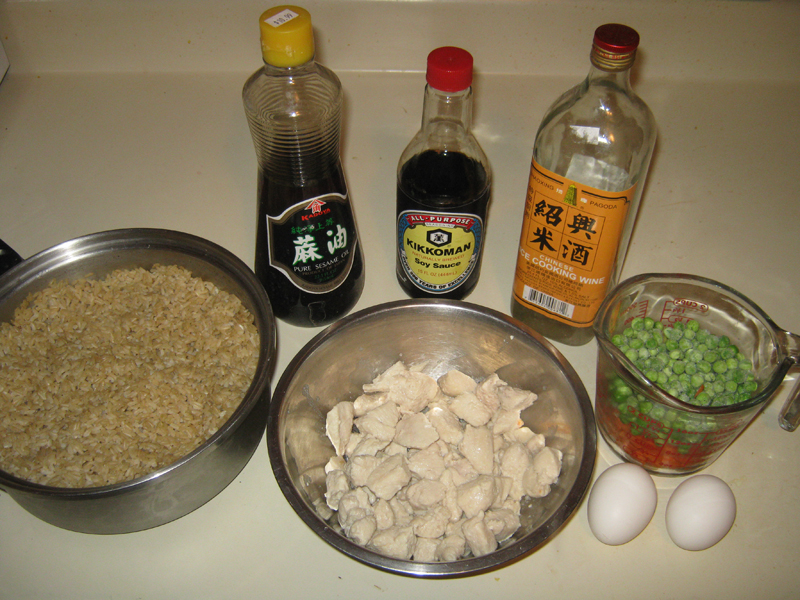
1 pound chicken, cut into chunks

1 teaspoons sesame oil and 1 teaspoon canola oil

3 Tablespoons sesame oil

1/2 cup peas

1 cup diced carrots

1-2 green onions, thinly sliced

2-3 cloves garlic, minced

2 eggs, lightly beaten.

4 cups cooked white or brown rice (day old or leftover rice works best)

1/4 cup soy sauce

1 Tablespoon rice wine

3/4 teaspoons ginger

1/4 teaspoon black pepper

IMG_4002Heat 1 teaspoon sesame oil and 1 teaspoon canola oil in wok or large skillet. Fry chicken in hot oil until cooked through. Remove when done.

Add 3 Tablespoons sesame oil to the wok and heat over medium heat. Add the peas, carrots, onion, and garlic. Stir-fry until tender. Push the mixture off to one side, then pour eggs on the other side of the skillet and stir-fry until scrambled.

Add rice and stir. Add soy sauce, rice wine, ginger, and pepper. Stir to blend. Continue stir-frying until thoroughly heated, then serve.

print this recipeIMG_4003

So That’s What All Those Letters Mean — An Introduction to the MBTI

After many years of being intrigued by personality types, and Myers-Briggs in particular, I am finally reading Isabel Briggs Myers’ book, Gifts Differing. I wish I’d read it sooner — aspects of the theory that it took me years to learn about through casual reading are all explained in chapter 1. I wish I’d stumbled across an article talking about what all those letters actually mean earlier, or that I’d thought to read the book.

Since the best way to really learn something is to teach it, and in order to write the article I wish I’d read years ago, here is my own version of an introduction to the Myers-Briggs Type Indicator (MBTI).

Disclaimer: some of the links in this post are affiliate links. This means that, at no additional cost to you, I will receive a commission if you click on the link and make a purchase on that website.

Note: All quotations are from the 1995 reprint of Gifts Differing.*

Judging and Perceiving.

As Isabel Myers explains it, the principle behind typology is to understand how and why other people’s minds work differently from our own. In chapter one, she says, “the theory is that much seemingly chance variation in human behavior is not due to chance; it in in fact the logical result of a few basic, observable differences in mental functioning.”

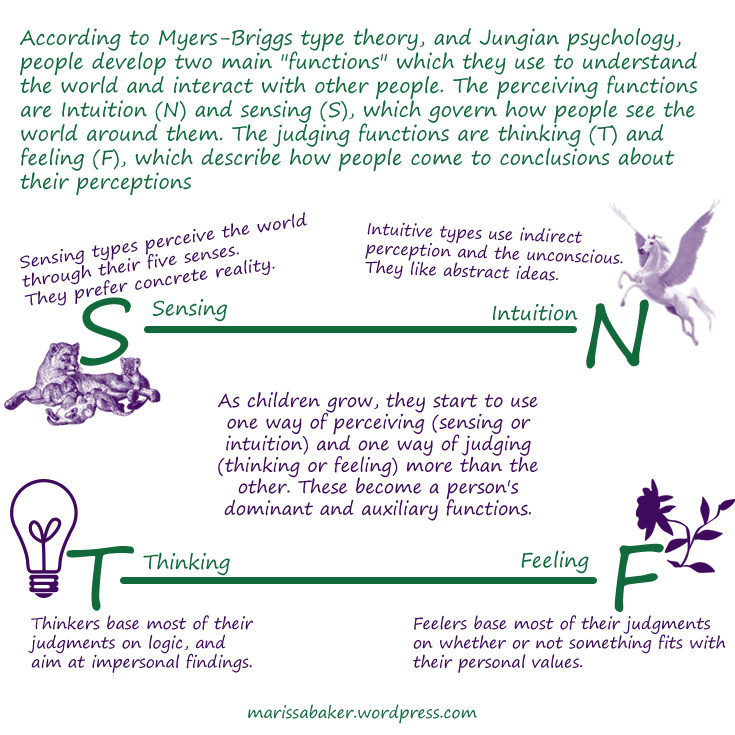
Myers-Briggs typology, and Jungian psychology, say that people have two main psychological “functions” which they develop and use to understand the world and interact with other people. The perceiving function includes “the process of becoming aware of things, people, occurrences, and ideas.” Intuition (N) and sensing (S) are two different ways of perceiving. The judging function “includes the process of coming to conclusions about what has been perceived.” Thinking (T) and feeling (F) are two different ways of judging.
So That's What All Those Letters Mean -- An Introduction to the MBTI by marissabaker.wordpress.com

As children grow, they start to use one way of perceiving (sensing or intuition) and one way of judging (thinking or feeling) more than the other. They become comfortable with the preferred perceiving and judging functions, and learn to use them much more effectively than the neglected function. This results in four possible combinations: sensing plus thinking (ST), sensing plus feeling (SF), intuition plus feeling (NF), and intuition plus thinking (NT).

Finding Dominant Functions

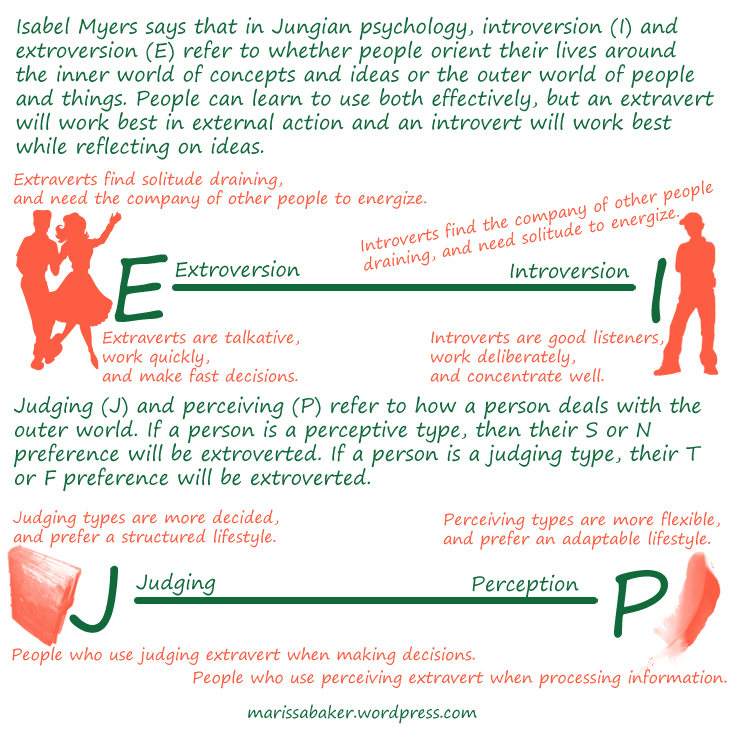
Isabel Myers says that in Jungian psychology, introversion (I) and extroversion (E) refers to whether people orient their lives around the inner world of concepts and ideas or the outer world of people and things. Every healthy person uses both introversion and extroversion, but there will be one with which they are most comfortable. This relates to the Sensing-Intuition and Thinking-Feeling functions by dictating whether a person’s dominant function is introverted or extroverted (more on that in a moment).
So That's What All Those Letters Mean -- An Introduction to the MBTI by marissabaker.wordpress.com

The last letter in a Myers-Briggs type refers to whether a person uses a perceptive (P) or a judging (J) “attitude as a way of life, a method of dealing with the world around us.” People use both a perceiving and a judging function; one extroverted and one introverted. If a person is a perceptive type, then their perceiving preference (S or N) will be extroverted. If a person is a judging type, their judging preference (T or F) will be extroverted.

Since the Judging-Perceiving preference only refers to outer behavior, it most easily observed in Extraverts. For example, an ENFJ will extrovert their judging function and use extroverted feeling (Fe) to interact with the outer world. Because they are an extrovert, this also makes Fe their dominant function. It is supported by an auxiliary perceiving function: introverted intuition (Ni). Dominant and auxiliary functions are a bit more complicated for introverts. An ISTP type will extrovert their perceiving function and use extroverted sensing (Se). However, since they are an introverted type, their dominant function is introverted thinking (Ti) and Se is their auxiliary function . The function they use the most is a judging one, but when they interact with the outer world they use perception.

Putting The Letters Together

It is far too simplistic to take each individual letter in a Myers-Briggs type separately. To say an INFJ is an introvert/intuitive/feeler/judger misses what the MBTI can tell us about how they look at the world with Ni and how they formulate judgements with Fe, and which of those they do most easily. It also passes over the fact that introverts sometimes use extroversion and that extraverts sometimes use introversion. That’s why the short Myers-Briggs style tests you might find online that line-up descriptions of Extravert-Introvert, Sensing-Intuition, Thinking-Feeling, and Judging-Perceiving and then have people choose which one is most “like them” can be an incorrect assessment of a person’s type.

One other thing to add about Myers-Briggs types is that Isabel Briggs Myers never intended for these types to be used to make people feel “boxed in” to their personality type or to infringe on a person’s right to self-determination. An ENTP, for example has “already exercised this right by preferring E and N and T and P.” Myers-Briggs type is a tool for better understanding who we have already chosen to be, and for learning to relate to and better understand people who think differently than us.

*indicates affiliate links

Learn More …

Introduction To Cognitive Functions: The Learning Processes

Introduction To Cognitive Functions: The Decision-Making Processes

Save

Be A Well of Water

I talked about Christ’s meeting with the woman at the well last week. This week, I’d like to focus on a specific verse from that interaction:

But whoever drinks of the water that I shall give him will never thirst. But the water that I shall give him will become in him a fountain of water springing up into everlasting life. (John 4.14)

Jesus told the woman that once He gives someone the gift of living water, they continue to receive a steady supply. We learn more about this a few chapters later.

On the last day, that great day of the feast, Jesus stood and cried out, saying, “If anyone thirsts, let him come to Me and drink. He who believes in Me, as the Scripture has said, out of his heart will flow rivers of living water.” But this He spoke concerning the Spirit, whom those believing in Him would receive; for the Holy Spirit was not yet given, because Jesus was not yet glorified. (John 7:37-39)

Here, we are clearly told this water is the Holy Spirit, and shown that the fountain Jesus spoke of in John 4 isn’t a tiny trickle that supplies just enough water for the person He gives it to — it is enough to supply a river that flows out from people who Christ is working with.

Don’t Stagnate

For you were once darkness, but now you are light in the Lord. Walk as children of light 9 (for the fruit of the Spirit[b] is in all goodness, righteousness, and truth), 10 finding out what is acceptable to the Lord. As I talked about on Monday, we all need outlets to keep from becoming stagnate. We have to share what we have been given. The Holy Spirit is supposed to be flowing through us an manifesting as fruits borne in our lives. “By this My Father is glorified,” Jesus said, “that you bear much fruit; so you will be My disciples” (John 15:8).

The fruit of the Spirit is love, joy, peace, longsuffering, kindness, goodness, faithfulness, gentleness, self-control. Against such there is no law. And those who are Christ’s have crucified the flesh with its passions and desires. If we live in the Spirit, let us also walk in the Spirit. (Gal. 5:22-25)

To briefly re-cap the analogy from Monday’s post, the Sea of Galilee is a source of freshwater because it has both an inflow and an outflow. The Dead Sea, on the other hand, has no outlet and is filled with brackish water. We are like that too. We either flow with Christ’s living water, or we become dead. We can’t be both alive and hoarding God’s gifts all to ourselves — “Does a spring send forth fresh water and bitter from the same opening?” (James 3:11).

Flowing With Life

"Become A Well" by marissabaker.wordpress.comIn 2 Timothy, Paul tells Timothy that he needs to “stir up the gift of God which is in you through the laying on of my hands” because “God has not given us a spirit of fear, but of power and of love and of a sound mind” (2 Tim. 1:6-7). A similar admonition is given to the whole church: “Do not quench the Spirit” (1 Thes. 5:19). There is a very real danger if we do not use the talents that God had given us (Matt. 25:14-20).

Every branch in Me that does not bear fruit He takes away; and every branch that bears fruit He prunes, that it may bear more fruit. (John 15:2)

We do not want to be the ones that the Father prunes out of the True  Vine for lack of fruit. We are to become more and more skillful “in the word of righteousness” and at some point grow to the point that we can “be teachers” (Heb. 5:12-14). We need  to learn this now, because in the future the Church will be teaching alongside Jesus Christ as His bride, living and working with the One who promises, “I will give of the fountain of the water of life freely to him who thirsts” (Rev. 21:6).

And he showed me a pure river of water of life, clear as crystal, proceeding from the throne of God and of the Lamb. (Rev. 22:1)

If we don’t become a well of water now, overflowing with God’s spirit and the fruts thereof, we will not be included in the inhabitants of the city that flows with God’s living water.

Snickerdoodles

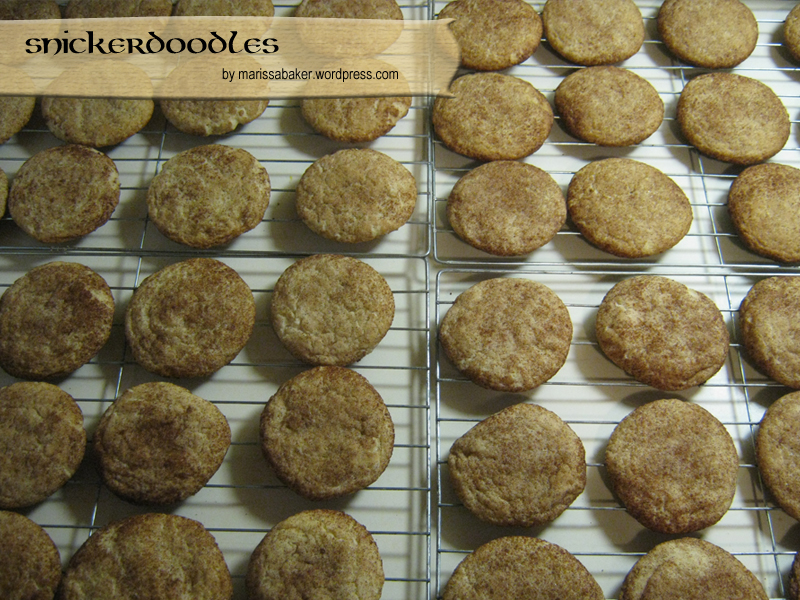
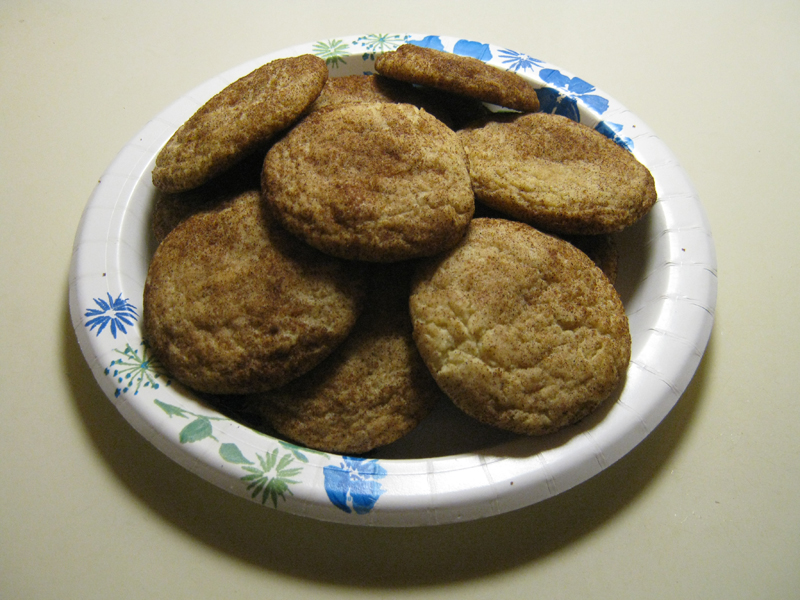
This is my favorite cookie. You need to plan ahead a little, since they will not bake right if the dough isn’t chilled first, but otherwise they are very easy to make. The recipe is from a close family friend, who was kind enough to bake them for me on a frequent basis when I was a child, and then gave me the recipe when I started baking in my own kitchen.snickerdoodles

Snicker Doodles

IMG_3981 print this recipe

1 cup butter

1-1/2 cups sugar

2 eggs

1-3/4 cups white, unbleached flour

1 cup whole wheat flour

2 teaspoons cream of tartar

IMG_39891 teaspoon baking soda

1/4 teaspoon salt

1 Tablespoon brown sugar

2 Tablespoons cinnamon

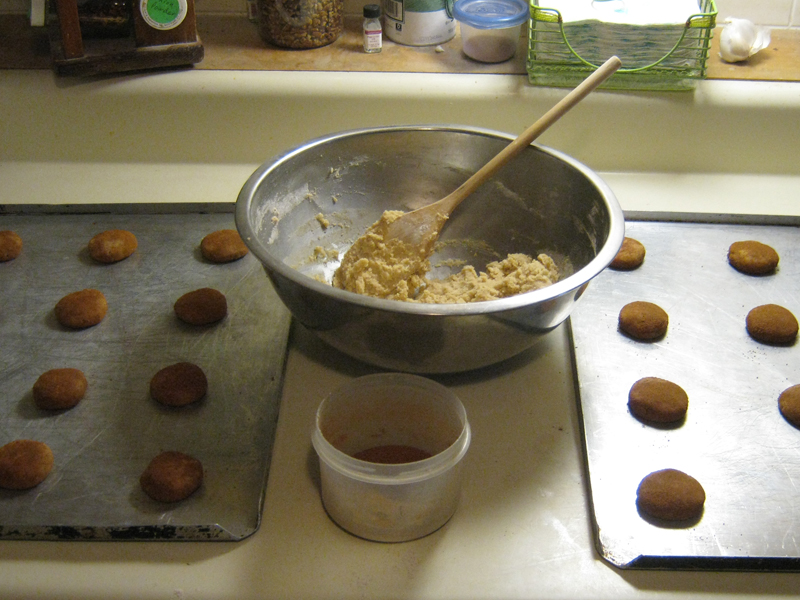
Mix butter and sugar until smooth. Add eggs and beat to incorporate eggs. Add dry ingredients and stir to combine. Chill dough thoroughly, at least 1 hour.

IMG_3992Remove from refrigerator and roll into balls the size of a walnut. Roll each cookie in mixture of brown sugar and cinnamon.

Place about 2 inches apart on ungreased cookie sheet. Bake until light brown but still soft, 7-9 minutes at 375°F. Do no over-bake.

print this recipe