Buying More Books

marissabaker.wordpress.comBefore I get into the subject of today’s post, I won NaNoWriMo! I hit the 50,000 word mark last Wednesday night. I think that puts me about 2/3 of the way through my plot outline, so I didn’t technically write a novel in a month. Still, 50,000 words is pretty impressive, if I may say so myself.

I have a fairly large library. Just over 1,100 books in total, according to the list I keep on my computer (I’ve been told this is “too many books” but I’m not convinced there’s any such thing). Even so, I’m constantly buying new books. The problem is, I have a limited book budget. That doesn’t mean I have to stop getting new books though. Here are some of my sources for finding more books without spending too much money.

Paper Back Swap

This is an amazing website: PaperBackSwap.com.  You post books you want to get rid of (yes, that sometimes happens), and when other members claim them you get a credit that can be used to request posted books. The only cost is shipping out books to other members. Unfortunately, many of the books I want have wait lists, but even so I’ve received enough books that the website estimates I’ve saved $84.17. Not too shabby. And I have 16 credits for whenever my wishlist books become available.

Trading Book Stores
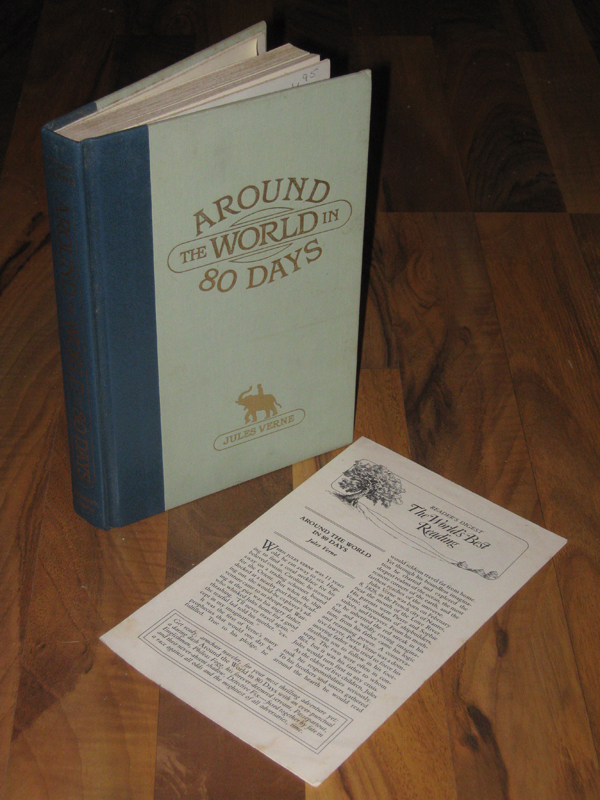
"Buying More Books," tips for economically growing your library. marissabaker.wordpress.comThere is a wonderful trading bookstore not half an hour’s drive from here that sells new and used books. My favorite way to approach this store is to turn in books my aunt no longer wants on her shelves, and then bring home books for me 🙂 That’s how I found books like my hardcover edition of Jules Verne’s Mysterious Island, several fairy tale volumes, and where I bought my first Reader’s Digest World’s Best Reading edition (not to be confused with those Reader’s Digest condensed book collections).

Library Book Sales

My local library has a book sale once a month. For a small fee, I’m a Friend of the Library and can get into the member pre-sale. Books sell for between $.025 and $1.00. Some months I buy nothing, sometimes I can hardly carry them all back to the car. If you don’t know when your local book sales are, try checking BookSaleFinder.com.

For Specific Books

For general book shopping, the three resources above are great. But if I’m looking for a specific title or edition. Amazon and Half.com are my go-to sites. If I want the book store experience, there’s three Half Price Books within about an hour’s drive.

Is there anywhere else you’d recommend looking for books to economically increase the size of your library? I’d love to hear your ideas. Also, if you have any ideas about finding more room for books, I’m starting to run out of space on my bookshelves …

My Favorite Fantasy Books

"My Favorite Fantasy Books" marissabaker.wordpress.comI’m writing a fantasy novel for NaNoWriMo this year, and since I have that genre on my mind, I thought I’d share a list of my favorite fantasy books. Maybe someday the novel I’m writing will be on another blogger’s favorite books list.

Books In No Particular Order

Concerning Hobbits

Though it is often considered childish compared to The Lord of the Rings, and I’ve heard that Tolkein wished he’d had time to re-write it, The Hobbit is my favorite book by J.R.R. Tolkein. I love all the books of Middle Earth for what Tolkein can teach me about writing fantasy, but just to sit down and enjoy reading a book I pick up The Hobbit.

“It’s all in the wardrobe just like I told you!”

childrens_storyThe Chronicles of Narnia by C.S. Lewis are a few more “children’s books” that I didn’t read until I was in my late teens, and not all at once. I think I read The Lion, The Witch, and The Wardrobe when I was 16, then The Magician’s Nephew, and finished the series a few years after that. I suppose it is fitting that I didn’t appreciate Narnia until I was older, since it was C.S. Lewis who said, “Some day you will be old enough to start reading fairy tales again.”

I’m Okay With Corlath Kidnapping Me

I mentioned The Blue Sword by Robin McKinley on my previous book list, but it belongs on here as well. I like the way McKinley handles magic in this world, the lore she weaves through the story, and the strong characters she creates. Some of the most interesting characters are not even human — the heroine’s incredible war horse and a hunting cat named Narknon.

How To Melt Wizards

I don’t hesitate to laugh-out-loud when I’m reading books, and The Enchanted Forest Chronicles by Patricia C. Wrede kept me giggling most of the time I was reading. I received some pretty puzzled looks from my family, until my sister read the four books and laughed almost as much as I did. The first book, Dealing With Dragons, is the best, and features a princess who asks a dragon to take her captive so she can avoid marriage, then proceeds to chase off all the princes who try to rescue her.

Dancing Bears

The Shadow of the Bear by Regina Doman is the first in a series of modern fairy tale retelling. It’s based on “Snow White and Rose Red.” Bear (aka Arthur Denniston) is one of those fictional men I fell in love with as a teenager the moment I read the scene where he dances with Blanche. I also really like the cover art for the first edition.

“True love is the best thing in the world, except for cough drops.”

If you like the film The Princess Bride, you’ll love the book by William Goldman. I recommend the 30th Anniversary Edition, so you can read Goldman’s introductions. He talks about being on-set for filming (which was, of course, done on location in Florin). It can be fun trying to figure out what actually happened and what didn’t (and whether or not it really matters).

McKinley Fairy Tales

Rose Daughter by Robin McKinley is my favorite “Beauty and the Beast” retelling, and is also the only novel of hers that I’ve thought had a thoroughly satisfying ending. Her retelling of “Sleeping Beauty,” Spindle’s End, also deserves an honorable mention just for the fact that magic in that world is so thick and tangible they have to dust if off the kitchenware before cooking.

Visionary Fiction

A Sword For The Immerland King, by F.W. Faller, is the book that introduced me to “visionary fiction.” His website defines it this way:

a fiction, stated as fact to allow the reader to explore the greater life issues in the safety of a good armchair, to wonder at their own shortcomings and marvel at the confidence of others who inspire them to vision and purpose in their own lives. It is allegory and truth rolled together in a plausibility that transcends time and space and gives us pause to ponder who we are and where we are going.

What Faller does with his world of Tessalindria reminds me of Tolkein’s work with Middle Earth, and what I’m hoping to do with Ves’endlera.

An Oracular Pig

The Chronicles of Prydain by Lloyd Alexander, follow the adventures of an assistant pig-keeper named Taran. It spans five books and is, I suppose, technically another series of children’s books. One of the most interesting things about these novels is that they are based in part on Welsh legends. The author uses some names from the original legends and hints of Welsh geography (which he warns is “not to be used as a guide for tourists”), then inserts main characters born out of his own imaginings.

Worlds of Ink

Inkheart, Inkspell, and Inkdeath are the three books in the Inkworld series by Cornellia Funke. Setting aside the great fantasy content for a moment, these are beautiful books. Each chapter begins with a quotation and ends with a sketch. They are books about books, with main characters being read into the real world and back into books and blurring the lines between reality and fiction.

A Completely Subjective Book List

Sometimes I like reading posts titled things like “Books Every Family Should Have In Their Library,” “Best YA Books of All Time,” and “Top 100 Fantasy Books Ever.” While I’ll occasionally get an idea for a new book to read, I usually end up checking to see if they’ve “rightly” included any books I like or “wrongly” included books I hate. One thing that always amuses me, at least slightly, is how all these lists propose to be good for every family or include all the best books even though it’s clear all such lists are completely subjective.

For this list, I’m not even going to try to be objective or include all the best books. This is an unabashed list of my favorite books, which I irrationally think everyone should read and enjoy just as much as I do. They aren’t even organized alphabetically — just whichever popped into my head first.

My “Must Read” Books

Mara: Daughter of the Nile

My mother gave me Mara, by Eloise Jarvis McGraw, when studying ancient Egypt in elementary school and I’ve read it pretty much every year since. It has everything a book needs — strong characters, good writing, and intriguing plot. On top of the admirable writing is danger, mystery, and romance. Spies! Double agents! Political intrigue! It also features the most romantic (possibly the only romantic) attempted murder in literary history. If I’m forced to choose just one favorite book, this is the one I pick.

Ender’s Game

Moving from one of my oldest favorites to one of the newest. I first read Ender’s Game by Orson Scott Card at the end of last year. It’s brilliant. I’ve written about it before, so I won’t spend much more time telling you how wonderful this book is, especially the characters. I cried buckets of tears in the last chapter.

The Blue Sword

Written by Robin McKinley, this may very well be my favorite fantasy book. Like Mara, The Blue Sword features a strong female protagonist and an irresistible hero (let me just say Corlath is the only person who I wouldn’t mind being abducted by [this statement will make sense if you read the book]). McKinley’s world building, characters, and story are excellent. My only quibble with this story is that, like many of her books, it doesn’t really end. It’s as if the author wasn’t sure how to end the story, so she slapped an epilog on and called it the last chapter. Perhaps I should just say that is part of the book’s irresistible charm.

Pride and Prejudice

I know it’s a terribly predictable title to include — couldn’t I have at least chosen one of Jane Austen’s lesser-known works? But I’ve read all six of Austen’s major novels at least once (some two or three times), and Pride and Prejudice remains my favorite. Maybe it’s the fact that people type Lizzie Bennet as an INFJ (which I’m not entirely convinced of, but it would explain why I identify with her so much). Perhaps it’s because Mr. Darcy is my favorite of Austen’s men. Whatever it is, Pride and Prejudice is firmly on my recommended reading list.

Fairy Tales

Not a single book, but it would take to long to list them all separately. I recommend Jack Zipes’ translation of The Complete Fairy Tales of the Brothers Grimm, augmented liberally with Hans Christian Anderson and Charles Perrault. The reasons for this have been explored at length in my posts Fairy Tales and Dark Fairy Tales, so I’ll not devote any more time here on describing their merits.

A Gown Of Spanish Lace

Roses for Mama

I read Christian fiction on an irregular basis, usually because I want a easy-to-read book that doesn’t require much thought to digest and might supply some spiritual encouragement (yes, I know that sounds terrible). In spite of my generally low expectations, two books by Janette Oke have made it to my favorites list. A Gown of Spanish Lace has outlaws.  Roses for Mama is simply charming.

Dinotopia

If I was offered the chance to move to any fictional place I wanted, I’d pack up right this minute and relocate to James Gurney’s Dinotopia. Who wouldn’t want to live in world filled with dinosaurs and without any worries about money? Specifically, I want to visit Waterfall City and the coastal towns along Warmwater Bay where you can swim with cryptoclidus. Once you’ve read Gurney’s first book Dinotopia: A Land Apart From Time, I advise moving on to Dinotopia Lost by Alan Dean Foster. I’ve read that one at least four times.

Slightly Bad Leah

As I mentioned last week, I recently finished reading Liz Curtis Higgs’ Bad Girls of the Bible series. Slightly Bad Girls, the last book, is a slightly different format than the first two. Higgs only covered five women’s stories — Sarah, Hagar, Rebecca, Rachel, and Leah — which allowed her to spend more time with their stories.  The fictional accounts span at least two chapters for each character, which allows a longer story-arch for each woman than in the two previous books.

Leah

Leah’s  story was the one I found most interesting. There is so much we don’t know about her. For example, we know Jacob was livid when he woke to find Leah in his bed instead of Rachel (Gen. 29:21-24), but we have no idea how Leah reacted to her father switching brides (or what Rachel’s opinion was for that matter).

I wonder what Leah was thinking. Was she so scared of her father that she didn’t dare disobey when he “brought her to Jacob” (Gen 29:23)? Did she want to get out of her father’s house so much she would have married anyone? Was she trying to steal Rachel’s husband? Perhaps she was in love with Jacob and hoped he would return that love once they were married (I don’t have much experience with relationships, but I’m pretty sure impersonating your unrequited-crush’s bride on their wedding night is not the best way to make him fall in love with you).

God’s Love

One of the most interesting verses in Leah’s story is this:

When the Lord saw that Leah was unloved … (Gen. 29:31)

Setting aside for the moment how terrible it was for Leah to be unloved, let’s think about how incredible God’s compassion was for her. He saw her and He  “listened to” her prayers (Gen.30:17). Isn’t it comforting to know that even when people who should love you don’t, God sees everything and cares deeply for our pain? It makes me think of my favorite Psalm.

O Lord, You have searched me and known me. You know my sitting down and my rising up; You understand my thought afar off. You comprehend my path and my lying down, and are acquainted with all my ways. (Ps. 139:1-3)

We serve a God who is powerful enough to do anything, and He chooses to let His attention and His compassion rest on us. For Leah, God’s care took the form of blessing her with children.

Leah’s Children

I hadn’t thought about it before, but Higgs points out that what Leah says when each of her sons was born reveal that she had a deeper faith in the God than we often give her credit for.

So Leah conceived and bore a son, and she called his name Reuben; for she said, “The Lord has surely looked on my affliction. Now therefore, my husband will love me.” Then she conceived again and bore a son, and said, “Because the Lord has heard that I am unloved, He has therefore given me this son also.” And she called his name Simeon. She conceived again and bore a son, and said, “Now this time my husband will become attached to me, because I have borne him three sons.” Therefore his name was called Levi. And she conceived again and bore a son, and said, “Now I will praise the Lord.” Therefore she called his name Judah. Then she stopped bearing. (Gen. 29:32-35)

Leah recognized that her sons were a gift from God, given to comfort her when He saw Jacob did not love her. She realized that she was heard and loved by God, and by the time she named her fourth child, Judah, she was able to offer praise to the Lord without even mentioning her hope that Jacob would learn to love her. (As an interesting side note, this is the first time the word “praise” appears in the King James translation.) I doubt Leah moved past her desire for her husband’s love, but perhaps she reached a point where her relationship with God gave her the peace needed to accept her life.

Not that I speak in regard to need, for I have learned in whatever state I am, to be content: I know how to be abased, and I know how to abound. Everywhere and in all things I have learned both to be full and to be hungry, both to abound and to suffer need. I can do all things through Christ who strengthens me. (Phil. 4:11-13)

Bad Girls of the Bible

I’ve been reading a series of three books by Liz Curtis Higgs titled Bad Girls of the Bible, Really Bad Girls of the Bible, and Slightly Bad Girls of the Bible. The first book was decided upon for a book club at church, and once I’d finished it I tracked down the other two from the library. Higgs’ writing style is a little more informal than I usually like (I found myself skipping some of her “Lizzie style” commentary), but I like the short fictionalized stories that begin each chapter and bring the woman’s story into a modern setting. I also appreciate spending an entire chapter discussing the Biblical accounts verse-by-verse, and sometimes even word-by-word, since I don’t always take the time I should to really think about the people in the Bible. I’ll talk about the first two books in the series now, but I have enough to say about Slightly Bad Girls that I think I’ll save it for another post.

Bad

Higgs’ reason for studying less-than-perfect women is that they can “show us how not to handle the challenges of life.” They can also be more relatable than women who seem perfect, and studying the weaknesses we share with women who stumbled can help us avoid pitfalls in our own lives.

The women discussed in this book are Eve, Potiphar’s Wife, Lot’s Wife, The Woman at the Well, Delilah, Sapphira, Rahab, Jezebel, Michal, and The Sinful Woman. I was really impressed with the fiction in this book. Eve becomes a sheltered rich girl, Delilah is a hairdresser, and Lot’s Wife a woman who refuses to leave her home near Mount Saint Helens. The fiction story for the Woman at the Well isn’t quite as well done, but it’s hard to come up with a modern fictionalized character to stand-in for Jesus so I think we’ll cut the author some slack.

Really Bad

I read these books slightly out of order, so this is the one I just finished. The title is a little misleading — it’s more like additional bad girls, rather than girls who are worse than those in the last book. Higgs describes the difference between the two books like this:
If the first Bad Girls of the Bible was all about grace, this second one is all about the sovereignty of God, the unstoppable power of God to accomplish his perfect will, no matter how much we mess up.

This book covers the Medium of En Dor, Jael, The Adulteress, Athaliah, Bathsheba, Herodias, Tamar, and The Bleeding Woman. What struck me most about this book was the Bleeding Woman’s story (from Matt. 9:20-22; Mark 5:25-34; Luke 8:43-48). This woman was bleeding for twelve years — that’s 4,380 days, plus a few extra for leap years. According to Levitical law, she was ceremonially unclean the entire time (Lev. 15:19-27). She couldn’t touch anyone, and probably had to live alone because everything she came in contact with became unclean. Can you imagine people not even wanting to be in the same house as you for twelve years? I like solitude as much as the next introvert, but that’s way too much alone-time.

When Jesus healed her, He took away not only her physical infirmity, but also her separation from other people. And He talked to her in public — not something teachers normally did with women, especially women who were still ceremonially unclean (Lev. 15:28-30). She is also the only woman in the Gospels who Jesus calls “daughter.” What an incredible story!

Writing Heroines

Last week, I wrote a post about the eight hero archetypes listed in The Complete Writer’s Guide to Heroes and Heroines: Sixteen Master ArchetypesI’ve used this book extensively since I discovered it in the library, and I’ve found it a great help in crafting dynamic characters. Characters I wrote before reading it even fit in the archetypes, which I’m taking as a sign that I was on the right track with character development. For these characters, the descriptions have helped me edit them to be stronger and more consistent.

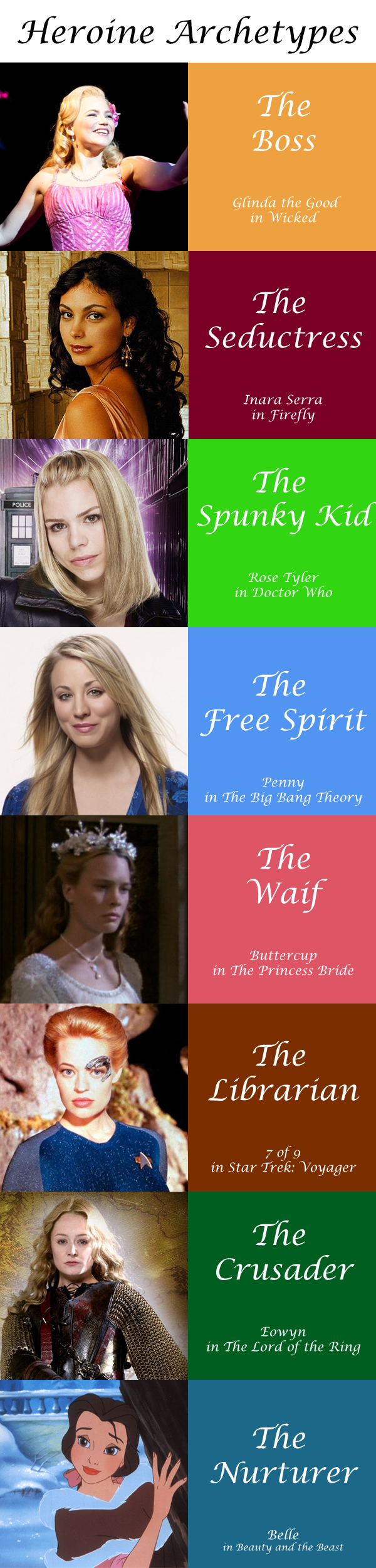
If you’re a writer and you can find a copy of the book, I highly recommend using it. If not, here’s a brief overview of each description for the eight female archetypes. All the quotes below are from the descriptions in the book.

Heroine Archetypes

Heroine ArchetypesThe Boss

This is a strong, tough character who wants to win at all costs. Typically, such a character always got her own way growing up and wants that to continue. “She will shade the truth in order to gain her objective and she is not above manipulating circumstances to make things go her way.”

The Seductress

Assertive, strong, and clever, this type of character learned at a young age she could charm people into doing what she wanted. She is cynical, driven, manipulative. “Her true desires and motives are carefully concealed behind a sensual smile. Knowledge is power, so she makes sure no one knows her” and instinctively distrusts people.

The Spunky Kid

This is the “heroine underdog.” She has a sense of humor and is reliable, supportive, unassuming, and skeptical. Sometimes, she “hides behind her sarcastic wit, and her lack of confidence may make her play down her best attributes, but she is spirited, cheerful and the most loyal of friends.”

The Free Spirit

Sincere, upbeat, and imaginative, this type of character can also be impulsive, meddling, and undisciplined. They have a strong sense of individuality and never plan anything, but always seem to land on their feet.  She is a natural entertainer, and “may be a handful for anyone who has to deal with her, but she makes the experience worthwhile in her zany, high-spirited way.”

The Waif

This character is trusting, easily influenced, kind, and insecure. She inspires others to want to save her, and is generally content to let herself be rescued. “Her delicate fragility makes her an easy target … [and] she adapts to any situation she falls into without complaint.” You’re far less likely to see her in fiction of today than the other archetypes, but that does not mean she should be avoided.

There is something refreshing about a heroine who does not talk back or fight every battle, but rather, allows a man to be a man and believes that if left well enough alone, situations will resolve themselves.

The Librarian

This type of character likes to organize everything. She is efficient, serious, dependable, rigid, repressed, and a perfectionist. She assumes she has all the answers and, “more often than not, she is right, but she can be a bit stubborn about considering other opinions.” She is also portrayed as having a passionate side when she “lets her hair down.”

The Crusader

“This is a heroine in the truest sense — deeds of valor are right up her alley.” She is courageous, resolute, and persuasive. Her flaws include obstinacy, rashness, and being outspokenly opinionated. She wants to set the word straight and “has no faith in the intrinsic merit of human nature; no belief that all will end well if left alone.”

The Nurturer

A character of this type needs to be needed. She is optimistic, capable, idealistic, self-sacrificing, and willing to compromise so she won’t hurt anyone’s feelings. Before thinking of herself, “she makes sure that all her loved ones are happy and content … Her serene, capable and patient manner invariably soothes troubled souls or hurting hearts.”

Writing Characters

There are three approaches to using these archetypes to create characters. A character could be a “core archetype,” fitting into a singe archetype and remaining consistent through the course of the story. Characters can also evolve, changing from one archetype to another because of the events of the story. Layered characters have elements of two archetypes, which may take turns being dominant but will not change over the course of the story.

An example of evolving archetypes is the Beast in Beauty and the Beast, who changes from a Lost Soul into a Chief as a result of Belle’s nurturing character. Layered characters include MacGyver (Warrior and Professor), Eliza Doolittle in My Fair Lady (Waif and Spunky Kid), and Princess Leia (Boss and Crusader).

I hope you’ve enjoyed reading about these character types, and that it sparks an idea for your own writing (or at least provided some interesting reading while procrastinating from writing 😉 ).