How To Be Friends With an INFJ

While trying to decide on my next topic, I saw that “how to be friends with an INFJ” was one of the top searches on my blog this past week. I’ve addressed the issue of friendship in some of my other posts about INFJs, but never written an entire post about it. It’s also something that has been on my mind recently, and it is a not infrequent topic of discussion between me and some close friends.

If you want to make friends with an INFJ, or get to know one better, there are a few key points to keep in mind. Some of these are true for all friendships, and especially friendships with INFJs, and others are more INF-specific. They are also a good first-step if you are romantically interested in an INFJ and want them to notice you.How To Be Friends With an INFJ | LikeAnAnchor.com
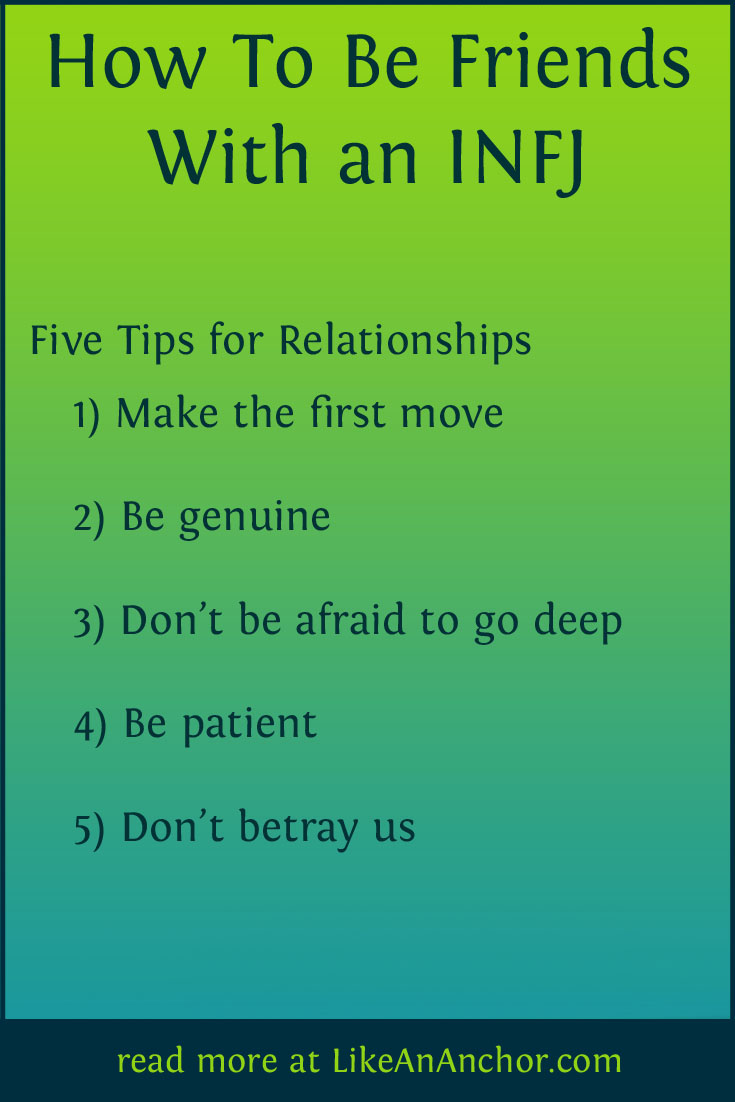
Five Tips for Relationships

1) Make the First Move

from INFJ Doodles

INFJs use extroverted feeling (Fe) to relate to the outside world. This means that we can draw energy from emotional interactions, and may appear more extroverted than other introverts. This is also true of ISFJs, who are often considered the most “extroverted” introverts since they love people so much.

Still, we are introverts, and we’re most comfortable talking with people we already know. If you want to get to know an INFJ, you’ll probably have to be the one who initiates a conversation. That lets us know you are interested in talking with us, which puts us at ease since we aren’t worried about whether or not we’re imposing on your time when you’d rather be doing something else.

2) Be Genuine

from INFJoe

Pairing Introverted Intuition (Ni) with Fe gives INFJs an almost super-human empathy. Many INFJs literally feel other people’s emotions, and we’re quick to pick up on unspoken cues that don’t match spoken words. We might not be able to tell what you’re holding back or lying about, but we can tell you’re not being genuine and that’s a huge turn off.

If an INFJ suspects you of being less than genuine, they loose interest very quickly. If you’re a new acquaintance, they might simply avoid seeing you again. If you’re someone they can’t avoid, then they will keep conversations civil but superficial. We don’t trust our true selves with people when we can’t get a read on what their true selves are like.

3) Don’t Be Afraid to Go Deep

INFJs have little interest in shallow conversations. We would rather have a few close friends than many casual acquaintances. The way the word “friend” is used has always bothered me as being imprecise. I have acquaintances, friends, and then close friends, but I just refer to them all as “friends” to avoid offending anyone who thinks they are a friend and then finds out I think of them as an acquaintance. People who meet INFJs often think that they know them well, while the INFJ thinks “they really don’t know me at all.”

If you want to be one of an INFJs close friends, then you have to make an effort to get beyond the superficial. INFJs respond very well to this, so once you indicate that you are interested in going beyond small-talk the sharing will go both ways. We like conversation, and we will talk as well as listen if we feel safe and interested. Here’s a great article called How To Turn Small Talk Into Smart Conversation. When I read this as an INFJ, my reaction was, “I wish more people would introduce themselves like this. I would be so much more interested in talking to them.”

4) Be Patient

found on Pinterest

Even if you’ve taken the first step to initiate a friendship, been completely honest, and encouraged deep conversation it can take quite a while for an INFJ to really open up. We have many layers, and the longer we are in a stable friendship with you, the more layers we’ll let you see. INFJs form instant perceptions of whether or not we can trust people, so first-impressions are important, but we also modify our impression based on how we observe your behavior over time. A bad first impression can be reversed if we see you making an effort to be friendly and trust-worthy, and a good first impression can be deepened as we see that what we’ve already shared with you stays safe.

Patience also comes into play during conversations. INFJs have trouble getting all their thoughts out into words. If the topic of conversation is something they’ve already thought about, they can speak readily and coherently. If it’s new and unfamiliar we typically do one of two things: 1) nod and make some general comments while our brains frantically race to come up with something to say. Usually that “something” shows up a week later in the shower. 2) start putting our thoughts into words, and sorting through ideas verbally. The final idea might take some time to emerge.

The second reaction is the one you’re going for in a friendship with INFJs. If we’re comfortable enough to think out-loud, it means we trust you. As long as you give us time to come up with an answer rather than look at us like we’re crazy, then we’ll relax and the conversation can continue to move forward. If you cut us off or jump to conclusions about what we think before we’ve had time to express outselves, we feel like you aren’t really interested in what we’re thinking and be hesitant to share with you later.

5) Don’t Betray Us

INFJs hold grudges. We might forgive readily (depending on the circumstances), but we don’t forget. It’s not something I’m proud of, but it is my automatic response. The closer you get to an INFJ, the harder it is to bounce-back to a close friendship after you’ve hurt us. The more we like you and the more we have invested in you, the more chances we’ll give you, but there’s a point at which we just give up and shut you out.

An INFJ might not completely sever ties with someone who has hurt them (depending on the nature of that betrayal), but they will withdraw. For example, if you give an INFJ the impression that you want to carry on a regular correspondence filled with deep discussion and then ignore her for 3 months and forget to answer any of her questions when you do reply, she will have no interest in continuing the correspondence.

Why Bother?

So why go to all this effort? What do you get out of a relationship with an INFJ?

check out this guide from Jennifer Soldner for more information about romantic relationships

For one thing, INFJs are surprisingly good fun to be around. We have a great sense of humor, delight in occasional spontaneity, and can talk about pretty much anything you like. But you don’t see all that until you make the effort to become friends. Until then, INFJs will hover in the background (away from other people) or blend in like a chameleon (with other people) to avoid stressful, superficial interactions.

INFJs are also good listeners, and we love to offer counsel. Sometimes we feel like our friends’ therapist, but we rarely mind. We want to help, and we’re good at suspending judgement. Since we’re so empathic, we aren’t often surprised by anything you tell us even if you thought you were doing a good job of keeping it hidden. Once it’s out in the open, we are sympathetic listeners who ask questions and want to fully understand what’s going on before we offer suggestions or any kind of judgements.

We’re also fiercely loyal. We don’t let many people get close, and we want to hold on to the very few that do become our true friends. We’ll do just about anything to keep the people we love in our lives. INFJs take the time to build-up their relationships, cultivate deepening friendships, and keep in touch with what’s going on in the lives of people we care about. We’re supportive, encouraging, and willing to adapt ourselves to make others happy as long as it doesn’t conflict with our core values. So get out there and start making friendships with INFJs. I don’t think you’ll regret it!

Save


Featured image credit: rawpixel.com via Pexels


If you’d like to know more about the INFJ personality type, check out my book The INFJ Handbook. I just updated it with a ton of new information and resources. You can purchase it in ebook or paperback by clicking this link.

Shy Introverts

Last week, when I wrote about reasons to homeschool introverts, I touched on the difference between “shy” and “introverted.” I said that shyness and introversion are often confused, but introversion is an inherited preference for how you recharge (alone, rather than with other people), while shyness is a fear response. We talked about how introverted children can become shy and insecure if they are told there’s something wrong with their preference for introversion, which reinforces a low self-confidence and increases feelings of shyness.

But looking at shyness this way doesn’t give a complete picture. It still assumes shyness is “bad,” while in reality the more mild forms of shyness might simply be traits of an introverted temperament. Also, for those of us who are both shy and introverted, being told that shyness and introversion aren’t the same thing is not very helpful. I agree with people who argue that introversion needs to be understood rather than overcome — introverts shouldn’t feet guilty for not being extroverts. But I’ve read articles that set out to prove introverts should be accepted just the way they are, and then turn around and start criticizing shy people for their fears and anxiety in social situations. It’s not very encouraging to be told that your introversion is okay, but you need to “get over” your shyness.

Is Shy Really So Bad?

While researching for this post, I cam across “A Quiet Rant About Introversion and Shyness” by Barbara Markway. Like this writer, I’m both an introvert and a highly sensitive person (HSP).  We’re also both shy, though not as “painfully shy” as we once were. Like her , I worry that we risk hurting shy introverts when we focus the conversation about shyness and introversion on the idea that introverts are not shy. Because some of us actually are.

Shyness is not necessarily a bad thing. It’s just viewed as bad in current American culture. Other cultures see shyness as a sign of modesty, and treat it as a virtue (Asian cultures are typically used as an example). So for those of us who are shy, quiet, and introverted, know that there’s not necessarily something “wrong” with you. Extreme shyness becomes a problem when your fear gets in the way of you choosing to move forward with things you want to do, but a little shyness  can be a positive trait depending on how you look at it.

“the shy and the introverted, for all their differences, have in common something profound. Neither type is perceived by society as alpha, and this gives both types the vision to see how alpha status is overrated, and how our reverence for it blinds us to things that are good and smart and wise.” — Susan Cain

Shyness vs. Social Anxiety

Social anxiety is where “shyness” becomes problematic. Both shyness and social anxiety disorder are motivated by a fear of social situations, but social anxiety is more of a phobia-level fear. It’s often accompanied by a physical response (nausea, sweating, heart racing), and a person with social anxiety disorder might not appear shy all the time. It’s much more complex than simply an exaggerated form of shyness, as illustrated in the essay “Social anxiety is not the same as excessive shyness” by Chris Alaimo. I recommend clicking over there and reading what he wrote if you’re interested in this topic.

“Many people are a little bit shy. If you’re shy, you might be somewhat uncomfortable in situations such as going to a party where you don’t know anyone, but you do it. You give yourself a push, you go to the party, after a while you relax and talk to people. The social phobic person, at the prospect of the same party, would be overwhelmed by such anxiety that [he or she] would have a physical reaction — perhaps nausea, sweating, heart racing, dizziness — and would avoid it if at all possible. It’s a matter of degree.” Rudolf Hoehn-Saric, MD, head of the Anxiety Disorders Clinic at Johns Hopkins University School of Medicine (as quoted on WebMD).

I actually didn’t know about this distinction until someone asked what the difference was and I did some research. Now, I’m not sure anymore whether I qualify as shy or socially anxious. Using the above example, I do experience the the heart-racing, nausea, and panic-attack reaction to going to an event, but I usually go anyway (often because a family member pushes me out of the house. Literally, sometimes). So do I have mild social anxiety, or extreme occasional shyness? I suppose it doesn’t really matter, since WebMD says the typical treatment is anti-depressants and I’m not going to do that for something that’s not having a more drastic impact on my life.

I think it’s something worth thinking about, though, for people who are very shy. One of the reasons I like type psychology is because when you know yourself, you are better able to plan for and cope with your weaknesses, as well as utilize your strengths. Along the same lines, wven if you don’t plan on seeking medical help for shyness or social anxiety, knowing there’s a name for what you’re dealing with can help make it seem more manageable, and it helps you track down information like Must-Have Coping Strategies for Social Anxiety.


Why Homeschool Introverts?

One of the big things that introverts want people to know is that “introversion is not the same as shyness.” And it isn’t — just because someone is introverted doesn’t mean they are shy, and there are plenty of shy extroverts as well (Susan Cain has an article about this). People tend to assume shyness is the same thing as introversion, but that’s just not true. Introversion refers to a preference for how someone gathers energy — they are energized by alone time rather than by being around groups of people. Shyness is fear.

But how is it that we become shy? If it’s not inborn, then we must learn it at some point, usually quite early in our lives. You might see an outgoing child become shy, but it’s rare that a socially confident adult suddenly develops traits of shyness. So what happens to turn introverted children shy?

Confusing “Shy” and “Introverted”

found on sparkpeople.com

The confusion between “shy” and “introverted” has a long history. Jung, whose work the Myers-Briggs test is based on, wrote that “the introverted attitude includes a tendency to be shy.” While extroverts can be shy (and it might actually be more difficult for them since shyness conflicts with their need to be energized by other people), shyness is more likely in introverts. A certain level of shyness might simply be part of the introverted temperament, but more extreme shyness and social anxiety is not an unavoidable part of introversion.

In his article “Are You Motivated by Your Fear or Your Preference?” Andy Mort says that understanding why introverts are believed to be shy and how that belief impacts society is important. Since introversion is so often confused for shyness, introverted children are often told that they are shy by well-meaning adults who think they need to “fix things.”

When I believed I was shy I adopted that label and acted shy; I feared certain social interactions because I didn’t want my ‘shyness’ to be picked up on, and so often withdrew. Shyness as an identity was reinforced by virtue of the fact that I believed my introverted tendencies were in fact me being shy. And the more I fought them by trying to be more extraverted, the more I withdrew (and more shy I believed I was) because I was using so much social energy. – Andy Mort

Rather than recognizing introverted children and teaching them how to be stable, confident introverts, we tell them they’re shy and try to turn them into extroverts. Someone once said, “Everybody is a genius. But if you judge a fish by its ability to climb a tree, it will live its whole life believing that it is stupid” (this quote is often attributed to Einstein, but I can’t find out if that’s accurate). Similarly, when we judge introverted children by their ability to be extroverts, we send them the message that there is something wrong with them, and we label that something shyness.

What Next?

It’s obvious that a solution to this problem has to include a flexibility that allows for people to actually be individuals. It’s one of the great ironies of today’s society that we’re obsessed with individualism, but only if it fits neatly within a certain standard. This is one of the many reasons parents choose to homeschool — to tailor the learning experience to each child’s needs.

One of the most common arguments leveled against homeschooling is that it creates shy, socially awkward children. In reality, homeschoolers are no more likely to be shy than public schooled children. In her book Introvert Power, Laurie Helgoe suggests that homeschooling is actually the best way for introverted children to learn, at least until school reforms like the ones Susan Cain discusses in this interview can be implemented.

from INFJoe

For an introverted child, homeschooling offers a chance for them to learn in their preferred environment — alone or in small groups of people they know well. Since they’re not stressed by the constant over-stimulation and energy drain of being around large groups, they’ll have more social energy available when they do interact with other children, which will help them develop stronger social skills and more confidence in social situations.

These social situations could be church gatherings, homeschool co-ops, field trips, play dates — pretty much any social activity with other children and with older or younger people. Since parents spend so much time with homeschooled children, they’ll usually know them well enough to tell when the child should be encouraged to get outside their comfort zone and make friends, and when to back-off and give them “introvert time.”

HSPs, Violence, and Guardians of the Galaxy

Honestly I have no idea what to write about for today’s post. Guardians of the Galaxy, which I recently watched? The book I just read about HSPs? How much I hate the head cold that kept me from attending a friend’s wedding?

Let’s go with a combo of the first two. My sister talked our whole family into going with her to see Guardians of the Galaxy yesterday. After being … less than impressed with the trailers, I found that I actually enjoyed the film for the most part. I’d thought it would be the characters or humor or plot that I didn’t enjoy, but that that wasn’t what bothered me.

It was the violence. You expect a certain level of violence in a Marvel superhero film. But at least in The Avengers they were trying to minimize casualties and none of the main characters enjoys killing. The Guardians (spoiler warning) do save an entire planet, but there’s a lot of collateral damage in a mining colony that no one seems concerned about, and Rocket Raccoon, Drax, and Groot are all seen laughing or grinning while killing people. The deaths are played for audience laughs too, like when Groot grows a tree limb through about 5 bad guys and batters them around inside a spaceships corridor to kill them and their companions. I think Peter Quinn and I were the only ones in the theater not laughing.

Sensitive to violence

If you take Elaine Aron’s self-test for High Sensitivity, one of the questions is “True or False: I make a point to avoid violent movies and TV shows.”

When I first took the test, I answered “false.” I wouldn’t watch things with what I considered excessive violence, but I would watch the occasional Criminal Minds episode and I had seen too many R-rated movies to count on one hand (but just barely, and most in a film class at college). Even so, during our yearly re-watching of The Lord of the Rings, I’d leave the room for most of the Battle of Helm’s Deep and if I was watching Henry V on my own I hit the skip button for Agincourt.

Now I think I’d answer “true,” mostly because I’m becoming more aware of how violence affects me and I’ve stopped trying to pretend that it doesn’t. I had to stop watching Criminal Minds because the nightmares got too bad (and even after I quit, they came back after reading Kristin Cashore’s Bitterblue). I wish I hadn’t seen X-Men: Days of Future Past in theaters because the battle scenes were so dark and raw. I’d still see it, but I’d have enjoyed it more on a smaller screen since I’m much more interested in character development than in impressive battle sequences. And now more recently, I find myself troubled by Guardians of the Galaxy.

Please tell me I’m not the only one who flinches when a character gets stabbed, punched, kicked, shot or otherwise maimed? That there’s other people who think even superhero movies could do with fewer explosions, mayhem, and destruction?

I suppose one solution would be to give up watching moves, but I’ll still go see Avengers: Age of Ultron for the same reason I let my sister talk me into seeing Guardians of the Galaxy. Marvel films are addictive. And hopefully in this one, there won’t be so much casual violence.

Best INFJ Images and Cartoons

I’m usually focused on serious stuff when discussing INFJs, but today I wanted something more lighthearted. We INFJs are deep thinking and often come across as serious, but we can also be fun-loving and positive. Many of us also like art and creative things, so you end up with doodles, comics, and cartoons describing us that range from screenshots with a caption to the elaborate “Care and Feeding of INFJs” Prezi. Here are a few of my favorites, but before we go any farther in this post …

A reminder

… I just wanted to remind you all that you’re invited to a Live Facebook event this Thursday evening (August 7th) at 8:00 pm EST for a company called Trades of Hope. Their mission is to give women around the world a chance to provide for themselves and their families by selling beautiful handmade items. The artists are from all over the world, and  you’ll learn more about them if you join us Thursday (you will need to friend me to access the event). There’s no pressure to buy, and I really do think you’ll find this company interesting and inspiring, as I do.

INFJ Images

I’m not sure this one was put together by an INFJ, but it was posted on the Introvert, Dear Facebook page, which is focused toward INFJs along with other introverts and HSPs.

It’s so true. People would tell me I should talk more in class, and one of the reasons I didn’t was because there’s so many ideas to sort through before you can decide what to actually say.

Love these “Type Heads.” They made some for each personality type.

click for more type heads

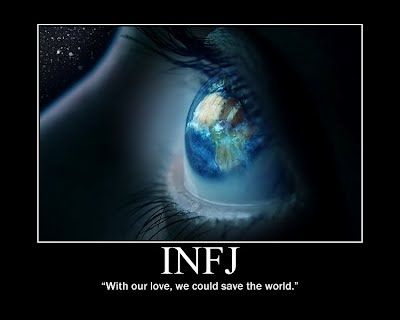
INFJ “Motivational Posters”

There’s a whole collection of those ubiquitous motivational posters made by and for INFJs. I found most on Pinterest and don’t know who originally put each one together.

Pin link
pin link
pin link

Just in case you were wondering, “No, we don’t see anything incompatible between the appreciation of love and beauty and that dangerous prairie dog.”

INFJoe Comics

The artist for these little comics is INFJoe. On his wordpress, he describes himself as “an INFJ joe amid extroverts, sensors, thinkers, and perceivers, and still trying to come to terms with it on a daily basis.”

from INFJoe
original post from INFJoe

INFJ Doodles

In my completely subjective opinion, I saved the best for last. The artist at Introvert Doodles posts one of these every day.

from INFJ Doodles. The artist said, “To enjoy any entertainment (book, movie, video game, tv show) I have to feel connected to the characters. That feeling of closeness lets me get lost in fictional worlds.”
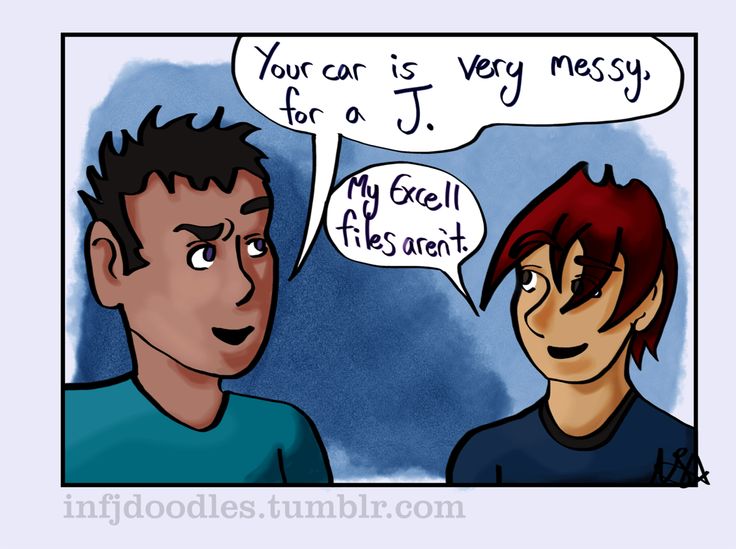
from INFJ Doodles. I love this one. I can be obsessive about organizing some things, and others look like a tornado went through them.
from INFJ Doodles

INFJ Dark Side

Descriptions of the INFJ personality type often emphasize our peaceful natures and ignore any hint of a “dark side.” For example, one commenter on my INFJ Loki post argued my typing is inaccurate because he couldn’t imagin an INFJ “carrying on a constant fight with everyone around you for the majority of your existence.” He knows INFJs are generally peaceful and conflict-avoidant, and couldn’t buy an INFJ as this type of villain.

People also describe INFJs as disconnected from the world, and unlikely to feel involved in the reality of what’s going on around us. All too often, people incorrectly assume this means we don’t care about what other people do or things that happen. This isn’t true. As Amelia Brown points out in her post The Dark Side Of The INFJ Personality Type, INFJs can be stubborn, judge others harshly, and abruptly cut people out of their lives. We do notice, and care, what’s going on enough to have a pretty decisive reaction in some cases.

Though INFJs are generally peaceful, gentle, and dislike engaging in confrontations, we’re not completely harmless (just ask my siblings). Every personality type has a dark side, and INFJs can be just as scary as anyone else.

INFJ Dark Side | LikeAnAnchor.com
Photo by Karen_Nadine on Pixabay

Read more