Myers-Briggs Types and Grief

 LMAP, CC-BY, via flickr
credit: LMAP, CC-BY, via flickr

I started writing this post nearly a year ago, after losing a dear friend, but I couldn’t finish it then. While I was grieving and watching the people around me grieve, I started wondering if the ways individuals respond to grief might be influenced by personality type. Once I started thinking about it, I was surprised that it wasn’t something I’d already read about in my personality studies.

People experience grief in such different ways that it would make sense for someone to try and find commonalities between how each personality type deals with grief. Maybe then we could come up with a self-help method for the grieving process more individualized than the inadequate and outdated 5 stages of grief model.

A few Google searchers later, I’d found plenty of forum topics where people who shared personality types were getting together to compare notes on how they deal with grief. I also found the following on the official Myers-Briggs website:

There have been many books written about personality type and grief, and it is perhaps one of the most profound uses of type. Understanding one’s personality type helps a person recognize why certain expressions of grief are better suited to his or her personal journey through this difficult process.

Unfortunately, they are neglected to give any more information about the “many books.” I’ve only been able to find Recovery from Loss: A Personalized Guide to the Grieving Process by Lewis Tagliaferre and Gary L. Harbaugh and Understanding Grief Types: Working with the Individual Nature of Bereavement by Lisa Prosser-Dodds (which had not yet been released).

Survey of Available Information

Recovery from Loss is specifically written for people who are grieving the loss of a spouse. It proposes a 20-step model for dealing with grief, and does address the role of personality type. However, the authors’ ideas are drawn from general knowledge of how different types respond to stressful situations rather than on actual research. They suggest this would be a profitable study, but do not undertake such a study themselves.

For such a study, I found a The Relationship Between Grief and Personality — A Quantitative Study by Lisa Prosser-Dodds, who presented this study of 239 individuals’ responses to grief as part of her PhD (I’m assuming it was also the starting point for her soon-coming book). Her study asks, ” Is there a difference in grief response between groups with differing MBTI personality types?” According to her, previous explorations of the MBTI’s role in grief are very few. She mentions four:

  1. a 1990 study of 51 bereaved mothers that said, “Extroverts reported higher levels of coping resources and focused on Social, Cognitive, Emotional and Spiritual resources.” The sample group mainly consisted of Extroverts and Feelers.
  2. a 1999 study of 14 people who had lost a spouse. This study “found differences in styles of grieving between varying personality types” but not “a significant use of inferior function,” which we would expect to show up in times of stress.
  3. the 1990 book Recovery From Loss, which I’ve alredy mentioned. Prosser-Dodds thinks their 20-step recovery model is presented “at a level of intellectual requirement that most grievers might become unable to digest,” and notes their observations are “not grounded in empirical data.”
  4. the 1994 book Voices of Loss, compiling first-hand accounts of grief and loss (not necessarily due to death) from various personality types. It is also “not based upon empirical data.”

 What We Can Learn

If you’re interested in reading part of Prosser-Dodd’s study, her summary of results begins on page 68 of this PDF document. The aspect of her findings that I found most surprising was that “When the dominant function aspect of the personality was compared, none of the results showed significant differences. All six subscales and the total scale scores failed to support the hypothesis.” Given Naomi Quenk’s writings on the role of inferior functions in times of stress, this is quite shocking. I would have assumed eruptions of the shadow played a key role in grief, but our dominant function might actually have more to do with how we grieve than our inferior functions.

Instead, “the results that showed the most significant differences were with the predictor variable functional pairs (NT, ST, NF and SF).” This probably wouldn’t have surprised Isabel Myers, since that is the method she used to divide personality types into four groups: “ST- Practical and Matter of Fact Types,” “SF – Sympathetic and Friendly Types,” “NF – Enthusiastic and Insightful Types,” and “NT – Logical and Ingenious Types.”

NF Types

Prosser-Dodd found that NF types had “higher levels of despair, disorganization and detachment” in their grief response, as wells as “slightly less personal growth.” NF type tend to feel things deeply in general, so it is hardly surprising that our grief response involves high levels of emotion. They are, however, better able than thinking types to find meaning in the tragedy of loss and regain balance in relation to the world.

NT Types

Intuitive Thinkers scored lowest on all aspects measured by the Integration of Stressful Life Events Scale. This measures the ability to make meaning out of a loss and to find one’s footing in the world while recovering. Prosser-Dodd said that considering NT types as “as the logical and strategic types, it would follow they might struggle with a comprehension of the loss in general and perhaps find it difficult to regain their footing in world following a loss.”

SF and ST Types

On the scales of despair, disorganization, and detachment the ST and SF types scored in between the NF and NT types, with SF types just a bit higher than ST types. Interestingly, ST types were the most likely to use a loss for personal growth. SFs scored higher than STs in being able to find their footing in the world and make meaning out of a loss (they’re better at this than NF types, as well).

The INFJ Writer

I’m sure I read somewhere that David Keirsey originally called the INFJ personality type “The Writer” instead of “The Counselor,” but I can’t find the article now. Nevertheless, it does seem that quite a few INFJs are attracted to writing. Even if they aren’t working as writers or typing away at a novel, they probably keep a journal/diary and are often more comfortable with written communication than they are with speaking. I’m a fairly typical example of INFJs in this regard — I write a blog (obviously), keep a journal, work as a writer, prefer writing e-mails to taking on the phone, and write fiction.

Speaking of writing fiction …

Winner-2014-Web-BannerI won NaNoWriMo! I’m particularly pleased with myself for conquering the 50,000 words a day early in spite of having pneumonia in November. Anyway, back to INFJ writers.

Imaginative Fiction

There’s an INFJ profile written by Dr. A.J. Drenth (which no longer appears on his website, but you can read it here) that has this to say about INFJs:

Although INFJs are commonly drawn to music, visual arts, design, or architecture, writing may well be this type’s signature creative talent. Adept at channeling their right-brain creativity into a fluid and engaging left-brain storyline, INFJs are unmatched in their feel for and creative use of the written word.

from INFJ Doodles

This creative aspect of our writing  talent seems to be tied to an INFJ’s primary function — Introverted Intuition (Ni). Intuitive types prefer possibility to actuality, future to the present, intuition to fact, and improvement over the status quo. When intuition is introverted, as for INFJs, the focus is mostly on an internal world where our minds tinker with “ideas, perspectives, theories, visions, stories, symbols, and metaphors” (Dr. A.J. Drenth, Introverted Intuition).

Even INFJs who don’t write typically have an affinity for stories and a “rich inner life.” We tend to live in a world of possibilities, and I find that one way to keep my fantasy life anchored in reality is to turn those ideas into stories and write them down. It’s weakness/temptation for INFJs to never move their ideas from possibility to reality. With creative writing, I can set my imagination loose and tell myself there’s a practical application for it as well.

INFJs as Writers

It’s hard to type people when you don’t know them, but there are some famous writers that we can guess were INFJs. Keirsey lists Emily Bronte and Emily Dickenson as “Counselor” types. Another list of famous INFJs adds writers like Chaucer, Dante Alighieri, Fyodor Dostoevsky, and Nathaniel Hawthorne. A forum discussion suggests Madeleine L’Engle, Antoine de Saint-Exupery, Lois Lowry, Ursla LeGuin, Franz Kafka, and several others could be added to the list.

my latest novel, laid-out in Post-It notes above my bed
my latest novel, laid-out in Post-It notes above my bed, with a different color for each point-of-view character

Now, the fact that many INFJs gravitate towards writing doesn’t mean that it’s always easy for us. I’m not sure how many stories I started and abandoned before finally finishing my first novel in 2011. It was for NaNoWriMo, and I needed that deadline to keep myself writing. It’s so easy to build the story in my head, and then lose interest in writing it down once I think I know how it ends.

Though knowing the end makes me lose interest in the story, I also need some kind of outline to keep me on track. I’ve discovered sticky notes on the wall is my new favorite way to plot-out novels. They can be removed or rearranged as needed, and you don’t need to have them all there to start writing. For my NaNo novel this year, I began with only half the plot laid-out, and added more scenes as I wrote and the direction of the story became clear.

Further Reading

Why INFJs Have Trouble Writing by Lauren Sapala

The INFJ Writing Personality: Eloquent Vision by Andrea J. Wenger

Love Languages and MBTI Types

Myers-Briggs types have much to tell us about ourselves and other people. Our MBTI type reflects our preferences for crowded parties or small gathering, describes how we connect with other people, shows us how we naturally respond to stress, and gives us a picture of our innate strengths and weaknesses. Another thing it’s often used for is trying to predict what type of person we’ll be attracted to, and most compatible with, in a romantic sense. Unfortunately, MBTI only gives part of the picture in this regard.

Types in Love

Disclaimer: some of the links in this post are affiliate links. This means that, at no additional cost to you, I will receive a commission if you click on the link and make a purchase on that website.

Use of the MBTI for romance is subject to much debate. Isabel Myer wrote in Gifts Differing*, chapter 11, that “it seems only reasonable that the greater mutual understanding between couples with more likeness than difference should lead, on the whole, to greater mutual attraction and esteem.” This was supported by her study of 375 married couples who were most frequently “alike on three of their four preferences rather than on only two, as would be expected by chance.” However, Isabel Myer was an INFP woman happily married to an ISTJ man. According to her own personality theory, they “shouldn’t” have gotten along, especially since she thought that shared S-N preferences were the most important for predicting a couple’s happiness together and understanding of each other. Obviously type isn’t the only important ingredient for happiness.

Elizabeth and Darcy from Pride and Prejudice, an NF – NT couple

David Keirsey’s book Please Understand Me II* agrees with Myers on the importance of S-N pairings, saying that his SP Artisan types are most compatible with SJ Guardians, and that NF Idealists are most compatible with NT rationals. His ideal pairing is someone who shares your S-N preference and is your opposite in the other three preferences. For example, he would pair an INFJ with an ENTP.

Continuing with INFJs as our example, these theories have influenced many INFJ profiles online. Jennifer Soldner’s Guide To INFJ Relationships lists ENFP, ENTP, INTJ and INFJ as the best matches for an INFJ. The worst matches are ESFP, ESTP, ESTJ, and ENTJ (note that this last one contradicts Keirsey’s rule for pairing NF and NT types). For the most part, these suggestions seem logical at first, much like Isabel Myer said when theorizing that people will get along best if they are similar. It doesn’t explain, however, why one study found that INFJs were most likely to marry either INFJs or ESTPs, or why Myers herself was happy married to someone so dissimilar in terms of type. Clearly there’s something else going on here.

The “Something Else”

Even with their generalizations about which types get along most easily together, both Isabel Myers and David Keirsey admit there are other very important ingredients to a lasting romantic relationship.

Individual relationships defy generalizations, and it should be stressed that two well-adjusted people of any two temperaments can find ways of making their marriage work for them.” (Keirsey)

“Understanding, appreciation, and respect make a lifelong marriage possible and good. Similarity of type is not important, except as it leads to these three. Without them, people fall in love and out of love again; with them, a man and woman will become increasingly valuable to each other and know that they are contributing to each other’s lives.” (Myers)

The 5 Love Languages by Gary Chapman

A mutual willingness to work together and actively build-up the relationships is more important than compatible MBTI types. One aspect of this is understanding the other person and learning how to love them. Becoming familiar with their Myers-Briggs type will help tremendously, but it’s not enough by itself. You also benefit from an understanding of Love Languages.

The five love languages theory was first published in 1995 by Gary Chapman, a relationship counselor and pastor. He says every person has a “language” that they use to communicate and receive love, either Words of Affirmation, Quality Time, Receiving Gifts, Acts of Service, or Physical Touch. Everyone has one primary love language, and you might have a secondary love language as well. If someone’s partner is not speaking their love language, they will not feel loved. There’s a test on Chapman’s website if you don’t know what your love language is and want to find out.

Layering Love Languages

In theory, any MBTI type can be combined with any one of the five love languages. I’m guessing, however, that there are some love languages that are more likely for certain MBTI types. Let’s take a quick look at the characteristics for the four type groups as related to different love languages.

SP types are typically concerned with outward, concrete ways of viewing the world, and focus on the here and now. Keirsey describes their preferred role in a romantic relationship as “playmate.” I could see SP types being particularly inclined toward Receiving Gifts, Quality Time, or Physical Touch as a primary love language. These all involve doing something for or with the loved one, which would appeal strongly to SP types.

Duty-fulfilling SJ types tend to play what Keirsey described as a “helpmate” role in relationships. They are stable, traditional, and thoroughly dependable people.  SJ types might be most in tune with Acts of Service, Quality Time or Words of Affirmation as a love language. These love languages visibly or verbally confirm that a SJ’s loved ones appreciate their constant reliability.

NF types are idealistic, enjoy abstract thought, and are natural romantics. Keirsey described their role in a romantic relationship as “soulmate.” They search for deep, genuine connections. Quality Time and Words of Affirmation seem like the most likely love languages, though Physical Touch and Acts of Service are also good possibilities. The key for NF types is genuine depth in a relationship, so they are inclined towards a language that increases emotional intimacy.

The NT types are highly intellectual, and Keirsey described their relationship role as “mindmate.” They are logical, abstract, and have little tolerance for the superficial. Words of Affirmation and Quality Time seem like the most likely love languages for an NT type, but after reading two different forum topics on MBTI types and love languages (one on Typology Central and one on Personality Cafe) I learned many NTs favor Physical Touch as well. My personal theory is that NT types view Service and/or Gifts with suspicion, wondering what the other person wants from them, while the others seem more genuine.

What about you? What are your Myers-Briggs type and love language(s)? Do you see a connection between the two? Share in the comments!

*indicates affiliate links

How To Be Friends With an INFJ

While trying to decide on my next topic, I saw that “how to be friends with an INFJ” was one of the top searches on my blog this past week. I’ve addressed the issue of friendship in some of my other posts about INFJs, but never written an entire post about it. It’s also something that has been on my mind recently, and it is a not infrequent topic of discussion between me and some close friends.

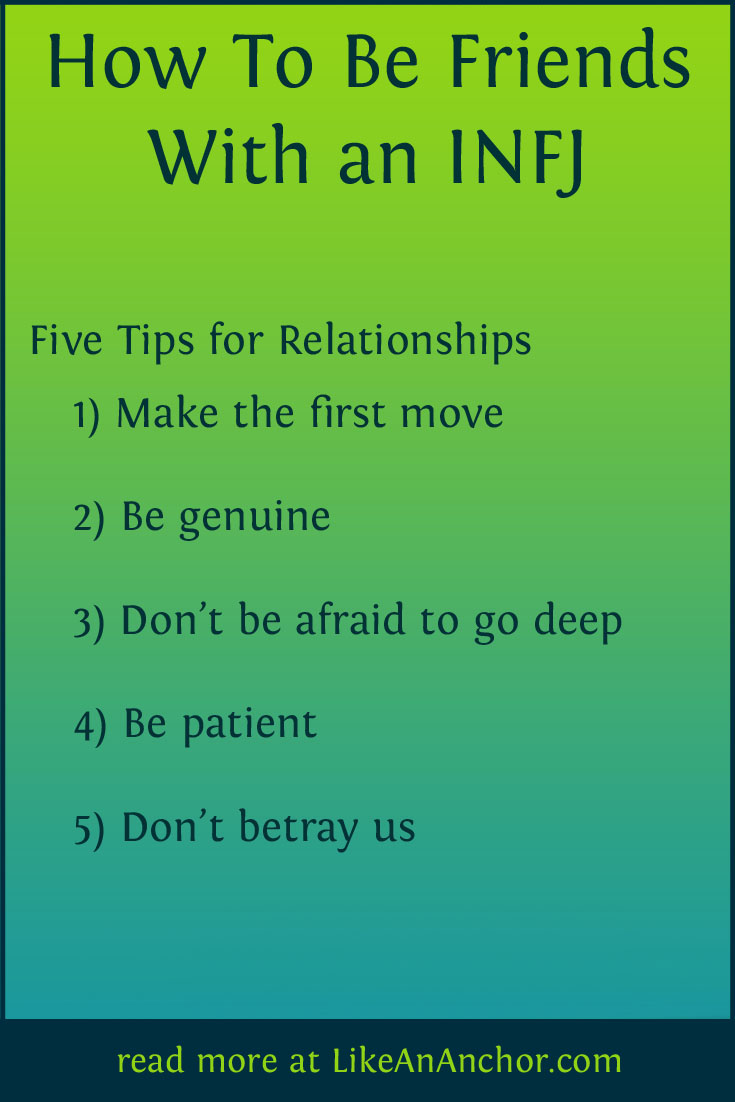
If you want to make friends with an INFJ, or get to know one better, there are a few key points to keep in mind. Some of these are true for all friendships, and especially friendships with INFJs, and others are more INF-specific. They are also a good first-step if you are romantically interested in an INFJ and want them to notice you.How To Be Friends With an INFJ | LikeAnAnchor.com

Five Tips for Relationships

1) Make the First Move

from INFJ Doodles

INFJs use extroverted feeling (Fe) to relate to the outside world. This means that we can draw energy from emotional interactions, and may appear more extroverted than other introverts. This is also true of ISFJs, who are often considered the most “extroverted” introverts since they love people so much.

Still, we are introverts, and we’re most comfortable talking with people we already know. If you want to get to know an INFJ, you’ll probably have to be the one who initiates a conversation. That lets us know you are interested in talking with us, which puts us at ease since we aren’t worried about whether or not we’re imposing on your time when you’d rather be doing something else.

2) Be Genuine

from INFJoe

Pairing Introverted Intuition (Ni) with Fe gives INFJs an almost super-human empathy. Many INFJs literally feel other people’s emotions, and we’re quick to pick up on unspoken cues that don’t match spoken words. We might not be able to tell what you’re holding back or lying about, but we can tell you’re not being genuine and that’s a huge turn off.

If an INFJ suspects you of being less than genuine, they loose interest very quickly. If you’re a new acquaintance, they might simply avoid seeing you again. If you’re someone they can’t avoid, then they will keep conversations civil but superficial. We don’t trust our true selves with people when we can’t get a read on what their true selves are like.

3) Don’t Be Afraid to Go Deep

INFJs have little interest in shallow conversations. We would rather have a few close friends than many casual acquaintances. The way the word “friend” is used has always bothered me as being imprecise. I have acquaintances, friends, and then close friends, but I just refer to them all as “friends” to avoid offending anyone who thinks they are a friend and then finds out I think of them as an acquaintance. People who meet INFJs often think that they know them well, while the INFJ thinks “they really don’t know me at all.”

If you want to be one of an INFJs close friends, then you have to make an effort to get beyond the superficial. INFJs respond very well to this, so once you indicate that you are interested in going beyond small-talk the sharing will go both ways. We like conversation, and we will talk as well as listen if we feel safe and interested. Here’s a great article called How To Turn Small Talk Into Smart Conversation. When I read this as an INFJ, my reaction was, “I wish more people would introduce themselves like this. I would be so much more interested in talking to them.”

4) Be Patient

found on Pinterest

Even if you’ve taken the first step to initiate a friendship, been completely honest, and encouraged deep conversation it can take quite a while for an INFJ to really open up. We have many layers, and the longer we are in a stable friendship with you, the more layers we’ll let you see. INFJs form instant perceptions of whether or not we can trust people, so first-impressions are important, but we also modify our impression based on how we observe your behavior over time. A bad first impression can be reversed if we see you making an effort to be friendly and trust-worthy, and a good first impression can be deepened as we see that what we’ve already shared with you stays safe.

Patience also comes into play during conversations. INFJs have trouble getting all their thoughts out into words. If the topic of conversation is something they’ve already thought about, they can speak readily and coherently. If it’s new and unfamiliar we typically do one of two things: 1) nod and make some general comments while our brains frantically race to come up with something to say. Usually that “something” shows up a week later in the shower. 2) start putting our thoughts into words, and sorting through ideas verbally. The final idea might take some time to emerge.

The second reaction is the one you’re going for in a friendship with INFJs. If we’re comfortable enough to think out-loud, it means we trust you. As long as you give us time to come up with an answer rather than look at us like we’re crazy, then we’ll relax and the conversation can continue to move forward. If you cut us off or jump to conclusions about what we think before we’ve had time to express outselves, we feel like you aren’t really interested in what we’re thinking and be hesitant to share with you later.

5) Don’t Betray Us

INFJs hold grudges. We might forgive readily (depending on the circumstances), but we don’t forget. It’s not something I’m proud of, but it is my automatic response. The closer you get to an INFJ, the harder it is to bounce-back to a close friendship after you’ve hurt us. The more we like you and the more we have invested in you, the more chances we’ll give you, but there’s a point at which we just give up and shut you out.

An INFJ might not completely sever ties with someone who has hurt them (depending on the nature of that betrayal), but they will withdraw. For example, if you give an INFJ the impression that you want to carry on a regular correspondence filled with deep discussion and then ignore her for 3 months and forget to answer any of her questions when you do reply, she will have no interest in continuing the correspondence.

Why Bother?

So why go to all this effort? What do you get out of a relationship with an INFJ?

check out this guide from Jennifer Soldner for more information about romantic relationships

For one thing, INFJs are surprisingly good fun to be around. We have a great sense of humor, delight in occasional spontaneity, and can talk about pretty much anything you like. But you don’t see all that until you make the effort to become friends. Until then, INFJs will hover in the background (away from other people) or blend in like a chameleon (with other people) to avoid stressful, superficial interactions.

INFJs are also good listeners, and we love to offer counsel. Sometimes we feel like our friends’ therapist, but we rarely mind. We want to help, and we’re good at suspending judgement. Since we’re so empathic, we aren’t often surprised by anything you tell us even if you thought you were doing a good job of keeping it hidden. Once it’s out in the open, we are sympathetic listeners who ask questions and want to fully understand what’s going on before we offer suggestions or any kind of judgements.

We’re also fiercely loyal. We don’t let many people get close, and we want to hold on to the very few that do become our true friends. We’ll do just about anything to keep the people we love in our lives. INFJs take the time to build-up their relationships, cultivate deepening friendships, and keep in touch with what’s going on in the lives of people we care about. We’re supportive, encouraging, and willing to adapt ourselves to make others happy as long as it doesn’t conflict with our core values. So get out there and start making friendships with INFJs. I don’t think you’ll regret it!

Save


Featured image credit: rawpixel.com via Pexels


If you’d like to know more about the INFJ personality type, check out my book The INFJ Handbook. I just updated it with a ton of new information and resources. You can purchase it in ebook or paperback by clicking this link.

The Missing Disney Princesses

UPDATE 12/19/2016: Hello, all. I’ve heard your comments, re-watched films, and re-typed some princesses (and added Moana!). Click here to check out my brand-new updated Disney Princesses MBTI Chart.

You may have seen those images with a Myers-Briggs chart that matches up an MBTI type for each character in a series or film. I did one for Lord of the Rings, the Star Wars one was quite popular for a while, and I’ve seen others for Hunger Games and Downton Abbey, to name just a few. Another you might have seen features Disney princesses.

The problem with these types of charts is it assumes there’s an example of each of the 16 types available. Unfortunately, they’re not always so evenly represented (I had this problem trying to type people in Lord of the Rings — there’s an unusually high number of introverts). Since there’s only 13 “official” Disney princess (if you count Elsa and Anna, who haven’t been officially crowned yet), that makes it rather difficult to come up with 16 types. On top of that, there also seems to be certain personality types which make “better” princesses than others, so there is some overlap. All together, the 13 official princesses represent 11 different personality types:

An MBTI chart for Disney's official princesses. I’ll give descriptions of each type in a moment, along with a bit on why I think they fit each princess. But first, 13 princesses really isn’t that many — they couldn’t have filled out the chart even if there wasn’t any overlap. So let’s add a few of the “unofficial” princesses: Jane, Kida, Giselle, Megara, Nala, and Esmerelda. We’ve now added six more characters, but only filled in two more MBTI types.

An MBTI chart for Disney's official and unofficial princesses.

The “missing” princesses can be explained by the fact that the NF and NT types are less common in real life. The lack of ESTJs (with the possible exceptions of Jane and Kida) is explainable by Isabel Myer’s observation that it is “the most traditionally ‘masculine’ type.” But one of the reasons Disney has been pressured to introduce more racially diverse Princesses is that little girls should be able to see people like them represented in the stories they enjoy. But what about the little INTJ and INTP girls, who see very few positive portrayals of their personality type, especially as female characters? (I asked my INTJ sister if she could think of any female characters who she identifies with as a similar personality and the only one she could come up with was  Dr. Temperance Brennan from Bones.)

Looking back at the chart of just the 13 official princesses, most of the missing personality types are thinkers: ESTJ, ENTJ, INTJ, and INTP. You could say that’s because most women are feeling types, but that’s a bit like saying most books are paperback instead of hardcover. There are more feeling-type women, but there are certainly plenty of thinking-type women as well. The only official Disney princesses who are thinking types right now are Jasmine, Mulan, Merida, and Tiana. The next Disney movie will feature their first Polynesian princess, Moana, and I think I would be awesome if she was also their first “official” princess who was an ESTJ, ENTJ, INTJ, or INTP. Or an ENFJ, since they’ve been left out, too.

Type Explanations for The Princesses

Disclaimer: typing fictional characters is a great way to stir-up disagreements, and it’s very rare that people agree on a typing. The types I’ve gone with for each character reflect my personal feelings, supported by reading other people’s thoughts on websites like personalitycafe.com and this excellent blog post. Please feel free to disagree, and let me know in the comments how you’d type these princesses 🙂

SJ types

The personality group that David Keirsey refereed to as “Guardians” is the best represented in this grouping of Disney characters. It’s really not surprising — they make good heroes and about 40 to 45 percent of the population falls into this group. SJ types are hardworking people who enjoy helping others and want to “do their duty.”

ESTJs are take-charge people who are practical, well-grounded, loyal and organized. They enjoy new experiences that appeal to their senses, such as meeting new people and traveling to a new place. They often ignore their intuition and base most of their decision on past experience. None of the official princesses fit this type, but Jane Porter from Tarzan and Kida from Atlantis might be ESTJs (honestly, I’m not sure, but I’m not sure where else to put them either).

The ISTJ is a very responsible type, and they are extremely hardworking. They value decisiveness and logic, with little time for make-believe or patience with other people’s oversights. Practical and fact-oriented, they are honest and dependable. Tiana from The Princess and the Frog is an ISTJ.

ESFJs are warm, friendly, and people-oriented. They value loyalty, friendship, and harmony. They are typically practical people with well-defined ideas that they aren’t afraid to share. Anna from Frozen is a very good example of this type, particularly in showing the strongly social side of ESFJs and their tendency to trust people quickly. Snow White is another example, and we could also add the “unofficial” princess Giselle, since she was patterned after Snow White’s personality.

ISFJs are as hardworking as ISTJs, but more interested in people than than in facts. They are very considerate, loyal, and will put up with quite a bit of abuse before provoking a conflict. ISFJs aren’t likely to express their inner ideas and feelings except with close friends. Cinderella is a good example of this type.

SP types

Keirsey called the SP types “Artisans,” because they work well with solid objects — whether it’s a weapon or a paintbrush. This group of personality types focuses on the now, and tends to be both fun-loving and realistic. 30 to 35 percent of the population fits in this group.

ESTPs like to take action — they don’t enjoy sitting around and waiting for something to happen. They are realistic, adaptable, and enjoy physical activities. In the case of Merida from Brave, this includes horseback riding and archery. They hate feeling confined, and are impatient with theories or ideas that they can’t see practical application for.

ISTP types are good with tasks that involve some kind of physical skill, and they like to take the time to think before acting so they can complete tasks in them most efficient way. They might seem aloof from other people, but do care about equality and fairness for groups and individuals. Mulan is an example of this type, and so is the “unofficial” princess Megara from Hercules.

ESFPs are friendly and focused on other people. They like observing as well as interacting with others, and have a powerful sense of curiosity. Material possessions interest them, and they often have some kind of a collection that they find ascetically pleasing. They hate structure and confinement as much as ESTPs. Ariel from The Little Mermaid is an excellent example of this type.

The ISFP type likes to work with people and meet their needs, but is generally quiet and reserved. Isabel Myer says they often “have a special love of nature and a sympathy for animals.” Like other SP types, they work well with their hands and are in tune with external sensory details (including things like music). Aurora from Sleeping Beauty is hard to type since she has so little screen-time, but she seems like an ISFP to me.

NF types

Types who rely on Intuition are more rare than Sensing types. The NF types who Keirsey called “Idealists” make up only 15 to 20 percent of the population. They are romantic, intuitive, spiritual, and seek good. Though their rarity in Disney is reflected by rarity in reality, it’s really surprising that this type isn’t more prevalent in fairy tale stories, especially since most NF types (though certainly not all) are women.

ENFJs are very social and have excellent people stills. They have a gift for expressing themselves and can influence other people (usually they have a very strong aversion to hurting others, but they have the potential to be manipulative). Typically honest and imaginative, they may hide their opinions in order to avoid disagreements and maintain harmony. None of the Disney princesses are ENFJs.

We finally got an INFJ Disney princess when Frozen was released last year (and I’ve already written about Elsa as an INFJ). This is the rarest personality type. INFJs are focused on their inner worlds of possibility and rely heavily on their intuition. They care deeply about other people, and avoid conflict as much as possible even if it means hiding their true self.

ENFPs are creative, imaginative, and artistic. They are easily excited by new ideas, but only follow through on pursuing the most important goals. Possibility excites them, and they love interacting with people and sharing their dreams and ideas. Rapunzel, sometimes typed as an ENFJ, is more typical of the ENFP type.

INFPs value internal harmony and have deep feelings that are rarely expressed to other people. They often seem like outsiders in their society and are more concerned with their inner moral code than with external expectations. Even so, they interact well with other people and are very loyal. Belle from Beauty and the Beast and Pocahontas are both examples of this type.

NT types

“Rationals,” as Keirsey described the NT types, are the rarest group — only 5 to 10 percent of the population. They are skeptical, analytical, and independent. Their rarity helps explain why there aren’t more Disney princesses in this category, along with the fact that most (though certainly not all) NT types are men.

ENTJs are problem-solvers who like to lead. They are curious about new possibilities, and enjoy theoretical problem solving as well as coming up with practical solutions for current problems. They are very forceful and decisive. None of the human princesses fit this type. Nala from The Lion King acts very much like an ENTJ, though, especially as an adult who leaves her pride to go off and find a solution to the problem of Scar.

The INTJ personality type is almost as rare as INFJs, and female INTJs are the rarest gender-type combination. They are often cast as villains in fiction, which is a shame because they make such wonderful scientists and detectives (like Basil of Bakerstreet from The Great Mouse Detective, to use Disney as an example [Update: after re-watching this film, I now type Basil as an INTP. Click here to read why]). INTJs are innovative, clever, and very organized. If something isn’t logically challenging, it rarely holds their interest.

ENTPs tend to be independent and a bit impersonal. They are more concerned with their projects and plans than with how those plans will affect other people. They don’t like routine, preferring new experiences that challenge their quick minds. ENTPs are versatile, clever, and enthusiastic about understanding their worlds. Jasmine and the “unofficial” princess Esmeralda are examples of this type.

INTPs are described by Isabel Myer as “the most intellectually profound of all the types.” They are curious, logical, easily bored, and focus on creating theory regardless of whether or not it has practical application. They often have trouble relating to people because they see little value in feelings and find it hard to explain their ideas in a way that makes sense non-experts. None of the Disney princesses fit this type.

Click to learn more about my upcoming INFJ e-book and contribute your story. Everyone whose stories are used in the book will receive a free copy once it is finished.

Save

Save

Best INFJ Images and Cartoons

I’m usually focused on serious stuff when discussing INFJs, but today I wanted something more lighthearted. We INFJs are deep thinking and often come across as serious, but we can also be fun-loving and positive. Many of us also like art and creative things, so you end up with doodles, comics, and cartoons describing us that range from screenshots with a caption to the elaborate “Care and Feeding of INFJs” Prezi. Here are a few of my favorites, but before we go any farther in this post …

A reminder

… I just wanted to remind you all that you’re invited to a Live Facebook event this Thursday evening (August 7th) at 8:00 pm EST for a company called Trades of Hope. Their mission is to give women around the world a chance to provide for themselves and their families by selling beautiful handmade items. The artists are from all over the world, and  you’ll learn more about them if you join us Thursday (you will need to friend me to access the event). There’s no pressure to buy, and I really do think you’ll find this company interesting and inspiring, as I do.

INFJ Images

I’m not sure this one was put together by an INFJ, but it was posted on the Introvert, Dear Facebook page, which is focused toward INFJs along with other introverts and HSPs.

It’s so true. People would tell me I should talk more in class, and one of the reasons I didn’t was because there’s so many ideas to sort through before you can decide what to actually say.

Love these “Type Heads.” They made some for each personality type.

click for more type heads

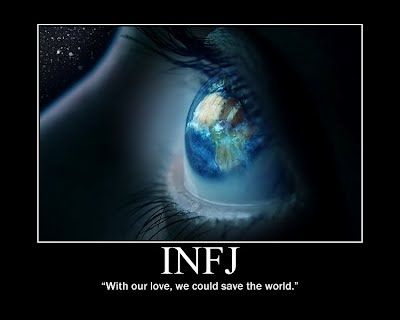
INFJ “Motivational Posters”

There’s a whole collection of those ubiquitous motivational posters made by and for INFJs. I found most on Pinterest and don’t know who originally put each one together.

Pin link
pin link
pin link

Just in case you were wondering, “No, we don’t see anything incompatible between the appreciation of love and beauty and that dangerous prairie dog.”

INFJoe Comics

The artist for these little comics is INFJoe. On his wordpress, he describes himself as “an INFJ joe amid extroverts, sensors, thinkers, and perceivers, and still trying to come to terms with it on a daily basis.”

from INFJoe
original post from INFJoe

INFJ Doodles

In my completely subjective opinion, I saved the best for last. The artist at Introvert Doodles posts one of these every day.

from INFJ Doodles. The artist said, “To enjoy any entertainment (book, movie, video game, tv show) I have to feel connected to the characters. That feeling of closeness lets me get lost in fictional worlds.”
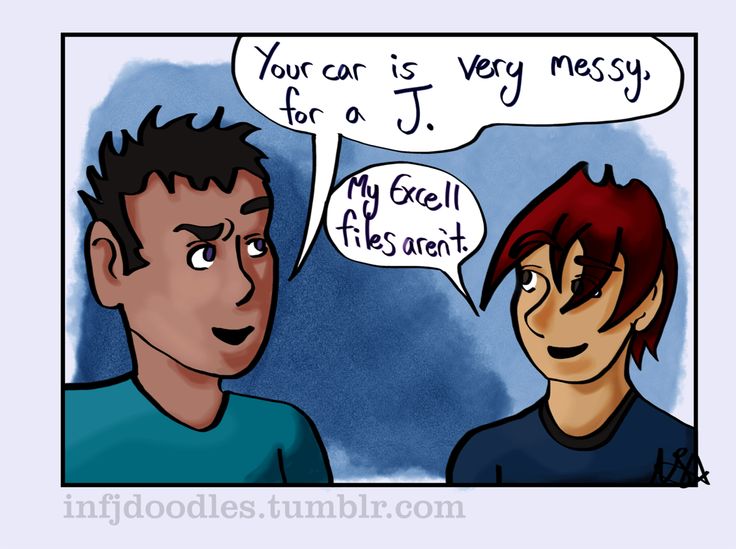
from INFJ Doodles. I love this one. I can be obsessive about organizing some things, and others look like a tornado went through them.
from INFJ Doodles