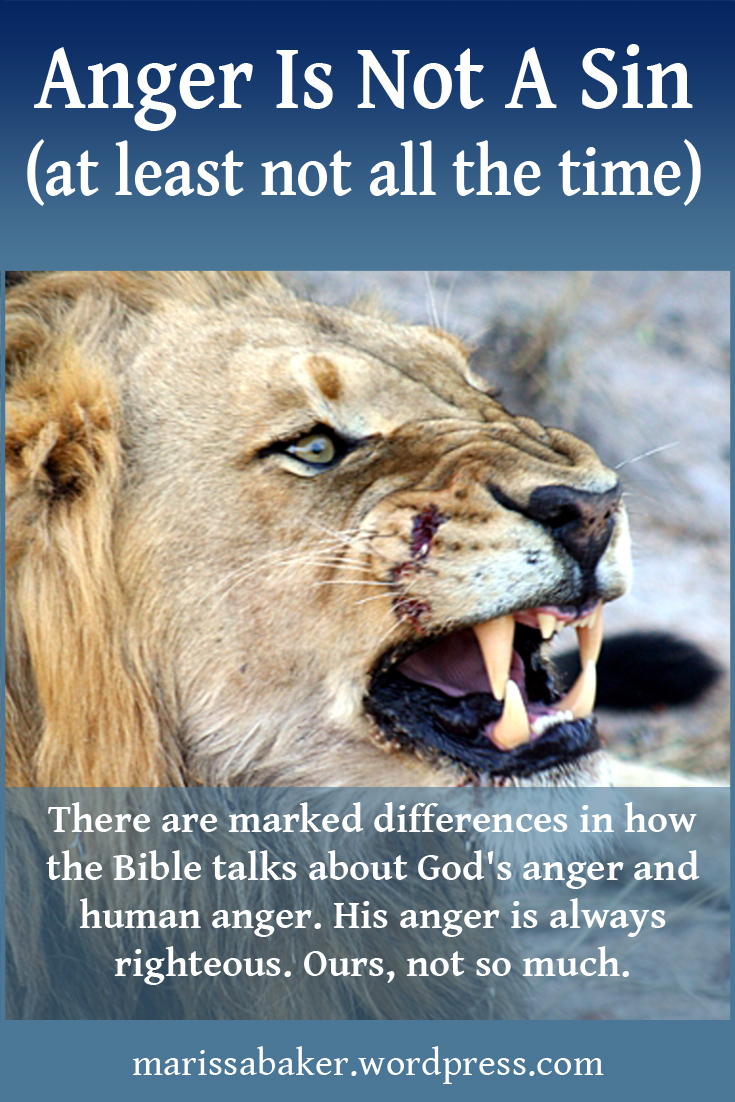
Anger Is Not A Sin (at least not all the time)

A couple weeks ago, I read a blog post that stated emotions can’t be sins. They just are, and how we act on them determines whether or not we’re sinning. The example they used was anger. For proof, they cited all the times God is described as angry. Because God is incapable of sin, this demonstrates that anger can’t be inherently sinful.

I knew the verses they were talking about, but just out of curiosity I ran a word search to see how often God is described as angry. 208 verses. That’s out of 268 verses in the KJV containing the word anger in any context. Anger is only used 60 times that it’s not in reference to God, and this isn’t even counting words like fury and wrath.

click to read article, "Anger Is Not A Sin (at least not all the time)" | marissabaker.wordpress.com
photo credit: “Angry” by Rodrigo Suriani, CC BY via Flickr

Wow. That’s far more than I’d expected. The sheer number of verses wasn’t the only interesting thing, though. There’s also a marked difference in how the Bible talks about God’s anger and human anger. God’s anger is always righteous, ours not so much. Read more

But What If God Scares Me?

So you’ve heard about the love and grace of Jesus and want to learn more. Maybe you even had another Christian lead you to Jesus and accepted Him as your savior. Then you sit down intending to read the Bible from start to finish and find something you weren’t quite expecting.

Genesis starts out with creation and the fall of man, then suddenly God’s wiping the whole earth out in a flood (Gen. 6:5-8). Next He’s scattering the people of Babel for building a tower (Gen. 11:5-9) and raining fire and brimstone down on Sodom and Gomorrah (Gen 19:24-25). Why does the God you know as forgiving and accepting seem so angry? Where is God’s love and grace here, in the Old Testament?

But What If God Scares Me? Bible reading for those who don't like the God they find in the Old Testament | marissabaker.wordpress.com

Many people give up on the Bible and/or their faith because God isn’t what they expect, or they go for a version of Christianity that highlights the New Testament and ignores any verses about uncomfortable topics like judgement and sin. But authentic Christianity demands something more of its followers. Jesus said, “Many are called, but few are chosen” twice in Matthew’s gospel (Matt. 20:16; 22;14). We don’t want to be the people who receive the seed of the gospel and then wither away because we have no root (Matt. 13:5-6, 20-21).

The lives of Christians are supposed to reflect the nature of our God. If we aren’t diving deep into His word, we won’t know who He is or what He requires, and we can’t grow roots into our faith. We can’t let misconceptions about or fear of His anger and expectations scare us away from getting to know Him. Read more

God’s Anger at Nineveh (Lessons from Nahum)

You usually only hear about Jonah, but there’s a second book in the Bible that’s concerned with the destruction of Nineveh. Since Nineveh repented after Jonah’s warning, its destruction was held off about 150 years — until 612 B.C. According to my study Bible, Nahum probably wrote his prophecy around 620 B.C., and this time Nineveh’s destruction really was just around the corner. The city’s repentance hadn’t translated into continued faithfulness through the generations, and the people’s return to wickedness meant it was time to fulfill the prophecy of destruction made originally though Jonah.

The burden against Nineveh. The book of the vision of Nahum the Elkoshite. God is jealous, and the Lord avenges; the Lord avenges and is furious. The Lord will take vengeance on His adversaries, and He reserves wrath for His enemies; the Lord is slow to anger and great in power, and will not at all acquit the wicked. (Nah. 1:1-3)

Studying a book wholly concerned with a fulfilled prophecy might seem like time that could better be spent elsewhere, but while reading through Nahum I realized it actually has quite a bit to teach us about who God is and how He works.

When God Gets Angry

God's Anger in Nahum | marissabaker.wordpress.comIn the first verses of Nahum, God is called “slow to anger” in the midst of a passage describing His wrath and vengeance. It might seem odd, but actually God’s fury at this time is an example of His being “slow to anger.”

The Lord is merciful and gracious, slow to anger, and abounding in mercy. He will not always strive with us, nor will He keep His anger forever. He has not dealt with us according to our sins, nor punished us according to our iniquities. For as the heavens are high above the earth, so great is His mercy toward those who fear Him (Ps. 103:8-11)

David’s Psalm is talking about God’s dealings with His own special people, but this is also what happened with Nineveh. Though the city was populated with unbelievers who oppressed God’s people, He held back His judgement when the city repented. He was “slow to anger” for 150 years, but this time there was no repentance and justice demanded a reckoning for sin.

Behold, I am against you,” says the Lord of hosts, “I will burn your chariots in smoke, and the sword shall devour your young lions; I will cut off your prey from the earth, and the voice of your messengers shall be heard no more.” Woe to the bloody city! It is all full of lies and robbery. Its victim never departs. (Nah. 2:13-3:1)

In Jonah, we weren’t given a list of Nineveh’s transgressions, but we have one here in chapter three: Lies, robbery (v. 1), warfare and slaughter (v.2-3), harlotry, witchcraft, the selling of nations and families (v. 4), and general “shame” (v. 5).

Your injury has no healing, your wound is severe. All who hear news of you will clap their hands over you, for upon whom has not your wickedness passed continually? (Nah. 3:19)

It’s one thing to commit sins that hurt you, but wickedness that spreads out and injures or enslaves other people is something God will not tolerate. He is slow to anger, but this sort of thing does make Him angry and will be removed. When the wound is incurable, it must be cut out to prevent further infection.

Hope For The Repentant

Even in the midst of prophecies about destruction and the outpouring of God’s wrath there is still, as always, hope.

Who can stand before His indignation? And who can endure the fierceness of His anger? His fury is poured out like fire, and the rocks are thrown down by Him. The Lord is good, a stronghold in the day of trouble; and He knows those who trust in Him. (Nah. 1:6-7)

God's Anger in Nahum | marissabaker.wordpress.comEven in troubles that come as part of God’s just vengeance, He is still a stronghold for those who trust in Him. In fact, getting close to God is the only safe place to be as the world draws nearer and nearer to judgement for its evils.

See that you do not refuse Him who speaks. For if they did not escape who refused Him who spoke on earth, much more shall we not escape if we turn away from Him who speaks from heaven, whose voice then shook the earth; but now He has promised, saying, “Yet once more I shake not only the earth, but also heaven.” Now this, “Yet once more,” indicates the removal of those things that are being shaken, as of things that are made, that the things which cannot be shaken may remain.

Therefore, since we are receiving a kingdom which cannot be shaken, let us have grace, by which we may serve God acceptably with reverence and godly fear. For our God is a consuming fire. (Heb. 12:25-29)

Though the events described in Nahum took place long before Christ was even born, there are parallels for Christians today. Just as Nineveh was destroyed, the world we now live in will be shaken and removed at Christ’s second coming. Whether that happens in our lifetimes or not, our responsibility now is to listen to God and actively draw near to Him as we strive to serve Him “acceptably.”

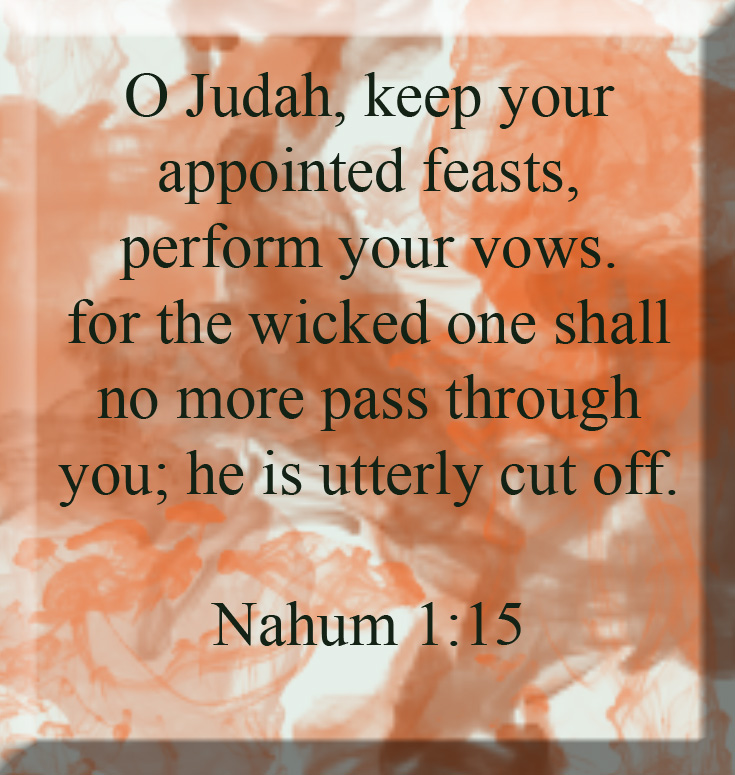
O Judah, keep your appointed feasts, perform your vows. For the wicked one shall no more pass through you; he is utterly cut off. (Nah. 1:15)

INFJ Dark Side

Descriptions of the INFJ personality type often emphasize our peaceful natures and ignore any hint of a “dark side.” For example, one commenter on my INFJ Loki post argued my typing is inaccurate because he couldn’t imagin an INFJ “carrying on a constant fight with everyone around you for the majority of your existence.” He knows INFJs are generally peaceful and conflict-avoidant, and couldn’t buy an INFJ as this type of villain.

People also describe INFJs as disconnected from the world, and unlikely to feel involved in the reality of what’s going on around us. All too often, people incorrectly assume this means we don’t care about what other people do or things that happen. This isn’t true. As Amelia Brown points out in her post The Dark Side Of The INFJ Personality Type, INFJs can be stubborn, judge others harshly, and abruptly cut people out of their lives. We do notice, and care, what’s going on enough to have a pretty decisive reaction in some cases.

Though INFJs are generally peaceful, gentle, and dislike engaging in confrontations, we’re not completely harmless (just ask my siblings). Every personality type has a dark side, and INFJs can be just as scary as anyone else.

INFJ Dark Side | LikeAnAnchor.com
Photo by Karen_Nadine on Pixabay

Read more

Songs by Mood

marissabaker.wordpress.comLast week, I learned that Neurowear launched a set of headphone about a year ago that scans your brainwaves and matches music on your iPod to your mood. As border-line creepy as that sounds to me, it’s just the next step from websites like Moodstream and Musicovery that play music based on whether you’re feeling happy, sad, calm, dark, lively, inspired, positive, creative, or pretty much any other mood you like.

I have genres or playlists that I’ll turn to for different moods, but I also have specific songs that I like to play for specific feelings. Is this just me? Or do you have a song you play every time you’re sad? A favorite song to match a happy mood? What about songs that help you deal with anger?

Angry

You know that feeling when you’re angry and you know you shouldn’t be, but you still need to do something with those feelings? That’s when I sing these songs. I feel much better afterwards and it means I’m not taking out my anger on anyone else, so they’re happy (although I have been told it’s creepy to witness).

No Good Deed — from Wicked (Idina Menzel)

Mordred’s Lullaby — Heather Dale

Blown Away — Carrie Underwood

Sad

These songs are like a pat on the back or a hug when I need reassurance. I listen to them when I’m feeling down and want to move out of that mood.

Everything is Fine — Josh Turner

Little Miss — Sugarland

You Are Loved — Josh Groban

Sub-category for when I’m discouraged about being single:

As Fast As I Could — Josh Turner

Melancholy

These songs are for sadness that I want to enjoy. It’s the “sad is happy for deep people” feeling rather than being sad for a reason that makes you not want to be sad any more.

Wine After Whiskey — Carrie Underwood

September — Daughtry

Katie — Celtic Thunder /Colm Keegan (which I’m afraid there’s no video for, but you can hear a clip)

Inspired

These are the songs I play when I want to feel like I’m fearless and I can do anything.

Defying Gravity — from Wicked (Idina Menzel)

Wide Open — Jason Aldean

I Stand — Idina Menzel

Happy

I was trying to think up songs for this category, and my sister said, “Don’t you sing One Direction when you’re happy?” As embarrassing as that may be,  yes I do. I’ve whittled it down to just one song from them, though.

What Makes You Beautiful — One Direction

Nil Se’n La — Celtic Woman

Hopeful

Since “Waiting For Superman” didn’t quite fit in with the happy or the melancholy songs, I’ve added this category.

Waiting For Superman — Daughtry

Wedding Day — Casting Crowns

This Is The Moment — from Jekyll and Hyde (Robert Cuccioli)

Peaceful

I play these songs when I want to relax and I’m trying to encourage a peaceful feeling. They’re usually the first songs I play, then I move on to a playlist of related songs and artists. Or I listen to instrumental music with dolphins.

Hero — Il Divo

So She Dances — Josh Groban

Worshipful

These are my favorite stand-in-awe of God songs.

Blessed Be Your Name — Robin Mark

Who Am I — Casting Crowns

In Christ Alone — Keith and Kristyn Getty

Redefining Meekness

Redefining Meekness marissabaker.wordpress.comThere are several words the Bible uses to describe Godly character that have a bad reputation in today’s society. Take “meekness” for example. If you ask Google for a definition, the first result says “quiet, gentle, and easily imposed on; submissive.” An even shorter way to put this would be “doormat.” If asked, the typical person today would probably agree with Mordred (from the musical Camelot) that “it’s not the earth the meek inherit, it’s the dirt.”

When Jesus said, “Blessed are the meek, for they shall inherit the earth,” was He really talking about the same trait we just defined? Though we do see from scripture that gentleness and submission are admirable qualities, what we do not see is the “easily imposed upon” weakness that our modern definitions for meekness carry.

Greek for Meek

The Greek word translated “meek” in the Beatitudes is from a word family that includes praos (G4235), praotes (G4236), praus (G4239), prautes (G4240). In the discussion of G4240, Zodhiates says the words refer to “an inwrought grace of the soul, and the expressions of it are primarily toward God.” Furthermore, he writes,

Prautes, according to Aristotle, is the middle standing between two extremes, getting angry without reason (orgilotes), and not getting angry at all (aorgesia). Therefore, prautes is getting angry at the right time, in the right measure, and for the right reasons. Prautes is not readily expressed in Eng. (since the term “meekness” suggests weakness), but it is a condition of the mind and heart which demonstrates gentleness, not in weakness, but in power.

Wow. That’s not at all like the English-language idea of meekness. This is strength of character that balances our emotions and helps establish our relationship with God. In the discussion of number 4236, Zodhiates adds,

It is the acceptance of God’s dealings with us considering them as good in that they enhance the closeness of our relationship to Him. … It is not the result of weakness, and in the third Beatitude it expresses not the passivity of the second Beatitude, but the activity of the blessedness that exists in one’s heart from being actively angry at evil.

Active Meekness

"Redefining Meekness" marissabaker.wordpress.comPrior to reading these definitions, my idea of meekness did not include gentleness demonstrated in power or activity against evil. No wonder these words are used to describe Jesus Christ (Matt. 11:29Matt. 21:5; 2 Cor. 10:1). With such an example to follow, Paul instructs Timothy to pursue meekness (1 Tim. 6:11), women are told a “meek and quiet spirit” is valued in the eyes of God (1 Pet. 3:4), and the church is expected to relate to other people with a spirit of meekness (Gal. 6:1; 2 Tim. 2:25; Tit. 3:2; 1 Pet. 3:15).

I therefore, the prisoner of the Lord, beseech you that ye walk worthy of the vocation wherewith ye are called, with all lowliness and meekness, with longsuffering, forbearing one another in love; endeavouring to keep the unity of the Spirit in the bond of peace. (Eph. 4:1-3, KJV)

Meekness is a necessary attribute for God’s people, but not quite in the way the world views it. Godly meekness is a strong character attribute that we must cultivate if we are going to become like Jesus Christ (Col. 3:12). It is anger at the right time for the right reason, but expressed in a gentle way that helps others instead of tearing them down. It is aceptence of God’s work in our lives that humbly says, “Not my will, but your’s be done.”

Who is wise and understanding among you? Let him show by good conduct that his works are done in the meekness of wisdom. (James 3:13)