
Learning More About Covenant Grace

There’s a fascinating relationship between God’s grace and the covenants He makes with people. Until the 5th century (when theologians brought Neo-Platonic philosophy into their interpretation of scriptures), Greek and Roman literature and early Judeo-Christian writings saw charis (grace) as something both relational and reciprocal (Schmidt, p. 201-202). The idea of “grace” as a free gift that God is obligated to give without having any expectations of the recipients was not originally part of the Greek language or of Christianity. Rather, there was a fuller, richer meaning to charis that Jesus, Paul, and other Bible writers used.

I’ve been reading a book on this topic by Brent J. Schmidt, who holds a PhD in classics, called Relational Grace: The Reciprocal and Binding Covenant of Charis (2015). His scholarship on the original meaning of charis is fascinating, but even without that background we can still see that grace comes with expectations. For example, Jesus said the one who “endures to the end will be saved” (Matt. 10:22, WEB) and that “unless your righteousness exceeds that of the scribes and Pharisees, there is no way you will enter the kingdom of heaven” (Matt. 5:20, WEB). We’re saved by God’s grace, and then He expects us to act in a certain way (with His power supporting us, of course).

The Bible talks about Christian conversion as a process and tells us that relationships with God require continued faithfulness. Yet the popular definition of grace in many modern churches still says grace is unmerited favor that God gives without expectation of anything in return. Trying to make these two ideas fit together is confusing, and it’s a problem first-century Christians didn’t have to deal with because they had a different definition for grace.

Ancient Understandings of Charis

Several centuries before Christ’s first coming and until at least the 4th century after, charis was understood as something that involved obligation and reciprocity (Schmidt, ch. 2 and 3). This meaning infused Greek, Roman, Jewish, and later Christian society to the point that everyone knew “receiving charis implied entering into reciprocal covenantal relationships” (p. 63).

Jews knew about covenantal relationships from the Bible. Every commandment was a covenant with God. Several stories, including Joseph, Moses, and David, associate the concepts of grace and mercy with covenants. Greek-speaking Jews lived in a culture that depended heavily on reciprocal relationships and understood what charis meant. When Paul taught them using the words charis, they would have understood that by accepting God’s grace they were making covenantal obligations.

Brent Schmidt, Relational Grace, p. 64

When Jesus Christ came to earth, one of the things that He did was establish a New Covenant on better promises and with a different sort of sacrifice. The Old Covenant was “completely unable … to perfect those who come to worship” (Heb 10:1, NET). In contrast, Jesus took away sin completely, giving us an incredible gift for us that we could never deserve nor repay. When we accept this “charis,” we enter a covenant with Him and His Father.

For by one offering he has perfected for all time those who are made holy. And the Holy Spirit also witnesses to us, for after saying, “This is the covenant that I will establish with them after those days, says the Lord. I will put my laws on their hearts and I will inscribe them on their minds,” then he says, “Their sins and their lawless deeds I will remember no longer.” Now where there is forgiveness of these, there is no longer any offering for sin.

Hebrews 10:14-16, NET (OT quotes bolded in this translation)

Grace is so closely connected with covenants that treating “the blood of the covenant ” as “an unholy thing” means someone has “insulted the Spirit of grace” (Heb. 10:29). Covenants and laws don’t vanish after Christ’s sacrifice–they move to a heart and spirit level. We can see this in Jesus’s Sermon on the Mount, where He talks about the deeper, spiritual, enduring applications of God’s law. Paul also talks about this shift from flesh-level to spirit-level in detail when he’s talking about law and covenants.
Grace in Paul’s Letter to the Romans

Shifting our definition of grace to align with the one Paul and his audience would have used gives us a better idea of how to properly interpret Paul’s letters. One of the best places to see that is in Romans 6. Here, Paul talks about how we are “not under law but under grace” (v. 14, NET). This verse and others like it are often read out of context, but if you read the surrounding text the reciprocal and obligatory aspects of charis are easy to see. This is a very long quote, but I think it’s important to look at the whole thing to get enough context to understand Paul’s words.

Therefore do not let sin reign in your mortal body so that you obey its desires, and do not present your members to sin as instruments to be used for unrighteousness, but present yourselves to God as those who are alive from the dead and your members to God as instruments to be used for righteousness. For sin will have no mastery over you, because you are not under law but under grace.

What then? Shall we sin because we are not under law but under grace? Absolutely not! Do you not know that if you present yourselves as obedient slaves, you are slaves of the one you obey, either of sin resulting in death, or obedience resulting in righteousness? But thanks be to God that though you were slaves to sin, you obeyed from the heart that pattern of teaching you were entrusted to, and having been freed from sin, you became enslaved to righteousness. (I am speaking in human terms because of the weakness of your flesh.) For just as you once presented your members as slaves to impurity and lawlessness leading to more lawlessness, so now present your members as slaves to righteousness leading to sanctification. For when you were slaves of sin, you were free with regard to righteousness.

So what benefit did you then reap from those things that you are now ashamed of? For the end of those things is death. But now, freed from sin and enslaved to God, you have your benefit leading to sanctification, and the end is eternal life. For the payoff of sin is death, but the gift of God is eternal life in Christ Jesus our Lord.

Romans 6:12-23, NET

Many translations use the word “servant” instead of “slave,” but doulos is best translated either as “bondservant” or “slave.” Being bound to serve the Lord in this way was seen as an “honor and a privilege” in the Jewish mindset (NET footnote on Rom. 1:1). It’s a very different sort of thing than slavery in the modern sense. In fact, at the time Paul was writing, the “asymmetrical social relationships between patron and client and between master and salve were founded on the reciprocal notion of charis” (Schmidt, p. 95). When Paul talks of slavery, he’s talking about us being obligated to God for His gifts and bound in a covenant with Him that has expectations.

Living by God’s Spirit

When Jesus healed a man in Bethesda who’d been sick for 38 years, He told the man, “Behold you are made well. Sin no more, so that nothing worse happens to you” (John 5:1-14, WEB). It’s similar to what He told the woman caught in adultery (a story that’s not in the earliest manuscripts but is traditionally included with John’s gospel): “Neither do I condemn you. Go your way. From now on, sin no more” (John 8:11, WEB). In one case, Jesus provided physical healing and in the other He freed her from being condemned to death. After giving these gifts, He told both people that they should respond by doing something specific: stop living a life of sin.

There is therefore now no condemnation for those who are in Christ Jesus. For the law of the life-giving Spirit in Christ Jesus has set you free from the law of sin and death. For God achieved what the law could not do because it was weakened through the flesh. By sending his own Son in the likeness of sinful flesh and concerning sin, he condemned sin in the flesh, so that the righteous requirement of the law may be fulfilled in us, who do not walk according to the flesh but according to the Spirit.

Romans 8:1-4, NET

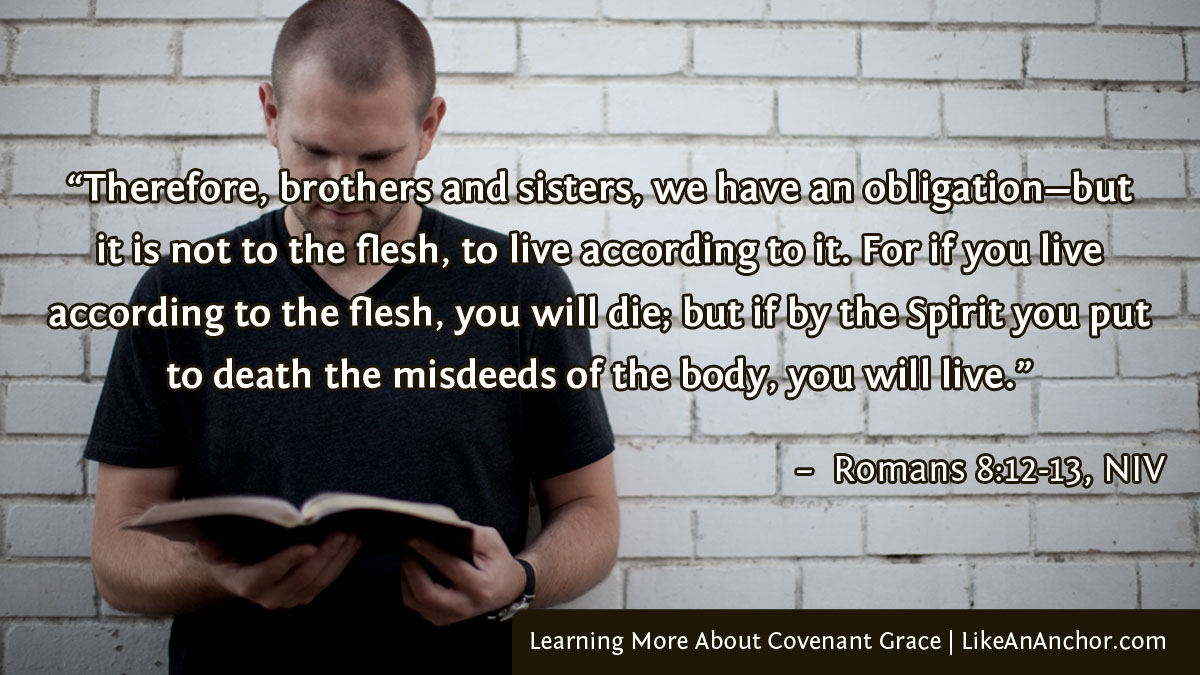
The Father and Son have given us incredible gifts. They’ve saved us from sin, adopted us into their family “with full rights of inheritance” (NET footnote on 8:15), and offer continued forgiveness so long as we do our best to follow Them and repent when we miss the mark. In response, “we are under obligation” to live a life lead by God’s spirit (Rom 8:12-14, NET). Being in a reciprocal covenant of grace is not about earning salvation or trying to pay back an impossible debt. It’s about having the right response of thankfulness to the incredible things God has done for us by welcoming us into His family. The more we can learn about that, the deeper relationship we can have with Him.

Featured image by José Roberto Roquel via Lightstock

Drawn To God

My new favorite Bible Study tool is the New English Translation with its 60,000+ translator’s notes. As I was perusing the pages (you can get a print version or access the whole thing for free online), I noticed the translation notes on Song of Songs take up more space than the actual text. Apparently, not only is this text’s interpretation widely debated, but it is also notoriously difficult to translate. As you might know if you’ve read some of my other posts or my short book God’s Love Story, I favor the interpretation that the Song is both a celebration of human love and an allegory of Christ’s love for the church. With that in mind, here’s one of the verses with a footnote that I found intriguing:

Draw me[a] after you; let us hurry!
May the king bring me into his bedroom chambers!

[note a] The verb מָשַׁךְ (mashakh, “draw”) is a figurative expression (hypocatastasis) which draws an implied comparison between the physical acting of leading a person with the romantic action of leading a person in love. Elsewhere it is used figuratively of a master gently leading an animal with leather cords (Hos 11:4) and of a military victor leading his captives (Jer 31:3). The point of comparison might be that the woman wants to be the willing captive of the love of her beloved, that is, a willing prisoner of his love.

Song of Songs 1:4, NET

Another translation for mawshak in this verse is “Take me away with you” (NIV, WEB). There are nuances of meaning for this Hebrew word (as the NET footnote points out), but the basic one is “to draw, drag, seize” (Brown–Driver–Briggs; Theological Wordbook of the Old Testament). Here in Song, and in a few other places as well, it can be understood as “entice, allure, woo” (TWOT). In those verses, it is connected with one of the many pictures God gives us for relating to Him–as a lover alluring, wooing, and drawing His bride to Himself.

Alluring us with Love, Kindness and Grace

Hosea is one of the books that makes the analogy of God as bridegroom and husband most clearly. God instructs the prophet Hosea to marry a prostitute because ancient Israel “continually commits spiritual prostitution by turning away form the Lord” (Hos 1:2, NET). God used Hosea’s marriage and his writings to teach that, even though Israel was unfaithful, God still promised “in the future I will allure her,” and then “you will call, ‘My husband’; you will never again call me, ‘My master'” (Hos. 2:14, 16, NET).

Later in Hosea, God talks about how He “drew” (mawshak) Israel out of Egypt “with leather cords” (NET), “with cords of a man” (KJV), or “cords of human kindness” (NIV). Though the NET presents a compelling case for the “leather” translation, I favor “human kindness” because it connects more strongly to the overall theme of God wooing His people that is found so often in Hosea. It would also echo the language God uses in Jeremiah 31:3.

Yahweh appeared of old to me, saying, “Yes, I have loved you with an everlasting love. Therefore I have drawn you with loving kindness.”

Jeremiah 31:3, WEB

Alternate translations for this passage include “That is why I have continued to be faithful to you” (NET), “That is why I have drawn you to myself through my unfailing kindness” (NET footnote), and “This is why in my grace I draw you to me” (CJB). God’s drawing of us to Himself is prompted by His everlasting love, and it is done with faithfulness and kindness.

Longing for God to Satisfy Us

The time Jeremiah speaks of when God draws His people to Him is followed by a time “when watchmen will call out … ‘Come! Let us go to Zion to worship the Lord our God!’” (31:6, NET). Those who claim the Lord as their God are eager to be drawn, rescued, and gathered by Him (Jer. 31:7-9). Their response here is much like the Beloved in Song of Songs–take me away! draw me after you!–and like that of David in this psalm.

How precious is your loving kindness, God!
The children of men take refuge under the shadow of your wings.
They shall be abundantly satisfied with the abundance of your house.
You will make them drink of the river of your pleasures.
For with you is the spring of life.
In your light we will see light.
Oh continue (mawshak) your loving kindness to those who know you,
your righteousness to the upright in heart.

Psalm 36:7-10, WEB

We can find all we need to satisfy us in the great One who loves us, the Lord our God. We can call on Him to draw us closer, and He will faithfully respond to our longing for Him.

Featured Image by Jackson David from Pixabay

Speaking In Agreement With God

A few days ago, a specific phrase in the book of Hebrews caught my eye. When I think of this verse, I usually picture the King James translation (or one of the many which follow it closely), which says, “let us offer the sacrifice of praise to God continually, that is, the fruit of our lips giving thanks to his name” (Heb. 13:15). This time though, I read it in the World English Bible, which says, “the fruit of lips which proclaim allegiance to his name.”

“Proclaim allegiance” seems like quite a different thing than “give thanks,” so I looked up the Greek word this phrase is translated from. It’s homologeo (G3670), which comes from two root words: homou (G3670), “together with,” and lego (G3004), “to say.” Put together, this word means “to assent, consent, admit,” confess, and/or “be in accord with someone” (Zodhiates’s dictionary). It can also mean “to say the same thing as another” or “declare openly,” often specifically in the sense that you’re proclaiming yourself a worshiper of someone (Thayer’s dictionary). It’s about more than saying “thank you” or even “confessing” (LEB for Heb. 13:15) or “acknowledging” (NET) God’s name. There’s also an element of aligning yourself with God and agreeing with Him.

A Deep, Relational Commitment

How we speak about God–particularly whether or not we align ourselves with Him in our words–matters deeply to Him and affects our relationship with both the Father and Son. Jesus made this very clear early in His ministry.

Whoever, then, acknowledges me before people, I will acknowledge before my Father in heaven. But whoever denies me before people, I will deny him also before my Father in heaven.

Matthew 10:32-33, NET

There ought to be a “togetherness” in how we speak about God and with God. If we are acknowledging, confessing, and proclaiming allegiance to Christ, then He does the same for us, claiming us before His Father and “before God’s angels” (Luke 12:8-9). It can’t just be words, though. Our acknowledgement has to hit a deeper level than mere lip-service.

In the Sermon on the Mount, Jesus warned that those who just say, “Lord, Lord” without doing God’s will won’t be in the kingdom of heaven. To them, Christ says, “I will declare (homologeo) to them, ‘I never knew you'” (Matt. 7:21-23, NET). Speaking together with God is not about good-sounding words that aren’t backed-up with actions. It’s about a confession that changes your life. It’s a commitment so deep that it can even be dangerous (which is what held some people back from aligning themselves with Christ when He walked on his earth, see John 9:22; 12:42).

Aligning with God for Salvation

Confession of this deep, aligning together sort is something that’s connected to salvation. Homologeo is the word used, for example, in this famous scripture:

if you confess with your mouth that Jesus is Lord and believe in your heart that God raised him from the dead, you will be saved. For with the heart one believes and thus has righteousness and with the mouth one confesses and thus has salvation.

Romans 10:9-10, NET

John makes a similar observation in his first epistle. First, he points out that “If we confess our sins, he [God] is faithful and righteous to forgive us the sins, and to cleanse us from all unrighteousness” (1 John 1:9, WEB). John goes on to talk about the fact that “Whoever denies the Son doesn’t have the Father. He who confesses the Son has the Father also,” and that we can “know the Spirit of God” by this criteria: “every spirit who confesses that Jesus Christ has come in the flesh is of God” (1 John 2:23; 4:2, WEB).

If anyone confesses that Jesus is the Son of God, God resides in him and he in God.

1 John 4;15, NET

In a footnote on 1 John 4:15, the NET translators say, “Here μένει (menei, from μένω [menō]) has been translated as ‘resides’ because the confession is constitutive of the relationship, and the resulting state (‘God resides in him’) is in view.” For these translators, homologeo is a key component of relationship with God.

Walk the Walk, Talk the Talk

The idea that this sort of confession is a life-long process of speaking and living together with God does not just come from a dictionary or a translator’s footnote. Paul connects Timothy’s “good confession” with fighting “the good fight of faith” and taking hold of eternal life (1 Tim. 6:12, WEB). Hebrews links homologeo to the people of faith who “confessed that they were strangers and pilgrims in the earth” and lived accordingly (Heb. 11:13, WEB). When done right, our confession is a life-long, transformative thing that involves the fruit of our lips matching our deeds, unlike the people Paul speaks of in this passage:

They profess to know God but with their deeds they deny him, since they are detestable, disobedient, and unfit for any good deed.

Titus 1:16, NET

We want to live very differently than this–as people who profess God and also by our deeds “proclaim allegiance to his name.” Throughout his letters, Paul uses homologeo to talk about salvation and the importance of our verbal confession turning into an allegiance manifested in how we live. It’s about relationship, and choosing to use our words and our lives to align with God and let other people know that we walk with Him.

Featured image by Monika Robak from Pixabay

What Happens When God Takes Justice to the Next Level?

In the sermon on the mount, Jesus talks about commands given to ancient Israel and then gives new guidelines for how to obey God from a heart level. He wants us to shine as lights in the world so that all “can see your good deeds and give honor to your Father in heaven” (Matt. 5:14-16, NET).

As preface to taking the commands to a spiritual level, Jesus says, “Do not think that I have come to abolish the law or the prophets. I have not come to abolish these things but to fulfill them” (Matt. 5:17, NET). In other words, He has come “to cause God’s will (as made known in the law) to be obeyed as it should be, and God’s promises (given through the prophets) to receive fulfillment” (Thayer’s dictionary entry on G4137, pleroo). And lest anyone think that the new covenant Jesus brings will make obedience any less of a priority, he adds, “unless your righteousness goes beyond that of the experts in the law and the Pharisees, you will never enter the kingdom of heaven!” (Matt. 5:20, NET).

We must have a righteousness that “goes beyond” the letter of the law. It’s no longer enough to not murder; Jesus expects us not to despise or condemn others as well (Matt. 5:21-22). Not cheating on our spouses isn’t enough; we’re not even to lust after someone who doesn’t belong to us (Matt. 5:27-28). God has always cared more about the state of the human heart than what we do, and now that desire for heart and spirit-level obedience is made even more explicit. We might even say that what Jesus reveals demands a higher degree of commitment to God than what He expected under the Old Covenant.

A Life for a Life

One of the commands Jesus talks about is, “You have heard that it was said, ‘An eye for an eye, and a tooth for a tooth” (Matt 5:38, WEB). This alludes to three passages in the Torah (according to the reference list in MySword Bible app): Exodus 21:24, Leviticus 24:20, and Deuteronomy 19:21.

The rest of the people will hear and become afraid to keep doing such evil among you. You must not show pity; the principle will be a life for a life, an eye for an eye, a tooth for a tooth, a hand for a hand, and a foot for a foot.

Deuteronomy 19:2-21, NET

The NET footnote on this verse says, “This kind of justice is commonly called lex talionis or ‘measure for measure’… It is likely that it is the principle that is important and not always a strict application. That is, the punishment should fit the crime and it may do so by the payment of fines or other suitable and equitable compensation.” This interpretation may well be true, and perhaps Jesus had this in mind when He mentioned this law in His sermon. Maybe people had begun applying it too strictly and missed the heart of God for fairness and justice.

Jesus does not, however, tell people they need to keep applying this law but in a slightly different way. For the other “you have heard … but I say to you” passages, Jesus reinforces keeping the law and makes it more broadly applicable while taking it to a heart level. For example, “Do not break an oath” becomes “do not take oaths at all” (Matt. 5:33-37). This time, though, the exact connection to a broader spiritual application isn’t so direct.

What Happens When God Takes Justice to the Next Level? | LikeAnAnchor.com
Image by Peter H from Pixabay

Mercy over Judgement

You have heard that it was said, ‘An eye for an eye and a tooth for a tooth.’ But I say to you, do not resist the evildoer. But whoever strikes you on the right cheek, turn the other to him as well. And if someone wants to sue you and take your tunic, let him have your coat also. And if anyone forces you to go one mile, go with him two. Give to the one who asks you, and do not reject the one who wants to borrow from you.

Matthew 5:38-42, NET, quoting Exodus 21:24; Leviticus 24:20.

In the past, God’s law let you exact equal retribution for a crime. Someone knocks your tooth out, they lose their tooth. God is a God of justice and judgement, and every time there is sin someone has to pay for it. One thing implied by that rule of justice is that when you transgress the law you will also be punished. That’s where we start to realize how much we need God to also be a God of mercy, and indeed He is.

For the one who obeys the whole law but fails in one point has become guilty of all of it. For he who said, “Do not commit adultery,” also said, “Do not murder.” Now if you do not commit adultery but do commit murder, you have become a violator of the law. Speak and act as those who will be judged by a law that gives freedom. For judgment is merciless for the one who has shown no mercy. But mercy triumphs over judgment.

James 2:10-13, NET , quoting Exodus 20:13-14

God wants to show us mercy. He delights in seeing it triumph over judgement. But if we want God to show us mercy, we must also show mercy when we have that opportunity. When someone hits you you don’t hit them back; you turn the other cheek, turn vengeance over to God, and live at peace with everyone you can (Rom. 12:17-21).

Mimicking Jesus’s Mercy

What Happens When God Takes Justice to the Next Level? | LikeAnAnchor.com
Image by Gianni Crestani from Pixabay

It is worth noting that when Jesus says, “resist not an evil doer,” the Greek word is anthistemi (G436). The only positive case of it being used between people is when Paul stood up to Peter’s hypocrisy in shunning Gentile believers (Gal. 2:11-17). It is also used when we’re told to “resist the devil” (James 4:7; 1 Peter 5:8-9) and to “withstand in the evil day” wearing God’s armor (Eph. 6:13). The command in the Sermon on the Mount does not mean we can’t correct someone in the spirit of love when they’ve made an error or that we do not resist the power behind all evil. We are, however, to commit ourselves to showing mercy and letting go of the option to revenge ourselves on someone else.

When God takes justice and fairness to the next level, it turns into mercy, long-suffering, peace, and love. The principle of “a life for a life” finds its fulfillment in Jesus Christ dying to free us from all the things we’ve done that deserve death. He gave His life to redirect the “compensation due sin,” which “is death” (Rom. 6:23, LEB), to Himself even though He did not deserve to suffer and die.

Our human nature might rise up against this “turn the other cheek” passage and say that it isn’t fair to let others get away with these sorts of things. But it also was not “fair” that Jesus died instead of us to pay the penalty for our sin. His mercy triumphed over judgement, and if we follow Him in spirit and in truth our mercy should also triumph over judgement.

Featured image by christian schwartz from Pixabay

When Other People Don’t Think Like You, Focus on Thinking Like God

I’ve long been fascinated by Philippians 3 (even wrote a whole post about it). Here, Paul talks about the things he had before conversion–religious status, a good background, the best education, zeal for his faith–and then says all his “human credentials” count for nothing. Indeed, he regards “them as dung!” It is so much more valuable to know Christ “and be found in him,” not because Paul is righteous by following the law but because he has “the righteousness from God that is in fact based on Christ’s faithfulness.” And then with all that as background, he talks about how he keeps striving to live a godly life and will keep doing so until the end of his life in the hope of attaining “to the resurrection of the dead” (Phil. 3:5-12, NET).

This discussion is framed by Paul addressing a contentious issue in the church. He warns the Philippians to “beware of the dogs” (false teachers, see NET footnote), “beware of the evil workers, beware of those who mutilate the flesh” (those who wrongly teach physical circumcision is still necessary” and those who “rely on human credentials” (Phil. 3:1-4, NET). That is why Paul brings up his own credentials. He’s not attacking these other teachers and saying their credentials mean nothing because Paul doesn’t have any and wants to make himself look better. Rather, he has the credentials and he still says they’re worthless because “human credentials can produce nothing that is pleasing to God” (NET footnote on v. 15). It is with this foundation that Paul then says what I want to focus on today.

Brothers and sisters, I do not consider myself to have attained this. Instead I am single-minded: Forgetting the things that are behind and reaching out for the things that are ahead, with this goal in mind, I strive toward the prize of the upward call of God in Christ Jesus. Therefore let those of us who are “perfect” embrace this point of view. If you think otherwise, God will reveal to you the error of your ways. Nevertheless, let us live up to the standard that we have already attained.

Phil. 3:13-16, NET

So often, when we disagree with someone in the church we instinctively want to defend our point of view. But what Paul indicates is that our first response should be to ask God to reveal His mind.

The Mind of Christ

One of the central goals of our Christian walk is to learn to think like God does. He fills us with His spirit to transform us and make us part of His family. We have received the Spirit “from God, so that we may know the things that are freely given to us by God” (1 Cor. 2:12, NET)

The unbeliever does not receive the things of the Spirit of God, for they are foolishness to him. And he cannot understand them, because they are spiritually discerned. The one who is spiritual discerns all things, yet he himself is understood by no one. For who has known the mind of the Lord, so as to advise him? But we have the mind of Christ.

1 Cor. 2:14-16, quoting Isa. 40:13, NET

We must “arm ourselves with the same mind” Christ had so that we can live “for the will of God” (1 Pet. 4:1-2, WEB). Part of the “will of God” involves living in harmony with our brethren. That only happens when all of us are trying to think like Christ.

Now the God of perseverance and of encouragement grant you to be of the same mind with one another according to Christ Jesus, that with one accord you may with one mouth glorify the God and Father of our Lord Jesus Christ. Therefore accept one another, even as Christ also accepted you, to the glory of God.

Rom. 15:5-7, WEB

Like Minded in Him

When scripture says that Christians are to be like minded, it does not mean we reach whatever mutual consensus we want. Our like-mindedness comes from all of us putting on the mind of Christ. That “we have the mind of Christ” verse I quoted earlier is preceded in Paul’s first letter to the Corinthians by this:

I urge you, brothers and sisters, by the name of our Lord Jesus Christ, to agree together, to end your divisions, and to be united by the same mind and purpose

1 Cor. 1:10, NET

Paul goes on to talk about how ridiculous it is to divide the church over which teacher to follow (1 Cor. 1:9-17), the fact that there is no room for human boasting before God (1 Cor. 1:18-31), that our faith is based in God’s wisdom, and that through His spirit we get to put on Jesus’ mind (1 Cor. 2:1-16). It has quite a few parallels with Philippians 3, where Paul talks about the uselessness of human credentials and then urges continued faithfulness, which includes living in peace with your brethren.

It’s a familiar refrain in Paul’s letters. “Live in harmony with one another” (Rom. 12:15). “Be of the same mind … being united in spirit” (Phil. 2:2). “Agree with one another, live in peace, and the God of love and peace will be with you” (2 Cor. 13:11). The more like God we become, the fewer disagreements we ought to have with others who are also becoming more like God.

Continue Aligning Yourself With God

The principle we’re discussing is simple in theory: put on Christ’s mind and you’ll all be united. In practice, we’re all at different levels of growth. None of us have fully put on the mindset and attitudes of Jesus yet, and we don’t always agree on what putting on His mind looks like. Returning to Philippians 3,

Therefore let those of us who are “perfect” embrace this point of view. If you think otherwise, God will reveal to you the error of your ways. Nevertheless, let us live up to the standard that we have already attained.

Phil. 3:15-16, NET

Let us therefore, as many as are perfect, think this way. If in anything you think otherwise, God will also reveal that to you. Nevertheless, to the extent that we have already attained, let’s walk by the same rule. Let’s be of the same mind.

Phil. 3:15-16, WEB

When we disagree, we can ask God to reveal His mindset and align us with truth. When seeking this sort of like-mindedness, always ask for God’s perspective so you can understand what He wants you to see–not to help you understand human teachings or teachers. Our goal for spiritual growth is to be like our Father. Unity with other believers happens as a result of that goal, not as the central goal itself.

Paul also admonishes us to “live up to” or “walk by” the standard we’ve already attained. This goes along with verses like the one in James that says if you know to do good and don’t do it that is sin to you (James 4:17) and passages in Romans that indicate we’re judged based on how well we do God’s will rather than how well we understand the law (Rom. 2:10-16). Though we might not always agree with other Christians on the best way to follow God, we need to live in peace with others as much as possible, follow God as faithfully as we understand how, and always be seeking to align our thinking and mode of living more closely with Him.

Featured image credit: Pearl via Lightstock

God’s Questions for A Faithless People

I often think when reading the Old Testament prophets that it’s as if God could be speaking to us today. We don’t live in a whole nation claimed by God and governed by His laws (as physical Israel was) but believers today are spiritual Israel — the people who belong to God (Rom. 2:28-29; Eph. 2:12-13). When God talks to His wayward, complaining people in history, those words can also resonate with those of us who follow Him today but perhaps aren’t doing as good a job of that as we should be.

Micah’s book starts out with an alarm cry. “Listen, all you nations! Pay attention, all inhabitants of earth!” As a result of His people’s rebellion, the Lord is going to come with great destruction to crumble, split, and melt the earth (1:2-5). A spiritual infection has spread even into the “leadership of my people” (1:9), and that cannot go uncorrected. Wicked schemes run rampant in the land and it will result in disaster (2:1-3). Though people say, “The Lord’s patience can’t be exhausted— he would never do such things,” He will not put up with lying, stealing, defrauding, and persecuting the innocent forever (2:7-11).

Reading this, I can’t help but think of the world today. Outside the church, society is crumbling and the world’s going crazy. Injustice, lack of integrity, and disregard for God’s ways runs rampant. And, to our shame, it’s not much better in some churches. We have plenty of excuses for the way things are — often boiling down to something along the lines of it’s too hard to follow God today, He doesn’t really care what we do, or it’s enough if we’re good in our own way — but those excuses don’t stand up well in the face of God’s questions. God offers hope as well as judgement, though, and I think we can learn much from that message today.

God Will Judge

We know from scripture God will judge the world, but sometimes we forget He will also judge His own household. Nearly 2,000 years ago, Peter wrote, “it is time for judgment to begin, starting with the house of God” (1 Pet. 4:17, all scriptures from New English Translation). That’s still happening today, and it was happening before Peter, too. There are things God’s people ought and ought not to do, and He will hold us accountable.

I said,
“Listen, you leaders of Jacob,
you rulers of the nation of Israel!
You ought to know what is just,
yet you hate what is good
and love what is evil.
You flay my people’s skin
and rip the flesh from their bones.

Micah 3:1-2

James warns that teachers “will be judged more strictly” (3:1), and the same seems true for other leaders among God’s people as well. We’re each responsible for our own actions, but leaders are also responsible for the people who listen to them. When someone misleads the people of God, all those who are disobedient face judgement but the fault lies most with the leaders (Micah 3).

God's Questions for A Faithless People | LikeAnAnchor.com
Image by Free-Photos from Pixabay

God’s Questions

After hearing of such judgement and disaster, the people’s objection from 2:7 might seems a reasonable one to some of us. God is loving, patient, and merciful — He wouldn’t really do that! And then when it turns out He’s different than we expect or want Him to be, those objections might then turn to complaints that God isn’t fair or that His expectations are unreasonable (something we also hear today). God has an answer to that.

Listen to what the Lord says:

“Get up! Defend yourself before the mountains.
Present your case before the hills.”
Hear the Lord’s accusation, you mountains,
you enduring foundations of the earth.
For the Lord has a case against his people;
he has a dispute with Israel!
“My people, how have I wronged you?
How have I wearied you? Answer me!
In fact, I brought you up from the land of Egypt;
I delivered you from that place of slavery.
I sent Moses, Aaron, and Miriam to lead you.
My people, recall how King Balak of Moab planned to harm you,
how Balaam son of Beor responded to him.
Recall how you journeyed from Shittim to Gilgal,
so you might acknowledge that the Lord has treated you fairly.”

Micah 6:1-5

God’s not the one who broke the covenant. If anyone has cause to bring an accusation against someone else, it’s God against the people. And though the language would change if used today (e.g. we no longer personify mountains as witnesses to treaties, as they did in the ancient Near East [NET footnote to v. 1]), God could say much the same thing to many modern Christians. Hasn’t He given and done so much for us? Is what He asks in response so unreasonable?

He has told you, O man, what is good,
and what the Lord really wants from you:
He wants you to carry out justice, to love faithfulness,
and to live obediently before your God.

Micah 6:8

There is Plenty of Hope

Following God really isn’t all that complicated. He tells us what He expects from us, Jesus lived an example of faithfulness, and then He died to cleanse us from the sins that we do commit. God is clear with His expectations, and He’s got a sort of “safety net” to save us if we slip; all we need to do is repent and move forward in renewed, faithful obedience. We’re the ones who complicate things, or perhaps more accurately the world makes following God seem confusing and difficult. But if we keep walking with Him, there are better days ahead.

God's Questions for A Faithless People | LikeAnAnchor.com
Image by David Mark from Pixabay

And in future days the Lord’s Temple Mount will be the most important mountain of all;
it will be more prominent than other hills.
People will stream to it.
Many nations will come, saying,
“Come on! Let’s go up to the Lord’s mountain,
to the temple of Jacob’s God,
so he can teach us his ways
and we can live by his laws.”
For instruction will proceed from Zion,
the Lord’s message from Jerusalem.
He will arbitrate between many peoples
and settle disputes between many distant nations.
They will beat their swords into plowshares,
and their spears into pruning hooks.
Nations will not use weapons against other nations,
and they will no longer train for war.
Each will sit under his own grapevine
or under his own fig tree without any fear.
The Lord of Heaven’s Armies has decreed it.
Though all the nations follow their respective gods,
we will follow the Lord our God forever.

Micah 4:1-5

This promise is still for the future. We can look forward to the time when Christ will rule as David’s heir (Mic. 5:2-9) and the whole world will have peace. Until then, we ought to follow the prophet’s example here in saying no matter what the other peoples of the earth do, we will follow God. In Hebrew, it is more literally “walk in the name of our God,” which involves recognizing His “authority as binding over” your life (NET footnotes to v. 4-5). Living as a Christian can’t be a half-hearted commitment. God wants your whole heart, and in light of how much He loves us that doesn’t seem an unreasonable request.

Featured Image by JPierre Desvigne from Pixabay