Thanksgiving And Grace

There’s a deep scriptural connection between thankfulness and grace. While it’s obvious that we should be thankful for God’s grace, what’s not so obvious in English is how closely the two concepts are linked by the Greek language that God picked for writing the New Testament. Here’s an example:

the service of this ministry is not only supplying the needs of the saints, but also is overflowing through many expressions of thanksgiving (eucharistia) to God. Through the proven character of this service they will glorify God because of the submission of your confession to the gospel of Christ and the generosity of your participation toward them and toward everyone, and they are longing for you in their prayers for you, because of the surpassing grace (charis) of God to you. Thanks (charis) be to God for his indescribable gift! (2 Cor. 9:12-15, LEB)

The Greek word charis (G5485) is typically translated “grace.” We usually define it as “unmerited favor.” It can also indicate what grace causes – joy, favor, gratification, acceptance, benefits, thanks, and gratitude. It’s etymological relatives eucharistos (G2170), eucharisteo (G2168), and eucharistia (G2169) are the words for thanks, thankfulness, and thanksgiving.

Direction of Grace

As I read through the Bible verses where charis appears, a pattern emerges in the translations. If charis is shown by God to man we call it grace (e.g. John 1:16-17). If charis is shown by man toward God we call it thanks (e.g. 1 Cor. 15:57). If charis is shown between men it’s a favor or credit (Luke 6:32-34; Acts 24:27), thanks (Luke 17:9), or occasionally a chance to minister grace (Eph. 4:29).

Receiving the grace of God should make us respond with something so similar, so closely connected, it can be called by the same word, charis. More commonly, though, “thanks” is translated from a word made by combining “eu” and “charis.” The word eu (G2095) means “good” or “well.” Literally, the combined word means “well favored,” though we usually take the implied meaning “to be grateful” or “thankful” (Strong’s on G2170, eucharistos). Read more

Where Do You Find Your Self-Value?

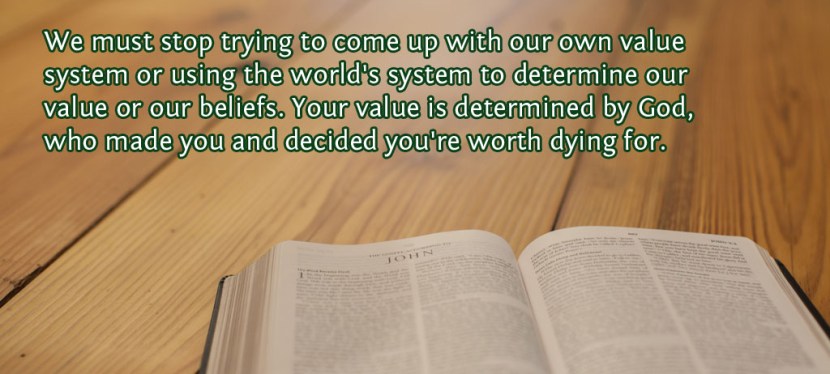
Before we can become the best versions of ourselves and have a right view of ourselves, we have to recognize our true value. The world will tell you that your relationship with yourself is the most important relationship you have, and that increasing your self-esteem will correct any problems you have with feeling like you’re not enough in some way. But following that advice isn’t deeply satisfying because I think deep down we all realize that we can’t assign value to ourselves.

That begs the question, “Who can assign value to you?” Other people, society, or impersonal metrics aren’t good measures either. The only satisfactory answer is God. Only the Creator can assign value to His creation. He knows what He created you for and who He created you to be, and therefore only He can declare how valuable you truly are.

Testing Where To Look For Value

We’ve been talking about Ecclesiastes here on this blog for a couple week now (click here to read “Crash Course in Ecclesiastes” and here for “Letting Death Give Us Perspective On Life“). One of the things that Solomon does in this book is present an in-depth analysis of all the different places that we can look for value.

Solomon experiments with finding value in his own wisdom, in pleasure, in wealth, in fine works, in great power, and in the legacy you leave for future generations. But he describes it all as “vanity” (hebel, H1892) — a transitory, unsatisfactory thing. As we modern people read through Ecclesiastes, we often label Solomon as depressed (probably accurate) and having low self-esteem. But Solomon himself doesn’t describe the problem as not esteeming himself enough. He knows the self isn’t a good place to look for value, and he wants something or someone else to give life meaning and tell him his purpose.

As Solomon works though his existential crisis, he concludes that meaning can only be found in God. God is the one who sets everything in motion and the only one with an accurate perspective on His plan (Ecc. 3:1-15). He’s in heaven and we’re on earth, so we need to be wary of jumping to conclusions about things we know nothing about (Ecc. 5:1-7). In the end, everything boils down to our duty to fear God and keep His commandments (Ecc. 12:13-14). That’s the key to understanding who we are and where our value lies. Read more

Crash Course In Ecclesiastes

It’s always puzzled me why so many people think of Ecclesiastes as depressing. For me as a teenager, it provided a map for navigating my way out of depression. Of course, I’m not saying it’s a magic cure for mental illness, but if you’re struggling with questions about the meaning of life or frustrated with how pointless it all seems, this book can provide a great deal of hope.

The book of Ecclesiastes contains the reflections of a deep thinker who works through an existential crisis. This sort of crisis happens when an individual starts to question whether their life (or life in general) has any purpose, meaning, or value. Solomon wrestled with these questions and records his thoughts for us to learn, as he did, that true meaning and purpose can only be found in God.

Ecclesiastes is one of those books that it’s not a good idea to read isolated pieces from. That’s one way you end up thinking there are few spiritual lessons in this book or misinterpreting its message. The whole thing is interconnected, with layers of thoughts building on each other as Solomon goes back and forth asking questions and contemplating possible answers. It’s vital that we look at this piece of writing as a whole before we start to dive deep into individual passages.

Cycles of Futility …

“Vanity of vanities,” says the Preacher; “Vanity of vanities, all is vanity” (Ecc. 1:2 , unless otherwise noted, all quotes are from the WEB version). Thus the book of Ecclesiastes opens, and Solomon will repeat this phrase throughout and in the conclusion (Ecc. 12:8). He presents everything in life as vanity, or hebel (H1892) — a vapor/breath; a transitory or unsatisfactory thing. That might seem like a depressing outlook, but can you really look at the world and say he’s wrong? Do things of this life last? Do they make sense? Is this world satisfying? Not on its own.

All things are full of weariness beyond uttering. The eye is not satisfied with seeing, nor the ear filled with hearing. That which has been is that which shall be; and that which has been done is that which shall be done: and there is no new thing under the sun.

Ecclesiastes 1:8-9, WEB

With a few thousand more years of history to look back on than Solomon had, we can see the truth of these statements. Nothing really changes. We’re not advancing toward a utopia. People just keep making the same mistakes over and over again, which looks to Solomon like cycles of futility and meaninglessness. Oh, there are technology advances and improvements in our lives, but people stay the same.

… Become Cycles of Hope

Having come to this conclusion about life, Solomon tries to resolve his existential crisis by looking for some kind of meaning. He says, “I applied my heart to seek and to search out by wisdom concerning all that is done under the sky” (Ecc. 1:13). He indulged in all sorts of sensory pleasures, amassed wealth, and created created great things but it was also vanity.

Next, he tried out wisdom and folly to compare the two, and found “that wisdom excels folly as far as light excels darkness” (Ecc. 2:13). But the wise and foolish both die. They can’t keep what they worked for or guarantee what they leave behind will have any effect. At this point, Solomon “hated life” and says, “I began to cause my heart to despair concerning all the labor which I had labored” (Ecc. 2:17, 20). Even realizing that you can have wisdom, knowledge, and joy in your life if you please God seems to him like “vanity and chasing after wind” (Ecc. 2:26). But now we come to the first part of Solomon’s ruminations where he glimpses hope.

For everything there is a season, and a time for every purpose under heaven … He has made everything beautiful in its time. He has also set eternity in their hearts, yet so that man can’t find out the work that God has done from the beginning even to the end.

Ecclesiastes 3: 1, 11, WEB

Solomon realizes that God is the one who made the cycles of time. What Solomon initially saw as hopeless repetition he now recognizes as beautiful (Ecc. 3:1-11). Solomon sees that it is a gift from God that we can do good and enjoy this life. He knows that God has a plan in place and that the righteous and wicked will be judged (Ecc. 3:12-17).

But What About Death?

Existential crises aren’t that easy to resolve, though, and Solomon still has questions. He’s accepted that God has a purpose for how the world keeps on turning. He knows that this life can be seen as a gift. but what about after you die? In Ecc. 3:18-22, Solomon concludes that humans die just like animals, and who knows whether their spirits really go to different places? Maybe this life is all we have and we should just make the most of it.

But that’s not a satisfactory answer either, since not everyone gets to enjoy this life. People oppress each other, and the oppressed have no comfort. People envy each other, live lonely lives, and there’s no end to the people who keep being born and dying in this fallen world. Solomon even suggests it would be better to never be born than to live and see all the evil that fills this world (Ecc. 4:1-16).

Immediately, the conversation turns. Solomon says, “Don’t be rash with your mouth and don’t let you heart be hasty to utter anything before God” (Ecc. 5:2). Perhaps he knows that’s what he’d been doing, as his thoughts ran away with fears and questions.

Don’t allow your mouth to lead you into sin. … For in the multitude of dreams there are vanities, as well as in many words: but you must fear God.

Ecclesiastes 5:6-7, WEB

Solomon knows God has a plan and the times are in His hands — he just needs to find a way to trust Him. He desperately wants to make sense of what’s going on in his life, in the world, and in the afterlife (if there is one).

Letting Death Give Us Perspective

Even with this reminder not to jump to hasty conclusions, Solomon continues to struggle. Everything people strive for in this life still seems futile to him. Sure you can enjoy it in this life, but you can’t take it with you when you go. Then we come to another major turning point in Solomon’s thought process. Instead of seeing death as the thing which robs life of meaning, he proposes that we use death to give us perspective on life. There truly is value in a good life well-lived and there is a future worth striving for. I talked about this section of Ecclesiastes in-depth last week, so if you haven’t read it yet here’s a link: “Letting Death Give Us Perspective On Life.”

As we continue in chapter 7, Solomon counsels to avoid extremes. Even a good thing like wisdom can drive you crazy if you “make yourself overly wise” (Ecc. 7:11-2, 16). We can’t make sense of everything or know the future (7:23-25). “There is no man who has power over the spirit to contain the spirit; neither does he have power over the day of death” (Ecc. 8:8). Because this is true we need to beware of hasty judgements, offenses, and conclusions. Rather, focus on fearing God (Ecc. 7:18).

Though a sinner commits crimes a hundred times, and lives long, yet surely I know that it will be better with those who fear God, who are reverent before him. But it shall not be well with the wicked, neither shall he lengthen days like a shadow; because he doesn’t fear God.

Ecclesiastes 8:12-13, WEB

More Questions

The latter part of chapter 8 and into chapter 9 seems like a step backward. Solomon was talking about it being “better with those that fear God” but then he remembers “that there are righteous men to whom it happens according to the work of the wicked. Again, there are wicked men to whom it happens according to the work of the righteous” (Ecc. 8:14). This frustrating situation sends Solomon right back to commending mirth, then reapplying his heart to wisdom trying to figure things out (8:15-16).

He concludes that “man can’t find out” the work of God no matter how much he seeks it, nor comprehend God’s plan and thoughts even if he is wise (Ecc. 8:17-9:1). Solomon even starts to question whether there’s purpose in death or not because he’s still wrestling with the fact that the same things happen to both righteous and wicked people (9:2-6).

I think most (if not all) of us can relate to this. Just because we think we’ve figured something out doesn’t mean nothing will shake our faith. Gross injustice, friends who die too young, tragic health trials — they can all make us question the frame through which we see the world. The fact that Solomon keeps going back and forth, asking the same questions and wrestling with the answers makes him very relatable.

Life’s Absurd, Enjoy It Anyway

We’re approaching the end of the book now and Solomon presents a revised conclusion: that we should live life to the fullest even though it’s absurd. We can’t predict the future, we can’t control anything, and we’ll be better off if we just live well and try not to overthink things (Ecc. 9:7-12).

Of course, overthinking things is something we humans are very good at. Solomon continues comparing wisdom and folly, and continues coming up against the conclusion that wisdom is far better. Chapter 10 reads much like part of Proverbs, and it leads into the final conclusions of Ecclesiastes.

Practice wisdom. Remember “you don’t know the words of God who does all.” Don’t get distracted or complacent. Keep working and living (Ecc. 11:5-6). Balance is key — rejoice in all your years but also “remember the days of darkness” that help give perspective. Remember that “God will bring you into judgement” for all you do, so put off both sorrow and evil (Ecc. 11:8-10).  He’s now speaking most pointedly to young people, urging them to “remember your Creator” today, before life gets harder or trials come or you grow old and full of regrets (Ecc. 12:1-6).

Now Let Us Hear The Conclusion

Crash Course In Ecclesiastes | LikeAnAnchor.com
Photo credit: Pearl via Lightstock

Here at the end is where Solomon finally answers his earlier question, “Who know the spirit of man, whether it goes upward?” (Ecc. 3:21).

Remember also your Creator in the days of your youth … before the silver cord is severed, or the golden bowl is broken, or the pitcher is broken at the spring, or the wheel broken at the cistern, and the dust returns to the earth as it was, and the spirit returns to God who gave it.

Ecclesiastes 12:1, 6-7, WEB

Solomon has reached the point where he has a confident assurance that there is life after death and God will sort-out everything that doesn’t make sense now. I suspect, and Matthew Henry’s commentary agrees, that Solomon wrote this in old age, hoping that his young audience would heed his wisdom without feeling the need to themselves experiment with life as he did.

Solomon shared what he learned from wresting with questions and doubts so others wouldn’t have to. This also seems to be when he put together the book of Proverbs (Ecc. 12:9-10). As Ecclesiastes wraps up, he admonishes young people not to study too widely, for not all the information out there is good (12:11-12). Better to stick with “the words of the wise” which “have been given by one Shepherd” (Ecc. 12:11, TLV).

This is the end of the matter. All has been heard. Fear God, and keep his commandments; for this is the whole duty of man. For God will bring every work into judgment, with every hidden thing, whether it is good, or whether it is evil.

Ecclesiastes 12:13-14, WEB

It’s so nice to have such a straight-forward conclusion at the end of such a deep, complex book. Here, Solomon tells us in no uncertain terms what the point of Ecclesiastes is. From it, we’re to learn that fearing God and keeping his commandments is man’s whole duty and that God will judge all our works.

Letting Death Give Us Perspective On Life

Ecclesiastes records the reflections of a deep thinker who works through an existential crisis and concludes meaning can only be found in God. While many people find this book depressing, I think taken as a whole it offers a remarkably hopeful perspective that can actually help us work through the sort of questions that were weighing on the author (most likely Solomon’s) mind.

When I recently went back to studying Ecclesiastes, I had this grand vision that I would write a post about the entire book (similar to “Crash Course in Romans”) in less than a week and post it today. I’m currently laughing at myself for thinking that was an attainable goal. Instead, we’re just going to talk about a handful of verses in the middle of the book that have captured my attention, and save the Crash Course in Ecclesiastes for next week.

The Vanity of Everything

Like Romans, Ecclesiastes is hard to understand if you take bits and pieces out of context, so before we get to the verses that I want to focus on today we need to take a quick look at what came before.

Solomon had shown the vanity of pleasure, gaiety, and fine works, of honour, power, and royal dignity … [and] there is as much vanity in great riches (Matthew Henry’s Commentary on Ecc. 5:9-17)

He has also been questioning the meaning of life. If all the things that people pursue on earth are meaningless, then what is there for us? Several times he argues that there is “nothing better” for men than to rejoice in this physical life (Ecc. 2:24; 3:13, 22; 5:18). But that’s still not a satisfactory answer for him. He wants more, something to explain why we should keep trying and what’s the purpose in living.

For who knows what is good for man in life, all the days of his vain life which he spends like a shadow? For who can tell a man what will be after him under the sun? (Ecc. 6:12, WEB)

A Different Perspective on Death

Up until this point, there has been a, “Let us eat and drink, for tomorrow we will die” theme running through Ecclesiastes (Is. 22:12-13). It seems that in Solomon’s mind at this time, death was the point at which hope falls apart. Sure you can enjoy this life, but it’s all emptiness because you still end up dead with no guarantee that you have anything to show for it. Now, though, Solomon suggests that we can use death to give us perspective on life.

It is better to go to the house of mourning than to go to the house of feasting: for that is the end of all men, and the living should take this to heart. Sorrow is better than laughter; for by the sadness of the face the heart is made good. The heart of the wise is in the house of mourning; but the heart of fools is in the house of mirth. (Ecc. 7:2-4, WEB)

We must not forget that there is “a time to be born, and a time to die … a time to weep, and a time to laugh; a time to mourn, and a time to dance” (Ecc. 3:2, 4, WEB). There’s nothing wrong with feasting and laughter in its proper time, but staying there makes your heart foolish. Wise men keep their ends in mind. Death reminds us that we only have so much time to decide how we’re going to live our lives and what we’ll be remembered for.

Letting Death Give Us Perspective On Life | LikeAnAnchor.com
Photo credit: Rosie Fraser via Unsplash

The End Is Better

We just talked about verses 2-4 in chapter 7. Now let’s go back to verse 1:

A good name is better than fine perfume; and the day of death better than the day of one’s birth. (Ecc. 7:1, WEB)

There is much value in a good life well-lived. Solomon has already concluded that “wisdom excels folly, as far as light excels darkness” (Ecc. 2:13, WEB). Here he reinforces that a good name — that is “a name for wisdom and goodness with those that are wise and good”(MHC on Ecc. 7:1-6) — is worth more than all the pleasures, wealth, etc. that he’d found so empty.

if we have lived so as to merit a good name, the day of our death, which will put a period to our cares, and toils, and sorrows, and remove us to rest, and joy, and eternal satisfaction, is better than the day of our birth, which ushered us into a world of so much sin and trouble, vanity and vexation. We were born to uncertainty, but a good man does not die at uncertainty. (MHC on Ecc. 7:1-6).

Death is not the end of the story, and for a man who considers his death and prepares for it (as Solomon goes on to say in the next verses, which we’ve already talked about) he has the opportunity to die with “a good name.” The word for “name” here is shem (H8034), and in the Hebrew concept it’s always connected with your reputation and character.

Those who die having a good reputation and a good character are no longer subject to the evils of this present life and await their resurrection to a much better life in the future. That gives those of us left behind great hope even in the midst of sorrow (1 Thes. 4:13-14).

Backing Into The Future

Letting Death Give Us Perspective On Life | LikeAnAnchor.com
Photo credit: Ashim D’Silva via Unsplash

The idea that the day of our death is better than the day of birth can be a hard one for people to come to grips with, even given the context we just talked about. We still grieve at death even though we know (as Solomon also concludes by the end of this book) that “the spirit returns to God who gave it” and that He will raise believers up in the last day (Ecc. 12:7; John 6:40). But maybe another verse in this section of Ecclesiastes can provide further explanation.

Better is the end of a thing than its beginning. (Ecc. 7:8, WEB)

The Hebrew word for “end” is achariyth (H319). To understand achariyth, we have to understand that the Hebrew concept of time is like “the view a man has when he is rowing a boat. He sees where he has been and backs into the future” (H.W. Wolff quoted in TWOT entry 68e). That’s why this word translated “end” can also mean last/latter days, after part, future, or reward. The end of a thing is better than the beginning because you will have arrived at the future goal and can now look back on where you’ve been with a better perspective.

If you’d rather not think about death then the idea that the end is better than the beginning can be a depressing one because it forces you to confront something uncomfortable. But ignoring the idea of our lives ending is foolish. Everyone is going to die whether we think about it or not, so why not use the fact that our lives will end as motivation to make the life we have a good one?


Featured image credit: carolynabooth via Pixabay

How Should We Honor The Days God Sets Apart For Him?

Practicing righteousness. Learning to love. Developing the mind of God. Following Christ. Those are all essentials of the Christian life, and there are many “tools” God has given us to help us succeed in these goals. These include prayer, Bible reading and study, the Holy Spirit inside us, and fasting.

God’s Sabbaths and holy days are also vital, and often overlooked, gifts given to help us align with God and His ways. Keeping these days as God commanded helps line us up with His will, reinforces His plan, and deepens our relationship with Him. Just as responding to an invitation to get together with your physical family lets you build relationships with them, so does responding to our heavenly Father’s invitations help us build relationships with Him, our Bridegroom, and the other children in His family.

For many Christians, keeping God’s holy days is a foreign concept because they’ve been (incorrectly) told “that’s just a Jewish/Old Testament thing. But when you start to recognize there’s lasting value in the days God calls holy to Him, you come up against the question, How do you keep the Sabbaths in a way that honors God?

Even if you have been keeping these days for a while, you know this isn’t always an easy questions to answer. There are certain rules and guidelines in scripture, but they don’t answer all our questions. Plus, knowing what to do, and what not to do, in keeping the holy days is about more than a list of rules. It’s about honoring God’s instructions on how to come before Him. So let’s take a look at what God says to do for these days and how we can obey those commands in the spirit and from our hearts. Read more

Understanding The Days That God Calls Holy To Him

Did you know that there are certain days in the Bible that God calls holy? One of these holy times happens every 7 days and we call it the weekly Sabbath. The other 7 holy days happen at set times in the spring, early summer, and fall.

If you’re reading this when it was posted, the fall holy days ended a couple weeks ago and the spring ones won’t start again for 6 months. This in-between time seems to me like the perfect opportunity for those of us who do keep the holy days to reflect on their meaning, along with how and why we keep them. And if you’ve never observed God’s holy days before, I hope you’ll find value in learning about them and maybe even join us in keeping them.

All the holy days are outlined in Leviticus 23, and then expounded on in other passages as well. In this chapter they’re all called “set feasts” (mo’ed) and “holy convocations (miqra). This identifies them as appointments that God has set at specific times for specific reasons. We talked about these Hebrew words, and others that describe God’s holy days, in last week’s post (click here to read it).

Sabbath

“The children of Israel shall keep the Sabbath, to observe the Sabbath throughout their generations, for a perpetual covenant. It is a sign between me and the children of Israel forever; for in six days Yahweh made heaven and earth, and on the seventh day he rested, and was refreshed.”

Exodus 31:16-7, WEB

As spiritual Israel (Rom. 9:6-8; Gal. 3:29; Eph. 2:12-13), this is part of God’s eternal law that is transferred to us (see post “Inheriting Covenants“). The author of Hebrews talks about this topic from 3:7 to 4:9 and concludes, “There remains therefore a Sabbath rest for the people of God.” The Greek word sabbatismos literally means “keeping Sabbath” (G4520, Thayer’s dictionary).

The Sabbath (which happens every week from sunset on Friday until sunset on Saturday) is a time when we stop doing work and other things that clutter our weeks and enter God’s rest. It’s a time to gather with other believers in God’s presence, to learn from Him, and take on His delights as our own. The Sabbath reminds us of His plan, purpose, and presence, and let’s us practice His rest.

Further study: “Delighting In The Sabbath” by Brian Shaw and Isaiah Study: Joy in the Sabbath Covenant With God

Passover

When the hour had come, he [Jesus] sat down with the twelve apostles. He said to them, “I have earnestly desired to eat this Passover with you before I suffer.”

Luke 22:14-15, WEB

The Passover (Pesach in Hebrew) observance was instituted in Exodus 12, and Israel was told they should keep it and the Feast of Unleavened Bread that followed “throughtout your generations by an ordinance forever” (Ex. 12:14, WEB). Jesus changed/added to (depending on your interpretation) the symbols associated with Passover, but still told his followers to continue keeping it “in remembrance of me” (Luke 22:19; 1 Cor. 11:23-26).

For New Covenant believers, Passover reminds us of God’s deliverance and Jesus’ sacrifice. Drinking the wine and eating the bread symbolize our commitment to and participation in the New Covenant. Passover also lets us “proclaim the Lord’s death until he comes” (1 Cor. 11:26, WEB). It is a way for us to keep in mind of, and remind others, that Jesus died for our sins and that He will return.

Further study: “Passover Questions: Am I Ready To Hear What God Says?” and “Why I’m Keeping Passover On Nisan 14

Feast of Unleavened Bread

Purge out the old yeast, that you may be a new lump, even as you are unleavened. For indeed Christ, our Passover, has been sacrificed in our place. Therefore let us keep the feast, not with old yeast, neither with the yeast of malice and wickedness, but with the unleavened bread of sincerity and truth.

1 Corinthians 5:7-8, WEB

Beginning the day after the Passover, the Feast of Unleavened Bread (Chag HaMatzot) lasts for 7 days. The first and last days are both holy convocations and days when we do no work. For all 7 days, we eat nothing with leavening in it and we eat unleavened bread (Lev. 23:6-8; Ex. 23:15).

As we can see in this quote from Paul’s letter, the early New Testament church was still keeping this Feast. They were doing so in the spirit as well as the letter, recognizing that there’s a purpose behind the symbolism of putting leaven out and taking in unleavened things. These days are a yearly reminder to keep putting off sin and putting on Christ’s nature.

Further study: “Rhythms of Worship” and “Exodus To Corinthians: A Passover Message For The New Testament Church

Feast of Weeks

Now when the day of Pentecost had come, they were all with one accord in one place.

Acts 2:1, WEB

On the Sunday after Passover, ancient Israel performed a ceremony called Firstfruits or Wavesheaf (Lev. 23:9-14). From that day, you count seven Sabbaths plus one day to get 50 days, then o-bserve the Feast of Weeks (better known today as Pentecost or, in Hebrew, Shavuʿoth).

Pentecost is a fascinating holy day. It’s connected with the story of Ruth and our role as firstfruits in God’s harvest. It’s the day Jesus and His Father gave the precious gift of their Holy Spirit to the church. It’s also the only single day called by the Hebrew word a chag (the other holy days designated “Feasts” are the 7-day long Unleavened Bread and Tabernacles). There’s a great deal of significance in this day, and it’s there for us today as well as for earlier believers.

Further study: “Firstfruits from the Rejects” and “The Bridegroom’s Pledge

Day of Trumpets

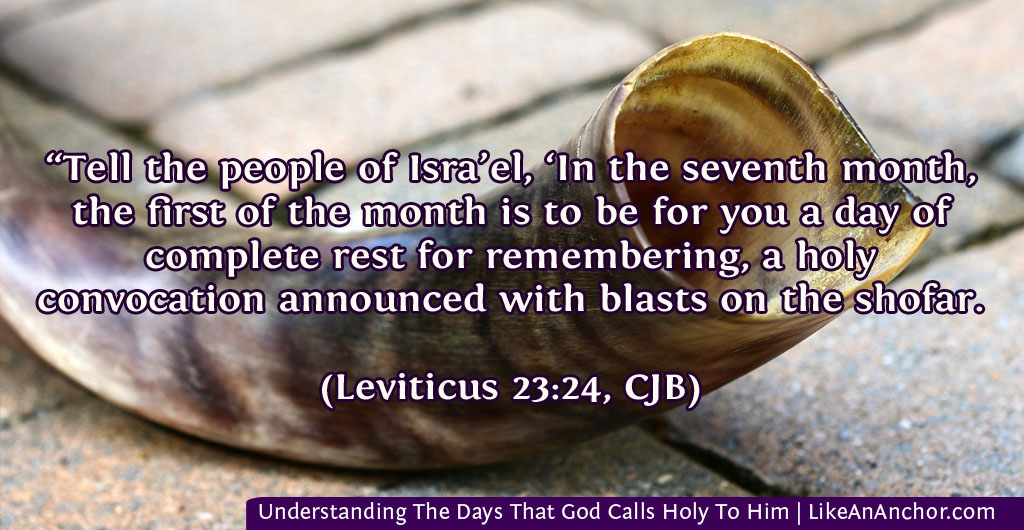
Speak to the children of Israel, saying, “In the seventh month, on the first day of the month, shall be a solemn rest to you, a memorial of blowing of trumpets, a holy convocation.”

Leviticus 23:24, WEB

There’s not nearly as much information in scripture about the Day of Trumpets/Shouting (Yom Teruah) as for the other holy days, but that doesn’t mean it’s any less important. Many believers (and I think rightly so) see it as the holy day which points to Christ’s return because of the connection with trumpet blasts (1 Thes. 4:16; Rev. 11:15). It’s one of the “shadows” speaking to us of Christ’s reality (Col. 2:16-17).

Further study: “Preparing For The Bridegroom To Come Back” and “With The Sound of Trumpets

Understanding The Days That God Calls Holy To Him | LikeAnAnchor.com
Photo credit: slgckgc via Flikr

Day of Atonement

Yahweh spoke to Moses, saying, “On the tenth day of this seventh month is the day of atonement: it shall be a holy convocation to you, and you shall afflict yourselves; and you shall offer an offering made by fire to Yahweh. … It shall be a Sabbath of solemn rest for you, and you shall deny yourselves. In the ninth day of the month at evening, from evening to evening, you shall keep your Sabbath.”

Leviticus 23:26-27, 32, WEB

The Jews consider the Day of Atonement (Yom Kippur) as the most solemn and holy time of the year. It was the only day a human being could enter the Holy of Holies inside the temple, and even then only the high priest. There was also a ceremony of two goats — one killed for the sins of the people as a picture of Jesus Christ and the other banished as picture of what will happen to Satan (Lev. 16; Heb. 2:17; Rev. 20:1-3).

Today, Atonement reminds us of Christ’s sacrifice, looks forward to a time when Satan is removed from the picture, and invites us to think deeply about our High Priest Jesus Christ. It’s also the only specific day we’re commanded to fast, which in itself has a whole host of spiritual benefits. Exactly how to “fast” is debated, but most people I know (including me) believe it’s a fast of no food or drink for 24 hours. This holy day is briefly mentioned in the New Testament (Acts 27:9).

Further study: “Clean Temples For Yom Kippur” and “Fasting

Feast of Tabernacles

And then every survivor from all those nations coming against Jerusalem will go up year after year to worship the king, Yahweh of hosts, and celebrate the Feast of Booths.

Zechariah 14:16, LEB

The Feast of Tabernacles or Booths (Sukkot) is a week-long feast with an 8th day, the Last Great Day, on the end (Lev. 23:33-36; 39-44). It was a Feast that Jesus kept (John 7:1-10; 37-39), and this prophecy in Zechariah shows it will still be celebrated in the future. It’s a time when we’re told to stay in temporary shelters. Most people I know celebrate this Feast by traveling to a “Feast site” hosted by a church group, staying in a hotel (a place we live temporarily) or camping in a tent (a temporarily set-up shelter), and attending daily church services.

This Feast is a season of great rejoicing, followed on the 8th day by a solemn observance called an atsarah (click here to go to last week’s post on Hebrew words associated with the holy days). Tabernacles reminds us that we’re strangers and pilgrims on this temporary earth, but that a time is coming when God will establish His kingdom here and all people will live in His peace.

Further study: “Tabernacles and Temples” and “Do You Value The Gifts From Your Bridegroom?

Conclusion

This is a long post, but it’s just the briefest overview of the days God calls holy to Him. These days offer a weekly (in the Sabbath) and yearly (in the annual Feasts) rehearsal of God’s plan. He invites — and commands — us to keep these days with Him on His set appointed times because they matter.

“You shall keep my Sabbaths, and have reverence for my sanctuary. I am Yahweh.”

Leviticus 26:2, WEB

We keep His Sabbaths because He is Yahweh — the eternal Lord and the only true God. These days mean something to God, and therefore should mean something to His children. The Sabbaths and Feasts are appointments that God has set at specific times for His people to gather together for specific reasons. God places a high value on these days, calling them “holy” or set-apart for Him. As His children, we should value these days as well.

Free resource! Click here to download a chart summarizing these holy days, including the Hebrew words used for each, when and how they were observed, and New Covenant applications:


Featured image credit: tihanyitom via Pixabay