Are You Little In Your Own Eyes?

Did you ever wonder why Saul changed his name to Paul?

I often forget that there even was a name change until something reminds me; I’m so used to thinking of Paul the Apostle and author of about half the New Testament. The name change isn’t even made a big deal of in scripture (not like God renaming Abram to Abraham). We just find out about it in a parenthetical note in Acts 13:9 and he’s called Paul from then on.

One of the likely explanations for this name change is that he had two names. Saul is a Hebrew name, and he would have gone by that since we know how proud he was of his Jewish heritage. He was also a Roman citizen, though, and Paul could have been his Roman name. It would make sense for him to switch the name he used when he became the Apostle to the Gentiles (GotQuestions.org). That’s a perfectly reasonable answer and a very likely explanation. I wonder, though, if the name meanings might have played a role in Paul’s decision as well.

Saul, “Asked For”

There’s one other famous Saul in the Bible. Saul the son of Kish, of the tribe of Benjamin, was Israel’s first king. His name means “asked for” or “prayed for” (BehindTheName.com). It comes from the Hebrew word sha’al , which means “to ask” (Brown, Driver, Briggs dictionary entry on H7592). It’s actually the word used when Israel asked for a king and received Saul as their answer (1 Sam. 8:10; 12:17-19).

We don’t know if Saul/Paul’s parents named him after King Saul, but people must have noticed the connection. Saul/Paul was even from the same tribe as King Saul. He was trained by a respected rabbi and, as a Pharisee, would have been intimately familiar with the Old Testament (Acts 22:2-3; Phil. 3:4-6). He’d have had the whole Torah memorized and very likely the rest of the Old Testament as well (including the story of King Saul).

In the Old Testament, God hand-picked Saul to be the first king. At that time, Saul was a humble man. He protested the prophet Samuel’s special notice of him, saying, “Am I not a Benjamite, of the smallest of the tribes of Israel? And my family the least of all the families of the tribe of Benjamin? Why then do you speak to me like this?” (1 Sam. 9:21, WEB). When Israel came together to anoint him as king, Saul hid (1 Sam. 10:20-24). But his attitude changed over the years. He started acting presumptuously, taking it upon himself to make decisions contrary to God’s commands and acting as if he was in the right.

Then Samuel said to Saul, “Wait a minute! Let me tell you what the Lord said to me last night.” Saul said to him, “Tell me.” Samuel said, “Is it not true that when you were insignificant in your own eyes, you became head of the tribes of Israel? … Why haven’t you obeyed the Lord?” …

Then Samuel said,
“Does the Lord take pleasure in burnt offerings and sacrifices
as much as he does in obedience?
Certainly, obedience is better than sacrifice;
paying attention is better than the fat of rams.
For rebellion is like the sin of divination,
and presumption is like the evil of idolatry.
Because you have rejected the Lord’s orders,
he has rejected you from being king.”

1 Samuel 15:16-17, 19, 22-23, NET

You can also translate the phrase “insignificant in your own eyes” as “little in your own sight.” I think that’s the key part here. When Saul was humble, he was also obedient. When he lost that perspective, then he started to disobey God and thinking he knew best. When Samuel confronted him, he protested, “But I have obeyed Yahweh’s voice” even with clear evidence to the contrary (1 Sam. 15:20, WEB). When he finally admitted he’d done wrong, he says, “I have sinned; yet please honor me now before the elders of my people and before Israel” (1 Sam. 15:30, WEB). It seems clear his priorities were on doing what was right in his own eyes and gaining honor before the people he led rather than on following God.

From Little to Big, and Big to Little

What about the Saul who we now know as Paul? He was absolutely sure he was following God’s plan when he persecuted those new Christians. When confronted about it, he could have said, “But I have obeyed the Lord” and worried about holding onto the honors he got as a respected Pharisee. But he had a very different response than King Saul. Here’s how Paul describes his conversion to King Agrippa:

 “according to the strictest party of our religion, I lived as a Pharisee. And now I stand here on trial because of my hope in the promise made by God to our ancestors, a promise that our twelve tribes hope to attain as they earnestly serve God night and day. Concerning this hope the Jews are accusing me, Your Majesty! Why do you people think it is unbelievable that God raises the dead? Of course, I myself was convinced that it was necessary to do many things hostile to the name of Jesus the Nazarene. And that is what I did in Jerusalem: Not only did I lock up many of the saints in prisons by the authority I received from the chief priests, but I also cast my vote against them when they were sentenced to death. I punished them often in all the synagogues and tried to force them to blaspheme. Because I was so furiously enraged at them, I went to persecute them even in foreign cities.

“While doing this very thing, as I was going to Damascus with authority and complete power from the chief priests, about noon along the road, Your Majesty, I saw a light from heaven, brighter than the sun, shining everywhere around me and those traveling with me. When we had all fallen to the ground, I heard a voice saying to me in Aramaic, ‘Saul, Saul, why are you persecuting me? You are hurting yourself by kicking against the goads.’ So I said, ‘Who are you, Lord?’ And the Lord replied, ‘I am Jesus whom you are persecuting. But get up and stand on your feet, for I have appeared to you for this reason, to designate you in advance as a servant and witness to the things you have seen and to the things in which I will appear to you. …

“Therefore, King Agrippa, I was not disobedient to the heavenly vision, but I declared to those in Damascus first, and then to those in Jerusalem and in all Judea, and to the Gentiles, that they should repent and turn to God, performing deeds consistent with repentance. … so I stand testifying to both small and great, saying nothing except what the prophets and Moses said was going to happen: that the Christ was to suffer and be the first to rise from the dead, to proclaim light both to our people and to the Gentiles.”

Acts 26: 5-16, 19-20, 22-23, NET

Here’s the big difference between the two Sauls. Both thought they were doing the right thing. But when King Saul was told about his mistake, he protested and defended himself and worried about how people saw him. When Jesus showed up and told Saul he was persecuting the Messiah, Saul/Paul “was not disobedient to the heavenly vision” and immediately course-corrected. King Saul went from “little in his own eyes” to arrogant, while Paul went from arrogant to humble and obedient.

Paul, “Small”

The name Paul comes “From the Roman family name Paulus, which meant ‘small’ or ‘humble’ in Latin” (BehindTheName.com). This perfectly describes Saul/Paul after his conversion. He had always wanted to do God’s will, and when he found out he and God disagreed on what that should look like, he immediately and humbly changed to align with God’s will.

If someone thinks he has good reasons to put confidence in human credentials, I have more: I was circumcised on the eighth day, from the people of Israel and the tribe of Benjamin, a Hebrew of Hebrews. I lived according to the law as a Pharisee. In my zeal for God I persecuted the church. According to the righteousness stipulated in the law I was blameless. But these assets I have come to regard as liabilities because of Christ. More than that, I now regard all things as liabilities compared to the far greater value of knowing Christ Jesus my Lord, for whom I have suffered the loss of all things—indeed, I regard them as dung!—that I may gain Christ, and be found in him, not because I have my own righteousness derived from the law, but because I have the righteousness that comes by way of Christ’s faithfulness—a righteousness from God that is in fact based on Christ’s faithfulness. My aim is to know him, to experience the power of his resurrection, to share in his sufferings, and to be like him in his death, and so, somehow, to attain to the resurrection from the dead.

Not that I have already attained this—that is, I have not already been perfected—but I strive to lay hold of that for which Christ Jesus also laid hold of me. Brothers and sisters, I do not consider myself to have attained this. Instead I am single-minded: Forgetting the things that are behind and reaching out for the things that are ahead, with this goal in mind, I strive toward the prize of the upward call of God in Christ Jesus.

Philippians 3:4-14, NET

This is one of my favorite passages from Paul’s letters. He has such a focused perspective on walking with Jesus and the value of his calling. Paul thought he was hot stuff once, but no more. He’s so humble he won’t even say he’s guaranteed a spot in the resurrection. He could boast about things if he wanted. “Am I not an apostle?” Paul reminds the Corinthians. “Have I not seen Jesus our Lord?” (1 Cor. 9:1, NET). But instead, he focuses on how he can best serve Jesus and the church.

For since I am free from all I can make myself a slave to all, in order to gain even more people. To the Jews I became like a Jew to gain the Jews. To those under the law I became like one under the law (though I myself am not under the law) to gain those under the law. To those free from the law I became like one free from the law (though I am not free from God’s law but under the law of Christ) to gain those free from the law. To the weak I became weak in order to gain the weak. I have become all things to all people, so that by all means I may save some.

I do all these things because of the gospel, so that I can be a participant in it.

Do you not know that all the runners in a stadium compete, but only one receives the prize? So run to win. Each competitor must exercise self-control in everything. They do it to receive a perishable crown, but we an imperishable one.

So I do not run uncertainly or box like one who hits only air. Instead I subdue my body and make it my slave, so that after preaching to others I myself will not be disqualified.

1 Corinthians 9:19-27, NET

Sorry about putting so many big long quotes in this post, but I think for this especially it helps to get Paul’s perspective in his own words. And it’s also good for us. After the passage I quoted in Philippians, Paul adds, “Be imitators of me, brothers and sisters, and watch carefully those who are living this way, just as you have us as an example” (Phil. 3:17, NET). We can learn from Paul’s example. We should be similarly humble, focused, and teachable. We should also examine ourselves and make sure we’re not making assumptions about what God wants us to do that don’t actually line up with His will and His word.

If you’re reading this the weekend it posts, we’re less than two weeks away from Passover. At this time of year, Paul warns us, “whoever eats the bread or drinks the cup of the Lord in an unworthy manner will be guilty of the body and blood of the Lord. A person should examine himself first, and in this way let him eat the bread and drink of the cup” (1 Cor. 11:27-28, NET). Self-examination is something we should do year-round (2 Cor. 13:5-6), but it’s particularly important now as we focus on making sure we’re coming before God in a worthy way.


Featured image by Jill Wellington from Pixabay

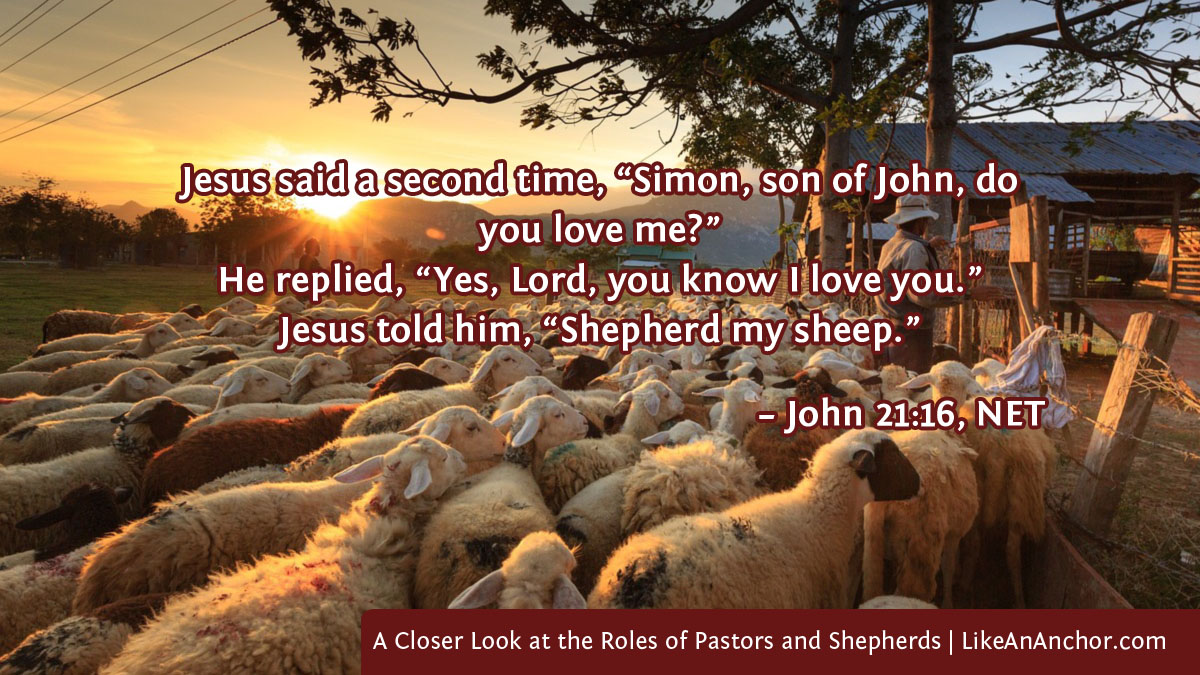
A Closer Look at the Roles of Pastors and Shepherds

A few weeks ago, I started a study on sheep, lambs, and shepherds in the Bible. One of the most interesting things I came across was looking into the words for “shepherd” and “pastor” in both English and Hebrew. As I mentioned last week, I don’t usually spend time looking at English words since they’re a translation choice rather than something that gives insight into the original intent, but sometimes it’s interesting. For example, in the case of “pastor,” it’s curious to see how the meaning of the word has changed over the years in Western Christianity. That study made me want to look into the roles of shepherds/pastors a little bit more. I wanted to see how looking at the Greek could add to understanding this, and dig more into our modern ideas of what a shepherd or pastor does.

Pasturing the Flock

First, a quick recap of the shepherd study from a few weeks ago. In Hebrew, the word translated “shepherd” is connected to the words for pasture, tend, and graze (Theological Wordbook: Old Testament 852). The shepherd is one who makes sure the flocks are fed in good pastures. In English, the word “shepherd” comes from sheep+herd and it means someone who herds sheep (Online Etymology Dictionary). But the English word “pastor” comes from the same Latin root as “pasture” (Online Etymology Dictionary). So really, “pastor” might be a more exact translation of râ‛âh than “shepherd” is, though the way those English words are used today makes shepherd the less confusing choice. (Interestingly, râ‛âh is translated “pastors” eight times in the 1611 KJV translation of Jeremiah.)

What about in Greek? In the KJV, WEB, and NET translations, “shepherd” and the one use of “pastor” (Eph. 4:11) are both translated from poimēn (G4166). The verb form is poimainō (G4165) and it’s translated in KJV as “rule” or “feed” but in WEB and NET as “shepherd,” “tend,” or “rule.” The word simply means to care for flocks of all sorts; it’s more like “flock-tender” than “sheep-herder” (Zodhiates G4165). Also, there’s another specific word, boskō (G1006), for taking animals to a pasture to graze. Bosko represents feeding where poimaino “involves total care” (Zodhiates G1006).

We see both of those feeding and shepherding words in Jesus’s conversation with Peter at the end of John’s gospel. He told Peter, “feed my lambs,” “tend my sheep,” and “feed my sheep” (John 21:13-17, WEB). The word translated “tend” is poimainō and the one translated “feed” is boskō. In other words, Jesus is telling Peter that it’s his role to provide wholistic care for the flock and to specifically feed them and provide pasture. Later, Peter passed this instruction on to his “fellow elders,” telling them to feed or “shepherd the flock of God” (poimainō in this case) (1 Peter 5:1-3).

Image of sheep in a pasture overlaid with text from 1 Peter 5:1-3, NET version:  “I urge the elders among you: Give a shepherd’s care to God’s flock among you, exercising oversight not merely as a duty but willingly under God’s direction, not for shameful profit but eagerly. And do not lord it over those entrusted to you, but be examples to the flock.”
Image by Tom from Pixabay

Feeding and Caring

The one time that translations like KJV and NET use the word “pastor” in the New Testament, it’s in Ephesians 4:11. Here, Paul is talking about unity in the body of Christ and the roles of people within His body. The WEB translation sticks with “shepherd” in this case, but let’s look at it in the NET.

He, the very one who descended, is also the one who ascended above all the heavens, in order to fill all things. And he himself gave some as apostles, some as prophets, some as evangelists, and some as pastors and teachers, to equip the saints for the work of ministry, that is, to build up the body of Christ, until we all attain to the unity of the faith and of the knowledge of the Son of God—a mature person, attaining to the measure of Christ’s full stature.

Ephesians 4:10-13, NET

Several translations see “pastors and teachers” as a linked concept. The freely paraphrased Voice and Message translations say “pastor-teachers,” while the Amplified Bible says “and some as pastors and teachers [to shepherd and guide and instruct].” Now, I’ll admit I resist this reading because I want pastors and teachers to be separate things (since I can call myself a teacher but not a pastor and I don’t want them to collapse into the same role), but that’s a selfish reason for preferring one translation over another so we’re going to push on with this study and see what we can learn.

Pastors take sheep to pasture. And since it’s translated from poimainō, it involves total care for the sheep. This does connect with “teacher” as a role when we think of the connection between God’s word and daily sustenance. For example, God wanted Israel to learn “that man does not live by bread only, but man lives by every word that proceeds out of Yahweh’s mouth” (Deut. 8:3, WEB). It’s such an important lesson that Jesus quotes it in His show-down with Satan (Matt 4:1-4; Luke 4:1-4).

Righteous Job “treasured up the words of his [God’s] mouth more than my necessary food” (Job 23:12, WEB). One Psalmist calls God’s words sweet like honey (Ps. 119:103, NET). The Lord says when His word can’t be found in a land, it’s like a famine (Amos 8:11-12). There’s even a fascinating connection for Ezekiel and John between eating words given by God and speaking prophecies (Eze. 2:8-3:4; Rev. 10:8-11). Also, when we’re properly feeding on the word of God, we can all become teachers.

For though you should in fact be teachers by this time, you need someone to teach you the beginning elements of God’s utterances. You have gone back to needing milk, not solid food. For everyone who lives on milk is inexperienced in the message of righteousness, because he is an infant. But solid food is for the mature, whose perceptions are trained by practice to discern both good and evil.

Hebrews 5:12-14, NET

So if shepherding involves caring for the flock of God, including feeding them, and teaching involves sharing God’s words which are like food for our spiritual lives, then shepherding/pastoring and teaching are closely connected. They’re not exactly the same thing, but it would seem that a primary job for pastors is to feed the flock. That’s not a shocking revelation; most pastors in Christian churches today are also teachers. But maybe we don’t always think about feeding as the primary role of pastors.

The Importance of Feeding

There is a lengthy passage in Ezekiel 34, along with a shorter one in Jeremiah 23:1-8, where the Lord condemns ancient Israel’s leadership for not doing their job properly. They didn’t protect the flock from dangers. They focused on taking care of themselves rather than putting the flock first. And, perhaps the worst offense of all based on how many times God mentions it, is that they did not feed the sheep.

Yahweh’s word came to me, saying, “Son of man, prophesy against the shepherds of Israel. Prophesy, and tell them, even the shepherds, ‘The Lord Yahweh says: “Woe to the shepherds of Israel who feed themselves! Shouldn’t the shepherds feed the sheep? You eat the fat. You clothe yourself with the wool. You kill the fatlings, but you don’t feed the sheep. …

“As I live,” says the Lord Yahweh, “surely because my sheep became a prey, and my sheep became food to all the animals of the field, because there was no shepherd, and my shepherds didn’t search for my sheep, but the shepherds fed themselves, and didn’t feed my sheep.” Therefore, you shepherds, hear Yahweh’s word: The Lord Yahweh says: “Behold, I am against the shepherds. I will require my sheep at their hand, and cause them to cease from feeding the sheep. The shepherds won’t feed themselves any more. I will deliver my sheep from their mouth, that they may not be food for them.”

“‘For the Lord Yahweh says: “Behold, I myself, even I, will search for my sheep, and will seek them out. … I will feed them with good pasture; and their fold will be on the mountains of the height of Israel. There they will lie down in a good fold. They will feed on fat pasture on the mountains of Israel. I myself will be the shepherd of my sheep, and I will cause them to lie down,” says the Lord Yahweh. “I will seek that which was lost, and will bring back that which was driven away, and will bind up that which was broken, and will strengthen that which was sick; but I will destroy the fat and the strong. I will feed them in justice.”’

Ezekiel 34:1-3, 8-11, 14-16, WEB

In sharp contrast, we see Jesus coming as both the Good Shepherd (John 10) and the Bread of Life (John 6). As the Shepherd who guards the sheepfold, Jesus says, “I am the door. If anyone enters through me, he will be saved, and will come in and go out, and find pasture” (John 10:9, NET). Perhaps, knowing the important role of a shepherd in feeding His flock, some of those listening to Him would have thought back to the miracle of the loaves and the fishes, and what Jesus taught after that about true sustenance.

 “Do not work for the food that disappears, but for the food that remains to eternal life—the food which the Son of Man will give to you.” …

Jesus said to them, “I am the bread of life. The one who comes to me will never go hungry, and the one who believes in me will never be thirsty.” …

“I am the living bread that came down from heaven. If anyone eats from this bread he will live forever. The bread that I will give for the life of the world is my flesh.” … Jesus said to them, “I tell you the solemn truth, unless you eat the flesh of the Son of Man and drink his blood, you have no life in yourselves. The one who eats my flesh and drinks my blood has eternal life, and I will raise him up on the last day. For my flesh is true food, and my blood is true drink.” …

 “The Spirit is the one who gives life; human nature is of no help! The words that I have spoken to you are spirit and are life.”

John 6:27, 35, 51, 53-55, 63 NET

If you’re reading this article the weekend it posts, then Passover just over two weeks away. Eating Jesus’s “flesh” (unleavened bread) and “blood” (wine) is something we do on that day every year (Luke 22:15-20; 1 Cor. 11:23-25). But He’s also our sustenance year-round. We need to keep coming to Jesus to satisfy our spiritual hunger and thirst. We need to keep reading His words that are spirit and life. And if we’re someone with a teaching and/or pastoring/shepherding role, we need to make sure we’re sharing this spiritual food with others as well.

Recognizing Good Shepherds

As I already mentioned, I think I can call myself a teacher, but I’m definitely not a pastor. I went back and forth on actually writing this post because it really isn’t my role to tell pastors how to do their jobs. But I do think knowing something about what the Bible says about pastors/shepherds helps each of us as sheep.

First, we need to recognize that human shepherds are fallible. Jesus is the Chief Shepherd. He’s the one who supplies all our needs and who the Father has given has ultimate Authority over His flock. Jesus doesn’t approve of it when people He lets tend His sheep fail in their duties, and He doesn’t abandon the sheep to substandard care. If you’ve had bad experiences with church leadership, that doesn’t mean Jesus doesn’t care (see those verses we talked about in Ezekiel 34). Also, sometimes people who are overall good leaders need grace and forgiveness because they’re human too.

Second, knowing what we can expect from a human shepherd who’s following Jesus’s example helps us recognize if there’s a teacher or pastor that we shouldn’t be listening to. Jesus said, “Beware of false prophets, who come to you in sheep’s clothing, but inwardly are ravening wolves. By their fruits you will know them” (Matt. 7:15-16, WEB). The same can likely be said of false shepherds. We’re to honor and respect those who serve in the church, but we’re also not supposed to follow them blindly if they’re going off after something other than the true Shepherd.

Finally, studying pastors and teachers reminds us that they do have a very important role in the church. There’s a tendency many of us have–especially if we’ve been burned by some of those wolves in sheep’s clothing–to be very skeptical of church leadership. We may think or act as if we’re the ones in charge and resist following someone’s leadership even if it’s a question of preference rather than something that’s actually, doctrinally important.

Now we ask you, brothers and sisters, to acknowledge those who labor among you and preside over you in the Lord and admonish you, and to esteem them most highly in love because of their work. Be at peace among yourselves.

1 Thessalonians 5:12-13, NET

Remember, the peace that God expects among people in His church includes the church leadership. They’re not to “lord over” the flock (Matt. 20:25-26; 1 Pet. 5:2-4) but they do have roles of leadership and authority, and they deserve respect. Paul even says to give “double honor” to church elders if they “provide effective leadership,” especially when they “work hard in speaking and teaching” (1 Tim. 5:17, NET). When things in the church are working the way God intends, then we all work together as a family with each part of the body filling different roles and some of those parts have more authority than others (all under the headship of Jesus, of course). We’re all learning submission and respect together, ultimately by submitting to Jesus’s leadership as the Good Shepherd.


Featured image by Pexels from Pixabay

Thoughts on Sharing the Gospel

I came down with a flu last week and just did not have the mental focus to do much of anything for the first few days. Which threw-off my typical Bible study routine and therefore my blog post plans. I did, however, feel good enough to read. As I perused my bookshelves, I realized I’d never actually read The Heliand: The Saxon Gospel translated by G. Ronald Murphy, which I’d been very excited about when I discovered it existed a few years ago.

The Heliand is an Old Saxon epic poem from the ninth-century A.D. The author is unknown, but based on clues in the text itself Murphey’s introduction suggests that we can assume the author thought a cultural translation of the gospel into a form Saxons could identify with would be a better conversion tool than Charlemagne’s forcible Christianization. This resulted in a gospel account that’s more of a retelling than a direct translation, with some interesting results.

For example, when Gabriel announces John the Baptist’s birth in The Heliand he says the All-Ruler sent him to say “your child will be a warrior-companion of the King of Heaven. He said that you and your wife should care for him well and bring him up on loyalty” (Song 2). Murphey’s footnote points out this is the “earliest known blending of Germanic warrior virtue with Christian religion,” and a likely origin for Medieval notions of knighthood.

In this version, all the disciples are called Christ’s warrior-companions. On the one hand, this is an inaccurate translation. It misses the Hebrew concept of a learner following a teacher and modeling his behavior. On the other hand, it’s not wrong to describe the original 12 disciples as “a picked group … for a special expedition or mission” (footnote on Song 14) or to say that we can also join Christ’s chosen warrior-companions. So maybe it’s not a mistranslation so much as a choice to emphasize a different Biblical aspect of following Jesus that will connect better with the audience. Then, after they’re interested in learning more, you could talk with them about what else it means to be a disciple.

What Makes A Good Translation?

As I think about The Heliand, I remember another book I read that talked about modern challenges with translating the Bible for some cultures today. There are still many languages in our modern world that don’t yet have a Bible translation. That’s something I don’t think we often think about as English-speaking Christians. The Bible has been available in English for over 400 years at this point and there are a dizzying array of translations available. At times, it can almost feel like the Bible has always been in English or has always been part of Western religious tradition.

I also get the sense from many American Christians that we expect what we read in our English Bibles to accurately reflect what’s in the Greek and Hebrew versions. I spend a lot of time looking at Greek and Hebrew words when I’m studying, so it always surprises me when I hear someone teaching from the Bible or writing an article about a Bible topic focus on one of the English words in a verse. For example, it might be helpful to know “disciple” comes from the Latin word for “learner” and it’s related to the word “discipline,” but the same link isn’t there between the Greek words manthanō and paideia so that tells us more about the translators than the New Testament writers.

Many of us opt for “literal” translations that are word-for-word, or as close to it as possible, like the New King James. “Dynamic” translations that aim to be thought-for-thought, like the New International Version, are also popular. The “free” or “paraphrase” translations like The Message are typically viewed with more suspicion (and rightly so, I think, since there’s more risk that the author’s opinion and modern culture will influence the text). (Click here for more on the different options with English translations.) However, despite the cautions with paraphrase translations, sometimes there might not be the option to translate word-for-word, or even thought-for-thought, depending on the language.

I think the other book I remember reading that talked about some of the challenges translating the Bible today was Reading the Bible with Rabbi Jesus by Lois Tverberg but I don’t remember for certain and I don’t have a copy here to check so I’ll need to reference it from memory.

In many cases, translators begin with the New Testament when translating since that seems like the most relevant for new Christians. That choice can, however, have some drawbacks. One of the stories I remember is that some well-meaning translators working on the gospel accounts left out all that boring genealogy information at the beginning. It wouldn’t mean anything to the people reading it anyway; they had never read a translation of the Old Testament in their language so they wouldn’t know who Abraham, David, and all those other people were. But then later, when the people they were working with found out about the genealogies, they said something like, “Oh! You mean Jesus was a real person? We thought he was made-up because he didn’t have a family.” In this case, the thing English-speaking readers thought was boring was essential for this non-Western audience. A literal translation was better.

The other story I remember involved the challenge of translating Paul’s letters into a language that didn’t have abstract nouns. How do you translate 1 Corinthians 13 into a language where love is always an action, not a concept to discuss? A direct translation is impossible; you’d have to paraphrase or introduce an entirely new concept to the target language. Obviously, it would be much easier to say, “when you’re loving, you’re also being patient and kind” than to try and explain abstract nouns. This is similar to what the author of The Heliand chose to do. He probably could have done a closer to literal translation from Greek into Old Saxon, but he evidently thought a paraphrase would make a whole lot more sense.

Cautions and Tips from the Word

When Jesus told His disciples to “go and make disciples of all nations,” He didn’t tell them precisely how they were to translate when “teaching them to obey everything I have commanded you” (Matt. 28:19-20, NET). But we do know that when He filled those same disciples and others with the Holy Spirit on Pentecost, “a crowd gathered and was in confusion, because each one heard them speaking in his own language” (Acts 2: 6, NET). God is perfectly fine with translations. And one of His most accomplished servants, Paul, modeled the importance of becoming relatable to people when preaching to them (1 Cor. 9:19-23).

Yet there are also cautions. James has this line, which ought to keep any of us teaching up at night: “Not many of you should become teachers, my brothers and sisters, because you know that we will be judged more strictly” (James 3:1, NET). In addition, we have very strict cautions not to add to or take away from the things which God delivers to us (Deut. 4:2; 12:32; Rev. 22:18-19). In other words, don’t take out the “boring” or uncomfortable bits, and don’t add things to make it more palatable either.

There’s a difference, though, between adding/taking away and making strategic decisions on what to emphasize first. If you’re writing an epic to be sung in Saxon mead halls, it makes sense to emphasize the fact that God is a warrior before talking about Him as a shepherd. If you’re translating into a culture that’s collective and family-oriented, you focus on God’s work building His family before talking about an individual relationship with God (actually, this is probably an easier translation than making it clear to individualistic Western readers that God sees His church as a whole collective).

There’s a lot to think about when considering how to translate God’s word, how to use the translations we have, and how to share the gospel across cultures. It’s even an increasingly relevant concern right here in the United States, where we can no longer assume people we talk with have any background in Christianity. Maybe there’s something we can learn from The Heliand about how to talk with people who may only have seen Christianity as something hostile to them. Maybe considering how the Bible is translated and taught cross-culturally can help us figure out how to speak with people who don’t have Christian backgrounds in our own cultures.

I am finally feeling better, so hopefully we’ll be back to a more typical sort of blog post next week. I hope you got something out of my musings on The Heliand this week, thought. If it made you think of any stories you’ve heard or experiences you’ve had sharing the gospel cross-culturally, I’d love to hear them.


Featured image by Peter H from Pixabay

“Song” Recommendation: It’s not sung in this version, but the reading by Dr. Shell gives us an idea of what The Heliand sounded like.

Behold! The Passover Lamb of God

Silly me. I thought when I started writing last week that I’d only have one post on shepherd, sheep, and lamb imagery in the Bible when there’s enough verses on that topic that multiple books could (and have) been written. As you can see, we’re back on this topic again today.

In last week’s post, we went over the Hebrew words for “sheep” and how they’re used in scripture. We also looked at the word for “shepherd,” and discussed the roles and responsibilities of godly shepherds. But we started with Passover lambs, and that’s what I want to come back to today. One of the things we touched on last week is that because we’ve gone astray from God like sheep from their shepherd, the Messiah had to come and die in our place like a lamb.

Let’s think about that a little more. Because we’re wayward sheep, Jesus came as the lamb. He had to take on human nature so He could live like us and die in our place. He became like us–people compared to sheep, one of the animals sacrificed over and over in the Old Testament because of human sins–so He could die instead of us as the one sacrificed Lamb securing forgiveness forever.

I started digging into this topic because of how close we’re getting to Passover. Now, we’re less than five weeks away. So let’s talk about the Lamb who takes away the sins of the world.

Look, the Lamb of God!

John begins his gospel in a unique way. Rather than starting with Jesus’s miraculous birth, he begins long before that. “In the beginning was the Word, and the Word was with God, and the Word was fully God,” John writes as he begins the gospel account, adding, “Now the Word became flesh and took up residence among us” (John 1:1, 14, NET). Only after establishing Jesus’s preexistence and divinity does he move into the familiar story of John the Baptist testifying that Jesus is the Messiah.

On the next day John saw Jesus coming toward him and said, “Look, the Lamb of God who takes away the sin of the world! This is the one about whom I said, ‘After me comes a man who is greater than I am, because he existed before me.’ I did not recognize him, but I came baptizing with water so that he could be revealed to Israel.”

Then John testified, “I saw the Spirit descending like a dove from heaven, and it remained on him. And I did not recognize him, but the one who sent me to baptize with water said to me, ‘The one on whom you see the Spirit descending and remaining—this is the one who baptizes with the Holy Spirit.’ I have both seen and testified that this man is the Chosen One of God.”

John 1:29-34, NET

We’ve likely read this or heard it dozens of times. Jesus came to die and take away our sins. We know this; it’s one of (if not the) central truths of Christianity. John the Baptist doesn’t stop with that truth, though; he keeps going deeper. Jesus “existed before,” He “baptizes with the Holy Spirit,” and He’s “the Chosen One of God.” And John begins these statements about Jesus by calling Him “the Lamb of God.”

Why A Lamb?

To understand why calling Jesus “the Lamb of God” was such an important statement, we need to look to the Old Testament that John’s Jewish listeners would have been so familiar with.

Gen 22:8 is an important passage in the background of the title Lamb of God as applied to Jesus. In Jewish thought this was held to be a supremely important sacrifice. G. Vermès stated: “For the Palestinian Jew, all lamb sacrifice, and especially the Passover lamb and the Tamid offering [daily burnt offering], was a memorial of the Akedah [binding of Isaac] with its effects of deliverance, forgiveness of sin and messianic salvation” (Scripture and Tradition in Judaism [StPB], 225).

NET Study Note on John 1:29

I knew the moment when Abraham willingly offered his son Isaac and God provided a ram in his place was pivotal, but I guess I hadn’t thought about it as deeply as I could have (see Gen. 22). I wouldn’t have connected it with all the daily sacrifices, though it makes sense since all of them point to the Messiah. And as I think about why Abraham’s willingness to sacrifice Isaac and God’s provision of a ram instead was considered so important, I ask myself, “What would have happened if this situation had gone differently?”

If Abraham hadn’t sacrificed Isaac, the Messenger of the Lord couldn’t have said, “now I know that you fear God because you did not withhold your son, your only son, from me” (Gen. 22:11, NET). Abraham wouldn’t have pictured a father willing to give up his son’s life because of trust in the promise of a great future (Heb. 11:17-19; Jam. 2:20-22).

On the other hand, if Abraham had sacrificed Isaac without God stepping in to provide a sheep substitute, then that would have been the end. Israel wouldn’t have been formed because Isaac wouldn’t have had a son, Jacob, to inherit the promises God made to Abraham and found the nation of Israel. There wouldn’t have been a promise to save the whole world through Abraham’s seed in the Messiah (Acts 3:18-26; Gal. 3:15-17).

No wonder, then, that the Jewish people recognize this time when Abraham was about to sacrifice his son and God stepped in with a substitute as a key moment. Abraham’s assurance that “God will provide for himself the lamb for the burnt offering” (Gen. 22:8, NET) echoed down through the ages, pointing to the time when God would provide a Lamb to take away the world’s sins.

The Passover Lamb

Let’s think back to that first Passover. Generations after Abraham and Isaac, the people of Israel were enslaved in Egypt. They’d cried out to God for help, and He sent Moses as a deliverer. Plagues rained down on Egypt, and still Pharaoh refused to let Israel go. So now it was time for one last plague. God pledged to kill all the firstborn in Egypt, human and animal. But there was a way for His people to escape.

Your lamb shall be without defect, a male a year old. You shall take it from the sheep or from the goats. You shall keep it until the fourteenth day of the same month; and the whole assembly of the congregation of Israel shall kill it at evening. They shall take some of the blood, and put it on the two door posts and on the lintel, on the houses in which they shall eat it. They shall eat the meat in that night, roasted with fire, with unleavened bread. They shall eat it with bitter herbs. …  This is how you shall eat it: with your belt on your waist, your sandals on your feet, and your staff in your hand; and you shall eat it in haste: it is Yahweh’s Passover. For I will go through the land of Egypt in that night, and will strike all the firstborn in the land of Egypt, both man and animal. I will execute judgments against all the gods of Egypt. I am Yahweh. The blood shall be to you for a token on the houses where you are. When I see the blood, I will pass over you, and no plague will be on you to destroy you when I strike the land of Egypt. This day shall be a memorial for you. You shall keep it as a feast to Yahweh. You shall keep it as a feast throughout your generations by an ordinance forever.

Exodus 12:5-8, 11-14, WEB

Thousands of years later, Jesus kept the Passover with His disciples and then died as the Passover lamb (Hebrew days begin at sunset, so when he kept the Passover in the evening and then died the next afternoon, it was all on a single day). In 1 Corinthians, Paul reinforces our understanding of how Jesus relates to Passover when talking about how we now observe Passover and the Festival of Unleavened Bread.

Clean out the old yeast so that you may be a new batch of dough—you are, in fact, without yeast. For Christ, our Passover lamb, has been sacrificed. So then, let us celebrate the festival, not with the old yeast, the yeast of vice and evil, but with the bread without yeast, the bread of sincerity and truth.

1 Corinthians 5:7-8, NET

Pretty much all of the 1 Corinthians letter links to Passover and Unleavened Bread. Here in this passage, Paul clearly identifies Christ as our Passover lamb or simply “our Passover,” since the Greek word for “lamb” isn’t specifically in this passage. Jesus fulfilled (i.e. filled up to the fullest extent) all that the Old Testament Passover pointed to. He’s the one whose sacrifice makes God “pass over” punishment for our sins. He saves our lives. And He’s the lamb that dies in our place.

Messianic Promise For Our Futures

In addition to being the Passover Lamb, Jesus’s coming was a direct fulfillment of promises God made to Abraham. Jesus’s mother Mary and John’s father Zacharias were well aware of this, and highlighted God’s covenant faithfulness to provide a Lamb and once again save Abraham’s children (Luke 1:46-55, 67-75). We also benefit from God’s faithfulness to do that right now. But Jesus’s role as a Lamb isn’t only about what happened in the past or about prophecies that have already been fulfilled.

Jesus is called the Lamb 33 times in Revelation. Here, we see the Lamb opening seals, pouring wrath on a wicked earth, and conquering as Lord of lords and King of kings. We also see Him receiving worship and praise, providing salvation, washing people clean in His blood, acting as their shepherd, and standing with those redeemed from the world.

 After these things I looked, and here was an enormous crowd that no one could count, made up of persons from every nation, tribe, people, and language, standing before the throne and before the Lamb dressed in long white robes, and with palm branches in their hands. They were shouting out in a loud voice, “Salvation belongs to our God, who is seated on the throne, and to the Lamb!” …

“These are the ones who have come out of the great tribulation. They have washed their robes and made them white in the blood of the Lamb! For this reason they are before the throne of God, and they serve him day and night in his temple, and the one seated on the throne will shelter them. They will never go hungry or be thirsty again, and the sun will not beat down on them, nor any burning heat, because the Lamb in the middle of the throne will shepherd them and lead them to springs of living water, and God will wipe away every tear from their eyes.”

Revelation 7:9-10, 14-17, NET (italics mark allusions to Isa 49:10 and  Isa 25:8)

This the future we have to look forward to. When we walk with the Lamb now, following our Shepherd as faithful sheep, we’ll get to stay with Him forever in the future (Rev. 21:9-11, 22-23, 27; 22:1-3). We can even become His wife.

“Hallelujah!
For the Lord our God, the All-Powerful, reigns!
Let us rejoice and exult
and give him glory,
because the wedding celebration of the Lamb has come,
and his bride has made herself ready.
She was permitted to be dressed in bright, clean, fine linen” (for the fine linen is the righteous deeds of the saints).

Then the angel said to me, “Write the following: Blessed are those who are invited to the banquet at the wedding celebration of the Lamb!” He also said to me, “These are the true words of God.”

Revelation 19:6-9, NET

It would have been a huge blessing on its own just to have Jesus as our Passover lamb. Yet here He is shaping our future as well. In Jewish tradition, a song called “Dayenu” has been part of Passover celebrations for over a thousand years. The title means “it would have been enough.” This song lists 15 gifts of God (including deliverance from slavery, the Red Sea parting, and giving the Torah), saying even one of those gifts would have been enough by itself, yet God keeps giving more. When speaking of the Messianic Passover Lamb, it would have been enough if Jesus had died for us but He doesn’t stop there. He’s the Lamb of God yesterday, today, and forever. He’s our savior and our good shepherd. And when we follow in His footsteps as the Lamb, we’ll have Him as our  shepherd and guardian for ever (1 Peter 2:20-25).


Featured image by Anja from Pixabay

What Can We Learn From Shepherd, Sheep, and Lamb Imagery in the Bible?

This year, we’ll be observing Passover just after sunset on April 4. That’s less than six weeks away. As I began thinking about Passover, I started musing on the shepherd, sheep, and lamb imagery found throughout the Bible. It’s central to Passover; the Old Covenant sacrifice for Passover was a young male from the flock and Jesus fulfilled that with His sacrifice as the Lamb of God, becoming the center of the New Covenant Passover.

That’s not the only place sheep, lambs, and shepherds show up, though. They’re found throughout the scriptures. Much of it’s literal, as we’d expect since God wrote the Bible through people who lived in an agrarian and herding society. These animals were also closely tied to religious worship since sheep and goats were one of the acceptable (and in some cases the commanded) animals used for sacrifice in the Old Testament. There are also important figurative and symbolic meanings. As mentioned already, Jesus is called the Lamb of God. God also casts Himself as a shepherd to His people throughout Old Covenant books and it’s a role Jesus claims in the New Covenant. And this seems an appropriate time of year to dig into all that a bit more.

OT Background on Sheep

Once I started looking into the Hebrew words translated sheep and lamb, I felt a little lost. There are so many different words! The Jewish Encyclopedia helped me make sense of them all:

The most usual terms for the sheep are “seh” and “kebes” (“keseb”); “kar” (Deut. xxxii. 14; Isa. lviii. 7) denotes the young lamb in pasture; “ṭeleh” (Isa. xl. 11 et al.), the suckling lamb; “ayil,” the ram; “raḥel,” the ewe. In the Aramaic portions of the Old Testament the term “emer” occurs (Ezra vii. 17), which term is found also in the cognate languages. The word “ẓon” is used collectively for small cattle, including sheep and goats.

“SHEEP” by Emil G. Hirsch and I. M. Casanowicz

Getting into more detail for how these words are used, I turned to the Theological Wordbook of the Old Testament. Kebs appears 128 times and “only 17 do not occur in the context of sacrifice” (TWOT 949). The (most likely) related keseb is used 13 times and in all but two places it’s used “where a distinction is being drawn between the two kinds of animals of the flock: sheep and goats” (TWOT 950). One of the other words, seh is a little less specific; it can mean lamb, sheep, or goat (TWOT 2237). Seh is the word used of the Passover sacrifice (Ex. 12:3) and of the Messiah (Is. 53:7). Finally, son or zon is a more generic word for “small cattle,” but it’s use typically emphasizes the meaning of flocks of sheep (TWOT 1864).

Your lamb (seh) shall be without defect, a male a year old. You shall take it from the sheep (kebs) or from the goats. You shall keep it until the fourteenth day of the same month; and the whole assembly of the congregation of Israel shall kill it at evening. … This is how you shall eat it: with your belt on your waist, your sandals on your feet, and your staff in your hand; and you shall eat it in haste: it is Yahweh’s Passover.

Exodus 12:5-6, 11, WEB

All we like sheep (zon) have gone astray.
    Everyone has turned to his own way;
    and Yahweh has laid on him the iniquity of us all.

He was oppressed,
    yet when he was afflicted he didn’t open his mouth.
As a lamb (seh) that is led to the slaughter,
    and as a sheep that before its shearers is silent,
    so he didn’t open his mouth.

Isaiah 53:6-7, WEB

Those two verses talking about Passover and Jesus’s sacrifice use the three main Hebrew words for “sheep.” That gives you an idea of how they’re used both literally and figuratively.

Pasturing the Flock

Continuing to explore how the Hebrew words are used, I find it interesting how different the Hebrew word for “shepherd” is than the English one. In English, we get to “shepherd” from sheep+herd–the word means someone who herds sheep (Online Etymology Dictionary). In Hebrew, the word translated “shepherd” is connected to the words for pasture, tend, and graze (TWOT 852). The shepherd is one who makes sure the flocks are fed in good pastures. Practically, there probably isn’t much difference in how shepherd and râ‛âh are used but I find it interesting to think of the Hebrew/Biblical shepherd primarily as one who provides pasture rather than one who herds sheep. The foundational understanding of what a shepherd does and why is a little different in each language.

Now, here’s where it gets really interesting. The word “pastor” comes into English from the same Latin root as “pasture” (Online Etymology Dictionary). So really, “pastor” might be a more exact translation of râ‛âh than “shepherd” is, though the way those English words are used today makes shepherd the less confusing choice. But I suspect this original connection between pastoring and feeding (which is lost in modern use of the word) is why the KJV translators used “feed the church of God” where modern translations use “shepherd” (Acts 20:28). This understanding of a shepherd’s primary role makes God’s condemnation of poor shepherds stand out to me even more than it did before.

Yahweh’s word came to me, saying, “Son of man, prophesy against the shepherds of Israel. Prophesy, and tell them, even the shepherds, ‘The Lord Yahweh says: “Woe to the shepherds of Israel who feed themselves! Shouldn’t the shepherds feed the sheep? You eat the fat. You clothe yourself with the wool. You kill the fatlings, but you don’t feed the sheep. …

“As I live,” says the Lord Yahweh, “surely because my sheep became a prey, and my sheep became food to all the animals of the field, because there was no shepherd, and my shepherds didn’t search for my sheep, but the shepherds fed themselves, and didn’t feed my sheep.” Therefore, you shepherds, hear Yahweh’s word: The Lord Yahweh says: “Behold, I am against the shepherds. I will require my sheep at their hand, and cause them to cease from feeding the sheep. The shepherds won’t feed themselves any more. I will deliver my sheep from their mouth, that they may not be food for them.”

“‘For the Lord Yahweh says: “Behold, I myself, even I, will search for my sheep, and will seek them out. … I will feed them with good pasture; and their fold will be on the mountains of the height of Israel. There they will lie down in a good fold. They will feed on fat pasture on the mountains of Israel. I myself will be the shepherd of my sheep, and I will cause them to lie down,” says the Lord Yahweh. “I will seek that which was lost, and will bring back that which was driven away, and will bind up that which was broken, and will strengthen that which was sick; but I will destroy the fat and the strong. I will feed them in justice.”’

Ezekiel 34:1-3, 8-11, 14-16, WEB

Those are just a few of the things Yahweh says to the shepherds of His people in Ezekiel 34; I encourage you to read the whole chapter along with Jeremiah 23:1-8. God is deeply concerned with the welfare of His sheep, particularly how well they’re being fed. Jesus emphasized this as well, when He told Peter three times “feed my lambs,” “tend my sheep,” and “feed my sheep” (John 21:13-17, WEB). The word translated “tend” in WEB is the Greek verb for tending a flock that’s often translated “shepherd” (G4165, poimainō), but the one translated “feed” is specifically used for taking animals to a pasture to graze (G1006, boskō). In other words, Jesus is telling Peter that it’s his role to pasture and tend the people of God. And then later, Peter told his “fellow elders” to feed or “shepherd the flock of God” (1 Peter 5:1-3).

The Role of Shepherds

As I muse on the role of shepherds in “pasturing” the flock, I’m reminded of how often David in Psalm 23 speaks of being fully satisfied by the food and drink that God provides. The good, perfect shepherd fills His sheep’s needs. The people He lets work under His authority and supervision have a similar role, though Jesus doesn’t delegate everything. He stays the Chief Shepherd, though other shepherds get the chance to work with Him to help care for His flock. “Caring for a flock” is what the Greek word for shepherd means (G4166, poimēn). It’s also the root word for a flock of sheep or spiritual group of people (G4167, poimnē and G4168, poimnion) and for chief shepherd (G750 archipoimēn). That last word is only used once.

So as your fellow elder and a witness of Christ’s sufferings and as one who shares in the glory that will be revealed, I urge the elders among you: Give a shepherd’s care to God’s flock among you, exercising oversight not merely as a duty but willingly under God’s direction, not for shameful profit but eagerly. And do not lord it over those entrusted to you, but be examples to the flock. Then when the Chief Shepherd appears, you will receive the crown of glory that never fades away.

1 Peter 5:1-4, NET

Peter got to spend time with the Chief Shepherd firsthand. He was most likely right there when Jesus spoke about His own role as “the good shepherd” who guards, gives life, takes the sheep to pastures, and never abandons His flock (John 10:1-18).

“The one who enters by the door is the shepherd of the sheep. The doorkeeper opens the door for him, and the sheep hear his voice. He calls his own sheep by name and leads them out. When he has brought all his own sheep out, he goes ahead of them, and the sheep follow him because they recognize his voice. They will never follow a stranger, but will run away from him, because they do not recognize the stranger’s voice.” …

“I am the door for the sheep. All who came before me were thieves and robbers, but the sheep did not listen to them. I am the door. If anyone enters through me, he will be saved, and will come in and go out, and find pasture. …

“I am the good shepherd. I know my own and my own know me—just as the Father knows me and I know the Father—and I lay down my life for the sheep. I have other sheep that do not come from this sheepfold. I must bring them too, and they will listen to my voice, so that there will be one flock and one shepherd.”

John 10:2-5, 7-9, 14-16, NET

The Role of Sheep

Discussing John 10 gives us a natural transition from talking about the role of Shepherd to the role of His sheep. There isn’t a whole lot we need to do as sheep. The Greek word translated sheep is probaton. It literally means “whatever walks forward,” but most usually means sheep or people who could be endearingly compared to those animals (Zodhiates, G4263). We just need to listen to the shepherd and walk after Him. Remember Isaiah 53:6? “All we like sheep have gone astray,” and the Lord laid our iniquities on the Messiah as the sacrificial lamb. Peter quotes that verse in his letter before giving his advice to fellow shepherds.

He himself bore our sins in his body on the tree, that we may cease from sinning and live for righteousness. By his wounds you were healed. For you were going astray like sheep but now you have turned back to the shepherd and guardian of your souls.

1 Peter 2:24-25, NET; bold italics represent quotes from Isaiah 53

We’ve now come full-circle to where we began with “Christ, our Passover lamb” (1 Cor. 5:7, NET). As John the Baptist said, Jesus is “the Lamb of God who takes away the sin of the world!” (John 1:29, NET). It’s a key title for Him, one that’s used 13 times just in Revelation.

I got a bit side-tracked while writing this post. I’d meant to tie it all back to Passover, which we did here at the end, but I hardly touched on Jesus’s role as the Lamb. I got so interested in the shepherd-pastor part of the discussion. We might need to come back to this next week. I hope you found this post, rambling as it was, interesting 🙂


Featured image by Mehmet Turgut Kirkgoz from Pixabay

What if the Proverbs 31 Woman Was Less Intimidating?

When I’m in a group of church ladies and someone mentions the Proverbs 31 woman, there’s often a collective groan. She’s such a high standard of Biblical womanhood that she seems intimidating–like we’ll never measure up to something like her and even suggesting we should is a scary thought. But is that really why she’s here at the end of Proverbs? To make us feel bad about ourselves or to show us exactly what a godly woman looks like? Maybe there’s a way that we can find her encouraging rather than threatening.

I will be addressing this post mostly to the women reading, and using words like “we” throughout. I apologize to the guys this leaves out. I hope you might still find some value in reading this, though. Perhaps you’ll think of it next time you read Proverbs, or the Proverbs 31 woman comes up in conversation, or one of the women in your life is feeling discouraged.

Translating Chayil

When we first start reading about the Proverbs 31 woman, we see a question. In the familiar King James it reads, “Who can find a virtuous woman?” (Prov. 31:10, KJV). I wrote about the translation choice here years ago in a post called “Mighty Women.” The Hebrew word translated “virtuous” is chayil (Strongs H2428). According to the Theological Wordbook of the Old Testament, this word basically means “strength,” which leads to translations like “power,” “might,” “valiant,” “army,” and “wealth” depending on how the word is used in context. Chayil is used of God’s power about 20 times, and of “valiant men,” “able men,” or “mighty men of valor” about 85 times (TWOT, 624a). Now look at how the word is translated in the KJV when used of women:

And now, my daughter, fear not; I will do to thee all that thou requirest: for all the city of my people doth know that thou art a virtuous woman. 

Ruth 3:11, KJV

A virtuous woman is a crown to her husband: but she that maketh ashamed is as rottenness in his bones. 

Proverbs 12:4, KJV

Who can find a virtuous woman? for her price is far above rubies … Many daughters have done virtuously, but thou excellest them all. 

Proverbs 31:10, 29, KJV

Now, to be fair, “virtue” originally meant “force; strength; vigor; moral strength” (Online Etymology Dictionary). However, by the 1590s (before the 1611 release of the KJV), it had taken on the meaning of “especially (in women) ‘chastity, sexual purity.'” The KJV translators only used “virtue” for chayil when it’s used for women. Modern translations often opt to soften the sex-based translation choice by using “worthy,” “noble,” and occasionally “valiant” in these verses (see Ruth 3:11; Prov. 12:4; 31:10, 29 in WEB and NET).

Fixing the translation probably doesn’t make her any less intimidating of a role model, though. “Virtuous” carries some historical baggage, but noble, worthy, and valiant are still high standards to live up to. I find the more accurate translation a little more inspiring, though. And maybe clarifying how to translate chayil is a good starting point for approaching the whole Proverbs 31 passage differently than we may have in the past.

Image of a woman reading a Bible overlaid with text from Ruth 3:11, TLV version: "Now my daughter, do not be afraid! Everything you propose, I will do for you, for everyone in town knows that you are a woman of valor.”
Image by Pearl from Lightstock

A Mother’s Advice

It had been a while since I’d read through Proverbs, but not long ago I found myself back there reading Proverbs 31. (I think it was for one of the scripture writing studies our ladies’ group is doing at church.) This was the first time I’d read it since I’d started thinking about planning a wedding. I was also reading it, I think for the first time, in the NET translation. I’ll just quote the whole passage here so we can look at it together:

1 The words of King Lemuel, an oracle that his mother taught him: …

10 Who can find a wife of noble character?
For her value is far more than rubies.
11 Her husband’s heart has trusted her,
and he does not lack the dividends.
12 She has rewarded him with good and not harm
all the days of her life.
13 She sought out wool and flax,
then worked happily with her hands.
14 She was like the merchant ships;
she would bring in her food from afar.
15 Then she rose while it was still night,
and provided food for her household and a portion to her female servants.
16 She considered a field and bought it;
from her own income she planted a vineyard.
17 She clothed herself in might,
and she strengthened her arms.
18 She perceived that her merchandise was good.
Her lamp would not go out in the night.
19 She extended her hands to the spool,
and her hands grasped the spindle.
20 She opened her hand to the poor,
and extended her hands to the needy.
21 She would not fear for her household in winter,
because all her household were clothed with scarlet,
22 because she had made coverings for herself;
and because her clothing was fine linen and purple.
23 Her husband is well-known in the city gate
when he sits with the elders of the land.
24 She made linen garments then sold them,
and traded belts to the merchants;
25 her clothing was strong and splendid;
and she laughed at the time to come.
26 She has opened her mouth with wisdom,
with loving instruction on her tongue.
27 Watching over the ways of her household,
she would not eat the bread of idleness.
28 Her children have risen and called her blessed;
her husband also has praised her:
29 “Many daughters have done valiantly,
but you have surpassed them all!”
30 Charm is deceitful and beauty is fleeting.
A woman who fears the Lord—she makes herself praiseworthy.
31 Give her credit for what she has accomplished,
and let her works praise her in the city gates.

Proverbs 31:1, 10-31, NET

I like starting with the beginning of chapter 31 because that clarifies the context for this passage. This whole chapter is advice from a mother to her son. It’s about the type of woman he should want to marry and how highly he ought to value that woman.

That’s an important piece of information. It clarifies that the stated purpose of this passage is not to say, “Here’s the type of woman that all women should be.” We can use Proverbs 31:10-31 as an example of a good woman who follows the Lord, but it’s not a prescriptive list for everyone. It’s also specifically about married women; there are aspects which can relate to singles but not the whole thing.

Image of a woman with her arms around two little girls overlaid with text from Proverbs 31:28-31, NET version: “Her children have risen and called her blessed; her husband also has praised her: ‘Many daughters have done valiantly,
but you have surpassed them all!’
Charm is deceitful and beauty is fleeting. A woman who fears the Lord—she makes herself praiseworthy. Give her credit for what she has  accomplished, and let her works praise her in the city gates.”
Image by David Clark Photography from Lightstock

Qualities of the Proverbs 31 Wife

As I read through the description of the Proverbs 31 wife, it seems like many of the specific descriptions could be summed up in general character traits. For example, “She perceived that her merchandise was good … She made linen garments then sold them, and traded belts to the merchants” shows us that she makes quality things and sells them. If we’re going to model her behavior, we don’t need to craft clothing; we need to do something productive with our time and make sure the things we’re producing are good quality. Here are the other qualities that stand out to me while reading:

  • Chayil–noble, strong, valiant
  • Trustworthy
  • Industrious and hardworking
  • A provider for her family and those working for her
  • Creator of quality goods, which she sells
  • Generous to the poor and needy
  • Fearless because she’s prepared
  • Wise and able to instruct
  • God-fearing
  • Accomplished, and given credit and praise for those accomplishments

Depending on when and where you grew up, you might have been told women shouldn’t work a job or get an education. You might have felt like your accomplishments should be hidden lest you appear too intelligent, too proud, or too intimidating. But the exact opposite is happening here.

King Lemuel’s mother supports the idea of a wife who works a job (specifically, her own business that she runs from her house while also caring for her family), manages and invests her own money, has wisdom and knowledge that she teaches to others, and who is publicly praised for her accomplishments. And that’s the kind of woman that she tells her son he should hope to find in a wife. (Perhaps the person who said no Christian guy would marry me after I got my bachelor’s degree should reread this chapter.)

We’re All Still Growing

Image of three women holding Bibles and talking with the blog's title text and the words "Becoming a valiant woman of strength, virtue, and courage is a process. The Proverbs 31 woman isn’t a standard to judge you against, but a friend you can imitate as you grow."
Image by Shaun Menary from Lightstock

When I read the Proverbs 31 woman passage most recently, I realized I didn’t find her all that intimidating. I wanted to mimic her, but in a good way rather than like I was under a weight of pressure. I want to be a wife for my soon-to-be husband who improves his life by being with him. And this passage reassures me I can do that with my talents, gifts, accomplishments, and knowledge.

Also, as I read this passage, I remember that God calls people “perfect” as long as they’re following Him and working toward perfection. Maybe the same is true here. If you’re working on following the Lord and growing as a woman of noble character, then perhaps you too can be described in the glowing terms of praise used here. I know many women–my mother, ladies at church, friends–who I’d say line up with this description of the Proverbs 31 woman pretty much exactly even though I know they’d say they’re far from perfect.

Reading passages like this, where we’re given an ideal to strive toward, should inspire us to keep doing our best and keep growing. Remember, our goal is “to build up the body of Christ, until we all attain to the unity of the faith and of the knowledge of the Son of God—a mature person, attaining to the measure of Christ’s full stature.” (Eph. 4:12-13, NET). That doesn’t all happen at once, and that’s okay. There’s a reason the Christian life is described as one of growing and building. It’s a process, and becoming a valiant woman of strength, virtue, and courage is no exception to that rule. So maybe next time you read Proverbs 31, think of her not as a standard to judge you against, but as a friend you can imitate as you grow.


Featured image by Shaun Menary from Lightstock

Song Recommendation: “Overcomer” by Mandisa