Often, we think of fear and love as opposite sides of a spectrum. It reminds me of reading Machiavelli in college. Even all these years later, I remember him advising that though it’s better for a prince to be both feared and loved, if he must chose one it should be fear. I looked up that quote again while working on this post, and I’d like to share part of it with you. It comes from The Prince, Machiavelli’s advice for ruling, which he dedicated to Lorenzo di Piero de’ Medici in 1532.
Upon this a question arises: whether it be better to be loved than feared or feared than loved? It may be answered that one should wish to be both, but, because it is difficult to unite them in one person, is much safer to be feared than loved, when, of the two, either must be dispensed with. Because this is to be asserted in general of men, that they are ungrateful, fickle, false, cowardly, covetous, and as long as you succeed they are yours entirely; they will offer you their blood, property, life and children, as is said above, when the need is far distant; but when it approaches they turn against you. … and men have less scruple in offending one who is beloved than one who is feared, for love is preserved by the link of obligation which, owing to the baseness of men, is broken at every opportunity for their advantage; but fear preserves you by a dread of punishment which never fails.
It’s a rather bleak view of human nature. We might not like it, but I suspect some of us are nodding our heads in agreement. An individual person might be honorable enough to stay loyal to a beloved ruler or friend, but people in general likely would turn on a leader they didn’t fear if he needed their aid. To human reasoning, Machiavelli’s advice makes a lot of sense even if we’d rather it didn’t.
God takes a very different view. He risks loving even though it would be very easy for Him to only relate to us through fear of a dreadful punishment. And throughout human history, a lot of people proved Machiavelli’s point right—they did take advantage of God’s mercy and run away from Him when things were going well for them, only turning back when they needed His help or He did something shocking. We learn a lot about how God felt during these cycles of faith and disobedience in ancient Israel’s history when reading prophets like Isaiah and Hosea. It hurt God and angered Him that His people were so fickle but rather than changing His character, He leaned even more into making sure He was both feared and loved. Ultimately, while He deserves fear and honor as our Lord, Master, and Creator, He chooses to relate to us primarily through a love that ought to inspire awe.
Image by Creative Clicks Photography from Lightstock
You Forgive, and So We Fear
I didn’t actually start this study intending to talk about Machiavelli. It was originally inspired by reading one little verse in Psalm 130 as part of the Dec. 16 reading in Chris Tiegreen’s OneYear Worship the King Devotional. It’s a short psalm so I’ll quote the whole thing here, but the part we’ll focus on is verse 4.
1 Out of the depths I have cried to you, Yahweh. 2 Lord, hear my voice. Let your ears be attentive to the voice of my petitions. 3 If you, Yah, kept a record of sins, Lord, who could stand? 4 But there is forgiveness with you, therefore you are feared. 5 I wait for Yahweh. My soul waits. I hope in his word. 6 My soul longs for the Lord more than watchmen long for the morning, more than watchmen for the morning. 7 Israel, hope in Yahweh, for there is loving kindness with Yahweh. Abundant redemption is with him. 8 He will redeem Israel from all their sins.
Psalm 130, WEB
I’m sure I’ve read this dozens of times before, but this time the wording for verse 4 really jumped out at me. “There is forgiveness with you, therefore you are feared” shows a causal link between forgiveness and fear. In other words, because God offers forgiveness, we fear Him. Here are a few other translations:
“But with you is forgiveness, so that you may be feared.” (LEB)
“But you are willing to forgive, so that you might be honored.” (NET)
“For with You there is forgiveness, so You may be revered.” (TLV)
It seems odd at first that God forgiving us would make us fear Him, but the more I meditate on this the more it makes sense. Why do we need forgiveness? Because “the compensation due sin is death, but the gift of God is eternal life in Christ Jesus our Lord” (Rom. 6:23, LEB). If God was only interested in justice, then we’d be dead. But He decided to do something else—Jesus died in our place and, as the lawgiver and judge, God accepts that substitutionary sacrifice and pardons us. He is the one with our fate in His hands, and yet He chooses to forgive. When we start trying to wrap our minds around what He’s done to give us our lives, we can’t help but tremble in fear, awe, and reverence.
Image by Jantanee from Lightstock
Fear, Awe, Righteousness, and Worship
Jamieson, Fausset, and Brown’s commentary on this verse in Psalm 130 points out that “pardon produces filial fear and love. … the sense of forgiveness, so far from producing licentiousness, produces holiness” (MySword app, JFB module, commentary on Psalms 130:4). Similarly, Barnes’s commentary says, “The offender is so pardoned that he is disposed to worship and honor God, for God has revealed himself as one who forgives sin, in order that the sinner may be encouraged to come to him, and be his true worshipper” (MySword app, Barnes module, commentary on Psalms 130:4). When God forgives us, we’re not supposed to take that as license to go out and do sinful things that would require more forgiveness. We’re supposed to recognize that forgiveness is a big deal, and take seriously what God chose to do for us. Our reaction should involve awe, reverence, worship, and honor for the God who saves our lives.
It’s also important that we don’t make the mistake of thinking “fear” here ought to be understood only as honor or reverence. While the concepts of fear and reverence are distinct in English, they aren’t so separated in Hebrew. Biblical uses of the word yare fall “into five general categories: 1) the emotion of fear, 2) the intellectual anticipation of evil without emphasis on the emotional reaction, 3) reverence or awe, 4) righteous behavior or piety, and 5) formal religious worship” (Harris, Archer, and Waltke, Theological Wordbook of the Old Testament, entry 907). Translators figure out which of those meanings to emphasize based on context, but we need to remember people hearing or reading this word originally would have had all five of those connections in mind even when one was the primary meaning.
Our respect for God includes a certain amount of fearful emotion simply because we have a proper view of His power and importance. If you don’t think, “It is a fearful thing to fall into the hands of the living God,” then you don’t really understand Him (Heb. 10:31, WEB). But if fear is the only thing you feel, then you don’t understand the truth that “God is love” (1 John 4:8, 16, WEB). We need both fear and love for our wonderful God who seeks a deep, lasting relationship with us. And understanding/appreciating forgiveness seems key to deepening that relationship.
The Depth of God’s Forgiveness
Image by PhotoGranary from Lightstock
Forgiveness is too large a topic to fully cover in the concluding section for a single blog post. But we can look at how the early church talked about forgiveness and see the emphasis they placed on it. In Acts, we see that the forgiveness of sins through Jesus Christ was a central part of the gospel message preached (Acts 2:37-39; 5:30-31; 10:40-43; 13:35-39). We learn even more about how the apostles saw forgiveness in Paul’s letter to the Colossians.
giving thanks to the Father who has qualified you to share in the saints’ inheritance in the light. He delivered us from the power of darkness and transferred us to the kingdom of the Son he loves, in whom we have redemption, the forgiveness of sins. …
For God was pleased to have all his fullness dwell in the Son and through him to reconcile all things to himself by making peace through the blood of his cross—through him, whether things on earth or things in heaven. And you were at one time strangers and enemies in your minds as expressed through your evil deeds, but now he has reconciled you by his physical body through death to present you holy, without blemish, and blameless before him— if indeed you remain in the faith, established and firm, without shifting from the hope of the gospel that you heard. …
And even though you were dead in your transgressions and in the uncircumcision of your flesh, he nevertheless made you alive with him, having forgiven all your transgressions. He has destroyed what was against us, a certificate of indebtedness expressed in decrees opposed to us. He has taken it away by nailing it to the cross.
Colossians 1:12-14, 19-23, 2:13-14, NET
If you skimmed that last quote (as I often skim parts of articles when I’m reading), you might want to go back and read it again more slowly. Look at what Paul says is involved in forgiveness. When God forgives us, He’s taking us out of a kingdom of darkness and turning strangers and enemies into family. Forgiveness is the result of a great victory over sin and death. It demonstrates both God’s power and His love.
I love reading the book of Hosea. It’s the sort of love story we might be very tempted to say must be fictional if we weren’t convinced of the Bible’s authenticity. It starts out like this:
When the Lord first spoke through Hosea, he said to him, “Go marry a prostitute who will bear illegitimate children conceived through prostitution, because the nation continually commits spiritual prostitution by turning away from the Lord.”
Hosea 1:2, NET
If this was the very first thing God said to you directly, you might privately wonder if it’s really Him. This just doesn’t sound like a good idea, though it’s an excellent illustration of how the nation of ancient Israel treated the Lord. Even the children’s names tell a story that continues all the way into the New Testament.
So Hosea married Gomer, the daughter of Diblaim. Then she conceived and gave birth to a son for him. Then the Lord said to Hosea, “Name him ‘Jezreel,’ because in a little while I will punish the dynasty of Jehu on account of the bloodshed in the valley of Jezreel, and I will put an end to the kingdom of Israel. At that time, I will destroy the military power of Israel in the valley of Jezreel.”
She conceived again and gave birth to a daughter. Then the Lord said to him, “Name her ‘No Pity’ (Lo-Ruhamah) because I will no longer have pity on the nation of Israel. For I will certainly not forgive their guilt. But I will have pity on the nation of Judah. I will deliver them by the Lord their God; I will not deliver them by the warrior’s bow, by sword, by military victory, by chariot horses, or by chariots.”
When she had weaned “No Pity” (Lo-Ruhamah), she conceived again and gave birth to another son. Then the Lord said: “Name him ‘Not My People’ (Lo-Ammi), because you are not my people and I am not your God.”
Hosea 1:3-9, NET
Continuing to read Hosea reveals a fascinating story. On one level, you have Hosea and Gomer’s love story (if you have trouble wrapping your mind around that or are just curious about imagining the feelings involved, I highly recommend the book Redeeming Love by Francine Rivers). On another level, you have God’s expression of great love for His own unfaithful bride, and what that reveals about His long-term plan. That second story carries into the New Testament as well; Peter and Paul both quote Hosea and reference the lesson from Gomer’s illegitimate children’s names to teach a lesson about how God is working today.
Image by Claudine Chaussé from Lightstock
My People! My Loved One!
Before jumping into the New Testament, lets look at what else God has to say about Lo-Ruhamah and Lo-Ammi in His message to Hosea. The first names He gives them aren’t the end of the story.
However, in the future the number of the people of Israel will be like the sand of the sea that can be neither measured nor numbered. Although it was said to them, “You are not my people,” it will be said to them, “You are children of the living God!” Then the people of Judah and the people of Israel will be gathered together. They will appoint for themselves one leader, and will flourish in the land. Certainly, the day of Jezreel will be great!
Then you will call your brother, “My People” (Ammi)! You will call your sister, “Pity” (Ruhamah)!
Hosea 1:10-2:1, NET
Even while asking Hosea to illustrate in heartbreaking detail how much unfaithful Israel hurt their Lord and Husband, God points to a time when He will reconcile with His people. The changes in the children’s names signify a change in the relationship between God and humanity.
“However, in the future I will allure her; I will lead her back into the wilderness, and speak tenderly to her. From there I will give back her vineyards to her, and turn the ‘Valley of Trouble’ into an ‘Opportunity for Hope.’ There she will sing as she did when she was young, when she came up from the land of Egypt. At that time,” declares the Lord, “you will call, ‘My husband’; you will never again call me, ‘My master.’ For I will remove the names of the Baal idols from your lips, so that you will never again utter their names! ….
“I will commit myself to you forever; I will commit myself to you in righteousness and justice, in steadfast love and tender compassion. I will commit myself to you in faithfulness; then you will acknowledge the Lord.
Hosea 2:14-17, 19-20, NET
Isn’t this a beautiful picture? Not only does God change His people’s names so they are “My people,” “My loved one!” (Hos. 2:1, WEB). He also changes the land’s name so the “Valley of Trouble” turns “into an ‘Opportunity for Hope’” (Hos. 2:15, NET). Then He even changes the name they’ll know Him by, so “that you will call me ‘my husband,’ and no longer call me ‘my master’” (Hos. 2:16, WEB).
In Hebrew thought and language, “The concept of personal names … often included existence, character, and reputation” (Theological Wordbook of the Old Testament, entry 2406). When someone names a child or when God renames someone, it’s “often descriptive of the parent’s wishes or expectations for the personality that was to mature” (TWOT 2406). The name changes here are about changing who we are and how we relate to God. They reveal God’s heart. He wants us to be His beloved people and he wants a husband-wife relationship with us more than a master-servant one. These name changes are also Messianic–they point to something that Jesus did when He died for us.
Image by Jantanee from Lighstock
Peter and Paul on the People of God
Paul and Peter both quote Hosea’s book in their writings, specifically referencing the name changes for Lo-Ruhamah and Lo-Ammi. Let’s start with Peter, since reading the general epistles provides good background information for understanding Paul. For more on this epistle, see my post Crash-Course In Peter: Pre-Reqs for Paul, Part Two. Peter writes to Jewish and Gentile believers and connects both of them to a long history of faith. One of several scriptures he references to back up that point comes from Hosea.
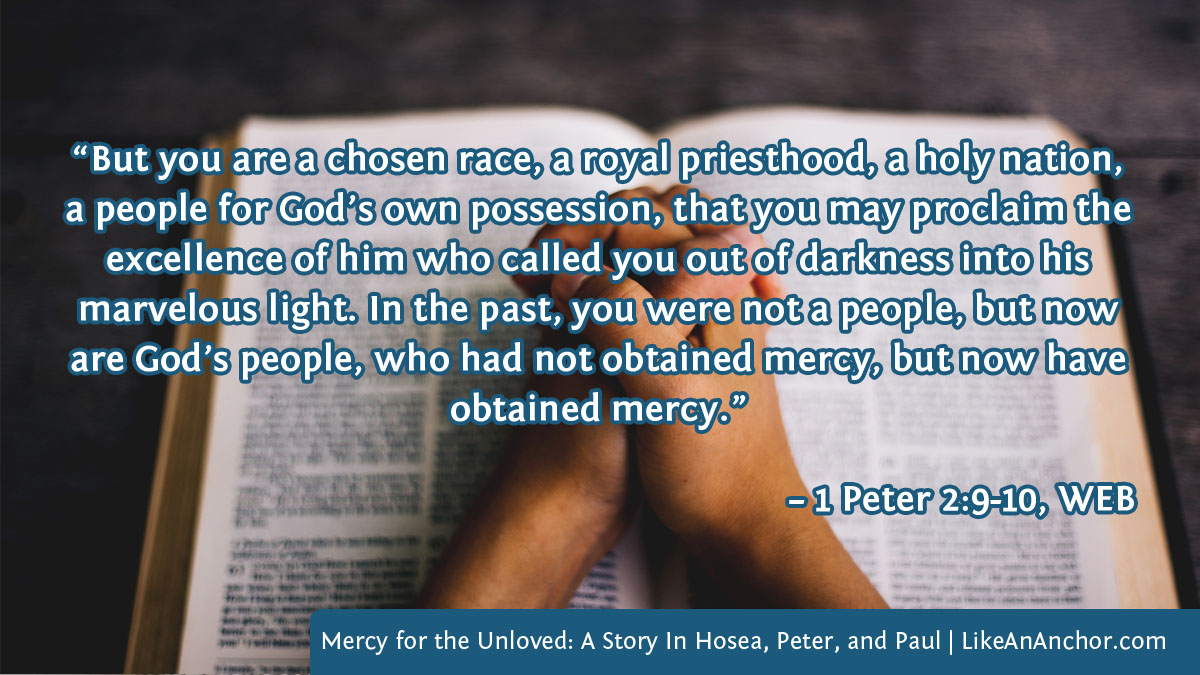
So as you come to him, a living stone rejected by men but chosen and precious in God’s sight, you yourselves, as living stones, are built up as a spiritual house to be a holy priesthood and to offer spiritual sacrifices that are acceptable to God through Jesus Christ. For it says in scripture, “Look, I lay in Zion a stone, a chosen and precious cornerstone,and whoever believesinhimwill neverbe put to shame.”So you who believe see his value, but for those who do not believe, the stone that the builders rejected has become thecornerstone,and a stumbling-stoneand a rock to trip over. They stumble because they disobey the word, as they were destined to do. But you are a chosen race, a royal priesthood, a holy nation, a people of his own, so that you may proclaim the virtues of the one who called you out of darkness into his marvelous light. You once were not a people, but now you are God’s people. You were shown no mercy, but now you have received mercy.
1 Peter 2:4-10, NET (italics and bold in original)
The NET translation puts references to the Old Testament in italics and direct quotes in bold to make it easy to see which parts of the NT directly link back to OT scriptures. Here, Peter quotes or alludes to Is. 28:16, Ps. 118:22, Is. 8:14, Ex. 19:5-6; Is. 43:20-21; Mal. 3:17, and Hos. 1:6, 9; 2:23. Paul does a very similar thing in the book of Romans (I also wrote a Crash Course in Romans post, so you can check that out or read the whole letter if you want context to these statements).
You will say to me then, “Why does he still find fault? For who has ever resisted his will?” But who indeed are you—a mere human being—to talk back to God? Does what is molded say to the molder, “Why have you made me like this?” Has the potter no right to make from the same lump of clay one vessel for special use and another for ordinary use?But what if God, willing to demonstrate his wrath and to make known his power, has endured with much patience the objects of wrath prepared for destruction?And what if he is willing to make known the wealth of his glory on the objects of mercy that he has prepared beforehand for glory—even us, whom he has called, not only from the Jews but also from the Gentiles? As he also says in Hosea:
“I will call those who were not my people, ‘My people,’ and I will call her who was unloved, ‘My beloved.’” “And in the very placewhere it was said to them, ‘You are not my people,’ there they will be called ‘sons of the living God.’”
And Isaiah cries out on behalf of Israel, “Though the number of the childrenof Israel are as the sand of the sea, only the remnant will be saved, forthe Lord will execute his sentence on the earth completely and quickly.”Just as Isaiah predicted,
“If the Lord of Heaven’s Armies had not left us descendants, we would have become like Sodom, and we would have resembled Gomorrah.”
What shall we say then?—that the Gentiles who did not pursue righteousness obtained it, that is, a righteousness that is by faith, but Israel even though pursuing a law of righteousness did not attain it. Why not? Because they pursued it not by faith but (as if it were possible) by works. They stumbled over the stumbling stone,just as it is written,
“Look, I am laying in Zion a stone that will cause people to stumble and a rock that will make them fall, yet the one who believes in him will not be put to shame.”
Romans 9:19-33, NET (italics and bold in original)
Here, Paul quotes many of the same scripturas Peter did: Is. 29:16; 45:9; Hos 2:23; 1:10; Isa 10:22-23; 1:9; 28:16; 8:14. He’s also making a similar point. Not only did Jesus’s sacrifice redeem those who are physical descendants of Israel who believe in Him as the Messiah, but He is also making those who were once part of other nations His beloved people.
Hope for All God’s People
Image by Jantanee from Lightstock
Much like in 1 Corinthians, where Paul expects his readers to connect quotes and allusions in that letter to the Feast of Unleavened Bread, Peter and Paul both assume their readers have an understanding of the Old Testament scriptures. Their Jewish readers would have heard the scriptures read at the synagogues their entire lives, and Gentile converts were expected to make a regular practice of listening to those as well (Acts 15:19-21). They would recognize these quotes. The most Biblically literate among them would also put the quotes in context, drawing on the original writer’s whole message when they interpreted Peter’s and Paul’s writings.
Christianity really isn’t a new religion that started after Jesus died–it was the next step in God’s plan that He’d been working on since before the beginning of our world. Peter and Paul reinforce this by quoting prophecies God gave in Hosea with fulfillment in the New Testament church. In Hosea, God promised to take a people that were not His and on whom He no longer had pity and transform them into something new. Then, as Peter and Paul discuss, He followed-through on that promise when Jesus’s sacrifice opened the way of life to all people. Those of a nation that had been chosen by God then rejected Him now had a chance to enter a covenant with Him again. Those who hadn’t been part of the family before are now welcomed in with open arms.
It’s an incredible message of hope. God follows through on His promises. He doesn’t leave those who are unloved and haven’t received mercy in that state. He calls them Beloved and pours out His mercy on them when they come to Him through Jesus Christ. Those promises are still in effect today. We can trust that God loves us this passionately; that He chooses us and claims us for His own special people. Just like He promised so long ago.
The word “tenacity” comes into English “from Latin tenacitas ‘an act of holding fast,’ from tenax (genitive tenacis) ‘holding fast, gripping, clingy; firm, steadfast'” (Online Etymology Dictionary). It’s not a word that’s used in any of the Bible translations I frequently read (WEB, NET, TLV, KJV), but the same concept is expressed with terms such as “hold fast” or the related idea of endurance.
When we hold fast to something on a physical level, it’s either because we love it so much (e.g. hugging your child tight) or because we need something to keep us from falling or getting pulled away (e.g. clinging to a rope when climbing a cliff or holding onto a tree branch to keep from being swept away in a flash flood). Something similar is happening on a spiritual level.
When we’re living in covenant with God and have a relationship with Him, He wants a close and loving relationship with us. He also expects an exclusive relationship, but there are other things pulling at our time and attention that could draw us away from Him if we don’t hold on tight. Putting something before Him, making covenant relationships with conflicting things, or holding tight to something other than God would mean that we’re being unfaithful to Him (Ex. 34:12-14). In contrast, holding fast to God involves having a faithful, love-filled relationship with Him.
In the Old Testament, Joshua warned ancient Israel about the importance of staying faithful to God. With God’s guidance, Joshua led them into the promised land, fought and conquered the land under God’s leadership, and saw the people settled in their promised inheritance. The surrounding nations weren’t completely gone, though, and neither were the influences from Israel’s past. So when Joshua was old, he called Israel together to give them instructions and warnings.
Therefore be very courageous to keep and to do all that is written in the book of the law of Moses, that you not turn away from it to the right hand or to the left;that you not come among these nations, these that remain among you; neither make mention of the name of their gods, nor cause to swear by them, neither serve them, nor bow down yourselves to them; but hold fast to Yahweh your God, as you have done to this day. …
“But if you do at all go back, and hold fast to the remnant of these nations, even these who remain among you, and make marriages with them, and go in to them, and they to you; know for a certainty that Yahweh your God will no longer drive these nations from out of your sight; but they shall be a snare and a trap to you, a scourge in your sides, and thorns in your eyes, until you perish from off this good land which Yahweh your God has given you.”
Joshua 23:6-8, 12-13, WEB (emphasis added)
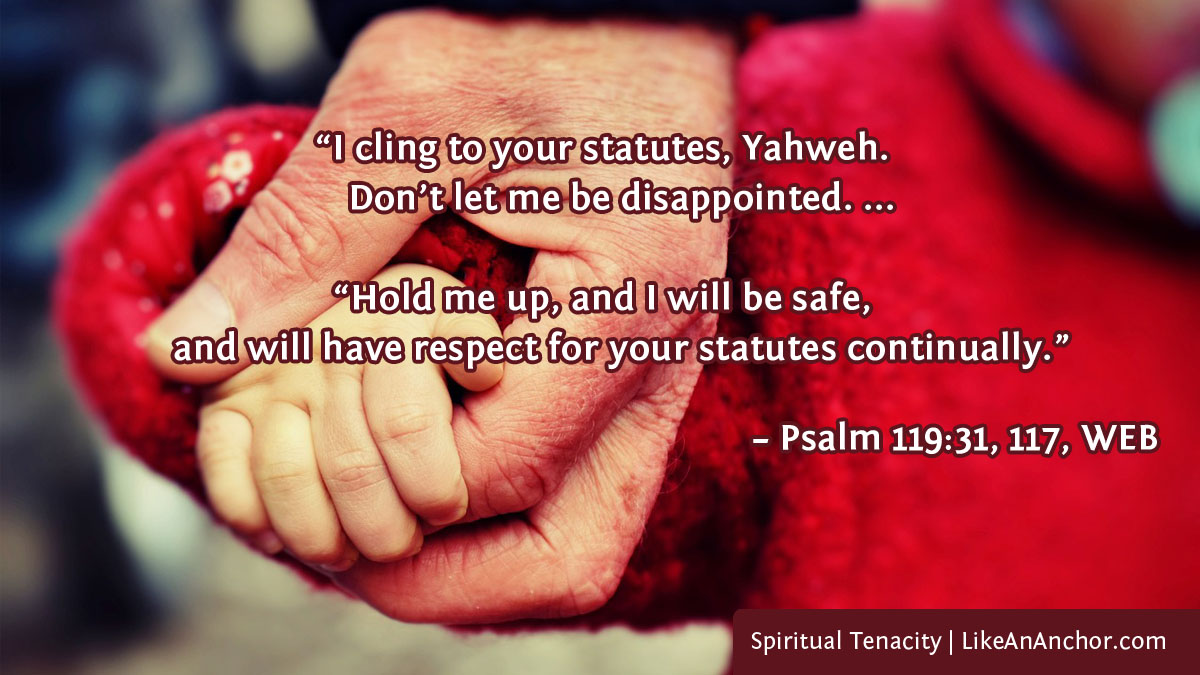
Here, Joshua presents the people with two options. They can “hold fast to Yahweh your God” or they could “hold fast” to the ungodly nations around them. Similarly, we see other people in the Bible holding fast to either good or bad things. A psalmist tells the Lord, “I hold fast to your rules” (Ps. 119:31, NET). Yahweh promises good things to those who “hold fast to my covenant” and keep the Sabbath (Is. 56:1-7, WEB). God praised Job to Satan as an example of “a pure and upright man,” saying, “he still holds firmly to his integrity” (Job 2:3, NET).
In contrast, there are others who “hold fast to their deception” (Jer. 8:5, NET). Proverbs says, “The evil deeds of the wicked ensnare him. The cords of his sin hold him firmly” (Prov. 5:22, WEB). Jesus chided people who rejected God’s law to “hold fast to human tradition” (Mark 7:1-8, NET). Clearly, we need to be careful what we’re clinging to. Are we holding on to God, or to things that are trying to tug us away from Him? Trying to do both isn’t going to work. “No man can serve two masters,” Jesus said, “for either he will hate the one, and love the other; or else he will hold to the one, and despise the other” (Matt. 6:24, KJV). We need to make sure the one we “hold to” is God.
There are strict warnings about who or what we choose to hold onto in this life. We can’t have divided loyalties when we come to God. He’ll work with us through our doubts, but He expects us to choose Him when it comes down to it. The admonition to us today is still the same as the one Joshua gave Israel: “hold fast to Yahweh your God.”
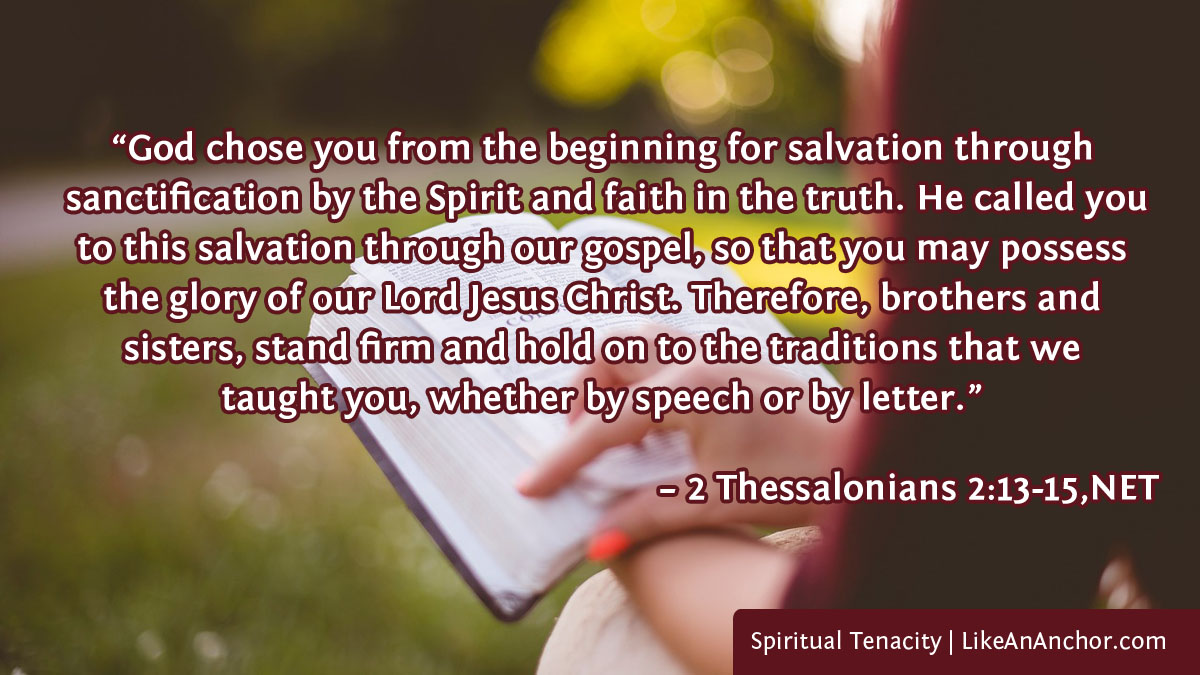
God also told people in the Old Testament to hold onto His covenant, including the Sabbaths (which are a sign of being in covenant with God). That continues today. For example, Paul told the Corinthian church to “hold firm the traditions” and “hold firmly the word which I preached to you” in an epistle contextualized by his discussion of the Feast of Unleavened Bread (1 Cor. 11:2; 15:2, WEB). Paul also gave similar instructions in three other letters (2 Thes. 2:15; 1 Tim. 1:18-19; Tit. 1:8-9). We need to carefully hold on to the truth God gives us and obey his instructions. And when we do that, we’re holding on to some amazing things.
Christ is faithful as a Son over his house. We are his house, if we hold fast our confidence and the glorying of our hope firm to the end. … we have become partakers of Christ, if we hold the beginning of our confidence firm to the end.
Hebrews 3:6-7, 13 WEB (emphasis added)
Therefore since we have a great high priest who has passed through the heavens, Jesus the Son of God, let us hold fast to our confession. …
And let us hold unwaveringly to the hope that we confess, for the one who made the promise is trustworthy.
Hebrews 4:14; 10:23 NET (emphasis added)
God wanted to demonstrate more clearly to the heirs of the promise that his purpose was unchangeable, and so he intervened with an oath, so that we who have found refuge in him may find strong encouragement to hold fast to the hope set before us through two unchangeable things, since it is impossible for God to lie. We have this hope as an anchor for the soul, sure and steadfast
Hebrews 6:17-19, NET (emphasis added)
Look how positive this wording is. We’re to “hold fast” to our confidence in Christ and the glory of hope, the confession of our faith and hope, and the hope of joy set before us in the future. Holding onto God, His word, righteousness, and goodness also means holding onto hope and joy. It makes me think back to part of our Isaiah study from earlier this year about the joy found in keeping covenant with God (see “Isaiah Study: Joy in the Sabbath Covenant With God“). In a close relationship with God, obedience flows naturally from love and honoring God brings joy while strengthening hope.
We can sum up the Bible’s “hold fast” instructions with this verse: “hold fast to what is good. Stay away from every form of evil” (1 Thes. 5:21-22, NET). Our spiritual walk requires tenacity–a conviction to hold tight to God and the goodness associated with Him while rejecting the things which would want to pull us away or present alternative things to cling to.
Something that helps us greatly in our quest to hold fast to good is that Jesus holds fast to us. He says that He and the Father hold Their people in Their hands (John 10:27-29). He also holds the keys to death, the spirits of God, the angels of the churches, and the keys to David’s kingdom–wonderous things we can only begin to understand (Rev. 1:16-18; 2:1; 3:1, 7). It’s in the letters to the churches in Revelation that Jesus describes Himself as holding these things, and it’s also here that He counsels us to keep holding on.
I am coming soon. Hold on to what you have so that no one can take away your crown. … The one who has an ear had better hear what the Spirit says to the churches.
Revelation 3:11, 13, NET
The “crown” here “refers to a wreath … worn as a symbol of honor, victory, or as a badge of high office” (NET footnote on Rev. 3:11). It’s not so much a symbol of ruling as it is of victory. Think of the laurel crowns in ancient Rome and Greece that still influence our language today; we use the word “laurels” for “a tangible symbol signifying approval or distinction” (Vocabulary.com).
We’re part of a spiritual war. We’ve joined up on God’s side–the one guaranteed victory in the end. Until the time when we receive our crowns of victory, we’re called to be soldiers in a war that mostly takes place on a spiritual plane but also bleeds into the physical realm. I have a book about this called Like An Anchor Study Guide: The Armor of God coming out early next year, but for now I’ll direct you to my series of blog posts on Spiritual Warfare if you want to read more about this.
You will be hated by everyone because of my name. Yet not a hair of your head will perish.By your endurance you will gain your lives.
Luke 21:17-19, NET
Jesus Christ and God the Father are the ones who make victory possible. We get to play a role, too. It’s our job to hang on to them and endure. That’s how we win. Spiritual tenacity is a vital component to living a victorious, godly life.
One thing I find fascinating when reading the Old Testament is thinking about how the ancient kings of Israel and Judah did at childrearing. I’m guessing they weren’t all that involved with raising their children given their other kingly responsibilities (and perhaps cultural expectations as well). Still, if we didn’t know the story we probably wouldn’t expect David, the “man after God’s own heart” to have children who end up in a situation where one rapes his half-sister, gets murdered by her brother, and then that brother rebels against David and sleeps with his concubines (2 Sam. 13-18). David’s son Solomon was a great king, but then Solomon’s son Rehoboam listens to bad advisors, messes everything up, and the kingdom splits into Israel and Judah (2 Chr. 10).
Reading the books of Kings and Chronicles, it often seems like the kings of Judah bounce back and forth from good, to bad, to okay, to really bad, to almost righteous with no real pattern. It just seems random, or perhaps it would be more accurate to say it’s deeply individual. We just don’t know that much about the kings and what influenced them to act the way they did. I suspect a closer look, though, will reveal some interesting things we can learn. This is going to be a pretty long post, mapping out the kings of Judah after Rehoboam through the fall of Judah. The first three sections of this post walk through the kings in order, then in the last section of the post I’ll share my thoughts looking back on this study (you can skim until then if you’re short on time).
Abijam to Athaliah
The scripture helpfully records summaries for each of the kings, giving us an overview of their deeds and character before (sometimes) filling in extra details. Before we dive into those summaries, here’s a link to a timeline of all the kings that should help with keeping all these names straight. Let’s start with Rehoboam’s son, along with the two kings after him.
Abijam began to reign over Judah. He reigned three years in Jerusalem. His mother’s name was Maacah the daughter of Abishalom. He walked in all the sins of his father, which he had done before him; and his heart was not perfect with Yahweh his God, as the heart of David his father. …
Abijam slept with his fathers, and they buried him in David’s city; and Asa his son reigned in his place. … He reigned forty-one years in Jerusalem. …Asa did that which was right in Yahweh’s eyes, as David his father did. He put away the sodomites out of the land, and removed all the idols that his fathers had made. … But the high places were not taken away. Nevertheless the heart of Asa was perfect with Yahweh all his days. …
Asa slept with his fathers, and was buried with his fathers in his father David’s city; and Jehoshaphat his son reigned in his place. … Jehoshaphat was thirty-five years old when he began to reign; and he reigned twenty-five years in Jerusalem. His mother’s name was Azubah the daughter of Shilhi. He walked in all the way of Asa his father. He didn’t turn away from it, doing that which was right in Yahweh’s eyes. However the high places were not taken away. The people still sacrificed and burned incense on the high places.
1 Kings 15:1-3, 8-12, 4, 24; 22:42-43, WEB
note: bold words added throughout to help keep track of names when a new ruler takes over.
Here, we have a son (Abijam) who walked in all the sins of his father (Rehoboam), followed by a king (Asa) who refused to follow his father’s bad example. Then, that king’s son (Jehoshaphat) followed his father’s example of righteousness. The scriptures actually say their hearts were “perfect with Yahweh” (in Asa’s case) and they did “what was right in Yahweh’s eyes” (in Jehoshaphat’s case)–high praise indeed. Then the next king went back the other direction.
Jehoram the son of Jehoshaphat king of Judah began to reign. He was thirty-two years old when he began to reign. He reigned eight years in Jerusalem. He walked in the way of the kings of Israel, as did Ahab’s house; for he married Ahab’s daughter. He did that which was evil in Yahweh’s sight.However Yahweh would not destroy Judah, for David his servant’s sake, as he promised him to give to him a lamp for his children always. …
Jehoram slept with his fathers, and was buried with his fathers in David’s city; and Ahaziah his son reigned in his place. …Ahaziah was twenty-two years old when he began to reign; and he reigned one year in Jerusalem. His mother’s name was Athaliah the daughter of Omri king of Israel. He walked in the way of Ahab’s house, and did that which was evil in Yahweh’s sight, as did Ahab’s house; for he was the son-in-law of Ahab’s house.
2 Kings 8:16-19, 24, 26-27, WEB
In case you’re getting a bit lost with all the names, this is talking about the daughter of King Ahab of Israel whose wife was the infamous Queen Jezebel. They were so bad that scripture says, “there was no one like Ahab, who sold himself to do that which was evil in Yahweh’s sight, whom Jezebel his wife stirred up” (1 Kings 21:25, WEB). Here, scripture does give us hints as to why this king went bad–he brought evil influences into his life.
Ahaziah dies in the same uprising that takes out Jezebel and her son Jehu. When his mother Athaliah heard it, she slaughtered all but one of her grandchildren and took Judah’s throne for herself (2 Kings 9-11). Out of the six rulers of Judah from Abijam to Athaliah, only two made an effort to walk with God.
Image by Pearl from Lightstock
Joash to Ahaz
Athaliah only ruled for six years before the people who’d rescued her one surviving grandson put him on the throne. This new child-king is called Joash or Jehoash. He spent his childhood living in Yahweh’s temple, presumably raised by his uncle, Jehoiada the priest, and the aunt Jehoshabeath who’d saved his life (2 Chr. 22:11-12).
Jehoash was seven years old when he began to reign.
Jehoash … reigned forty years in Jerusalem. His mother’s name was Zibiah of Beersheba. Jehoash did that which was right in Yahweh’s eyes all his days in which Jehoiada the priest instructed him. However the high places were not taken away. The people still sacrificed and burned incense in the high places.
2 Kings 11:27-12:3, WEB
There’s an interesting qualifier here. Jehoash did what “was right in Yahweh’s eyes,” but only in the days when “Jehoiada the priest instructed him.” After that, things go terribly wrong. We learn the details about that by moving from 2 Kings to 2 Chronicles, where he’s called King Joash.
Now after the death of Jehoiada, the princes of Judah came, and bowed down to the king. Then the king listened to them. They abandoned the house of Yahweh, the God of their fathers, and served the Asherah poles and the idols …
The Spirit of God came on Zechariah the son of Jehoiada the priest; and he stood above the people, and said to them, “God says, ‘Why do you disobey Yahweh’s commandments, so that you can’t prosper? Because you have forsaken Yahweh, he has also forsaken you.’”
They conspired against him, and stoned him with stones at the commandment of the king in the court of Yahweh’s house. …
[Joash’s] own servants conspired against him for the blood of the sons of Jehoiada the priest, and killed him on his bed, and he died. They buried him in David’s city, but they didn’t bury him in the tombs of the kings.
2 Chronicles 24:17-18, 20-21, 25, WEB
Joash, who started out so well, wasn’t even buried with the kings of Judah. He’s one of the few kings whose childhood we know about; he was raised by a God-fearing uncle and most likely aunt as well. Then the moment the people influencing him change, Joash’s character changed as well. It’s a sobering lesson in being careful about those you trust as influences, as well as a lesson in having your own convictions and sticking to them. It makes you wonder how much of Joash’s flip-flopping between good and bad examples influenced the kings after him.
Amaziah was twenty-five years old when he began to reign, and he reigned twenty-nine years in Jerusalem. His mother’s name was Jehoaddan, of Jerusalem. He did that which was right in Yahweh’s eyes, but not with a perfect heart. Now when the kingdom was established to him, he killed his servants who had killed his father the king. But he didn’t put their children to death, but did according to that which is written in the law in the book of Moses …
Now from the time that Amaziah turned away from following Yahweh, they made a conspiracy against him in Jerusalem. He fled to Lachish, but they sent after him to Lachish, and killed him there. They brought him on horses, and buried him with his fathers in the City of Judah.
2 Chr. 25:1-4, 27-28 WEB
Amaziah did a little better than his father, but he didn’t say “perfect” with God. His son follows the same pattern once he brings ruling Judah. He starts out okay, but then he goes kind a crazy.
All the people of Judah took Uzziah, who was sixteen years old, and made him king in the place of his father Amaziah. … he reigned fifty-two years in Jerusalem. His mother’s name was Jechiliah, of Jerusalem. He did that which was right in Yahweh’s eyes, according to all that his father Amaziah had done. He set himself to seek God in the days of Zechariah, who had understanding in the vision of God; and as long as he sought Yahweh, God made him prosper. …
But when he was strong, his heart was lifted up, so that he did corruptly, and he trespassed against Yahweh his God; for he went into Yahweh’s temple to burn incense on the altar of incense.… He had a censer in his hand to burn incense, and while he was angry with the priests, the leprosy broke out on his forehead before the priests in Yahweh’s house, beside the altar of incense. … Uzziah the king was a leper to the day of his death, and lived in a separate house, being a leper; for he was cut off from Yahweh’s house. Jotham his son was over the king’s house, judging the people of the land.
2 Chr. 26: 1, 3-5, 16, 19, 21, WEB
Uzziah does not have other people to blame for influencing him in the wrong direction (though he does go off the right path after “the days of Zechariah,” so it seems he was better when he had a strong, positive influence in his life). He just let his success get the better of him, gave into pride, and thought he needed to act as a priest as well as a king. For his corruption, Uzziah becomes a leper and his son rules in his place (that’s why you’ll see them overlapping in a timeline of all the kings).
Jotham was twenty-five years old when he began to reign, and he reigned sixteen years in Jerusalem. His mother’s name was Jerushah the daughter of Zadok. He did that which was right in Yahweh’s eyes, according to all that his father Uzziah had done. However he didn’t enter into Yahweh’s temple. The people still acted corruptly. … Jotham became mighty, because he ordered his ways before Yahweh his God. …Jotham slept with his fathers, and they buried him in David’s city; and Ahaz his son reigned in his place.
Ahaz was twenty years old when he began to reign, and he reigned sixteen years in Jerusalem. He didn’t do that which was right in Yahweh’s eyes, like David his father,but he walked in the ways of the kings of Israel, and also made molten images for the Baals.Moreover he burned incense in the valley of the son of Hinnom, and burned his children in the fire, according to the abominations of the nations whom Yahweh cast out before the children of Israel. He sacrificed and burned incense in the high places, and on the hills, and under every green tree.
2 Chr. 27:1-2, 6, 9; 28:1-4, WEB
It seemed for a while that the kings were getting better. Uzziah was impious, but he didn’t forsake Yahweh like his father Amaziah. Then Jotham stayed with doing what “was right in Yahweh’s eyes,” even though the people he ruled over were corrupt. Then all of the sudden, his son Ahaz starts putting up idols and sacrificing children (a sin that so horrified God He hadn’t even imagined people should do it).
Image by Inbetween from Lightstock
Hezekiah to Zedekiah
I told you this would be a long post 🙂 We’re now at one of the greatest kings of Judah, famous for his religious reforms and the detail the Bible gives us about events during his reign.
Hezekiah began to reign when he was twenty-five years old, and he reigned twenty-nine years in Jerusalem. His mother’s name was Abijah, the daughter of Zechariah. He did that which was right in Yahweh’s eyes, according to all that David his father had done. In the first year of his reign, in the first month, he opened the doors of Yahweh’s house, and repaired them. He brought in the priests and the Levites, and gathered them together into the wide place on the east, and said to them … “Now it is in my heart to make a covenant with Yahweh, the God of Israel, that his fierce anger may turn away from us.”
2 Chronicles 29:1-5, 10, WEB
We have a lot of details about Hezekiah’s reign; probably more than any other king besides David and Solomon (2 Kin. 18-20; 2 Chr. 29-32; Is. 36-39). None of those details tell us about his life before he was king, but by the age of 25 when he assumed the throne he was passionate about following God faithfully and he stayed that way until his death. He also surrounded himself with good influences, including the prophet Isaiah. Unfortunately, it seems he didn’t have much influence on his own 12-year-old son.
Manasseh was twelve years old when he began to reign, and he reigned fifty-five years in Jerusalem.He did that which was evil in Yahweh’s sight, after the abominations of the nations whom Yahweh cast out before the children of Israel. For he built again the high places which Hezekiah his father had broken down; and he raised up altars for the Baals, made Asheroth, and worshiped all the army of the sky, and served them. … He also made his children to pass through the fire in the valley of the son of Hinnom. He practiced sorcery, divination, and witchcraft, and dealt with those who had familiar spirits and with wizards. He did much evil in Yahweh’s sight, to provoke him to anger. … Manasseh seduced the inhabitants of Jerusalem, so that they did more evil than did the nations whom Yahweh destroyed before the children of Israel. …
Therefore Yahweh brought on them the captains of the army of the king of Assyria, who took Manasseh in chains, bound him with fetters, and carried him to Babylon. When he was in distress, he begged Yahweh his God, and humbled himself greatly before the God of his fathers. He prayed to him; and he was entreated by him, and heard his supplication, and brought him again to Jerusalem into his kingdom. Then Manasseh knew that Yahweh was God.
2 Chronicles 33:1-3, 6, 9, 11-13, WEB
It’s a rollercoaster now. From one of the most righteous kings (Hezekiah), to a wicked child-sacrificing king who then did a 180° turn of repentance (Manasseh), to a brief yet very wicked king (Amon), then back to a righteous king (Josiah).
So Manasseh slept with his fathers, and they buried him in his own house; and Amon his son reigned in his place.
Amon was twenty-two years old when he began to reign; and he reigned two years in Jerusalem. He did that which was evil in Yahweh’s sight, as did Manasseh his father; and Amon sacrificed to all the engraved images which Manasseh his father had made, and served them. He didn’t humble himself before Yahweh, as Manasseh his father had humbled himself; but this same Amon trespassed more and more. His servants conspired against him, and put him to death in his own house. But the people of the land killed all those who had conspired against king Amon; and the people of the land made Josiah his son king in his place.
Josiah was eight years old when he began to reign, and he reigned thirty-one years in Jerusalem. He did that which was right in Yahweh’s eyes, and walked in the ways of David his father, and didn’t turn away to the right hand or to the left. For in the eighth year of his reign, while he was yet young, he began to seek after the God of David his father; and in the twelfth year he began to purge Judah and Jerusalem from the high places, the Asherah poles, the engraved images, and the molten images. … All his days they didn’t depart from following Yahweh, the God of their fathers.
2 Chronicles 33:20-25; 34:1-3, 33 WEB
Josiah was the last really good king of Judah. Joahaz his son only reigned three months before he’s taken captive to Egypt and his evil brother Jehoiakim takes over. He reigned 11 years before being taken captive into Babylon. Jehoiachin his son reigned wickedly for just three months before the Babylonians took him as well and set up his brother Zedekiah. Zedekiah did evil, refused to “humble himself before Jeremiah the prophet speaking from Yahweh’s mouth,” rebelled against Babylon, and Jerusalem was destroyed (2 Chr. 36). Thus ends the reign of the Judean kings.
Image by Matt Vasquez from Lightstock
Summary of Judah’s Kings
David—righteous with a perfect heart
Solomon—righteous, but not perfect with God in the end
Rehoboam—evil
Listened to bad advisors
Asa—righteous with a perfect heart
Jehoshaphat—righteous with a perfect heart
Jehoram—evil
Ahaziah—evil
Welcomed evil influences into his life
Athaliah—evil
Jehoash—righteous for a while, then turned wicked
Faithful only while he had good influences
Amaziah—righteous, but not perfect hearted
Uzziah—righteous at first, but disobeyed God later
Faithful only while he had good influences
Jotham—righteous
Ahaz—evil
Hezekiah—righteous with a perfect heart
surrounded himself with good influences
Manasseh—evil, but repented and changed
Amon—evil
Josiah—righteous
surrounded himself with good influences
Joahaz—evil
Jehoiakim—evil
Jehoiachin—evil
Zedekiah–evil
Lessons from the Kings
Alright, now that we’ve gone through a 3,000-word history lesson, what next? (I honestly didn’t intend for it to be that long; it just happened :lol:) One of the few patterns I did notice is probably obvious to you too based on how I’ve written about the kings–some of the really bad ones had evil influences, several that went from good to bad changed after a good influence died, and the good ones surrounded themselves with positive influences. It’s not all that shocking–we’ve all heard adages like “evil company corrupts good behavior.” We know the people around us influence how we live and act.
And yet, the influences don’t tell the whole story. Manasseh did some of the most horrible things any king of Judah ever tried, and yet he sincerely repented based not on the influence of another person but on a distress-prompted, character-redefining revelation that Yahweh is God. We see Asa, Jehoshapat, and Jotham all described as righteous with God and we’re not told anything about their influences. Some of the perfect-hearted kings came to power right after a father who was thoroughly wicked in God’s eyes, and some of the most evil kings rule right after seeing their righteous father lead the country.
It feels almost anti-climactic to go through that whole study and say it comes down to an individual issue of the heart. And yet, I also find this encouraging. The most famous kings are the ones that reformed all of Judah and brought the nation back into covenant with God, but Jehoshaphat and Jotham are still commended for doing what “was right in Yahweh’s eyes” even though they didn’t reform the entire country. Their individual faithfulness mattered a great deal to God, and it’s the same for us as well.
We also see real-life examples of the point God makes about himself in Ezekiel 18 and 33–He interacts with people according to the way their actions reveal their character. God says He delights when the wicked “return from his way, and live” (Ezk. 18:21, WEB), and we see that when He accepts Manasseh’s repentance even after he commits abominable sins like child sacrifice. God also says, “The righteousness of the righteous will not deliver him in the day of his disobedience” (Ezk. 33:12,WEB), and we see this as well when kings who started out doing well are labeled as unrighteous because they did not stay faithful to God all their lives.
Looking back at ancient Israel’s history can give us perspective on our own walks with God (1 Cor. 10:1-13). We learn from the examples of the past how to follow God with perfect hearts. We also see warnings about how not to live, and learn we need to avoid evil influences and take personal responsibility for obeying and following God. We can also take encouragement seeing that God’s character is unchanging–He still interacts with us in both righteousness and mercy.
Years ago when I was studying the topic of prophecy in the Bible, I noticed a link between prophecy and music that I thought seemed strange at the time. When we think of prophecy, we typically think of foretelling future events. We might also think of “inspired speaking,” which is the more general sense of both the Hebrew naba (H5012 “prophecy”) and the Greek propheteia (G4394 “prophecy”). Thus, a prophet (nabiy [masculine] or nebiyah [feminine] in Hebrew and prophetes in Greek) is someone who shares a message inspired by God; they’re a spokesperson for Him.
It’s likely impossible to read the Bible without noticing the importance of music, especially in the Psalms. People of God sing a lot, often accompanied by lively music and dancing. With this in mind, perhaps the link between music and prophecy shouldn’t surprise me, but it did. I hear this much less often now, but when I was a teen I was warned repeatedly against the dangers of getting too caught up in the emotions of worship music. Those emotions could stir you up to ignore theologically questionable lyrics or make a fool out of yourself swaying and back and forth in church (or so the argument went). And yet, people in the Bible deliberately sought out music as part of not only their praise but also to help them hear God’s voice.
Prophets as Singers
Revisiting this study started with my mom suggesting that someone should put together a study on music for our monthly scripture writing group. So far, I’ve come up with 20 scriptures for the topic “Inspiring Music.” They’re not all direct links between prophecy and music, but they all have to do with inspiration and singing or playing musical instruments. Several of these verses have to do with prophets and prophetesses who used music when sharing inspired words.
Miriam the prophetess, the sister of Aaron, took a tambourine in her hand; and all the women went out after her with tambourines and with dances. Miriam answered them,
“Sing to Yahweh, for he has triumphed gloriously. He has thrown the horse and his rider into the sea.”
Exodus 15:20-21, WEB
Now Deborah, a prophetess, the wife of Lappidoth, judged Israel at that time. …
Then Deborah and Barak the son of Abinoam sang on that day, saying,
“Because the leaders took the lead in Israel, because the people offered themselves willingly, be blessed, Yahweh!
Judges 4:4; 5:1-2, WEB
With two of the Old Testament prophetesses singing like this, Brown-Driver-Briggs dictionary even includes “gift of song” as part of their definition for nebiyah. The Theological Wordbook of the Old Testament notes that it’s rare, but musicians are “designated nebi’im” (entry 1277). We see another example of this when David appointed “some of the sons of Asaph, Heman, and Jeduthun to prophesy as they played stringed instruments and cymbals” (1 Chr. 25:1-3, NET). It shouldn’t come as any surprise to us that music can be divinely inspired, but seeing it linked with prophecy underscores the importance God places on musical praise, worship, and teaching.
In addition to these examples of prophets and prophetesses as musicians, we also have an example of a prophet who listened to music.
Elisha said, “As Yahweh of Armies lives, before whom I stand, surely, were it not that I respect the presence of Jehoshaphat the king of Judah, I would not look toward you, nor see you. But now bring me a musician.” When the musician played, Yahweh’s hand came on him.
2 Kings 3:14-15, WEB
Here, three kings came to Elisha asking him to talk with God for them. Though he wouldn’t have responded to the kings of Israel and Edom, Elisha said he would seek God’s guidance out of respect for the king of Judah. In order to do that, he asked for a musician and it was while he listened to music that “Yahweh’s hand came on him.” It’s a fascinating precedent for someone using music to help them communicate and connect with God.
Music was a key part of worship in God’s temple, particularly after King David appointed singers and musicians for worship in the tabernacle. That type of ministry through music continued into Solomon’s day and beyond whenever kings and righteous leaders reinstituted true worship (1 Chr. 6:31-32; 2 Chr. 23:18; Neh. 12:44-46).
He [Hezekiah] set the Levites in Yahweh’s house with cymbals, with stringed instruments, and with harps, according to the commandment of David, of Gad the king’s seer, and Nathan the prophet; for the commandment was from Yahweh by his prophets. The Levites stood with David’s instruments, and the priests with the trumpets. Hezekiah commanded them to offer the burnt offering on the altar. When the burnt offering began, Yahweh’s song also began, along with the trumpets and instruments of David king of Israel. All the assembly worshiped, the singers sang, and the trumpeters sounded. All this continued until the burnt offering was finished.
Let the peace of Christ be in control in your heart (for you were in fact called as one body to this peace), and be thankful.Let the word of Christ dwell in you richly, teaching and exhorting one another with all wisdom, singing psalms, hymns, and spiritual songs, all with grace in your hearts to God.
Colossians 3:15-16, NET
When God looks at His church, there are some specific things He expects to see. He wants us to be at peace with each other and have peace inside us. He wants to see Jesus’s words in us “richly,” overflowing in “teaching and exhorting with wisdom.” And He wants to see us “singing psalms, hymns, and spiritual songs.” The context indicates that singing is part of our teaching and exhortation (our inspired and inspiring words); a conclusion reinforced by another letter Paul wrote.
And do not get drunk with wine, which is debauchery, but be filled by the Spirit,speaking to one another in psalms, hymns, and spiritual songs, singing and making music in your hearts to the Lord,always giving thanks to God the Father for all things in the name of our Lord Jesus Christ,
Ephesians 5:18-20, NET
When we’re filled with the Spirit, that’s going to inspire music both aloud and in our hearts. I know it can be hard sometimes to get excited about singing. Maybe you don’t like the way your voice sounds or you’re turned-off by the style of music at your church. I like singing, but there are some hymns that sound an awful lot like a funeral dirge to me and I just can’t work up much involvement singing those. But there are other hymns that I love, and when I’m at home I’m free to pick a style of Christian music I like and dance around singing them all I want. If we want to make music part of our worship, surely we can all find songs that match our tastes well enough that we can sincerely use them to glorify God. At the very least, we can appreciate the words of the music we sing at church and recognize the value God places on music.
In addition to the encouraging and exhorting aspect of “speaking to one another in psalms, hymns, and spiritual songs,” there’s also a link to thankfulness. Thanksgiving is a key aspect of praise and of song, and it should accompany our teaching, exhorting, and singing. (2 Sam. 22:50, Ps. 33:2, and others). In this as in so many other things, it comes down to the state of your heart. When we have God’s spirit inside us, want to encourage others, and have a thankful attitude, then godly music is one of the ways for us to both express our appreciation for the Lord and strengthen our relationship with Him.
I’ve been going back and forth on making a post like this for quite some time now. There isn’t one right formula for studying your Bible, and I’m not saying there is. As long as you’re reading God’s word, praying for His guidance, and working to know Him better then you can have a productive study. I don’t want to imply the way I study is the “right” or “best” way. But a few people have asked me to recommend Bible study resources, and I also realized that some of the study tools I use to help me understand the Greek and Hebrew behind our English translations aren’t familiar to everyone.
In this post, I’ll go through resources I use frequently and highly recommend. If you have other resources that you like to use, I’d love to learn about them. Please leave a comment so everyone reading can benefit from the recommendations 🙂
Disclaimer: Some of the links on this page are affiliate links (marked with an *). This means that if the resource I mention is available for purchase on Amazon, I provide a link and if you use that link to make a purchase I will receive a commission (at no additional cost to you).
Background Reading
Whenever I’m reading a text, I like to ask myself contextual questions. When was this written? Who was it written for? What culture(s) influenced the writer? When reading the Bible, the ultimate author behind the text is God, but He used human beings who were influenced by the world they lived in. Modern, Western Christians often think of Christianity as a Western/European religion and either don’t think about or misunderstand the ancient Eastern cultural context. This can lead to misinterpretations of the Bible and misunderstandings about underlying concepts such as how language works.
Misreading Scriptures with Western Eyes (coupled with attending a Messianic congregation for several years) fundamentally changed how I read the Bible, I think very much for the better. The modern world, particularly modern Western culture, is not very similar to the Biblical world. While God’s message is simple enough for a child to understand and His word can speak to everyone where they are, it’s also full of riches so deep we’ll never reach the bottom. Familiarizing yourself with the cultural context is key to understanding the Bible on a deeper level. These are my two favorite books I’ve found so far on that topic:
There are three free digital resources that I use to support a deeper study of God’s word. These tools provide a variety of Bible translations, the ability to compare those translations, resources for studying the Greek and Hebrew behind our English translations, and a variety of commentaries. I use all of these tools to varying degrees, depending on exactly what I’m trying to study.
MySword app–this is a free-to-download Android app. I use this app on my phone as my Bible when at church, traveling, and often when studying at home. It makes it easy to compare translations, look up words in a dictionary, and do pretty robust word studies all in the palm of your hand. It’s also a great supplement to the language tools I’ll talk about in the next section.
The search tool for MySword is pretty good, and you can search for Greek and Hebrew words by searching for the Strong’s number in translations that include those. However, the free version of MySword doesn’t include all the search tools that eSword has and it limits you to 100 results.
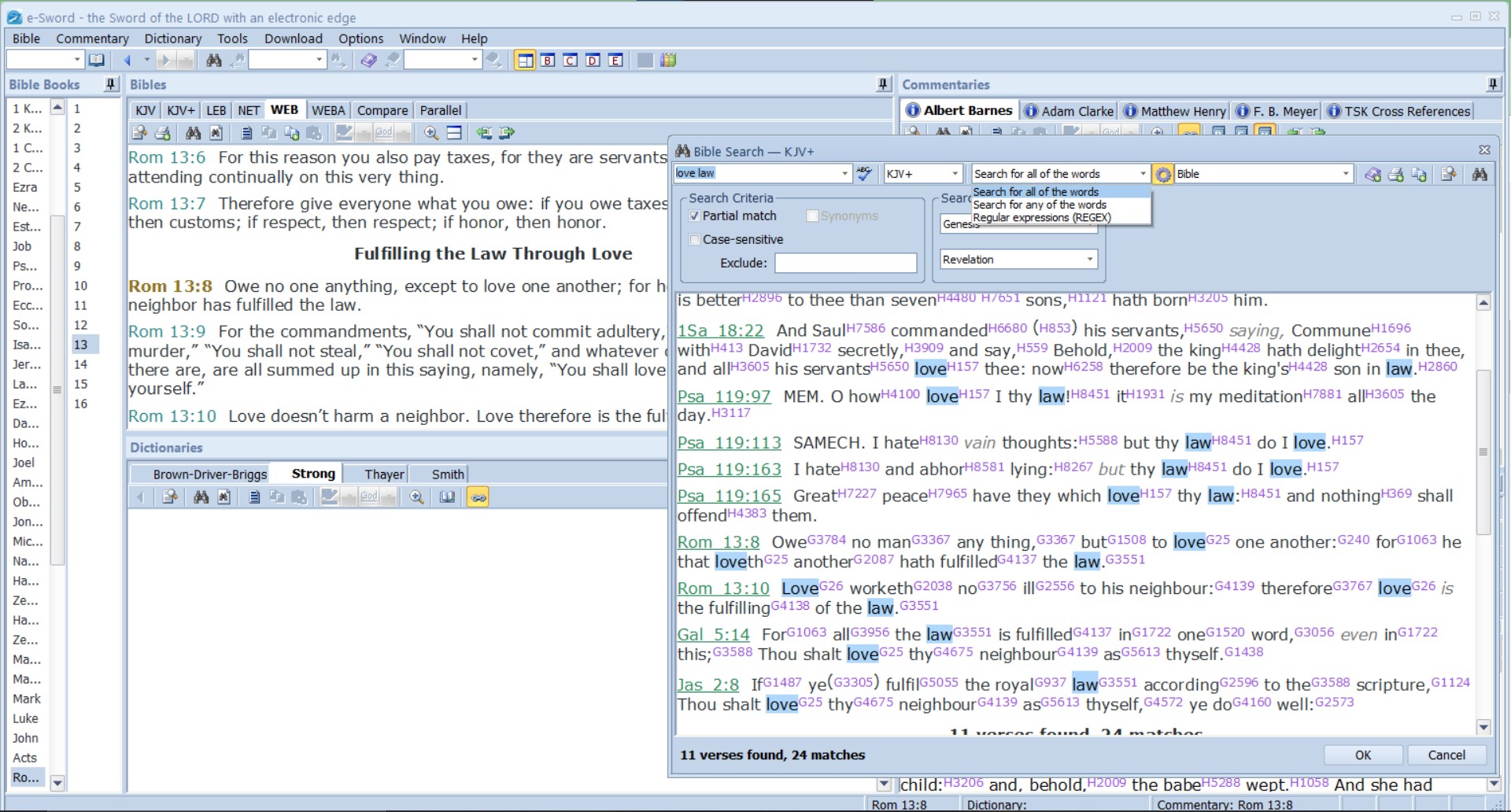
eSword for PC–a free-to-download Bible study program. I mostly use this one if I want to search for specific words or topics in the Bible. The search tools are robust (even more so than MySword) and make it easy to search for parts of words, whole words, and Greek and Hebrew words (by searching for the Strong’s number). You can also have a Bible, dictionary, commentary, and your own notes all open on the same screen.
BibleGateway–an online resource that makes comparing Bible translations very simple. It’s the easiest tool I’ve found for looking at multiple translations side-by-side and doing full text searches of more than one translation at the same time. I use it all the time when writing my blog posts for this site. One thing I like about this website compared to MySword or eSword is that it includes full footnotes (very handy with translations like NET).
Screenshot showing eSword search tool
Language Tools
I’ve done some formal study of Greek–enough to recognize words, understand basic grammar, and read it a little–but not much for Hebrew. The tools I use to study the Bible’s original languages aren’t a perfect substitute for really learning the languages, but I think they do make it easier for someone with a basic understanding of how language works (something any of us can learn relatively easily) to get a deeper look into the nuances of the Bible without devoting their lives to a study of ancient languages.
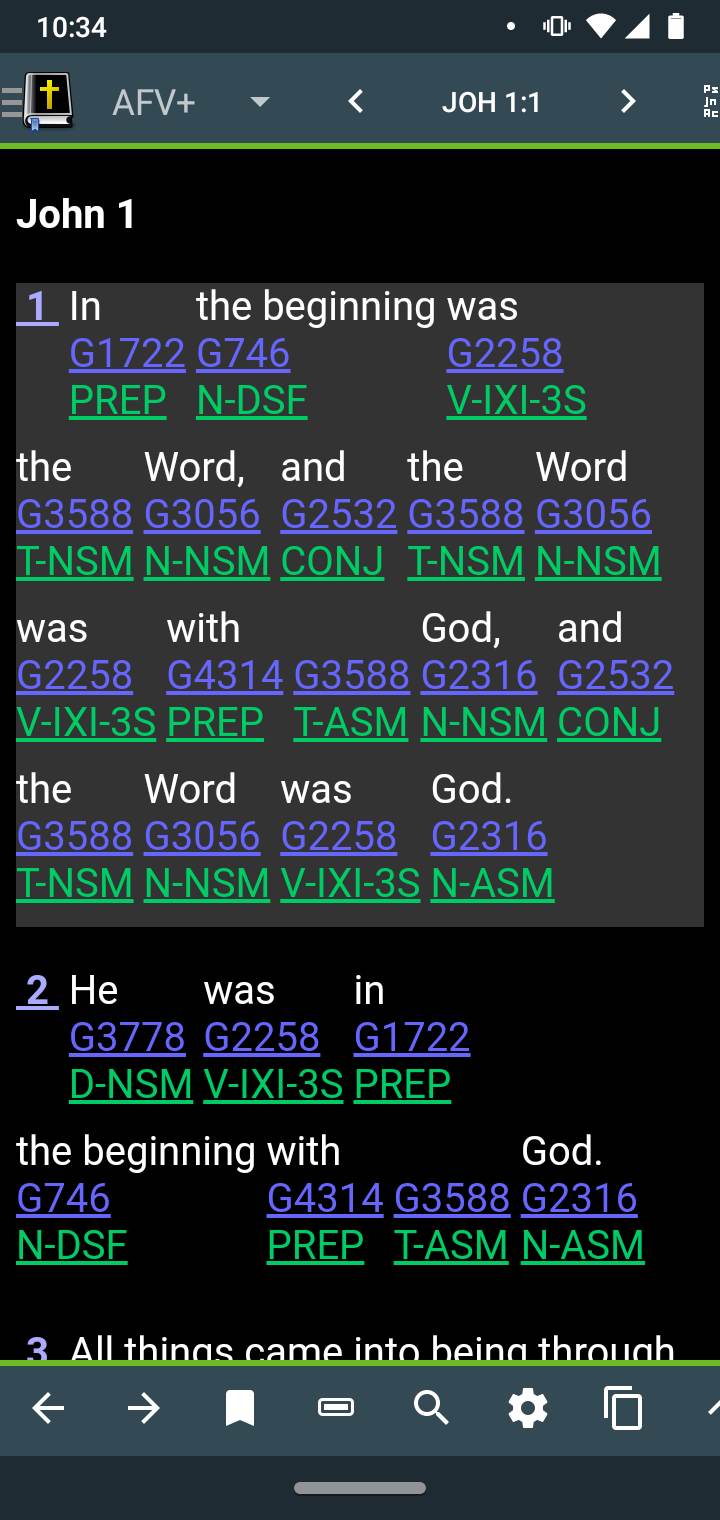
In both eSword and MySword, I recommend Thayer’s Dictionary for Greek and Brown-Driver-Briggs (BDB) for Hebrew. Both of these digital tools offer downloadable modules that link those dictionaries to Strong’s numbers. For any Bible translation that includes Strong’s numbers, you can click on that number and go right to the dictionary. Some of the translations also offer codes that give you more insight into how the word is used. For example, here’s what John 1:1 looks like in the MySword module for A Faithful Version with Strong’s numbers and Morphology (AFV+) if you click on more detail for the word translated “Word.”
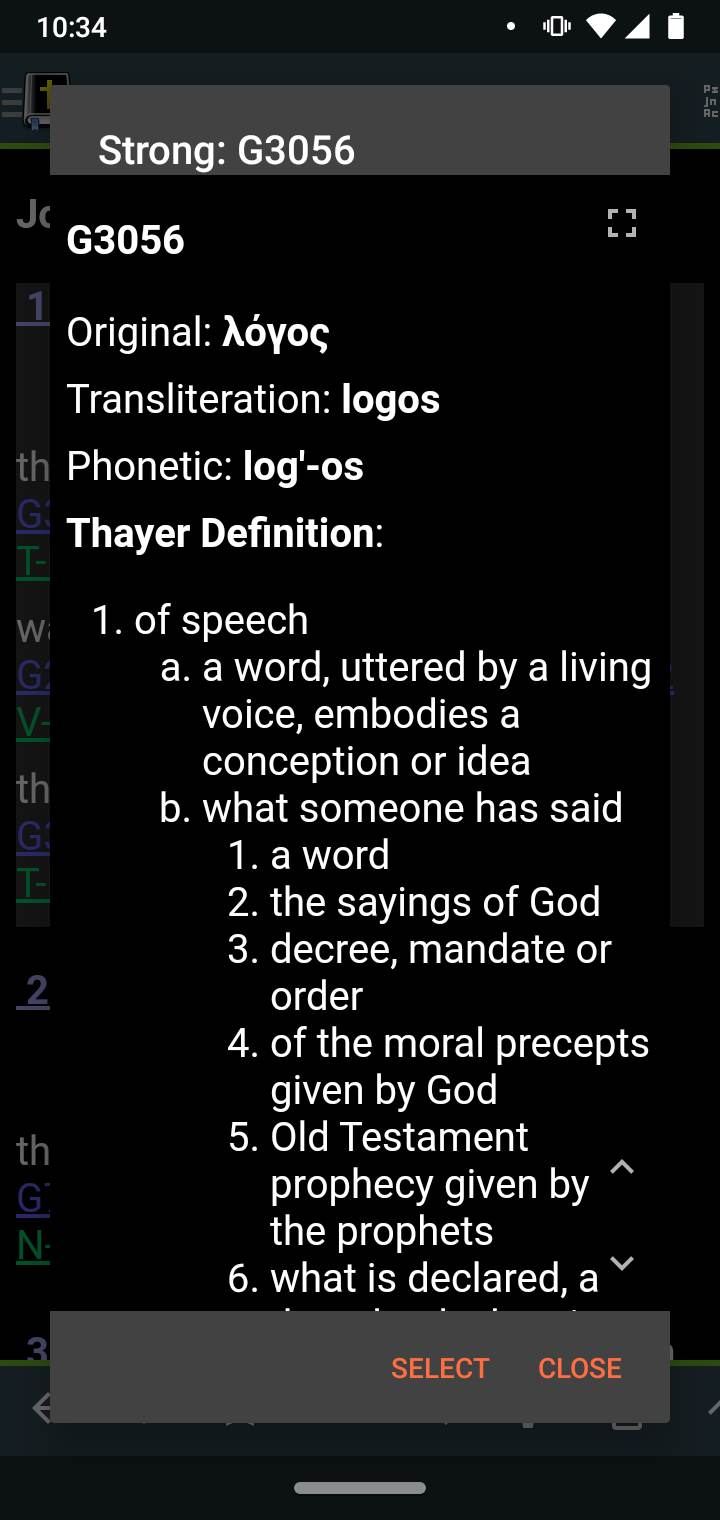
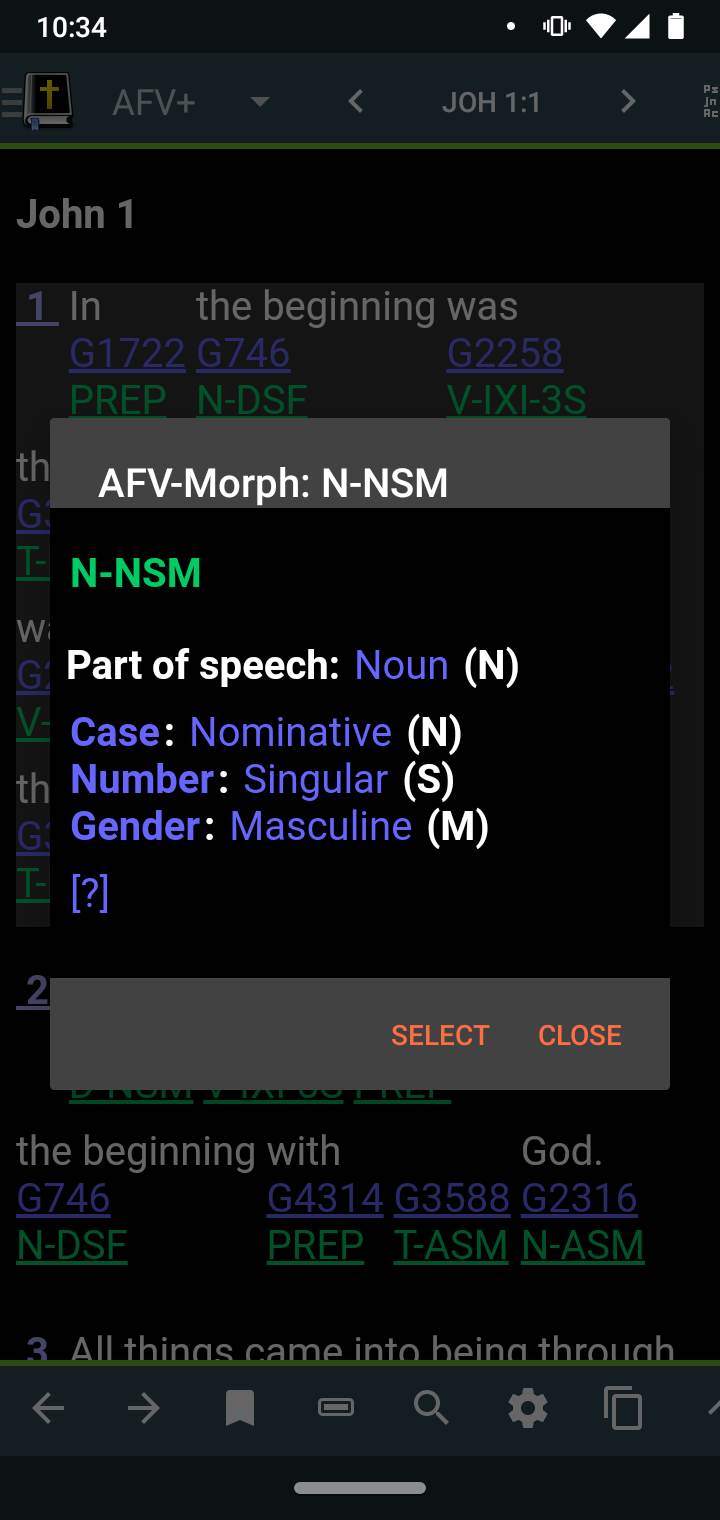
Screenshot of MySword AFV+ translationScreenshot of MySword Thayer’s DictionaryScreenshot of AFV+ morphology
I don’t read AFV+ much just because all those codes can get confusing to look at, but it is great for looking up the nuances behind a translation. If you click on the Strong’s number (G3056), it takes you to Thayer’s dictionary. I don’t have this in the screenshot, but if you scrolled down it would also provide Strong’s definition and a list of all the places this word is used in the New Testament (you could also search for G3056 in the AFV+ or other Strong’s coded translation to see all the places its used).
If you click on the morphology link (N-NSM) this translation shows you linguistic information for the word. Logos is a noun, and here it’s in the nominative case (identifying logos as the subject of the sentence), singular in number, and masculine gender (Greek has gendered nouns much like French or German). I use this tool most often to look up whether a word is singular or plural since you can’t always tell in English (e.g. when Paul says “you are the temple of God,” “you” is plural in the Greek but ambiguous in English).
Hebrew and Greek Dictionaries
In addition to these digital language tools, I also have two print dictionaries that I really like. These provide more complete definitions than the tools in eSword or MySword and also help you understand how different words relate to each other.
Theological Wordbook of the Old Testament* (TWOT) by Laird R. Hariss, Gleason L. Archer, Jr., and Bruce K. Waltke — my favorite Hebrew dictionary. Rather than being tied to Strong’s numbers, this dictionary groups Hebrew words by their root, which provides a much deeper look at the nuances of the Hebrew language. The different numbering system can make this one a bit more challenging to use, but in MySword the BDB dictionary module makes things easy by telling you where to look up the word in TWOT.
Google Is Your Friend
Another general tool that I use a lot is a simple Google search. Don’t know what the Genitive Case is in Greek? There are language-learning tools to help you understand Greek grammar. Partly remember a verse but can’t find it in eSword, MySword, or BibleGateway? Try Googling the words you remember with the word “Bible” and it’ll help you figure out if it’s in a translation you hadn’t thought of or if it’s a quote from something else. Suddenly need an interlinear version of the Septuagint? I recently found one on StudyLight.org. We’re fortunate to live in a time when we have access to Bible Study tools people even just a few decades before could only dream about or could only access in specialized print books.
Most of my Bible studies end up on this blog. That means I’m usually looking at specific topics when I study, so being able to search the Bible effectively, look up Hebrew and Greek words, and compare translations is super helpful. It’s also helpful to be listening to and reading things that prompt Bible-related ideas that can turn into studies which then show up here on my blog. Here are some of my favorite Christian resources for inspiring new studies:
“Truth Be Told” podcast–a thoughtful and thought-provoking “theology and apologetics podcast born out of a love of God‘s word, a hope to find common ground with those who study it, and a desire to outline truth as the Bible tells it.”
Listening to Sermons–usually I don’t go out of my way to listen to extra messages, but I hear ones very much like those I link to for this point every week at my local church. So many of my ideas for Bible studies and then blog posts come from a phrase or scripture that catch my ear in a message someone else is giving, often on a completely different topic.
As I mentioned before, not everyone Bible studies the same way, and that’s okay. We have different spiritual temperaments and different ways we most easily connect with God and His word. Some might spend more time reading whole books rather than focusing on topics. Some might find the most value in picking one verse and meditating on it for their whole study time. Others could read, then search for ways to put those lessons into real-world action. And I’m sure there are way more study styles than I could list here.
I like Gary Thomas’s book Sacred Pathways* as a tool to describe those temperaments (you can read my full review by clicking here). I most closely align with what he calls the “Contemplative” and “Intellectual” temperaments, and I suspect others with similar ways of relating to God will be the ones that find this post most useful (if they haven’t already tracked down similar resources of their own). Still, I hope some of these tools and resources will be helpful for you whatever your spiritual temperament. And I hope you’ll share some of your own favorite resources in the comments.










 Like An Anchor