Wisdom for A Reason

A couple weeks ago while listening to a sermon, I noticed something about Solomon’s request for wisdom that I’d never realized before. It’s a familiar story: King David’s son Solomon became king in his father’s place, and God came to him in a dream. God told Solomon to ask something of Him, and Solomon asked for wisdom (1 Kings 3).

In Gibeon, Yahweh appeared to Solomon in a dream by night; and God said, “Ask for what I should give you.”

Solomon said, “You have shown to your servant David my father great loving kindness, because he walked before you in truth, in righteousness, and in uprightness of heart with you. You have kept for him this great loving kindness, that you have given him a son to sit on his throne, as it is today. Now, Yahweh my God, you have made your servant king instead of David my father. I am just a little child. I don’t know how to go out or come in. Your servant is among your people which you have chosen, a great people, that can’t be numbered or counted for multitude. Give your servant therefore an understanding heart to judge your people, that I may discern between good and evil; for who is able to judge this great people of yours?”

This request pleased the Lord, that Solomon had asked this thing. God said to him, “Because you have asked this thing, and have not asked for yourself long life, nor have you asked for riches for yourself, nor have you asked for the life of your enemies, but have asked for yourself understanding to discern justice, behold, I have done according to your word. Behold, I have given you a wise and understanding heart, so that there has been no one like you before you, and after you none will arise like you. I have also given you that which you have not asked, both riches and honor, so that there will not be any among the kings like you for all your days. If you will walk in my ways, to keep my statutes and my commandments, as your father David walked, then I will lengthen your days.”

1 Kings 3:5-14, WEB

The part of this story that I hadn’t paid attention to before is why Solomon asked for wisdom. It wasn’t to be the smartest person in the room or so he’d have an advantage in making political decisions. He asked for wisdom so that he could properly judge God’s people; Solomon wanted to govern with justice.

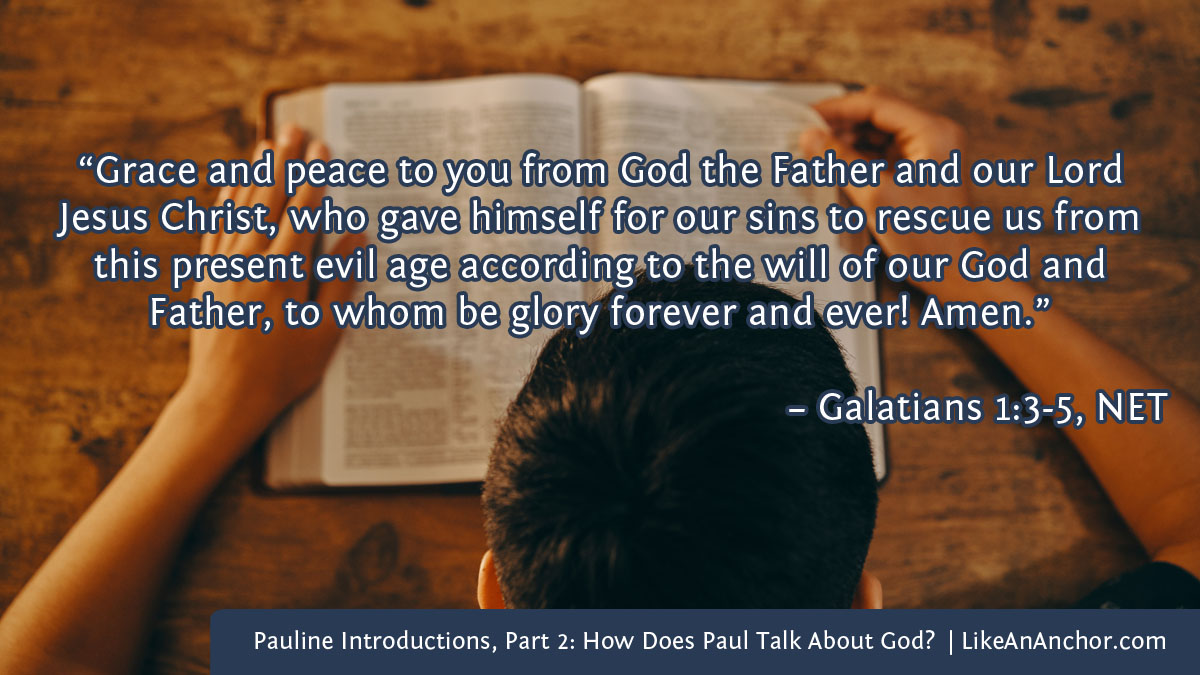
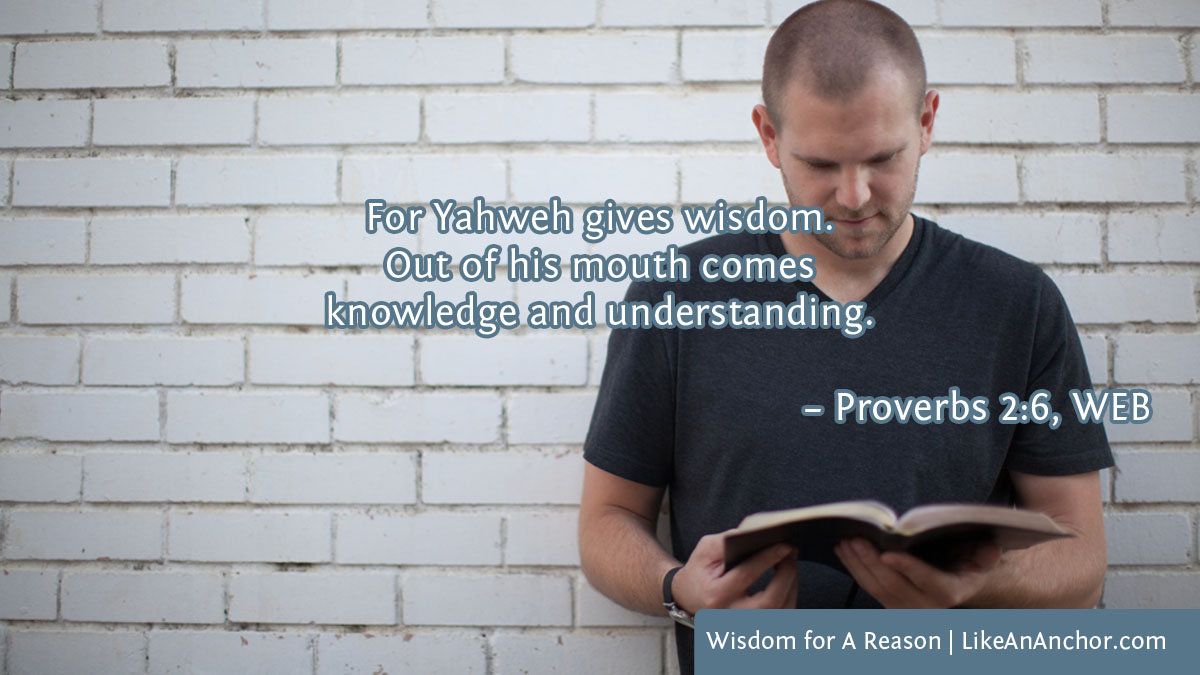
Image of a man reading a Bible overlaid with text from Proverbs 2:6, WEB version: "For Yahweh gives wisdom. Out of his mouth comes knowledge and understanding."
Image by Anggie from Lightstock

Justice, Judgement, and Governance

In the English language, judgement, government, and justice are separate things. We hope they’re connected, but we don’t see the judicial system or people who govern/rule as inseparably about justice. In Hebrew, though, it’s the same word. The root word shapat (which is used in 1 Kings 3:9, 28) means “to exercise [all] the processes of government” (Theological Wordbook of the Old Testament [TWOT], entry 2443). Ancient understanding didn’t really separate what we think of as different branches of government nor did they separate the law from the lawgiver: “the centering of law, rulership, government in a man was deeply ingrained” (TWOT 2443). This makes perfect sense when we think of God as the Lawgiver and Ruler. The Bible treats His Law as an extension of His character, and a good king of Israel was expected to act as God’s representative in upholding divine law.

The derivative word mishpat (used in 1 Kings 3:11, 28) has “at least thirteen related, but distinct, aspects of the central idea, which if to be rendered by a single English word with similar range of meaning ought by all means to be the word ‘justice’” (TWOT 2443c). These 13 meanings include “the act of deciding a case of litigation,” “a sentence or decision issuing from a magistrate’s court,” “an ordinance of law,” “one’s right under law,” and “sovereignty, the legal foundation of government in the sense of ultimate authority or right.” We get to see Solomon use his gift of wise judgement immediately, as the next thing recorded in this narrative is the story of the two mothers arguing over one living child. Both claim to be the baby’s mother and that a child who died belonged to the other. Solomon wisely figured out who the real mother was without even needing to conduct an investigation.

All Israel heard of the judgment (mishpat) which the king had judged (shaphat); and they feared the king, for they saw that the wisdom of God was in him to do justice (mishpat).

1 Kings 3:28, NET

Solomon’s wisdom wasn’t confined to judicial matters or government–God’s blessing exceeded Solomon’s initial request (1 Kings 4:229-34)–but that was the central reason he gave for requesting wisdom. It seems from the way that Solomon talked about his new responsibilities that he was worried he wouldn’t be able to govern as well as he ought, and he asked for supernatural help to discern and do justice. There was a purpose behind his request, and it was related to the role he was meant to fill in ruling and serving God’s people.

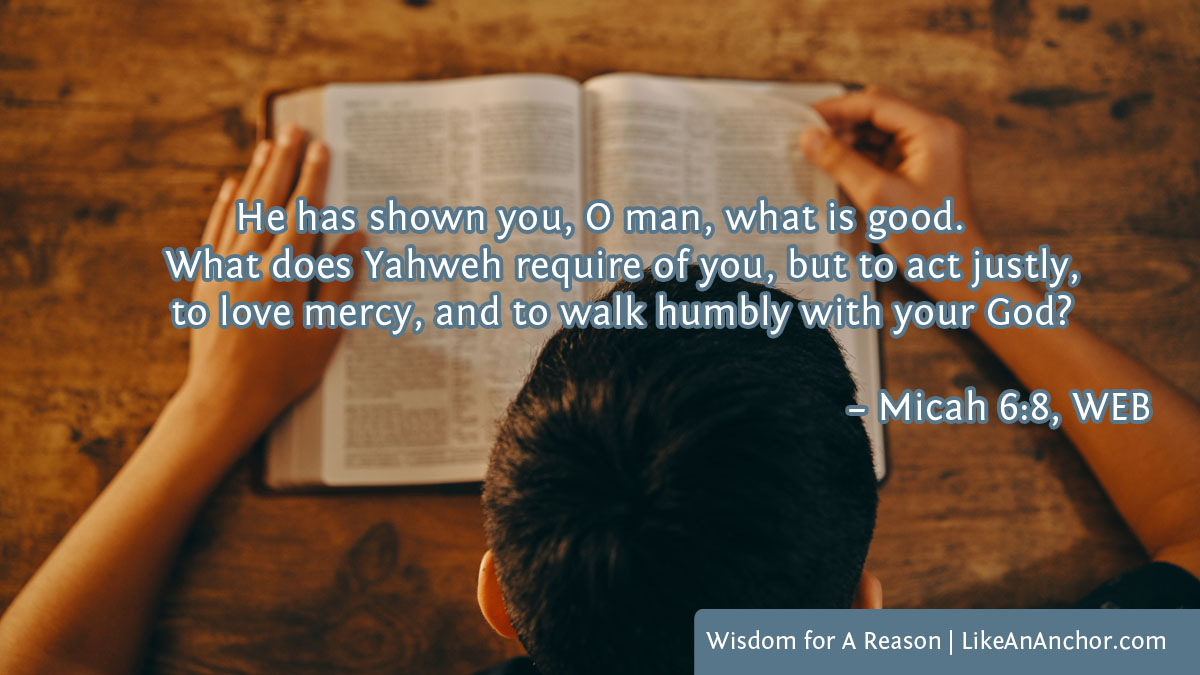
Image of a man reading the Bible overlaid with text from Micah 6:8, WEB version: "He has shown you, O man, what is good. What does Yahweh require of you, but to act justly, to love mercy, and to walk humbly with your God?"
Image by Matt Vasquez from Lightstock

Next-Level Justice and Love

As I pondered Solomon’s reason for asking God to give him wisdom, it made me think of what Paul told the Corinthians about wisdom and knowledge. In the opening part of 1 Corinthians, Paul made a distinction between wisdom as the world defines it and wisdom that God gives through His holy spirit. Earthly wisdom can get in the way of us following God–we get so impressed with what we know and how we wisely apply our knowledge that it’s hard for us to realize how much we need God and how little our own talents impress Him (Jer. 9:23-24; 1 Cor. 1:26-31). It took Solomon a long time to realize this, even with his wisdom being a gift from God (Ecc. 12:9-14).

The wisdom that Paul talked about is “not a wisdom of this age or of the rulers of this age, who are perishing. Instead we speak the wisdom of God, hidden in a mystery, that God determined before the ages for our glory” (1 Cor. 2:6-7, NET). It’s a different sort–or maybe a different level–of wisdom than Solomon had. This fits into a larger pattern in the New Testament of Jesus taking things from God’s Old Covenant interactions with people to a higher, deeper, more spiritual level.

We see good examples of this in the Sermon on the Mount, [where He mentions a law (e.g “You have heard that it was said, ‘Do not commit adultery’ [Matt. 5:27, NET]) and then shares the New Covenant application (e.g. “But I say to you that whoever looks at a woman to desire her has already committed adultery with her in his heart” [Matt. 5:28, NET]). He goes through this pattern several times, revealing that God expects more of us under the New Covenant because we’re to keep the spirit and intent of the law, not just the letter.

There is one law that seems like an outlier to this pattern. In the past, God’s law let you exact equal retribution for a crime (e.g. “An eye for an eye and a tooth for a tooth” (Ex. 21:24; Lev. 24:20; Matt. 5:38). Jesus doesn’t say to be more extreme with this law, but rather “do not resist the evildoer” (Matt. 5:39, NET). It might not seem like a logical escalation to us, but when God takes justice to the next level, it turns into mercy, long-suffering, peace, and love (Matt. 5:38-48).

Heading

Image of a woman reading the Bible, overlaid with blog's title text and the words, "When we ask God for wisdom and knowledge,  we should remember why He gives these sorts of gifts and know how He wants them to be used."
Image by Pearl from Lightstock

Wisdom by itself doesn’t do much for us. There has to be a purpose behind it, and it has to be the right kind of wisdom (i.e. “wise in what is good and innocent in what is evil” [Rom. 16:19, NET]). In 1 Corinthians, Paul discussed both wisdom and knowledge (which aren’t the same thing, but are connected). This church had several issues they needed to work through, including a mistaken idea that they had all the answers.

 With regard to food sacrificed to idols, we know that “we all have knowledge.” Knowledge puffs up, but love builds up. If someone thinks he knows something, he does not yet know to the degree that he needs to know.

1 Corinthians 8:1-2, NET

Having knowledge isn’t a problem in itself; we’re actually supposed to have some types of knowledge (1 Cor. 12:8; 14:6; 15:34). But no matter how much we know, we still have incomplete knowledge and a limited perspective compared to God. Also, not everyone has the same understanding, and there are times that acting on your knowledge–even if you’re right–can undermine someone else’s faith (1 Cor. 8:4-13). If you’re using your knowledge to increase your pride or hurt other people, then it’s worse than useless.

And if I have prophecy, and know all mysteries and all knowledge, and if I have all faith so that I can remove mountains, but do not have love, I am nothing. 

1 Corinthians 13:2, NET

Wisdom is often defined as using knowledge in the right way. I think there’s a connection here between Solomon’s wisdom to do justice and Paul’s teaching that knowledge is useless without love. Just like there was a reason behind the wisdom Solomon asked for, so there should be a driving factor behind our use of knowledge as well. Without love (a central aspect of God’s character and law [Rom. 13:10; Gal. 5:14; 1 John 4:8, 16]), intellectual gifts are pointless.

Solomon spent a lot of time in Ecclesiastes bemoaning how empty his life felt even with so much wisdom. He ultimately came to the conclusion that wisdom is definitely better than folly, but that the most important thing is to “Fear God, and keep his commandments; for this is the whole duty of man” (Ecc. 12:13, WEB). When we ask God for wisdom, knowledge, and understanding (which He will give us if we ask [James 1:5]), we should remember why He gives these sorts of gifts–so that we can follow His example and develop His character in us, including His love and justice.

He has told you, O man, what is good,
and what the Lord really wants from you:
He wants you to carry out justice, to love faithfulness,
and to live obediently before your God.

Micah 6:8, NET

Featured image by Pearl from Lightstock

Waiting In Hope

In the lady’s scripture writing group that I’m part of in our local church congregation, the theme for January is “Wait on the Lord.” When I was writing a scripture earlier this month, I noticed that some translations of Psalm 31:24 used the word “hope” and others used the word “wait.” Those are two very different words in English, so I wondered how they could be so connected in Hebrew that “hope” is just as good of a translation for the word as “wait.”

I’ve heard quite a few native English speakers describe Hebrew as weird and frustrating. How can you have words that mean completely opposite things depending on the context? It makes no sense! But the more I study the Bible and read about Hebrew language and thought, the more I appreciate that Hebrew isn’t a more limited language than English. It’s just a very different kind of language. Lois Tverberg compares languages to painting styles–Hebrew uses broader brush strokes and a more limited color pallet (i.e. number of words; about 8,000 for Hebrew) while English uses a fine-tipped brush, different colors, and more colors (there are about 100,000 English words). Language shapes so much of how we think, so if we want to understand the thought process of the people God used to write the Bible, it helps to learn more about the languages they used.

A Look At Hebrew Language

Be strong, and let your heart take courage,
    all you who hope in Yahweh.

Psalm 31:24, WEB

Be strong and confident,
all you who wait on the Lord.

Psalm 31:24, NET

In English, these different translations make it seem like the verse could mean two completely different things. For English speakers, hoping in Yahweh isn’t at all the same thing as waiting on the Lord. We think of hope as a feeling of expectation, desire, or trust (Oxford Languages via Google). Waiting is something we do until something else happens, a staying in place or delaying action (Oxford Languages via Google). If you’re excited about the thing you’re waiting on or trust that it could happen you might feel hope, but they’re not necessarily connected.

The Hebrew word translated either “hope in” or “wait on” is yachel/yahal (יָחַל, H3176). It’s a verb (action word) that is primarily translated “hope” in the KJV, but also “wait,” “trust,” and “tarry.” The Theological Wordbook of the Old Testament (TWOT) states that the word carries “the idea of ‘tarrying’ and ‘confident expectation, trust'” as well as “hope” (TWOT entry 859). They explain the hope-wait connection like this:

yahal is used of ‘expectation, hope’ which for the believer is closely linked with ‘faith, trust’ and results in ‘patient waiting.’ … This yahal ‘hope’ is not a pacifying wish of the imagination which drowns out troubles, nor is it uncertain (as in the Greek concept), but rather yahal ‘hope’ is the solid ground of expectation for the righteous.”

TWOT entry 859

Yahal “is a close synonym to batah ‘trust’ and qawa ‘wait for, hope for'” (TWOT 859). We won’t look at batah in this post, but most of the other verses I’ve been writing this month translate “wait” from the word qavah or qawa (קָוָה, H6960). This word “means to wait or to look for with eager expectation” (TWOT 1994). Qavah has to do with waiting in faith, trusting in God, hope for the future. The root verb qawa is most often translated “wait” and “look for” in the KJV. It’s the derivative noun tiqvah that’s usually translated “hope” or “expectation.” There are also several other words that can be translated “wait.” Some of these are also translated “hope,” including sabar/shabar (H7663: “to inspect, examine, wait, hope, wait upon [BDB]) and others without the hope connotation, such as chakah (H2442: “wait, wait for, await” [BDB]). We won’t dive into all these different words in this post, but I wanted to bring them up to demonstrate the wait/hope connection is woven throughout the language.

Image of a man reading the Bible overlaid with text from Psalm 71:14-15, WEB version: "As for me, I will wait continually, and will continue to praise you. I will tell about your justice, and all day long proclaim your salvation, though I cannot fathom its full extent."
Image by Matt Vasquez from Lightstock

Confident Expectation

Once I started thinking about “wait” and “hope” as being connected, it’s almost impossible not to see it. The first time the word yahal appears in the Bible is in Genesis 8:12. This is after the flood, while Noah, his family, and all the animals are still on the ark.

At the end of forty days, Noah opened the window of the ship which he had made, and he sent out a raven. It went back and forth, until the waters were dried up from the earth. He himself sent out a dove to see if the waters were abated from the surface of the ground, but the dove found no place to rest her foot, and she returned into the ship to him, for the waters were on the surface of the whole earth. He put out his hand, and took her, and brought her to him into the ship. He waited yet another seven days; and again he sent the dove out of the ship. The dove came back to him at evening and, behold, in her mouth was a freshly plucked olive leaf. So Noah knew that the waters were abated from the earth. He waited yet another seven days, and sent out the dove; and she didn’t return to him any more.

Genesis 8:6-14, WEB

There are two times in this passage where an English translation says, “He waited.” The first time, the Hebrew word is chûl/chı̂yl (H2342): “to twist, whirl, dance, writhe, fear, tremble, travail, be in anguish, be pained” (BDB definition). Clearly, this is not a hopeful sort of waiting. It’s an anxious waiting. But then, after the dove comes back with “a freshly plucked olive leaf” so that Noah knew the waters were starting to dry up, the type of waiting changes. This time, “he yahal yet another seven days.” Now, Noah had a reason to hope and the way that he waited changed.

Unfortunately, there isn’t an English word that would capture wait/hope as a dual meaning. Translators either have to pick one or the other, or replace the single word with a whole phrase that means something similar. The Amplified Bible translation (AMP) does this for yahal sometimes (though not in Genesis 8). AMP renders Psalm 31:24 as “Be strong and let your hearts take courage, All you who wait for and confidently expect the Lord.” That’s what Noah was doing, at least once he’d seen evidence that the earth was growing back after the flood.

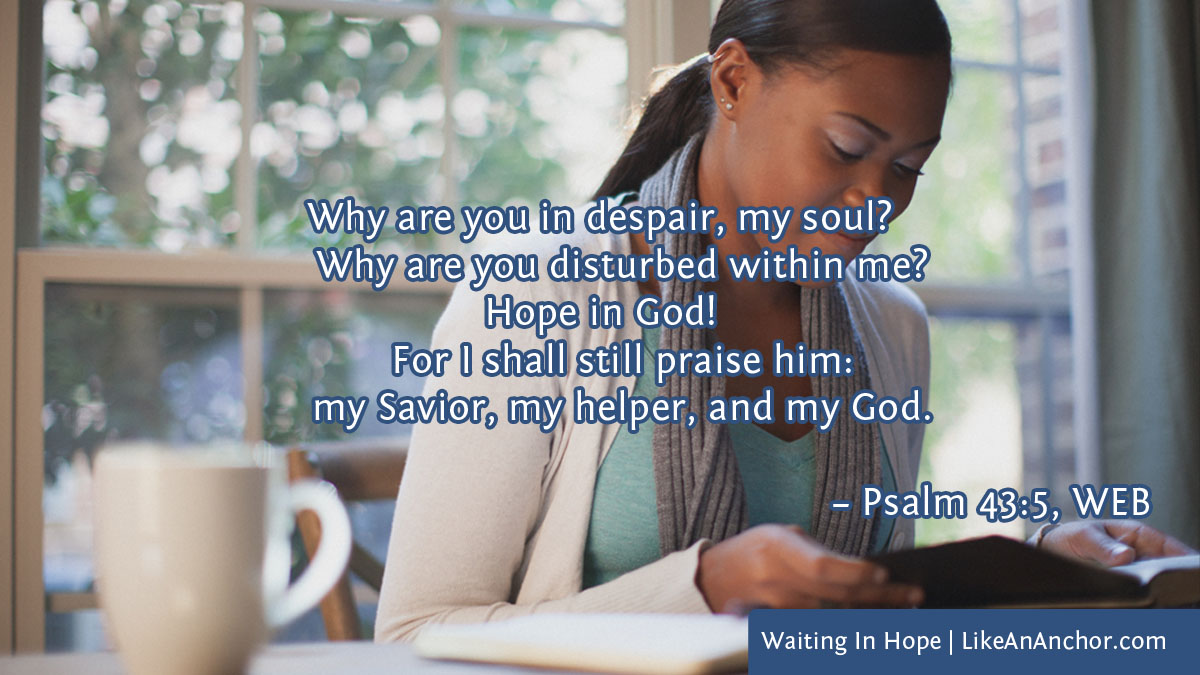
Image of a woman reading the Bible overlaid with text from Psalm 43:5, WEB version: "Why are you in despair, my soul? Why are you disturbed within me? Hope in God! For I shall still praise him: my Savior, my helper, and my God."
Image by Pearl from Lightstock

God Shows Up

When studying a Hebrew word, I often like to focus on how the word is used in Psalms because those songs are so much about the relationship between people and God. Relationships lie at the heart of Christianity, and I find it particularly insightful to look at how people of faith used certain words when recording their feelings, thoughts, and worship.

We see yahal in 19 verses in Psalms, including some that describe a situation where it doesn’t seem like “hope” is the expected response. While “hope” is the traditional default translation, the NET translators maintain that “to wait” is the “base meaning” of yahal and whether “the person waiting is hopeful or expectant” depends on context (footnote on Ps. 42:5). I wonder, though, if the authors meant there to be some hints of hope even in the ones where it doesn’t seem (to us) to fit the context. After all, there are other words the authors could have used for “wait.”

Behold, Yahweh’s eye is on those who fear him,
    on those who hope in his loving kindness,
    to deliver their soul from death,
    to keep them alive in famine.
Our soul has waited for Yahweh.
    He is our help and our shield.
For our heart rejoices in him,
    because we have trusted in his holy name.
Let your loving kindness be on us, Yahweh,
    since we have hoped in you.

Psalm 33:18-22, WEB

Here, “hope” is translated from yahal and “waited” from chakah (the NET translates all of them “wait”). Now, this one (Psalm 33) is a psalm of praise, and it makes sense to our minds that we’d see “hope” in this context. But we also see “I hope in you, Yahweh” (Ps. 38:15) in a psalm that begins with God’s indignation and wrath (Psalm 38) and the instruction “hope in” or “wait for” God (Ps. 42:5, 11; 43:5) when suffering despair and persecution (Psalms 42; 43). Those are the times when we need hope the most. And one of the reasons that we can have hope that’s a “confident expectation” rather than something uncertain is because God has showed up so many other times when we (and other people of faith) waited for Him.

A Sure, Certain Hope

Image of a woman looking up at the sky, overlaid with blog's title text and the words, "Several Hebrew words can be translated either "wait" or "hope." Learning about the wait-hope connection that Bible writers saw can help us hold on to hope today when we're waiting on God."
Image by Brightside Creative from Lightstock

One of God’s promises that we’re still waiting on is that He will resurrect all His faithful followers from the dead. That’s not something that’s happened yet. Like so many of God’s promises, some people (even in the 1st century, right after Jesus’s life, death, and resurrection) say that it won’t happen. But, as Paul points out, God’s track record proves that He can follow-through on His promises.

Now if Christ is being preached as raised from the dead, how can some of you say there is no resurrection of the dead? But if there is no resurrection of the dead, then not even Christ has been raised. And if Christ has not been raised, then our preaching is futile and your faith is empty. … And if Christ has not been raised, your faith is useless; you are still in your sins. Furthermore, those who have fallen asleep in Christ have also perished. For if only in this life we have hope in Christ, we should be pitied more than anyone. But now Christ has been raised from the dead, the firstfruits of those who have fallen asleep. 

1 Corinthians 15:12-14, 17-20, NET

For Paul, the fact that God the Father raised Jesus Christ from the dead proves that He will raise “those who have fallen asleep in Christ” as well. Our hope in the resurrection is a confident expectation because there’s already proof that God can do it, just like Noah’s hope that the water would recede became confident when he saw evidence of plant life on the earth.

You are my hiding place and my shield.
    I hope (yachal) in your word. …
Uphold me according to your word, that I may live.
    Let me not be ashamed of my hope (seber).

Psalm 119:114, 116, WEB

God’s word contains many promises that we can read about. They’re backed up by His proven character, and because He is trustworthy we know that when we wait hopefully, He’s not going to disappoint us or make it so that we’d be ashamed of following Him.

Being therefore justified by faith, we have peace with God through our Lord Jesus Christ; through whom we also have our access by faith into this grace in which we stand. We rejoice in hope of the glory of God. Not only this, but we also rejoice in our sufferings, knowing that suffering produces perseverance; and perseverance, proven character; and proven character, hope: and hope doesn’t disappoint us, because God’s love has been poured into our hearts through the Holy Spirit who was given to us. For while we were yet weak, at the right time Christ died for the ungodly. 

Romans 5:1-6, WEB

Just reading through the Bible and observing how people talk about hope, we can see that it’s connected with confident expectation and it’s something that Biblical writers treat as certain as long as it’s pointed towards God. Studying the Hebrew language a little bit more and learning that wait and hope are so closely connected in that language can help us understand on a deeper level how the Biblical writers understood hope and waiting on God. It can teach us about both the Old Testament, which was written in Hebrew, and the New Testament, which was written by Jewish people who were deeply influenced by their linguistic history. And that can help us hold on to hope today when we’re waiting on God to do something in our lives or fulfill His promises.


Featured image by Ben White

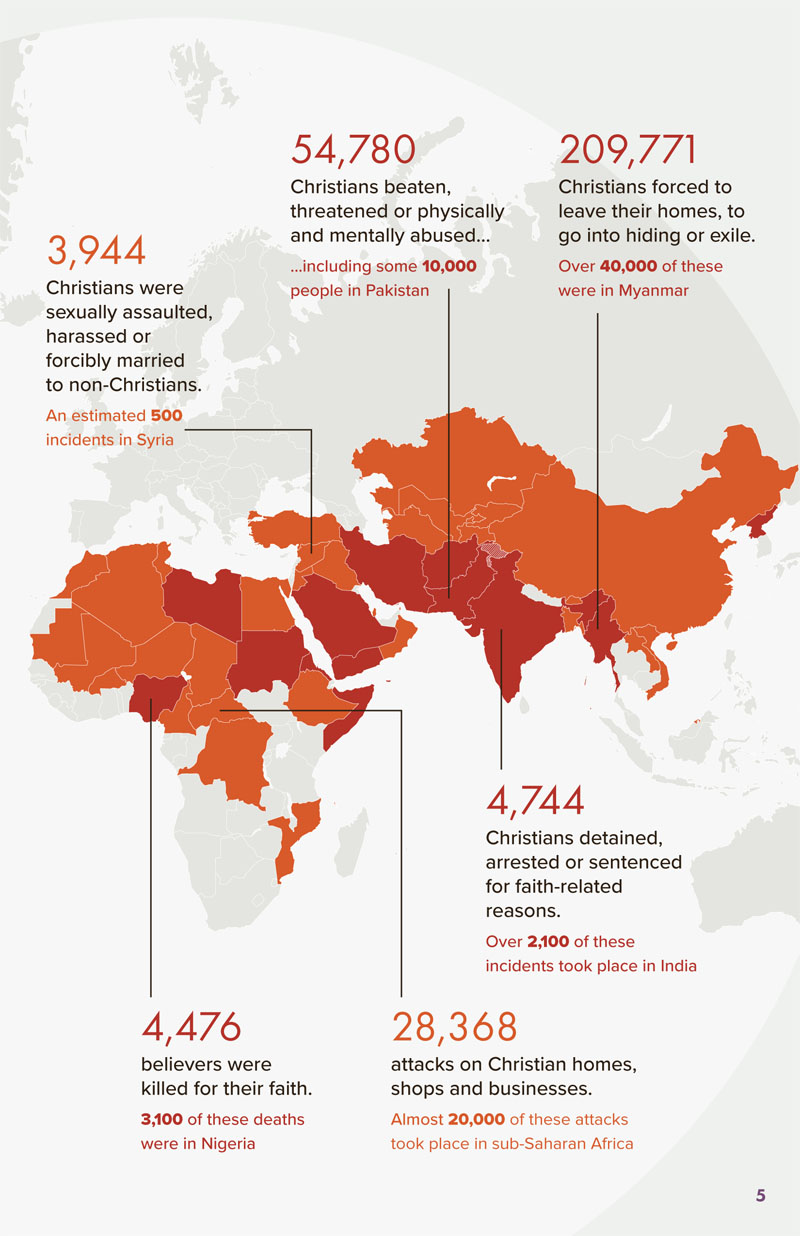
How Can You Help Persecuted Christians?

The 2025 World Watch List from OpenDoors released this week. It’s the most authoritative report you can get on locations around the world where Christians face persecution and discrimination because of their faith. OpenDoors conducts on-the-ground research in 150 countries around the world, then shares the top 50 most dangerous countries each year.  The organization has a presence in 70 nations where Christians face heavy persecution, lending substantial aid and standing alongside those suffering for their faith in Jesus.

You can download a copy of this year’s World Watch List by clicking here (you can also order print copies for your church, if you want). I encourage you to take some time to thoughtfully read through the reports on each country, the requests from our brethren who live there, and the individual stories bravely shared. Then, if you can, visit the Arise Africa page and add your name to the petition that Open Doors will present to the African Union, the United Nations, other groups as part of a four-year campaign to aid God’s people in sub-Saharan Africa. 

One thing that struck me deeply is that when asked how other people can help, persecuted Christians ask for prayer. “Pray for my child,” asks a man who escaped North Korea (p. 9). “Pray that God will give me strength,” asks a woman secretly ministering in Yemen (p. 11). Manga from Nigeria, who was nearly killed for refusing to deny Jesus, asks us to pray “for strength to remain firm” and “that fire for Jesus” would keep burning in their hearts (p. 15). Pastor Soré from Burkina Faso requests prayers that Christians there “stay firm in their faith” (p. 29). A man from Mexico requests prayers for hope, strong hearts, and growth of the church (p. 41). A believer in China shares, “Thank you for praying. I feel that I am not by myself. Through your prayers, I can feel that God has been looking after me to make me feel secure” (p. 23). It’s just like what the early church did–facing persecutions, encouraging each other to stand steadfast in the faith, and praying for one another.

Finally, pray for us, brothers and sisters, that the Lord’s message may spread quickly and be honored as in fact it was among you, and that we may be delivered from perverse and evil people. For not all have faith. But the Lord is faithful, and he will strengthen you and protect you from the evil one. And we are confident about you in the Lord that you are both doing—and will do—what we are commanding. Now may the Lord direct your hearts toward the love of God and the endurance of Christ.

2 Thessalonians 3:1-5, NET

As I mentioned in my 2024 blog recap, we have readers coming to LikeAnAnchor from all around the world. That includes thousands of people in Nigeria and India, as well as hundreds more from many other countries that appear in the World Watch List. I’m very grateful to have you here reading and, as the Apostle Paul frequently said, I remember you and make “mention of you in my prayers.” I don’t know most of you personally, but you are in my thoughts.

My friends, we might feel discouraged or powerless when we think about the opposition that we and/or our brethren in the world are facing, but we must remember the power of the God we serve. Praying to Him isn’t just something we do because we can’t do something more; prayer is one of the most powerful things that we can do to help others. Let’s never forget to pray for our brothers and sisters around the world.


A quick note on next week’s post: if you read my newsletter, you’ll know that I’d planned on sharing a study this week on the connection between waiting and hoping in the Hebrew language. I needed more time for that study, and when I read the World Watch List report this week, I felt moved to share this instead. We’ll be back to our regular Bible study posts next week.

Don’t Be Surprised

One of the big lessons we can learn from the Bible is that God wants us to be prepared. There are a lot of warnings in the Bible, and we’re told many things in advance so we won’t be surprised. There are also many examples we can look at, particularly things that happened to Jesus Christ, that give us hints about what we might go through.

Following Jesus in Everything

Writing about Jesus, the author of Hebrews said, “he was obligated in all things to be made like his brothers, that he might become a merciful and faithful high priest in things pertaining to God, to make atonement for the sins of the people” (Heb. 2:17, WEB). He became like us, and we’re supposed to become like Him. If Jesus did something, then we shouldn’t be surprised that we’re supposed to do that as well.

“If I then, your Lord and Teacher, have washed your feet, you too ought to wash one another’s feet. For I have given you an example—you should do just as I have done for you. I tell you the solemn truth, the slave is not greater than his master, nor is the one who is sent as a messenger greater than the one who sent him. If you understand these things, you will be blessed if you do them.”

John 13:14-17, NET

We’re supposed to follow Jesus’s example. We’re even supposed to become perfect just like God the Father is perfect (Matt. 5:43-48). We can also expect that many of the things Jesus experienced will be things we go through as well. He took part in flesh and blood like us, He was tempted just like us (though He never sinned), and He learned humility and obedience just like we have to (Heb. 2:14; 4:15; 5:8; Phil. 2:5-8). If something happened to Him, we shouldn’t be surprised that it happens to us.

“Remember what I told you, ‘A slave is not greater than his master.’ If they persecuted me, they will also persecute you. If they obeyed my word, they will obey yours too.”

John 15:20, NET

We might marvel when we look at how the disciples handled persecution in the book of Acts. They even rejoiced “because they had been considered worthy to suffer dishonor for the sake of the name” (Acts 5:41, NET). They’d seen Jesus persecuted and they knew that they shouldn’t expect to be treated better than their master. He put up with unjust persecution for following His father, and so they put up with unjust persecution for following Him. It’s part of following His example.

Expecting Tough Times

We get to see how the disciples handled the truth of Jesus’s statement that, “If they persecuted me, they will also persecute you” in the book of Acts. We also get to read about Peter’s take on this topic in his first epistle, where he applied Jesus’s words to the whole church body of believers (and expanded it to include other types of suffering as well).

 Dear friends, do not be astonished that a trial by fire is occurring among you, as though something strange were happening to you. But rejoice in the degree that you have shared in the sufferings of Christ, so that when his glory is revealed you may also rejoice and be glad.

1 Peter 4:12-13, NET

Often when something bad–or even just inconvenient–happens to us, our human reaction is to bemoan, “Why me?” Peter thinks we shouldn’t be surprised by tough things, even if it’s something that could be categorized as “a trial by fire.” It isn’t strange, it’s just part of life as followers of Jesus. Our Messiah suffered persecution, so why shouldn’t we? He was tempted and tried (see Matt. 4:1-11), so why wouldn’t we be? That doesn’t make it easy, but it is expected.

We sent Timothy, our brother and fellow worker for God in the gospel of Christ, to strengthen you and encourage you about your faith, so that no one would be shaken by these afflictions. For you yourselves know that we are destined for this. For in fact when we were with you, we were telling you in advance that we would suffer affliction, and so it has happened, as you well know. So when I could bear it no longer, I sent to find out about your faith, for fear that the tempter somehow tempted you and our toil had proven useless.

1 Thessalonians 3:1-5, NET

Like the people of Thessalonica, we’ve been given warnings that life will be hard sometimes. We read the Bible and listen to sermons, and we know that following God doesn’t exempt us from facing trials (though He does promise to work all things out for good in the end and give us a way to endure trials [Rom. 8:28; 1 Cor. 10:13]). That doesn’t always stick in our heads, though, when bad things happen. That’s one reason it’s so important to be connected with Messiah’s community–so people can check on and encourage you just like Paul did for the Thessalonians.

For this is the gospel message that you have heard from the beginning: that we should love one another, not like Cain who was of the evil one and brutally murdered his brother. And why did he murder him? Because his deeds were evil, but his brother’s were righteous. Therefore do not be surprised, brothers and sisters, if the world hates you.

1 John 3:11-13, NET

John spends a lot of this epistle talking about how God loves us and our duty to love Him and each other. He also points out that when we love in a Godly way, it’s a radical departure from how the world lives. We’re supposed to love our fellow Christians–everyone who is fathered by God, practices righteousness, and is growing toward perfection (1 John 3:1-16). In contrast, many people in the world hate those whose deeds are righteous (John 3:19-20;15:18-19). That shouldn’t surprise us–it’s been that way since Cain and Able.

Other Warnings

I didn’t plan on this blog post to focus so much on persecution and trials, but when you start studying warnings that’s a main theme that pops out. I suspect it’s because God and the Biblical writers know that the hardships we encounter can keep us from enduring unless we develop a strong root system of faith (see Mark 4:1-20). There are other warnings, though, and cautions so that we’re not surprised.

“For false messiahs and false prophets will appear and perform great signs and wonders to deceive, if possible, even the elect. Remember, I have told you ahead of time.”

Matthew 24:24-25, NET

God tells us a lot about the future. We don’t know when the end time events that He prophesied are going to happen (Acts 1:6-7), but Jesus gave us plenty of warnings about what those times will be like and how we’re supposed to guard ourselves as we get closer to the time of his return (Matt. 24-25, and many other prophecies). He told us these things before they happened so that we won’t be misled (Matt. 24:4-5), alarmed (Matt. 24:6), deceived (Matt. 24:24), unprepared (Matt. 24:42-44; 25:1-13), or shirking our duties (Matt. 24:45-51; 25:14-46).

God doesn’t tell us exactly what’s going to happen or when in our lives, but He doesn’t leave us in the dark about his overarching plan. We won’t know the specifics of trials we face before they happen, but He warns us they will happen and promises He’ll be there through them. He wants us to join His family, and sets us up for success.

“You heard me say to you, ‘I am going away and I am coming back to you.’ If you loved me, you would be glad that I am going to the Father, because the Father is greater than I am. I have told you now before it happens, so that when it happens you may believe.”

John 14:28-29

When we see God follow through on His promises, it strengthens our faith. He’s given us many insights into how the world works, what we can expect, and what we’re looking forward to so that we can develop a deep, strong faith and trust in Him. We can have confidence and peace, knowing that God has already assured us of His good plans and purposes related to us and the world. We can also trust Him through trials, knowing we’ve been warned of them in advance and having the perspective that God will use them to refine us and that He’ll be with us no matter what comes.


Featured image by Pexels from Pixabay

Song Recommendation: “Sparrows” by Jason Gray

Revive Me, Lord

Two Sabbaths ago, my dad gave a message in our church group about personal revival, specifically on the topic of rekindling a waning interest in Bible study. I was feeling a bit down emotionally at the start of that following week, and I remembered he mentioned a Hebrew word often translated “revive” that I thought it might be encouraging to look at more closely. It turned into such an interesting study that I didn’t get this post finished for last week and skipped posting so I could spend two weeks studying and writing.

The Hebrew word in question is chayah or haya (depending on how you want to transliterate it into the English alphabet). It’s Strong’s number H2421 and entry 644 in the Theological Wordbook of the Old Testament (TWOT), where the authors devote nearly three full pages to haya and its derivatives. It’s a very important word in the Old Testament writings, with the root word appearing 270 times, and it’s translated as “live,” “alive,” “quicken,” “nourish,” “recover,” and “revive” (along with a few other less frequent phrases) in the King James Version. The closely related derivative chay (H2416) appears 498 times, and it’s most often translated “life” or something that is alive, e.g. “a living thing.” Today, let’s take a closer look at these words and see what we can learn.

“Life” In Hebrew

The TWOT says the root verb haya means “to live or have life” (in the simple Qal stem) or “giving or restoring life” (in the word’s two other verb stems) (p. 279). The “range of meaning” also includes “‘to preserve or sustain life’ or ‘to nourish’ … ‘or to restore to health, to heal, recover'” (p. 280). Key to understanding this word is that it is usually very concrete rather than an abstract idea.

“The OT speaks of life as the experience of life rather than as an abstract principle of vitality which may be distinguished from the body. This is because the OT view of the nature of man is holistic, that is, his function as body, mind, spirit is a unified whole spoken of in very concrete terms. Life is the ability to exercise all one’s vital power to the fullest; death is the opposite.”

R. Laird Harris, Gleason L. Archer, Jr., and Bruce K. Waltke; TWOT entry 644, p. 279

We might think this is a very different viewpoint from the New Testament, but that’s because we’ve been influenced by modern ideas about people being bodies with spirits or souls rather than unified wholes. The idea that humans have a soul that’s separate and immortal came into Christianity from Neoplatonic philosophy about 200-300 years after Christ’s human life (see “Rethinking Heaven: Capturing A Vision Of The Resurrection” and “Relational Faith: A Book Review and Theological Reflection“). We’re “spirit, soul, and body” (1 Thes. 5:23, WEB) as a unified whole, living our lives as human beings made in God’s image.

While chayah can have slightly “less concrete” meanings, such as living “by the words of God ‘not by bread alone’ (Deut 8:3; Ps 119:50, 93)” even these uses are grounded in “the biblical unity of man’s nature” and seem to refer to both physical “prosperity as the gift of obedience” and “the spiritual quality of life” (TWOT, p. 280). There are also hints in the Old Testament that chayah refers to the eternal, spiritual life God offers after death, not just the physical life that He gives us (Ps. 49:9; Prov. 12:28; 15:24; Dan. 12:2). The concreteness of the word ties in well with the Biblical teaching that there will be a bodily resurrection (i.e. we’ll be resurrected as spirit beings with spirit bodies, not something ghostly or disembodied).

Walking with God for Life

Since chayah is used so many times in the Bible, I thought I’d focus today’s study on the ways that it’s used in the Psalms (just to make things a little more manageable). I did this by looking up chayah (H2421) and chay (H2416) with the program eSword, which yielded 82 matches in the psalms (31 chayah, 51 chay). This includes several categories of verses, including ones describing God as “the living God” (Ps. 42:2; 84:2) and talking about us being in the “land of the living” (Ps. 27:13; 56:13; 142:5). I want to focus, though, on the ones that speak of how God impacts our lives (click for examples).

Surely goodness and loving kindness shall follow me all the days of my life,
    and I will dwell in Yahweh’s house forever.

Psalm 23:6, WEB

The much beloved Psalm 23 shows Yahweh’s involvement with David’s whole life (and ours as well). God is the shepherd who provides all our needs, restores our souls, guides us, guards us, and comforts us. Chay appears in the last verse, providing a conclusion to the short psalm. When we remember that the life represented by chay can involve nuances of preserving, sustaining, nourishing, and reviving, it deepens our understanding of the quality of life that God wants to give us.

In another section of scripture, Jesus said, “I have come so that they may have life, and may have it abundantly. I am the good shepherd” (John 10:10-11, NET). Obviously, the word chay doesn’t appear here because the New Testament was written in Greek rather than Hebrew, but I think we can see how the meaning is connected. God wants our lives to be good, not just abstractly but in a real, tangible way.

 I have set Yahweh always before me.
    Because he is at my right hand, I shall not be moved.
Therefore my heart is glad, and my tongue rejoices.
    My body shall also dwell in safety.
For you will not leave my soul in Sheol,
    neither will you allow your holy one to see corruption.
You will show me the path of life.
    In your presence is fullness of joy.
In your right hand there are pleasures forever more.

Psalm 16:8-11, WEB (footnote on v. 10: “Sheol is the place of the dead”)

As with Psalm 23, chay appears in the conclusion of Psalm 16 (also a psalm of David). Long after David’s death, the apostle Peter said that this Psalm is really “about the resurrection of the Christ, that he was neither abandoned to Hades, nor did his body experience decay” (Acts 2:31, NET [italics mark allusions to Psalm 16]). David was a prophet, and he knew he was writing about one of his descendants who would be the Messiah/Christ (Acts 2:22-33). A lot of this psalm also feels personal, though, and I suspect that we can read it on both levels: a messianic prophecy and an expression of David’s assurance that God will take care of him.

I’m not sure how much David understood about God’s ultimate plan to bring human beings into His family, but it is accurate that God won’t leave us in the grave forever. It’s also accurate to say that he shows us “the path of life” in multiple senses: the path to walk in order to have a good life here on this earth, and the path to eternal life with God forever.

Revival from God

I find it ironic that I’ve been struggling to focus on and finish this study, which was inspired by a message about reviving a waning interest in Bible study. For some reason, I’ve just had a very hard time for this post with going from reading Bible scriptures to knowing how to put them together and what to say about them.

In the Psalms, there are several times where chay or chayah are translated “revive” (as well as the more common “life” or “live”). It shows up a lot in Psalm 119. This whole psalm is like a love letter to God’s word; every single verse talks about God’s law, ordinances, statues, precepts, way, etc. Here, we learn that revival (chayah) is found in the words of God.

My soul is laid low in the dust.
    Revive me according to your word!

Psalm 119:25, WEB

I will never forget your precepts,
    for with them, you have revived me.

Psalm 119:93, WEB

Hear my voice according to your loving kindness.
    Revive me, Yahweh, according to your ordinances.

Psalm 119:149, WEB

It seems that the solution to my problem focusing on study is to persistently come back to God and His word even if it takes a while for things to come together and make sense. In fact, that’s the solution to all of our problems. It’s not like there’s anywhere else to go for answers. As Peter said when Jesus asked if the twelve wanted to go away after several other disciples decided not to listen to Him anymore, “Lord, to whom would we go? You have the words of eternal life” (John 6:68, NET).

We can physically survive without having a relationship with God, but we can’t have full, abundant, and eventually eternal life apart from Him. He doesn’t promise that we’ll never have tough times or difficult feelings, but He does promise life-giving revival in Him and His word if we come to Him during those challenges.


Featured image by Sasin Tipchai from Pixabay

Song Recommendation: “Mayim Chaim” by Zemer Levav

Should We Find Our Identities in Christ?

Sometimes, as Christians, we hear and use phrases that sound good but aren’t actually in the Bible. Many common Christian phrases like “What would Jesus do?” are inspired by scriptures, but aren’t actually a quote from anywhere in the Bible. For phrases like this, we need to make sure that we’re not just using them because they sound good. We need to check if they’re actually backed up by the Bible. Sometimes they’re accurate according to scripture, and sometimes they’re not.

We talked about one example earlier this year: “Spare the rod, spoil the child.” This sounds like something from Proverbs, but it’s really from a 17th-century poem by Samuel Butler. In this case, the popular phrase distorts the meaning of similar (though not identical) Bible scriptures.

Another common phrase in modern Christianity is “find your identity in God” or “find our identity in Christ.” There is no scripture that tells us to do this exact thing; it’s not a quote from the Bible. That doesn’t necessarily make it inaccurate, but it does mean we need to check it out carefully and examine the underlying assumptions.

Based on the tagline for this blog (“Finding our true selves in the people God created us to be”), you can probably guess that I think finding our identity in God is a solid Biblical idea. But it is good to remain open to questioning our assumptions and being corrected by the Bible, particularly for topics like this where it’s not a quote from scripture. It’s good for us to study to prove whether our assumptions are right or wrong.

Image of people standing in a circle, holding hands to pray, overlaid with text from Genesis 1:27, NET version: “God created humankind in his own image, in the image of God he created them, male and female he created them.”
Image by Matt Vasquez from Lightstock

What Does It Mean?

When someone says you should “find your identity in Christ,” what do they mean? Answering this question is a first-step toward checking if the phrase lines-up with scripture.

The word “identity” in this context means “the fact of being who or what a person or thing is” and “the characteristics determining who or what a person or thing is” (Google/Oxford Languages definition). It’s about who you are and who you or others think you are. In today’s world, it’s become increasingly common to talk about how we identify ourselves. We’re told we can fill in the blank in, “I identify as …” however we want. People today want to determine their own identities.

In a Christian context, the phrase “find your identity in Christ” generally means a couple similar things. It means we should let God define who we are rather than listening to our own “I am” or the world’s “you are” statements. In other words, we believe what He says about us is true even (especially) when it contradicts what we might say about ourselves or what others say about us.

It can also mean becoming more and more like Jesus until His identity becomes our own. If identity is “who or what a person” is and “the characteristics determining” who they are, then having the same identity as Christ is just another way of saying we should become like Him. For the purposes of this post, we’ll operate on the assumption that “find your identity in Christ/God” means 1) believe the things God says about who you are, and 2) become like Jesus Christ. As we’ll see, both of those ideas do show up in the Bible.

Image of two hands, palms up, overlaid with text from Matt. 5:13, 14, NET version: "You are the salt of the earth. ... You are the light of the world."
Image by Who Is Like The Lord from Lightstock

What God Says About You

I’ve written about this topic before, but it’s worth revisiting in today’s context. There are many places in the Bible where God makes “you are” statements to His people or where God’s people make “I am” statements that we can identify with. From scripture, we know that we are (collectively) the temple of God (1 Cor. 3:16-17; 2 Cor. 6:16-18) and we belong to Him (1 Cor. 6:19-21). God also describes us as people worth dying for (Rom. 5:8), as salt and light in this earth (Matt. 5:13-14), as called and chosen (1 Pet. 2:9), and as friends and siblings of Jesus Christ (John 15:14, Rom. 8:16-17). We are greatly loved and highly valued by both the Father and the Son (John 3:16; 15:13-14).

We can also look at examples of how God interacted with specific people to see how He encouraged them to redefine how they see themselves to line-up with how He saw them. Let’s consider Moses for a moment. When God appeared to him in the burning bush, He called Moses to free his people from slavery in Egypt. Moses did not think he was qualified (Exodus 4:1-17). He protested, “they will not believe me, nor listen to my voice” and “I am not eloquent … for I am slow of speech, and of a slow tongue” (Ex. 4:1, 10, WEB)).” God answered both these protests; He could make Moses believable and give him the ability to speak. God did agree to make Aaron Moses’s spokesperson, but with God’s help Moses eventually grew to the point that he could speak on his own (all of Deuteronomy, for example, is an address from Moses to God’s people). God knew who Moses could be, and He helped Him get there. God did a similar thing for Jeremiah.

The Lord’s message came to me,
“Before I formed you in your mother’s womb I chose you.
Before you were born I set you apart.
I appointed you to be a prophet to the nations.” 

I answered, “Oh, Sovereign Lord, Really I do not know how to speak well enough for that, for I am too young.” The Lord said to me, “Do not say, ‘I am too young.’ But go to whomever I send you and say whatever I tell you. Do not be afraid of those to whom I send you, for I will be with you to protect you,” says the Lord. Then the Lord reached out his hand and touched my mouth and said to me, “I will most assuredly give you the words you are to speak for me. Know for certain that I hereby give you the authority to announce to nations and kingdoms that they will be uprooted and torn down, destroyed and demolished, rebuilt and firmly planted.”

Jeremiah 1:4-10, NET

In terms related to our topic today, Jeremiah didn’t identify as a prophet. He identified as a poor speaker too young for the Lord’s important work. But God had a different identity for him that was backed-up by God’s protection and power. Later, God offered even more reassurance, saying, “I, the Lord, hereby promise to make you as strong as a fortified city, an iron pillar, and a bronze wall. You will be able to stand up against all who live in the land” (Jer. 1:18, NET). Like many of us today, Jeremiah probably wouldn’t have described himself as a strong person, but with God’s help he became someone who can stand against any foe (as we can today with God’s armor [Eph. 6:10-18]).

Image of a couple reading the Bible to their two daughters overlaid with text from Eph. 5:1-2, NET version: “Therefore, be imitators of God as dearly loved children and live in love, just as Christ also loved us and gave himself for us, a sacrificial and fragrant offering to God.”
Image by Marcus from Lightstock

Becoming Like Jesus Christ

Jesus is our model for living a Christian life. If we say we have a relationship with Him and His Father, then we ought “to walk just as Jesus walked” (1 John 2:6, NET). He left “an example for you to follow in his steps” (1 Pet. 2:21, NET; see also John 13:14-15). Over and over, New Testament writers point to Jesus as the one we’re supposed to be like. We “walk in love, even as Christ also loved us” (Eph. 5:2, WEB), we’re told to “please his neighbor for his good to build him up” because that’s what Christ did (Rom. 15:1-3, NET), and “have the same attitude toward one another that Christ Jesus had” (Phil. 2:5, NET).

One of the goals of our Christian walk is to become like Jesus, inside and out. When Paul wrote to the Corinthians about how we understand the things of God because God’s spirit is inside us, he also said “we have the mind of Christ” (1 Cor. 2:16, NET). In the same passage, he talks about those who are “mature” (1 Cor. 2:6) and those who are “infants in Christ” (1 Cor. 3:1, NET). I think the implication here is that the more mature we are as Christians, the more we understand the things of God and have the mind of Christ (see also Heb. 5:11-6:3). Becoming like God is our goal.

(See what sort of love the Father has given to us: that we should be called God’s children—and indeed we are! For this reason the world does not know us: because it did not know him. Dear friends, we are God’s children now, and what we will be has not yet been revealed. We know that whenever it is revealed we will be like him, because we will see him just as he is. And everyone who has this hope focused on him purifies himself, just as Jesus is pure).

1 John 3:1-3, NET

Much of what we are told to do as God’s followers is “so that you may be like your Father in heaven” (Matt. 5:45, NET; see Matt. 5:43-48). He is making us fully part of His family, to the point that “we will be like him” in the future. When we have that hope of eternal life with God as His family members, the natural and necessary response is to work on making ourselves like God the Father and Jesus Christ.

A Higher Identity

Being part of God’s family is an identity that is higher, better, and far more important than our other identities. Paul is a great example of someone who had an “identity” that most people of his time would envy, but he gave it up so that he could identify with Christ.

If someone thinks he has good reasons to put confidence in human credentials, I have more: I was circumcised on the eighth day, from the people of Israel and the tribe of Benjamin, a Hebrew of Hebrews. I lived according to the law as a Pharisee. In my zeal for God I persecuted the church. According to the righteousness stipulated in the law I was blameless. But these assets I have come to regard as liabilities because of Christ. More than that, I now regard all things as liabilities compared to the far greater value of knowing Christ Jesus my Lord, for whom I have suffered the loss of all things—indeed, I regard them as dung!—that I may gain Christ, and be found in him, not because I have my own righteousness derived from the law, but because I have the righteousness that comes by way of Christ’s faithfulness—a righteousness from God that is in fact based on Christ’s faithfulness. My aim is to know him, to experience the power of his resurrection, to share in his sufferings, and to be like him in his death, and so, somehow, to attain to the resurrection from the dead.

Philippians 3:4-11, NET

Paul didn’t stop being an Israelite, Benjamite, or highly-educated Pharisee when he started following Jesus. Those identities just didn’t matter nearly as much anymore. Similarly, I don’t stop being a wife, mother, American, red-head, or someone with a master’s degree when I follow Jesus, but those identities aren’t nearly as important as my primary identity as a Christian. Being Christian makes me a better wife and mother, putting both of those roles in a new perspective. My citizenship in heaven (Phil. 3:20) supersedes my identity as an American. My visible/ethnic identities like red-head and white take a back seat to knowing I’m a child of God, part of one human race He created (Acts 17:26-28). My education becomes something that’s not worth boasting about because knowing God is so much more important (Jer. 9:23-34; 1 Cor. 1:26-31).

There isn’t a Bible verse telling us to find our identities in Jesus, but the phrase does reflect solidly Biblical ideas: believe what God says about who you are and become like Jesus Christ. Believing God is a first-step of faith (Heb. 11:6), and that includes believing the things He says about us and about the future He has planned for us as His family members. As we grow in our relationships with God and follow the example of Jesus Christ, we’re supposed to become more and more like Him. Just like Moses, Jeremiah, Paul, and other faithful men and woman throughout the ages, we should find our primary identity–the fact of our being and the characteristics of who we are–in God.


Featured image by Respostas com Você from Pixabay

Song Recommendation: “You Say” by Lauren Daigle