Continuing to Grow and Change for Jesus our Passover

We’re getting closer and closer to Passover. Based on Paul’s instructions in 1 Corinthians, these months leading up to Passover (Pesach) and the Day of Unleavened Bread (Chag HaMatzot) are a time of self-examination for New Covenant Christians. We spend time in prayer and study, asking God to share what He sees in us and help us grow and change to become more like Him. We take time to try and figure out what things in us still don’t look like God, repent of them, and seek His aid in changing our lives to align more and more with His ways.

A couple weeks ago, I kept ending up in Ephesians 5 as I read my daily devotional and worked through a month-long scripture writing study on deception (you can find similar scripture writing plans by clicking here). There’s a lot to think about in this chapter. It comes near the end of a fairly long letter where Paul writes to believers about the blessings and spiritual inheritance that we have through Christ, and says he gives thanks for the faith and love they’re already showing (Eph. 1). Paul reminds them of their transgressions/offenses and sins which God and Christ saved them from when He took those who were once outside God’s family and made them wholly part of His people (Eph. 2). As the letter goes on, Paul implores his readers to value the great and wonderful mysteries God grants us, not to lose heart when some of us suffer, and to fully commit to our relationship with Jesus Christ (Eph. 3). Based on all this, Paul calls his readers to unity with their fellow believers and insists they live holy, spiritual lives (Eph. 4).

Throughout the letter, Paul makes some brutal statements about our spiritual condition before we entered a relationship with God. “You were dead in your offenses and sins” and “were by nature children of wrath” (Eph. 2:1, 3, NET). In our lives before meeting Jesus, we were “corrupted in accordance with deceitful desires” (4:22). Paul even says, “you were at one time darkness” (5:8). This sinful state is where we all started out, desperately in need of Jesus to save us. We want to move on from that as quickly as possible and embrace all the good things God tells us about our new identities in Him. And while it is good and right to fully embrace who we are in God, we also need to remember how bad things were without Him. If we don’t keep that perspective, then it’ll be easy to slip back into worldly things because we don’t think of them as being “that bad.”

Slipping Back is Idolatry

Humans have a tendency for self-justification. Even when we’re beating ourselves up about something, we might also be making excuses for ourselves. Or maybe we read through the Bible and see our conduct in some of the things God says not to do, then tell ourselves that it’s not really all that bad. We make mistakes, but we’re human. No big deal.

It is true that God can remove our sins and He has abundant mercy for our mistakes. But it’s not because they’re “no big deal.” Sin results in death, and the reason God can forgive us so freely is because Jesus died in our place. That’s a really big deal. We need to understand the magnitude of what Jesus did for us, and the level of offense we cause if we turn back to wicked ways and brush it off as something that doesn’t really matter. In his one-year Worship the King devotional, Chris Tiegreen sums it up like this:

“we were idolaters. False worshipers. People who gave glory and honor to things that were not worthy, while neglecting the glory and honor that should go to the One who is. That hurts.

“It’s a brutal assessment, but we have to own up to it. We don’t like to think of our flirtation with impurity or materialism as idol worship, but it is.”

Chris Tiegreen, Worship the King, p. 51

Going back to Ephesians, Paul says that flirting with things like “sexual immorality, impurity of any kind, or greed … vulgar speech, foolish talk, or coarse jesting” is “not fitting for the saints” and “out of character” for those saying they want to imitate Jesus’s way of life (Eph. 5:1-4, NET). If we tell ourselves that things God calls sins are okay for us, then it turns into idolatry. We’re putting our desires for sinful things higher than our desire for God and saying our ideas of morality are more accurate than His.

Moving Into the Light

Emphasizing our need to change and grow as we follow Jesus Christ does not downplay God’s mercy or grace in any way. Grace is something we can’t do anything to earn, but once we accept God’s grace we enter a covenant with Him and agree to live in a spiritual way. He expects certain things of people who promise to follow Him, including that we won’t run off after things which have nothing to do with godliness.

For you can be confident of this one thing: that no person who is immoral, impure, or greedy (such a person is an idolater) has any inheritance in the kingdom of Christ and God. Let nobody deceive you with empty words, for because of these things God’s wrath comes on the sons of disobedience. Therefore do not be sharers with them, for you were at one time darkness, but now you are light in the Lord. Live like children of light—for the fruit of the light consists in all goodness, righteousness, and truth—trying to learn what is pleasing to the Lord.

Eph. 5:5-10, NET

God’s connection with Light is something we’ve explored in other Bible study posts. We’re supposed to shine with Jesus’s light in our lives, to be like lamps burning with bright fire as we imitate the Light of our Messiah. There’s a sharp divide in the world that’s been there since the fall of mankind. On the one hand, there is darkness and death. On the other, there is light and life. Jesus calling us out of darkness gives us the option to choose light. It’s an incredible gift. And unless we don’t really value that gift of Light, we’ll be doing our best to “live like children of light.”

Living With Wisdom

Therefore consider carefully how you live—not as unwise but as wise, taking advantage of every opportunity, because the days are evil. For this reason do not be foolish, but be wise by understanding what the Lord’s will is. And do not get drunk with wine, which is debauchery, but be filled by the Spirit, speaking to one another in psalms, hymns, and spiritual songs, singing and making music in your hearts to the Lord, always giving thanks to God the Father for all things in the name of our Lord Jesus Christ, and submitting to one another out of reverence for Christ.

Ephesians 5:15-21, NET

Because of everything Paul talked about before–particularly the way our dark pasts contrast with the light we’re supposed to live in now–he urges us to “consider carefully how you live.” We ought to do this careful consideration throughout the year, but Passover is a particularly fitting time for a check-in. How wise are we in how we live our lives? Are we letting God fill us with His spirit, then letting that pour out through our lips as praise, worship, and thanks? Do we demonstrate our reverence for Christ by submitting to each other in love?

I doubt we can fully answer “yes” to all these questions (I know I can’t), and this isn’t even a full list of everything we’re supposed to do as we imitate Christ. But remember that as long as you’re on the path toward perfection, God treats you as if you’re already perfect. When we trust Him and do our best to follow His example of holiness, He’ll keep filling us with His spirit and light. We’ll be able to stay on track following Him instead of slipping back into idolatry. He’ll empower us to grow and change, becoming more and more like Him each year.

Featured image by Corey David Robinson from Lightstock

Song Recommendation: “Immanuel” by Joshua Aaron

Revisiting the Deep Things of God’s Covenants

I wrote a bunch of posts about covenants in spring of 2016. Those posts, especially “Inheriting Covenants,” make up a Bible study that I still think about on a weekly basis. I’ve considered revisiting my covenants study several times over the past five years. During Sukkot this year–a time filled with scripture-rich messages and Bible discussions–I felt the time was right for another study.

Covenants are the framework that God uses for His relationship with human beings, which means they’re a vital part of Christianity. If we want to be in a relationship with God, then we’d better make sure we understand the terms of that relationship. God loves everyone, but He isn’t in a loving, friendship-relationship with everyone; only with those who keep covenant with Him. The better we understand Biblical covenants, the better we understand how God relates to us and to all of humanity.

Covenants 101

As I wrote about five years ago in “Covenants 101: An Introduction to Relationship with God,” Hebraic understanding of covenants in the Old Testament forms the basis for covenants between God and man. We need to start in the Old Testament for this study because Jesus Christ’s covenanting work (and the way New Testament writers talk about that) grows out of the earlier covenants. The central covenant in the Old Testament–the one New Testament writers call “the Old Covenant”–is the one made at Sinai, but it’s not the only significant covenant in the Old Testament.

Noah

Though some describe God’s relationship with Adam and Eve as a covenant, the first time the Hebrew word bĕriyth is used is in relation to Noah (Gen. 6:18; 9:8-17). In this covenant, God establishes a promise not to flood the whole earth again. He describes this to Noah as “the covenant which I make between me and you and every living creature that is with you, for perpetual generations.” The sign, or token, of this covenant is a rainbow. Like other covenants, this one involved an established relationship, specific words and promises, and a sign to seal the covenant and remind both parties of its existence.

Abraham

In Genesis 15, the Lord Yahweh initiates a covenant with Abraham that forms the basis of the future religious covenants with His people. The key promises for this covenant were land inheritance and heirs. The covenant also establishes a relationship, which is maintained when both parties stay faithful to their covenant agreements. In this covenant, as in all others God makes with His people, He is unfailingly faithful. He sets the terms, binds Himself to them, and then invites people into a covenant relationship with Him based on those terms.

When a Bible translation says, “the Lord made a covenant,” a more literal version of the Hebrew phrase would be “Yahweh cut a covenant.” Covenants often involved blood sacrifices to show the seriousness of the covenant agreement. We see that here in Genesis 15, with God binding Himself to the covenant by walking between the blood sacrifices. Later in Genesis 17, when Abraham learns more about his role in the covenant, he binds himself to it with the sign God gave him of male circumcision.

Israel

In many ways, the Sinai or Mosaic covenant grows from the Abrahamic covenant. The children of Israel, those promised descendants of Abraham, just recently delivered from slavery in Egypt, arrive at Mount Sinai to find God giving them a covenant. This covenant involved blood (sprinkled on the people as they bound themselves to the covenant), promises from God to the people and from the people to God, and agreement from both parties. The words of this covenant agreement are briefly covered in Exodus 19 through 24, then expounded on through the remainder of Exodus, Leviticus, and Deuteronomy.

In addition to blood and male circumcision, salt was also a sign of the Sinai covenant (Lev. 2:13; Num. 18:19). This connects the Sinai covenant with friendship (we’ll talk most about that in a moment). In addition, Israel is described as being in a marriage covenant with God because they agreed to bind themselves to Him; this analogy is also used to describe the New Covenant (Jer. 31:32; 2 Cor. 11:2).

David

God’s covenant with King David also plays a key role in Biblical history. Oddly, there’s no mention of a sign for this covenant in 2 Samuel 7. It is, however, described as “a covenant of salt” in 2 Chronicles 13:5. We need to go outside the Bible to get more information on this type of covenant. Salt and covenant are traditionally linked, likely because of salt’s preservative qualities and because sharing salt at meals is a sign of established friendship (“What is a ‘covenant of salt’?”). The promises of the Davidic covenant focus on God providing loving kindness, relationship, and kingship for David and his descendants.

Covenants, Messiah, and Inheritance

Another important aspect of the Abraham, Mosaic, and Davidic covenants is the promise of the Messiah. Paul tells us the Abrahamic covenant pointed directly to Jesus Christ (Gal. 3:15-18). Jesus’s words, “all things must be fulfilled which were written in the Law of Moses and the Prophets and the Psalms concerning Me,” reveal the Mosaic covenant points to Him as well (Deut. 18:15-16; Luke 24:44). Jesus is also a fulfillment of God’s promises that David’s descendants would be established as rulers forever (2 Sam. 7:16; Jer. 33:14-22; Acts 2:25-36). Jesus’s role in these covenants is key to understanding what covenants mean and how they change between the Old Covenants and the New Covenant.

Defining “Covenant”

The words translated “covenant” in the Bible come from the Hebrew bĕriyth (H1285) and the Greek diatheke (G1242). These words have slightly different meanings that echo our slightly different relationships to covenants with God before and after the sacrifice of Jesus Christ.

Bĕriyth is a binding agreement between two parties. As we saw in the examples discussed above, these covenants established a relationship defined by the covenant words and sealed with signs such as blood and salt. Diatheke is a little different. It can be translated “testament” (as in, “last will and testament”) and reflects the unilateral will of one person. Despite those differences, both words are translated “covenant” and the Biblical writers clearly connect their discussions of diatheke to the relationships God describes in the Old Testament as bĕriyth.

In The Complete WordStudy Dictionary of the New Testament, Spiros Zodhiates proposes a definition of covenant that covers both the unilateral enactment of diatheke and the established relationship of bĕriythHe writes that a covenant “is a divine order or agreement which is established without any human cooperation and springing from the choice of God Himself whose will and determination account for both its origin and its character” (entry G1242, section IV). As we look at Old and New Testament covenants, we always see God as the initiator. He makes promises that people did not ask for nor expect and which cannot be nullified by their descendants. Yet even though covenants are unilateral in some senses, they are also mutual because people can chose for themselves whether or not to keep the terms of the covenant. Covenants are initiated by God, but responding is our choice.

Jesus’s Covenant Inheritance

Covenants that God makes with people aren’t just for one individual, but most of the Old Testament covenants were limited to certain groups. The covenant made with Noah is for all living things on earth. Abraham’s and David’s covenants were made with that individual man and his descendants; no one else could join. The Sinai covenant was for all the children of Israel, their descendants, and anyone outside that group who wanted to follow Yahweh. Someone joining the covenant from the outside was rare, though prophesy pointed to a time when all nations would enter covenant with God (Is. 56:6-7).

Jesus came to this earth as a physical descendant of Abraham, an Israelite heir of the covenants with God, and a man in the lineage of David. Not only was He the promised Messiah pointed to by the covenants, but He was also born into the physical position of an heir to the covenants. As such, He inherited the covenants made with Abraham, the children of Israel, and David. The writer of Hebrews goes so far as to say that God appointed Jesus “heir of all things” (Heb. 1:2, NET). That position as heir to all the covenants put Him in a unique position for sharing those covenants with us.

Our Inheritance Through Jesus

Every human who tried to keep covenant with God failed to do so perfectly. We are fallible, and even though God is merciful and loving we deserved to inherit the curses contained in the covenanting words. The only one who perfectly kept God’s covenant was Jesus Christ, and so He’s the only one who truly deserved to inherit all the promises. Once He inherited, He died and “willed” those promises to us (Heb. 9:15-28). This washed our sins away and made it possible for all people–not just the descendants of certain individuals–to walk in covenant with God.

In the New Testament, Paul writes to Gentile believers that they were “aliens from the commonwealth of Israel and strangers from the covenants of promise, having no hope and without God in the world” until the time of their conversion. They were not previously heirs to the covenants, “but now in Christ Jesus you who once were far off have been brought near by the blood of Christ” (Eph. 2:12-13). In another letter, Paul extends this analogy to say, “if you belong to Christ, then you are Abraham’s descendants, heirs according to the promise” (Gal. 3:28-29). Jesus makes us part of the family and shares the inheritance with us.

If you’re in covenant with Christ, then you are counted an heir of all the covenanting promises made before. We’ll even inherit alongside those original heirs, who haven’t yet fully received the promises; they’re awaiting the resurrection when all the faithful will rise together and inherit the promises as members of God’s family (Heb. 11:8-13, 39-40).

Getting Into Covenant

How do we get into covenant with God? It seems like a serious thing, perhaps something that requires special steps. Really, though, understanding the importance of covenants doesn’t change much about our understanding for how someone enters a relationship with God. The same things needed to join yourself in relationship with God and become part of His church are what’s needed to enter this covenant with Him. At its most basic, this means we need to repent, believe in Jesus, and be baptized (Mark 1:15; Acts 2:38). Once that happens, God makes us part of His New Covenant people.

God offers salvation freely, but that salvation is also offered on His terms. He initiates the covenant and establishes its parameters, then gives us the opportunity to join that covenant. Paul’s letters reveal that all believers in Jesus become part of this covenant. In a letter to one of the churches, Paul talks about how God “made us sufficient as servants of a new covenant, not of the letter, but of the Spirit” (2 Cor. 3:6). He also says that those who’ve been justified by Jesus’s sacrifice, follow Him faithfully, and love God are “heirs of God and also joint heirs with Christ” (Rom. 8:16-17; Titus 3:5-7; James 2:5). As followers of Jesus, we inherit covenant responsibilities and promises as part of joining a New Covenant with God.

To be clear, keeping covenants is not the same idea as us trying to “earn salvation” by keeping the law. Under the New Covenant, the law is written within the hearts of everyone who chooses to follow God. That’s what the phrase “not under the law” that Paul uses means—the law becomes internal, transforming our hearts so we have no desire to break it, rather than functioning as external rules. Salvation is a gift, and once we receive it we begin a process of change. Receiving grace means that we agree to live in a certain way as we walk in covenant with God. Even under grace we should still follow God’s way of life, refusing to jeopardize our inheritance for the momentary gratification of fleshy desires (Gal 5.19-21; Heb. 12:14-17).

Learning about covenants help us understand the implications of our belief in God the Father and Jesus the Messiah. It gives us a deeper understanding of the type of commitment we make to God as believers. It helps us fully appreciate and participate in the relationship that God offers us. And if you’re like me, it fills you with awe at the realization that God longs for a stable, faithful relationship with His people so much that He keeps making covenants with us over and over again, constantly inviting us closer to Him and opening up salvation to more and more people each time He makes a new covenant.

Featured image by Alyssa Marie from Lightstock

Guarding What God Has Put in Your Heart

I can’t tell you how many times I’ve heard messages on the importance of guarding our hearts. God wants relationships with people who are pure in heart and who are whole-heartedly devoted to Him. In order to be like that, we need to be careful what we let into our hearts. Guarding our hearts, we’re often told, is about not letting bad things in.

Though that aspect of guarding our hearts is of vital importance, there’s also another side to this. To quote a daily devotional I’ve been reading, “We are to keep things in –things like the Spirit of Jesus, the humility and gentleness, the servanthood and sacrifice, the worship and thankfulness” (Chris Tiegreen, 365 Pocket Devotions, p.23). We need to be careful that we’re not so focused on keeping bad things out that we forget to keep the good things in.

Keep Truth In Your Heart

When Samuel was sent to anoint David, Yahweh told him, “God does not view things the way people do. People look on the outward appearance, but the Lord looks at the heart” (1 Sam. 16:7, NET). What’s in our hearts is what matters most to God. We don’t want to let in things that would corrupt our hearts, but we’re also not evaluated based on what we’ve kept out. God looks at what we keep in.

My child, pay attention to my words;
listen attentively to my sayings.
Do not let them depart from your sight,
guard them within your heart;
for they are life to those who find them
and healing to one’s entire body.
Guard your heart with all vigilance,
for from it are the sources of life.

Proverbs 4:20-23, NET

This is the one Bible passage that clearly instructs us to guard our hearts. It starts out by telling us to put wise words inside us and then “keep them in the center of your heart” (v. 21, WEB). It’s about guarding the good things in our hearts because what’s inside us determines what comes out of our lives, for good or evil.

He said, “What comes out of a person defiles him. For from within, out of the human heart, come evil ideas, sexual immorality, theft, murder, adultery, greed, evil, deceit, debauchery, envy, slander, pride, and folly. All these evils come from within and defile a person.”

Mark 7:20-23, NET

If what’s inside our hearts is bad, the fruit our lives produce will be bad also, no matter how much we polish up the outside. We can, however, with God’s help, replace the bad things with good things. Change has to happen in our hearts as we internalize the words of God, and then we need to guard those good things that He gives us.

Attach Your Hearts to Good Things

Putting His law inside people’s hearts is one of the central aspects of God’s new covenant. When He prophesied the new covenant, He said, “I will put my law within them and write it on their hearts and minds. I will be their God and they will be my people” (Jer. 31:33, NET). That’s what’s happening as part of the covenant Jesus instituted with His sacrifice (Heb. 8:7-13; 10:14-18). In order to have good things come from our lives we need to have good things in our hearts, and that comes from entering this covenant with God. We also need to diligently guard what God is teaching and giving us.

“Don’t lay up treasures for yourselves on the earth, where moth and rust consume, and where thieves break through and steal; but lay up for yourselves treasures in heaven, where neither moth nor rust consume, and where thieves don’t break through and steal; for where your treasure is, there your heart will be also.”

Matthew 6:19-21, NET

Part of guarding our hearts involves being careful about what “treasure” we attach ourselves to. If the things that we care about most and pour our energy into are worldly, that’s where our hearts will be. But if we put our efforts, time, and affection into good and godly things, then that is what our hearts and souls will treasure.

Entrust God With Your Heart

There is one other verse that uses the phrase “guard your hearts.” This time, though, it’s not an instruction for us. It’s something God does for us when we trust Him with our hearts and minds.

Do not be anxious about anything. Instead, in every situation, through prayer and petition with thanksgiving, tell your requests to God. And the peace of God that surpasses all understanding will guard your hearts and minds in Christ Jesus.

Philippians 4:6-7, NET

We talked about this type of peace at length just a couple weeks ago in a post called “Finding Peace On Earth Today.” The peace that God offers is a sort of peace that’s not dependent on external circumstances. Rather, it is a product of a heart that is committed to fully trusting God. True, lasting, godly peace comes when we trust God to take care of the things that threaten to take away our peace. When we pray in every situation, God shares His peace with us and it works to guard our hearts.

The task of guarding our hearts–keeping good things in and stopping bad things from taking over–is a life-long process. It’s something that God expects us to be actively involved in, and it’s something that He’s committed to helping us with.

Featured image by Photo Mix from Pixabay

Finding Peace On Earth Today

Today’s world is not a peaceful place. Wars, rumors of wars, rioting, brutality, oppression, and unrest plague the whole earth. Fears fill our minds, confusing and contradictory information comes at us from every side, and there’s always a new reason in the news for anger, anxiety, or grief. If we ever needed proof that there’s no peace on earth, this past year supplied it.

In the midst of all this, the Bible describes peace as something God gives to His people and which He expects us to have. Finding peace while here on this earth may seem an impossible task, but God specializes in doing the impossible (Luke 1:37; 18:27). The peace God offers is not dependent on external circumstances. It comes from what He is doing inside us and it’s a special type of peace that is only available through God.

Putting Peace in our Minds

The peace God offers us cannot be destroyed by what’s going on in the world. Also, thankfully, it is a type of peace that we can have even during times of trouble and strife–the sort of times when we most need peace.

Do not be anxious about anything. Instead, in every situation, through prayer and petition with thanksgiving, tell your requests to God. And the peace of God that surpasses all understanding will guard your hearts and minds in Christ Jesus.

Philippians 4:6-7, NET

Paul doesn’t tell us that God will take away any reason we might have for anxiety. Rather, he says not to worry about any of the situations that could cause anxiety. Instead, we take those situations to God in prayer and with thanksgiving. We can do this with confidence in the promise that God’s peace–a peace so incredible we can’t understand it, yet which we still get to participate in–will guard our hearts and minds. God doesn’t just take away anxiety and give us peace, though, without any action on our part. We have a role to play as well. In addition to praying for God’s peace, Paul also tells us to replace our anxious thoughts with something else.

Finally, brothers and sisters, whatever is true, whatever is worthy of respect, whatever is just, whatever is pure, whatever is lovely, whatever is commendable, if something is excellent or praiseworthy, think about these things. And what you learned and received and heard and saw in me, do these things. And the God of peace will be with you.

Philippians 4:8-9, NET

We have the power to change how we think and even how we feel. We are not at the mercy of our outside circumstances or even our own emotions. That’s true of all human beings. Everyone of us can change and improve the way we think and process emotion. And when we have God’s spirit, we have additional aid in finding real peace. God created us and He knows how to balance and heal our minds, hearts, and souls.

Pursuing Righteousness and Peace

I recently heard a sermon where the speaker talked about the deep connection between righteousness and peace. He started by quoting Psalm 85:10, “Righteousness and peace have kissed each other” (WEB). It’s part of the verse I used as the title of my post about INFJ Christians, but I hadn’t realized how often these two concepts are linked. It seems you can’t have the type of peace God offers without also seeking to imitate His righteousness.

I am Yahweh your God, who teaches you to profit, who leads you by the way that you should go. Oh that you had listened to my commandments! Then your peace would have been like a river and your righteousness like the waves of the sea.

Isaiah 48:17-18,. WEB

Righteousness and peace must be pursued together (2 Tim. 2:22). The type of peace God offers is only found in relationship with Him, and we can’t have a close relationship with God if we insist on living unrighteous lives. We need to follow His steps, heed His words, and embrace both His righteousness and His peace.

For the kingdom of God does not consist of food and drink, but righteousness, peace, and joy in the Holy Spirit. For the one who serves Christ in this way is pleasing to God and approved by people. So then, let us pursue what makes for peace and for building up one another.

Romans 14:17-19, NET

Bearing the Fruit of Peace

Many (perhaps most) of us saw 2020 as a year of severe trails. One of the ways the Bible talks about trials is as discipline–a tool God uses to disciple us into being like Him. Interestingly, this process is not only connected to learning to be righteous as God is righteous. It’s also connected to peace.

Now all discipline seems painful at the time, not joyful. But later it produces the fruit of peace and righteousness for those trained by it.

Hebrews 12:11, NET

Times of trial are often when peace seems most elusive, but when we go through our trials with God at our side they can actually lead to peace. Several Bible verses tell us to have joy in trials (Rom. 5:3-5; James 1:2-4), and I think recognizing how much we can learn from them is one key to having that sort of joyful perspective. Challenges help to refine us, and eventually produce good fruits in our lives.

But the wisdom from above is first pure, then peaceable, gentle, accommodating, full of mercy and good fruit, impartial, and not hypocritical. And the fruit that consists of righteousness is planted in peace among those who make peace.

James 3:17-18, NET
Finding Peace On Earth Today | LikeAnAnchor.com

We spent a couple of months earlier this year talking about all these attributes of Godly wisdom, including peace. In that post, we talked about Proverbs and how that book shows us that peace is something which happens when you live with wisdom. It’s one of the fruits that comes from aligning with God’s righteousness.

There is a way to have peace inside us even while living in a world where there is no peace. None of us knows what the year 2021 holds in store. It could be better than 2020, it could be more of the same, or it could even be worse. The outside circumstances cannot take away our peace, though, when that peace is grounded in our relationship with God.

Featured image by Pixabay from Pexels

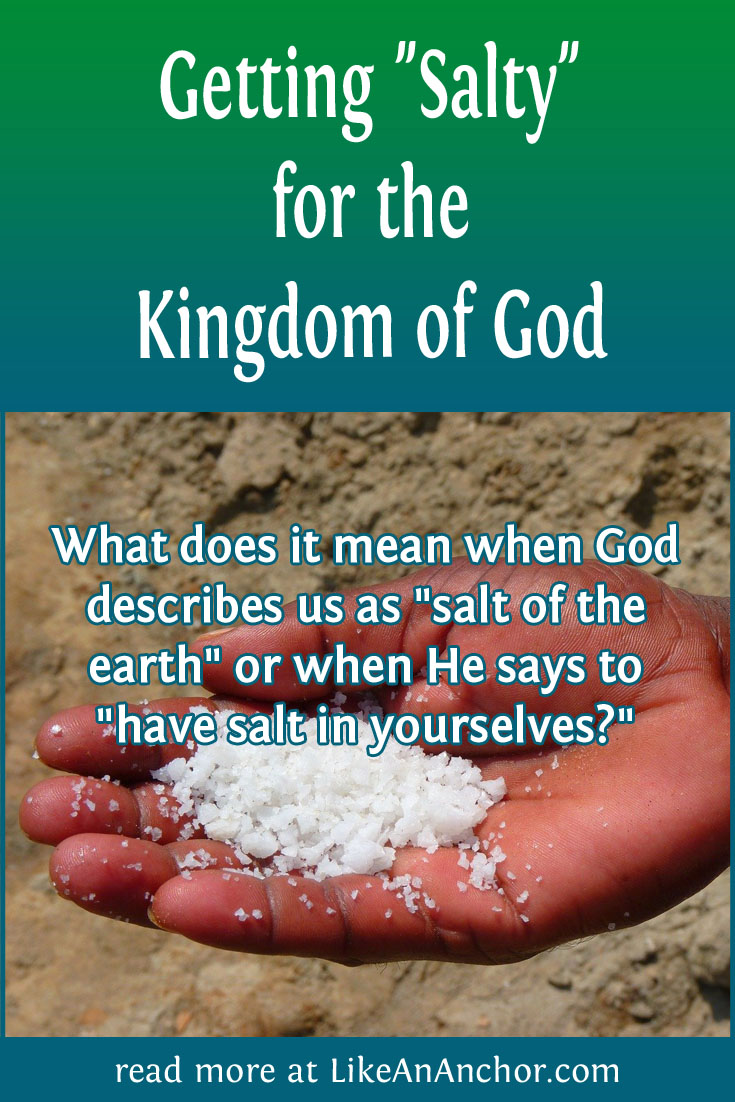
Getting “Salty” for the Kingdom of God

Have you ever thought about the phrase “covenant of salt” or “salt of the covenant”? If you’re like me, you might not have even realized these phrases are in the Bible–I never noticed them until I heard a teaching on it a few years ago. I’ve come back to study salt again now because the grace book I talked about in last week’s post drew my attention to this verse:

Let your speech always be with grace, seasoned with salt, that you may know how you ought to answer each one.

Colossians 4:6, WEB

In Relational Grace, Brent Schmidt says that “in Greek usage,” a conversation described as “seasoned with salt” meant one that’s “enlivened with wisdom” (p. 94). He also mentions “cleansing and preservation” are associated with salt. He does not bring up the covenants of salt mentioned in the Old Testament, but Schmidt does write extensively on the covenanting aspects of grace, and that made me wonder if there might be a “covenants of salt” connection as well. And, as a larger question, what does it mean when God describes us as “salt of the earth” or when He says to “have salt in yourselves?”

Covenants of Salt

In the Torah, God instructed Israel to use salt in some very specific ways. Salt was an essential ingredient for holy incense (Ex. 30:34-35). It was also a vital part of sacrifices.

Moreover, you must season every one of your grain offerings with salt; you must not allow the salt of the covenant of your God to be missing from your grain offering—on every one of your grain offerings you must present salt.

Leviticus 2:13, NET

The phrasing here is such a strong instruction–you must include salt. And it’s repeated three times just in this one sentence! Clearly, the presence of covenant salt mattered deeply to God. The connection between salt and offerings continues throughout the Old Testament (Ezra 6:9; 7:22; Ezekiel 43:24). In addition, God described the portion of the offerings that were given to priests as “a covenant of salt” in Numbers 18:19. The NET footnote on this verse explains

Salt was used in all the offerings; its importance as a preservative made it a natural symbol for the covenant which was established by sacrifice. Even general agreements were attested by sacrifice, and the phrase “covenant of salt” speaks of such agreements as binding and irrevocable. Note the expression in Ezra 4:14, “we have been salted with the salt of the palace.”

NET study note on Num. 18:19

This last line refers to a phrase in a letter where the writers claim “we are loyal to the king,” which is translated from an Aramaic phrase that literally means “we eat the salt of the palace” (Ezra 4:14, NET). Though covenants are not mentioned explicitly in this verse, it adds another layer to our discussion because of the close connection between loyalty and salt.

In 2 Chronicles 13:5, a king of Judah challenged Israel, saying, “Don’t you realize that the Lord God of Israel has given David and his dynasty lasting dominion over Israel by a formal covenant?” or, in other words, “a covenant of salt?” (NET footnote). The covenants of salt were binding, formal, and intended to be long-lasting. They were something that God–and the people who care about Him–took very seriously.

You Are Salt

With that background, Jesus’s words “you are the salt of the earth” (Matt. 5:13) could possibly be read as “you are a sign of the covenants sprinkled throughout the earth,” or perhaps, “you are connected to the covenant and my sacrifice.” Of course, there is also the fact that “Salt was used as seasoning or fertilizer … or as a preservative” (NET footnote), and this may also be connected to Jesus’s words. Still, I think it’s safe to assume Jesus’s listeners–all of them Jews–would have been familiar with the strong covenant connection that salt had and would have assumed that was at least part of His meaning.

Adding further depth to the idea that we, as followers of Jesus, “are the salt of the earth” is the association of salt with incense. During one of the scenes in heaven that’s recounted in Revelation, “the twenty-four elders fell down before the Lamb, each one having a harp, and golden bowls full of incense, which are the prayers of the saints (Rev. 5:8). Like incense, our prayers are “seasoned with salt, pure and holy” (Ex. 30:35, WEB).

Everyone will be salted with fire [many manuscripts add “and every sacrifice will be salted with salt”]. Salt is good, but if it loses its saltiness, how can you make it salty again? Have salt in yourselves, and be at peace with each other.

Mark 9:49-50, NET (bracketed line from footnote)

If salt implies a covenant, then the instruction “have salt in yourselves and be at peace” is a covenant imperative. It doesn’t mean we ought to eat more salty foods, but rather that we’re meant to live in loyal covenant with God. It involves following “the God of peace,” who raised “our Lord Jesus” from the dead and equips us to do His will “by the blood of the eternal covenant” (Heb. 13:20-21, NET).

Speak Salty Words

Let’s go back now to the verse in Colossians that started this whole post, and read a little bit more of the context.

Conduct yourselves with wisdom toward outsiders, making the most of the opportunities. Let your speech always be gracious, seasoned with salt, so that you may know how you should answer everyone.

Colossians 4:5-6, NET

This part of Paul’s letter is talking about how we “conduct ourselves” or “walk”–“a common NT idiom for one’s lifestyle, behavior, or manner of conduct” (NET footnote). We’re to exercise wisdom when interacting with those outside the faith, use our time well, and be gracious and “seasoned with salt” in the way we speak.

In today’s world, being “salty” implies irritation or hostility. This verse is telling us to do the opposite in our dealings with others. We’re to interact with people in a grace-filled way that is seasoned with wisdom and influenced by an awareness of our covenant with God. As the salt of the earth, we’re meant to remember our covenant loyalty to God and show our faithfulness to Him as we interact with other people.

Featured image by andreas160578 from Pixabay

Learning More About Covenant Grace

There’s a fascinating relationship between God’s grace and the covenants He makes with people. Until the 5th century (when theologians brought Neo-Platonic philosophy into their interpretation of scriptures), Greek and Roman literature and early Judeo-Christian writings saw charis (grace) as something both relational and reciprocal (Schmidt, p. 201-202). The idea of “grace” as a free gift that God is obligated to give without having any expectations of the recipients was not originally part of the Greek language or of Christianity. Rather, there was a fuller, richer meaning to charis that Jesus, Paul, and other Bible writers used.

I’ve been reading a book on this topic by Brent J. Schmidt, who holds a PhD in classics, called Relational Grace: The Reciprocal and Binding Covenant of Charis (2015). His scholarship on the original meaning of charis is fascinating, but even without that background we can still see that grace comes with expectations. For example, Jesus said the one who “endures to the end will be saved” (Matt. 10:22, WEB) and that “unless your righteousness exceeds that of the scribes and Pharisees, there is no way you will enter the kingdom of heaven” (Matt. 5:20, WEB). We’re saved by God’s grace, and then He expects us to act in a certain way (with His power supporting us, of course).

The Bible talks about Christian conversion as a process and tells us that relationships with God require continued faithfulness. Yet the popular definition of grace in many modern churches still says grace is unmerited favor that God gives without expectation of anything in return. Trying to make these two ideas fit together is confusing, and it’s a problem first-century Christians didn’t have to deal with because they had a different definition for grace.

Ancient Understandings of Charis

Several centuries before Christ’s first coming and until at least the 4th century after, charis was understood as something that involved obligation and reciprocity (Schmidt, ch. 2 and 3). This meaning infused Greek, Roman, Jewish, and later Christian society to the point that everyone knew “receiving charis implied entering into reciprocal covenantal relationships” (p. 63).

Jews knew about covenantal relationships from the Bible. Every commandment was a covenant with God. Several stories, including Joseph, Moses, and David, associate the concepts of grace and mercy with covenants. Greek-speaking Jews lived in a culture that depended heavily on reciprocal relationships and understood what charis meant. When Paul taught them using the words charis, they would have understood that by accepting God’s grace they were making covenantal obligations.

Brent Schmidt, Relational Grace, p. 64

When Jesus Christ came to earth, one of the things that He did was establish a New Covenant on better promises and with a different sort of sacrifice. The Old Covenant was “completely unable … to perfect those who come to worship” (Heb 10:1, NET). In contrast, Jesus took away sin completely, giving us an incredible gift for us that we could never deserve nor repay. When we accept this “charis,” we enter a covenant with Him and His Father.

For by one offering he has perfected for all time those who are made holy. And the Holy Spirit also witnesses to us, for after saying, “This is the covenant that I will establish with them after those days, says the Lord. I will put my laws on their hearts and I will inscribe them on their minds,” then he says, “Their sins and their lawless deeds I will remember no longer.” Now where there is forgiveness of these, there is no longer any offering for sin.

Hebrews 10:14-16, NET (OT quotes bolded in this translation)

Grace is so closely connected with covenants that treating “the blood of the covenant ” as “an unholy thing” means someone has “insulted the Spirit of grace” (Heb. 10:29). Covenants and laws don’t vanish after Christ’s sacrifice–they move to a heart and spirit level. We can see this in Jesus’s Sermon on the Mount, where He talks about the deeper, spiritual, enduring applications of God’s law. Paul also talks about this shift from flesh-level to spirit-level in detail when he’s talking about law and covenants.

Grace in Paul’s Letter to the Romans

Shifting our definition of grace to align with the one Paul and his audience would have used gives us a better idea of how to properly interpret Paul’s letters. One of the best places to see that is in Romans 6. Here, Paul talks about how we are “not under law but under grace” (v. 14, NET). This verse and others like it are often read out of context, but if you read the surrounding text the reciprocal and obligatory aspects of charis are easy to see. This is a very long quote, but I think it’s important to look at the whole thing to get enough context to understand Paul’s words.

Therefore do not let sin reign in your mortal body so that you obey its desires, and do not present your members to sin as instruments to be used for unrighteousness, but present yourselves to God as those who are alive from the dead and your members to God as instruments to be used for righteousness. For sin will have no mastery over you, because you are not under law but under grace.

What then? Shall we sin because we are not under law but under grace? Absolutely not! Do you not know that if you present yourselves as obedient slaves, you are slaves of the one you obey, either of sin resulting in death, or obedience resulting in righteousness? But thanks be to God that though you were slaves to sin, you obeyed from the heart that pattern of teaching you were entrusted to, and having been freed from sin, you became enslaved to righteousness. (I am speaking in human terms because of the weakness of your flesh.) For just as you once presented your members as slaves to impurity and lawlessness leading to more lawlessness, so now present your members as slaves to righteousness leading to sanctification. For when you were slaves of sin, you were free with regard to righteousness.

So what benefit did you then reap from those things that you are now ashamed of? For the end of those things is death. But now, freed from sin and enslaved to God, you have your benefit leading to sanctification, and the end is eternal life. For the payoff of sin is death, but the gift of God is eternal life in Christ Jesus our Lord.

Romans 6:12-23, NET

Many translations use the word “servant” instead of “slave,” but doulos is best translated either as “bondservant” or “slave.” Being bound to serve the Lord in this way was seen as an “honor and a privilege” in the Jewish mindset (NET footnote on Rom. 1:1). It’s a very different sort of thing than slavery in the modern sense. In fact, at the time Paul was writing, the “asymmetrical social relationships between patron and client and between master and salve were founded on the reciprocal notion of charis” (Schmidt, p. 95). When Paul talks of slavery, he’s talking about us being obligated to God for His gifts and bound in a covenant with Him that has expectations.

Living by God’s Spirit

When Jesus healed a man in Bethesda who’d been sick for 38 years, He told the man, “Behold you are made well. Sin no more, so that nothing worse happens to you” (John 5:1-14, WEB). It’s similar to what He told the woman caught in adultery (a story that’s not in the earliest manuscripts but is traditionally included with John’s gospel): “Neither do I condemn you. Go your way. From now on, sin no more” (John 8:11, WEB). In one case, Jesus provided physical healing and in the other He freed her from being condemned to death. After giving these gifts, He told both people that they should respond by doing something specific: stop living a life of sin.

There is therefore now no condemnation for those who are in Christ Jesus. For the law of the life-giving Spirit in Christ Jesus has set you free from the law of sin and death. For God achieved what the law could not do because it was weakened through the flesh. By sending his own Son in the likeness of sinful flesh and concerning sin, he condemned sin in the flesh, so that the righteous requirement of the law may be fulfilled in us, who do not walk according to the flesh but according to the Spirit.

Romans 8:1-4, NET

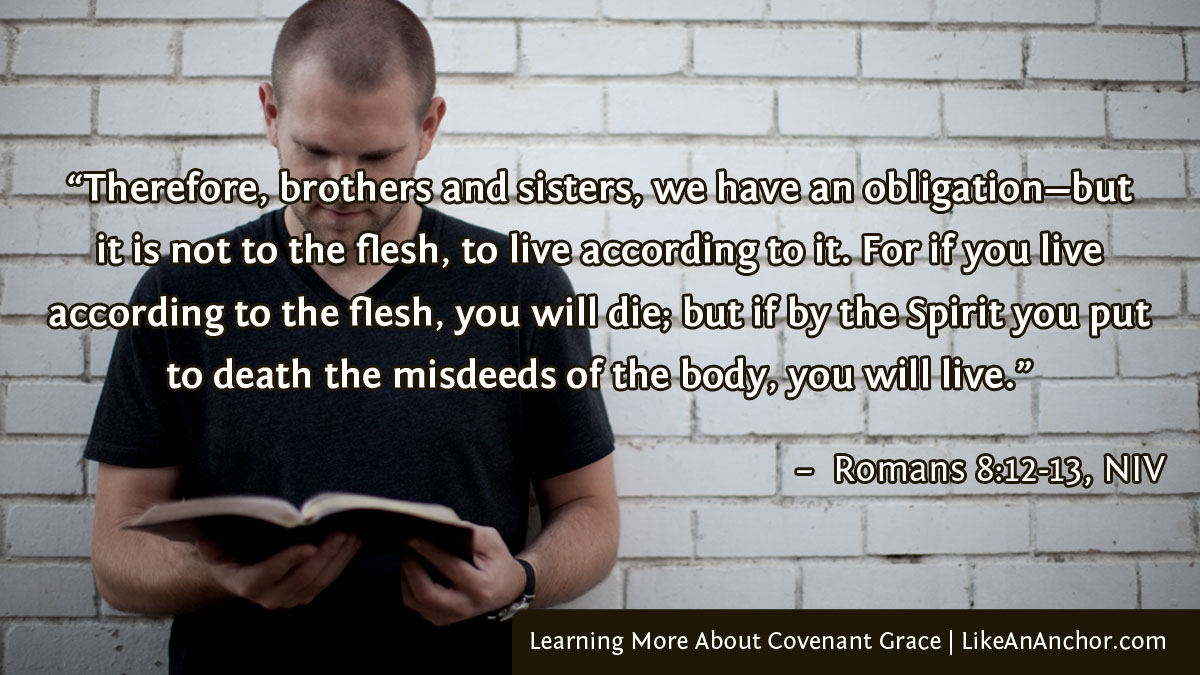
The Father and Son have given us incredible gifts. They’ve saved us from sin, adopted us into their family “with full rights of inheritance” (NET footnote on 8:15), and offer continued forgiveness so long as we do our best to follow Them and repent when we miss the mark. In response, “we are under obligation” to live a life lead by God’s spirit (Rom 8:12-14, NET). Being in a reciprocal covenant of grace is not about earning salvation or trying to pay back an impossible debt. It’s about having the right response of thankfulness to the incredible things God has done for us by welcoming us into His family. The more we can learn about that, the deeper relationship we can have with Him.

Featured image by José Roberto Roquel via Lightstock