Watching Cinderella

Having watched Frozen last Tuesday (I shoveled the driveway so I could get to the theater) I’ve been in a Disney watching mood. Since my sister and I had been discussing Lucifer the cat’s role in Cinderella recently, I decided to start with that film.

Is this really the story of poor, misunderstood cat?

"Watching Cinderella" by marissabaker.wordpress.com. Is this really the story of a poor, misunderstod cat?The mice describe Lucify as “meany, sneaky, jump at you.” But if Lucifer the cat could talk, what would his version of this film look like? Cinderella wakes him up early every morning, orders him to “come,” and then shuts the door on his rump. Next, she takes Lucify down to a kitchen inhabited by a dog – a dog that mocks him and dreams of chasing and eating him. If he tries to defend himself by getting that horrible dog thrown out of the house, Cinderella berates him.

But Cinderella isn’t the only person in this house who torments the cat. Cinderella says, “It’s certainly not my idea to feed you first,” which shows that it’s his owner’s idea to wake him up early. She also decrees that “Lucifer gets his bath,” a bath clearly meant to punish Cinderella at the cat’s expense. And then the stepmother leads a music lesson for her off-tune daughters in the room Lucify has chosen for his nap. It would make anyone grumpy.
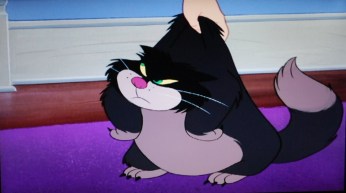
"Watching Cinderella" by marissabaker.wordpress.com. Is this really the story of a poor, misunderstod cat?On top of this, he is surrounded by a mouse infestation encouraged by the woman who drags him out of bed every morning. These mice must be gotten rid of – they are on the tables, in the serving trays, stealing trim from the sewing room, and have the entire house honeycombed with tunnels and secret doors — but when he catches one Cinderella takes his prize away and shakes him. These aren’t just any mice either – they attack him unprovoked in the middle of breakfast! They pluck out his whiskers, pull his tail, topple a broom on his head, trick him and snap a button in his face, pull on his eyelids, then one turns into a horse and attacks him. Finally the mice come after him with forks and fire, the birds gang up on him to drop pots and pans on his head, and they set the dog on him and he falls out of the tower (in the original uncut version, it is clear that this fall was fatal).

Not A Grimm Tale

Contrary to what you might read when people are contrasting Disney fairy tales with the “original Grimm version,” Disney’s Cinderella is not based on the version told by the Brothers Grimm, but rather on Charles Perrault’s “Cinderella, or The Little Glass Slipper” (as stated in the opening credits). This is the story where Cinderella sleeps in “the garret at the top of the house,” the one with a fairy godmother and magic pumpkin, and where the stepsisters’ feet don’t fit the glass slipper. It does depart from Perrault’s tale in a few aspects. For one thing, Cinderella’s father is absent from the story, but not necessarily dead, nor is Cinderella included in the invitation to the ball. She does not even ask to go, and says “That would not befit me at all” when her stepsisters teasingly ask if she would like to go to the ball. The ball lasts two days, and she leaves her slipper the second night. Her sister’s beg her forgiveness at the end, and she arranges marriages for them with “two great noblemen of the court.”

Grimm’s “Cinderella” is like Perrault’s concerning the main story (a girl is mistreated by her step-family, goes to a ball magically, leaves her shoe, and marries a prince), but there are significant differences. In this story, there is no fairy godmother – Cinderella’s father brings her a twig which she plants on her mother’s grave and it grows into a magical tree with a bird that lives in its branches and throws her “whatever she had requested.” That is where she gets the clothes for all three days of the ball. She does not loose her slipper because she is fleeing before the magic disappears – the prince coated the castle steps with pitch so she couldn’t run away so fast. The slipper that he gets as a result of this trick is made of gold. Both step sisters cut off parts of their feet to fit in the shoe, and the prince only notices the blood oozing out when they are halfway back to the castle. The Prince asks Cinderella’s father is he has any other daughters (he’s clearly alive in this version), and the man says, “No. There’s only little Cinderella, my dead wife’s daughter, who’s deformed, but she can’t possibly be the bride.” The prince demands to see her and marries her when the shoe fits. At the wedding, the stepsisters eyes get pecked out by birds.

Would the prince have married Cinderella if he didn’t have to chase her?

This isn’t so much a question inspired by re-watching Cinderella as it is something I’ve been wondering for a while now. Why does the prince pick Cinderella? Yes, I know it’s a fairy tale and he has to marry her for the happy ending, but it becomes an important question if you want to tell a story that fleshes out the prince’s character (my retelling makes them childhood friends to get around this problem). There’s even an entire song devoted to this question in the Rodgers and Hammerstein version: “Do I Love You Because You’re Beautiful?

In this Disney film, the prince appears for the first time 48 minutes into the story. We don’t hear their meeting – we just see him bow and kiss her hand (it evidently wasn’t much of an introduction. She doesn’t realize he’s the prince, and he doesn’t know her name). He doesn’t even have a line until singing “So This Is Love.” Between the palace, and the waltzing, and the walk in the garden it’s a pretty impressive first date. It doesn’t seem like quite enough to lead to matrimony, yet the Grand Duke says, “He won’t rest until he finds her. He’s determined to marry her.” Not that the Prince actually does any searching himself – the Grand Duke is the one who travels around trying on slippers.

In the written version they spend a little more time together and there’s a reason for the secrecy about her name. Perrault’s version has a two-day ball, and Cinderella talks with her stepsisters in her princess guise. She has to keep her name a secret so they won’t know her. In Grimm’s version, the ball lasts three days and she hides her identity because the prince is actually following her far enough each night to question her father about the elusive princess.

While they do spend a little more time together in the written stories, it still doesn’t seem like enough to base a marriage on. The prince can choose any woman in the kingdom to marry, but the one he goes after is the mysterious princess who presents an intriguing challenge. Would she have held his attention if it had been easy to win her hand? I doubt it.

A Completely Subjective Book List

Sometimes I like reading posts titled things like “Books Every Family Should Have In Their Library,” “Best YA Books of All Time,” and “Top 100 Fantasy Books Ever.” While I’ll occasionally get an idea for a new book to read, I usually end up checking to see if they’ve “rightly” included any books I like or “wrongly” included books I hate. One thing that always amuses me, at least slightly, is how all these lists propose to be good for every family or include all the best books even though it’s clear all such lists are completely subjective.

For this list, I’m not even going to try to be objective or include all the best books. This is an unabashed list of my favorite books, which I irrationally think everyone should read and enjoy just as much as I do. They aren’t even organized alphabetically — just whichever popped into my head first.

My “Must Read” Books

Mara: Daughter of the Nile

My mother gave me Mara, by Eloise Jarvis McGraw, when studying ancient Egypt in elementary school and I’ve read it pretty much every year since. It has everything a book needs — strong characters, good writing, and intriguing plot. On top of the admirable writing is danger, mystery, and romance. Spies! Double agents! Political intrigue! It also features the most romantic (possibly the only romantic) attempted murder in literary history. If I’m forced to choose just one favorite book, this is the one I pick.

Ender’s Game

Moving from one of my oldest favorites to one of the newest. I first read Ender’s Game by Orson Scott Card at the end of last year. It’s brilliant. I’ve written about it before, so I won’t spend much more time telling you how wonderful this book is, especially the characters. I cried buckets of tears in the last chapter.

The Blue Sword

Written by Robin McKinley, this may very well be my favorite fantasy book. Like Mara, The Blue Sword features a strong female protagonist and an irresistible hero (let me just say Corlath is the only person who I wouldn’t mind being abducted by [this statement will make sense if you read the book]). McKinley’s world building, characters, and story are excellent. My only quibble with this story is that, like many of her books, it doesn’t really end. It’s as if the author wasn’t sure how to end the story, so she slapped an epilog on and called it the last chapter. Perhaps I should just say that is part of the book’s irresistible charm.

Pride and Prejudice

I know it’s a terribly predictable title to include — couldn’t I have at least chosen one of Jane Austen’s lesser-known works? But I’ve read all six of Austen’s major novels at least once (some two or three times), and Pride and Prejudice remains my favorite. Maybe it’s the fact that people type Lizzie Bennet as an INFJ (which I’m not entirely convinced of, but it would explain why I identify with her so much). Perhaps it’s because Mr. Darcy is my favorite of Austen’s men. Whatever it is, Pride and Prejudice is firmly on my recommended reading list.

Fairy Tales

Not a single book, but it would take to long to list them all separately. I recommend Jack Zipes’ translation of The Complete Fairy Tales of the Brothers Grimm, augmented liberally with Hans Christian Anderson and Charles Perrault. The reasons for this have been explored at length in my posts Fairy Tales and Dark Fairy Tales, so I’ll not devote any more time here on describing their merits.

A Gown Of Spanish Lace

Roses for Mama

I read Christian fiction on an irregular basis, usually because I want a easy-to-read book that doesn’t require much thought to digest and might supply some spiritual encouragement (yes, I know that sounds terrible). In spite of my generally low expectations, two books by Janette Oke have made it to my favorites list. A Gown of Spanish Lace has outlaws.  Roses for Mama is simply charming.

Dinotopia

If I was offered the chance to move to any fictional place I wanted, I’d pack up right this minute and relocate to James Gurney’s Dinotopia. Who wouldn’t want to live in world filled with dinosaurs and without any worries about money? Specifically, I want to visit Waterfall City and the coastal towns along Warmwater Bay where you can swim with cryptoclidus. Once you’ve read Gurney’s first book Dinotopia: A Land Apart From Time, I advise moving on to Dinotopia Lost by Alan Dean Foster. I’ve read that one at least four times.

Dark Fairy Tales

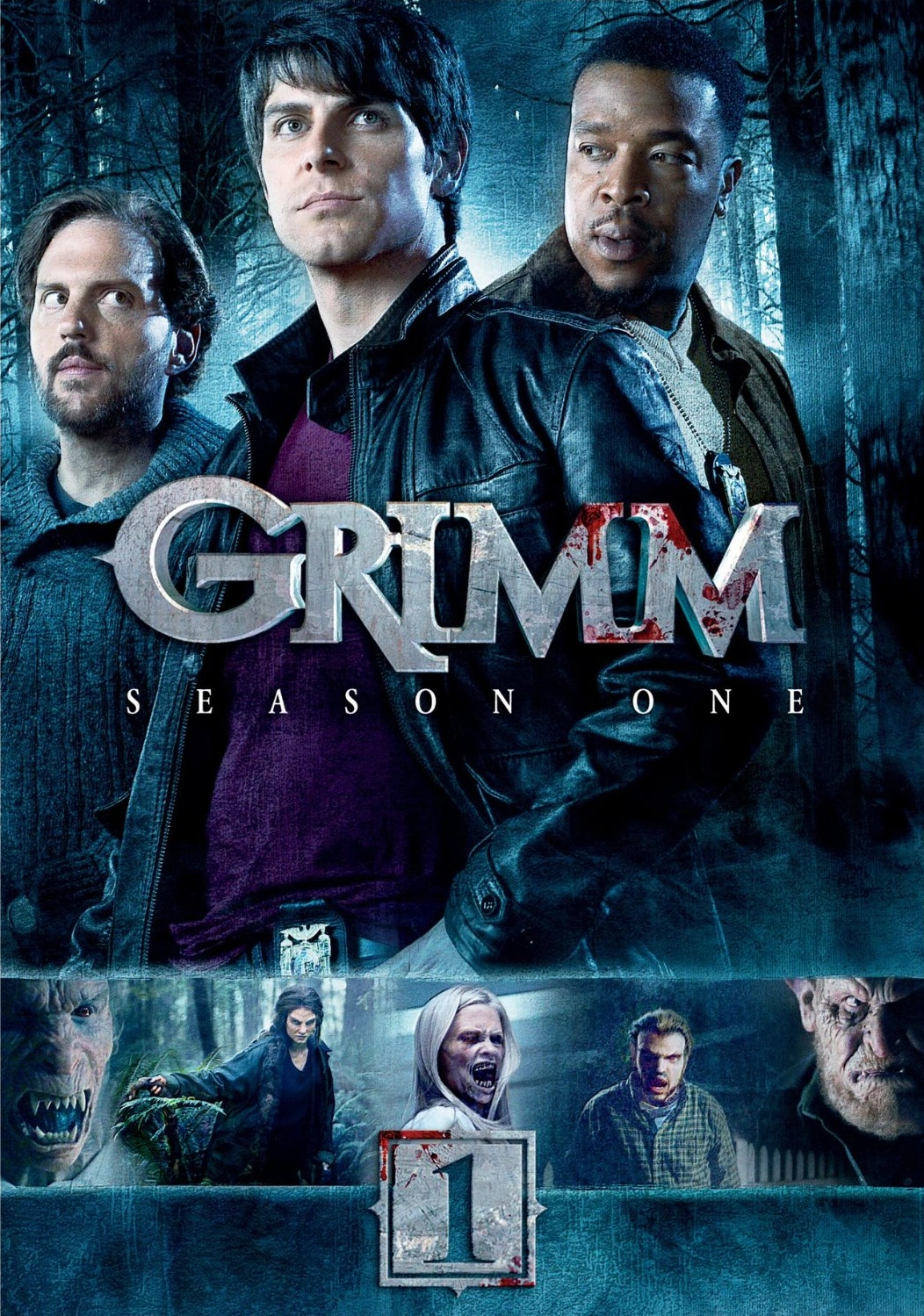
I recently started watching the TV show Grimm. I’m still about a season-and-a-half behind, but catching up pretty quickly (no spoilers if you’ve watched more than me!).  For those who aren’t familiar with the show, it’s about a homicide detective named Nick who recently inherited his family’s gift for seeing strange creatures known as Wesen. Together with his detective partner, his girlfriend, and a reformed Blutbot (aka “the big bad wolf”), Nick discovers that a surprisingly high number of Wesen happen to commit crimes in Portland, Oregon (seriously, are there no human criminals?)
The thing that makes Grimm different from other crime dramas, and what initially attracted me to the show, is the folkloric element. The stories are loosely based on fairy tales and myths from a variety of cultures, most notably those collected by Jacob and Wilhelm Grimm. Each episode uses elements of an original legend, but changes the plot. Another “change” that has been made is that Grimm is much darker than the popular idea of fairy tales as Disney princess stories.

I say “change” in quotation marks because the fairy tales most of us grew up with are MUCH tamer than the original versions (or, more accurately, the earliest versions we have written down). Yet many people assume fairy tales started out innocent and have been corrupted by our modern culture. Take this quote from Plugged In Online’s review of Snow White and the Huntsman, for instance.

I’ve always liked fairy tales, whether in cartoony-flick or storybook-for-the-kids form. But it appears that those “once upon a time” sweet and innocent versions don’t often make the grade nowadays. Today’s reimaginings usually have to come with a bit more bite.

The trend with today’s versions of fairy tales, including Grimm, isn’t so much making the stories darker as it is returning to fairy tales’ darker roots. Even the fairy tales we consider “sweet and innocent” used to have a darker side. Cinderella’s step sisters cut off their toes and heels to fit into the glass slipper. The Little Mermaid’s prince marries someone else and she considers murdering him, but dies instead. And I’m not even going to talk about Sleeping Beauty and Rapunzel.

Why read/watch "Dark Fairy Tales" marissabaker.wordpress.com
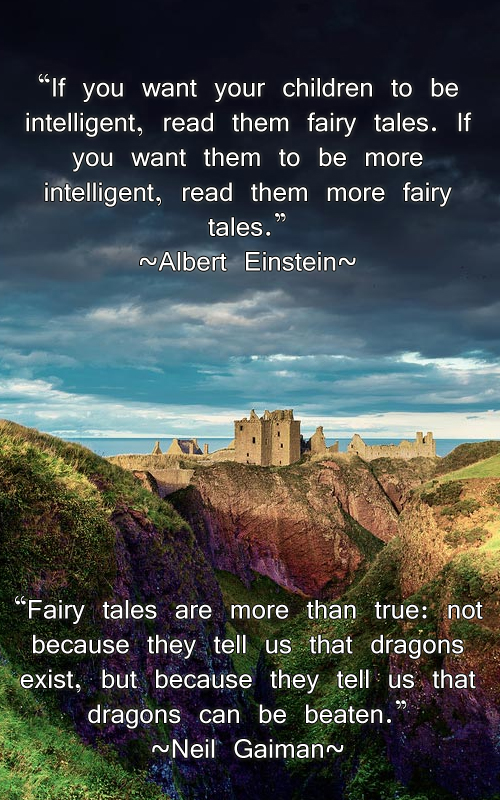
background image of Dunnottar Castle

Don’t misunderstand me — I love Disney films. And they can get pretty dark, at least so far as the villain is concerned. But I love the older versions as well. I wouldn’t read all of them to a young child, but it is possible to shelter children too much (see my previous post where I talk about banning fairy tales). And there is certainly no reason not to read fairy tales as an adult. In the words of C.S. Lewis,

When I was ten, I read fairy tales in secret and would have been ashamed if I had been found doing so. Now that I am fifty, I read them openly. When I became a man I put away childish things, including the fear of childishness and the desire to be very grown up.

Lewis also said, to those who think fairy tales belong in the nursery,  “Some day you will be old enough to start reading fairy tales again.” My own fairy tale reading did not begin in earnest until I had graduated high school, so I suppose by this definition the more fairy tales I read, the more grown-up I get.

Fairy Tales

I love fairy tales. When I was little, my exposure to fairy tales was mostly through Disney films (my favorite is Beauty and the Beast, just in case anyone is wondering). I started seriously reading fairy tales just a few years ago, when my favorite English professor loaned me a collection of Celtic Fairy Tales. Since then, I’ve read all the Brothers Grimm tales, many of Andersen’s fairy tales, more Celtic folklore, and collections of French fairy tales including Perrault’s writings.

I’ve been reading some of C.S. Lewis’s essays collected in the book “Of Other Worlds.” I’ve enjoyed reading his fiction (Narnia and the Space Trilogy), as well as Mere Christianity, so it was nice to get insight into his mind and writing process. For the blogt I wrote to post on my writing website tomorrow (yes, I write under a pen name), I turned to one of these essays for inspiration. I liked writing it so much, that I decided to post it here as well.

C.S. Lewis on Children’s Writings

By tracking down a quote on Pinterest, I came across C.S. Lewis’s essay “On Three Ways of Writing For Children” (full text online here). Though I don’t write specifically for children, I like to think that my fantasy novels would appeal to (and be appropriate for) some young people. After all, I can’t be the only child who was reading Jules Verne by age 10 and searching for other stories of the fantastic.

The essay becomes most interesting to me when Lewis addresses the question of what kinds of stories are worth reading as children. Since he wrote children’s fantasy — not because he set out to write for children, but “because a children’s story is [sometimes] the best art-form for something you have to say” — he spends much of the essay defending fairy tales.

If I have allowed the fantastic type of children’s story to run away with this discussion, that is because it is the kind I know and love best, not because I wish to condemn any other. But the patrons of the other kinds very frequently want to condemn it. About once every hundred years some wiseacre gets up and tries to banish the fairy tale. Perhaps I had better say a few words in its defence, as reading for children.

Just as when Lewis was writing (in 1952), modern parents have been banning classic fairy tales. Hansel and Gretle and Little Red Riding Hood are not read because they are “too scary,” but there are other reasons as well. More than 50% of parents wouldn’t “read their kids Cinderella because the heroine spends her days doing housework. Many felt that this theme of female domesticity didn’t send a good message.” The politically incorrect word “dwarves” disqualifies Snow White from polite society. Rapunzel’s kidnapping and imprisonment is “too dark” a theme (actually, it is darker than they think– in the Grimms version she’s not actually kidnapped. Her father gives her to a witch to save his own life).

Whether or not to read fairy tales (and which ones to read) to children is a choice that will vary from parent to parent and also depends on the child. There are plenty of fairy tales I wouldn’t read to a very young or sensitive child (like The Little Mermaid, where she is in agony the entire time she has legs and dies at the end). But on the whole, I tend to agree with Lewis when he said,

Since it is so likely that they will meet cruel enemies, let them at least have heard of brave knights and heroic courage. Otherwise you are making their destiny not brighter but darker. Nor do most of us find that violence and bloodshed, in a story, produce any haunting dread in the minds of children. As far as that goes, I side impenitently with the human race against the modern reformer. Let there be wicked kings and beheadings, battles and dungeons, giants and dragons, and let villains be soundly killed at the end the book. Nothing will persuade me that this causes an ordinary child any kind or degree of fear beyond what it wants, and needs, to feel. …

It would be nice if no little boy in bed, hearing, or thinking he hears, a sound, were ever at all frightened. But if he is going to be frightened, I think it better that he should think of giants and dragons than merely of burglars. And I think St George, or any bright champion in armour, is a better comfort than the idea of the police.

As a child who was deeply afraid of things that go bump in the night, I can wholeheartedly support Lewis’s claim that a “bright champion in armour” is a far better comforter than the police. And if my mind had not been filled with fairy tales, fantasy, and knights in shining armor I would never have dreamed up Jamen and Karielle or Bryant and Aelis (who now live in my in-progress and finished novels) or invented Ves’endlara.

Which fairy tales would you read, or not read to children? As an adult, do you enjoy reading fairy tales?