INFJs like to look in. Sometimes this habit works against us. Our mind is a busy freeway of thoughts that steer our car off the happy highway. Certain circumstances are particularly disorienting. Our mind twists, turns, and reverses these situations so much that they no longer match up to reality. Here are a few you might recognize:
It is no secret that introverts would rather eat a brick sideways than engage in small talk. But I’ve only been offered that choice twice in my life, so the chit chat is unavoidable even to the ghostyist INFJ.
It’s even worse when we think our conversation partner is more successful, better looking, or more interesting than we are. When this happens, the chatter milk can sour in an instant.
It starts with rotten self-talk like, “why am I such a loser compared to him?” Or, “why can’t I just relax and talk like she can?” Or even, “why do I suck at life?” Then the pulverized mind of the INFJ has to throw a few words together to continue the conversation. Not good.
One time, I ran into somebody I hadn’t seen for well over a year. He started with, “I haven’t seen you for a while, so I just wanted to say hi.”
I volleyed, “Yeah, so how have you been?” Not a bad start, but the meter on my coherence tank plummeted as the palaver continued.
When he tried to end things with, “Ok so, I just wanted to say hi,” I again replied, “Yeah, so how have you been?”
Realizing I had repeated myself, I answered my own question. “Good, good, yes right?” It was ridiculous, so I excused myself and retreated to the restroom.
It Will Be All Better When…
For the INFJ, successes that should be celebrated and lead to happiness and further growth can actually lead to frustration, sadness, and even depression. This has a lot to do with “I’ll start my diet on Monday” self-promising. We tell ourselves,
“Once I get through this social-event-stuffed weekend, everything will be perfect.”
“As soon as school ends, I’ll get back to writing my book.”
“I’ll be so happy after I lose these ten pounds.”
This kind of thinking ensures that we’re never where we are. We’re not here, we’re in our head. We’re so busy thinking about what would make us happy that we miss out on the present moment. Since no amount of achievement will evict us from our brain, we’re better off focusing on how to make our head a happier place.
There’s Only One Side: Mine
We INFJs will brood, contemplate, deliberate and ruminate the DNA right out of an idea. Other folks might have an opinion, a passing notion, or even a half-baked solution. But if they don’t agree with us, they’re wrong.
Or so we think.
We’re awesome at dissecting an issue, but have a hard time accepting opposing points of view. It’s hard for us to trust that others have as much going on between the ears as we do (they probably don’t, but that’s beside the point).
And heaven forbid that people want to speak about a problem without also brainstorming for a solution. I mean, what’s the point in highlighting a fault if we don’t want to fix it, right?
Your Turn…
I’d like to hear from the rest of you INFJs, and from those who love them. What other ways do INFJs overthink or misunderstand social situations? Please share below.
Author Bio: John Lindholm is a middle school math teacher and a writer for the Introvert Spring INFJ Forum (which you are welcome to join). He enjoys writing fiction as well as articles and other pieces about introversion. Check him out at InwardFacingWriters.com.
Last week, I stumbled across an article on Pinterest talking about female INFJs. Well, technically it was about INFj in the Socionics system, which is a bit different than the MBTI type and may include INFPs as well, but for purposes of this article we’ll just talk about INFJ types. The original article, written in 2011 by someone identified only as Beskova, paints a portrait of the INFJ type that is beautiful on the surface but doesn’t quite manage to reach their heart. It’s part of a disturbing trend in portrayals of INFJs, though this is the most extreme example I’ve seen.
Like many people who treat the INFJ type as quasi-mythical, this writer describes INFJs as flawless, naive, pure and submissive. They even describe a typical INFJ appearance: “Women of this type are very feminine and are delicate, modest and even shy. … They have a very ephemeral body, and sometimes lightly stooped posture.”
Reading on, it seems the INFJ has no faults. They never gossip or argue, meet adversity with mild gentleness, focus on humanitarian efforts, fit into any job, and submit themselves selflessly to helping the people in their lives. In short, the article says, “When a female INFj becomes your wife, know that in your home there lives a quiet angel” who “makes for one of the most obedient wives.”
The biggest problem with this portrait of an INFJ isn’t just that it’s untrue; it’s the fact that INFJ women may try to fit into this mold if they end up in a relationship with someone who expects “their” INFJ to act like this. One thing that’s become clear in the months I’ve been reading things INFJs share online is that we’re one of the types most vulnerable to getting involved in unhealthy relationships with narcissists. And INFJ descriptions that make us out to be perfectly submissive and obedient aren’t helping discourage interest from unhealthy people.
Myth: INFJs won’t start a fight
It’s true that INFJs are one of the most conflict-avoidant types. Until a person does something the INFJ can’t live with, we’ll often just nod and smile at most conversations and suggestions. This happens with casual acquaintances when we don’t want to wast energy on conflict, and in closer relationships when we don’t want to deal with the emotional fall-out of conflict unless there’s a very good reason. I talk about this at greater length in my INFJ Handbook.
But if you think INFJs can’t get angry or won’t take a stand when things aren’t as they should be, think again. INFJs tend to draw a line in their minds, and once it’s crossed we’ll make sure we let you know. Once we get started, we’ll probably tack on a list of every other way you’ve ever let us down as well. The closer we are to you, the better we’ll know how to tear you apart (note: we’re not proud of this fact, and many INFJs work hard at controlling their anger). The best way to avoid this in a relationship is to keep open lines of communication, which is the number one thing many INFJs are looking for in a relationship. INFJs prefer to keep our emotions out in the open, and if we feel safe and heard then there’s no need to bottle up our feelings until we explode.
Myth: INFJs are always agreeable
In this socionics article, the writer talks about how INFJ women often need/want other people to make decisions for them. They write, “If you are her husband take responsibility for making major decisions in development of your family and she will with pleasure obey you.” Now, I’ll be honest — sometimes I do want people to make decisions for me. But if an INFJ is consistently told she can’t be trusted with important decisions and is left out of the planning process, then she’s going to stop trusting you.
The other party might not even notice an INFJ doesn’t agree with him if he’s expecting her to be what the article says: “friendly and dutiful, never quarrel nor ask much for themselves.” We place a high value on trust and communication in relationships, and assuming we agree with you instead of really asking us what we think is a good way to experience the INFJ door slam.
A tip for people who know INFJs: If we don’t actually agree with you, or simply don’t care, we’ll typically make non-committal sounds, nod our heads, and avoid eye contact. If pressured to commit to something we don’t want to do or think, but won’t openly disagree with, we’ll try to push it off to an unspecified future date. When an INFJ actually agrees with you, we’ll make eye contact, our face will light-up, and we’ll say things like “Oh, yes” instead of just nodding. Usually, we’ll also be able to explain why we agree with you in specific terms.
Myth: INFJs are completely altruistic
One last quote from the socionics article: “watch that her emotional resources aren’t spent on her girlfriends, who inadvertently will use your wife as a psychotherapist. She will never refuse them herself, of course. Out of compassion. Therefore, it will be best if you take the matter into your own hands and limit the flow of those desiring to obtain psychotherapeutic sessions and useful advice from her.” Excuse me! What gives someone else the right to limit an INFJ’s contact with her friends? That’s the sort of controlling behavior that’s a huge red-flag in any relationship.
In addition to being incapable of taking care of herself, INFJ wives are apparently so dutiful they’ll do all the housework without any complaint even though they hate cleaning and cooking. For the record, this INFJ loves cooking and the housework doesn’t always get done in a reasonable amount of time. Also, one reason INFJs will avoid conflict and try to help people is because of how it affects us. Sometimes I do what people ask just because I don’t want to stay awake for three hours that night re-hashing every word of the resulting argument. It’s a self-protecting mechanism. That’s not to say INFJs don’t care about people — we do, deeply, and we will support our friends and family whenever possible. It’s a good thing. We can stretch ourselves too thin at times, but INFJs value their introvert time and don’t usually need someone to step in an control their lives to keep them from burning out. We’re not that altruistic.
In conclusion …
I may have dispelled some of the “mystic unicorn” aura surrounding INFJs, but perhaps that’s a good thing. Our rarity doesn’t make us better than other types, and type portraits that make us out to be something ephemeral and idyllic really aren’t helpful. As my siblings (and no doubt other people who INFJs have let into their lives) can testify, we’re not perfect.
Two years ago this weekend, I published my first INFJ blog post on this site. It seems fitting, then, that I’m releasing my first e-book this weekend and that it is all about INFJs. Inside, you’ll find:
Quick introduction to Myers-Briggs type theory
Thorough description of the INFJ personality type
Discussions of INFJ strengths and weakness
Tips for personal growth
List of things that INFJs want other people to know
A very special thanks to Kerry, Rachel, Johanna, Denise, and Yeni — the INFJs who contributed the stories appearing in this book. You should have already received a free PDF copy of this book at the e-mail address I have on record for you. If not, let me know.
You can purchase this book in the Amazon Kindle store. For this first week only, the book is on-sale for $0.99. It will go back to the regular price of $2.99 next Monday morning.
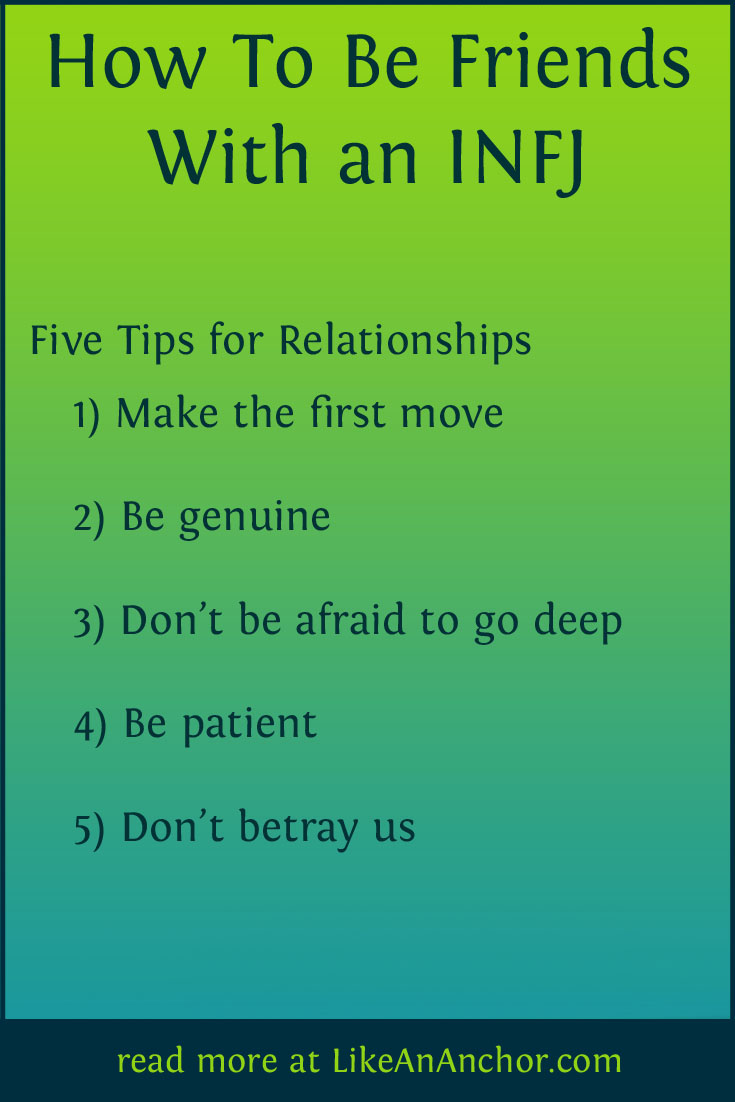
While trying to decide on my next topic, I saw that “how to be friends with an INFJ” was one of the top searches on my blog this past week. I’ve addressed the issue of friendship in some of my other posts about INFJs, but never written an entire post about it. It’s also something that has been on my mind recently, and it is a not infrequent topic of discussion between me and some close friends.
If you want to make friends with an INFJ, or get to know one better, there are a few key points to keep in mind. Some of these are true for all friendships, and especially friendships with INFJs, and others are more INF-specific. They are also a good first-step if you are romantically interested in an INFJ and want them to notice you.
INFJs use extroverted feeling (Fe) to relate to the outside world. This means that we can draw energy from emotional interactions, and may appear more extroverted than other introverts. This is also true of ISFJs, who are often considered the most “extroverted” introverts since they love people so much.
Still, we are introverts, and we’re most comfortable talking with people we already know. If you want to get to know an INFJ, you’ll probably have to be the one who initiates a conversation. That lets us know you are interested in talking with us, which puts us at ease since we aren’t worried about whether or not we’re imposing on your time when you’d rather be doing something else.
Pairing Introverted Intuition (Ni) with Fe gives INFJs an almost super-human empathy. Many INFJs literally feel other people’s emotions, and we’re quick to pick up on unspoken cues that don’t match spoken words. We might not be able to tell what you’re holding back or lying about, but we can tell you’re not being genuine and that’s a huge turn off.
If an INFJ suspects you of being less than genuine, they loose interest very quickly. If you’re a new acquaintance, they might simply avoid seeing you again. If you’re someone they can’t avoid, then they will keep conversations civil but superficial. We don’t trust our true selves with people when we can’t get a read on what their true selves are like.
3) Don’t Be Afraid to Go Deep
INFJs have little interest in shallow conversations. We would rather have a few close friends than many casual acquaintances. The way the word “friend” is used has always bothered me as being imprecise. I have acquaintances, friends, and then close friends, but I just refer to them all as “friends” to avoid offending anyone who thinks they are a friend and then finds out I think of them as an acquaintance. People who meet INFJs often think that they know them well, while the INFJ thinks “they really don’t know me at all.”
If you want to be one of an INFJs close friends, then you have to make an effort to get beyond the superficial. INFJs respond very well to this, so once you indicate that you are interested in going beyond small-talk the sharing will go both ways. We like conversation, and we will talk as well as listen if we feel safe and interested. Here’s a great article called How To Turn Small Talk Into Smart Conversation. When I read this as an INFJ, my reaction was, “I wish more people would introduce themselves like this. I would be so much more interested in talking to them.”
Even if you’ve taken the first step to initiate a friendship, been completely honest, and encouraged deep conversation it can take quite a while for an INFJ to really open up. We have many layers, and the longer we are in a stable friendship with you, the more layers we’ll let you see. INFJs form instant perceptions of whether or not we can trust people, so first-impressions are important, but we also modify our impression based on how we observe your behavior over time. A bad first impression can be reversed if we see you making an effort to be friendly and trust-worthy, and a good first impression can be deepened as we see that what we’ve already shared with you stays safe.
Patience also comes into play during conversations. INFJs have trouble getting all their thoughts out into words. If the topic of conversation is something they’ve already thought about, they can speak readily and coherently. If it’s new and unfamiliar we typically do one of two things: 1) nod and make some general comments while our brains frantically race to come up with something to say. Usually that “something” shows up a week later in the shower. 2) start putting our thoughts into words, and sorting through ideas verbally. The final idea might take some time to emerge.
The second reaction is the one you’re going for in a friendship with INFJs. If we’re comfortable enough to think out-loud, it means we trust you. As long as you give us time to come up with an answer rather than look at us like we’re crazy, then we’ll relax and the conversation can continue to move forward. If you cut us off or jump to conclusions about what we think before we’ve had time to express outselves, we feel like you aren’t really interested in what we’re thinking and be hesitant to share with you later.
5) Don’t Betray Us
INFJs hold grudges. We might forgive readily (depending on the circumstances), but we don’t forget. It’s not something I’m proud of, but it is my automatic response. The closer you get to an INFJ, the harder it is to bounce-back to a close friendship after you’ve hurt us. The more we like you and the more we have invested in you, the more chances we’ll give you, but there’s a point at which we just give up and shut you out.
An INFJ might not completely sever ties with someone who has hurt them (depending on the nature of that betrayal), but they will withdraw. For example, if you give an INFJ the impression that you want to carry on a regular correspondence filled with deep discussion and then ignore her for 3 months and forget to answer any of her questions when you do reply, she will have no interest in continuing the correspondence.
Why Bother?
So why go to all this effort? What do you get out of a relationship with an INFJ?
For one thing, INFJs are surprisingly good fun to be around. We have a great sense of humor, delight in occasional spontaneity, and can talk about pretty much anything you like. But you don’t see all that until you make the effort to become friends. Until then, INFJs will hover in the background (away from other people) or blend in like a chameleon (with other people) to avoid stressful, superficial interactions.
INFJs are also good listeners, and we love to offer counsel. Sometimes we feel like our friends’ therapist, but we rarely mind. We want to help, and we’re good at suspending judgement. Since we’re so empathic, we aren’t often surprised by anything you tell us even if you thought you were doing a good job of keeping it hidden. Once it’s out in the open, we are sympathetic listeners who ask questions and want to fully understand what’s going on before we offer suggestions or any kind of judgements.
We’re also fiercely loyal. We don’t let many people get close, and we want to hold on to the very few that do become our true friends. We’ll do just about anything to keep the people we love in our lives. INFJs take the time to build-up their relationships, cultivate deepening friendships, and keep in touch with what’s going on in the lives of people we care about. We’re supportive, encouraging, and willing to adapt ourselves to make others happy as long as it doesn’t conflict with our core values. So get out there and start making friendships with INFJs. I don’t think you’ll regret it!
There seems to be a movement in some of the Christian relationship blogs I read to debunk the “myth” of soul mates. The argument can be summed up in this quote from Boundless.org’s article Myths About Soul Mates: “Believing that ‘the one’ is out there, waiting to ‘complete you,’ inevitably leads to discontentment and maybe even divorce.” Another of their articles, Hoping for a Soul Mate, quotes Atlanta psychiatrist Frank Pittman as saying, “Nothing has produced more unhappiness than the concept of a soul mate.” If you’re not familiar with these arguments, I encourage you to glance at one or both links before reading on.
Just so we’re all starting out on the same page, here’s a composite definition of what the articles I referenced above seem to mean when they use the term “soul mate”:
A soul mate is your perfect match, who complements all your weaknesses and strengths and loves you unreservedly for who you are. There is only one soul mate for each person, and you’re on a search to find them so they can “complete you.”
These articles say this is an impossible ideal and it becomes dangerous when we start holding the person we’re in a relationship with to impossible and unrealistic expectations. And I do acknowledge this is a danger if we’re focused on the idea of finding one perfect mate (see this scene in Ever After for a humorous example of a few problems which can result).
Given these compelling arguments about the dangers of having an expectation like this in dating, you might be wondering why I’m writing a post about believing in soul mates. I have a slightly different take on the idea of soul mates, though.
My Idea of a Soul Mate
I imagine there are several people out there who have the potential to be our “soul mates.” For me, I think this would look like a relationship where I feel safe sharing my inner thoughts, feelings, and emotions. Someone who can understand, relate to, or at least appreciate the parts of my mind which I so rarely share, and with whom I can connect on a “kindred spirits” level. It almost goes without staying that this kind of connection must have a spiritual/religious component as well — I doubt I could be in this kind of relationship with someone who does not share my faith. I think there’s also a bit of truth in the idea of finding a mate who “completes” you, not in the way that most people might think of it but in the way that God meant when He created a husband and wife to be two parts of a whole.
As I mentioned, in this theory there are multiple people with whom the potential exists for forming a soul mate connection. You might meet several, but your goal should be that your relationships only reach a “soul mate level” with one of these people. I suspect that there’s a point in a good relationship where the other potential soul mates no longer matter because a “sole soul mate” relationship has been forged.
This is where the idea of commitment comes in. Once you choose to marry someone, you’re also choosing to cultivate a soul mate relationship only with them (the first article I linked to actually touches on this point). This is also why can be dangerous to form deep emotional intimacies with someone of the opposite sex who you don’t intend to marry (or whom you’re not sure yet if you will marry) — sharing your heart without the promise of commitment to a sole soul mate relationship seems like a good way to get your heart broken.
I’m sure not everyone will agree with this idea, and really I don’t expect them to. There’s so much variation in our individual personalities, tastes and ideas that it seems ridiculous to expect everyone to want and expect the same thing from a romantic relationship.
Jane Eyre (INFJ) and Edward Rochester (ENTP or ENTJ)
When David Keirsey wrote his personality theories based on Myers-Briggs, he suggested that each of his four personality groups would be looking for, and be, a different kind of romantic partner. He describes the Artisans (Myers’ SP types) as Playmates, who are “exciting and fun” and usually end up married to Guardians (SJ types), who are looking to fill a Helpmate role. Rationals (NT types) want a Mindmate with whom they can have intellectual discussions and explore “abstract rather than concrete” ideas. They often marry the Idealists (NF types, like my INFJ personality), who are searching for Soulmates.
What Idealists wish for in their spouse is a Soulmate, a spouse who knows their feelings without being told of them, and who spontaneously expresses words of endearment, words that acknowledge their mate’s unique identity. Idealists want the marital relationship to be, as they put it, “deep and meaningful,” Other types will settle for much less than this. … suffice it to say that Idealists are asking their spouses for something most of them do no understand and do not know how to give. (Please Understand Me II, p.146)
Well, that sounds depressingly unattainable. Honestly, when I was reading this book the first time the beginning of this paragraph had me nodding and thinking it sounded exactly just right, but that final sentence is really discouraging. Still, I don’t think I have such unrealistic expectations as Keirsey describes Idealists as having in other parts of his book (though it does sound idyllic). Maybe he’s right and 80-85% of the population will tell me I’m crazy to hope for a “soul mate.” But hopefully someday I’ll be able to say, like the bride in Song of Songs, “I found him whom my soul loves” (Song. 3:4, WEB).
Descriptions of the INFJ personality type often emphasize our peaceful natures and ignore any hint of a “dark side.” For example, one commenter on my INFJ Loki post argued my typing is inaccurate because he couldn’t imagin an INFJ “carrying on a constant fight with everyone around you for the majority of your existence.” He knows INFJs are generally peaceful and conflict-avoidant, and couldn’t buy an INFJ as this type of villain.
People also describe INFJs as disconnected from the world, and unlikely to feel involved in the reality of what’s going on around us. All too often, people incorrectly assume this means we don’t care about what other people do or things that happen. This isn’t true. As Amelia Brown points out in her post The Dark Side Of The INFJ Personality Type, INFJs can be stubborn, judge others harshly, and abruptly cut people out of their lives. We do notice, and care, what’s going on enough to have a pretty decisive reaction in some cases.
Though INFJs are generally peaceful, gentle, and dislike engaging in confrontations, we’re not completely harmless (just ask my siblings). Every personality type has a dark side, and INFJs can be just as scary as anyone else.
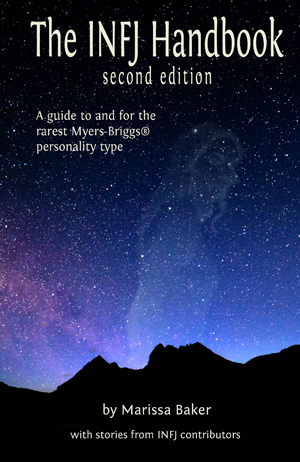 If you’d like to know more about the INFJ personality type, check out my book The INFJ Handbook. I just updated it with a ton of new information and resources. You can purchase it in ebook or paperback by clicking this link.






 Like An Anchor