Goals, Growth, and a Happy Birthday to Me

Today is my 25th birthday. Other than posting this, my birthday plans involve spending time with family and eating cheesecake. My original idea for this post was to write one of those “Letter To Me” things addressed to my 15 year old self (since 10 years is a nice round number). Part of that’s still here, but it’s not the focus. Why? because while a post all about me could be mildly entertaining, I doubt anyone will find it helpful. Instead, I want to encourage you to join me in thinking about how you’ve changed in the past ten years, and what you want the next 10 years to look like.

If you’re like me, looking at a more narrow time frame of your life to inspect how you’ve changed can be disheartening. I don’t usually feel like I’ve made much progress in a week or a month or sometimes even a year on things like personal growth, forwarding my publishing goals, and growing my business. But look at 10 years, and you can see how much you’ve accomplished, some of it in little steps that you probably didn’t notice when you were walking them."Happy Birthday To Me" marissabaker.wordpress.com

10 Years Ago

I tried to look back at my journal for the year I turned fifteen, but the only entry between November 2002 and June 2006  is an undated poorly-spelled complaint about not having many friends or knowing how to talk to people. It does look like a clump of pages was torn out, but I don’t remember why. Even without a record of my precise thoughts, though, there are plenty of specific things I remember that are pertinent to how much I’ve changed. Setting aside the potential implications contacting your past self might have on the time-space continuum, here are a couple suggestions I’d share with me then:

Dear 15-year-old-me,

Stop reading the Thoroughbred book series right now. I mean it — take that stack beside your bed back to the library immediately. Why? because you’re going to feel guilty when you turn sixteen without having ever been asked out on a date, because some of the characters teased Christina for turning “sweet sixteen and never been kissed.” Which is just plain ridiculous. And speaking of kissing, stop reading the Hardy Boy/Nancy Drew cross-over books as well. You don’t have to be 5′ 3″ and taste like mint for a guy like Joe Hardy to like you (and do you really want him to? this version is kissing a different girl in every book). Honestly, you have poor taste in fictional men. Go read Jane Austen.

Be nicer to your siblings. My brother asked me to include this, but he’s right. They’ll still be some of your best friends when you’re 25, and if you’d treated them as well as they deserved you’re probably all be even better friends. And on the subject of friends, don’t give-up because you can’t seem to make any new ones. You haven’t even met the person who will become your best-friend-who’s-not-a-sibbling yet.

Love,

25-year-old-me

When I was fifteen, I was still convinced that I didn’t need a plan for after high school because within a few years I was going to meet Prince Charming and live happily ever after. Aside from reading and my homeschool work, the only thing I really had interest in was gardening (I ran a little roadside greenhouse selling plants for two years in high school). I hadn’t even started writing yet (I mean, not seriously writing. I would jot down ideas), or really even cooking. Now I list writing and cooking as two things I can’t imagine not doing, largely because I love them so much.

  • What important aspects of your life now were missing 10 years ago?

Now

One thing I haven’t touched on yet is my spiritual walk. I knew at 14 that I wanted to be baptized, but I couldn’t find a minister who didn’t think I was too young. Which I probably was, but I was pretty sure of my faith when I turned 15. Without getting into too much details, that changed after I graduated high school. While I never actually left “the church,” when I again decided to be baptized at 19 it felt almost like coming back, and I’ve seen tremendous growth since then. Not, like, all the time of course — I have plenty of set-backs and doubts like everyone else, but I also think recognizing the fact that we’re nowhere near perfect and we can’t move toward perfection without God is a huge step towards spiritual growth.

  • How is your spiritual growth now different than it was 10 years ago?

As you all know if you’ve been reading this blog on any kind of a regular basis, my writing is now a huge part of my life (this blog, fiction, and copywriting). I love to cook and bake. I have an outlet for sharing my faith. I have a few close, stable friendships with dear people who I hadn’t even met 10 years ago and now can’t imagine life without.

  • Have you met any people who are now your “best friends” within the past 10 years?

Oh, and regarding the whole panic-about-not-having-a-boyfriend thing, I’ve still never been in a serious relationship and I’m actually okay with being unmarried at 25. I still want to get married, but I know that I wasn’t really ready for that kind of commitment during the time frame I was expecting marriage to happen and I’m willing to entertain the possibility that the same thing is true now. More importantly, I’ve actually started turning over my worries about the timing for this and other goals to God.

10 Years Ahead

  • Where do you want to be in 10 years?

My first impulse to this question is, “I have no idea.” I didn’t plan 10 years ago to end up where I am today, and I don’t really know if having a 10 year plan now would be any more advantageous. But I keep hearing about the importance of having a vision for your future, finding your passion, planning a life mission. And I can see the advantages.

In my life, the time period where I’ve felt most productive was my last three years of college. I had a goal (graduate with Latin honors and research distinction in my major), and I worked toward it. The more focused I got on projects, the more productive I was. For example, November 2011 I was was doing the final editing and writing on my thesis, wrote a 50,000 word novel for NaNoWriMo, and taking a full class load that included French (my hardest subject). I was exhausted by the end of the month, but I felt great (and yes, I met those academic goals next year when I graduated).

That’s kinda missing now, and it’s not a good thing. I don’t like being unfocused and not having a more definite goal to work toward. My faith provides a goal for spiritual growth toward eternal life, but it’s also supposed to be an integral part of my life and keep me moving forward personally and professionally as well. I need a direction on a physical level to go along with my direction on a spiritual level.

For my readers who are MBTI fans, personality type plays a role as well — INFJs like me must have a goal. We hate not having something clear (and preferably world-altering) to work toward. So, yea. Making better goals is next on my list.

  • What steps can you take now to move forward with focus and purpose into the next 10 years?

INFJ — Finding Our Label

INFJ -- Finding Our Label marissabaker.wordpress.com
my mind is an interesting place

One of the things you’ll notice if you read things written by INFJs (including the comments under web articles and blogs) is how much those four little letters mean to us. There are other Myers-Briggs types who couldn’t care less what label someone else  “slaps on them” and certainly make no effort to search out a description of their personality type. They simply don’t see the need (which is, somewhat ironically, usually typical of their personality type).

INFJs are not like that. We’re on a search for what David Keirsey calls “self-actualization” even before we realize it. We know we’re different than most other people (about 99% of other people, in fact), but we don’t know why. Many INFJs grow up thinking there’s something wrong with them, either because they are flat-out told that or because they notice they are so different.

I discovered my personality type through an Internet quiz when I was in high school. These quizzes are not always accurate, but the one I happened to stumble across was close enough to recognize me as an INFJ. Everything I read in those results, and in the INFJ profiles that I hunted down next, sounded so familiar. Suddenly I wasn’t the only person with vivid dreams that seemed to blur lines between real and imaginary, or the only person who felt everything deeply and yet couldn’t seem to connect with someone in a conversation. My helplessness with numbers and difficulty working with facts might be inconvenient, but wasn’t abnormal any more. I didn’t have to try and ignore my intuition or try to come up with a logical reason for everything – I could simply accept the fact that intuition is how my mind works.

Other INFJs have similar stories, stories which I’d love to hear. In fact, I’m interested in any stories you INFJs out there would like to share. I’m writing an e-book, and think it would be so much more meaningful if I could include personal stories from other INFJs as well. If you think you might like to contribute, check out this post for details.

INFJs — please share your stories

Update: The book is finished, and you can download the final version here. Thank you so much for your interest!

I’ve started work on an INFJ e-book, and would like to ask you – my fellow INFJs – to share some of your personal experiences. I don’t want this to just be another description of the INFJ personality type. I want real stories that INFJ readers can relate to, and which will give non-INFJ readers insight into how we think. Specifically, I’m looking for short first-hand accounts of what life is like as an INFJ. You can share anything you like, but here are a few prompts:

  • How did you first discover your type, and what was your reaction?
  • In what ways do you feel different from non-INFJs?
  • What role does intuition play in your life?
  • How would you describe the way you feel emotions as an INFJ?
  • Are there any areas of your life or specific situation where you rely on thinking more than feeling?
  • How does an INFJ’s inferior function (Extroverted Sensing) show up for you when you’re stressed?
  • What do you wish other people knew about INFJs?

You would be credited by first-name only to protect your privacy, or I can give you a pseudonym if you prefer to remain completely anonymous. Alternately, if you want your full name used or me to direct readers to your blog I could do that as well. Everyone whose stories are used in the book will receive a free copy once it is finished. If you want to contribute, you can post responses as comments here, or get in touch through my contact form.

INFJ Dark Side

Descriptions of the INFJ personality type often emphasize our peaceful natures and ignore any hint of a “dark side.” For example, one commenter on my INFJ Loki post argued my typing is inaccurate because he couldn’t imagin an INFJ “carrying on a constant fight with everyone around you for the majority of your existence.” He knows INFJs are generally peaceful and conflict-avoidant, and couldn’t buy an INFJ as this type of villain.

People also describe INFJs as disconnected from the world, and unlikely to feel involved in the reality of what’s going on around us. All too often, people incorrectly assume this means we don’t care about what other people do or things that happen. This isn’t true. As Amelia Brown points out in her post The Dark Side Of The INFJ Personality Type, INFJs can be stubborn, judge others harshly, and abruptly cut people out of their lives. We do notice, and care, what’s going on enough to have a pretty decisive reaction in some cases.

Though INFJs are generally peaceful, gentle, and dislike engaging in confrontations, we’re not completely harmless (just ask my siblings). Every personality type has a dark side, and INFJs can be just as scary as anyone else.

INFJ Dark Side | LikeAnAnchor.com
Photo by Karen_Nadine on Pixabay

Read more

Empathic Feeling

I realized Tuesday night when I was reading Fire by Kristin Cashore and crying into the bath water that I wasn’t crying because I felt sad a character had died. I was crying because someone in the book felt sad that this character had died. Once I thought about it, I realized that at least half of the times when fiction moves me to tears, it is in empathy with the characters rather than my own feelings being affected. In other words, I’m crying because the character is crying, not because of what moved the character to tears. Sometimes it is both (Ender’s Game, for example).

This feeling other people’s feelings (fictional and real) is something I didn’t have much of a grasp on until I discovered my Myers-Briggs type and started reading what other INFJs wrote about being overwhelmed with the emotions of others. Adding high sensitivity to the mix only heightens this (here is a wonderful article about Elaine Aaron’s research on the Highly Sensitive Person).

A Range of Empathy

The extent to which INFJs report feeling other people’s emotions range from an awareness of how others are reacting, to not being able to remember the last time you experienced a feeling that belonged only to you. “You feel it, I feel it,” an anonymous INFJ wrote. I may not be quite ready to claim my feeling of and for others reaches that extent, but I share her decision to try and avoid encountering strong negative emotions (e.g. a news story about child molestation, a film where a family is torn apart, real-life conflict) because of how overwhelming it is — emotionally as well as physically in terms of headaches and stomach pain.

Managing Feelings

In INFJ Coach’s series of blog posts on “10 Steps to an Amazing INFJ Life,” part two is “Manage Those Pesky Emotions.” Her article is mainly about dealing with our own emotions when they surface, but the comments point out that this is only part of the problem. One commenter named Jennie wrote that she asks herself,

“Is this my emotion that I’m feeling, or is it someone else’s emotion?’ Many of us INFJs are emotional sponges for the emotions that other people are feeling. Our NF gives us a very high degree of empathy, but sometimes taking on other people’s emotions can be too much to handle.

The other side to this is what INFJ writer Cheryl Florus points out in Personality Junkie’s INFJ Strategies for Dealing with Emotions: Part I. Because an INFJ’s feeling is extroverted, we often have an easier time understanding the emotions of other people than our own emotions (for more on function stacks, see this post). We feel emotions strongly, but need to make an effort to learn how to experience and express them in a way that doesn’t seem overwhelming or uncontrolled. Often, writing down or talking about our emotions is a way to get them outside us so we can look at them more objectively (I keep a journal and talk to my closest family members). Sometimes, until I’ve done this, I’m not exactly sure what it is I’m feeling, let alone how it should be expressed and dealt with.

What about you? Are you an INFJ with experience feeling other people’s feelings (or a non-INFJ who does the same thing, because I’d love to hear from you)? Or are you someone who has never had this happen and thinks we’re crazy?

So That’s What All Those Letters Mean — An Introduction to the MBTI

After many years of being intrigued by personality types, and Myers-Briggs in particular, I am finally reading Isabel Briggs Myers’ book, Gifts Differing. I wish I’d read it sooner — aspects of the theory that it took me years to learn about through casual reading are all explained in chapter 1. I wish I’d stumbled across an article talking about what all those letters actually mean earlier, or that I’d thought to read the book.

Since the best way to really learn something is to teach it, and in order to write the article I wish I’d read years ago, here is my own version of an introduction to the Myers-Briggs Type Indicator (MBTI).

Disclaimer: some of the links in this post are affiliate links. This means that, at no additional cost to you, I will receive a commission if you click on the link and make a purchase on that website.

Note: All quotations are from the 1995 reprint of Gifts Differing.*

Judging and Perceiving.

As Isabel Myers explains it, the principle behind typology is to understand how and why other people’s minds work differently from our own. In chapter one, she says, “the theory is that much seemingly chance variation in human behavior is not due to chance; it in in fact the logical result of a few basic, observable differences in mental functioning.”

Myers-Briggs typology, and Jungian psychology, say that people have two main psychological “functions” which they develop and use to understand the world and interact with other people. The perceiving function includes “the process of becoming aware of things, people, occurrences, and ideas.” Intuition (N) and sensing (S) are two different ways of perceiving. The judging function “includes the process of coming to conclusions about what has been perceived.” Thinking (T) and feeling (F) are two different ways of judging.

So That's What All Those Letters Mean -- An Introduction to the MBTI by marissabaker.wordpress.com

As children grow, they start to use one way of perceiving (sensing or intuition) and one way of judging (thinking or feeling) more than the other. They become comfortable with the preferred perceiving and judging functions, and learn to use them much more effectively than the neglected function. This results in four possible combinations: sensing plus thinking (ST), sensing plus feeling (SF), intuition plus feeling (NF), and intuition plus thinking (NT).

Finding Dominant Functions

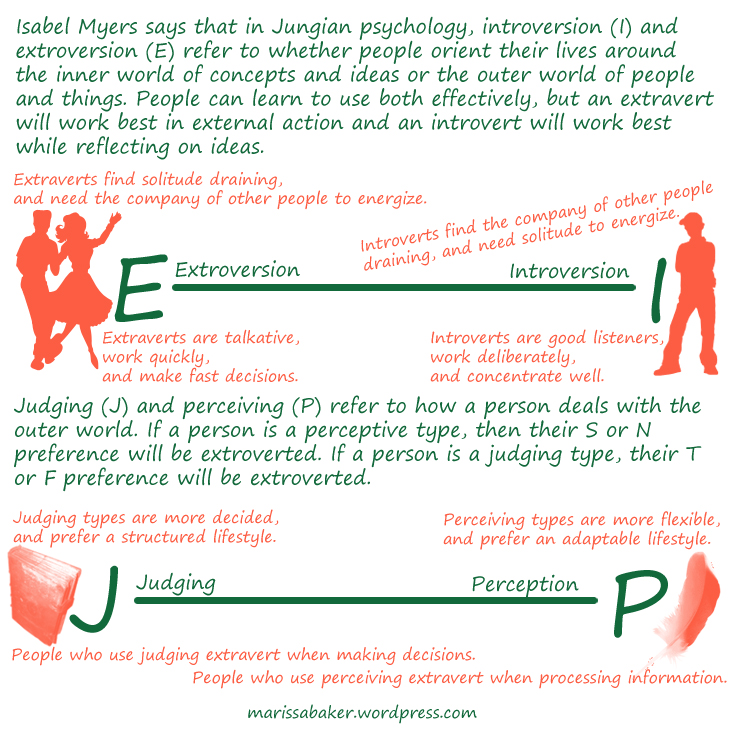
Isabel Myers says that in Jungian psychology, introversion (I) and extroversion (E) refers to whether people orient their lives around the inner world of concepts and ideas or the outer world of people and things. Every healthy person uses both introversion and extroversion, but there will be one with which they are most comfortable. This relates to the Sensing-Intuition and Thinking-Feeling functions by dictating whether a person’s dominant function is introverted or extroverted (more on that in a moment).

So That's What All Those Letters Mean -- An Introduction to the MBTI by marissabaker.wordpress.com

The last letter in a Myers-Briggs type refers to whether a person uses a perceptive (P) or a judging (J) “attitude as a way of life, a method of dealing with the world around us.” People use both a perceiving and a judging function; one extroverted and one introverted. If a person is a perceptive type, then their perceiving preference (S or N) will be extroverted. If a person is a judging type, their judging preference (T or F) will be extroverted.

Since the Judging-Perceiving preference only refers to outer behavior, it most easily observed in Extraverts. For example, an ENFJ will extrovert their judging function and use extroverted feeling (Fe) to interact with the outer world. Because they are an extrovert, this also makes Fe their dominant function. It is supported by an auxiliary perceiving function: introverted intuition (Ni). Dominant and auxiliary functions are a bit more complicated for introverts. An ISTP type will extrovert their perceiving function and use extroverted sensing (Se). However, since they are an introverted type, their dominant function is introverted thinking (Ti) and Se is their auxiliary function . The function they use the most is a judging one, but when they interact with the outer world they use perception.

Putting The Letters Together

It is far too simplistic to take each individual letter in a Myers-Briggs type separately. To say an INFJ is an introvert/intuitive/feeler/judger misses what the MBTI can tell us about how they look at the world with Ni and how they formulate judgements with Fe, and which of those they do most easily. It also passes over the fact that introverts sometimes use extroversion and that extraverts sometimes use introversion. That’s why the short Myers-Briggs style tests you might find online that line-up descriptions of Extravert-Introvert, Sensing-Intuition, Thinking-Feeling, and Judging-Perceiving and then have people choose which one is most “like them” can be an incorrect assessment of a person’s type.

One other thing to add about Myers-Briggs types is that Isabel Briggs Myers never intended for these types to be used to make people feel “boxed in” to their personality type or to infringe on a person’s right to self-determination. An ENTP, for example has “already exercised this right by preferring E and N and T and P.” Myers-Briggs type is a tool for better understanding who we have already chosen to be, and for learning to relate to and better understand people who think differently than us.

*indicates affiliate links

Learn More …

Introduction To Cognitive Functions: The Learning Processes

Introduction To Cognitive Functions: The Decision-Making Processes

Save