What Happens When God Takes Justice to the Next Level?

In the sermon on the mount, Jesus talks about commands given to ancient Israel and then gives new guidelines for how to obey God from a heart level. He wants us to shine as lights in the world so that all “can see your good deeds and give honor to your Father in heaven” (Matt. 5:14-16, NET).

As preface to taking the commands to a spiritual level, Jesus says, “Do not think that I have come to abolish the law or the prophets. I have not come to abolish these things but to fulfill them” (Matt. 5:17, NET). In other words, He has come “to cause God’s will (as made known in the law) to be obeyed as it should be, and God’s promises (given through the prophets) to receive fulfillment” (Thayer’s dictionary entry on G4137, pleroo). And lest anyone think that the new covenant Jesus brings will make obedience any less of a priority, he adds, “unless your righteousness goes beyond that of the experts in the law and the Pharisees, you will never enter the kingdom of heaven!” (Matt. 5:20, NET).

We must have a righteousness that “goes beyond” the letter of the law. It’s no longer enough to not murder; Jesus expects us not to despise or condemn others as well (Matt. 5:21-22). Not cheating on our spouses isn’t enough; we’re not even to lust after someone who doesn’t belong to us (Matt. 5:27-28). God has always cared more about the state of the human heart than what we do, and now that desire for heart and spirit-level obedience is made even more explicit. We might even say that what Jesus reveals demands a higher degree of commitment to God than what He expected under the Old Covenant.

A Life for a Life

One of the commands Jesus talks about is, “You have heard that it was said, ‘An eye for an eye, and a tooth for a tooth” (Matt 5:38, WEB). This alludes to three passages in the Torah (according to the reference list in MySword Bible app): Exodus 21:24, Leviticus 24:20, and Deuteronomy 19:21.

The rest of the people will hear and become afraid to keep doing such evil among you. You must not show pity; the principle will be a life for a life, an eye for an eye, a tooth for a tooth, a hand for a hand, and a foot for a foot.

Deuteronomy 19:2-21, NET

The NET footnote on this verse says, “This kind of justice is commonly called lex talionis or ‘measure for measure’… It is likely that it is the principle that is important and not always a strict application. That is, the punishment should fit the crime and it may do so by the payment of fines or other suitable and equitable compensation.” This interpretation may well be true, and perhaps Jesus had this in mind when He mentioned this law in His sermon. Maybe people had begun applying it too strictly and missed the heart of God for fairness and justice.

Jesus does not, however, tell people they need to keep applying this law but in a slightly different way. For the other “you have heard … but I say to you” passages, Jesus reinforces keeping the law and makes it more broadly applicable while taking it to a heart level. For example, “Do not break an oath” becomes “do not take oaths at all” (Matt. 5:33-37). This time, though, the exact connection to a broader spiritual application isn’t so direct.

What Happens When God Takes Justice to the Next Level? | LikeAnAnchor.com
Image by Peter H from Pixabay

Mercy over Judgement

You have heard that it was said, ‘An eye for an eye and a tooth for a tooth.’ But I say to you, do not resist the evildoer. But whoever strikes you on the right cheek, turn the other to him as well. And if someone wants to sue you and take your tunic, let him have your coat also. And if anyone forces you to go one mile, go with him two. Give to the one who asks you, and do not reject the one who wants to borrow from you.

Matthew 5:38-42, NET, quoting Exodus 21:24; Leviticus 24:20.

In the past, God’s law let you exact equal retribution for a crime. Someone knocks your tooth out, they lose their tooth. God is a God of justice and judgement, and every time there is sin someone has to pay for it. One thing implied by that rule of justice is that when you transgress the law you will also be punished. That’s where we start to realize how much we need God to also be a God of mercy, and indeed He is.

For the one who obeys the whole law but fails in one point has become guilty of all of it. For he who said, “Do not commit adultery,” also said, “Do not murder.” Now if you do not commit adultery but do commit murder, you have become a violator of the law. Speak and act as those who will be judged by a law that gives freedom. For judgment is merciless for the one who has shown no mercy. But mercy triumphs over judgment.

James 2:10-13, NET , quoting Exodus 20:13-14

God wants to show us mercy. He delights in seeing it triumph over judgement. But if we want God to show us mercy, we must also show mercy when we have that opportunity. When someone hits you you don’t hit them back; you turn the other cheek, turn vengeance over to God, and live at peace with everyone you can (Rom. 12:17-21).

Mimicking Jesus’s Mercy

What Happens When God Takes Justice to the Next Level? | LikeAnAnchor.com
Image by Gianni Crestani from Pixabay

It is worth noting that when Jesus says, “resist not an evil doer,” the Greek word is anthistemi (G436). The only positive case of it being used between people is when Paul stood up to Peter’s hypocrisy in shunning Gentile believers (Gal. 2:11-17). It is also used when we’re told to “resist the devil” (James 4:7; 1 Peter 5:8-9) and to “withstand in the evil day” wearing God’s armor (Eph. 6:13). The command in the Sermon on the Mount does not mean we can’t correct someone in the spirit of love when they’ve made an error or that we do not resist the power behind all evil. We are, however, to commit ourselves to showing mercy and letting go of the option to revenge ourselves on someone else.

When God takes justice and fairness to the next level, it turns into mercy, long-suffering, peace, and love. The principle of “a life for a life” finds its fulfillment in Jesus Christ dying to free us from all the things we’ve done that deserve death. He gave His life to redirect the “compensation due sin,” which “is death” (Rom. 6:23, LEB), to Himself even though He did not deserve to suffer and die.

Our human nature might rise up against this “turn the other cheek” passage and say that it isn’t fair to let others get away with these sorts of things. But it also was not “fair” that Jesus died instead of us to pay the penalty for our sin. His mercy triumphed over judgement, and if we follow Him in spirit and in truth our mercy should also triumph over judgement.

Featured image by christian schwartz from Pixabay

When Other People Don’t Think Like You, Focus on Thinking Like God

I’ve long been fascinated by Philippians 3 (even wrote a whole post about it). Here, Paul talks about the things he had before conversion–religious status, a good background, the best education, zeal for his faith–and then says all his “human credentials” count for nothing. Indeed, he regards “them as dung!” It is so much more valuable to know Christ “and be found in him,” not because Paul is righteous by following the law but because he has “the righteousness from God that is in fact based on Christ’s faithfulness.” And then with all that as background, he talks about how he keeps striving to live a godly life and will keep doing so until the end of his life in the hope of attaining “to the resurrection of the dead” (Phil. 3:5-12, NET).

This discussion is framed by Paul addressing a contentious issue in the church. He warns the Philippians to “beware of the dogs” (false teachers, see NET footnote), “beware of the evil workers, beware of those who mutilate the flesh” (those who wrongly teach physical circumcision is still necessary” and those who “rely on human credentials” (Phil. 3:1-4, NET). That is why Paul brings up his own credentials. He’s not attacking these other teachers and saying their credentials mean nothing because Paul doesn’t have any and wants to make himself look better. Rather, he has the credentials and he still says they’re worthless because “human credentials can produce nothing that is pleasing to God” (NET footnote on v. 15). It is with this foundation that Paul then says what I want to focus on today.

Brothers and sisters, I do not consider myself to have attained this. Instead I am single-minded: Forgetting the things that are behind and reaching out for the things that are ahead, with this goal in mind, I strive toward the prize of the upward call of God in Christ Jesus. Therefore let those of us who are “perfect” embrace this point of view. If you think otherwise, God will reveal to you the error of your ways. Nevertheless, let us live up to the standard that we have already attained.

Phil. 3:13-16, NET

So often, when we disagree with someone in the church we instinctively want to defend our point of view. But what Paul indicates is that our first response should be to ask God to reveal His mind.

The Mind of Christ

One of the central goals of our Christian walk is to learn to think like God does. He fills us with His spirit to transform us and make us part of His family. We have received the Spirit “from God, so that we may know the things that are freely given to us by God” (1 Cor. 2:12, NET)

The unbeliever does not receive the things of the Spirit of God, for they are foolishness to him. And he cannot understand them, because they are spiritually discerned. The one who is spiritual discerns all things, yet he himself is understood by no one. For who has known the mind of the Lord, so as to advise him? But we have the mind of Christ.

1 Cor. 2:14-16, quoting Isa. 40:13, NET

We must “arm ourselves with the same mind” Christ had so that we can live “for the will of God” (1 Pet. 4:1-2, WEB). Part of the “will of God” involves living in harmony with our brethren. That only happens when all of us are trying to think like Christ.

Now the God of perseverance and of encouragement grant you to be of the same mind with one another according to Christ Jesus, that with one accord you may with one mouth glorify the God and Father of our Lord Jesus Christ. Therefore accept one another, even as Christ also accepted you, to the glory of God.

Rom. 15:5-7, WEB

Like Minded in Him

When scripture says that Christians are to be like minded, it does not mean we reach whatever mutual consensus we want. Our like-mindedness comes from all of us putting on the mind of Christ. That “we have the mind of Christ” verse I quoted earlier is preceded in Paul’s first letter to the Corinthians by this:

I urge you, brothers and sisters, by the name of our Lord Jesus Christ, to agree together, to end your divisions, and to be united by the same mind and purpose

1 Cor. 1:10, NET

Paul goes on to talk about how ridiculous it is to divide the church over which teacher to follow (1 Cor. 1:9-17), the fact that there is no room for human boasting before God (1 Cor. 1:18-31), that our faith is based in God’s wisdom, and that through His spirit we get to put on Jesus’ mind (1 Cor. 2:1-16). It has quite a few parallels with Philippians 3, where Paul talks about the uselessness of human credentials and then urges continued faithfulness, which includes living in peace with your brethren.

It’s a familiar refrain in Paul’s letters. “Live in harmony with one another” (Rom. 12:15). “Be of the same mind … being united in spirit” (Phil. 2:2). “Agree with one another, live in peace, and the God of love and peace will be with you” (2 Cor. 13:11). The more like God we become, the fewer disagreements we ought to have with others who are also becoming more like God.

Continue Aligning Yourself With God

The principle we’re discussing is simple in theory: put on Christ’s mind and you’ll all be united. In practice, we’re all at different levels of growth. None of us have fully put on the mindset and attitudes of Jesus yet, and we don’t always agree on what putting on His mind looks like. Returning to Philippians 3,

Therefore let those of us who are “perfect” embrace this point of view. If you think otherwise, God will reveal to you the error of your ways. Nevertheless, let us live up to the standard that we have already attained.

Phil. 3:15-16, NET

Let us therefore, as many as are perfect, think this way. If in anything you think otherwise, God will also reveal that to you. Nevertheless, to the extent that we have already attained, let’s walk by the same rule. Let’s be of the same mind.

Phil. 3:15-16, WEB

When we disagree, we can ask God to reveal His mindset and align us with truth. When seeking this sort of like-mindedness, always ask for God’s perspective so you can understand what He wants you to see–not to help you understand human teachings or teachers. Our goal for spiritual growth is to be like our Father. Unity with other believers happens as a result of that goal, not as the central goal itself.

Paul also admonishes us to “live up to” or “walk by” the standard we’ve already attained. This goes along with verses like the one in James that says if you know to do good and don’t do it that is sin to you (James 4:17) and passages in Romans that indicate we’re judged based on how well we do God’s will rather than how well we understand the law (Rom. 2:10-16). Though we might not always agree with other Christians on the best way to follow God, we need to live in peace with others as much as possible, follow God as faithfully as we understand how, and always be seeking to align our thinking and mode of living more closely with Him.

Featured image credit: Pearl via Lightstock

The Beatitudes, Part Eight: Blessed Are Those Who Have Been Persecuted

This last beatitude is probably the most difficult one to hear. The need for humility as we recognize our spiritual helplessness is something we can wrap our mind around. We know that mourning and grief are part of being human, and we welcome God’s promise of comfort. Gentleness is a fruit of the spirit and a character trait of Christ, so we know that it’s a good thing for us to learn. A hunger and thirst for righteousness is like a hunger and thirst for God. Giving and getting mercy and forgiveness is a familiar theme through scripture. We also know that we’re supposed to become like God, who is pure and perfect, so it’s no surprise that the “pure in heart” are blessed. And God loves peace so much that it seems natural for Jesus to call peacemakers children of God. But then we come to this last one.

Blessed are those who have been persecuted for righteousness’ sake, for theirs is the Kingdom of Heaven.

Matthew 5:10, WEB

For many Christians around the world and throughout history, the idea that they’ll be persecuted for their faith is not shocking. In fact, Christianity is among the most persecuted religions in the world. Just last year, one report stated that “Christian persecution ‘at near genocide levels'” in certain countries (BBC News, 3 May 2019). More recently, the 2020 World Watch List report released by Open Doors found that “1 in 8 believers, worldwide” “experience high levels of persecution” for their faith in Jesus Christ (click here for more information).

Here in the US, though, we have not experienced anything like this. Moreover, Western Christians in the modern world seem to have a sense that we shouldn’t be persecuted; as if somehow we deserve an exemption because we live in such evolved, democratic societies. And even if we don’t feel like that, persecution is frightening. It may even make us wonder if following Jesus is worth the cost. Perhaps that’s why this is the one beatitude that Jesus immediately elaborates on.

Blessed are you when people reproach you, persecute you, and say all kinds of evil against you falsely, for my sake. Rejoice, and be exceedingly glad, for great is your reward in heaven. For that is how they persecuted the prophets who were before you.

Matthew 5:11-12, WEB

If we are persecuted (or worry we may be persecuted), this is the sort of thing we need to hear; a reassurance that we can hold tight to God and that He’ll take care of us. None of us are alone. God’s people don’t fit in with the rest of the world, and from the very earliest Bible records those who follow God faced opposition from the world. But they didn’t face it by themselves and neither will we, because God is on our side. Not only that, but we have a future goal to look forward to which is amazing enough to make whatever happens to us in this life seem like it really doesn’t matter.

Faithful and Righteous

The Hebrews 11 faith chapter comes to mind while reading about those who are persecuted and blessed. All the people listed there were faithful and righteous, and most faced persecutions of some sort. Abel was murdered. Abraham, Isaac, and Jacob did not get along well with everyone they met, and some stole from or cheated them. Joseph was sold into slavery. Moses suffered abuse for Christ (Heb. 11:26, NET). David was hunted by Saul.

Others were tortured, not accepting their deliverance, that they might obtain a better resurrection. Others were tried by mocking and scourging, yes, moreover by bonds and imprisonment. They were stoned. They were sawn apart. They were tempted. They were slain with the sword. They went around in sheep skins and in goat skins; being destitute, afflicted, ill-treated— of whom the world was not worthy—wandering in deserts, mountains, caves, and the holes of the earth.

Hebrews 11:35-38, WEB

I don’t much like reading this passage. The whole “sawn asunder” (v. 37, KJV) thing especially bothers me. But I think, like the people these verses are talking about did, we need to focus on this part: “That they might obtain a better resurrection.” Or, to quote a translation I recently fell in love with, “to obtain resurrection to a better life” (v. 35, NET).

The Beatitudes, Part Eight: Blessed Are Those Who Have Been Persecuted | LikeAnAnchor.com

When We Suffer, We’re Being Like Christ

Jesus promises that God has a reward for those who face persecution “for righteousness’ sake.” This isn’t a concept you hear much about in the world today, but righteousness is a key part of scripture. In a broad sense, Thayer’s dictionary defines it as the “state of him who is as he ought to be” (G1343, dikaiosune). God is righteous and He’s the one who models and defines righteousness for us. It involves obedience to God, personal integrity, “purity of life,” and “correctness of thinking, feeling, and acting” (Thayer).

Peter talks about the idea of suffering for righteousness several times in his first epistle. He says that “it is commendable” if you patiently endure suffering you don’t deserve “because of conscience toward God.” That is, after all, what Christ did (1 Pet. 2:19-25). Jesus suffered for our sins and if we suffer for following Him and doing God’s will, well, that’s better than if we were to suffer for doing wrong (1 Pet. 3:17-18).

But in fact, if you happen to suffer for doing what is right, you are blessed. But do not be terrified of them or be shaken. But set Christ apart as Lord in your hearts and always be ready to give an answer to anyone who asks about the hope you possess. Yet do it with courtesy and respect, keeping a good conscience, so that those who slander your good conduct in Christ may be put to shame when they accuse you.

1 Peter 3:14-16, NET (Old Testament quotes bolded in original)

When Peter wrote this epistle, I wouldn’t be surprised if he was thinking back to something Jesus told him and the other disciples at His last Passover here on earth. Jesus said, “If they persecuted me, they will also persecute you. … they will do all these things to you for my name’s sake, because they don’t know him who sent me” (John 15:20-21).

Count The Cost

Suffering as a Christian is pretty much guaranteed. If you aren’t persecuted for righteousness’ sake, scripture makes it seem like that’s actually more unusual than if you are. That’s one reason we’re told to count the cost before following Jesus; because this life demands commitment and sacrifice (Luke 14:25-35). When Paul counted that cost, even with all the persecutions he suffered (2 Cor. 11:23-28), he concluded that nothing else mattered as much as knowing Christ and that the rewards for following Him will be so amazing the suffering seems as nothing (Rom. 8:18-30).

Yes most certainly, and I count all things to be a loss for the excellency of the knowledge of Christ Jesus, my Lord, for whom I suffered the loss of all things, and count them nothing but refuse, that I may gain Christ and be found in him, not having a righteousness of my own, that which is of the law, but that which is through faith in Christ, the righteousness which is from God by faith, that I may know him, and the power of his resurrection, and the fellowship of his sufferings, becoming conformed to his death, if by any means I may attain to the resurrection from the dead.

Philippians 3:8-11, WEB

Paul says here that he “suffered the loss of all things,” and that’s in addition to all the direct persecutions he talks about in other epistles. But when he counted the cost of following Jesus, he still came to the conclusion that it was all worth the effort. He, like those in the faith chapter, “looked for the city which has the foundations, whose builder and maker is God” (Heb. 11: 10, WEB). He knew the reward for following God far outweighed any downsides.

Theirs is the Kingdom of Heaven

The reward mentioned in this beatitude brings us full circle in our series of posts. “Blessed are the poor in spirit,” Jesus said at the beginning of this sermon on the mount, “for theirs is the Kingdom of Heaven” (Matt. 5:5, WEB). The New English Translation puts it a little differently: “for the kingdom of heaven belongs to them.”

When John the Baptist and then Jesus came preaching, they both said, “Repent, for the Kingdom of Heaven is at hand!” (Matt. 3:1-2; 4:17). Throughout Matthew’s gospel (other writers use the phrase “kingdom of God”), this emphasis on the kingdom of heaven continues. Jesus told us who would and would not enter the kingdom of heaven, taught us to pray “Let your kingdom come,” and shared analogies for what the kingdom is like (click for verse list).

One of the things Jesus said is, “Not everyone who says to me, ‘Lord, Lord,’ will enter into the kingdom of heaven—only the one who does the will of my Father in heaven” (Matt. 7:21, NET). Just a little earlier in the same sermon where He makes this statement, Jesus gives us a succinct guide in the form of Beatitudes to some of the ways we can align ourselves with God. This is what righteousness is about — not being “experts in the law” but going beyond that and learning to truly be like God (Matt. 5:18-20), even to the point that the same people who hate Jesus will also hate us because we are so much like Him. Yes, that may mean we are among “those who are persecuted for righteousness,” but “the kingdom of heaven belongs to them.” And I think Paul is right when he says getting into that kingdom and being with God forever is worth whatever we might have to give up or go through in this life.

Featured image credit: Magnify Studio via Lightstock

The Beatitudes, Part Seven: Blessed Are The Peacemakers

The seventh type of person that Jesus talks about in what we call the beatitudes is the peacemaker. Like the others in this list, they are blessed — fully satisfied by God — and they also receive an additional, specific blessing.

“Blessed are the peacemakers, for they shall be called children of God.”

Matthew 5:9, all quotes from WEB translation

Being part of God’s family is what He desires for everyone who He has called into His church. Here, Jesus specifically links being God’s children with being peacemakers. This is an activity that God, the ultimate peacemaker, does and it’s one He wants us to learn.

Much as in English, the Greek word for “peacemaker” basically means someone who makes peace. “Peace,” in this sense, is a tranquil, blessed state with security and without strife (eirene, G1515). The Hebrew equivalent is shalom wholeness; nothing missing and nothing broken.

Jesus’s Example

In Psalms and Proverbs, it talks about God making peace for His people by blocking their enemies from harming them (Ps. 147:14; Prov. 16:7). Moving beyond simply referring to “peace” as an absence of war, God promises to “make with them a covenant of peace” which will make them secure in their lands and involve God placing His dwelling among them (Ezk. 34:25; 37:26). It’s looking forward to the time when divisions between God and mankind are removed and there can be true, complete peace.

But now in Christ Jesus you who once were far off are made near in the blood of Christ. For he is our peace, who made both one, and broke down the middle wall of separation, having abolished in his flesh the hostility, the law of commandments contained in ordinances, that he might create in himself one new man of the two, making peace.

Ephesians 2:13-15

Jesus “made peace through the blood of his cross” and reconciled us to God (Col. 1:20-22). Without that, there would be separation because of our sins, but God cared so much about making peace with us that Jesus died to remove those sins. He established a covenant of peace by giving His life. He was all-in as a peacemaker; fully committed to reconciling humanity and God.

Following Things of Peace

We know we’re to imitate Jesus, and that includes in His commitment to peacemaking. He is the Sar Shalom — Prince of Peace (Is. 9:16-17) — and His people also value peace. If we have His spirit and wisdom inside us, we will “make peace” and sow “the fruit of righteousness” in peace (James 3:17-18).

So then, let’s follow after things which make for peace, and things by which we may build one another up.

Romans 14:9

If you look at this verse in-context, Paul is telling us that how we treat each other is more important than making sure we all believe the same things on relatively minor topics. One of God’s primary expectations for those in His church is that they will live at peace with each other. This requires humility and selfless care for others (Phil. 2:1-4) and a commitment to living out the fruit of the spirit, including peace (Gal. 5:22-23).

A Family at Peace

The Beatitudes, Part Seven: Blessed Are The Peacemakers | LikeAnAnchor.com

God is building a family. He does not want a family full of petty bickering, but one of peace. Right now, there are two fully spirit, immortal members of the God-family: Father and Son. Their relationship is so close that Jesus told us, “I and the Father are one” (John 10:30). Their goal is that we may also be one with them, and with each other in them (John 17:11, 20-23).

See how great a love the Father has given to us, that we should be called children of God! For this cause the world doesn’t know us, because it didn’t know him. Beloved, now we are children of God. It is not yet revealed what we will be; but we know that when he is revealed, we will be like him; for we will see him just as he is. Everyone who has this hope set on him purifies himself, even as he is pure.

1 John 3:1-3

Being children of God involves imitating our Father. Here, John describes that imitation as becoming pure, as God is pure, but we can also include other godly character traits and roles within that goal, including peacemaking. Being a peacemaker is part of living according to God’s spirit — which He gives us as a key part of adopting us as His children — rather than according to the lusts of our flesh (Rom. 8:1-17).

Dear readers, let’s be peacemakers, especially now as we’re living in a time when it’s so easy to divide instead of unite. God has given us His spirit if we’ve committed our lives to Him. And through His spirit, we have what we need to not only be His children, but to act like we’re part of His family by mimicking Him in every aspect of our lives.

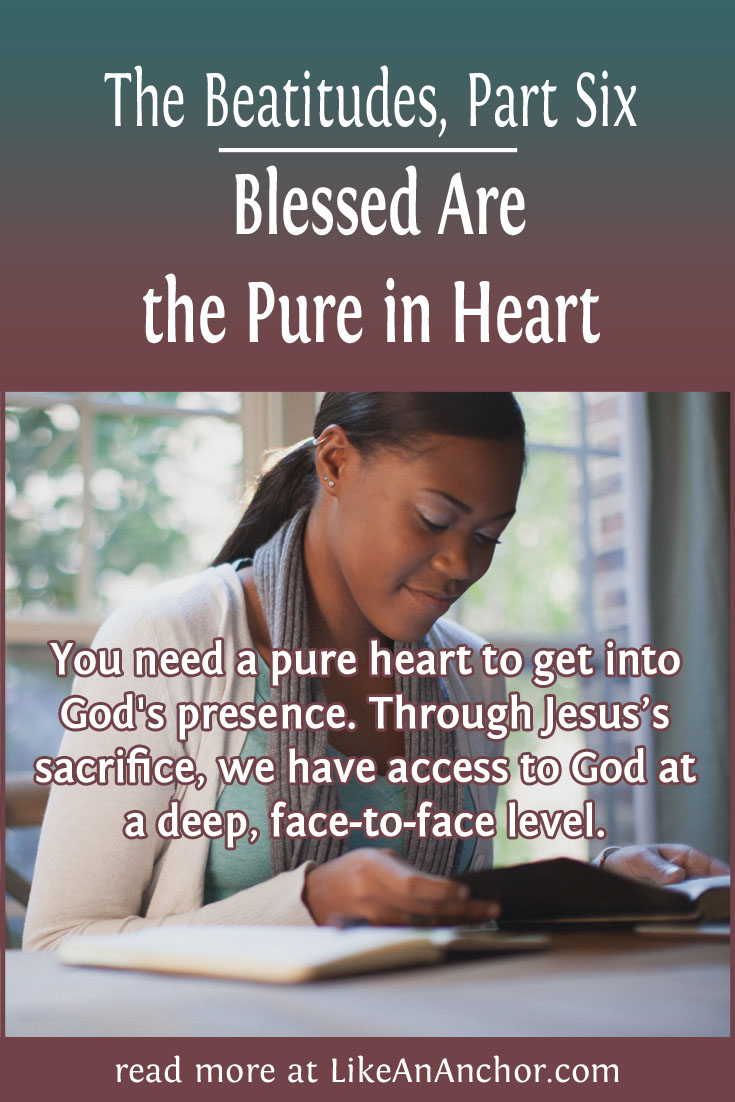
The Beatitudes, Part Six: Blessed Are the Pure in Heart

We’ve been looking at the Beatitudes from Jesus’ Sermon on the Mount over the past several weeks. Now we’re up to the sixth of these attitudes that Jesus says result in blessings from God. Those who are “blessed” in this sense are fully satisfied by God, and each also receives a specific blessing to go along with that. For example,

Blessed are the pure in heart, for they shall see God. (Matt. 5:8, all quotes from WEB translation)

Those pure in their hearts are fully satisfied by God, and they get to see Him. It’s a wonderful thing to think about, though when you start to ponder the idea of seeing God more questions come up. What does it mean to see God? How and when will this happen? And what does it actually mean to have a pure heart in the sense used here?

Washing By Jesus

Purity starts with something God does. Jesus told His disciples that they were “pruned clean because of the word” He spoke to them (John 15:3), and that’s the same Greek word translated “pure” in Matthew’s gospel (G2513 katharos). He also said they were “completely clean” if they let Him wash them (John 13:8-10). Extending this to all believers, Peter talks about God’s work with the Gentiles, saying, “He made no distinction between us and them, cleansing their hearts by faith” (Acts 15:9). It is God’s work in us that gives us pure hearts; we can’t get to that state on our own.

But when the kindness of God our Savior and his love toward mankind appeared, not by works of righteousness which we did ourselves, but according to his mercy, he saved us through the washing of regeneration and renewing by the Holy Spirit, whom he poured out on us richly, through Jesus Christ our Savior (Titus 3:4-6)

We are washed by the blood of Jesus from all uncleanness that comes from sin. None of us are exempt from the consequences of sin, nor can we fix that problem on our own. We can come to Jesus boldly, though, knowing that He will take care of cleansing us from our sins and making us fit to not only enter God’s presence but become part of His family.

let’s draw near with a true heart in fullness of faith, having our hearts sprinkled from an evil conscience, and having our body washed with pure water (Heb. 10:22)

Cleansed In God’s Presence

Back in Old Testament times, God had clear criteria for who He would allow into His temple and therefore His presence. Part of this criteria had to do with ceremonial cleanliness, but even under the first covenant there was a deeper application as well.

Who may ascend to Yahweh’s hill? Who may stand in his holy place? He who has clean hands and a pure heart; who has not lifted up his soul to falsehood, and has not sworn deceitfully. (Ps. 24:3-4)

You needed a pure heart to get into God’s presence. Jesus’ sacrifice washing us clean takes care of all our ceremonial uncleanness, and it also purifies our hearts. Through Him, we have access to God at a deeper level than was typically possible before the New Covenant. This doesn’t take all the responsibly out of our hands, though. Once our hearts are purified, we play a role in keeping them that way. We do that by following God faithfully and by asking Him for new cleansing if we stumble.

Seeing you have purified your souls in your obedience to the truth through the Spirit in sincere brotherly affection, love one another from the heart fervently, having been born again, not of corruptible seed, but of incorruptible, through the word of God, which lives and remains forever. (1 Pet. 1:22-23)

Seeing God’s Face

This idea of being purified to enter God’s presence connects with seeing God’s face. Ultimately, we will see God “as He is” after the resurrection when He welcomes us as spirit-beings into His kingdom (Job 19:26; 1 John 3:1-2). Until then, no ones sees the Father’s face but many people have seen God through Jesus Christ (John 1:18; 14:8-9). We can actually have a “faces to faces” relationship with God today in the sense that we can know Him, see who He really is, and form a close relationship with Him.

seeing it is God who said, “Light will shine out of darkness,” who has shone in our hearts to give the light of the knowledge of the glory of God in the face of Jesus Christ. (2 Cor. 4:6)

Seeing God will be literal in the future, but for now it’s more metaphorical. John said, “He who does evil hasn’t seen God,” which implies that those who do not do evil have seen God (3 John 1:11). When we pursue a relationship with God and commit to living life the way He expects of us, out of a pure heart, then we get the chance to “see” God.

One thing I have asked of Yahweh, that I will seek after: that I may dwell in Yahweh’s house all the days of my life, to see Yahweh’s beauty, and to inquire in his temple. … When you said, “Seek my face,” my heart said to you, “I will seek your face, Yahweh.” (Ps. 27: 4, 8)

What a blessing it is to have Jesus personally purify our hearts so that we can have a face-to-face relationship with Him and His Father! There is nothing more precious than the chance to know God intimately and be known by Him.

Featured image by congerdesign from Pixabay

The Beatitudes, Part Five: Blessed Are The Merciful

I recently read Just Mercy by Brian Stevenson, shortly after watching the film adaptation (both are excellent, by the way; I highly recommend reading and watching). Mercy and justice are tricky things for us humans to balance. We don’t have perfect perspective on every situation. We don’t know all the relevant facts. We want justice but we often mishandle it badly. And for some reason, it’s often hard to show mercy or to convince others it’s a good idea.

“Blessed are the merciful, for they shall obtain mercy.” (Matt. 5:7, all quotes from WEB translation)

We all need mercy, particularly from God. We also all need to give mercy, otherwise we won’t receive any. It’s the same principle as forgiveness. As Jesus says just a little later in the same sermon where He gives us the Beatitudes,

“For if you forgive men their trespasses, your heavenly Father will also forgive you. But if you don’t forgive men their trespasses, neither will your Father forgive your trespasses.” (Matt. 6:14-15)

Reciprocal Mercy

The relation between the character trait and how God rewards it is very direct in this particular Beatitude. You give mercy, you get mercy. And it’s not just about passively letting mercy happen or giving it only when absolutely necessary. The Greek word eleemon (G1655) is “active compassion and benevolence involving thought and action.” It is an expression of the love inside you, and it’s closely related to other words like elos (G1656, applied grace, pity, compassion) and eleemosune (G1654, actions of mercy) (Zodhiates’ dictionary). Here’s the only other place this specific form of the word for “mercy” is used in scripture:

Therefore he was obligated in all things to be made like his brothers, that he might become a merciful and faithful high priest in things pertaining to God, to make atonement for the sins of the people. (Heb. 2:17)

We’re to have the same kind of mercy that Jesus has as a result of His life here on earth as a human being. He learned what it’s like to be human and that gave Him an even deeper compassion for us than God had before (which was already bountiful).

It is because of Yahweh’s loving kindnesses that we are not consumed, because his compassion doesn’t fail. They are new every morning. Great is your faithfulness. (Lam. 3:22-23)

Yahweh is gracious, merciful, slow to anger, and of great loving kindness. Yahweh is good to all. His tender mercies are over all his works. (Ps. 145:8-9)

Don’t Miss The Point

Mercy is something Jesus was looking for, and which He taught, while on this earth. One of the things He taught was that faith which refuses to show mercy is empty and dead. For example, when the Pharisees berated him for eating with tax collectors and sinners, Jesus said,

“Those who are healthy have no need for a physician, but those who are sick do. But you go and learn what this means: ‘I desire mercy, and not sacrifice,’ for I came not to call the righteous, but sinners to repentance.” (Matt. 9:12-13)

He was quoting Hosea 6:6, no doubt a very familiar verse to the religious leaders and experts of His day, and telling them they didn’t understand what it means. At least a few of them probably had all of Hosea memorized, and here’s this young rabbi from Nazareth (of all places) telling them they’re missing the point of this scripture. It’s no wonder the Pharisees were offended, nor is it any wonder so many of the people they’d treated without mercy responded with joy to Jesus’s message. Jesus was boldly proclaiming the mercy which has always been a part of God’s plan, and He made very clear that this mercy did not belong only to an elite group. It is for all His people.

To Ransom With Mercy

If you are reading this the weekend it posted, we just observed Yom Kippur (Day of Atonement) less than a week ago. This solemn, holy day represents God’s covering mercy. A more direct translation of the Hebrew words kippur and kaphar might be “to cover (G3722, Strong’s dictionary; Brown, Driver, and Briggs lexicon). However, the Theological Wordbook of the Old Testament challenges that interpretation and instead links atonement, ransom, and the mercy seat. This word family is about reconciliation made possible by the removal of sins rather than by covering them over (TWOT entry 1023).

On Yom Kippur, the Old Testament priest made a special sacrifice and sprinkled the blood on the mercy seat — the place of atonement/propitiation (TWOT 1023c). Sacrifice in this situation, as well as in the more general sense, “was the symbolic expression of an innocent life given for a guilty life” (TWOT 1023a). This concept gains even more meaning in the New Covenant observance of Yom Kippur because Jesus the Messiah is the innocent life given in ransom for our guilty lives.

So what does this have to do with the Beatitudes? Everything. To receive this sort of mercy, we have to show this sort of mercy. it is an imperative. God makes the first move — Jesus has already died for us and grace in Him is given freely, not earned by anything we do. But if we do not respond to His gift by showing mercy, He can take back His mercy (Matt. 18:21-35).

What Mercy Looks Like

Jesus told a parable about a man who owed his lord an impossible debt (about 300 metric tons of silver) and was forgiven everything he owed. That man went to one of the other servants who owed him a very small amount (about 500 grams of silver) and refused offer forgiveness. He didn’t even respond to that man’s pleas for patience in repaying the debt. At the end of the parable, the lord says, “Shouldn’t you also have had mercy on your fellow servant, even as I had mercy on you?” (Matt. 18:33).

If we want to know what mercy looks like, we need only look to God. How has He been merciful to you? Go and treat other people that way. Show mercy, as the good Samaritan did (Luke 10:25-37). And to it with cheerfulness, not out of grudging necessity (Rom. 12:8). Present yourself a living sacrifice to do God’s will, remembering His great mercy toward you (Rom. 12:1). Be tender and compassionate to your brethren (Phil. 2:1-2).

It seems so simplistic to say that God just wants us to love each other and treat each other with compassion and mercy. But that is what He wants. It’s not too much to ask, and the more we become like Him the easier it will be to respond with love and mercy to everyone around us.

Featured image credit: Who Is Like The Lord via Lightstock