
Do I Love God Enough To Obey Him?

The apostle John had a particularly close relationship with Jesus. Though Jesus loved all of “his own who were in the world,” John is identified in particular as a disciple “whom Jesus loved” (John 13:1, 23; 19:26; 20:2, 21:7, 20-24). If we want to know Jesus — and we do, because that’s part of salvation and eternal life (John 17:3; Phil. 3:8) — then who better to learn from than John?

We’re taking a short break from our series on godly wisdom because I really felt like this was the topic I should be studying this week. Love and relationship are so important to God. Knowing Him and being known by Him are central to salvation, Christianity, and our eternal hope. We have to know Him in His way, though. Jesus said there will be people at the end who think they know Him and yet never had a relationship with Him (Matt. 7:21-23). That’s a scary thought, but John makes sure to leave us guides in his writings for how to love Jesus and how to tell whether or not we truly know Him.

Knowing God is Essential to Life

John’s writings are among my favorite in the New Testament. He highlights Jesus’ power and divinity — the things that make Him so much higher than us — more than any other gospel writer, yet He also highlights Jesus’s love and His longing for relationship — the things that make Him closer to us. The way John talks about Jesus and the Father makes it clear that the powerful, eternal, creator God longs for a relationship with us.

In the beginning was the Word, and the Word was with God, and the Word was God. The same was in the beginning with God. All things were made through him. Without him, nothing was made that has been made. In him was life, and the life was the light of men. … The Word became flesh, and lived among us.  (John 1:1-4, 14, WEB)

Jesus came here not just to die for our sins and reconcile us to God, but also to get to know us. He is the good shepherd who knows His sheep and is known by His own, who choose to follow Him (John 10:14, 27). He calls us His followers, friends, chosen, and beloved (John 15:12-16). And He reveals that knowing Him and the Father is key to eternal life (John 17:3). The importance of knowing and being known by God cannot be overstated.

Keeping the Words of the Lord

We often like to think of concepts like love and grace as something with “no strings attached.” If there’s a commitment or reciprocation implied, then we may start to get defensive and resent that it’s not “freely given.” That idea would have been ludicrous to the people of Jesus’ day. Grace is a reciprocal arrangement (we don’t have time to go into that in this post, but click here for an excellent booklet on the subject). Love has to do with commitment and covenants that attach us to God. In a way that seems odd to modern readers, relationship with God is connected to obedience and law.

“One who has my commandments and keeps them, that person is one who loves me. One who loves me will be loved by my Father, and I will love him, and will reveal myself to him.” … “If a man loves me, he will keep my word. My Father will love him, and we will come to him, and make our home with him.” (John 14:21, 23, WEB)

Really knowing Jesus goes beyond saying we believe in Him. It includes letting that belief change the way we live. We demonstrate how much we respect and care about Him by living according to His commandments. And since John points out that Jesus is also the Word — one of two God-beings who’ve been here for eternity — that includes the commands He gave in the Old Testament as well as the New. Jesus stated in no uncertain terms that He wasn’t here to get rid of everything He’d taught before as the Word, but rather to elevate those commands to an even higher level under a New Covenant (Matt. 5:17-48).
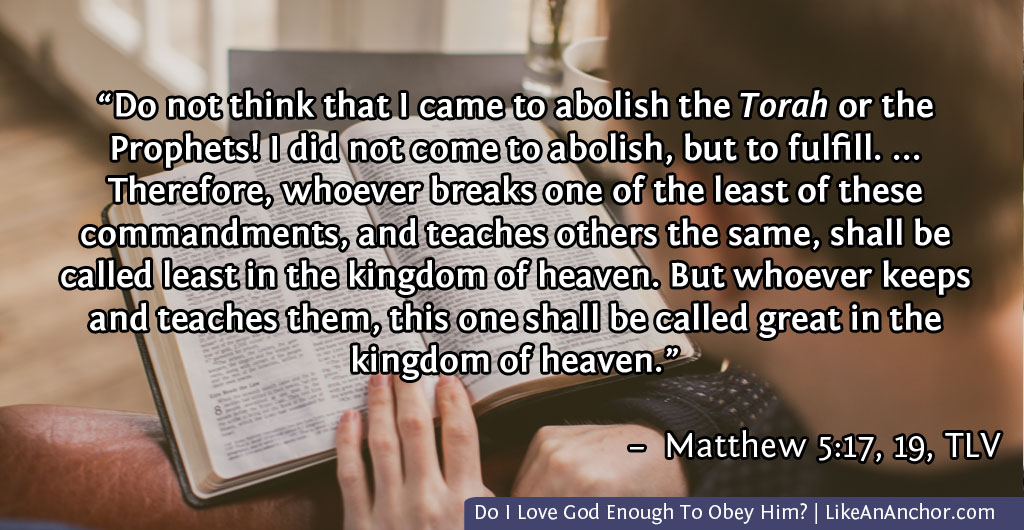
Do I Love God Enough To Obey Him? | LikeAnAnchor.com
Photo credit: Anggie via Lightstock

Knowing and Commandment Keeping

John further explores the topic of knowing Jesus in his first epistle. He begins, much as he did in writing his version of the gospel, with Jesus’ eternal existence as the Word of life. Then he shares that “God is light, and in him is no darkness at all,” which means we have to walk in light in order to fellowship with God (1 John 1:1-2:2).

This is how we know that we know him: if we keep his commandments. One who says, “I know him,” and doesn’t keep his commandments, is a liar, and the truth isn’t in him. But God’s love has most certainly been perfected in whoever keeps his word. This is how we know that we are in him: he who says he remains in him ought himself also to walk just like he walked. (1 John 2:3-6, WEB)

As this letter continues, John keeps coming back to themes of love, law, sin, and relationship with God. 1 John is one of those Bible books that it’s good to read in one setting (it’s not that long) to get a better feel for the points the writer is making in-context. As you read through it, one thing he continues to repeat is that we can’t have a relationship with God if we insist on breaking His commandments.

Choosing Righteousness as God’s Children

Whoever remains in him doesn’t sin. Whoever sins hasn’t seen him and doesn’t know him. Little children, let no one lead you astray. He who does righteousness is righteous, even as he is righteous. (1 John 2:1-2, WEB)

If we go back toward the beginning of the letter, we see John has already clarified that the children of God don’t practice sin, but if we slip up we can still repent and Jesus will restore our relationship with God (1 John 2:1-2). He’s not saying a Christian who sins is automatically disqualified for salvation. But he is saying that salvation comes with the expectation from God that we’ll respond to His work in us by starting to live lives modeled after His righteous standards.

We declare by our choices whether we are children of God, who practice righteousness, or children of the devil, who practice lawlessness (1 John 3:8-10). Again and again John emphasizes that children of God keep God’s law, chiefly the two laws that Jesus and Paul identified as the most important  — love God and love others (Matt. 22:36-40; Rom. 13:9-10). All other commands hinge on those two. God is love and we need to love as He does, in deed and in truth (1 John 3:11-24; 4:7-21). That’s just how we do things in the family of God.

How I Love Thy Law

As John wraps-up this letter, he ties what he’s written about loving and knowing God together with what he wrote about loving our brethren. He also addresses a common complaint about how “hard” it is to obey God.

By this we know that we love the children of God, when we love God and keep his commandments. For this is loving God, that we keep his commandments. His commandments are not grievous. (1 John 5:2-3, WEB)

Many people think of commandment keeping as something burdensome, but John tells us that’s far from true. Living within God’s law yields blessings, not hardship. Our attitude toward God’s law should be like that expressed in Psalm 119. This psalmist is in love with the law because it belongs to the God whom he loves. God’s laws are an expression of His character. If we want to be like the Lawgiver and receive the blessings that come from walking with Him, then we’ll respect His word.

Psalm 119 speaks of God’s law as a source of delight, strength, liberty, hope, comfort, life, wisdom, righteousness, peace, and much more. How we keep God’s law is different now — elevated to a spiritual level in the New Covenant — but it still matters (this is largely what Romans is about). God cares about the relationship we have to His words and whether or not we love Him enough to do what He tells us to do. Which brings us to the question of today’s title, “Do I love God enough to obey Him?”

It’s easy to say we love God but it’s harder to follow-through on the things that prove our love is genuine. If we truly love Him, though, obeying His word shouldn’t be a problem for us. It’ll still be a struggle at times to submit our own will to that of our sovereign God, but it’s something worth doing. The blessings of knowing God far outweigh any aspects of obedience that we might find inconvenient. And when we love God and follow His words, continuing to turn back to Him if/when we make mistakes, then we’ll have the assurance that we know Him and are known by Him as well.


Peaceful Wisdom

We’ve been working on a study of godly wisdom, as described in James 3:17. Last week, we talked about how “the wisdom from above is first pure.” James goes on to say it is “then peaceful.”

In what way is wisdom peaceful? We might say that wisdom avoids strife, but that can’t be all there is to it since peace in the Bible goes far beyond lack of conflict. It’s a state of tranquility, harmony, and wholeness that comes from being in a relationship with God. And since God is the source of true wisdom, it’s not too much of a surprise that wisdom and peace are linked.

Paths of Wisdom

There are not many verses in the Bible directly talking about the link between wisdom and peace. Searching for those two words turns up a verse in 1 Kings 5:12 that says “Yahweh gave Solomon wisdom, as he promised him. There was peace between Hiram and Solomon.” Other verses talk about wise people who hold their peace, but that phrase means to keep silent rather than to have shalom (Job. 33:33; Prov. 11:12).

As usual when studying wisdom, the best place to find what we’re looking for is in Proverbs. This book of wisdom has several things to say about peace, and one of these passages is found in a lengthy discussion of wisdom. Read more

Pure Wisdom

Last week, we looked at how God defines His kind of wisdom. One verse in particular, James 3:17, lists characteristics of “the wisdom from above” and gives us a starting point for defining godly wisdom. The first characteristic on that list is “pure.”

What does it mean to say that something, in this case wisdom, is pure? Synonyms for this word include undefiled, chaste, clean, innocent, and sacred. In Greek, the word hagnos (G53) is very closely related to hagios (G40), which is the word used for a thing or person set apart for God’s holy use.

Purity and holiness are key concepts in scripture. We’re supposed to have these traits, and they’re part of the type of wisdom that comes from God Himself. Since they’re so important, let’s take a closer look and see what we can learn.

A Pure Bride For Jesus

 For I am jealous over you with a godly jealousy. For I married you to one husband, that I might present you as a pure virgin to Christ. But I am afraid that somehow, as the serpent deceived Eve in his craftiness, so your minds might be corrupted from the simplicity that is in Christ. (2 Cor. 11:2-3, WEB)

Priests in the Old Testament were told to “take a wife in her virginity” (Lev. 21:13), and Paul extends  this into a metaphor for talking about us as the future bride of our High Priest, Jesus the Messiah. He’s not talking about never having sex, though, or even never having sinned.  The purity of a Christian is something we arrive at as part of a process. Read more

What Is God’s Definition Of Wisdom?

Knowledge is knowing a tomato is a fruit. Wisdom is knowing not to put it in a fruit salad.

We all have a basic idea of what wisdom is, even if the first example to come to mind is a humorous one. It has to do with applying knowledge and experience in a sound manner. The Bible has a lot to say about wisdom and its importance. Part of what it says involves clarifying that God’s wisdom is not the same as worldly wisdom. James writes,

Who is wise and understanding among you? Let him show by his good conduct that his deeds are done in gentleness of wisdom. But if you have bitter jealousy and selfish ambition in your heart, don’t boast and don’t lie against the truth. This wisdom is not that which comes down from above, but is earthly, sensual, and demonic. (James 3:13-15, WEB)

There is a wisdom that comes “from above” — from God — and there’s a wisdom that does not. James defines the wisdom from above in another verse, which we’ll come back to later. We need to be careful which wisdom we practice and what type of wisdom we praise.

Wisdom of Men vs. Gift of God

Paul also speaks of the difference between “wisdom of men” and the wisdom from above. One is about clever, persuasive arguments. The other is about truth.

My speech and my preaching were not in persuasive words of human wisdom, but in demonstration of the Spirit and of power, that your faith wouldn’t stand in the wisdom of men, but in the power of God. We speak wisdom, however, among those who are full grown, yet a wisdom not of this world nor of the rulers of this world who are coming to nothing. But we speak God’s wisdom in a mystery, the wisdom that has been hidden, which God foreordained before the worlds for our glory (1 Cor. 2:4-7, WEB)

God’s wisdom is something precious, something hidden from people who don’t know Him. Once we do know Him, though, this wisdom is available for the asking.

Read more

Doing Deeds of Mercy

Mercy is an outward action. We can see this clearly when we think of how God shows mercy to us. He pours out mercy on us though we’ve done nothing to deserve His forgiveness and compassion. Jesus died for us. The Father provides for us. They alleviate the consequences of our sins. Their mercy is active and changes things in the lives of people who come to Them for help and relationship.

What about our mercy? I think sometimes we expect God’s mercy to be active yet think it’s okay for ours to be more passive. We mercifully forgive others on the inside (mostly) and don’t take action against them, so that’s good enough. We feel compassion for those in distress, and that’s a kind of mercy, right? We don’t really have to do any merciful acts to be considered merciful, do we? After all, God’s more concerned with what’s inside us than what we’re actually doing.

While God does look on our hearts, if our hearts are in the right place that should motivate us to take certain actions, including deeds of righteousness and mercy. Belief, repentance, and salvation are only the first steps in our walks with God. We’re to enter covenant with Him and start becoming like him. An integral part of this is learning to be merciful as God is merciful.

Mercy Starts With God

In Greek, the type of mercy we’re discussing is elos (G1656). There are other words for feelings of pity or compassion. Elos involves acting on those feelings. Spiros Zodhiates explains it in contrast to “charis (5485) which is God’s free grace and gift displayed in the forgiveness of sins as offered to men in their guilt. God’s mercy (elos) is extended for the alleviation of the consequences of sin.” Mercy is applied grace. It is passing over deserved punishment. It is reaching out to relieve suffering. It is active loving kindness, corresponding to the Hebrew word chesed which we talked about last week.

But God, being rich in mercy, for his great love with which he loved us, even when we were dead through our trespasses, made us alive together with Christ—by grace you have been saved — and raised us up with him, and made us to sit with him in the heavenly places in Christ Jesus (Eph. 2:4-6, WEB)

God’s mercy prompts Him to take life-changing, life-saving action. We can’t apply mercy at the same level God does, but we need to learn how to be merciful in the same way that He is.

Doing Deeds of Mercy | LikeAnAnchor.com
Photo credit: Jantanee via Lightstock

A Word for Mercy in Action

The word eleemosune (G1654) refers to actions of mercy. It’s the things we do when motivated by elos. The King James Version translated it “alms” and the concept has come to mean charitable giving in much the same way that the Hebrew word for righteousness, tzedakah, is equated with righteous giving. Originally, though, it was not just about giving money although that was definitely included.

This word is used to describe Tabitha’s “acts of mercy” and Cornelius’ “gifts to the needy” that have “gone up for a memorial before God” (Acts 9:36; 10:4, WEB). Also in Acts, Luke records the story of a lame man who sat in the door of the temple each day “to ask gifts for the needy,” or “alms” (Acts 3:2). When Peter saw this he said, “I have no silver or gold, but what I have, that I give you. In the name of Jesus Christ of Nazareth, get up and walk!” (v. 6). Peter didn’t have money but he still gave a gift of mercy.

Another example of mercy in action is found in the parable of the Good Samaritan. You can read it in Luke 10:25-37. A lawyer asked Jesus who qualified as his neighbor for the command “love your neighbor as yourself.” Jesus answered by telling the story of a Jewish man who was left for dead by robbers. A priest and a Levite passed him by, “but a certain Samaritan, as he traveled, came where he was. When he saw him, he was moved with compassion” and helped the man. When Jesus asked this lawyer which of the three who encountered the injured man “‘seemed to be a neighbor to him who fell among the robbers?’ He said, ‘He who showed mercy on him.’ Then Jesus said to him, ‘Go and do likewise.'”

Doing Deeds of Mercy | LikeAnAnchor.com
Photo credit: Shaun Menary via Lightstock

How to do Merciful Deeds

Being recipients of God’s mercy is supposed to motivate us to follow His merciful example. If we don’t, God can withdraw His mercy from us. It’s a scary thought, but that’s what Christ teaches (see Matthew 18:21-35, which I discuss in “Are You Participating in God’s Forgiveness?”).

So speak and so do, as men who are to be judged by a law of freedom. For judgment is without mercy to him who has shown no mercy. Mercy triumphs over judgment. (James 2:12-13, WEB)

Doing Deeds of Mercy | LikeAnAnchor.com
Photo credit: Jantanee via Lightstock

God wants to show mercy and we should too. We should delight in loving kindness, as He does (Jer. 9:24). Twice in Matthew’s gospel, Jesus speaks out against those who don’t understand what it means when God says, “I desire mercy, and not sacrifice” (Matt. 9:13; 12:7). His Jewish audience would have known He was quoting Hosea, where God laments Israel’s unfaithfulness to the covenant (Hos. 6:1-7).

God is not satisfied with obedience only when we feel like giving it or only in the areas we want to surrender to Him. He wants an ongoing, heart-transforming relationship with us as we seek to become more like Him and embrace our Godly identity. And that includes desiring and showing mercy.

The wisdom that is from above is first pure, then peaceful, gentle, reasonable, full of mercy and good fruits, without partiality, and without hypocrisy. Now the fruit of righteousness is sown in peace by those who make peace. (James 3:17-18, WEB)

This is a partial description of how God’s personality, character, and mind work, which means it’s also a list of character traits we should develop as people who follow him. And it includes being “full of mercy.” Let us be wise, godly people who learn to actively show mercy through our actions as well as by having feelings of compassion.


Featured image credit: Who Is Like The LORD via Lightstock

Book Review: Reclaiming Our Forgotten Heritage by Curt Landry

Back in February, I read an article on Bible Gateway interviewing Curt Landry about his new book Reclaiming Our Forgotten Heritage: How Understanding the Jewish Roots of Christianity Can Transform Your Faith. As a Messianic believer, I was excited that a book about appreciating the Jewish roots of our faith was being released by a mainstream Christian publisher like Thomas Nelson.

I didn’t get to read the book until recently because I was distracted by other new releases, some of which I had advance reader copies to review, and I was waiting for a library to buy it. I finally got a copy through an inter-library loan program and eagerly sat down to read. Unfortunately, while this book contains some really good content, I felt like it was too much about Curt Landry and not enough about its stated purpose of helping people understand how the Jewish roots of Christianity can transform their faith.

Our Forgotten Heritage

When Jesus arrived here on earth (or Yeshua, to use His Hebrew name), He didn’t come to bring a new religion. Yeshua came as the next stage in God’s plan which He’d laid out from the foundation of the world. What we now call Christianity has its roots in the faith of the ancient Israeli people and the Jews of Jesus’ time. Though this phrasing is mine, this is one of the main arguments of Landry’s book and it’s the part I found most fascinating.

Read more