Myers-Briggs Types and Grief

 LMAP, CC-BY, via flickr
credit: LMAP, CC-BY, via flickr

I started writing this post nearly a year ago, after losing a dear friend, but I couldn’t finish it then. While I was grieving and watching the people around me grieve, I started wondering if the ways individuals respond to grief might be influenced by personality type. Once I started thinking about it, I was surprised that it wasn’t something I’d already read about in my personality studies.

People experience grief in such different ways that it would make sense for someone to try and find commonalities between how each personality type deals with grief. Maybe then we could come up with a self-help method for the grieving process more individualized than the inadequate and outdated 5 stages of grief model.

A few Google searchers later, I’d found plenty of forum topics where people who shared personality types were getting together to compare notes on how they deal with grief. I also found the following on the official Myers-Briggs website:

There have been many books written about personality type and grief, and it is perhaps one of the most profound uses of type. Understanding one’s personality type helps a person recognize why certain expressions of grief are better suited to his or her personal journey through this difficult process.

Unfortunately, they are neglected to give any more information about the “many books.” I’ve only been able to find Recovery from Loss: A Personalized Guide to the Grieving Process by Lewis Tagliaferre and Gary L. Harbaugh and Understanding Grief Types: Working with the Individual Nature of Bereavement by Lisa Prosser-Dodds (which had not yet been released).

Survey of Available Information

Recovery from Loss is specifically written for people who are grieving the loss of a spouse. It proposes a 20-step model for dealing with grief, and does address the role of personality type. However, the authors’ ideas are drawn from general knowledge of how different types respond to stressful situations rather than on actual research. They suggest this would be a profitable study, but do not undertake such a study themselves.

For such a study, I found a The Relationship Between Grief and Personality — A Quantitative Study by Lisa Prosser-Dodds, who presented this study of 239 individuals’ responses to grief as part of her PhD (I’m assuming it was also the starting point for her soon-coming book). Her study asks, ” Is there a difference in grief response between groups with differing MBTI personality types?” According to her, previous explorations of the MBTI’s role in grief are very few. She mentions four:

  1. a 1990 study of 51 bereaved mothers that said, “Extroverts reported higher levels of coping resources and focused on Social, Cognitive, Emotional and Spiritual resources.” The sample group mainly consisted of Extroverts and Feelers.
  2. a 1999 study of 14 people who had lost a spouse. This study “found differences in styles of grieving between varying personality types” but not “a significant use of inferior function,” which we would expect to show up in times of stress.
  3. the 1990 book Recovery From Loss, which I’ve alredy mentioned. Prosser-Dodds thinks their 20-step recovery model is presented “at a level of intellectual requirement that most grievers might become unable to digest,” and notes their observations are “not grounded in empirical data.”
  4. the 1994 book Voices of Loss, compiling first-hand accounts of grief and loss (not necessarily due to death) from various personality types. It is also “not based upon empirical data.”

 What We Can Learn

If you’re interested in reading part of Prosser-Dodd’s study, her summary of results begins on page 68 of this PDF document. The aspect of her findings that I found most surprising was that “When the dominant function aspect of the personality was compared, none of the results showed significant differences. All six subscales and the total scale scores failed to support the hypothesis.” Given Naomi Quenk’s writings on the role of inferior functions in times of stress, this is quite shocking. I would have assumed eruptions of the shadow played a key role in grief, but our dominant function might actually have more to do with how we grieve than our inferior functions.

Instead, “the results that showed the most significant differences were with the predictor variable functional pairs (NT, ST, NF and SF).” This probably wouldn’t have surprised Isabel Myers, since that is the method she used to divide personality types into four groups: “ST- Practical and Matter of Fact Types,” “SF – Sympathetic and Friendly Types,” “NF – Enthusiastic and Insightful Types,” and “NT – Logical and Ingenious Types.”

NF Types

Prosser-Dodd found that NF types had “higher levels of despair, disorganization and detachment” in their grief response, as wells as “slightly less personal growth.” NF type tend to feel things deeply in general, so it is hardly surprising that our grief response involves high levels of emotion. They are, however, better able than thinking types to find meaning in the tragedy of loss and regain balance in relation to the world.

NT Types

Intuitive Thinkers scored lowest on all aspects measured by the Integration of Stressful Life Events Scale. This measures the ability to make meaning out of a loss and to find one’s footing in the world while recovering. Prosser-Dodd said that considering NT types as “as the logical and strategic types, it would follow they might struggle with a comprehension of the loss in general and perhaps find it difficult to regain their footing in world following a loss.”

SF and ST Types

On the scales of despair, disorganization, and detachment the ST and SF types scored in between the NF and NT types, with SF types just a bit higher than ST types. Interestingly, ST types were the most likely to use a loss for personal growth. SFs scored higher than STs in being able to find their footing in the world and make meaning out of a loss (they’re better at this than NF types, as well).
Heartbreak and Vulnerability

This week, I was reading someone’s comments on a young lady’s question about her increasingly physical relationship with her boyfriend when I ran into a phrase that always makes me twitch. The commenter suggested breaking up with the boyfriend immediately, then said, “Do not get attached to any boy until you are ready to have a serious relationship.”

Now, that might be good advice in this specific case (since the girl was 16 and had only been dating the guy for 3 months). But in Christian circles, the idea of not getting attached to anyone until you’re ready to get married has been painted with a wide brush across a whole range of situations. It’s often treated as a sure solution to avoiding heartbreak and keeping yourself “pure” for God.

Concerning Conduct

I first heard this advice in courtship circles, where young people are advised to avoid developing feelings for someone of the opposite sex and just be friends until they reach a point where they want to get married. Then, in theory, you can start courting one of these friends and explore the possibility of marriage with them. If you develop feelings for someone before you’re in a position where you could get married to them, then you’re doing something wrong.

Struggle then against yourself as you would struggle against an enemy. Refuse to listen to a wish, to dwell even upon a possibility, that opens to your present idea of happiness. All that in the future may be realized probably hangs upon this conflict. … I only require from you what depends upon yourself, a steady and courageous warfare against the two dangerous undermines of your peace and of your fame, imprudence and impatience.

If not for the slightly out-dated language, you might think I quoted this from a courtship book written within in the past ten years or so. Actually, this quote is from the novel Camilla, first published in 1796 by Frances Burney. It’s part of the letter a pastor writes to his daughter, and is based on 18th century conduct books. Camilla’s father urges her not to let the man she is attracted to learn of her affection, because as a woman it is her duty to “retire to be chosen” by a man rather than seek out a man she loves. It doesn’t turn out quite like he planned, though, since Edgar is waiting for a sign that Camilla has feelings for him before he confesses his attraction to her. They spend much of the 913 pages of this novel miserable because neither one thinks they can properly and decently give the other a hint about how they feel.

On Heartbreak

There are oodles and oodles of songs and stories about heartbreak. Two people fall in love (or at least become quite attached to each other), have a relationship, then the relationship ends and one or both people end up with “broken hearts.” One thing this model presupposes is that you have to be in a relationship in order to get your heart broken. I don’t think that is the case. You can experience the feeling of heartbreak without actually having been in a relationship with someone.

This is one of the things the courtship movement got right — if you let yourself get attached to someone, there’s always the chance that they can hurt you, even if it’s simply by not returning your feelings. Courtship phrased this as “giving away pieces of your heart,” and said the reason it’s a bad idea is because then you don’t have as much heart left to give the person you actually do marry (which is really a ridiculous idea when you think about it; it’s not like we’re born with a set amount of love that we have to dole out sparingly, but problems with the courtship movement is a topic for another day).

I’ve never been in a romantic relationship, but even so I feel like my heart’s been broken a few times. It’s largely my own fault, too — I let myself get pretty close (emotionally) to a few guys I liked, and nothing came of the relationships. But would I have been better if I’d tried to keep myself from feeling anything at all, as Camilla’s father suggests? I really don’t think so.

On Vulnerability

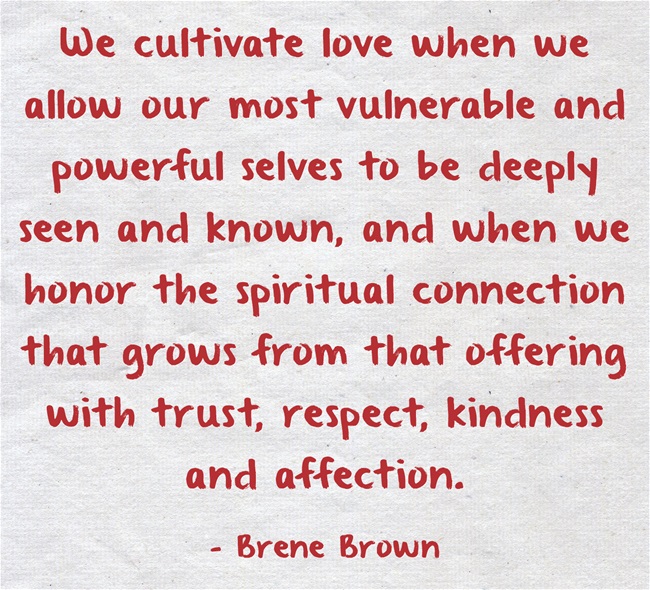
Being open to the possibility of heartache is a prerequisite for entering any kind of relationship. The people who know us best and who we are closest to are those who are most capable of loving us, but they are also the people who could most easily hurt us. If we want to gather people around us to love and be loved by us, we have to take risks. We have to have the strength to be vulnerable.

To love someone fiercely, to believe in something with your whole heart, to celebrate a fleeting moment in time, to fully engage in a life that doesn’t come with guarantees – these are risks that involve vulnerability and often pain. But, I’m learning that recognizing and leaning into the discomfort of vulnerability teaches us how to live with joy, gratitude and grace.” ― Brené Brown, from “The Gifts of Imperfection”

A Hypothesis on Heartbreak | marissabaker.wordpress.comNow, we should exercise a certain amount of caution when letting people get close to us. Some people simply cannot be trusted with your heart, but you usually don’t know who these people are until you start to get to know them. The key is to be vulnerable in stages. Don’t pour out all your thoughts, emotions, and self into someone you just met. You do, however, need to start connecting to people authentically if you want to develop relationships. Locking everyone out might keep them from breaking your heart, but you’ll end up lonely if you try that and loneliness can feel an awful lot like heartbreak.

Brene Brown has a great TED talk about this subject. She says that the people who have “a strong sense of love and belonging” see vulnerability as fundamental. They share a willingness “to say ‘I love you’ first, the willingness to do something where there are no guarantees … to invest in a relationship that may or may not work out.” It’s not easy, and it’s not guaranteed to keep you safe, but I think it is better to risk getting close to people than fighting your human desire for connection “as you would struggle against an enemy.”

A Trip to the Zoo

I have two reason why you’re getting a rambling post about how I spent yesterday rather than a nice, neat article:

1) NaNoWriMo

50,000 words in 30 days = one novel, and not much sleep. I’ve done it twice before, and I’m trying again this year with a Young Adult novel full of super humans (click to visit my writer’s website). I’m prepared with enough Lindt hazelnut truffles to reward myself every 5,000 words (plus a few extras, just in case).

2) Zoo Day!

Months ago we got half-price tickets to the Columbus Zoo, and just never seemed to find time to use them. Then we realized they expired in February, and it wasn’t getting any warmer, so we went yesterday. It was so cold that most of the South-Asian and African animals weren’t out, but the predators were very active.

Amur leopards
the Amur leopards were moving too fast for my camera

Very, very active, in some cases. The brown bears were chasing each other all over their exhibit, my family saw a tiger try to pounce on one guy through the glass, and there was a cheetah stalking a child being pulled in a wagon.

brown bears
huge brown bears

We also saw an extremely rare creature — an awake koala. They sleep 22 hours a day if given the chance, and I think this is the only time I’ve ever seen one moving.

koala
hungry koala

I’d say the dinosaurs were even more rare, but they weren’t moving much. Didn’t even try to snatch a tourist out of the boat ride, so I suspect they were animatronic.

it's a dinosaur
It’s a dinosaur!

The aquarium in Columbus might not be huge by public aquarium standards, but it’s certainly one of the most impressive at a zoo. I love the manatees. Columbus and Cincinnati are the only aquariums in the U.S. outside of Florida that help with manatee rescue and rehabilitation.

manatee
Stubby can’t be released into the wild because of propeller damage to her fluke and an autoimmune disease that affects her skin

And last but not least … I found a yurt!

yurt, a.k.a. one of the cutest structures known to man

Choose God (Lessons from Hosea, part two)

Last week, we began a study of Hosea, and covered the first three chapters. We looked at how Hosea’s marriage to a prostitute pictured God’s covenant with unfaithful Israel in the Old Testament, and how that serves as a warning to us. We need to learn from Israel’s example and not follow their pattern of repeatedly rejecting God, but rather hold fast to Him as He fulfills His promises to reestablish a marriage covenant with His people.

As we continue in Hosea, we see God addressing the reasons for Israel’s unfaithfulness. Everything that separated Israel from God was Israel’s fault.  God never let down His side of the bargain — Israel got into trouble because they walked away from Him. This holds true for the New Testament as well.

If we endure, we shall also reign with Him. If we deny Him, He also will deny us. If we are faithless, He remains faithful; He cannot deny Himself. (2 Tim 2:12-13)

God is always faithful to His promises, including His promise that sin will be punished. Like with Israel, it is still up to us to choose between life and death, blessings and cursing (Deut. 30:9).

Lack of Knowledge

Hear the word of the Lord, you children of Israel, for the Lord brings a charge against the inhabitants of the land: “There is no truth or mercy or knowledge of God in the land.” (Hos 4:1)

God gives three reasons for His “controversy” with Israel. They lacked truth, did not show mercy, and had no knowledge of Him. This resulted in “swearing and lying, killing and stealing and committing adultery” (Hos. 4:2). The farther they strayed from God, the more corrupt and destructive they became.

My people are destroyed for lack of knowledge. Because you have rejected knowledge, I also will reject you from being priest for Me; because you have forgotten the law of your God, I also will forget your children. (Hos 4:6)

This verse specifically refers to knowledge about God and His ways. The New Testament tells us that “the wisdom of this age” — knowledge that the world esteems — is coming to nothing (1 Cor. 2:6), but that “all the treasures of wisdom and knowledge” are hidden for us to find in the Father and Christ (Co. 2:2-3).

Chapters 4 and 5 cover punishments for Israel, and deal with prophecies of an Assyrian invasion and Judah’s alliances with Egypt and Syria. In chapter 6, the people say, “Come, and let us return to the Lord,” but they are not sincere (Hos. 6:1, 4).  Their sham repentance is not what God was looking for.

For I desire mercy and not sacrifice, and the knowledge of God more than burnt offerings. But like men they transgressed the covenant; there they dealt treacherously with Me. (Hos. 6:6-7)

God is all about relationship. He wants to know the people we’ll become when we learn to know Him. All the religious services and laws given to Israel weren’t the “point” of the Old Covenant. They were supposed to be an outward sign of an inward condition — a heart full of truth, mercy, and the knowledge of God.

Because of Unbelief

Israel’s lack of relationship with God was a result of choices they make to walk away from Him.

When I would have healed Israel, then the iniquity of Ephraim was uncovered, and the wickedness of Samaria. For they have committed fraud; a thief comes in; a band of robbers takes spoil outside. They do not consider in their hearts that I remember all their wickedness; now their own deeds have surrounded them; they are before My face. (Hos. 7:1-2)

Wickedness, lies, adulteries (Hos. 7:3-4) — their sins kept piling up until God could say of the people that “none among them calls upon Me” (Hos 7:7). The entire nation rejected the One who they had entered into a covenant with.

Woe to them, for they have fled from Me! Destruction to them, because they have transgressed against Me! Though I redeemed them, yet they have spoken lies against Me. They did not cry out to Me with their heart when they wailed upon their beds.
They assemble together for grain and new wine, they rebel against Me; though I disciplined and strengthened their arms, yet they devise evil against Me; they return, but not to the Most High; they are like a treacherous bow. Their princes shall fall by the sword for the cursings of their tongue.  (Hos. 7:13-16)

quotescover-JPG-96Israel did this continually in the Old Testament. Psalm 78 records that even though “their heart was not steadfast with Him, nor were they faithful in His covenant” that God was “full of compassion” and held back His anger many times (Ps. 78:37-38). He was grieved by their sins, because they would not let Him be their God. Though He acted as their Redeemer, Deliverer, and Rock, “again and again they tempted God, and limited the Holy One of Israel” (Ps. 78:35, 41-42). By not believing in Him, they rejected His good works in their lives.

This rejection of God continued into the New Testament as well. Matthew 13:58 records that Jesus “did not do many mighty works” in His hometown “because of their unbelief.” Mark’s account of this incident phrases it, “He could do no mighty work there, except that He laid His hands on a few sick people and healed them” (Mark 6:4-6). Where there was belief, simply touching the edge of Christ’s garments brought healing (Mark 5:27-29, 34). Where there was no faith, He was actually limited in how many miracles He could perform.

Make A Choice

Israel was given a choice whether or not to follow God and welcome His involvement in their lives. Many of them made the wrong choice, as Paul describes in Romans 11 when comparing God’s people to an olive tree where some of the natural branches were removed. In this analogy, Gentile New Testament Christians are wild olive branches grafted into the Rootstock. Once there, we also have a choice to make.

You will say then, “Branches were broken off that I might be grafted in.” Well said. Because of unbelief they were broken off, and you stand by faith. Do not be haughty, but fear. For if God did not spare the natural branches, He may not spare you either. Therefore consider the goodness and severity of God: on those who fell, severity; but toward you, goodness, if you continue in His goodness. Otherwise you also will be cut off.  And they also, if they do not continue in unbelief, will be grafted in, for God is able to graft them in again. (Rom. 11:19-23)

Like so many serious warnings in the Bible, this contains hope as well as caution. The Bible provides us with records of Israel rejecting God, being punished, and returning to Him again and again. God leaves as many doors open as possible for people to come back to Him, and He’s eager to “graft them in again” if they repent. These doors are open to us as well. But God still wants us to learn from Israel’s mistakes and choose not to leave Him at all, because even though He is a God of enormous mercy there is a point where we can go too far away to get back to Him.

For if we sin willfully after we have received the knowledge of the truth, there no longer remains a sacrifice for sins, but a certain fearful expectation of judgment, and fiery indignation which will devour the adversaries. Anyone who has rejected Moses’ law dies without mercy on the testimony of two or three witnesses. Of how much worse punishment, do you suppose, will he be thought worthy who has trampled the Son of God underfoot, counted the blood of the covenant by which he was sanctified a common thing, and insulted the Spirit of grace? (Heb. 10:26-29)

Like He did in Deuteronomy 30 with Israel, today God sets before His people a choice between life or death, blessings or cursing, and good or evil. He wants us — pleads with us — to choose life, blessings, and good, but the choice is still ours to make.

Time and Foreknowledge (Free Will, Part 2)

Last week, I started writing about a question one of my friends asked regarding my views on free will. That post was part 1 and it has lots of background info for this post, so if you haven’t read it yet you can check it out here. Another aspect  of the question he asked, which I didn’t have time to get to last week, was “Do you believe God is omniscient, or do you believe there are limits to His knowledge of the future, etc.”

Omniscience basically means “all knowing,” and I suppose given these two options I’m going to have to go with saying that I believe there are some limits to God’s knowledge of the future. That’s the short answer 🙂 Here’s the long one …

God Knowing Us

Prophecy teaches us that God has knowledge of future events — fulfilled prophecy gives us proof that He was correct in the past and we have faith that He will also be correct about the future. God has a plan for where the world is heading, and He certainly has the power to get it there. This is the kind of thing we talked about last week when looking at the examples of Jonah and Abraham.

Continuing with these two examples, I’ve said I believe that Jonah, Abraham, and Sarah had free will in how they responded to God’s work in their lives. But the fact that God didn’t make the decisions for them doesn’t prove that He didn’t know how they would respond.

O Lord, You have searched me and known me. You know my sitting down and my rising up; You understand my thought afar off. You comprehend my path and my lying down, and are acquainted with all my ways. (Ps. 139:1-3)

Many verses speak of God knowing our hearts, but these are mostly present-tense, as far as I can tell. From perfect knowledge of what we are now, I suppose God has a pretty good idea of what we will be and how we will act in the future. I think we still have the potential to surprise Him, through.

I, the Lord, search the heart, I test the mind, even to give every man according to his ways, according to the fruit of his doings. (Jer. 17:10)

If God did know exactly how we were going to live our lives, however, why does He need to search our hearts to determine how to reward us? Probably the best example of this is Abraham’s test. God commanded him to sacrifice his only son, and Abraham was prepared to do so right up to the moment God stopped him. Up until Abraham was at the point where he was about to kill Isaac, it seems that God didn’t know how far Abraham would go to obey Him.

And He said, “Do not lay your hand on the lad, or do anything to him; for now I know that you fear God, since you have not withheld your son, your only son, from Me.” (Gen. 22:12)

God’s Foreknowledge

Some people use Psalm 139:16 to say God knows the day we will die and has all our days mapped out. The King James Version doesn’t give that sense at all, but other translations could. Here’s a few:

Thine eyes did see my substance, yet being unperfect; and in thy book all my members were written, which in continuance were fashioned, when as yet there was none of them. (KJV)

Your eyes saw my substance, being yet unformed. And in Your book they all were written, the days fashioned for me, when as yet there were none of them. (NKJV)

Your eyes saw my unformed body; all the days ordained for me were written in your book before one of them came to be. (NIV)

I really have doubts about this interpretation, though. Going back to the story of Nineveh, God told those people through Jonah that He would destroy their city in 40 days. We know “it is impossible for God to lie” (Heb. 6:18), so I can’t believe He told them this if he already knew He would delay Nineveh’s punishment (Jon. 3:1-10).

A similar case occurs in 2 Kings 20. King Hezekiah falls ill, and the Lord sends Isaiah the prophet to tell him, “Set your house in order, for you shall die, and not live” (2 Kings 20:1). Hezekiah prayed to the Lord …

And it happened, before Isaiah had gone out into the middle court, that the word of the Lord came to him, saying, “Return and tell Hezekiah the leader of My people, ‘Thus says the Lord, the God of David your father: “I have heard your prayer, I have seen your tears; surely I will heal you. On the third day you shall go up to the house of the Lord. And I will add to your days fifteen years. I will deliver you and this city from the hand of the king of Assyria; and I will defend this city for My own sake, and for the sake of My servant David.”’” (2 Kings 20:4-6)

Again, why would God tell Hezekiah that he was going to die if He already knew that He would give Hezekiah 15 years? This story is one of the reasons we have hope when we pray — because we know God hears us and can intervene to answer our prayers. If everything was predestined, what would be the point of praying? For that matter, what would be the point of obeying the commandments or being loving and faithful? As a commenter on last week’s post pointed out, “If there were no free will, then whether we believe in God & Jesus, and whether we love them or not, would be determined by God, not us. And if that were the case, then it would not be true faith and it would not be true love. For faith and love to be real, there must be a choice.”

Some Ideas About Time

From what I read in the Bible, along with a dab of theoretical physics and a heavy dollop of sci-fi, here’s my pet theory: assuming time and space are connected, then “a God who is not limited by space is not limited by time” (I got that from an old Moody science tape).  I hypothesize that God can step outside of time in a way and see how the potential outcomes are changing. He can look at the whole breadth of human history, read every nuance of the present, and predict and direct the course of events. He has a definitive end goal in mind, and He can directly intervene to accomplish that goal, but I think our specific futures are in a state of flux, changing as we make decisions.

Time and Foreknowledge (Free Will, Part 2) | marissabaker.wordpress.comI’m perfectly willing to admit there are flaws and gaps in my theory, and it might even be totally worthless, but it is what makes sense to me. I’d love to hear your thoughts/ideas/theories if you’d like to share them. 🙂 I really don’t think we can fully understand how God relates to time and the future right now — we can just see glimpses and try to make sense of the clues we are given.

“For My thoughts are not your thoughts, nor are your ways My ways,” says the Lord. “For as the heavens are higher than the earth, so are My ways higher than your ways, and My thoughts than your thoughts. (Is. 55:8-9)

In keeping with the fact that God’s thoughts are very different and much higher than ours, He has a unique view of time as well.

But, beloved, do not forget this one thing, that with the Lord one day is as a thousand years, and a thousand years as one day. (2 Pet. 3:8)

For a thousand years in Your sight are like yesterday when it is past, and like a watch in the night. (Ps. 90:4)

This is very confusing for us, trapped in a single moment of linear time. We have imperfect recall of our own past, second-hand knowledge of history and other people’s lives, limited understanding of the present, and dim ideas about the future. Compared to us, God is indeed omniscient, even if there are what we think of as “limits” to His foreknowledge.

The Potter’s Hands (Free Will, Part 1)

A few weeks ago, a friend asked for my thoughts on “free will.” He’d written a blog post about the subject, and someone contacted him to say they didn’t believe in free will. The ongoing discussion has prompted a fascinating Bible study for me, and I think I’ll have to make this a two-part post to fit everything in.

The idea of predestination has a long history in Christianity. My understanding is it basically says God has foreknowledge of all things that will happen and predetermines who will receive salvation and who will not. The idea that God is all knowing would imply He knows things like how and when we will die and whether or not we’ll be in His family. And if He already knows the course of our lives, doesn’t that mean we don’t have free will?

Does not the potter have power over the clay, from the same lump to make one vessel for honor and another for dishonor? What if God, wanting to show His wrath and to make His power known, endured with much longsuffering the vessels of wrath prepared for destruction, and that He might make known the riches of His glory on the vessels of mercy, which He had prepared beforehand for glory (Rom. 9:21-23)

At first, this scripture does seem to indicate that God determines our fates and we do not have free will because He shapes our lives. However, when we start looking at examples of how God deals with people, I think we see more evidence for free will than against it. While God does directly intervene to shape the course of some individual’s lives, we also have choices.

Dealing With Jonah

Let’s take the case of Jonah. If it looks like anyone in the Bible didn’t have freedom to choose his own path, it’s Jonah. He was told, “go to Nineveh, that great city, and cry out against it; for their wickedness has come up before Me” (Jon. 1:2). He decided that wasn’t a good idea, and we all know how God used a storm and a big fish to override Jonah’s decision and get him back on track.

So Jonah arose and went to Nineveh, according to the word of the Lord. Now Nineveh was an exceedingly great city, a three-day journey in extent. And Jonah began to enter the city on the first day’s walk. Then he cried out and said, “Yet forty days, and Nineveh shall be overthrown!” (Jon. 3:3-4)

The people of Nineveh responded with repentance, and “God relented from the disaster that He had said He would bring upon them, and He did not do it”( Jon. 3:10) The prophecy of Nineveh’s destruction still happened, but God changed the time-table to spare all these people who chose to repent (my study Bible says the destruction happened 100 years later). The Ninevites had free will.

And really, so did Jonah. God was determined to use him for the purpose of contacting Nineveh, but that didn’t stop Jonah from choosing to try running away and then choosing a bad attitude about God’s mercy toward Nineveh (Jon. 4:1-11).  Though God directly molded Jonah’s life, Jonah still chose how he would respond to God’s work.

Abraham’s Children

The life of Abraham is another example. In Genesis 15, the Lord promised Abraham a son and made a covenant with him. Then, after living in Canan for 10 years and having no children, Abram and Sari took matters into their own hands and conspired to create a son using Sari’s Egyptian servant, Hagar (Gen 16:3, 15). But this was not how God planned to give Abraham a son.

And Abraham said to God, “Oh, that Ishmael might live before You!” Then God said: “No, Sarah your wife shall bear you a son, and you shall call his name Isaac; I will establish My covenant with him for an everlasting covenant, and with his descendants after him. And as for Ishmael, I have heard you. Behold, I have blessed him, and will make him fruitful, and will multiply him exceedingly. He shall beget twelve princes, and I will make him a great nation. But My covenant I will establish with Isaac, whom Sarah shall bear to you at this set time next year.” (Gen. 17:18-21)

Though Abraham and Sarah did not act in the way God had intended, He worked with His peoples’ choice. God’s plan moved forward as He willed, but with the addition of Ishmael and all the consequences of his birth.

Ananias and Sapphira

A New Testament example of free will can be seen in Ananias and Sapphira. God does not tempt anyone with evil and does nothing for our harm (James 1:13), so I don’t think we can say that He set them up to fail or that they had no choice but to sin. This is born out by the wording in Acts when Peter confronts each of them about keeping back part of the price of the land they sold as a donation to the church.

But Peter said, “Ananias, why has Satan filled your heart to lie to the Holy Spirit and keep back part of the price of the land for yourself? While it remained, was it not your own? And after it was sold, was it not in your own control? Why have you conceived this thing in your heart? You have not lied to men but to God.” (Acts 5:3-4)

Though Satan is identified as putting the evil idea in his head, the blame for choosing to do wrong is laid squarely on Ananias (and later on Sapphira as well in Acts 5:8-9). Both these individuals had the power to chose what they did with their possessions, and they chose wrong.

Authority to Plan

I think the point of Romans 9:21-23 is not that we have no choice, but rather that God has the authority to make decisions regarding how He deals with individuals and shapes future events. If we back-up and look at the verses leading to this point in Romans, Paul is talking about Israel. He covers the issue of Abraham’s children (Rom. 9:6-9), and then moves on to Isaac’s sons.

And not only this, but when Rebecca also had conceived by one man, even by our father Isaac (for the children not yet being born, nor having done any good or evil, that the purpose of God according to election might stand, not of works but of Him who calls),  it was said to her, “The older shall serve the younger.” As it is written, “Jacob I have loved, but Esau I have hated.” (Rom. 9:10-13)

This is not telling us that Esau had no choice when he sold his birthright (Gen. 25:29-34), or that Jacob had no choice but to steal Esau’s blessing (Gen. 27:1-40). Nor does it mean Isaac and Rebekah were fated to pick favorites and set up a rivalry between their sons. It means God has a plan and He was going to carry it out using or (in spite of) the good and bad choices His people made.

What shall we say then? Is there unrighteousness with God? Certainly not! For He says to Moses, “I will have mercy on whomever I will have mercy, and I will have compassion on whomever I will have compassion.” So then it is not of him who wills, nor of him who runs, but of God who shows mercy. For the Scripture says to the Pharaoh, “For this very purpose I have raised you up, that I may show My power in you, and that My name may be declared in all the earth.” Therefore He has mercy on whom He wills, and whom He wills He hardens. (Rom. 9:14-18)

God chooses who to work with and who not to. I suppose you could say there are elements to predestination in this, since God pre-determines which people He will call in this life, which will be nudged toward completing His will, and which will be left to “time and chance” and their own devices.

You will say to me then, “Why does He still find fault? For who has resisted His will?” But indeed, O man, who are you to reply against God? Will the thing formed say to him who formed it, “Why have you made me like this?” Does not the potter have power over the clay, from the same lump to make one vessel for honor and another for dishonor? (Rom 9:19-21).

In my mind, this is actually one of the stronger arguments in favor of free will. We have free will, and God has free will. He get’s to choose how He interacts with His creation, and to a certain extent we get to choose how we interact with God. Even being chosen by God doesn’t necessarily mean we’ll end up in His family — Hebrews 6:4-6 tells us it is possible to “fall away” and reject God’s calling. And if someone is not being called by God right now, that doesn’t mean He is ignoring the choices they make. It’s possible to get His attention (Matt. 15:21-28) and to call upon His name (Rom. 10:13).

Any thoughts or comments? Notice something I missed? Have a scripture to add? One closely related topic that might come to mind is God’s omniscience and the extent of His foreknowledge. That’s what I’m focusing on next week.The Potter's Hands (Free Will, Part 1) | marissabaker.wordpress.com