Have you ever cut someone out of your life because you were 100% done with that relationship? Then you’ve done a door slam. Anyone can door slam someone else, but it’s INFJs who are most “famous” (infamous?) for it in personality type circles. The INFJ Door Slam involves deciding not to invest any more time or emotional energy into another person. It’s also pretty final.
When you’re struggling with a hurtful and/or decaying relationship it’s always hard to know how to handle things. Do I slam the door on them and avoid more hurt? Do I try to address the problem and patch things up? The more self-aware I become, the more I realize that I have the capability to emotionally hurt those close to me and that I don’t want to do that. Sometimes relationships have to end, but perhaps it’s worth taking a little extra time to step back and ask how you can protect yourself while minimizing the damage you do to the other person.
While the door slam can be a healthy defense mechanism (like if you need to get out of a relationship with a narcissistic personality that’s controlling and manipulating you), it can also be a way of avoiding conflict. Much as we hate conflict, it’s sometimes necessary to rebuild a friendship that might actually be valuable if you’d put time and effort into fixing things. But how can you tell the difference between relationships you should fight for and ones you need to let go?
Are You Being Hurt?
That’s the first question. For a type known for their lie-detecting skills, INFJs are surprisingly prone to ending up in relationships with people who are not trustworthy. We can be far too inclined toward initially giving people the benefit of the doubt and then holding on to people who aren’t healthy for us. This might be because we feel that we need to help them, or because we see the person they want to be rather than who they are, or because we don’t feel that we have the energy to get out of the relationship. Read more →
Congratulations on the procurement your new INFJ!* INFJs are highly sought after in the personality type collecting world given their extremely rare nature. INFJ spotting is a very difficult hobby, requiring forays into the deepest recesses of bookstores, yoga studios, and the internet. Keeping an INFJ in your life once you’ve found one can be even more of a challenge.
INFJs are widely considered one of the most amiable and empathetic personalities. Their minds offer a good balance of emotion and logic that helps them relate to most types of people, and they highly value commitment and relationships. As introverts, though, they have limited social energy and they don’t maintain relationships with most of the people they meet. Once you’ve found an INFJ, taking your acquaintance to the level or friendship, or relationship, isn’t simple. That is, unless you have this user guide.
Overview of the INFJ
The INFJ is a strange sort of creature, often compared to unicorns. Their uniqueness is a result of two things: the way their brains/personalities are hardwired and the rarity of their personality type. What’s perfectly normal for an INFJ seems unusual among humanity as a whole because so few people function this way. Understanding your INFJ’s basic functions is the first step towards successful interaction with the INFJ.
It’s strange that a personality type for which “homemaker” is one of the top recommended career options has such a difficult time finding love. While not true of all INFJs, many of us are romantics in every sense of the word. We’re idealists who still believe in soul-mates. We’re eager to dive deep into relationships and prioritize the people closest to us. We’re among the MBTI types least likely to cheat in a romantic relationship.
But we also shy away from any type of deep relationship if we don’t feel completely safe. Our idealism means we often have unrealistic expectations for our (potential) romantic partners. The soul-mate type of understanding we crave is hard to find. And so here I am, turning 27 this year having been on 4 dates since I was 19 (all with guys I chose not to go out with a second time) and yet still wanting to be in a relationships (almost) just as much as ever.
So what’s a single INFJ to do? It sounds cliche, but I agree with Amelia Brown on Introvert, Dear that it’s important to focus on “the relationship you have with yourself.” If you’re not comfortable with yourself, you’re never going to be happy, regardless of whether or not you’re in a relationship with someone else. Also, if you haven’t taken ownership of your life, your choices, and your struggles then you’re going to have a harder time cultivating the sort of strong, lasting relationship INFJs crave. Read more →
I’m staring out the backseat window watching unplanted fields roll by while having a conversation. It’s going pretty well — we’re exchanging ideas, sharing authentic feelings, clarifying anything that was unclear earlier — in short, it’s the kind of meaningful conversation I crave with people I care about. Only one problem: it’s all happening in my head and the guy I’m talking with has no clue we just had this conversation.
From talking with other INFJs and writing my INFJ Handbook, I know thinking through past and potential conversations is something my personality type does. We tend to favor the world inside our own heads and spend plenty of time there. We’re also interested in people, though, so it makes sense that many of our inner thoughts are about how others might respond to us and what they might think about our ideas.
But living inside your head isn’t just an INFJ thing — a preference for the inner world is one of the main ways we define introversion. With that in mind, I asked a group of introverts on Facebook if they related to this and got some interesting responses from several different personality types. I also mentioned that sometimes I forget which conversations I’ve actually had with people and which ones only took place in my head and that resonated with some but, everyone. Here’s a few of the comments I got (used with permission):
“That doesn’t sound like something limited to certain personality types, other than introversion itself. I find myself doing it from time to time. I don’t usually think about others’ feelings or intuit what they are thinking, but the conversations always play out in my head way more than they ever do in real life” (anonymous ISTJ)
“Yes, I do! It’s getting harder and harder to distinguish which is the “real” conversation. I know too well how you feel … I don’t think it’s limited to any particular personality type” (anonymous)
“Yep, all the time. It’s the really confrontational ones that will get me though. I get really angry at scenarios I have dreamed up in my head” (Charis Tippets Branson, INFJ)
“90% of the conversations I have are in my head” (anonymous)
“I do that. Though I remember if I’ve actually had those conversations because the imaginary ones were full of remarks I’d never actually say” (Mary Menard)
“I do this regularly. It’s especially helpful if it’s a hard conversation that needs to happen. The problem is that I have it all figured out and sometimes forget I didn’t actually have the conversation. Last week I told my husband, ‘So, do I really have to call and talk to her or could I just pray and ask God to tell her for me?’ He said I need to call. 😐 I wrote down what to cover or I get into listening mode and have no idea what I was planning to say” (anonymous INFJ)
Last week, I stumbled across an article on Pinterest talking about female INFJs. Well, technically it was about INFj in the Socionics system, which is a bit different than the MBTI type and may include INFPs as well, but for purposes of this article we’ll just talk about INFJ types. The original article, written in 2011 by someone identified only as Beskova, paints a portrait of the INFJ type that is beautiful on the surface but doesn’t quite manage to reach their heart. It’s part of a disturbing trend in portrayals of INFJs, though this is the most extreme example I’ve seen.
Like many people who treat the INFJ type as quasi-mythical, this writer describes INFJs as flawless, naive, pure and submissive. They even describe a typical INFJ appearance: “Women of this type are very feminine and are delicate, modest and even shy. … They have a very ephemeral body, and sometimes lightly stooped posture.”
Reading on, it seems the INFJ has no faults. They never gossip or argue, meet adversity with mild gentleness, focus on humanitarian efforts, fit into any job, and submit themselves selflessly to helping the people in their lives. In short, the article says, “When a female INFj becomes your wife, know that in your home there lives a quiet angel” who “makes for one of the most obedient wives.”
The biggest problem with this portrait of an INFJ isn’t just that it’s untrue; it’s the fact that INFJ women may try to fit into this mold if they end up in a relationship with someone who expects “their” INFJ to act like this. One thing that’s become clear in the months I’ve been reading things INFJs share online is that we’re one of the types most vulnerable to getting involved in unhealthy relationships with narcissists. And INFJ descriptions that make us out to be perfectly submissive and obedient aren’t helping discourage interest from unhealthy people.
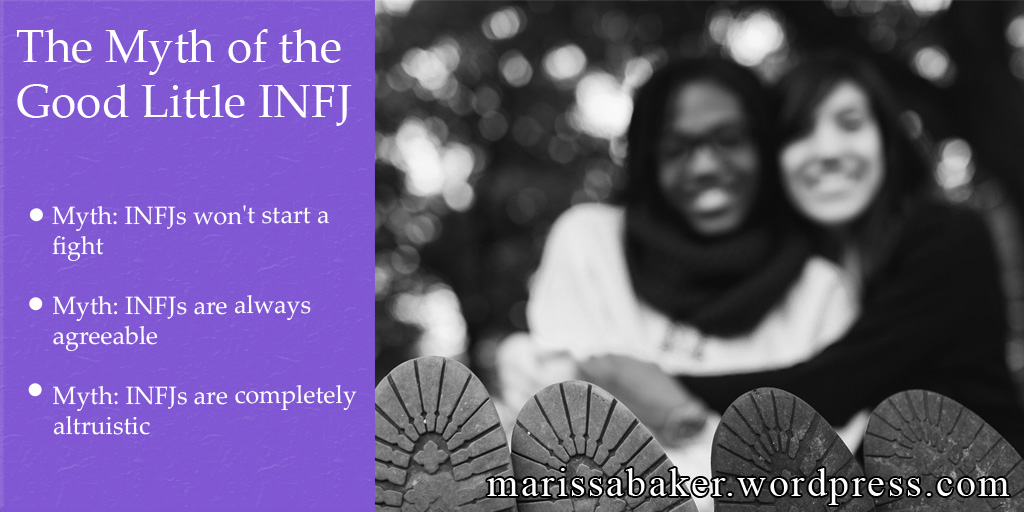
Myth: INFJs won’t start a fight
It’s true that INFJs are one of the most conflict-avoidant types. Until a person does something the INFJ can’t live with, we’ll often just nod and smile at most conversations and suggestions. This happens with casual acquaintances when we don’t want to wast energy on conflict, and in closer relationships when we don’t want to deal with the emotional fall-out of conflict unless there’s a very good reason. I talk about this at greater length in my INFJ Handbook.
But if you think INFJs can’t get angry or won’t take a stand when things aren’t as they should be, think again. INFJs tend to draw a line in their minds, and once it’s crossed we’ll make sure we let you know. Once we get started, we’ll probably tack on a list of every other way you’ve ever let us down as well. The closer we are to you, the better we’ll know how to tear you apart (note: we’re not proud of this fact, and many INFJs work hard at controlling their anger). The best way to avoid this in a relationship is to keep open lines of communication, which is the number one thing many INFJs are looking for in a relationship. INFJs prefer to keep our emotions out in the open, and if we feel safe and heard then there’s no need to bottle up our feelings until we explode.
Myth: INFJs are always agreeable
In this socionics article, the writer talks about how INFJ women often need/want other people to make decisions for them. They write, “If you are her husband take responsibility for making major decisions in development of your family and she will with pleasure obey you.” Now, I’ll be honest — sometimes I do want people to make decisions for me. But if an INFJ is consistently told she can’t be trusted with important decisions and is left out of the planning process, then she’s going to stop trusting you.
The other party might not even notice an INFJ doesn’t agree with him if he’s expecting her to be what the article says: “friendly and dutiful, never quarrel nor ask much for themselves.” We place a high value on trust and communication in relationships, and assuming we agree with you instead of really asking us what we think is a good way to experience the INFJ door slam.
A tip for people who know INFJs: If we don’t actually agree with you, or simply don’t care, we’ll typically make non-committal sounds, nod our heads, and avoid eye contact. If pressured to commit to something we don’t want to do or think, but won’t openly disagree with, we’ll try to push it off to an unspecified future date. When an INFJ actually agrees with you, we’ll make eye contact, our face will light-up, and we’ll say things like “Oh, yes” instead of just nodding. Usually, we’ll also be able to explain why we agree with you in specific terms.
Myth: INFJs are completely altruistic
One last quote from the socionics article: “watch that her emotional resources aren’t spent on her girlfriends, who inadvertently will use your wife as a psychotherapist. She will never refuse them herself, of course. Out of compassion. Therefore, it will be best if you take the matter into your own hands and limit the flow of those desiring to obtain psychotherapeutic sessions and useful advice from her.” Excuse me! What gives someone else the right to limit an INFJ’s contact with her friends? That’s the sort of controlling behavior that’s a huge red-flag in any relationship.
In addition to being incapable of taking care of herself, INFJ wives are apparently so dutiful they’ll do all the housework without any complaint even though they hate cleaning and cooking. For the record, this INFJ loves cooking and the housework doesn’t always get done in a reasonable amount of time. Also, one reason INFJs will avoid conflict and try to help people is because of how it affects us. Sometimes I do what people ask just because I don’t want to stay awake for three hours that night re-hashing every word of the resulting argument. It’s a self-protecting mechanism. That’s not to say INFJs don’t care about people — we do, deeply, and we will support our friends and family whenever possible. It’s a good thing. We can stretch ourselves too thin at times, but INFJs value their introvert time and don’t usually need someone to step in an control their lives to keep them from burning out. We’re not that altruistic.
In conclusion …
I may have dispelled some of the “mystic unicorn” aura surrounding INFJs, but perhaps that’s a good thing. Our rarity doesn’t make us better than other types, and type portraits that make us out to be something ephemeral and idyllic really aren’t helpful. As my siblings (and no doubt other people who INFJs have let into their lives) can testify, we’re not perfect.
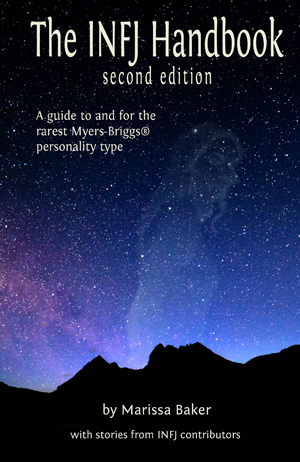
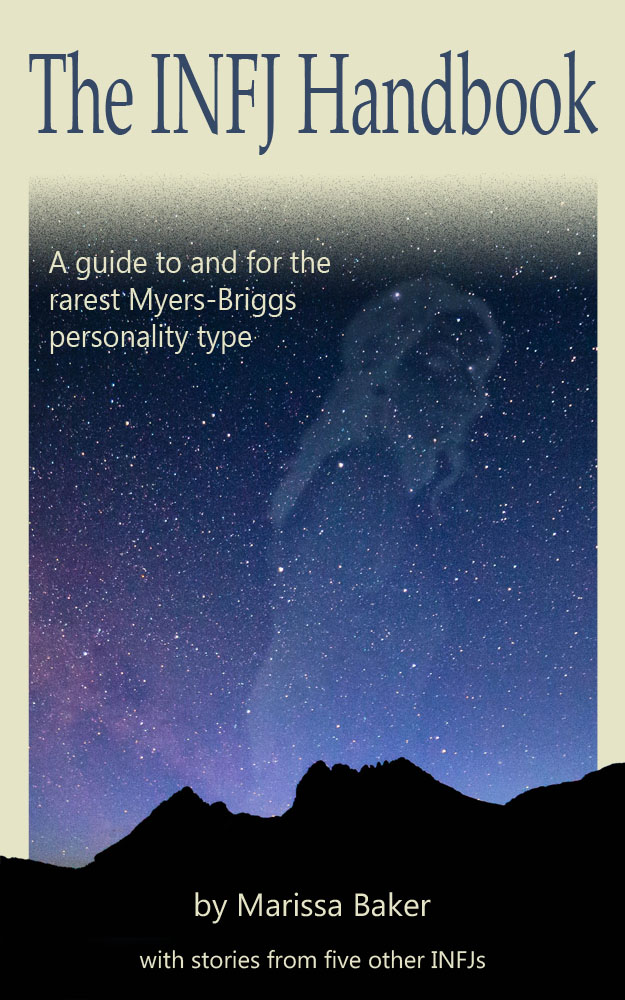
Two years ago this weekend, I published my first INFJ blog post on this site. It seems fitting, then, that I’m releasing my first e-book this weekend and that it is all about INFJs. Inside, you’ll find:
Quick introduction to Myers-Briggs type theory
Thorough description of the INFJ personality type
Discussions of INFJ strengths and weakness
Tips for personal growth
List of things that INFJs want other people to know
A very special thanks to Kerry, Rachel, Johanna, Denise, and Yeni — the INFJs who contributed the stories appearing in this book. You should have already received a free PDF copy of this book at the e-mail address I have on record for you. If not, let me know.
You can purchase this book in the Amazon Kindle store. For this first week only, the book is on-sale for $0.99. It will go back to the regular price of $2.99 next Monday morning.




 Like An Anchor