I didn’t get to read the book until recently because I was distracted by other new releases, some of which I had advance reader copies to review, and I was waiting for a library to buy it. I finally got a copy through an inter-library loan program and eagerly sat down to read. Unfortunately, while this book contains some really good content, I felt like it was too much about Curt Landry and not enough about its stated purpose of helping people understand how the Jewish roots of Christianity can transform their faith.
Our Forgotten Heritage
When Jesus arrived here on earth (or Yeshua, to use His Hebrew name), He didn’t come to bring a new religion. Yeshua came as the next stage in God’s plan which He’d laid out from the foundation of the world. What we now call Christianity has its roots in the faith of the ancient Israeli people and the Jews of Jesus’ time. Though this phrasing is mine, this is one of the main arguments of Landry’s book and it’s the part I found most fascinating.
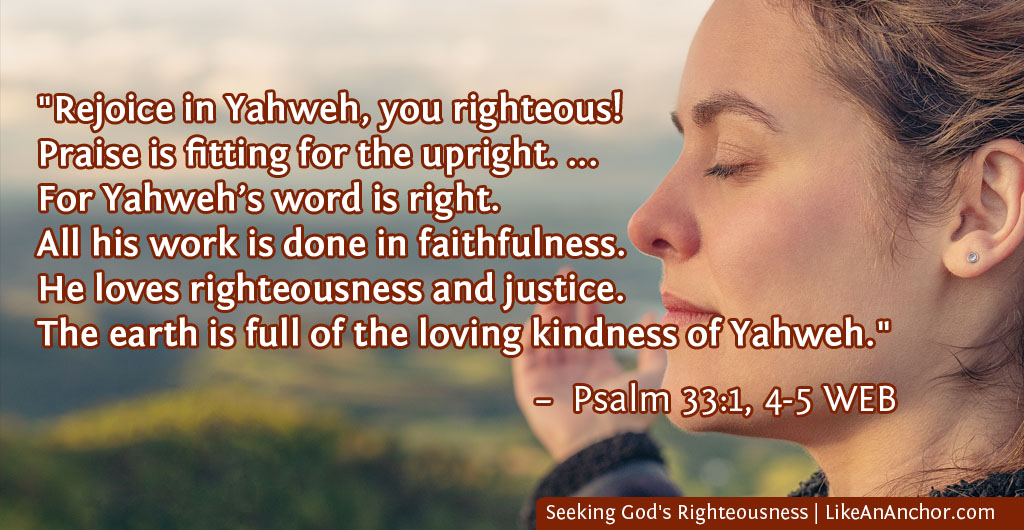
“I am Yahweh who exercises loving kindness, justice, and righteousness in the earth, for I delight in these things,” says Yahweh.
I quoted this scripture from Jeremiah 9:24 in last week’s post and I’ve been thinking about it ever since. God defines Himself by using these three concepts and says He delights in them. If they’re that important to Him, then they should be important to us.
I feel like we talk fairly often about the fact that God balances justice/judgement and mercy/loving kindness. But sometime we’re puzzled about how exactly that works. Back in Medieval times, theologians wondered how a God of judgement and justice could also be one of mercy. Now we ask how a God of love and mercy could also be one of judgement. I think taking God’s characteristic righteousness into account — as well as studying the Hebrew word meanings — can help answer those questions.
Shapat, justice
We in the Christian churches today often start with the New Testament when trying to understand a concept. It can be useful, though, to start with the Old Testament because that’s the foundation the New Testament writers built on. In Hebrew, words for justice, judgement, government, and ordinances are all interconnected in the root word shapat (Theological Wordbook of the Old Testament, entry 2443).
We tend to think of judgement/justice as a judicial concept. In Hebrew thought, though, the functions of government were’t divided as we so often do today. The primary meaning “of shapat is to exercise the process of government” in any realm or any form.
When the Bible speaks of God’s judgement or justice it’s also referencing all aspects of His government, not simply judicial laws. To quote TWOT again, “although the ancients knew full well what law … was, they did not think of themselves as ruled by laws rather than by men … The centering of the law, rulership, government in a man was deeply ingrained.” Apply that concept to God, and the notion of justice has to do with Him as the center of true law, rulership, and government. He is the source of real authority and has the absolute right to rule as He chooses.
I’ve been reading a book called Reclaiming Our Forgotten Heritage by Curty Landry and one of his comments about what we’re supposed to “seek first” caught my eye. This book is about how understanding the Jewish roots of Christianity can transform your faith. It’s amazing to me how much we can miss when we read the Bible in English with a Western cultural mindset. And it’s equally amazing how much it can deepen our understanding of God and His ways to dive-in to the roots of our faith.
One of the things Landry talks about is how our interpretation of words and stories in the Bible can change based on whether we approach them through a Western philosophical lens or a first-century Jewish one. An example is how we see the word “righteousness” in Matthew 6:33.
When we read “seek first the kingdom of God and His righteousness,” we in the Western world tend to think this means we have to be righteous in the sense of being a “law-abiding citizen” of heaven. But a Jewish person listening to Jesus would have thought of the Hebrew concept of tzedakah, which changes how you interpret this verse. Let’s take a look at that.
Righteousness in Hebrew
Tzedakah is about justice, righteousness, and truthfulness (Brown, Driver, Briggs lexicon, entry H6666). It’s associated with God’s fairness and is also tied to acts of charity and giving. At my Messianic congregation, this word is written on the box where we put tithes and offerings because tzedakah is so closely connected with righteous giving.
In her article “God’s Kind of Righteousness,” Lois Tverberg points out that “tzedakah means more than just legal correctness – it refers to covenantal faithfulness, often resulting in rescuing those in distress and showing mercy to sinners.” It’s quite a bit different than what most of us think of when we think “righteousness,” but it’s very much in line with God’s character.
From this Jewish perspective, then, one would better read Matthew 6:33 in this way: “Seek first the kingdom and the righteous acts of God – seek first kindness, seek first abundant benevolence, seek first gracious acts and deliverances – and all these other things will then be added to you.” Read in this way, Matthew 6:33 requires a daily walk of faith that still challenges me to this day. (Landry, p. 134).
It might not sit well with many American Christians that we need to do what is right in addition to believing what is right. Or, depending on exactly what you believe, it might be challenging to know that our obedience has to go beyond legal correctness. But as a deeper look into tzedakah demonstrates, true faith involves ongoing growth and change as we become more and more like God. Nothing we can do will save us — “by grace you have been saved through faith, and that not of yourselves; it is the gift of God” (Eph. 2:8, all scriptures from the WEB translation). But after we’re saved, we do take certain actions in accordance with God’s ways — “faith, if it has no works, is dead in itself” (James 2:17).
He has shown you, O man, what is good. What does Yahweh require of you, but to act justly, to love mercy, and to walk humbly with your God? (Micah 6:8)
Jesus called justice, mercy, and faith “the weightier matters of the law” (Matt. 23:23). These are things which must not be left undone by God’s people. And though righteousness isn’t on this list, it is closely associated with mercy and justice (see Ps. 33;5; 889:14; Is. 16:5; Hos. 2:19). We’re supposed to become like God and since righteousness is part of His character it should be part of ours as well.
Our God loves righteousness (Ps. 11:7; 33:5). He even reveals it as one of His names which He puts on His people — Yahweh Tsidqenu, the Lord our Righteousness (Jer. 23:6; 33:16). In the Matthew 6:33 verse we opened with, Jesus doesn’t say “seek to be righteous” or that we should seek righteousness in general. He’s very specific. We are to seek God’s righteousness.
Yahweh says, “Don’t let the wise man glory in his wisdom. Don’t let the mighty man glory in his might. Don’t let the rich man glory in his riches. But let him who glories glory in this, that he has understanding, and knows me, that I am Yahweh who exercises loving kindness, justice, and righteousness in the earth, for I delight in these things,” says Yahweh. (Jer. 9:23-24)
Knowing God involves understanding that He exercises and loves righteousness. If we want to be righteous as He is, we need to come to Him. He will reveal His righteousness when we follow His ways and keep seeking Him, as Jesus told us to in Matthew 6:33 (Is. 54:17; 56:1; 61:10).
Returning to the idea that righteousness involves more than just law-based obedience, Jesus taught “that unless your righteousness exceeds that of the scribes and Pharisees, there is no way you will enter into the Kingdom of Heaven” (Matt. 5:20). He said this during the same sermon where He told us, “seek first God’s Kingdom and his righteousness.” Seeking righteousness is a foundational part of our faith, and yet the most scrupulously obedient religious elite of Jesus’ day didn’t practice God’s righteousness in a way that pleased Him. There is more to it than simply following rules.
We aren’t saved based on how well we measure up to God’s just laws. Jesus Christ died for us “so grace might reign through righteousness to eternal life” (Rom. 5:21). As we talked about earlier, God’s type of righteousness has to do with His kindness and benevolence — righteous acts that spring from His righteous character. His righteousness toward us isn’t about legal justification based on us already being perfect, but rather about bringing us into a right state with Him and empowering us to follow His example of righteous doing (Rom. 3:21-31).
Through Christ, we have “become the righteousness of God” (2 Cor. 5:21). We’re to be “filled with the fruits of righteousness, which are through Jesus Christ, to the glory and praise of God” (Phil. 1:11). Righteousness isn’t just passively applied, though. We must “follow after righteousness” (1 Tim. 6:11; 2 Tim. 2:22) and seek God’s “instruction in righteousness” from scripture (2 Tim. 3:16; Heb. 5:13). To quote Curt Landry again, seeking first God’s kingdom and His righteousness “requires a daily walk of faith” that challenges each of us today.
After writing last week’s post about coming to the Father through Jesus, I started studying the words “intercessor” and “mediator.” Interestingly, I found that in Hebrew the word used for “intercession” also means to encounter, come between, and meet with. It’s used in a variety of contexts, but I focused on the ones that related to how God interacts with us here on earth.
There are multiple ways that God can interact with humans. Two of those interactions involve rewarding good and punishing evil. We see the word for “intercession” used in both these contexts. This confused me at first, but as I studied it I found something that is very exciting and encouraging about how the two meanings connect.
Meeting With Punishment
The Hebrew word paga (Strong’s H6293) means “to encounter, meet, reach, entreat, make intercession” (BDB definition). Here’s one place it’s used in Exodus, when Moses and Aaron were talking with Pharaoh.
They said, “The God of the Hebrews has met with us. Please let us go three days’ journey into the wilderness, and sacrifice to Yahweh, our God, lest he fall on us with pestilence, or with the sword.” (Ex. 5:3, WEB)
“Fall on us” is translated from the word paga. We might paraphrase, “Let us worship God, or He’ll meet us with punishment.” It seems strange to have the same word as “intercession” used for meeting someone with pestilence or sword. Intercession tends to be seen as a more positive thing. If we head over to Isaiah’s writings, though, this starts to make more sense.
Those words, or a variation, come up again and again when I talk with people about what they need when they’re hurting. You’ll also find this advice in books, articles, and interviews talking about how to interact with grieving people. Don’t try to compare your pain to theirs, or explain it away, or slap verbal band aids on the wound. Just be there for them.
Whenever we think about suffering in the Bible, Job is one of the first stories that comes to mind. This man lost seven sons and three daughters all in one day, along with all his wealth. Shortly after that, Satan struck him “with painful sores from the soul of his foot to his head” (Job 1:13-22; 2:7-8, all quotes from WEB). Family, wealth, and health all gone in a moment. Job was about as low as you can humanly get. And so his three best friends came to comfort him and to teach us important lessons about how to interact with hurting people.
Comfort, Sympathy, and Silence
Now when Job’s three friends heard of all this evil that had come on him, they each came from his own place: Eliphaz the Temanite, Bildad the Shuhite, and Zophar the Naamathite; and they made an appointment together to come to sympathize with him and to comfort him. When they lifted up their eyes from a distance, and didn’t recognize him, they raised their voices, and wept; and they each tore his robe, and sprinkled dust on their heads toward the sky. So they sat down with him on the ground seven days and seven nights, and no one spoke a word to him, for they saw that his grief was very great. (Job 2:11-13)
Things started out well. 1) they cared about Job enough to keep track of what was going on with him and know he needed support. 2) they came to him for the purpose of comfort and sympathy. 3) they shared in his grief, weeping with him. 4) they didn’t talk; they just sat with him and waited to see what he’d need. Read more →
During His ministry on earth, Jesus said He was not here to destroy the law. Yet we also have record of the Jews saying He “broke the Sabbath” (Matt. 5:17; John 5:18). Do those two statements contradict?
Similarly, Paul said his own writings “establish the law,” but he also asked his readers why they would be “subject to ordinances” now that they live by faith (Rom. 3:31; Col. 2:20). Aren’t those statements contradictory as well?
These statements actually don’t contradict each other, but to understand why you have to know something about the Jewish world at the time. On one hand, you have God’s law that He delivered to His people through Moses (the Torah). On the other hand, you have additional rules, regulations, and traditions that were put in place by human beings.
So if we look more closely, we see Christ was not here to destroy God’s law, but He did loose the Sabbath from restrictions added by human teachers. Similarly, in Romans Paul is talking about establishing the law of God, but in Colossians he is talking about walking away from “the commandments and doctrines of men” (Col. 2:20-23).
So what does all this have to do with modern Christians? We’ll take a close look at this question in today’s post, and I think we’ll find that these statement that at first appear contradictory actually teach us about how we are supposed to relate to God’s law. They also teach us how to respond when other people (including teachers and leaders) start to change or add to God’s word.
Torah Teachers and Lawbreakers
For a long time, I’ve been confused about the opening verses for Matthew 23. They read like this:
Then Jesus spoke to the multitudes and to his disciples, saying, “The scribes and the Pharisees sit on Moses’ seat. All things therefore whatever they tell you to observe, observe and do, but don’t do their works; for they say, and don’t do.”
Matthew 23:1-3, WEB
I used to think Jesus was telling people to follow the extra traditions because we should respect authority even if it’s corrupt. That didn’t seem quite right, but it was the best I could figure out. Then a heard a sermon about the true meaning of legalism that explained things differently and (I think) more accurately.
Sitting in Moses’ seat refers to the scribes and Pharisees teaching the Torah that Moses taught. The Apostles make a similar observation later, saying they don’t need to focus their efforts on teaching Torah because the synagogues are already reading Moses every sabbath (Acts 15:21). Torah is important, but it was already being taught. That is why Jesus said to “observe and do” what the Jewish leaders said to do — because they were teaching God’s law.
These leaders were not, however, doing the law themselves and that’s why we’re told not to imitate their works. In fact, by saying “they say and don’t do” Christ is identifying them as lawbreakers (Matt. 23:4-36, particularly verse 23). They legalistically followed doctrines of men but broke the laws of God.
Jesus tells us to do what the scribes and Pharisees said inasmuch as they were faithfully teaching God’s words, but not to follow their example because they weren’t really keeping God’s law. This connects to an earlier point He made in the Sermon on the Mount.
Do not think that I have come to destroy the law or the prophets. I have not come to destroy them but to fulfill them. For truly I say to you, until heaven and earth pass away, not one tiny letter or one stroke of a letter will pass away from the law until all takes place. Therefore whoever abolishes one of the least of these commandments and teaches people to do so will be called least in the kingdom of heaven, but whoever keeps them and teaches them, this person will be called great in the kingdom of heaven. For I say to you that unless your righteousness greatly surpasses that of the scribes and Pharisees, you will never enter into the kingdom of heaven.
Matthew 5:17-20, LEB
I imagine it shook some of Jesus’ hearers to learn He expected them to follow God’s word with more righteousness than the scribes and Pharisees. That group was the most righteous that Jews could get, following every little ordinance to the letter. But as Jesus teaches in Matthew 23, their “righteousness” was not the type of righteousness that God seeks. Jesus wants His people to follow His words faithfully from the heart, not to put on a more righteous show. Aligning ourselves with Jesus is how we become truly righteous.
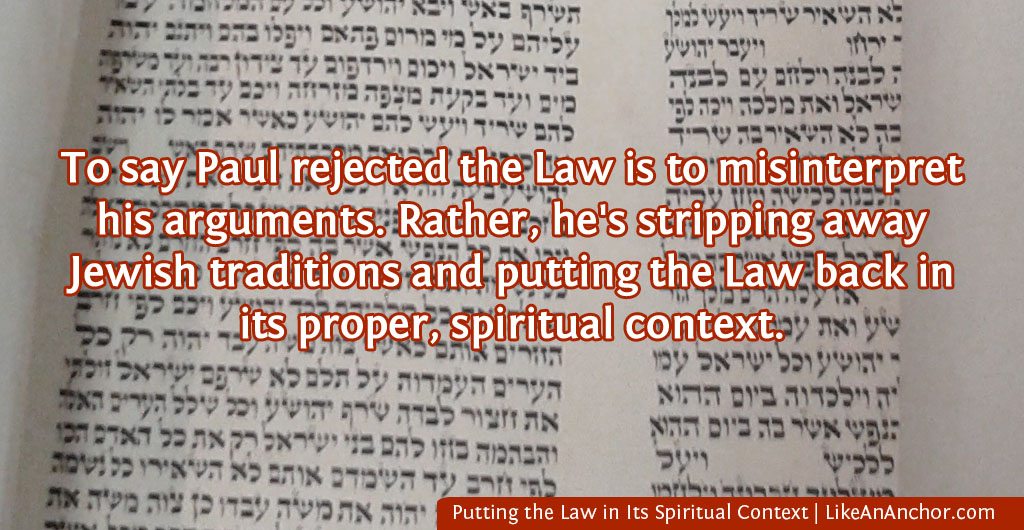
These passages of Jesus’ teachings are key to understanding Paul’s writings. As a faithful apostle he would not have contradicted Jesus by abolishing God’s commands or teaching people to break the law. Rather, Paul’s writings expand on how we relate to God’s laws as spirit-led Christians.
Photo credit: me
Inward Judaism
In the Old Testament, God promised a new kind of covenant relationship with His people, one where the Law would be written in their minds and hearts instead of imposed from the outside (Jer. 31:33). That happened when Jesus came as the Messiah (Heb. 8). So now we come to Paul — a rabbi who was once a Pharisee and became a faithful follower of Jesus (Phil. 3:4-6). Paul teaches how we should relate to God’s law under the New Covenant. He teaches that it’s not so much about “do”s and “don’t”s, but about inward transformation that makes us spiritual like God instead of fleshy.
For he is not a Jew who is one outwardly, neither is that circumcision which is outward in the flesh; but he is a Jew who is one inwardly, and circumcision is that of the heart, in the spirit not in the letter; whose praise is not from men, but from God.
Romans 2:28-29, WEB)
In this chapter of Romans, Paul tells his readers God cares more about how you live than your pedigree or your professions of lawfulness. “It isn’t the hearers of the law who are righteous before God, but the doers of the law will be justified” (Rom. 2:13, WEB). We need to keep the Law because we have a relationship with the Lawgiver which changes our character, not because we think the law will save us on its own. New Covenant believers still keep God’s law, but our relationship with it is different.
As Romans progresses, Paul builds an explanation for how post-Crucifixion believers relate to God’s law. We’ve all sinned and stand condemned under the law of God, which is incapable on its own of making anyone righteous. We can only be saved by Christ’s atoning sacrifice (Rom. 3:20-27). This doesn’t get rid of God’s law, though. “May it never be! No, we establish the law” (Rom. 3:31, WEB). Paul himself (perhaps anticipating how his words might be misread) makes sure that we understand his arguments establish God’s law rather than say it doesn’t matter.
Our walks as Christians should be closely identified with Jesus and affected by our participation in Him. We are buried into His death, raised to new life with Him, and now walk in Him freed from sin (Rom. 6:1-11). Because of this, we must not let sin rule over us. Instead of serving sin, we are now servants of righteousness (Rom. 6:12-23).
In dying with Christ, we also died to the condemnation from sinning/breaking the law and we are now joined to the Lawgiver in a New Covenant marriage “so that we serve in newness of the spirit, and not in oldness of the letter” (Rom. 7:1-6). There’s a struggle inside us about how we relate to the law that only Jesus can reconcile. “The law indeed is holy, and the commandment holy, and righteous, and good” (Rom. 7:12). It is also “spiritual, but I am fleshly, sold under sin” (Rom. 7:14). We want to do what God says but wrestle with human inability to be good.
For I joyfully agree with the law of God in my inner person, but I observe another law in my members, at war with the law of my mind and making me captive to the law of sin that exists in my members. Wretched man that I am! Who will rescue me from this body of death? Thanks be to God through Jesus Christ our Lord! So then, I myself with my mind am enslaved to the law of God, but with my flesh I am enslaved to the law of sin.
Romans 7:22-25, LEB
Jesus makes it possible for our inner man, which hopefully agrees with God’s law as Paul did, to live in alignment with Him even though we fall short of God’s perfect standard. We rejoice with God’s law and walk in the spirit, free from the fear that came with not measuring up under the old covenant. There’s no condemnation now because in Christ, we walk not after the flesh but in the spirit (Rom. 8:1-14).
We learn more about this flesh vs. spirit distinction in Paul’s other writings, notably Galatians 5:13-26. Instead of following our fleshly desires into sin or being preoccupied by trying to make ourselves perfect by our own power, we focus on walking in the spirit. This process necessarily results in change. Paul makes it clear that if we aren’t changing from flesh to spirit then we’re not in Christ. It’s as simple as that. Following Jesus and truly modeling His love results in us fulfilling the law in its proper, spiritual context as God always desired. Righteousness happens as a sort of side-effect when we’re following Christ and living a life that is truly spirit-led.








![Image of a Bible open on a table overlaid with Matt. 23:24, TLV version: “Woe to you, Torah scholars and Pharisees, hypocrites! You tithe[a] mint and dill and cumin, yet you have neglected the weightier matters of Torah—justice and mercy and faithfulness. It is necessary to do these things without neglecting the others. O blind guides, straining out a gnat while swallowing a camel!](https://likeananchor.com/wp-content/uploads/2019/08/law-spirit-3.jpg)
 Like An Anchor