INFJs — please share your stories

Update: The book is finished, and you can download the final version here. Thank you so much for your interest!

I’ve started work on an INFJ e-book, and would like to ask you – my fellow INFJs – to share some of your personal experiences. I don’t want this to just be another description of the INFJ personality type. I want real stories that INFJ readers can relate to, and which will give non-INFJ readers insight into how we think. Specifically, I’m looking for short first-hand accounts of what life is like as an INFJ. You can share anything you like, but here are a few prompts:

  • How did you first discover your type, and what was your reaction?
  • In what ways do you feel different from non-INFJs?
  • What role does intuition play in your life?
  • How would you describe the way you feel emotions as an INFJ?
  • Are there any areas of your life or specific situation where you rely on thinking more than feeling?
  • How does an INFJ’s inferior function (Extroverted Sensing) show up for you when you’re stressed?
  • What do you wish other people knew about INFJs?

You would be credited by first-name only to protect your privacy, or I can give you a pseudonym if you prefer to remain completely anonymous. Alternately, if you want your full name used or me to direct readers to your blog I could do that as well. Everyone whose stories are used in the book will receive a free copy once it is finished. If you want to contribute, you can post responses as comments here, or get in touch through my contact form.

Kate Morton’s novels

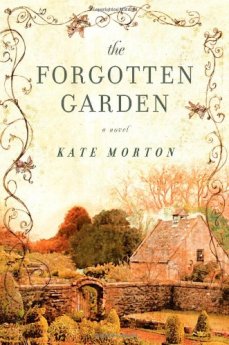
I love Kate Morton’s books. The first one I read, about 2 years ago now, was The Forgotten Garden. It was her second novel, and spans several time periods to discover the history of a girl abandoned on a ship sailing for Australia in 1913. It is not told in chronological order, and moves between the little girl, Nell, and her granddaughter Cassandra as they both travel to England and investigate Nell’s past as tied to the Blackhurst Manor on the Cornish coast.

One of the things I enjoyed most about this novel was the way it wove two different time periods together. If told in chronological order, the story may have been interesting but there would have been no mystery. This way of telling the story does not feel contrived, however, or as if the writer is telling the story out of order simply to confuse the reader with an elaborate plot.

The same is true of Morton’s third book, The Distant Hours, which I read last year.This one has more of a Gothic element. Though the story takes place in both present-day and the relatively modern World War II era, it still has clear ties to the more distant and mysterious past.

It was not until I read Daphne du Maurier’s book Rebecca for the first time a couple weeks ago that I realized what a great influence her writing style had been on Kate Morton (the inside cover of the dust jacket on one of Morton’s books even references du Maurier). A mystery uncovered through flash-backs. A young woman who discovers the past is even darker and more convoluted than she imagined. An ancestral home filled with secrets.

And that brings us to Kate Morton’s first novel, The House At Riverton, which I finally started reading. I’m about 2/3 of the way through now. This most likely means that I’m at the point in the book where I think I have everything pretty much figured out, and all my suppositions are about to be turned upside down. As I read this book, I realize another reason I love Morton’s writing style — there isn’t an extraneous scene in the book. Everything that happens builds the plot or contributes to essential character development. In novels this size (the shortest is 480 pages), that is an achievement.

I’m enjoying this novel quite a lot, partly for the reason that Morton’s writing style is just as enjoyable in her first novel as in later works, and partly because of the many parallels with Dowton Abbey (Morton’s book was published 3 years before the first season aired, so any similarities are coincidence or the script-writer pilfering from her). Unlike the other two novels, where one character in the present is investigating another in the past, the 98-year-old narrator of this book is looking back on her own life and telling her secrets to her grandson and a film maker.

There is one more novel to read once I finish this one, Morton’s latest book The Secret Keeper. I think I will wait a little while before reading it, though, perhaps a whole year like I did in between her other books. I don’t like the thought of not having another one waiting for me when that one is over.

TheGeekSpa.com
don’t forget to check out new Sherlock and Doctor Who themed items in my Etsy store


Alphabet Name List

Alphabet Names marissabaker.wordpress.comI recently set up an account with my favorite name website, NameBerry. For me, it’s almost as potentially addictive as Pinterest — I could spend hours browsing names, interacting with other writers, and discussing the best names for other people’s children. One of the forum topics I stumbled across last week was about favorite names from each letter of the alphabet.

When I tried to fill out the alphabet chart, there were some letters (A, C, and S) that were hard to narrow down to just one name each for boys and girls. Other letters (O and U), I had hard time finding anything I liked or would actually use even on a fictional person. It was fun, though, and I decided to share it here as well as on that site.Alphabet Names marissabaker.wordpress.com

I’ve mentioned my name obsession before, along with a few of my favorite names. This list is longer, and includes a few that I like the sound of more than the meaning. The two that aren’t linked to NameBerry or another website are from fantasy stories. Brigan is my favorite character from Kristian Cashore’s book Fire, and while it is used as a last name there doesn’t appear to be a distinct meaning. Faramir is from Tolkein’s Lord of the Rings and means “sufficient jewel” or “jeweled hunter” in Elvish.

Boy and Girl Alphabet Names

Alasdair and Aithne
Brigan and Brianne
Callen and Chasia
Derek and Desiree
Ethan and Eliana
Faramir and Felicity
Garreth and Gabriela
Hugh and Huali
Iain and Illiani
Jace and Jeanette
Kevin and Kaira
Lance and Liya
Merrick and Marina
Neil and Nuriel
Ohan and Ondine
Peregrin and Petra
Quade and Quarry
Rohan and Raine
Shane and Simone
Tristan and Talia
Ulric and Udelia
Vigo and Vivian
Wyatt and Waverly
Xavier and Xandra
Yevgeny and Yasmine
Zachary and Zoe

Alphabet Names marissabaker.wordpress.com

Outlets

"Outlets" by marissabaker.wordpress.comMy dad gave a sermon this past weekend where one of the points he made involved an analogy about the Sea of Galilee and the Dead Sea. The Sea of Galilee is a healthy body of water — Israel’s main source of freshwater in fact, according to the Google — because it has an outlet that keeps the water fresh. The Dead Sea, on the other hand, has no outlet so the minerals keep building up to the point that nothing can live there. Out of curiosity, I looked up both these lakes on Google Maps satellite images. There is a striking difference even from this distance.

There’s a spiritual lesson in this, which is what was brought out in the sermon. If we don’t share and use the gifts that God gives us, we will stagnate instead of growing and bearing spiritual fruit.

The other thing I thought about in connection to this idea is how much I need an outlet for my thoughts. Apparently this is something that MBTI types who use Extraverted Feeling as a primary (ESFJs and ENFJs) or secondary function (ISFJs and INFJs) have in common. We need to express our feelings and thoughts in some way in order to process them. I’d been thinking about re-writing my About page for a while, and this idea lead me to a better way of articulating the purpose of this blog. Here’s the update:

The Sea of Galilee in Israel is a thriving, beautiful lake that acts as the main water source for all of Israel. Its outflow is the Jordan River, which flows to the Dead Sea. The water there is brackish — 25% salts — and the minerals continue to build up because there is nowhere for the water to flow out of the sea. The Dead Sea is dead because it has no outlet.

This blog is my outlet for random thoughts that pop in my head (Monday’s posts), recipes I like (Wednesday’s posts), and Bible Studies I want to share (Saturday’s posts). Monday’s posts can be about pretty much anything — MBTI types, yurts, and Doctor Who just to name a few. Cooking is something that makes me feel alive, and so Wednesday’s posts are all about making food. I love to come up with and perfect recipes and watch people enjoying the food I make. The most important outlet, though, are the posts on Saturdays. God has worked amazingly in my life, and if we keep silent about His majesty the rocks will cry out to sing his praises. When He leads my Bible study, I don’t want to keep what I learn confined to the growing stack of notebooks in my closet any more.

The Power of Names

A friend of mine wrote a post about names last week that provided the inspiration for this post (he doesn’t post very often, but everything he writes is worth reading. Check out his blog here). He didn’t cover any of my main points — he took the discussion in a Biblical direction that I’m largely going to ignore for this post, but which I certainly find intriguing.

It has been several years now since I started researching names and wondering about the importance of name meanings. The meaning of my own name is hard to pin down, and searching for its origins lead me to looking up names of people I know, which lead me to collecting other names that I like.

Meaning of Names

In many cultures, names are something to be taken very seriously. Sometimes it is the meaning of the name which is important in determining a child’s destiny and character. Sometimes names are changed after a major event in a person’s life, as when God changed Abram’s name to Abraham and Sarai’s name to Sara (Gen. 17:4-6, 15-16). Some belief systems say that knowing someone’s name gives one power over them, and certain cultures make a practice of keeping true names a secret.
“The Power of Names”by marissabaker.wordpress.comMy own name has a confusing array of meanings. My mother tells me she saw the meaning “wished-for child” and that was what she thought my name meant when she and my dad named me. Since then, I have seen several different possible meanings for “Marissa” depending on which name/word it is derived from. If it is from the Hebrew mara, my name means “bitterness.” If it is from the Latin maris, then my name means “of the sea.” The “wished-for child” meaning is apparently associated with the Hebrew in some way, but I can find little information on it. Usually, I go with “of the sea” as my name meaning.

Naming Characters

I think part of the reason I like reading about, collecting, and researching names so much is that I’m a writer and all my characters need names. Some writers pay very close attention to the names they give their characters, and fit either the meaning or a historic significance to the character. For example, the character Cecil in A Room With A View by E.M. Forster is figuratively blind in many ways. His name is of Latin origin, and means “blind.”“The Power of Names”by marissabaker.wordpress.com

In my own writings, one of my favorite characters is a man named Bryant. His name is from the Irish, and means “strong, virtuous, and honorable.” From another story set in the same world, Jamen has a name derived from Benjamin and meaning “son of the right hand.” He and his twin brother are vying for their father to name one his heir, and Jamen would like nothing more than to be his father’s right hand.

My Favorite Names

Some of the names I collect have nothing to do with my fiction. There are a few names I like that I would be hesitant to use in my writings because I might like to give the name to a child some day. I don’t think I would want want my children to think I named them after one of my fictional characters. Typically for these names, I try to put them together so the first and middle names have meanings that fit together. Most of them are just names I like, but Eileen was also my Grandmother’s name and Renee is my sister’s middle name.

“The Power of Names”by marissabaker.wordpress.comJason Alexi. “God is my salvation and protector”

Christopher Hugh. “One who holds Christ in his heart, mind and soul”

Derek Callen. “Ruler and rock of the people.”

Eliana Eileen. “My God has answered with light”

Melody Chasia. “Music protected by God”

Liya Renee. “I am the Lord’s reborn”
It’s NaNoWriMo Time!

National Novel Writing Month is well underway, and I am happy to report I have not yet fallen behind. The challenge is to write 50,000 words in a single month (which requires 1,667 words per day). I completed NaNoWriMo in 2011 while taking a full class load, working part time, and writing my undergraduate research thesis, so this year can’t be any harder, right?

This year, I very cleverly decided to begin NaNoWriMo by going to a church lock-in over the weekend. I frantically wrote 3,400 words on Friday, and wrote another 1,383 on the drive home before my laptop battery died (and another 1,100 before I went to bed). I was surprised how much I could write after only 3 hours of sleep (maybe 4 if you count the nap in the car).  I’m not going back to re-read for quality until after November is done, but the quantity part I was able to manage.

If you’re interested in the story I’m writing, you can look me up on the NaNo website under the name ‘linnon.am.meleth.vin’, or check out my writing blog under the pseudonym Maris McKay, where I’ve been writing about outlining my NaNo novel and drawing maps for the new fantasy world.