Thoughts on Marrying The Wrong Person

I have lots of thoughts about love. Am I a relationship expert? no. Do I have much experience with romantic relationships? not really. But I’ve read an awful lot of books on relationships, written romances, talked at length with people who’ve had successful (and otherwise) relationships, and thought about it a great deal. In short, I fit David Keirsey’s description of NF personality types as people who are “in love with love.”

So of course when a friend shared a talk on Facebook called “Why You Will Marry The Wrong Person” by British philosopher and author Alain de Botton, I had to watch it. I think I skimmed de Botton’s article by the same name quite a while ago, but sitting down and listening to this talk prompted a whole lot of thoughts that I wanted to write about. Here’s the video:

Managing Expectations

“It is in fact hope that drives rage. … If we’re to get a little less angry about our love lives we will have to diminish some of our hopes.” — Alain de Botton

If you read the post from two days ago, then you know I already touched on unreasonable expectations in my post “5 Relationship Problems INFJs Often Struggle With.” Those of us (not just INFJ types) with particular romantic ideals and good imaginations might struggle with it more, but the issue of romantic hopes and dreams not matching reality affects everyone.

One of de Botton’s main points is that your will marry the wrong person because our idea of “the right person” doesn’t exist. By and large, we don’t have realistic ideas about what it means to find the right person or even how to love. We need to shift our expectations in the realm of romance. Maybe instead of looking for the ‘right’ or ‘perfect’ person, we should consider it a success when we, in de Botton’s words, “manage to find a good enough person.”
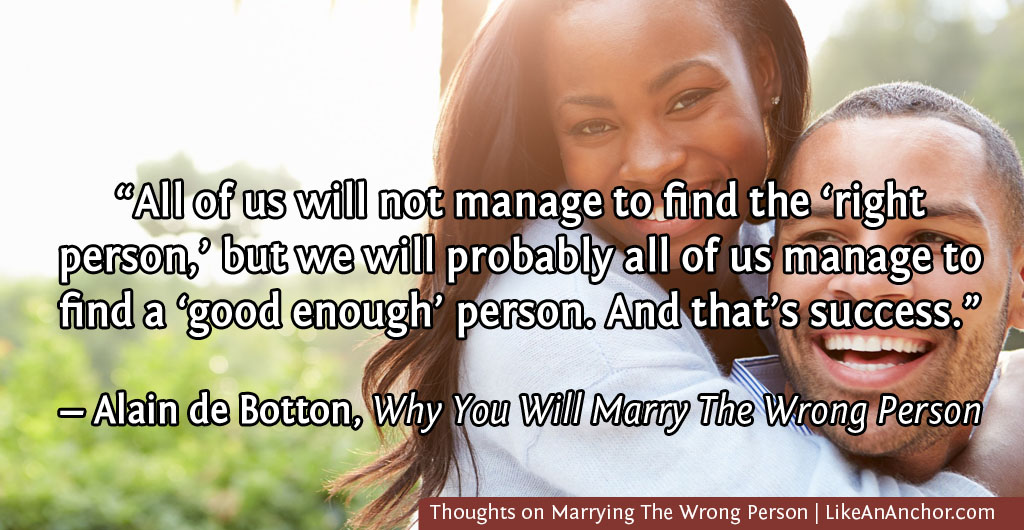
Thoughts on Marrying The Wrong Person | LikeAnAnchor.com
Photo credit: Free-Photos via Pixabay

You Are Hard To Live With

“We are basically, psychologically quite strange. We don’t normally know very much about this strangeness. It takes us a long, long time before we’re really on top of the way in which we are hard to live with.” — Alain de Botton

As de Botton says, if you’re human you’re hard to live with. But he also says most of us are blind to the hows and whys. That might be true, but as someone who lives with anxiety I’m also quite certain I’m not easy to live with. I might not know everything that’s wrong with me. I’m probably missing some of the real reasons that I’m hard to live with and have blown other things out of proportion. But my anxiety tells me over and over again that there’s something wrong with me and people won’t, or shouldn’t, want to be around me.

“We tend to believe that true love means accepting the whole of us. It doesn’t. No one should accept the whole of us, we’re appalling.”  — Alain de Botton

The way de Botton phrases this bothers me because I know that living with the idea “I’m appalling/ broken/ worthless” isn’t healthy, psychologically. I think the goal should be to arrive at a more balanced view of yourself. Maybe de Botton thought most of his audience needed to be told they’re appalling to help get them closer to balance, but I also think there are people who hear “you’re appalling” way too much (from self and others). What we really need to hear is that we’re worthy of love even though “in everyone, and of course in ourselves, there is that which requires forbearance, tolerance, forgiveness” (to quote C.S. Lewis in The Four Loves).

Extreme Vulnerability

I’m a big fan of Brené Brown and love the work she does on shame and vulnerability. I know vulnerability is a vital part of human connection and I believe that it’s a good thing. Still, the part of de Botton’s talk where he discussed the vulnerability needed to create a good romantic relationship bothered me.

“We get into these patterns of not daring what we really need to do … [which is to say ] ‘I’m actually a small child inside and I need you.’ This is so humbling most of us refuse to make that step and therefore refuse the challenge of love.” — Alain de Botton

I’m not sure about this one. Yes, extreme vulnerability is needed to build relationships, but I’m also wondering isn’t it better to approach a relationship from a place of I could survive without you, but I really want you in my life rather than I desperately need you? Although, to be fair, he probably isn’t talking about the kind of “need you” that goes along with something like insecure attachment styles.

I also wonder if my qualms about this part of his talk might be more about some of my personal experiences and my fear of being seen as “clingy.” I don’t want to say ‘I need someone’ while I’m single because I don’t want to be that person who’s just all wrapped up in finding a relationship. Even in a relationship, though, I don’t want to say ‘I need you’ because it feels like weakness. I really do feel like I’m a small child inside and I need someone, but there’s also part of me that hates this side of myself.

But shouldn’t asking for what we want and need feel like (and be) something that’s okay to do? I suppose I’m going to have to (somewhat reluctantly) agree with de Botton on this point.

Learning How To Love

I do really like de Botton’s description of love as a skill that needs to be learned. It’s a sad thing that in the world today we’re constantly told love just “happens” or that it’s all about emotion. If that were the case, romance should be pretty easy but it’s not. And because we don’t think of love as a skill or something that requires hard work, we keep trying to find love that “feels good” or where we’re magically compatible. It’s no wonder that we’re continually disappointed.

“To love ultimately is to have the willingness to interpret someone’s on the surface not very appealing behavior in order to find more benevolent reasons why it may be unfolding. In other words, to love someone is to provide charity and generosity of interpretation.” — Alain de Botton

“True psychological maturity … is the capacity to recognize that anyone you love is going to be a mixture of the good and the bad. Love is not just admiration for strength. It’s also tolerance for weakness and recognition of ambivalence.” — Alain de Botton

Love is about so much more than just how we feel. It is an action and a choice. This reminds me of one of the questions that comes up quite often in the personality type community: “Which type is a good fit for me romantically?” The often unsatisfying answer is “any of them.” Oh, there are some types that tend to get along better with each other but type really isn’t a good predictor of which relationships will work out. It’s much more important to find someone who will work to understand you and whom you’re willing to work to understand than to find someone of a “compatible” type.
Thoughts on Marrying The Wrong Person | LikeAnAnchor.com
Photo credit: 5688709 via Pixabay

What We’re Really Looking For

“Quite a lot about our early experiences of love are bound up with various kinds of suffering. … We think we’re out to find partners who will make us happy, but we’re not. We’re out to find partners who will feel familiar. And that may be a very different thing. Because familiarity may be bound up with particular kinds of torture. .. [We may reject people because they will] not be able to make us suffer in the way we need to suffer in order to feel that love is real.” — Alain de Botton

I’ve been pondering this part of de Botton’s talk for days. Is it true in general? Is it true for me? It reminds me of something my ex-boyfriend said about what I think I “deserve” in love, which I don’t want to go into detail about but has been bugging me since he brought it up. I don’t have an answer as to whether or not we’re looking for lovers who will hurt us in all the ways that feel familiar from other people we’ve loved.

However, I do think that as a general rule often times what we’re looking for romantically isn’t necessarily what would be best for us. This goes back to the idea that we’re looking for someone who will just accept and understand us, when in reality we all have parts of ourselves that are hard to live with. We should really be looking for someone who will help us become a better person and with whom we can build compatibility (more on that in a moment).

“You probably believe that when somebody tries to tell you something about yourself that’s a little ticklish and a little uncomfortable that they’re attacking us. They’re not; they’re trying to make you into a better person. And we don’t tend to believe this has a role in love.” — Alain de Botton

I think you should look for someone who loves who you are so much that they want you to grow into an even better version of yourself. They’ll also want you to do that for yourself as much (or more) than they want you to do it for them.

I want to make sure and note, though, that this is a very different thing than someone who tries to manipulate and/or change you “for your own good.” No other human being has the right to decide what’s good for you or mold you into something you’re not. Someone who really loves you will help you grow as yourself, not make you change into what they want.

Achieving Compatibility
Thoughts on Marrying The Wrong Person | LikeAnAnchor.com
Photo credit: Free-Photos via Pixabay

This is my favorite quote from the whole talk:

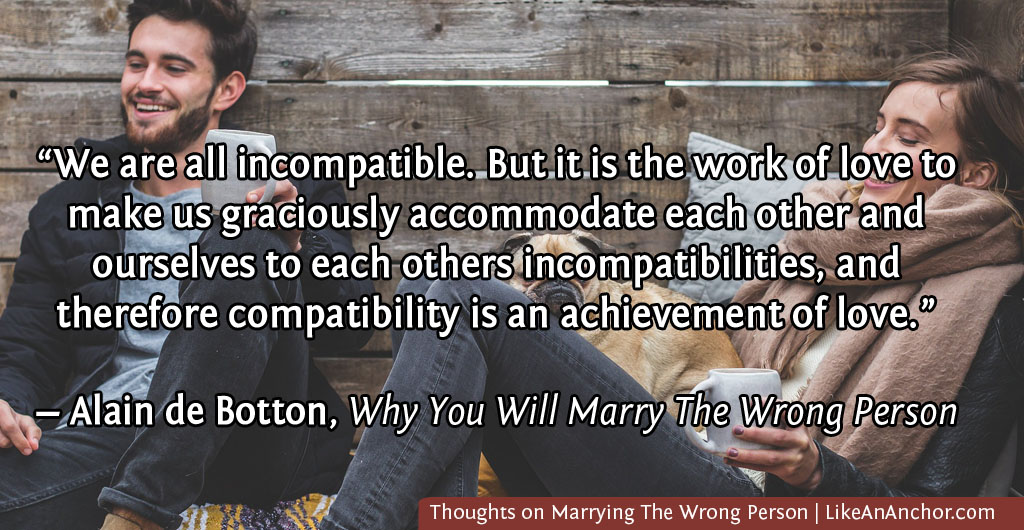
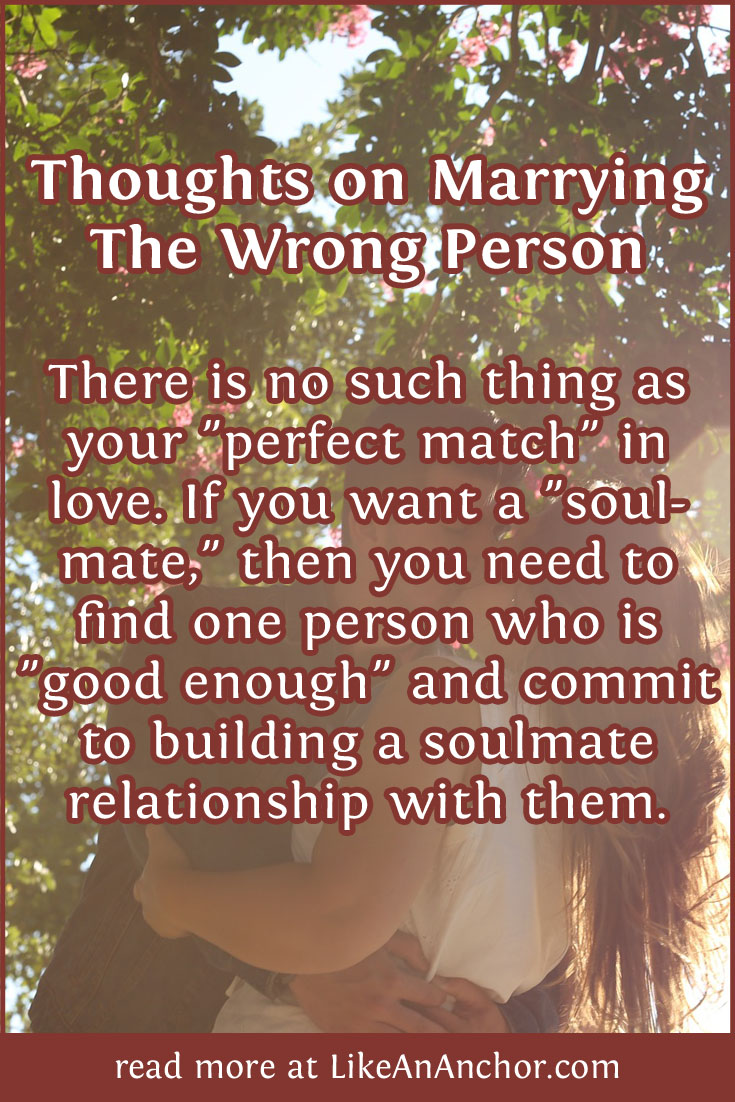
“You cannot have perfection and company. To be in company with another person is to be negotiating imperfection every day. … We are all incompatible. But it is the work of love to make us graciously accommodate each other and ourselves to each others incompatibilities, and therefore compatibility is an achievement of love.” — Alain de Botton

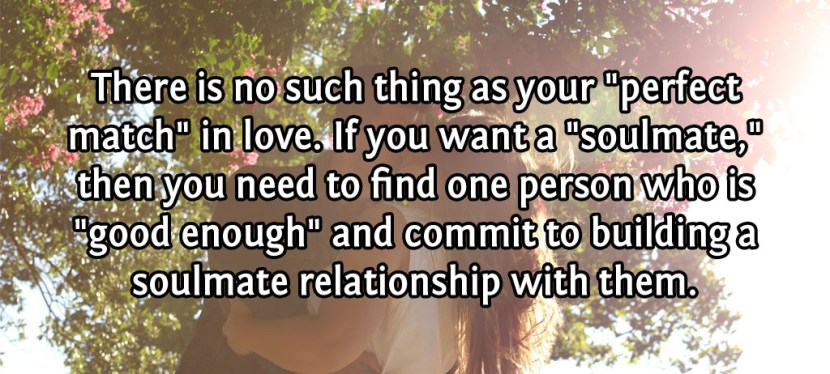
I absolutely love this perspective on love and compatibility. Love is so much more than something we find or fall into. If you want a “soulmate,” then you need to find one person who is “good enough” and commit to building a soulmate relationship with them.

“Compromise is noble. We compromise in every area of live, there’s no reason why we shouldn’t compromise in our love life. … Let’s look a bit more benevolently at the art of compromise. It’s a massive achievement in love.” — Alain de Botton

5 Relationship Problems INFJs Often Struggle With

INFJs long for relationships. Whether it’s close friendships or romantic partnerships, we’re hard-wired for connection (as are all people, really, though we approach it in different ways depending on personality type and individual differences).

As I think most people know, finding a good relationship is bloody difficult (side note: I may or may not watch too much British television). Today, though, we’re not going to talk about the relationship problems that everyone faces. We’re focusing on the problems that many INFJs find particularly troublesome. Other types (especially NFs and FJs) will probably identify with these struggles as well, and I’m sure INFJs also struggle with some relationships problems that aren’t on this list. Still, these five things seem to come up with more consistency for INFJs.

1) Hopes and Dreams vs. Reality

INFJs tend to have active imaginations. That combines to with INFJ idealism to develop some pretty spectacular expectations for relationships. In fact, David Keirsey identifies this as a trait of all Idealist (NF) types. He wrote,

In all areas of life, Idealists are concerned not so much with practical realities as with meaningful possibilities, with romantic ideals.  … if any type can be said to be “in love with love,” it is the NF. And yet, while they fall in love easily, Idealists have little interest in shallow or insignificant relationships. On the contrary, they want their relationships to be deep and meaningful, full of beauty, poetry, and sensitivity. (Please Understand Me II, p.142)

Keirsey goes on to say that NF types seek “a Soulmate” with whom they can have this “deep and meaningful” relationship. He also notes that “Idealists are asking their spouses for something most of them do not understand and do not know how to give” (p.146). As a single INFJ longing for romance, that’s one of the most depressing things I’ve ever read. It’s like we’re setting ourselves up for romantic failure. Read more

Letting Death Give Us Perspective On Life

Ecclesiastes records the reflections of a deep thinker who works through an existential crisis and concludes meaning can only be found in God. While many people find this book depressing, I think taken as a whole it offers a remarkably hopeful perspective that can actually help us work through the sort of questions that were weighing on the author (most likely Solomon’s) mind.

When I recently went back to studying Ecclesiastes, I had this grand vision that I would write a post about the entire book (similar to “Crash Course in Romans”) in less than a week and post it today. I’m currently laughing at myself for thinking that was an attainable goal. Instead, we’re just going to talk about a handful of verses in the middle of the book that have captured my attention, and save the Crash Course in Ecclesiastes for next week.

The Vanity of Everything

Like Romans, Ecclesiastes is hard to understand if you take bits and pieces out of context, so before we get to the verses that I want to focus on today we need to take a quick look at what came before.

Solomon had shown the vanity of pleasure, gaiety, and fine works, of honour, power, and royal dignity … [and] there is as much vanity in great riches (Matthew Henry’s Commentary on Ecc. 5:9-17)

He has also been questioning the meaning of life. If all the things that people pursue on earth are meaningless, then what is there for us? Several times he argues that there is “nothing better” for men than to rejoice in this physical life (Ecc. 2:24; 3:13, 22; 5:18). But that’s still not a satisfactory answer for him. He wants more, something to explain why we should keep trying and what’s the purpose in living.

For who knows what is good for man in life, all the days of his vain life which he spends like a shadow? For who can tell a man what will be after him under the sun? (Ecc. 6:12, WEB)

A Different Perspective on Death

Up until this point, there has been a, “Let us eat and drink, for tomorrow we will die” theme running through Ecclesiastes (Is. 22:12-13). It seems that in Solomon’s mind at this time, death was the point at which hope falls apart. Sure you can enjoy this life, but it’s all emptiness because you still end up dead with no guarantee that you have anything to show for it. Now, though, Solomon suggests that we can use death to give us perspective on life.

It is better to go to the house of mourning than to go to the house of feasting: for that is the end of all men, and the living should take this to heart. Sorrow is better than laughter; for by the sadness of the face the heart is made good. The heart of the wise is in the house of mourning; but the heart of fools is in the house of mirth. (Ecc. 7:2-4, WEB)

We must not forget that there is “a time to be born, and a time to die … a time to weep, and a time to laugh; a time to mourn, and a time to dance” (Ecc. 3:2, 4, WEB). There’s nothing wrong with feasting and laughter in its proper time, but staying there makes your heart foolish. Wise men keep their ends in mind. Death reminds us that we only have so much time to decide how we’re going to live our lives and what we’ll be remembered for.

Letting Death Give Us Perspective On Life | LikeAnAnchor.com
Photo credit: Rosie Fraser via Unsplash

The End Is Better

We just talked about verses 2-4 in chapter 7. Now let’s go back to verse 1:

A good name is better than fine perfume; and the day of death better than the day of one’s birth. (Ecc. 7:1, WEB)

There is much value in a good life well-lived. Solomon has already concluded that “wisdom excels folly, as far as light excels darkness” (Ecc. 2:13, WEB). Here he reinforces that a good name — that is “a name for wisdom and goodness with those that are wise and good”(MHC on Ecc. 7:1-6) — is worth more than all the pleasures, wealth, etc. that he’d found so empty.

if we have lived so as to merit a good name, the day of our death, which will put a period to our cares, and toils, and sorrows, and remove us to rest, and joy, and eternal satisfaction, is better than the day of our birth, which ushered us into a world of so much sin and trouble, vanity and vexation. We were born to uncertainty, but a good man does not die at uncertainty. (MHC on Ecc. 7:1-6).

Death is not the end of the story, and for a man who considers his death and prepares for it (as Solomon goes on to say in the next verses, which we’ve already talked about) he has the opportunity to die with “a good name.” The word for “name” here is shem (H8034), and in the Hebrew concept it’s always connected with your reputation and character.

Those who die having a good reputation and a good character are no longer subject to the evils of this present life and await their resurrection to a much better life in the future. That gives those of us left behind great hope even in the midst of sorrow (1 Thes. 4:13-14).

Backing Into The Future

Letting Death Give Us Perspective On Life | LikeAnAnchor.com
Photo credit: Ashim D’Silva via Unsplash

The idea that the day of our death is better than the day of birth can be a hard one for people to come to grips with, even given the context we just talked about. We still grieve at death even though we know (as Solomon also concludes by the end of this book) that “the spirit returns to God who gave it” and that He will raise believers up in the last day (Ecc. 12:7; John 6:40). But maybe another verse in this section of Ecclesiastes can provide further explanation.

Better is the end of a thing than its beginning. (Ecc. 7:8, WEB)

The Hebrew word for “end” is achariyth (H319). To understand achariyth, we have to understand that the Hebrew concept of time is like “the view a man has when he is rowing a boat. He sees where he has been and backs into the future” (H.W. Wolff quoted in TWOT entry 68e). That’s why this word translated “end” can also mean last/latter days, after part, future, or reward. The end of a thing is better than the beginning because you will have arrived at the future goal and can now look back on where you’ve been with a better perspective.

If you’d rather not think about death then the idea that the end is better than the beginning can be a depressing one because it forces you to confront something uncomfortable. But ignoring the idea of our lives ending is foolish. Everyone is going to die whether we think about it or not, so why not use the fact that our lives will end as motivation to make the life we have a good one?


Featured image credit: carolynabooth via Pixabay

The Difference Between Having Anxiety and Feeling Anxious

Every human being knows what it’s like to feel anxious about something, but that’s not the same thing as having anxiety. There’s a difference between normal anxiety (which is appropriate to the situation) and dealing with an anxiety disorder (which is a mental health condition).

In day-to-day life it’s actually really hard to define the line between normal worry and too much worry (as Dr. Ramani Durvasula says in “Why It’s So Crucial to Understand Anxiety Disorders“). What pushes you into problematic anxiety can vary depending on the individual. It will also vary for an individual depending on other factors in their lives. In addition, anxiety looks different for everyone who struggles with it. That means my personal examples in this article are an accurate reflection of my anxiety, but won’t be equally relatable for everyone with anxiety.

There are plenty of situations where it’s normal to feel anxious. But when anxiety starts to define your life, or keeps you from functioning normally, or generalizes to everyday situations, there’s a good chance you’re dealing with something different than normal human nervousness. Anxiety can also be a clue that something else is going on. If you think your worry might have crossed a line into too much worry, it’s a good idea to talk with a mental health professional.

Disclaimer: I’m not a counselor or therapist and this article can’t be used to diagnose anxiety or as a treatment guide. If you’re struggling with something talk with a mental health professional. They will be much more helpful than me. I also want to say that there’s nothing shameful about seeking answers or asking for help. And if you do get a diagnosis, remember it’s a starting point for treatment, not a sentence or judgement on who you are. You wouldn’t feel ashamed about finding out you have lyme disease or a heart condition, and there shouldn’t be a stigma against mental health problems either. Read more

What Does Each Myers-Briggs® Type Look Like When They Get Stressed-Out?

Stress is something we all have to deal with. It’s part of being human. But how we each react to stress is, at least partly, determined by our personality types.

Each personality type has four mental processes called “cognitive functions” that they use when living their day-to-day lives. These functions describe how our minds work. For example, an ESTJ type is most comfortable using Extroverted Thinking to make decisions in the outer world. That’s supported by their co-pilot Introverted Sensing, which is their preferred way to learn and process information. Then they have a tertiary process called Extroverted Intuition, which they’re not quite as comfortable with. The fourth function, in this case Introverted Feeling, is called the inferior process and it’s not well developed at all.

For more information on how cognitive functions work, read “The Simplest Guide to Myers-Briggs® Functions Ever

When we’re stressed-out our minds typically go to our inferior process. (We can also “loop” between our dominant and tertiary, but that’s a topic for another post). This explains why we start acting out of character when under stress. Stress throws off the familiar, comfortable balance of our mental processes and changes how we deal with things. And because we each use a different combination of these mental functions, a stress-response is going to look a little different for each type.

Why Study Stress-Responses?

Recognizing what a stress-reaction looks like for different types can help us in several ways. If you’re in any kind of relationship with someone, knowing what happens when they’re stressed can give you a different perspective on them when they start to act out a character. Instead of being puzzled by their behavior, you can recognize it as the way they respond to stress.

In terms of our relationship with ourselves, knowing our own stress reactions can help us recognize when we need to practice some self-care. If you’re starting to go into your inferior function, then it’s time to take a look at your life and figure out what’s the cause of your stress and how you can get yourself back into balance. Read more

How Should We Honor The Days God Sets Apart For Him?

Practicing righteousness. Learning to love. Developing the mind of God. Following Christ. Those are all essentials of the Christian life, and there are many “tools” God has given us to help us succeed in these goals. These include prayer, Bible reading and study, the Holy Spirit inside us, and fasting.

God’s Sabbaths and holy days are also vital, and often overlooked, gifts given to help us align with God and His ways. Keeping these days as God commanded helps line us up with His will, reinforces His plan, and deepens our relationship with Him. Just as responding to an invitation to get together with your physical family lets you build relationships with them, so does responding to our heavenly Father’s invitations help us build relationships with Him, our Bridegroom, and the other children in His family.

For many Christians, keeping God’s holy days is a foreign concept because they’ve been (incorrectly) told “that’s just a Jewish/Old Testament thing. But when you start to recognize there’s lasting value in the days God calls holy to Him, you come up against the question, How do you keep the Sabbaths in a way that honors God?

Even if you have been keeping these days for a while, you know this isn’t always an easy questions to answer. There are certain rules and guidelines in scripture, but they don’t answer all our questions. Plus, knowing what to do, and what not to do, in keeping the holy days is about more than a list of rules. It’s about honoring God’s instructions on how to come before Him. So let’s take a look at what God says to do for these days and how we can obey those commands in the spirit and from our hearts. Read more