5 Self-Care Tips for Grad School

I’m getting close to the end of my second semester of grad school. It’s been a great opportunity to learn, to meet new people, to build skills, and to have fun. It’s also stressful. Course loads are different than in undergrad (which was almost 10 years ago for me). On top of that, you’re also teaching (or in my case tutoring), plus working other jobs, and right now you’re navigating all the Covid-19 stuff as well. Plus, there’s often other “life happens” sorts of things going on. By the end of the semester, people look half-zombie.

Everyone deals with stress, regardless of whether or not they’re in grad school, and self-care is something we all need to make time for. That “making time for” part can be particularly tricky, though, when you’re juggling multiple jobs, classes, research projects, and eventually a thesis. With that in mind, here are some of the self-care things that I’ve been doing during my first year of grad school. I hope others will find these tips helpful as well. Share any other tips you have in the comments!

1) Go for walks

This is one of the more time-consuming things on the list, but it’s also one of the ones that’s most helpful. A few times a week, I go walking for about half an hour. Not only does exercise help keep you physically healthy, it also gives you a short break from all the sitting and reading that’s so much a part of grad school. This ticks several boxes on the self-care list: exercise, giving your eyes a rest from studying, and giving your brain a chance to process everything you’ve been learning. You’ll likely find yourself more relaxed and better able to focus after taking a short walk.

2) Keep to some kind of a routine

Routines are a difficult thing to come by when your schedule is changing every semester and may even be different from one day to the next. Keeping something consistent can be a big help in making you feel like you have some control and stability in your life, which can help lower the anxiety that’s often such a big part of grad school. I’ve done this with my morning routine of prayer/Bible study, yoga, shower, and breakfast. You might find that a morning routine works for you, too, or maybe that it’s better to have a bedtime routine, or something that you do over a lunch break to help you re-center and focus.

3) Schedule a weekly reset

Resting one day out of the week has a long history in Christianity. Much of the world (even within churches) has moved away from a Sabbath, but there is still great value in taking God up on His offer of rest. Non-Christians can benefit from this principle as well by scheduling time every week for some more extensive self-care. Schedule something with a friend, do a mini retreat in your home, shut off your phone or email for a day. For me, I eat a nice meal Friday night (since Shabbat goes from sunset Friday to sunset Saturday), take a relaxing bath, play a low-stress game or read, then spend Saturday fellowshipping with other believers. After a long week of work, study, and life it’s so nice to be able to spend one day at the end of the week relaxing and resetting before starting it all over again next week.

4) Eat and sleep

Food and sleep are basic human needs, yet for some reason they seem the easiest to forget or push to the side when you’re in school. Dinner? That’s a snack between work and class, then maybe I’ll eat something at 9:00 tonight when I get home. Sleep? is that the thing where you fall into bed after writing like a maniac and hope you pass-out until your alarm goes off? I see the undergrads I work with skipping this self-care, I see my classmates doing it, and I catch myself doing it as well. I’m not as consistent about practicing this self-care tip as I should be, but most of the time I manage to make myself eat 3 meals a day and get 7 hours of sleep (which is what I’ve figured out I need in order to stay healthy and awake). Some of the best things you can do to take care of yourself are to eat as healthy as you can, don’t skip meals, and figure out how much sleep you need then make sure you get it as consistently as possible.

5) Say “no” when you need to

It’s good to say “yes” to a lot of the opportunities that come your way in grad school. But it’s also helpful to know when you need to say “no” and give yourself permission to do that. You’re human, and you can’t be on every committee, go to every conference, or re-adjust your schedule to convenience everyone in your life. If you’re not sure you have time for something, it’s okay to tell someone you need to check your schedule and get back with them, and then say “yes” or “no” depending on what you can realistically fit into your life. It won’t do you any good to take on more projects than you can complete successfully, or to say “yes” to something that’s going to rob so much time from something essential (like eating and sleeping) that you end up getting sick.

Takeaways

Grad school is fun and crazy, and I’m still figuring it out, but I am getting better at making sure I practice the self-care I need in order to stay physically healthy and mentally alert. When I take care of my own needs, then I can be more fully present for the things that I want and need to do, and for the people I want to work with.

Are you thinking about going to grad school? Currently in grad school? Survived grad school and moved on to something new? I’d love to hear your thoughts! Everyone (whether you’ve been to university or not) share your favorite self-care tips in the comments!

Featured image by Tiny Tribes from Pixabay

Jesus: The Mercy Seat and Atonement Sacrifice

I love how dynamic the Bible is. Read a verse you’ve studied dozens of times, and suddenly a slightly different translation or an idea you had last month snaps into clarity and you see a deeper, fuller layer of God’s truth. I like to think that’s the holy spirit working, aligning our thoughts and ideas more closely with God so we can understand the things given to us by God.

The verse to most recently strike me in this way was the NET translation of Romans 3:25. I quoted it in last week’s post. Here, Paul says of Jesus that “God publicly displayed him at his death as the mercy seat accessible through faith.” In the KJV, this was translated as “whom God hath set forth to be a propitiation through faith in his blood.” Both translations are profound, but seeing that connection to the mercy seat (which is an accurate translation of G2435, hilasterion, and is also used in Heb. 9:5) made me think about the idea in this verse more deeply.

“Mercy seat” is one of those things in the New Testament that wouldn’t make any sense at all without context from the Old Testament. Reading either testament in isolation would mean you only get a partial picture of God’s story and plan. It’s all one book, and nowhere is that more visible than when looking at how key aspects of the Old Testament law and worship point straight to Jesus Christ.

Context for the Mercy Seat

The mercy seat was the top part of the ark of the covenant. It is the location where the incense and the blood of the yearly Yom Kippor (Day of Atonement) sacrifice were placed (Lev. 16:11-17) and the place that God’s presence appeared when He met with His people (Ex. 30:6; Num. 7:89). In the Old Testament, the NET uses the translation “atonement lid” for the Hebrew word kapporet to represent that this ornate “lid” for the ark of the covenant (Ex. 25:10-22) is the location where atonement is made and accepted (NET footnote). When there was a tabernacle or temple, the atonement lid/mercy seat was located inside the most holy place (also called the inner sanctuary or holy of holies). A heavy curtain or veil separated this inner sanctuary from view; only the high priest could enter and only once a year.

That background helps us understand what the New Testament writers tell us about Jesus’s death. When Matthew 27:51, Mark 15:38, and Luke 23:45 say “the temple curtain was torn in two” when Jesus died, they most likely mean the curtain that separated the holy of holies from the rest of the temple. Jesus’s death ripped open the separation between God and man. We’re not removed from the place where God appears or the location where atonement is made anymore. On their own, human beings had never been holy or pure enough to be in God’s presence, but now through the blood of Jesus which washes our sins away we can access the holiest places in the heavens.

One Sacrifice in the Heavenly Sanctuary

As we’ve seen, even though the Greek word translated “mercy seat” only shows up twice in the New Testament, the concept plays a much bigger role than it might seem at first. When Paul calls Jesus “the mercy seat accessible through faith,” it’s in the context of God’s righteousness (which “is attested by the law and the prophets”) being even more fully demonstrated in Jesus and the New Covenant than it was in the Old Covenant law (Rom. 3:19-26). There’s a “passing over” of sins that is connected with sacrifice, and the “mercy seat” is the “place or object” where that propitiation/atonement happens (Theological Wordbook of the Old Testament, entry 1023, kapportet).

The author of Hebrews expands on this sacrifice even more. As part of a lengthy discussion of Jesus’s priesthood (which takes up most of the book), this writer says one of the reasons that Jesus “shared in” our “humanity” was “so that he could become a merciful and faithful high priest in things relating to God, to make atonement for the sins of the people” (Heb. 2:14-17, NET). Remember, for Jewish readers (and probably non-Jewish converts in that society as well) the idea of atonement was linked to Yom Kippur and the sacrifice for that day where the high priest offered blood and incense at the mercy seat. Unlike the Old Covenant Levitical priests, Jesus “has no need” to offer daily or even yearly sacrifices (Heb. 7:23-28; 10:10-14). His New Covenant priesthood operates on a heavenly level.

For Christ did not enter a sanctuary made with hands—the representation of the true sanctuary—but into heaven itself, and he appears now in God’s presence for us. And he did not enter to offer himself again and again, the way the high priest enters the sanctuary year after year with blood that is not his own, for then he would have had to suffer again and again since the foundation of the world. But now he has appeared once for all at the consummation of the ages to put away sin by his sacrifice.

Hebrews 9:24-26, NET

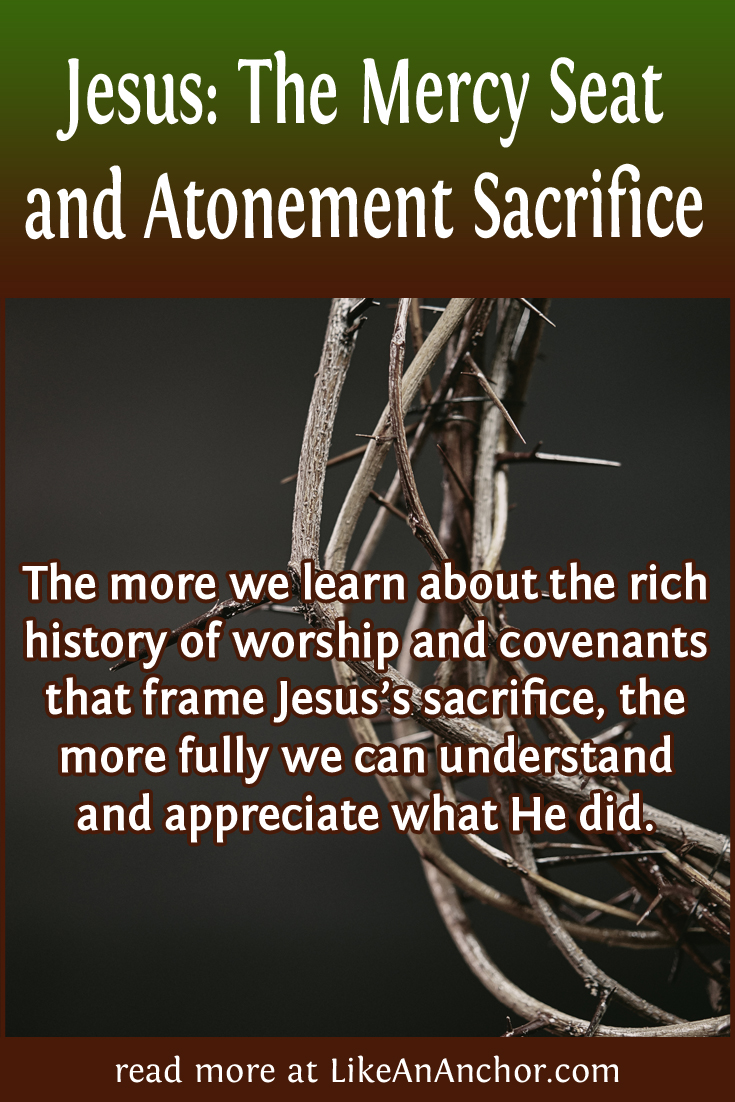
The holy places, priesthood, worship, and sacrifices of the Old Covenant all pointed to this: Jesus the High Priest entering the heavenly sanctuary with His own blood to put away sin from all who will accept what He does on their behalf. The importance of Jesus’s sacrifice is something that all Christians, whatever their background or denomination, are intimately familiar with. The more we learn about the rich history of worship and covenants that frame His sacrifice, though, the more fully we can understand and appreciate what Jesus did. And it also deepens our understanding of what He is currently doing–His priesthood has no expiration date. He is still, right this very moment, acting as the “mercy seat” and High Priest in the heavenly temple whose atonement sacrifice removes all our sins by substituting Himself in our place.

Featured image by Pearl via Lightstock

The Lord’s Wonderful Faithfulness Toward Us

We often talk about our faith–faith toward God, faith in His promises, faith that He really does exist and that He really is God. In addition to that, the Bible frequently talks about God’s faith toward us. He is described as “faithful” in all His dealings with humanity, and it’s often in the context of praise.

I’ve noticed myself thanking God for His faithfulness in many of my prayers lately. I love the reassurance of knowing God is faithful. We can anchor our hope in that truth, knowing He won’t fail us. He’s constant, reliable, and committed. His faithfulness is a fact that doesn’t change, but sometimes we can lose sight of or forget about it, which lets doubts and worries get a foothold in our lives. The crazier life gets, the more we need to remember the faithfulness of God in order to stay confidently grounded in our faith through the storms of life.

Faithfulness in His Work

God’s faithfulness has been part of all His dealings from the beginning. One psalmist wrote, “All his work is done in faithfulness” (Ps. 33:4, WEB). Those works include creation, His dealings with people, the covenants He made, and the promises He gives us for a good future.

Yahweh, you are my God. I will exalt you! I will praise your name, for you have done wonderful things, things planned long ago, in complete faithfulness and truth.

Isaiah 25:1, WEB

From our more limited perspective, it might sometimes seem as if the world and its history are random, chaotic, and miserable. But since the very beginning, God has been working on (and doing) wonderful things. He shares details about that work with us in the Bible, and invites us to be part of the continuing work today.

For I am sure of this very thing, that the one who began a good work in you will perfect it until the day of Christ Jesus.

Philippians 1:6, NET

Paul doesn’t use the word “faithfulness” in this verse, but that’s the concept He’s talking about. God will always be who He says He is, and He will do what He says He will do. That’s what makes Paul’s confidence possible. And because God’s faithfulness is unchanging, we can also have the same confidence today that Paul had nearly 2,000 years ago. God started a good work in us when He called us into His family, and He’s not going to give up on us.

Faithfulness in His Life and Death

Paul speaks more directly about God’s faithfulness in Romans, where he connects it with righteousness and Jesus’s sacrifice. In this letter, Paul is talking about the role of the Law for New Covenant believers and the transition from keeping the letter of the Law under the Old Covenant to keeping the spirit of the Law under the New Covenant.

Today, under the New Covenant, Paul writes that the “righteousness of God” has been revealed “apart from the law” to those who had been under the law (the Jewish people and ancient Israel) as well as to “the whole world” (Rom. 3:19-21). This happens “through the faithfulness of Jesus Christ for all who believe” (Rom. 3:22).

God publicly displayed him at his death as the mercy seat accessible through faith. This was to demonstrate his righteousness, because God in his forbearance had passed over the sins previously committed. This was also to demonstrate his righteousness in the present time, so that he would be just and the justifier of the one who lives because of Jesus’ faithfulness.

Romans 3:25-26, NET

God’s faithfulness finds its ultimate expression in Jesus Christ, who faithfully held up His part of the covenants He made with people and died to make a new, better covenant possible. We live because of Jesus’s faithfulness, and we can trust that the Father (who was willing to give up His Son for us) and the Son (who was willing to give up His life for us) will remain faithful into the future as well.

Faithfulness in Relation to Us

After reaching this point in our study of faithfulness, it’s no wonder that the psalms are filled with praise for God’s wonderful faith toward us. What can be more amazing than the Creator Lord of the Universe committing Himself to you, and me, and every believer? We ought to be in awe of His faithfulness and of the incredible love at its core.

Enter his gates with thanksgiving,
and his courts with praise.
Give him thanks.
Praise his name.
For the Lord is good.
His loyal love endures,
and he is faithful through all generations.

Psalm 100:4-5, NET

I will give you thanks before the nations, O Lord.
I will sing praises to you before foreigners.
For your loyal love extends beyond the sky,
and your faithfulness reaches the clouds.

Psalm 108:3-4, NET

These Psalmists could praise the Lord’s faithfulness like this even before Jesus came as the Messiah. How much more cause do we have now to sing praise, knowing what we know today and being recipients of His grace? We have such incredible proof of God’s faithfulness recorded in scripture, both in the stories of faithful believers and in the reality of Jesus’s sacrifice.

Many of us (perhaps all of us reading this) have also all been on the receiving end of His faithfulness. Accepting Jesus’s sacrifice on our behalf lets us participate in one of the most significant proofs of God’s faithfulness, and if you’re like me you also have an abundance of other examples of God’s faithfulness showing up in your life. Today, I invite you to join me in meditating on the Lord’s faithfulness toward you and the proofs of His ongoing faithfulness in scripture. Though other parts of our lives might seem unstable, unreliable, or unpredictable God is faithful. We can trust Him to be exactly who He says He is, do exactly what He says He’ll do, and never give up on the work He has begun inside us.

Featured image by Temi Coker via Lightstock

What Would the Myers-Briggs® Types Be Like as RPG Classes?

As I mentioned in a blog post a couple weeks ago, one of my big projects for my first semester of grad school is a paper that’s currently titled “A Rhetorical Analysis of the Literature Surrounding the Intersection of Role-Playing Games, Race, and Identity.” Though this project had nothing to do with personality type, any time I start thinking about questions of identity I also start thinking about how someone’s Myers-Briggs® type might play a role.

One of the great things about role-playing games (RPGs) is that players get to act-out different types of identities that we can’t or won’t explore in the real-world. The shy intellectual human can play as a charming, live-in-the-moment elf bard. The clumsy, bubbly person who attracts attention just by walking into a room can slip into the character of a sneaky gnome rogue. In real-life when making game-play decisions, people often choose characters who are very different from themselves. For purposes of this post, though, I’d like to think about what type of character the different Myers-Briggs® types might be if class was based on personality traits.

While this isn’t a particularly significant topic in relation to personal growth, I think it’s fun to write these sort of pop-culture Myers-Briggs® posts every once in a while. The stereotypes for RPG classes are an oversimplification of personality traits, of course, so let’s also keep in mind that there’s a lot of individual variation within types in real life and not everyone will identify with the broad generalizations in this post.

For those not all that familiar with RPG games, you can think of classes sort of like professions, or descriptions of a character’s particular skill set. They typically involve fantasy elements, though there are also plenty of RPGs that take place in a science fiction setting or alternate versions of our own world. I’ll be drawing from two lists of common character classes for this post that aren’t specific to any one game: “Standard RPG Classes and Characters” from Gameaboo and “Fantasy Character Classes” from TV Tropes.

ENFJ – Mage

ENFJs are well-known for being a type that makes great leaders and counselors. Many choose real-life careers like teacher, coach, or pastor. The ENFJs I know also seem to be good at just about anything they put their minds to, and they can fit in with any group they want. I chose the Mage class for them because there are so many subclasses within it–including priest, cleric, and enchanter–that could fit ENFJ’s unique blend of people-loving extrovert and big-picture-thinking intuitive.

ENTJ – Wizard

For most RPGs, the wizard class refers to people who’ve learned their powers through academic study and discipline. They didn’t just stumble into or inherit their class–they deliberately chose a goal and worked hard to achieve it. In real-life, ENTJs’ favorite mental process is one that Personality Hacker describes as “intrinsically fascinated by measurements, goal setting and improvements.” This type has the discipline to learn difficult things, and often an interest in tackling challenging life goals.

INFJ – Scholar

One of my favorite character ideas that I haven’t actually used in a game (yet) is a knowledge-domain cleric with a scholar background. I feel like she fits my INFJ-nature perfectly. INFJs are often bookish people who enjoy collecting information and facts, then putting it to good use to help people in clever ways. We’re often stereotyped as the counselor, dreamer, sage type and that fits the scholarly archetype of fantasy games quite well.

INTJ – Rogue

The thief/assassin/rogue class has been a core archetype for RPG games since these games were first invented. They tend to be intelligent, perceptive, and highly skilled in very specific ways. Depending on the game, this is the class that offers a “Mastermind” specialization (which is also one of the most popular nicknames for the INTJ type). Deliberate, logical, and think-outside-the-box INTJs probably won’t identify with all of the rogue stereotypes, but I still think it’s a good choice for them.

ENFP – Swashbuckler

I like the Swashbuckler archetype for ENFPs for several reasons (including because it makes me think of The Scarlet Pimpernel). Swashbucklers are charming entertainers, yet they also fall in to a classically heroic archetype. In real-life, many ENFPs enjoy being the center of attention and they also passionately champion their favorite causes and/or people. I think this class is a good fit for the ENFP’s characteristic blend of pizzazz, spontaneity, and adherence to their core values.

ENTP – Sorcerer

The sorcerer class typically uses in-born magic, which can be as wild and unpredictable as it is powerful. Depending on mechanics for the specific game, they may also be very charismatic characters. I’ve written several posts about how ENTPs are typically portrayed in fiction, and they’re often insanely clever, charming, and independent sorts of people. Things that other types find challenging (like charming a room full or people or coming up with a brilliant idea at the last minute) often seems to come naturally to ENTPs.

INFP – Druid

Nature magician seems an obvious choice for the stereotypically gentle, peaceful INFPs who often love animals, plants, and the natural world. Druids also tend to be more reclusive types of magic users, shunning “normal” society for a different path in life, much like INFPs tend to care more about authenticity than about fitting in with other people. Druid could fit other introverted, nature-loving types as well, but I decided to give them to the INFPs.

INTP – Artificer

What better class for the personality often stereotyped as a “mad scientist” than the Artificer (also called Engineer, Tinkerer, or Alchemist)? Characters with this class beat their enemies and help their friends by coming up with clever gadgets. Rather than relying on fantasy magic (though some of these characters may use that as one of their tools), they usually use on technology and their own minds to solve problems and navigate complicated situations.

ESFJ – Cleric

In real-life, ESFJs are often seen as the caring, motherly personality that’s the first on the scene if friends or family need help. If you know any ESFJs, you may also know them as no-nonsense people who, if the situation calls for it, can be just as intimidating as they are kind. Seems perfect for the cleric/healer class who’s always there to support the party during a fight.

ESTJ – Warlord

I initially had “Summoner” here (a class that joins forces with another, more powerful creature and then summons/draws on that creature or its power to do significant battle damage), then an ESTJ on Twitter suggested “Warlord” as a better option. The Warlord class is a type of fighter that specializes in tactics, leadership, and support to make the entire party more efficient. It really does seem a perfect fit for the ESTJ type.

ISFJ – Paladin

Whenever I think of ISFJs, the first people that come to mind are Captain America and my dad. Most of you don’t know my dad, but you probably recognize how perfectly Captain America fits into the archetype of a good person fighting for what’s right. That’s basically the description of a paladin from RPGs as well.

ISTJ – Fighter

Fighters are typically the strongest class and one of the most highly specialized in non-magical skills. They’re not all that concerned with complex, arcane mysteries or with learning hidden skills and information. Rather, they’re the sort of people out at the front of the battle putting themselves at risk to keep their party safe. Like most SJ types, ISTJs typically have a strong sense of duty that makes them a great fit for the classic heroic archetypes like knight/fighter/warrior.

ESFP – Bard

Bards are my favorite characters to play, possibly because they’re just about my exact opposite. Bards are the most charming performers, the character who can talk anyone into doing anything, and among the most imaginative characters (you have to be inventive if you’re going to try and fight evil monsters with a flute). Seems a good fit for the personality type commonly nicknamed “The Performer” or “The Entertainer.”

ESTP – Barbarian

SP types are considered the most physical, in-the-moment of the personalities since their favorite mental process is so good at quickly processing and responding to incoming sensory data. The Barbarian or Berserker class describes characters who thrive when they’re in the middle of the action, up-close-and-personal with whatever challenges they’re facing, and so that’s why I chose them for the ESTP type.

ISFP – Monk

The Monk class is often a fighter-type character that’s powered by a focused, internal energy. They blend physicality with meditation and martial arts skills. Depending on the game, they might be more self-sufficient than some of the other classes since they have both physical skills and magical abilities. Real-life ISFPs are often called Artists because they blend their SP outer-world skills with inner-world focus on authentic self-expression, which is why they remind me of RPG Monks.

ISTP – Ranger

The Archer/ Hunter/ Ranger class archetype is highly skilled at surviving on their own out in the wild. I could have picked from quite a few different adventuring classes for ISTPs (see Susan Storm’s article “Why ISTPs Make the Best Action Heroes“), but Rangers seemed to me like an especially good fit.

——

Let me know what you thought of this post. Would you have picked a different class for your type? Do you enjoy playing RPGs? I’d love to read your thoughts in the comments!

Our Daily Bread

We recently observed Passover and the Feast of Unleavened Bread (Chag haMatzot). I suppose studying what the Bible has to say about bread is an obvious topic after that, but it’s been a more interesting study than I’d expected for something that seems so basic. Even the Lord’s model prayer that so many of us memorize talks about bread, and it has more to say on that topic than I’d assumed. Bread also acts as a spiritual symbol in scripture–Jesus calls Himself the “Bread of Life” and Paul talks about what kind of bread we’re supposed to be.

Bread for Each Day

So pray this way:

Our Father in heaven, may your name be honored,
may your kingdom come,
may your will be done on earth as it is in heaven.
Give us today our daily bread,
and forgive us our debts, as we ourselves have forgiven our debtors.
And do not lead us into temptation, but deliver us from the evil one.

Matthew 6:9-13, NET

The phrase “our daily bread” involves a curious word. In Greek, “daily” is epiousios (G1967) and it’s only used here and in Luke’s account of this same prayer. It’s not even used outside of the Bible anywhere but other “early Christian literature,” which makes the meaning hard to figure out (NET footnote). “Daily” is just a best-guess for the translation. Other suggestions include “the coming day,” “for existence” (NET footnote), “the bread of our necessity,” and “the bread that suffices for each day” (Thayer’s dictionary).

I wonder if, in using a word that indicated sufficient, needed bread for each day, Jesus might have been thinking about Proverbs 30. Here, Agur asks for two things from God: “Remove falsehood and lies far from me; do not give me poverty or riches” (Prov. 30:7-8, NET). This last one might seem an odd request–who wouldn’t want to be rich?–and Agur provides further details.

feed me with my allotted portion of bread,
lest I become satisfied and act deceptively
and say, “Who is the Lord?”
Or lest I become poor and steal
and demean the name of my God.

Proverbs 30:8-9, NET

It seems there’s as much of a danger in feeling as if you are “rich and have acquired great wealth, and need nothing” (to quote the Laodiceans from Revelation 3) as there is in being so poverty stricken that you’re in danger of starving. Neither extreme is healthy, and so balance in prosperity is a prayer worth praying. We need balance–both in the physical things like Agur is talking about and in the spiritual things that Jesus is talking about in the letter to Laodicea (Rev. 3:14-22).

I usually think of the request in the model prayer as asking for provision of needs, with bread standing in for all the things like food and clothing that Jesus tells us we don’t need to worry about just a little later in this same sermon (Matt. 6:25-34). I recently heard someone point out, though, that the focus of this prayer isn’t on physical things. It’s about honoring God’s name, praying for His will and His kingdom, and asking for forgiveness and deliverance. There’s no reason not to assume physical provision is included, but it’s likely that Jesus also intended for us to think about spiritual bread. He is, after all, the bread of life.

Living Bread from Heaven

After one of the loaves and fishes miracles (recorded in John 6), Jesus crossed over to the other side of a lake and the whole multitude followed Him. There, He told them they’d followed Him not because they believed He was the Messiah or because they saw miracles, but because they’d eaten a free meal. He advised them, “Do not work for the food that disappears, but for the food that remains to eternal life” (John 6:27, NET). To work for this eternal food, they must do “the deed God requires—to believe in the one whom he sent” (6:29). Then, these same people who’d just seen Jesus turn five loaves of bread and two fish into enough food for more than 5,000 people with 12 baskets full of leftovers, actually asked Him, “what miraculous sign will you perform, so that we may see it and believe you?” They even brought up the manna in the wilderness miracle, showing full well that they knew they’d seen one bread miracle and were asking for another (John 6:30-31).

Jesus and His Father weren’t focused on delivering physical bread this time, though. There wasn’t going to be a repeat of free food on the ground every morning when the Israelites woke up (Ex. 16:4-36). Rather, they’d planned a far more enduring way to satisfy a deeper, spiritual hunger. Yes, Jesus fed the people when they were hungry but the plan was to go far beyond providing for physical needs. Just as Jesus was here on earth to take the Law and the Covenants to a deeper, higher, fuller level, He did the same thing with the miracle of bread from heaven.

“I am the bread of life. Your ancestors ate the manna in the wilderness, and they died. This is the bread that has come down from heaven, so that a person may eat from it and not die. I am the living bread that came down from heaven. If anyone eats from this bread he will live forever. The bread that I will give for the life of the world is my flesh. … the one who eats my flesh and drinks my blood has eternal life, and I will raise him up on the last day. For my flesh is true food, and my blood is true drink.”

John 6:48-51, 54-55, NET

This brings us right back to where we started this post: Passover and Unleavened Bread. Jesus’s flesh is symbolized by the bread and His blood by the wine that form the core symbols of the New Covenant Passover (Matt. 26:26-30; 1 Cor. 11:23-26). The invitation for us to eat this bread from heaven is also an invitation to be part of His covenant community and be sustained by God.

Our Unleavened Lives

Grace and salvation through Jesus Christ are gifts that we can do nothing to earn. Once we accept those gifts, though, we enter a reciprocal covenant relationship with God. We are supposed to respond a certain way after we’ve received grace. In other words, it is because of the Bread of Life that we ourselves can take on the characteristics of a very particular kind of bread.

Purge out the old yeast, that you may be a new lump, even as you are unleavened. For indeed Christ, our Passover, has been sacrificed in our place. Therefore let’s keep the feast, not with old yeast, neither with the yeast of malice and wickedness, but with the unleavened bread of sincerity and truth.

1 Cor. 5:7-8, WEB

Because we “eat” the Bread of Life, we become “unleavened” bread. Symbolically during the Passover and Days of Unleavened Bread, leaven represents sin. Eating unleavened bread for that seven-day festival pictures us putting sin out of our lives and replacing it with His character. During the remaining days of the year, though we are free to eat yeasted and otherwise leavened breads, the importance of turning to God to fill all our needs (including our need to daily take-in Jesus Christ) remains the same.

God is concerned about our physical needs. He appreciates it when we choose not to fret about where we’ll get our physical daily bread and instead ask Him to provide (as Jesus did in His model prayer), trusting that He can and will take care of us. Even more than that, though, He is concerned about supplying our spiritual needs because that has eternal ramifications. We also ought to pray for God to “give us today our daily Bread of Life,” trusting that He will satisfy our spiritual hunger.

Featured image by FotoshopTofs from Pixabay

The Rightness of Trusting God’s Will Even When It’s Scary

One of the most astonishing statements in all of scripture was made on Passover evening nearly 2000 years ago, on the night in which Jesus was betrayed. Knowing exactly what was about to happen, Jesus still prayed “not my will but yours be done” (Matt. 26:36-46; Luke 22:39-46). This is the ultimate example of meekness–power submitted to the will of God. Jesus could have asked His Father for “more than twelve legions of angels” to free Him from the arresting mob if He’d wanted to(Matt. 26:51-45). Instead, He said, “Father, if this cup cannot be taken away from me unless I drink it, your will must be done” (Matt. 26:42).

Scripture describes Jesus as being “anguished and distressed” and feeling “deeply grieved” in His soul. Emotionally, that sounds like just about as bad as it can get for a human being. Yet even in such a dire situation, He prayed for God’s will to be done. I suspect He even prayed that in part because of the dire situation, using His conviction that God can be trusted and that His will is best to carry Him through what lay ahead.

For us today, who’ve committed to following Jesus’s example, “Your will be done” should also be our prayer during times of testing and trouble (as well as in good times). That’s not always easy to say, though. We might even be afraid or reluctant to pray for God’s will to be done, especially when the future seems uncertain. It comes down to an issue of trust and perspective.

God Knows Best

I often think about the spiritual implications of my struggles with anxiety. If I give in to catastrophizing and fear, what does that say about my level of (mis)trust in God? Connecting that idea to today’s post, it seems that whether or not we want to pray, “Your will be done,” is often tied-in to all those fears and worries. Is God really good all the time? Does He care enough to make this situation work out for me? What if praying for His will means I don’t get what I want or need?

I think we need to reject shaming people (including ourselves) for weaknesses and fears, and rather encourage each other to keep choosing trust and faith over and over again. Anxieties are “afflictions, not sins” (to quote C.S. Lewis), though they can lead us into sin if we let them. Overcoming fear is an ongoing process and it involves conscious choice, including the choice to trust that God knows what He’s doing.

We know that we should pray for God’s will to be done, but we’re often afraid to. Why? Because we do not trust that His will is best for us. We think His agenda and ours are by nature at odds with one another.

Because of our corruption, they may in fact be at odds. But if we could see the whole picture, we would understand that it is our own will that falls short of fulfilling our well-being, not His.

CHRIS TIEGREEN, 365 POCKET DEVOTIONS, DAY 114

It’s often easy to pray, “May your kingdom come, may your will be done on earth as it is in heaven” (Matt. 6:10, NET). When it’s less personal, sometimes it’s easier to wrap our minds around the idea that God changing things and making them better is a good thing (especially when it’s becoming more and more clear how much suffering and corruption is in the world). But it’s often harder to pray, “May your will be done (not mine)” in very personal situations that affect us immediately and directly (especially if we have a preferred outcome in mind). And yet that’s exactly what Jesus did, and what His disciples do.

His Good Plans Will Come to Pass

Paul’s a great example of one of Jesus’s disciples who submitted his own will and plans for his life to God. He started out by persecuting those who believed in Jesus the Messiah, then completely changed his life in response to God making His will known. That cost Paul greatly in terms of physical things, but also blessed him richly in terms of spiritual things.

I’m pretty sure I’ve written before about Paul’s view on trials–“that our present sufferings cannot even be compared to the coming glory that will be revealed to us” (Rom. 8:18, NET). It might not seem at first as if he’s talking about God’s will here, but he is. Going back to Romans 7:14-21, we find Paul describing the struggle between his unspiritual self and the spiritual law of God–his will versus God’s will. Next, Romans 8:1-17 talks about the leading of God’s spirit and Him saving us from sin, which is something He desires/wills for all people (1 Tim. 2:4; 2 Pet. 3:9). Then, Paul describes a struggle in creation, which was not willingly “subjected to futility … in hope,” but as part of God’s will for adopting children into His family (Rom. 8:19-26).

And he who searches our hearts knows the mind of the Spirit, because the Spirit intercedes on behalf of the saints according to God’s will. And we know that all things work together for good for those who love God, who are called according to his purpose …. What then shall we say about these things? If God is for us, who can be against us?

Romans 8:27-28, 31, NET

God has a plan. It’s a good plan. And because He’s the all-powerful Creator and Sustainer of the universe, His good plans for each of us and the whole of creation will come to pass. When we keep this in mind, there’s no need for us to fearfully grasp for control or to worry and fret about the future (Matt. 6:25-34).

We Follow in Christ’s Footsteps

I recently started reading C.S. Lewis’s collection of passages from George MacDonald’s writings. One of the quotes which caught my eye says that because God “is against sin,” sometimes it also feels as if He is against the things that we want, strive for, and dream about. Which might actually be the case, if we’re still living lives influenced by sin, but God is never against us. When God is against someone’s sinful desires,” He is altogether and always for them” (Unspoken Sermons, First Series, The Consuming Fire). God is for us, and sometimes that means showing us that the things we want aren’t good for us. MacDonald also said that God’s “wrath will consume what they call themselves so that the selves God made shall appear” (same source). Coming to the Light isn’t always a comfortable process, but it is always good for us.

What these quotes make me think of is the fact that because God’s will and His love always work for good in the end, sometimes the immediate result of submitting to His will is painful, as it was for Jesus. Jesus knew, though, that His suffering was part of God’s plan to bring about good for the whole world, and things happened exactly as the Father purposed (Acts 4:27-28). Jesus prayed for God’s will knowing with absolute certainty “that the Father had handed all things over to him, and that he had come from God and was going back to God” (John 13:3, NET). We also know that He focused on “the joy set out for him” when “he endured the cross, disregarding its shame,” and that He “has taken his seat at the right hand of the throne of God” (Heb. 12: 2, NET). Following His example, we can also pray for God’s will to be done knowing that God has good things in store for us and for the entire world.

Thinking about Jesus’s trust in His Father also adds another layer to how we can understand the verse, “Endure your suffering as discipline; God is treating you as sons” (Heb. 12:7, NET). Jesus did not need to be disciplined in order to correct bad behavior (since He never sinned), but He certainly suffered. Scripture is clear that following in His footsteps will involve suffering (sometimes from the world, sometimes as an attack from spiritual evil, and sometimes as part of God’s refining process that’s meant to strengthen us and help us grow). When we suffer, we know that we’re not going through anything that Jesus wasn’t willing to go through as well; God is not treating us any differently than He did His only begotten son. We also know that we can look forward to the same goal that Jesus focused on–the goal of eternal life together with God, as a family. We can also pray “your will be done” knowing that God is faithful, that He knows what He’s doing, and that He will work things out for good in the end.

Featured image by Jantanee via Lightstock