Lady Susan: Jane Austen’s Comedic Seductress

Once upon a time (in this particular case the 18th century) quite a few novels were written entirely as series of fictional letters. These were called epistolary novels. Evelina by Frances Burney is one example, but far more well known was Samuel Richardson’s Pamela and Clarissa. Jane Austen had probably read both Burney and Richardson when she penned her own epistolary work, Lady Susan.

In [Richardson’s] fiction, resourceful young women record their efforts to resist the advances of scheming libertines. The young Austen signals her audacity by turning the figure of the predatory male seducer into a highly unconventional (and middle-aged) seductress. — John Mullan in “Does Love & Friendship improve Jane Austen’s ending?

Don’t ever let anyone tell you Jane Austen was “just a romance novelist.” By the age of 19 or 20 she was perfecting her signature satiric style, turning Richardson’s well-respected style up-side-down, and inverting gender stereotypes for contemporary fiction. Predatory, aggressive, and manipulative women weren’t unheard of in fiction at the time, but making them the most engaging character in a story wasn’t encouraged. Perhaps that’s why she set the manuscript aside, choosing neither to destroy nor publish it (Lady Susan was first published 54 years after Austen’s death).Lady Susan: Austen's Comedic Seductress #theclassicsclub | marissabaker.wordpress.com

The story follows recently widowed Lady Susan Vernon. We enter the narrative as she announces her intention to visit her brother- and sister-in-law, Charles and Catherine Vernon, at their country residence. Though not happy to host the woman who tried to prevent her marriage, Mrs. Vernon welcomes her sister-in-law as cordially as possible. She becomes less cordial after her brother Reginald De Courcy arrives to meet “the most accomplished coquette in England” and falls head-over-heels for Lady Susan. And that’s after he’d heard from a reliable source that she’d left her previous residence after seducing the married Mr. Manwaring and stealing Miss Manwaring’s suitor, Sir James Martin, for her own daughter.

The first screen adaptation of this novella came out just last year. Titled Love & Friendship for some inexplicable reason (it’s the title of an unrelated work Austen wrote at age 14), I’m still not quite sure what to make of this film. While it preserves the witty, irreverent comedy of Austen’s novella, I still felt something was off about the adaptation. Transferring letters to dialogue made for some character meetings that didn’t make sense (Lady Susan and Mrs. Johnson wouldn’t have been able to meet in person so often; the companion who arrives with Lady Susan in the film isn’t in the book and only exists here to be talked at). And while several female characters were fleshed out more to help them hold their own on screen with Lady Susan, the male characters became even more buffoonish than in the novella (SPOILER WARNING: Reginald in the film is helplessly manipulated throughout the film, while in the novella, he’s the one to break things off with Lady Susan).

Also, why does every single character introduction stop the action with an out-of-context shot of them overlaid with a description of how they fit in the story? The costuming is beautiful, though, and Kate Beckinsale turns in a fantastic performance as Lady Susan. As in the novella, she’s by far the most interesting character.Lady Susan: Austen's Comedic Seductress #theclassicsclub | marissabaker.wordpress.com

I enjoyed reading Lady Susan. I’m a big fan of Jane Austen’s work and this is the first of her writings outside the six major novels that I’ve read. It makes me want to track down more of her juvenilia. It’s fun reading your favorite authors’ early works, especially ones they didn’t necessarily mean for other people to read. I’ve heard that the other stories she wrote as a teenager were even less “proper” than Lady Susan; certainly much less refined than the novels she polished up for publication.

It was also nice to read a short book from my Classics Club list. I love long books as a general rule, but honestly I’m starting to feel intimidated by the number of enormous books I chose. Three Dickens novels? what was I thinking! At least I had the good sense not to put Clarissa on the list (word count for first edition: 969,000).


Click here to get a copy of Lady Susan. Please note that this is an affiliate link. This means that, at no additional cost to you, I will receive a commission if you click on the link and make a purchase.

Is Your Church The Same As God’s Church?

How do you define “church”? A building where Christians worship, the clergy of a religious body, all the believers in a religion, a specific denomination, a public worship gathering — those are all definitions we use in the English language. If we say we “go to church,” we either mean the building or the service. If we say of a group, “this is my church,” we’re generally telling people which denomination we’re part of. If we say someone chose the church as a career path, we mean they went into the clergy.

But those definitions don’t really get at what “church” means in the Bible. In fact, the only part of our English definition that overlaps with the Greek word’s definition is “the whole body of Christians” (Merriam-Webster 3a). And because there’s such a difference, I think it’s important to look at what the New Testament writers were talking about when they discussed the church. We want to learn about how God sees His church, not just how human beings define it today.

Called Out Ones

In the New Testament, “church” is translated from ekklesia (G1577). It’s a compound word that literally means a “calling out” (Strong’s Dictionary). In general, it’s used of a “gathering of citizens called out from their homes into some public place.” In the church-specific sense, it’s “an assembly of Christians” that gathers in a specific place or “the whole body of Christians scattered throughout the earth” (Thayer’s Dictionary). Read more

I’m A Christian … Now What?

What do you do after becoming a Christian? You’ve acknowledged your need for a savior, repented of your past sins, confessed Jesus Christ as your Lord and Savior, and received the gift of God’s grace. The foundations are in place. Now what?

There are some Christians, even Christian teachers, who don’t really know how to answer this question. Those who teach we have no role to play in our salvations and that nothing’s expected of us after conversion are left in a tough pickle. One could, according to this theory, have someone convert to Christianity then go out lying, sleeping around, and stealing but still be considered saved as a part of God’s family. And even the good people who wouldn’t dream of doing something like that are still left with the question, “What do I do now?”

God answers this question for us in the pages of His Bible. You can’t do anything to make God owe you salvation; it is a gift that He chooses to give freely to those who respond to His call. But once you’ve been given this gift your life is supposed to change. Salvation transforms the way you live and gives us a purpose.

I'm A Christian ... Now What? | marissabaker.wordpress.com
Photo credits: Bart Lumber via Flickr and Neely Wang via Lightstock

Choose A Way

In Acts, Christians are described as people who follow “the way” of the Lord (Acts 9:2; 18:25-26; 19:9, 23; 22:4; 24:14, 22). It’s a metaphorical use of the Greek word hodos (G3598), meaning “a course of conduct.” When used literally, hodos refers to the roadway you travel on a journey. In both cases, use of this word implies motion, travel, and activity.

Christians aren’t meant to stagnate. They’re meant to walk through life in a certain way. We get to choose whether we’ll walk in the ways of men or the way of God. And God’s instructions in the New Testament for how to walk look a  lot like His laws about how to behave from the Old Testament. The law can’t bring salvation and it was never intended to. But it was a revelation of God’s character and He hasn’t changed. Our conduct still matters to Him.

Ephesians is a fantastic place to start diving deeper into this topic.  Here, Paul reminds his readers that they “once walked according to the course of this world.” They were “children of disobedience” influenced by God’s adversary and acting in ways contrary to God’s teachings (Eph. 2:2-3, WEB).

But God, being rich in mercy, for his great love with which he loved us, even when we were dead through our trespasses, made us alive together with Christ (by grace you have been saved)(Eph. 2:4-5, WEB)

Trespasses — sin — kills people. That’s why the choice of whether or not to follow God has always been presented as a choice between life and death (Deut. 30:15-18). Grace lets us choose life even after we’ve done things worthy of death. But it doesn’t give us license to sin or permission to sit around twiddling our thumbs. Read more

That Which Every Joint Supplies: INFP Christians

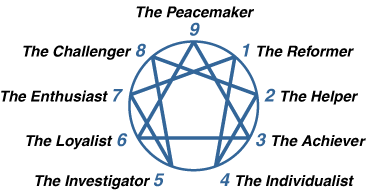
This is my third post in a series about Christians of different Myers-Briggs types. When you start talking with people in the churches, it quickly becomes clear that while we share a common faith there is quite a variety among us as well. Some of that has to do with background, some with the denomination we’re part (or not part) of, and some with personality. And if we want our churches to be a welcoming place for all people who seek to know Jesus, it’s a good idea for us to understand how different personality types relate to their faith.

Our walks with God don’t all look the same. We’re influenced by our backgrounds, variations in beliefs, and individual personalities. And even though the goal is for us all to become “like God,” that doesn’t mean we become indistinguishable from each other. God created great variety in people and I believe He did that for a reason. So let’s spend today’s post hearing from and talking about the unique perspectives of INFP Christians.

I heard from five INFPs who responded to most of the questions I asked. In general, INFPs are private people and I’m not surprised that the response rate was lower than what I saw for the INFJ post and the ENFP post I wrote earlier. One INFP who I talked with in-person said she wouldn’t feel comfortable submitting even an anonymous response. Still, I hope any INFP Christians reading this post will feel safe commenting and adding their thoughts to the conversation. I’d love to hear from more of you! Read more

Which Criminal Are You?

When Jesus died, He hung on the cross between two criminals. In Greek, the word is kakourgos, a compound of evil+doer. This refers to someone who’s employment is practicing wrong things. While we might not have personally broken laws that would make us criminals in our societies, we have more in common with at least one of these two men than you might think.

Every human being has “sinned and come short of the glory of God” (Rom. 3:23, KJV). Because “sin is the transgression of the law,” this also makes us all law breakers (1 John 3:4, KJV). Like these criminals, we have practiced things that were not right. And when we recognize that fact, we also realize that “the compensation due sin is death, but the gift of God is eternal life in Christ Jesus our Lord” (Rom. 6:23, LEB). Like the criminals, we’re facing death and Jesus is there. But how do we respond to Him?

Which Criminal Are You? | marissabaker.wordpress.com
Photo credit: Dennis Hill via Flickr, CC BY

Pride v. Humility

One of the criminals who was hanged insulted him, saying, “If you are the Christ, save yourself and us!” (Luke 23:39, WEB)

One criminal resented what was going on and attacked his fellow sufferer. Matthew Henry describes him as “hardened to the last.” Even his own agony “did not humble his proud spirit nor teach to give good language.”

In contrast, the other criminal was “softened at the last.” He acknowledges the justice of their punishment as “the due reward for our deeds” (Luke 32:41, WEB). He’s much more humble, willing to accept the consequences of his actions and admit their wrongness. This basic attitude difference sets the stage for other differences between these two men. Read more

Walking Across Sea World

Because yesterday was Father’s Day, I want to share with you a little (true) story I wrote for the Encouraging Dads Project. Those of you who follow my Facebook page might have seen it before, but I hadn’t shared it on the blog yet.

This story goes out with a big “Thank You!” to all the dads and father figures making positive differences in their children’s lives. Even the “little things” you’re doing mean more than you realize.

Me and Harpy in 2002

My father dislikes shopping of any kind. Gift shops are particularly pointless. We just paid how much to get in, and now they want us to buy overpriced junk just because it’s got their logo on it? I don’t think so!

I share that so you’ll understand how rare it was to have him inside a gift shop, let alone offering to buy something in it. The setting is Sea World Ohio, a well-nigh forgotten theme park along Geauga Lake near the city of Aurora. Summer sun beat down on the pavement, sending trickles of sweat down my dad’s back as he pulled two little princesses around in a red wagon. My sister and I had been treated to an orca show at Shamu Stadium, sent through a playground with a sea of ocean-colored plastic balls, and given the chance to pet stingrays. And now, we needed stuffed animals.

I’m not talking about just any stuffed animal. It was a pure white harp seal pup nearly as large as I was at 5 or 6 years old. He had big brown eyes and a friendly smile. He was perfect, except for one thing. The only one left in the gift shop had a big stain discoloring his side.

If there was one thing my father disliked more than buying overpriced promotional items, it was buying defective overpriced promotional items. But let me tell you what Daddy didn’t do. He didn’t tell me I was stupid for wanting that stuffed seal. He didn’t tell me I wasn’t worth getting the best seal Sea World had to offer. And he didn’t tell me to suck-it up and live without the seal either. Instead, he sent a message that has stuck with me my entire life.

Daddy walked to the opposite end of a 50-acre theme park to retrieve a better version of my baby seal. At the time, he probably just thought he was doing a nice, and rather inconvenient, thing for his little girl. But he was doing so much more than that. He told me I was valued. He told me that he listened when I talked about things I wanted. He told me he’d go above and beyond to make me happy. All by walking across a theme park to pick up a stuffed animal.

In the grand scheme of things, a stuffed seal isn’t the most impressive present a dad could buy for his daughter. But the love behind that gift solidified Harpy’s position as my favorite toy. He slept in my bed, went on vacations, and attended slumber parties with me for about ten years after Daddy walked across Sea World for him. Now, another 10+ years down the road he’s a bit fragile and has lost some of his fluffiness and most of his white color, but I’ll never get rid of him.

We remember the big moments with our dads because of the intangible things that go along with them. My dad gave me other gifts. But this one sticks in my memory because it was a visible reminder of the sort of things he did, and still does, every day in the many ways he took care of me and told me I was precious to him.

This article originally appeared on Encouraging Dads.com, January 2017.

Save

Save