When we think of “grace” we typically throw out definitions like “unmerited favor,” “free gift,” and “unearned salvation.” And those concepts are certainly included in the meanings of the Hebrew chen (H2580) and Greek charis (G5485). Both words translated “grace” are about good things we don’t deserve being graciously given to us by God.
But we also tend to make assumptions about God’s grace that aren’t necessarily found in scripture. For example, we assume that because the favor is unearned there aren’t any expectations laid on those who accept it. We think because the gift is free it can’t be revoked, rejected, and/or lost. We project cultural and traditional assumptions onto scripture that can cloud the meaning.
Several weeks ago, a Messianic Rabbi gave what’s probably the best message I’ve ever heard on grace (click here to listen to it). My goal in this post isn’t to share his entire message, but to narrow-in on one of the points he made that really captured my attention.
Saved By Grace
The very first time we see the word “grace” in the Bible is in reference to Noah. At this time, God looks down from heaven and sees “the wickedness of man was great in the earth, and that every intent of the thoughts of his heart was only evil continually” (Gen. 6:5). For that reason, God chose to bring judgement on the earth in the form of a flood. “But Noah found grace in the eyes of the Lord” (Gen. 6:6). Read more →
INFJs place a high value on interpersonal harmony. Often, that manifests (especially in less mature/confident INFJs) as an unwillingness to just flat-out turn someone down. We’d much rather use “maybe,” “someday,” and “that might be nice” rather than “no,” “never,” and “I don’t think so.”
But that can back-fire on us and create discord in friendships. Other types can interpret our “maybes” as commitments, then get upset at us for breaking our word. Or they might recognize that we’re brushing them off and become frustrated by our refusal to give them a direct answer. Our attempts to avoid conflict can actually make things worse.
Last week, we talked about one problem that can plague INFJ friendships — the fact that we have a tendency drop out of contact with our friends. It’s fairly easily explained from the INFJ’s perspective, but it can have an unintentional affect of hurting the people around us. Another similar (and in some ways related) problem is our temptation to noncommittally agree with what we think people want to hear, then ignore them and hope they forget about it. Read more →
Due to wisdom tooth surgery on Thursday I’m not dancing this morning (it all went very well, praise God and thanks to a good dentist, but I’ve been advised not to risk dislodging the blood clot that’s helping it heal by any sort of vigorous exercise so soon after surgery). But I was very tempted to risk it and I’m still wishing I could have danced. (Update: 1 hour after this posted, I showed up at church and they’d changed to slower songs so I did get to dance. Hallelujah!)
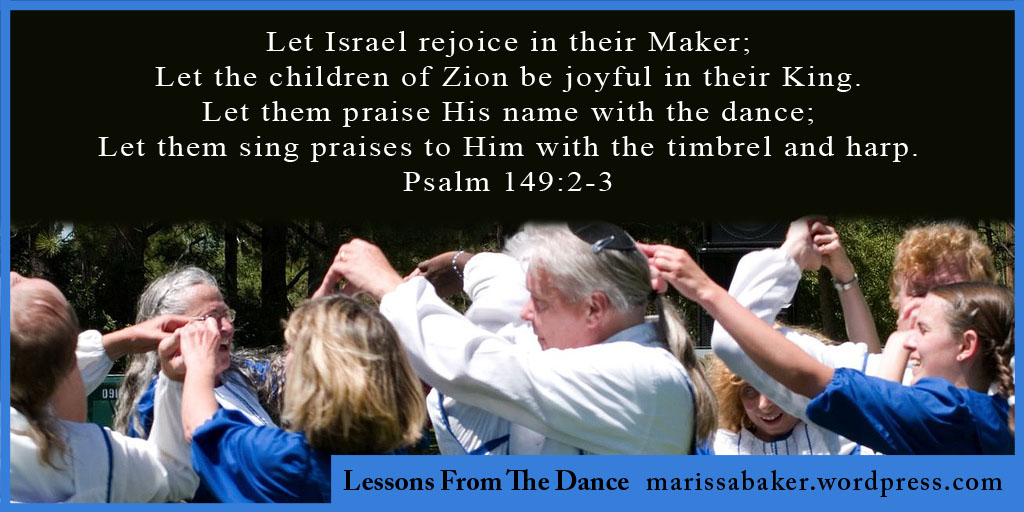
For those who that last paragraph left a bit confused, I’m referring to what’s known as Davidic or Messianic dance. It’s easier to show a video than to try to describe it in words. Here’s my dance team (several years before I met them) dancing to one of our very favorite songs:
I joined a Messianic dance team early in 2015. My first introduction to the dance was about a year before that, when a dancer shared some basic lessons at a Feast of Unleavened Bread event in Michigan. I absolutely loved it, and I picked up the dances so quickly my mentors say that God has given me a gift for the dance (there’s really no other way to explain why I’m good at it — normally I’m rather clumsy).
Dancing at church, especially to open the service, seems a bit odd to many Christian denominations. But there is Biblical precedent for dance as part of worship and I’ve found the inclusion of dance (and especially being involved in the dance) is a blessing I hadn’t expected. And it has taught me some valuable lessons about dancing in unity with God on a spiritual level.
Basics First
When you’re first learning to dance, you have to start with the basic steps. We don’t just expect new students to know how to do the Hallelu dance. First, we teach them how to do the mayim, tcherkessia, coupe, and 3-point turn that make up the Hallelu step combination. As they learn the basic steps, we start putting the steps together into patterns to match the different songs. And we keep going over and over those basic steps for the first couple months after new dancers join because they’re the basis for every dance we do.
It’s much the same when we first begin our Christian journey. We start out learning about the foundations of repentance and faith. We learn that we should “love the Lord your God with all your heart, with all your soul, and with all your mind” and “love your neighbor as yourself.” Then we learn how to apply those truths in every day situations.
As we grow, God deepens our understanding and adds more foundational principles like “the doctrine of baptisms, of laying on of hands, of resurrection of the dead, and of eternal judgment” (Heb. 6:1-3). Then we learn more about His expectations for those following Him, what grace truly means, how He wants us to view His commandments, and practical ways to follow Jesus with every step we take. But it all starts with the basics.
Listen To The Music
Even if you know the basic dance steps, they’re not worth much until you set them to music. Music is so much a part of the dance that our dance leader often has trouble recollecting the steps of a dance when she’s trying to walk through and teach them slowly without music. As soon as the music plays, though, it all comes back to her.
You can’t dance without listening to the music. A waltz calls for different steps than a tune in 4/4 time. In some songs, you need to wait for pauses in the music. For others, you have to be thinking two steps ahead because the music moves so fast. Often, listening to the lyrics tells you which part of the dance you’re supposed to be doing in multi-part dances.
In the same way, we have to “tune” our Christian walks to the song God plays through His scriptures. While the Bible doesn’t use the dancing analogy much, it does talk about Jesus coming “to guide our feet into the way of peace” (Luke 1:78) and of God directing the steps of good men (Psalm 37:23, 31; 119:133). We have to study His words so we know the right steps and we need to listen for the guiding of His spirit for how to apply what we learn.
Dance Together
Davidic dance isn’t a solo endeavor. We dance in circles of unity. Every dancer is responsible for knowing the steps to a given dance and how to follow the music. But there are some songs that just don’t stick in your mind as well and there are times (even when you’re no longer a beginner) that you just can’t remember what comes next.
If you can’t remember a step, you can follow one of the other dancers. You’re already watching them to keep in unity, and you know you can count on them for reminders. In turn, they should know they can count on you to know what you’re doing for when they can’t remember a step. We help keep each other on track.
Walking as Christians is made easier by fellowship with other believers. While God will certainly work with people who are isolated from other Christians, His intention is for the body of believers to come together and grow as we build each other up and learn to use our gifts (1 Cor. 12:1-31). We’re on this walk of faith together and we have the opportunity to help each other find the right steps to stay in unity with God.
I’ve written before about how other types can be friends with an INFJ. But there’s another side to that dynamic: what INFJs are like as friends. We can be fantastic friends — fun, engaging, good listeners, intensely loyal. But sometimes we’re not the best sort of friends and often, that’s the INFJ’s fault.
There are some things I love about being an INFJ personality type. And then there are other aspects which aren’t so nice, and some of those can negatively impact our friendships if we’re not careful. Today, I’m speaking of our tendency to drop out of contact with people.
INFJs are a curious mix of mental processes. We’re most comfortable using Introverted Intuition (also called “Perspectives”). This is focused on collecting information about how the world works, processing it internally, and making speculative leaps about what it means. Basically, it’s advanced pattern recognition.
That’s paired with Extroverted Feeling (aka “Harmony”). This mental process is in-tune with other people’s feelings and wants to make sure their needs get met. It’s generally the first mental place INFJs go when trying to make a decision, asking, “How will this affect other people and my relationship with them?” When well-developed in an INFJ, they can be so outgoing and social that they seem like extroverts.
But we might also skip this process and spend more time in our tertiary Introverted Thinking (aka “Accuracy”). That one’s more about analyzing of facts, trying to make things “make sense to me.” It’s also impersonal. When INFJs spend more time inside their heads than on developing our extroverted side, we can stay in an introverted Intuition-Thinking loop.
Distracted By The Inner World
Using our Intuitive and Thinking process together isn’t always a bad thing for the INFJ. Our Extroverted Feeling side is important to develop so we can make decisions more easily, maintain friendships, and experience personal growth. But we to also need alone time to re-charge and it can be a good way to process data. It only becomes a problem sometimes when we get “stuck” in our introverted side. Read more →
If we say we’re followers of Jesus Christ, there are certain things we should, nay, we must do. As we talked about last week, there are observable markers of being someone who follows God — things we should be able to notice when we examine ourselves. Those things are inseparably connected with Christ’s presence in us.
There is plenty of freedom within the perfect law of liberty, but there are absolutes as well. God is highly personal and He’ll work with you on a personal level. That does not, however, mean He has different requirements for how different people follow and worship Him. He’s also a just God who is not inconsistent in His commandments, laws, and expectations. We might have different understandings of what God expects, but as we grow toward God we should also be growing in unity as we understand His mind more fully. There isn’t one law for you and one law for me. There’s just God telling us all to walk in His ways.
Love + Obedience + Indwelling
John begins both his gospel and his first epistle with a focus on Jesus Christ’s role as the Word of life. Then, in the epistle, he focuses on how we can have fellowship with this great Being and His Father. We must “walk in the light as He is in the light,” “confess our sins” so He’ll forgive us, and then keep His commandments (1 John 1:5-2:3). We cannot claim to know God unless we’ve keeping His word and walking as Jesus walked (1 John 2:4-6). God wants us to be part of His family and that means becoming like Him (1 John 3:1-2). Read more →
So the election happened a couple weeks ago. Unfortunately, one of the two candidates won. We all knew it was going to happen. Most of us wouldn’t have been all that happy either way. There are plenty of people who would have been scared and upset with either outcome. And of course there are some on both sides who’d have been dancing for joy when their candidate won because they honestly thought they’d be a good president.
My title is a bit misleading, I suppose. It does matter who the president is because that impacts the future course of our nation, how other nations see us, and the policy that affects every day life for many people. But now that Donald Trump is president, we have to live with it. He won fairly according to the rules set up in our country. If Hillary Clinton had won, I’d be writing pretty much the exact same thing.
But though it does matter who’s president, it is shocking to see how many people are taking their candidate’s loss as a personal affront and the way they’re vilifying other Americans who disagreed with them. If you supported Trump, you’re therefore a racist misogynist who hates Muslims and women. If you supported Clinton, you’re therefore an air-head liberal not in touch with reality and careless of society’s moral decline. And on and on we go, painting people we don’t know with broad bush strokes according to how we view the candidate they supported.
That has to stop. We are not our political parties. We don’t always vote for someone because we agree with all their actions or every view they hold. (Just in case you’re wondering, I voted 3rd party because I couldn’t in good conscience choose either Clinton or Trump. My alternate plan was not voting at all.) Some people who voted for Trump did so because they preferred his policies even though they couldn’t stand his personal morals and don’t share the bigoted views that have been associated with his campaign. Some people who voted for Clinton did so because they thought she was the less-terrifying option or agreed with her policies, not because they wanted a female president at any cost or permission to slaughter babies.
How you and I choose to act in response to the election results has become so much more important than who won and who lost. If we want to hold our country and the new president to a higher standard, we must first start by holding ourselves to a higher standard. Don’t want to live in a country where people are harassed for how they look, think, or worship? Then don’t go around harassing people who disagree with you and stand up against such harassments whenever you can. Dislike the idea of someone being thrown out of your country for speaking their mind or living life how they choose? Don’t threaten someone else’s liberties of expression and belief.
It’s become startlingly obvious to people throughout America that there are plenty of Americans who don’t agree with us. Yet we still have to live together. We need to find a way to disagree without attacking each other. We need to figure out how to work together for a more united society while still respecting others’ differences. And we need to give our new president a chance to live up to his promises to “bind the wounds of division,” “work together and unify our great country,” and “deal fairly with everyone, with everyone — all people and all other nations” as we “seek common ground, not hostility; partnership, not conflict.”
Whether or not you believe him is moot at this point. Encourage him to actually do it instead of pretending he’s not president. And meanwhile, remember to be the change you want to see in the world. Or, to quote Gandhi more directly, “We but mirror the world. All the tendencies present in the outer world are to be found in the world of our body. If we could change ourselves, the tendencies in the world would also change.” Instead of adapting to the growing culture of hate, let’s dig deep inside ourselves and stand for goodness.






 Like An Anchor