We had to cook a turkey so all the beef from our butchered steers would fit in the freezer, so I have lots of cooked turkey to experiment with. My go-to recipe for leftover turkey is a rice casserole, but it calls for sour cream and I won’t have that until I go grocery shopping (by way of the library book sale) tomorrow. For my first foray into something-other-than-rice-casserole, I chose this Turkey Tetrazzini recipe from allrecipes.com.
Most pictures I saw were adding peas to it, but I opted for carrots. I also thought 1-2/3 cups of Parmesan cheese was way too much, a change you’ll see reflected in my recipe. I’m thinking next time I’ll cut the cheese on top to 1/4 cup instead of 1/3 cup — the Parmesan taste was still a bit strong.
Bring a large pot of lightly salted water to a boil. Add spaghetti, and cook for 8 to 10 minutes or until al dente. Drain, and place in a lightly greased 13x9x2-inch baking dish. Meanwhile, bring vegetables to boil in medium sauce pan and remove from heat. Drain, and spoon over the spaghetti.
Melt butter in a medium saucepan over medium heat. Whisk in flour. Add in chicken broth and milk, whisking until smooth. Cook and stir until the mixture comes to a boil. Stir in about 2/3 cups Parmesan cheese and the 1/2 cup Mozzarella cheese. Remove from heat.
Mix turkey into the chicken broth mixture. Pour evenly over spaghetti. Top with remaining Parmesan cheese. Bake for 40-50 minutes in the preheated oven, until surface is lightly browned and edges are bubbling.
I love having red hair. But there are times when I wish it wasn’t quite so unusual. No one walks up to other girls and says, “Wow, your hair is brunette” or “Your hair is so blond.” As if I didn’t already know I have red hair. Hair stylists tell me they have clients who would kill for my hair color (which is kinda creepy if you think about it– red hair isn’t that amazing).
The most awkward comments are those about how rare red hair is becoming. The first one I remember happened when I was only seven or eight years old and an elderly couple told my red-haired sister and me that we needed to marry red-headed men so we could preserve the red-head population. I’ve heard these types of comments several times since then, but the most awkward has to be the one we received last week.
My sister and three friends were about to jump out of a plane (don’t worry, they had parachutes). I convinced myself it was okay to be cowardly and tag along just to take pictures (after all, think how many books you could buy for the cost of a skydive!). We were all standing in the hanger, waiting on the instructors, when a guy who might have been in his 60s walked up to the desk. He looked over at my sister and I and commented on our red hair. But he wasn’t content to stop there, and continued by saying how rare red-heads are becoming. I braced myself for the inevitable comment about red-headed babies, but wasn’t quite ready for him to shout, “You should breed!”
One of the best sermons we heard during the Feast of Tabernacles was titled “Why Will God Release Satan to Deceive the World Again?” (Sept. 24 sermon, link in Pacific COG archives). I could probably write half a dozen blog posts on different points he brought up, but for now I want to focus on just one. In the context of trying to see things from God’s point of view (such as understanding His decision to release Satan after the Millennium [Rev. 20:1-10]), the speaker brought up the subject of suffering. When we’re suffering, our automatic response is to want the suffering to end because we view it in a negative light, but God’s perspective can be very different.
Blessed Persecution
If we start reading the beatitudes, those who Christ calls blessed are not always in a condition we would consider a blessing. They are “poor in spirit” (Matt. 5:3), they mourn and weep (Matt. 5:4; Luke 6:21), they are hungry (Luke 6:21), they are hated (Luke 6: 22), and they are persecuted.
Blessed are those who are persecuted for righteousness’ sake, for theirs is the kingdom of heaven. Blessed are you when they revile and persecute you, and say all kinds of evil against you falsely for My sake. Rejoice and be exceedingly glad, for great is your reward in heaven, for so they persecuted the prophets who were before you. (Matt. 5:10-12)
I don’t know about you, but my first reaction when I’m feeling persecuted is not to “rejoice and be exceedingly glad” or to “leap for joy” (Luke 6:23). Yet we should be more like the apostles who, after they were beaten and commanded not to preach Jesus any more, “departed from the presence of the council, rejoicing that they were counted worthy to suffer shame for His name” and made themselves the target of more persecution by continuing to preach (Acts 5:40-42).
If we suffer with Him
The question, “Why would God allow suffering?” is frequently asked by those in the church and by those who have rejected belief in God. If He’s all powerful, we wonder, why would He allow such terrible things to happen? One answer, as pointed out in the sermon I’ve been referring to, is that God sees suffering in a different light than we do. Often, what we see as negative in this moment will ultimately be for our good. For example, in Romans 8, Paul writes that we will be glorified with Christ on the condition that we suffer as He suffered.
The Spirit itself beareth witness with our spirit, that we are the children of God: and if children, then heirs; heirs of God, and joint-heirs with Christ; if so be that we suffer with him, that we may be also glorified together. For I reckon that the sufferings of this present time are not worthy to be compared with the glory which shall be revealed in us. (Rom. 8:16-18, KJV)
This is certainly not the only scripture that talks of our glorious future as being conditional on present suffering. Here are a few more:
our light affliction, which is but for a moment, is working for us a far more exceeding and eternal weight of glory (2 Cor. 4:17)
if you should suffer for righteousness’ sake, you are blessed (1 Pet. 3:14)
But when you do good and suffer, if you take it patiently, this is commendable before God. For to this you were called, because Christ also suffered for us, leaving us an example, that you should follow His steps (1 Pet. 2:20-21)
Why is suffering so important?
Finding these scriptures and understanding that suffering is part of being a Christian is not hard. Accepting that there is a good reason for suffering in your life or in the lives of those you love is the hard part. And this is why I really appreciated this sermon message, because the speaker didn’t just tell people “suffering is good for you, be happy.” He pulled together an easy-to-understand analysis that moved logically from the proper reaction to suffering, to the reward for suffering, to the reason for suffering.
My brethren, count it all joy when you fall into various trials, knowing that the testing of your faith produces patience. But let patience have its perfect work, that you may be perfect and complete, lacking nothing. (James 1:2-4)
The reason for trials and testings and suffering is that it helps us learn to be like God. If we were dancing through life without a care in the world, we would forget how much we depend on God. If we never suffered for following Christ, we would have no sense of how much we owe Him for dying in our place. If we did not suffer the consequences of sin, we would never learn to hate sin as much as God does.
After skipping yesterday, my goal of blogging everyday about something that happened during the Feast is falling by the wayside. Luckily, I had this recipe as a backup for today’s cooking post.
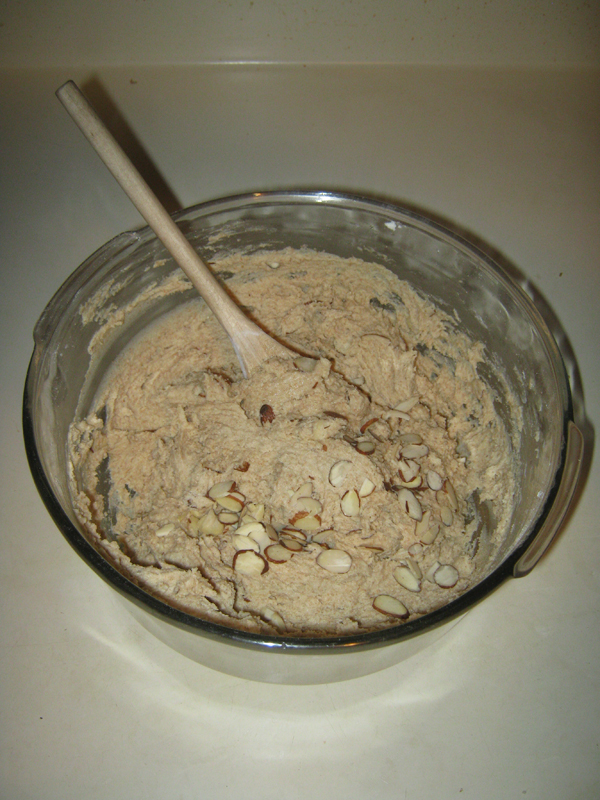
These cookies are easy to make and come together pretty quickly. They also take less time to bake than other cookies, since you can put them close together and fit more on a cookie sheet. The original recipe was for Italian Butterball cookies that I tracked down for an Italian potluck at church, but I’ve changed it quite a bit and have since lost the original link.
The only time I’ve ever had a problem with them turning out well was when I accidentally used baking soda instead of baking powder (in case you were wondering, it results in cookies that taste like vomit — don’t try it). Otherwise, it’s a great recipe.
Beat together the butter and 3/4 cup confectioners’ sugar with an electric mixer in a large bowl until smooth. Add the egg, vanilla extract, and almond extract.
Stir together the flour, baking powder, and salt in a bowl and mix into the butter mixture until just incorporated. Add almonds and stir.
Shape the dough into 1-inch balls and arrange on greased baking sheet spaced about 2 inches apart.
Bake at 350°F until firm, about 8-10 minutes. Cool on the sheet for 5-10 minutes before removing to cool completely on a wire rack.
Roll the cooled cookies in confectioners sugar to coat.
In keeping with my decision to blog every day of the Feast of Tabernacles, I’m going to share a story from a previous Feast for today’s post. I originally wrote this account to read aloud in a creative non-fiction class in 2011. The only thing I’ve edited from that version is changing the guys’ names, and my sister asked for her name to be taken out.
It was so hot in Panama City Beach that my glasses would steam up stepping outside from the air conditioned hotel. My family was there two years ago, in the fall, meeting with a church group that had chosen Florida as the location to observe the week-long Feast of Tabernacles, one of our annual Holy Days. Just a couple days into the Feast, my sister and I met two brothers, Quentin and Declan. Somehow, in the course of our conversation, the idea of kayaking on a nearby lagoon came up. Not entirely comfortable going anywhere with two guys we’d hardly known more than an hour, I was trying to politely refuse when Quentin suggested our whole family come. Well, surely he couldn’t be that dangerous if he was willing to include our Dad, Mom, and younger brother, so my sister and I agreed to the plan and invited the two brothers to eat lunch with our family in the condominium.
Of course, something had to go wrong. Mommy sliced her finger open on a can of pineapple, not too seriously, but enough to keep her from kayaking. Since she was laid-up, Daddy and my brother also stayed behind and my sister and I set out with Quentin and Declan. We split the cost of kayak rentals, but still, (or so my mother informs me) it was my first “date” as well as my first time kayaking. As it turned out, I enjoyed the kayaking part a lot more than the “dating” part. Quentin and I shared one kayak, and Declan and my sister shared the other. Both brothers had quickly lost interest in my sister after learning she was under 18, and I learned later that Declan and my sister hardly spoke the whole kayaking venture. By the time we got back to the hotel, I was convinced that lagging conversation would have been preferable to mine and Quentin’s discussion.
The kayaking adventure began promisingly. We watched pelicans ungracefully plop into the ocean and laughed at terns diving like missiles honing in on fish in the water below. The water was so clear you could look through the ripples and see fish swimming through snaky sea-grass while crabs skittered along the sandy bottom. Occasionally, a fish would randomly leap from the water, as if it was so happy to be alive that simply swimming was no longer enough and it had to take flight.
We had stopped paddling for a moment to take in the scenery when Quentin suddenly asked, “Have you heard of the book The Five Love Languages?”
I drew out my “Yes…?” like a question, which he took as permission to reveal that his love language was “Quality Time.” Then, as if the conversation were not awkward enough already, he went on to explaining that he particularly liked time spent with someone in a natural setting.
You mean like a lagoon in Florida, alone with someone you met just THREE HOURS AGO? I thought while mumbling something non-committal. Picking up my paddle, I cut short the conversation by steering our kayak back towards my sister’s and Declan’s kayak, vowing there was no way I was going to tell Quentin one of my primary love languages was “Touch”.
We had evening services yesterday, so there was a whole free day to fill with activities. My plan was to find all the book stores in the area and visit each, but we ended up at two antique stores and a mall instead. There was, however, a used book store in the mall, so I have one of the bookstores here checked off my list. I was particularly glad we stopped because I finally found a copy of C.S. Lewis’s Mere Christianity in hardcover for less than Amazon.com sells the paperback.
Some time ago, I signed up for an e-newsletter through biblegateway.com that sends a C.S. Lewis quote every day. This morning, it was a quote from Mere Christianity. It’s long, but I’d like to share it with you, if you don’t mind.
As a great Christian writer (George MacDonald) pointed out, every father is pleased at the baby’s first attempt to walk: no father would be satisfied with anything less than a firm, free, manly walk in a grown-up son. In the same way, he said, “God is easy to please, but hard to satisfy.”
I think every one who has some vague belief in God, until he becomes a Christian, has the idea of an exam or of a bargain in his mind. The first result of real Christianity is to blow that idea into bits. When they find it blown into bits, some people think this means that Christianity is a failure and give up. They seem to imagine that God is very simple-minded! In fact, of course, He knows all about this. One of the very things Christianity was designed to do was to blow this idea to bits. God has been waiting for the moment at which you discover that there is no question of earning a pass mark in this exam or putting Him in your debt.
Then comes another discovery. Every faculty you have, your power of thinking or of moving your limbs from moment to moment, is given you by God. If you devoted every moment of your whole life exclusively to His service you could not give Him anything that was not in a sense His own already. So that when we talk of a man doing anything for God or giving anything to God, I will tell you what it is really like. It is like a small child going to his father and saying, “Daddy, give me sixpence to buy you a birthday present.” Of course, the father does, and he is pleased with the child’s present. It is all very nice and proper, but only an idiot would think that the father is sixpence to the good on the transaction. When a man has made these two discoveries God can really get to work. It is after this that real life begins.
I think this is a great way to look at our relationship with God as His children. There’s not a thing we can do to earn salvation on our own. The second paragraph in this quote is saying basically the same thing Paul says when he writes, “For by grace you have been saved through faith, and that not of yourselves; it is the gift of God,not of works, lest anyone should boast” (Eph. 2:8-9). Every good thing in our lives is a gift directly from God. All that is good in us is a result of His work in our lives. We bring nothing to our relationship with God but our broken selves, desperately in need of Him to make us whole.
Such a realization is important because we cannot have a relationship with God without humility, and we cannot have humility if we think we are doing God a favor by agreeing to be part of His family. God’s family will be made up of people who know they have nothing to offer God and are wild with joy that He wanted to work with them anyway.
 We had to cook a turkey so all the beef from our butchered steers would fit in the freezer, so I have lots of cooked turkey to experiment with. My go-to recipe for leftover turkey is a rice casserole, but it calls for sour cream and I won’t have that until I go grocery shopping (by way of the library book sale) tomorrow. For my first foray into something-other-than-rice-casserole, I chose this Turkey Tetrazzini recipe from allrecipes.com.







 Like An Anchor