Creation Will Be At Peace

As you’ll know if you’ve been keeping track of my last few posts, my family and I are currently celebrating the Feast of Tabernacles (Lev. 23:33-43). One of the things I always look forward to at the Feast is singing in the choir. Since 2004 or 2005, I’ve only skipped singing one year. I’ve developed quite a collection of favorite songs, including the one we sang yesterday called “Let Us Join Our Hearts Together,” “King All Glorious” (which I someday hope to sing the solo part for), and “Creation Will Be At Peace.”

“Creation Will Be at Peace” sums up the hope that is an integral part of the Feast of Tabernacles. After the tribulation and after Satan is bound for 1,000 years (which we just pictured while celebrating The Day of Atonement), creation will finally be at peace, as will humanity for the first time since the Garden of Eden. It is such an encouragement to attend the Feast every year and be reminded of the wonderful future God has in mind for the entire world."Creation Will Be At Peace" marissabaker.wordpress.com

The wolf also shall dwell with the lamb, the leopard shall lie down with the young goat, the calf and the young lion and the fatling together; and a little child shall lead them. The cow and the bear shall graze; their young ones shall lie down together; and the lion shall eat straw like the ox. The nursing child shall play by the cobra’s hole, and the weaned child shall put his hand in the viper’s den. They shall not hurt nor destroy in all My holy mountain, for the earth shall be full of the knowledge of the Lord as the waters cover the sea. (Is. 11:6-9)

“Because We Love The Brethren”

We had a lovely first day of the Feast yesterday. Our little group is live-streaming from Pacific Church of God, and the sermon yesterday was excellent. Mr. Railston’s main theme was using the Feast to make a positive difference in the lives of other people, instead of focusing on “what can I do for me this Feast?” Our focus should be on rejoicing with others and giving them reason to rejoice, not simply making ourselves happy.

There were two scriptures that particularly stood out to me. In a discussion of Matt. 22:35-40, Mr. Railston pointed out that the first great commandment, loving God, could be done in isolation. The second great commandment, to love your neighbor as yourself, must be fulfilled in the presence of other people. And here’s the second scripture:

We know that we have passed from death to life, because we love the brethren. He who does not love his brother abides in death. (1 John 3:14)

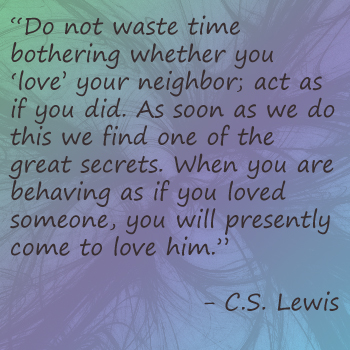
"Because We Love The Brethren" marissabaker.wordpress.comI’ve studied the subject of love in the Bible often, but I hadn’t thought much about the scripture in 1 John, or about the fact that we need to be around people to love them. It’s not that I really expected to love my brethren as a hermit — I just hadn’t thought of it in those words. I tend toward a more introspective approach to life, and my first reaction is to worry about changing myself and bringing “every thought into submission.” While it is important to be personally working toward perfection, I think my approach should probably be a little closer to C.S. Lewis’s councel to “not waste time bothering whether you ‘love’ your neighbor; act as if you did.” Sometimes action has to come before we feel like doing something or we think we’re perfectly ready.

Feast of Tabernacles

Happy Feast of Tabernacles! marissabaker.wordpress.comHappy Feast of Tabernacles! This holy day season is the most anticipated time of the year for my family, and for many of my friends. A whole eight days of getting away from “the world” (well, unless you’re in school and then there’s all that homework …), fellowshipping with other believers, and obeying the command to “rejoice before the Lord your God for seven days” (Lev. 23:33-43).

I’ve decided that one of the things I’m going to do this Feast to make it a little “extra special” is post something on this blog every day. I finished all of the writing that I needs done (copywriting articles, posts on my author blog), so I can focus my writing for the next week on fiction and fun things like this blog. Since I like writing so much, I’m really looking forward to that.


Apple Crisp

Apple Crisp recipe marissabaker.wordpress.com
A piece of warm apple crisp. Also tastes good with ice cream

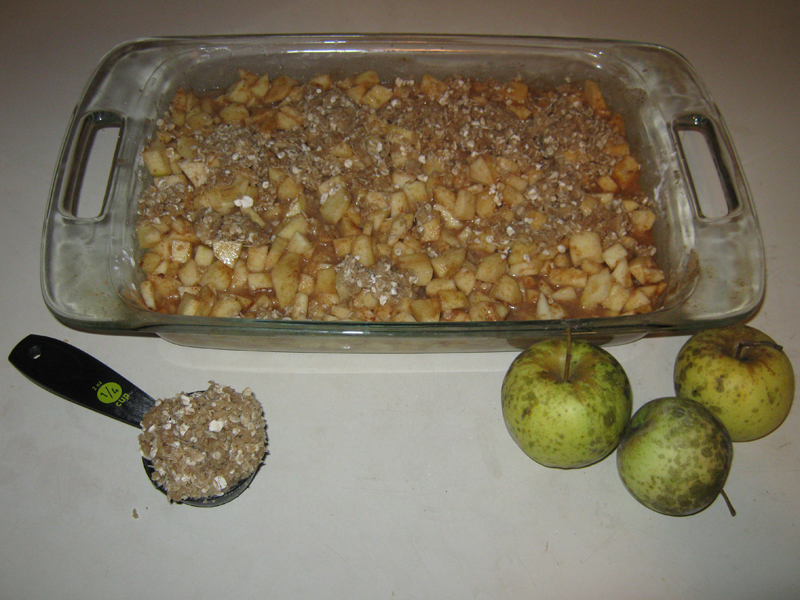
I’m particularly fond of this recipe. I’ve tweaked the original recipe so much that I consider this wholly mine. My family refers to it as “Marissa’s perfect apple crisp”. My dad likes it so much that he picks out the best apples that fall from our trees and brings them in so I can bake with them. These pictures are from first one I’ve made with this year’s fresh apples. You can also use thawed-out frozen apple pieces. Just reduce water in the filling to 1 or 1-1/4 cup (depending on how much liquid is in the apples when you unthaw them).

Perfect Apple Crisp

print this recipe

Filling

6 cups apples

Apple Crisp recipe marissabaker.wordpress.com
topping the crisp

¾ cups sugar

¼ cup all-purpose flour

2 Tablespoons whole wheat flour

1 ½ teaspoon cinnamon

1 ½ cups water

Topping

1 ¼ cups brown sugar

¾ cups all-purpose flour

½ cup whole wheat flour

1 ¼ cups quick oats

10 tablespoons melted butter

Place chopped apples in a greased 9” x 13” glass baking pan. Spread dry ingredients over the apples. Pour water over the filling, and mix thoroughly.

Apple Crisp recipe marissabaker.wordpress.com
ready to come out of the oven

Mix all toping ingredients in a bowl until crumbly. (I usually melt the butter in a large, microwave-safe bowl and then mix the dry ingredients into that.) Spread topping over the apples.

Bake for 30-35 minutes at 350°F, or until heated through and bubbling.

print this recipe

My Homeschool Socialization Story

An introverted homeschooler's views on socialization at school marissabaker.wordpress.com
a picture of a much-younger me

Once upon a time, there was a little girl named Marissa whose parents were worried about her going to kindergarten. She was going to be away from home all day, five days a week for the first time in her life. So her mother enrolled her in a summer school program where she would only be gone half a day, to help her get accustomed to being away from home.

Every time Marissa was dropped off at this school, her little sister would cry because Marissa was being abandoned. Years later, there are only two things Marissa remembers about this experience. One was that the teachers wanted her to take naps on a thin blue pad in the middle of a large room filled with strange people. She never slept because she was too nervous, but she had to lay there anyway. The second is hiding under the playset outside the school when all the children were sent outside so she wouldn’t have to face the other children (her mother says one of the boys hit her, but she must have blocked this memory).

One day, when Marissa’s mother picked her up from school, Marissa was crying. She asked, “Have I been away long enough? Can I come home now?” This broke her father’s heart, and he decreed that Marissa would never have to go back to school again.

After this short summer, I was homeschooled through all twelve years of elementary, middle, and high school. My sister also graduated from our homeschool, and my brother is currently finishing up high school at home. I’m one of those homeschooling success stories who went to college, earned better grades there than I did in high school from my mom, and earned my B.A. along with an undergrad research project that I’ve been assured could have gotten me into grad school and on track for my English PhD.

Socializing Homeschoolers

The previous paragraph aside, my goal today is not to defend the academic merits of homeschooling. I want to talk about socialization. Last week, a friend shared with me a great blog post that covered everything from the hypocrisy of America’s talk about “diversity,” to the merits of homeschooling, to defending introverts. In this post, Matt Walsh addressed the frequent claim that we need to send our children to public schools so they can “be socialized.”

In fact, kids who are homeschooled tend to be much better in “social situations” because they learned how to socialize from adults, rather than aping the personality traits of their peers. Public school doesn’t make kids “sociable,” and I think you could more accurately argue for the opposite. The whole concept that we need to send our children to government facilities to be “socialized” makes me shudder. Our children aren’t animals, and I wish we’d stop speaking about them as if they were.

This is a common argument from homeschool families and homeschooling supporters. I don’t exactly want to argue against it, but I have to admit my experiences are somewhat different. While the homeschooled me was quite comfortable socializing with adults and people younger than me, I was never very comfortable in my peer group (a fact that hasn’t changed much, though I’m a little more confident around other young people since going through college). The flip side of this is public school kids I’ve met who ignore younger kids and make no effort to hide the fact that they don’t want to talk with adults. There are, of course, both homeschoolers and public schoolers who are comfortable socializing with anyone and everyone (I suspect this is a personality-type thing more than a where-they-went-to-school thing).

Introverts in School

In a book titled Introvert Power, Laurie Helgoe (who holds a PhD in psychology) discusses the pressures that introverts face in an extroverted society, including the public school system.

In an extroverted society, we rarely see ourselves in the mirror. We get alienating feedback. Alienating feedback comes in the form of repeated encouragement to join or talk, puzzled expressions, well-intended concern, and sometimes, all-out pointing and laughing. … Alienating feedback happens where neighborhoods, schools, and offices provide no place to retreat. Alienating feedback happens when our quiet spaces and wilderness sanctuaries are seen as places to colonize.

Unfortunately, I don’t have her book in front of me at the moment and can’t find the other quote I wanted online. I’ll have to make do with a paraphrase. In her discussion of the school system, Helgoe talks about how the emphasis on group projects and participation in class can sabotage introverted children’s efforts to learn. Her idea isn’t to completely do away with this kind of work, but that schools should cater to different learning needs instead of trying to fit everyone into the extrovert-ideal mold. In the absence of such an education environment, she suggest homeschooling can be the best environment for an introverted child to learn because it allows them to utilize their strengths and can more easily be designed to fit individual children.

My Experiences

An introverted homeschooler's views on socialization at school marissabaker.wordpress.com
from Pinterest

Though I did have friends my age while growing up — most through church, a few through homeschool groups — I did not really interact with a wide variety of people my age until I started college. There, I got a taste of what it might have been like for me to have gone to public school. After settling into life at college, I usually ate alone while reading, talked in class only when I was called on or had an idea I really wanted to share, and socialized with a few people one-on-one or in (very) small groups. And, in spite of the teacher who proclaimed that people eating alone was the most pathetic thing in the world because at heart we are (or should be) social animals, I was content with the level of socialization I enjoyed/avoided at college.

I don’t know exactly what would have happened had I been in public school instead of homeschooled those twelve years. If thrown into the social environment of public school while growing up, I might have made friends and “crawled out of my shell.” However, I suspect it would have been much more like my summer school experience and my first quarter of college, except without the confidence gained by twelve years of studying on my own and being told it was okay to be bookish. My basic personality would not have altered, but I would have felt pressured to hide my quietness and conform instead of being supported in my personal growth. Like Beatrix Potter says in this quote, “Thank goodness I was never sent to school; it would have rubbed off some of the originality.” The world doesn’t need cookie-cutter minions popped out of identical molds and taught identical things. It needs a wide variety of people who have been given the chance to shine using their individual talents. And that is something homeschooling is uniquely suited to do.

Reasons for Atonement

Today, the 14th of September/10th of Tishrei is the Day of Atonement, or Yom Kippur. It is, as far as my research can find, considered the holiest day of the Jewish year. That does not, however, mean this important day holds no significance for Christians. Like the rest of the Old Testament, God’s Holy Days were given to man for a purpose that did not expire when Jesus Christ instituted the New Covenant. Some things were replaced/filled to the fullest, such as animal sacrifices being fulfilled by Jesus Christ’s sacrifice (Heb. 7:26-28). Others were updated to be understood in a spiritual light, which is what I touched on in “Righteousness by Faith” and “Purpose of the Law.” In the case of God’s Sabbaths and Holy Days, we have ample evidence that Jesus Christ kept these days as Holy and that the New Testament church followed His example.

Loose The Bonds of Wickedness

The Day of Atonement (Yom Kippur) for Christians marissabaker.wordpress.comThe Day of Atonement is specifically referred to as “the Fast” in Acts 27:9. But knowing that Paul and his fellow believers observed the Day of Atonement only gives modern Christians an example to follow. That in and of itself is not an explanation for why this day should be observed. For that, we have to take a look at the Old Testament observance.

And the Lord spoke to Moses, saying: “Also the tenth day of this seventh month shall be the Day of Atonement. It shall be a holy convocation for you; you shall afflict your souls, and offer an offering made by fire to the Lord. And you shall do no work on that same day, for it is the Day of Atonement, to make atonement for you before the Lord your God.For any person who is not afflicted in soul on that same day shall be cut off from his people.And any person who does any work on that same day, that person I will destroy from among his people.You shall do no manner of work; it shall be a statute forever throughout your generations in all your dwellings. It shall be to you a sabbath of solemn rest, and you shall afflict your souls; on the ninth day of the month at evening, from evening to evening, you shall celebrate your sabbath.” (Lev. 23:26-32)

Leviticus 23 lists the most important days of the year in God’s calendar, yet Atonement is the only one where the people are told they will be “cut off” and/or “destroyed” if it is not properly observed. A possible reason for the significance placed on this particular day lies in the symbolism of fasting. In my Google searches looking for descriptions of the Jewish observance of Yom Kippur, I stumbled across a Christian website that had the following to say about Atonement. (To provide proper attribution, here’s the link [but I didn’t finish reading this article and I don’t know anything about the site].)

An Israelite’s refusal to fast, which resulted in the offender being cut off from the community (Leviticus 23:29) is the Old Testament’s equivalent of a person today refusing to repent, which will result in the offender being cut off from eternal life (Luke 13:3). Fasting is outward proof that the person doing the fasting is serious about repentance, which is vital for forgiveness.

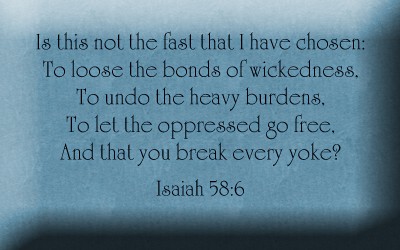
This idea fits in nicely with the purpose of fasting. In Isaiah 58, God answers Israel’s question about why He has no respect for their fasts by describing an acceptable fast. “Is this not the fast that I have chosen,” He asks in verse 6, “To loose the bonds of wickedness, to undo the heavy burdens, to let the oppressed go free, and that you break every yoke?”

Undo The Heavy Burdens

When we fast, it serves as a reminder of how much we need God and of the severity of our struggle against sin.  Going without food or water for 24 hours (or 25, in the Jewish tradition) reminds us how weak we are as human beings. The reminder of how much we need physical food and water — which is provided by God (James 1:17) — also helps us realize how much we are dependent on God for spiritual things. We are to hunger and thirst after righteousness (Matt. 5:6), but does my soul always long for God as much as my throat longs for water today?

As the deer pants for the water brooks, so pants my soul for You, O God. (Ps. 42:1)

O God, You are my God; early will I seek You; my soul thirsts for You; my flesh longs for You in a dry and thirsty land where there is no water. (Ps. 63:1)

Fasting should also remind us of our daily struggle against sin. I’m so used to drinking and eating that I have to consciously remind myself not to  grab a drink of water or open my dark chocolate and cashew stash today. While we were without God in the world, we were in a similar state of sinning without really thinking about it. But now that we have been redeemed by Christ’s sacrifice, we are to walk in newness of life and must make an effort to run away from sin and toward Christ (Rom. 6:4). Without His divine aid, we would slide back into sin.

Let The Oppressed Go Free

As we know, Jesus Christ’s sacrifice is what frees us from the heavy burden of sin (John 8:31-36). If freeing people from wickedness is also the purpose of fasting, it makes sense that fasting under the New Covenant would be related to the subject of repenting and accepting Christ’s sacrifice on our behalf.

In the Old Testament, the Day of Atonement was the only day of the year on which the High Priest could enter the Holy of Holies in the tabernacle or temple (Lev. 16:2-10; 16:29-34). It is, therefore, this day that is referred to in Hebrews when the writer says,

the priests always went into the first part of the tabernacle, performing the services.  But into the second part the high priest went alone once a year, not without blood, which he offered for himself and for the people’s sins committed in ignorance; the Holy Spirit indicating this, that the way into the Holiest of All was not yet made manifest while the first tabernacle was still standing. …

But Christ came as High Priest of the good things to come, with the greater and more perfect tabernacle not made with hands, that is, not of this creation. Not with the blood of goats and calves, but with His own blood The Day of Atonement for Christians marissabaker.wordpress.comHe entered the Most Holy Place once for all, having obtained eternal redemption. For if the blood of bulls and goats and the ashes of a heifer, sprinkling the unclean, sanctifies for the purifying of the flesh,  how much more shall the blood of Christ, who through the eternal Spirit offered Himself without spot to God, cleanse your conscience from dead works to serve the living God? (Heb. 9:6-8, 11-14)
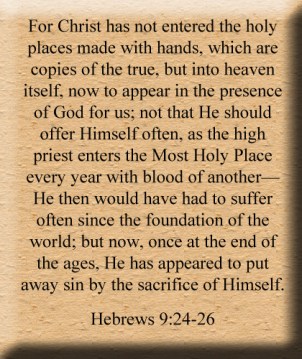
Christ’s sacrifice supersedes the physical animal sacrifices by a human priest, just as His priesthood supersedes the Levitical system. But doing away with the animal sacrifice does not do away with our need for repentance. Christ said His servants would fast (Mat. 6:16-18; Matt. 9:14-16), and our obedience to this (particularly in the commanded fast on the Day of Atonement) reminds us of our need for redemption. Fasting helps us draw near to God, shows us how much we need Him, and is a physical sign of our willingness to obey His commands.

Break Every Yoke

The third main element of the Day of Atonement in the Old Testament involved the “scapegoat” or the “Azazel goat.”

“And when he has made an end of atoning for the Holy Place, the tabernacle of meeting, and the altar, he shall bring the live goat. Aaron shall lay both his hands on the head of the live goat, confess over it all the iniquities of the children of Israel, and all their transgressions, concerning all their sins, putting them on the head of the goat, and shall send it away into the wilderness by the hand of a suitable man. The goat shall bear on itself all their iniquities to an uninhabited land; and he shall release the goat in the wilderness. (Lev. 16:20-22)

In the churches I’ve been a part of, this has traditionally been read as symbolic of Satan being bound so that he “so that he should deceive the nations no more till the thousand years were finished” (Rev. 20:1-3. Permanently removed in verse 10). I see no reason to contest this interpretation. Though God’s people have been freed by Christ’s sacrifice, we still have to deal with  living in a fallen world subject to Satan’s influence. The “whole creation groans” and is subject to “the bondage of corruption” until the time of Christ’s return and Satan’s removal (Rom. 8:21-22), which will finally fulfill the Day of Atonement. Today reminds us of the incredible hope God gives us that someday, the entire world will be released from Satan’s yoke and enjoy the true freedom found in being a part of God’s family.