Praying For You

I’ve written about prayer before, but I want to shift the focus this time from praying for everyone (1 Tim. 2:1, 8) to praying for our brethren. There are numerous examples of praying for those close to us and who share our faith. Jesus prayed for His disciples and “for them also which shall believe on Me through their word” (John 17:20). Paul mentions that he prays for the brethren (Rom. 1:9; 2 Cor. 13:7; Eph. 1:16; Php. 1:4, 9; Col. 1:3, 9; 1 Thes. 1:2, 3:10; 2 Thes. 1:11; 2 Tim 1:3; Phm. 1:4 ) and instructs his readers to pray for each other, for him, and for others in ministry (Rom. 15:30; 2 Cor. 1:11; Eph. 6:18; Col. 4:2-3, 12; 1 Thes. 5:25; 2 Thes. 3:1; Heb. 13:18). James tells us to “pray one for another, that ye may be healed” (Jas. 5:16).

Each time Paul says that he is praying for the brethren, he mentions specific things he is praying. In Romans, it is that he will be able to visit them shortly. In 2 Corinthians, he prays that they would “do no evil.” In Ephesians, he asks “That the God of our Lord Jesus Christ, the Father of glory, may give unto you the spirit of wisdom and revelation in the knowledge of Him”. Philippians, 1 Thessalonians, 2 Timothy, and Philemon record general requests made on someone’s behalf.

In Colossians and 2 Thessalonians, Paul gives more extensive lists of specific things he was praying for. These can serve as a model when we are praying for each other. The focus is on spiritual matters, praying for a person to increase in knowledge and develop a closer relationship with God.

For this cause we also, since the day we heard it, do not cease to pray for you, and to desire that ye might be filled with the knowledge of His will in all wisdom and spiritual understanding; that ye might walk worthy of the Lord unto all pleasing, being fruitful in every good work, and increasing in the knowledge of God; strengthened with all might, according to His glorious power, unto all patience and longsuffering with joyfulness (Col 1:9-11)

Wherefore also we pray always for you, that our God would count you worthy of this calling, and fulfil all the good pleasure of his goodness, and the work of faith with power: that the name of our Lord Jesus Christ may be glorified in you, and ye in Him, according to the grace of our God and the Lord Jesus Christ. (2 Thes. 1:11-12)

Jas 5:16  Confess your faults one to another, and pray one for another, that ye may be healed. The effectual fervent prayer of a righteous man availeth much.  Jas 5:17  Elias was a man subject to like passions as we are, and he prayed earnestly that it might not rain: and it rained not on the earth by the space of three years and six months.  Jas 5:18  And he prayed again, and the heaven gave rain, and the earth brought forth her fruit. From James 5:16, we know that “The effectual fervent prayer of a righteous man availeth much.” Prayer is one of the most helpful things we can do for another person. We should never feel like, “I just don’t know what I can do to help” as long as we are able to pray.

I’m going to end this post with a lovely prayer recorded in Psalm 20 as translated in The Holy Bible in its Original Order. Usually I prefer the King James for Psalms, but the translation for this psalm makes the prayer seem more personal, and God’s help nearer.

May the Lord answer you in the day of trouble, the name of the God of Jacob set you on high, may He send you help from the sanctuary, and strengthen you out of Zion. May He remember all your offerings and accept your burnt sacrifice. Selah. May He grant you according to your own heart and fulfill all your plans.

We will shout for joy in your victory, and in the name of our God we will set up banners; may the Lord fulfill all your prayers. Now I know that the Lord saves His anointed; He will answer him from His holy heaven with the saving strength of His right hand.

Some trust in chariots and some in horses, but we will remember the name of the Lord our God. They are brought down and fallen, but we have risen and stand upright. Save, O Lord; let the King hear us when we call.


Chocolate Frozen Cheesecake

frozen chocolate cheesecake recipe
Cheesecake in the freezer

I’m celebrating my birthday early with my favorite birthday cake. Cheesecake is amazing in all shapes, sizes, and flavors, but this is one of my personal favorites. It’s smooth, creamy, and best of all considering what time of year it is — frozen! It’s very rich, so perfect for cutting into thin pieces and sharing with guests. It will keep in the freezer for a several days, though, so you can spread it out over a few days if you don’t want to share it with very many people.

Frozen Chocolate Cheesecake

print this recipe

Frozen Chocolate Cheesecake crustCrust

1¼ cups chocolate graham cracker crumbs

¼ cup butter, melted

Mix graham cracker crumbs and butter. Press into 9-inch spring form pan.

 Filling

Frozen Chocolate Cheesecake ingredients1 (8-oz) package cream cheese, softened

1 (14-oz) can sweetened condensed milk

2/3 cup chocolate syrup

1 cup whipping cream

Beat first three ingredients in glass bowl with an electric mixture. Whip the cream in a separate, smaller bowl. Fold whipped cream into other mixture.

fozen chocolate cheesecake
pouring the batter

Poor into prepared spring form pan and freeze overnight.

print this recipe

Vive Les Introverts

I’ve been fascinated by type psychology since high school. In lieu of a guidance counselor (since I was homeschooled), my mother suggested I see if the library had any books about career testing or if I could find websites that offered free tests. That was when I first stumbled upon the MBTI and discovered my personality type. I know there are many people who don’t find value in personality types, either because the type method doesn’t fit them well or they just don’t care, but when I found out what my type was, I suddenly felt like I wasn’t alone in the universe. Apparently this is a typical reaction for INFJs, since it is the least common type.

Before this turns into a post about my personality type, I want to get on to my real topic. Last week, I came across this video via the blog Personality Junkie. If you have 19 minutes, I highly recommend watching it. Even if you’re not an introvert, she has an interesting perspective on culture and the contributions of both introverts and extroverts to society.

I read Susan Cain’s book, Quiet: The Power of Introverts in a World That Can’t Stop Talking, a few months ago. If you like this talk, you should check it out. Her research is extensive, and it’s presented in a reader-friendly, almost conversational format.

“Introverts … may have strong social skills and enjoy parties and business meetings, but after a while wish they were home in their pajamas. They prefer to devote their social energies to close friends, colleagues, and family. They listen more than they talk, think before they speak, and often feel as if they express themselves better in writing than in conversation. They tend to dislike conflict. Many have a horror of small talk, but enjoy deep discussions.” – Susan Cain

Even though I grew up in one of the most introvert-friendly environments you can find (homeschooled by supportive, introverted parents), I’ve long felt like there was “something wrong with me.” This is apparently common for introverts, especially in western culture where we are constantly presented with extroversion as a cultural ideal. Fun, outgoing, talkative people are surrounded by friends and happy — melancholy, lonely bookworms who stay home on Saturday night can only wish they were that “cool.”

good grade, social life, adequate sleep. Pick Two [welcome to college]
I’ll take #1 and #3, please
By the time I was a couple years into my college studies, I’d become convinced that working alone was the best way for me to succeed. Writing my ideas was more productive than talking about them, working in groups just slowed me down. But even carrying a 3.98 GPA didn’t help much when favorite professors said, “You’d be the perfect student if only we could get you to talk more.” I was already talking more than I wanted — sometimes as much as once or twice per class to get those participation points I didn’t usually need, but was too contentious to just ignore.

Since reading Susan Cain’s book and another called Introvert Power: Why Your Inner Life if Your Hidden Strength by Laurie Helgoe, I’ve started to feel more comfortable embracing my introvertedness. Ironically, this has helped me when I need (or want) to extrovert — it’s easier to talk to people when I’m more comfortable being myself.

“Let’s clear one thing up: Introverts do not hate small talk because we dislike people. We hate small talk because we hate the barrier it creates between people.” – Laurie Helgoe

About 50% of the world’s population is introverted, and research indicates we are born with a base personality type. Though socialization plays a role, we can’t help being introverted or extroverted. And there’s really no reason we should want to “help it.” Introverts have just as much to offer the world as extroverts. We just approach life a little differently.

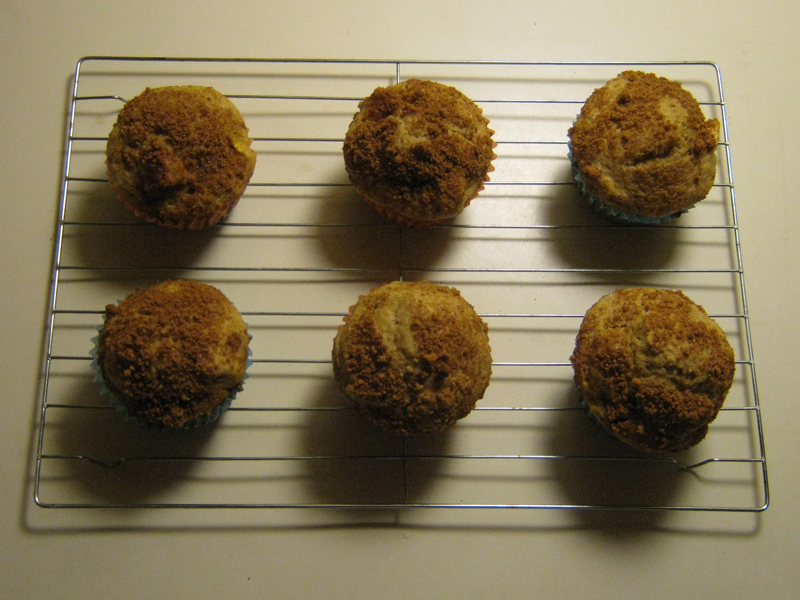
Muffins!

Cinnamon-sugar topping makes these apple muffins irresistible

I love breads and pastries. Usually I’m able to resist the allure of the baking section when I’m in a store, but when the last two apples in a bag start to get too soft to want to eat as a snack, there really is no other option than to convert them into muffins.

This recipe is from Better Homes and Gardens Homemade Bread Cook Book (1973). It can easily be altered for other fruits. For instance, you can use blueberries instead of apples, add 1/2 teaspoon lemon juice, and leave off the topping to have a lovely blueberry muffin recipe.

Apple Muffins

Print This Recipe

1 cup white, unbleached flour

¾ cups whole wheat flour

¼ cup sugar

2½ teaspoons baking powder

¾ teaspoon salt

½ teaspoon cinnamon

1 well-beaten egg

¾ cup milk

1/3 cup cooking oil

1 cup peeled and chopped apple

topping

2 tablespoons sugar

½ teaspoon cinnamon

Stir thoroughly the dry (first six) ingredients; make well in center.

apple muffins
muffins cooling

Blend egg, milk, oil, and apples in a small bowl. Add all at once to dry mixture. Stir until just moistened.

Line muffin pans with baking papers and fill ¾ full. Sprinkle with topping.

Bake at 400°F for 12-18 minutes, or until toothpick inserted near center comes out clean.

Print This Recipe

Anxious For Nothing

There is something that I find comforting about realizing how well God knows us.

O LORD, Thou hast searched me, and known me. Thou knowest my downsitting and mine uprising, Thou understandest my thought afar off. Thou compassest my path and my lying down, and art acquainted with all my ways. For there is not a word in my tongue, but, lo, O LORD, Thou knowest it altogether. (Ps. 139:1-4)

If I take the wings of the morning, and dwell in the uttermost parts of the sea; Even there shall thy hand lead me, and thy right hand shall hold me.  Psa 139:9-10This is my favorite Psalm. Not only does it have one of the most fantastically poetic phrases in the Bible — “If I take the wings of the morning, and dwell in the uttermost parts of the sea” — it is also the prayer of a man who is in awe of his God and takes comfort in the close relationship they share. David put his complete trust in God, and shared all his worries, troubles, and fears with full confidence that God would hear and respond.

I cried unto the LORD with my voice; with my voice unto the LORD did I make my supplication. I poured out my complaint before Him; I shewed before Him my trouble. When my spirit was overwhelmed within me, then Thou knewest my path. (Ps. 142:1-3)

Throughout the Psalms, we can see examples of David bringing his anxiety before God, much as Peter admonishes us to do when he writes, “Humble yourselves therefore under the mighty hand of God, that He may exalt you in due time: casting all your care upon Him; for He careth for you” (1 Pet. 5:6-7). It is certainly not easy to let go of our worries, but that is what we are expected to do.

In the sermon on the mount, Jesus spends a large portion of chapter 6 admonishing His followers against earthly anxiety. He says to “lay up for yourselves treasures in heaven” instead of on earth and “take no thought for your life” (6:20, 25). Paul says much the same thing in Philippians:

Be careful for nothing; but in every thing by prayer and supplication with thanksgiving let your requests be made known unto God. And the peace of God, which passeth all understanding, shall keep your hearts and minds through Christ Jesus. (Php. 4:6-7)

The word translated “careful” is G3309 merimnao (μεριμνάω). Zodhiates says it means, “To care, be anxious, troubled, to take thought.” When we pray to God and draw near to Him, we do not have to be anxious about anything. Now, I can write this just fine, but I’ll be the first person to admit I’m not very good at letting go of my anxiety. I worry about my family and friends, being in groups of people,  my 15-year-old cat, how people will respond to my writings, and my future (which encompasses a whole sub-group of worries we won’t get into right now). I spend an inordinate amount time worrying, and usually things aren’t nearly as bad as I feared. In short, I am anxious about things that turn out to be nothing to worry about.

Just think how much time and energy we could save if we really believed that God will make “all things work together for good to them that love God, to them who are the called according to His purpose” (Rom. 8:28). This doesn’t mean we’ll never worry at all. But it should mean that we can let go of our anxieties more quickly and “let the peace of God rule in your hearts” (Col. 3:15).

Fairy Tales

I love fairy tales. When I was little, my exposure to fairy tales was mostly through Disney films (my favorite is Beauty and the Beast, just in case anyone is wondering). I started seriously reading fairy tales just a few years ago, when my favorite English professor loaned me a collection of Celtic Fairy Tales. Since then, I’ve read all the Brothers Grimm tales, many of Andersen’s fairy tales, more Celtic folklore, and collections of French fairy tales including Perrault’s writings.

I’ve been reading some of C.S. Lewis’s essays collected in the book “Of Other Worlds.” I’ve enjoyed reading his fiction (Narnia and the Space Trilogy), as well as Mere Christianity, so it was nice to get insight into his mind and writing process. For the blogt I wrote to post on my writing website tomorrow (yes, I write under a pen name), I turned to one of these essays for inspiration. I liked writing it so much, that I decided to post it here as well.

C.S. Lewis on Children’s Writings

By tracking down a quote on Pinterest, I came across C.S. Lewis’s essay “On Three Ways of Writing For Children” (full text online here). Though I don’t write specifically for children, I like to think that my fantasy novels would appeal to (and be appropriate for) some young people. After all, I can’t be the only child who was reading Jules Verne by age 10 and searching for other stories of the fantastic.

The essay becomes most interesting to me when Lewis addresses the question of what kinds of stories are worth reading as children. Since he wrote children’s fantasy — not because he set out to write for children, but “because a children’s story is [sometimes] the best art-form for something you have to say” — he spends much of the essay defending fairy tales.

If I have allowed the fantastic type of children’s story to run away with this discussion, that is because it is the kind I know and love best, not because I wish to condemn any other. But the patrons of the other kinds very frequently want to condemn it. About once every hundred years some wiseacre gets up and tries to banish the fairy tale. Perhaps I had better say a few words in its defence, as reading for children.

Just as when Lewis was writing (in 1952), modern parents have been banning classic fairy tales. Hansel and Gretle and Little Red Riding Hood are not read because they are “too scary,” but there are other reasons as well. More than 50% of parents wouldn’t “read their kids Cinderella because the heroine spends her days doing housework. Many felt that this theme of female domesticity didn’t send a good message.” The politically incorrect word “dwarves” disqualifies Snow White from polite society. Rapunzel’s kidnapping and imprisonment is “too dark” a theme (actually, it is darker than they think– in the Grimms version she’s not actually kidnapped. Her father gives her to a witch to save his own life).

Whether or not to read fairy tales (and which ones to read) to children is a choice that will vary from parent to parent and also depends on the child. There are plenty of fairy tales I wouldn’t read to a very young or sensitive child (like The Little Mermaid, where she is in agony the entire time she has legs and dies at the end). But on the whole, I tend to agree with Lewis when he said,

Since it is so likely that they will meet cruel enemies, let them at least have heard of brave knights and heroic courage. Otherwise you are making their destiny not brighter but darker. Nor do most of us find that violence and bloodshed, in a story, produce any haunting dread in the minds of children. As far as that goes, I side impenitently with the human race against the modern reformer. Let there be wicked kings and beheadings, battles and dungeons, giants and dragons, and let villains be soundly killed at the end the book. Nothing will persuade me that this causes an ordinary child any kind or degree of fear beyond what it wants, and needs, to feel. …

It would be nice if no little boy in bed, hearing, or thinking he hears, a sound, were ever at all frightened. But if he is going to be frightened, I think it better that he should think of giants and dragons than merely of burglars. And I think St George, or any bright champion in armour, is a better comfort than the idea of the police.

As a child who was deeply afraid of things that go bump in the night, I can wholeheartedly support Lewis’s claim that a “bright champion in armour” is a far better comforter than the police. And if my mind had not been filled with fairy tales, fantasy, and knights in shining armor I would never have dreamed up Jamen and Karielle or Bryant and Aelis (who now live in my in-progress and finished novels) or invented Ves’endlara.

Which fairy tales would you read, or not read to children? As an adult, do you enjoy reading fairy tales?