Why Aren’t There More Christian Environmentalists?

I’m getting so tired of Christians mocking the idea of climate change on the basis that God is in control and it’s arrogant to think that we can affect His world. Some of the people most vocally against any efforts to care for our planet are the ones who believe it is a gift from a benevolent creator!

I suppose part of the reason for this is political. In the United States, we’ve turned environmental concerns into a partisan issue and since most Christians are Right-leaning they certainly can’t support any idea associated with the Left. Personally, I find this whole thing ridiculous. Not only should our planet’s health concern everyone, but as Christians we’re not supposed to get so involved in worldly affairs that we can only listen to one side of an issue like this. Rather, we’re called to be citizens of a heavenly country with priorities that transcend political parties.
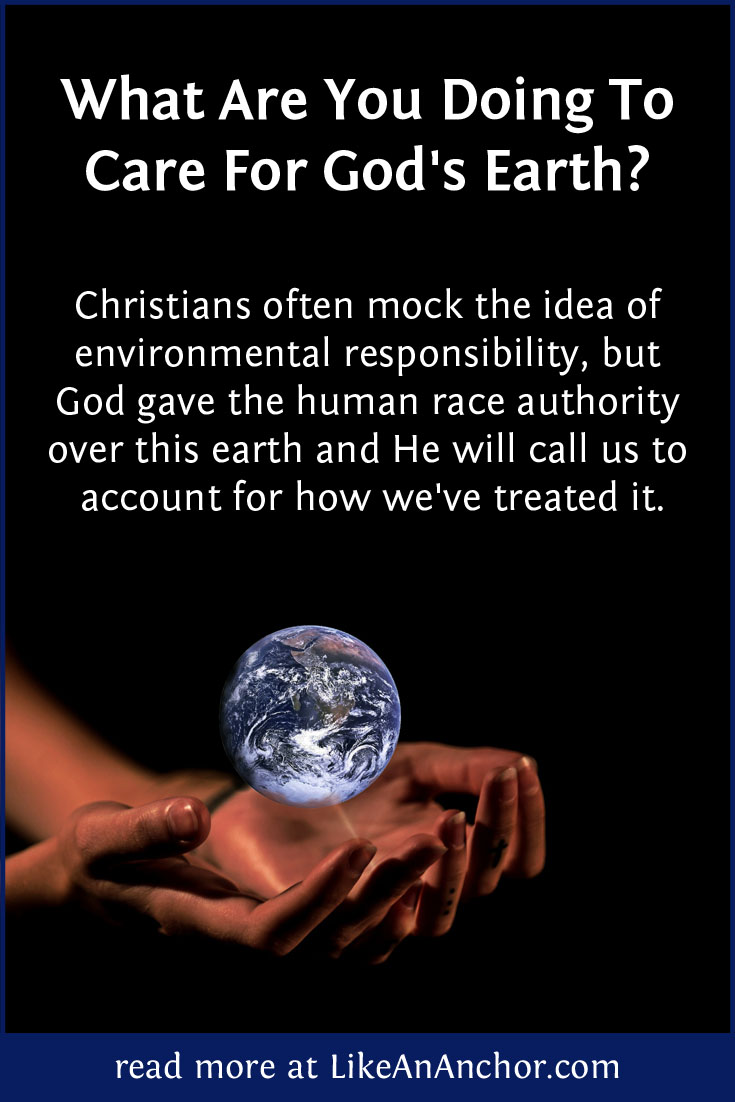
Why Aren't There More Christian Environmentalists? | LikeAnAnchor.com
Photo credit: cocoparisienne via Pixabay

Another reason for the argument that we can do whatever we want to the earth has to do with God’s words in Genesis. “God said to them [Adam and Eve], ‘Be fruitful, multiply, fill the earth, and subdue it. Have dominion over the fish of the sea, over the birds of the sky, and over every living thing that moves on the earth’” (Gen. 1:28, WEB). The word “subdue” comes from the Hebrew kabash (H3533) and it means to subject, conquer, keep under, and bring into bondage.

But there’s also something else that God told man about how to deal with the earth. “Yahweh God took the man, and put him into the garden of Eden to cultivate and keep it” (Gen. 2:15, WEB). The word translated  “cultivate” (abad H5647) refers to working and serving. The word for “keep” is shamar (H8104), and it’s about guarding something you have charge over. It’s what you do when something is precious and requires careful attention. For example, it’s the word used when Israel is told to keep God’s covenant and sabbaths (Ex. 19:5; 31:13-14) and when God is described as keeping/preserving His people (Ps. 37:28; 89:28).

I’m pretty sure that if we were keeping the earth in this sense we wouldn’t be filling it with trash or spewing toxic chemicals all over it.

The Principle of Stewardship

You might argue that we weren’t explicitly told to “keep” the whole earth — that this instruction only applied to Adam and Eve’s responsibilities in the Garden of Eden. So let’s go back to that word “subdue.” I don’t think it’s unreasonable to say that once you subdue something what you do with it is your responsibility. And the Bible is pretty clear about how we’re supposed to care for the things we’re responsible for.

He who is faithful in a very little is faithful also in much. He who is dishonest in a very little is also dishonest in much. If therefore you have not been faithful in the unrighteous mammon, who will commit to your trust the true riches? If you have not been faithful in that which is another’s, who will give you that which is your own? (Luke 16:10-12, WEB)

The earth will be here for as long as God needs/wants it to be. But the condition that it’s in until He decides to bring this world to a close with the return of Jesus Christ is, at least to a certain extent, our responsibility. We’ve been given this earth to look after, but it does not belong to us. “The earth is Yahweh’s, with its fullness; the world, and those who dwell therein” (Ps. 24:1, WEB). He care about how we take care of it because our attitude toward caring for things on this earth (including the earth itself) tells Him something about our character. It tells us whether or not He can trust us with eternal life.

Getting Started

We can’t do much to improve the health of the planet on our own. Many environmental problems are related to things outside our control. But the fact that other people, companies, or countries aren’t acting as responsible stewards of the planet doesn’t let us off the hook for our individual contributions. Using less plastic, foregoing toxic chemicals, and choosing products that can be reused instead of thrown away are choices we each have the power make.

I’ve been using Pinterest to collect tips, products, and articles related to living in a more environmentally responsible way. You can check that out here if you’re looking for ideas on how to get started on your own quest to be a better steward of God’s world.


Why Is It So Hard For Sensing And Intuitive Types To Understand One Another?

I’ve been informally studying the Myers-Briggs® typology system for about 10 years now, but for most of that time I still felt confused about the difference between Sensing and Intuition. Though I’m usually pretty good at seeing things from other people’s perspectives as an INFJ, I’d have a hard time understanding Sensors. I had good friendships with Sensing types, and I’d protest when people in the Intuitive community spread hurtful myths about Sensors, but I got stuck explaining the exact difference between the two.

I think this is a problem that quite a few of us face. For myself and many others who I’ve talked with online, the Sensing/Intuitive dynamic is even harder to figure out than Introvert/Extrovert, Thinking/Feeling, or Judging/Perceiving. Someone who doesn’t share our S/N preference seems even less “like us” than those who don’t match on the E/I, T/F, or J/P. Our preference for Sensing or Intuition influences us, and how we relate to others, so much that most typologists say you should only date or marry someone who matches your S/N preference.

Of course, type isn’t really a good predictor of romantic happiness and many couples (including INFP Isabel Myers and her ISTJ husband) are quite happy without matching on S/N. So maybe it’s not a good idea to just assume Sensors and Intuitive can’t understand each other. Perhaps what we really need is a better grasp of the real difference between Sensing and Intuition and a commitment to using that understanding to appreciate the strengths and differences of each type. Read more

Mercies That Don’t Run Out

How many times can God forgive you? I think sometimes we might feel there’s a limit, or that God gets tired of “dealing with” us. We might even think that someday He could just give up on us if we can’t get ourselves straightened out fast enough. But what does the Bible say?

It is because of Yahweh’s loving kindnesses that we are not consumed, because his compassion doesn’t fail. They are new every morning; great is your faithfulness. Yahweh is my portion, says my soul; therefore will I hope in him. (Lam. 3:22-24, WEB)

This doesn’t mean God winks at sin or thinks it’s not a big deal. “The compensation due sin is death,” and without His mercies we would be finished (Rom. 6:23, LEB). But the mercies don’t run out. Each morning we have a chance to walk with Him, repenting of past wrongs, letting Him work in our lives to make us like Him, and trusting in his loving kindness, compassion, and faithfulness to lead us into a hopeful future.

God Doesn’t Remove His Mercies

Our sins can separate us from God if we refuse to  turn from them (Is. 59:2). When we choose to do things in a way that doesn’t line up with God’s way of life, we’re walking away from him. It’s unfaithful, like a wife cheating on her husband. But, unlike many human spouses who’ve been cheated on, God keeps asking us to come back. Read more

Your Memory Doesn’t Work The Way You Think It Does

We tend to think of our memories as pretty reliable things. We might joke about how forgetful we are, but when we do remember something we assume that it’s accurate.

I was 12 years old on September 11, 2001 and I vividly remember hearing about the terrorist attack. I was in our family minivan with my mother, sister, and little brother when the news came over the radio. I wasn’t quite sure what had happened, and was more worried that my mother was going to drive into another car on the crowded in-town roads because she was so upset. We continued on to the roller skating rink where we’d been heading, skated for a while, and then stopped when the announcement went out over the loudspeaker. Several people gathered together to pray, but we stayed off to one side praying just as a family. I felt scared, confused, and very alone.

That’s probably not what actually happened, though. Another thing I remember is starting a diary because I was sure that this was such a pivotal turning point in our nation’s history that decades from now some historian would care about what I wrote. I can’t find that diary anywhere, so I have no way to compare my memories now against what I recorded back then. But if I’m anything like other people, then only a little over 50% of these details I remember are accurate. Read more

7 Fictional Characters That You’ll Relate to If You’re An INTJ

What fictional characters do you relate to as an INTJ?

Just as we can describe real people using the Myers-Briggs® typology system, we can also use the system to type well-written fictional characters. Some of fiction’s most iconic characters are INTJs, and today we’re going to talk about seven of them that I think real-life INTJs will find very relatable.

One of the other great things about looking at character personality types is that it helps us to better understand people who have different types than we do. Fictional INTJs can serve as examples for what real-life INTJs might be like, and also show how much variation can exist between individuals with the same type.

Bruce Wayne

Batman’s personality type is hotly debated, but the sheer number of INTJs who think he’s one of them merits Bruce Wayne’s inclusion on this list. Plus, the many iterations of his character do fit INTJ pretty well and inconsistencies could be explained just by the number of writers, actors, and other creatives involved in Batman’s portrayal throughout the years.

INTJs relate to Bruce Wayne/Batman’s rock-solid principles and his self-confidence when he knows he’s right. They also relate to the fact that he trusts very few people, but the ones he does trust are extremely important to him. Read more

Surely Goodness and Kindness Will Follow Me

“The Lord is my shepherd; I shall not want” begins one of the most famous passages in scripture. For many, Psalm 23 is their favorite part of the Bible. The whole thing is absolutely beautiful, but today I just want to focus on a phrase at the end.

Surely goodness and mercy shall follow me all the days of my life: and I will dwell in the house of the Lord for ever. (Ps. 23:6, KJV)

The Hebrew word translated “mercy” here is often translated “loving kindness” in more modern versions of the Bible. And this isn’t the only place where God’s loving, kind mercies are linked with His inherent goodness.

O Give Thanks For Who God Is

The link between goodness and kindness is mentioned again and again in songs of praise. Ten times in the Bible we’re told to praise and thank Yahweh “for he is good, for his loving kindness endures forever” (1 Chr. 16:34; 2 Chr. 5:13; 7:3; Ezr. 3:11; Ps. 106:1; 107:1; 118:1, 29; 136:1; Jer. 33:11).

Goodness and loving kindness are an essential part of God’s nature and character. Yahweh (to use His proper name) “is good. His loving kindness endures forever, his faithfulness to all generations” (Ps. 105:5, WEB). This isn’t something that’s ever going to change. We can count on Yahweh — both the Father and the Son — being good, lovingly kind, and faithful forever and ever. And when we walk with them, we’ll get to experience Their goodness and kindness directly. Read more