Fictional MBTI – Scott Lang (ISFP)

With Captain America: Civil War coming out in just seven weeks, I thought I’d add a post on Scott Lang to my collection of fictional MBTI types. It’s also a pretty good excuse to buy and re-watch Ant-Man.

If you do a quick Google search to see how others on the interwebs are typing Scott Lang, you’ll mostly find ESTP, with a few ISTP, ISFP and one INTP guesses thrown in. One thing all these types have in common is that they’re extroverting their Perceiving process, so that’s where we’re going to start (the P/J preference in an MBTI type refers to how we interact with the outer world).

Sensing vs. Intuition

The S/N preference describes our perceiving function, which is the mental process we use to learn new information. Isabel Meyers wrote that Sensing types “depend on their five senses for perception.” They want to see, touch, and test the information they’re taking in. Subjective or indirect information is less trustworthy, and less interesting, than their own direct experiences. Intuitives, on the other hand, “are comparatively uninterested in sensory reports of things as they are” (Gifts Differing, 57). Intuition is an innovative process that resembles advanced pattern recognition (in Personality Hacker’s words) and focuses on exploring possibilities.

Types that have a “P” in their four-letter name extrovert this mental process. Personality Hacker describes Extroverted Sensing (Se) as a “real-time kinetic” function that’s very in-tune with verifiable details of the outer world. Types with Se high in their function stack are typically very comfortable in their bodies and have a natural talent working with their hands.

Extroverted Intuition (Ne) is the function that ENTP Iron Man leads with. It’s very much about exploring the outer world and trying things just to see what will happen. It actively searches for patterns that haven’t been found and understood yet.

Looking at Scott Lang in Ant-Man (we’re not covering the comics here, just the film), I don’t really see much evidence of him using Intuition. He’ll still have intuition in his function stack (Introverted Intuition is the opposite of Se, so in an SP type that will be either his tertiary or inferior function) but it’s not what he leads with. Just a few examples:

  • Se types are typically very good working with their hands and coordinating their bodies. Scott possesses the skills to burgle houses (quite impressively) even before having the suit. He is also trained as an electrical engineer and we see him doing skilled hands-on work throughout the film.
  • When Scott encounters a challenging safe to crack, he doesn’t explore possibilities or try different things. He relies on what he knows will work from past experience and quickly implements it to bypass the fingerprint scanner and freeze the door. He also doesn’t forget any Sensing details (blows up air mattress for the door to land on, hangs comforter in the door to catch the flying hardware).
  • The “Whose pajamas are these?” question would be irrelevant to Ne, but it’s a detail Se would notice.
  • Scott learns to control the suit and fight fairly quickly by testing it out actively. It become natural to him and he’s soon effortlessly coordinating sensory details (like timing his jump off the servers at Pym Tech to coincide with bringing Antony into position to catch him).

Feeling vs. Thinking

The F/T preference describes how we make decisions about our behavior and what we think the world should look like. Feeling types typically prioritize how a decision lines up with their values and those of society. Feeling is concerned with the emotional impact of a decision. Thinking, on the other hand, “is essentially impersonal” (Gifts Differing, 65). This process seeks objective truth that doesn’t depend on the perspectives of other people

For “P” types, the judging process is internally focused. Introverted Feeling (Fi) types tend to check-in with the emotional impact of a decision by looking inward. They want to “determine what feels the most in alignment with oneself” (Personality Hacker). For them, decisions have to “feel right” and authentic.

Introverted Thinking (Ti) also checks in with the inner reality, but doesn’t focus on authentic feeling. Instead, it prizes things that “make sense.” Whether or not Ti types can objectively explain a decision, it has to line-up with the theory they’ve formulated about how the world works. They are interested in facts, but “chiefly as illustrative proofs” of their ideas (Gifts Differing, 78).

This one was harder for me to pin-down in Scott. The difference between Fi and Ti confuses me, but a couple articles from Personality Junkie helped clear things up (click to read “Introverted Feeling (Fi) vs. Introverted Thinking (Ti)” and “The Laws of P-Types: Fi & Ti Laws“). Prelude Character Analysis’ ISFP vs. ISTP article was also useful.

  • Scott’s infamous VistaCorp burglary was based on what he felt was right, not on logic. There’s an interesting interview on YouTube where Scott talks about this incident. He says he’s tired of having his “name dragged through the mud” by media who don’t recognize why he did what he did. He’s willing to pay the price for his choices, but he wants the world to respond according to his internal value system and recognize VistaCorp was morally culpable.
  • In the film itself, Scott is very careful about how he’s defined. He insists he’s a cat-burglar because “robbery involves threat” and he detests violence. This is not just about specificity and getting facts right — it’s about how he’s seen by others in society and how he feels about himself.
  • When Scott talks about how he sees himself and his subjective view of the world, he defines himself in relation to the kind of man his daughter wants him to be. This is also why he chooses to help Hank Pym. It isn’t about logic — it’s about a “chance to earn that look in your daughter’s eyes, to become the hero that she already thinks you are.”
  • Scott is certainly not suspicious of emotions or hesitant to share and talk about feelings, unlike the typical ISTP (such as Black Widow and Hawkeye, who I’ll eventually write posts about). He’s not very well in-tune with how others will respond, though (unlike an Extroverted Feeling type, such as ISFJ Steve Rogers). For example, when Pym and his daughter are reconciling Scott expresses his appreciation of their feelings, but in doing so ruins the moment.

Extrovert vs. Introvert

The question now becomes what order Scott uses these functions in. Does he lead with his Extroverted Sensing process (ESFP) or with his Introverted Feeling process (ISFP)? There are very few scenes where we see Scott seeking out people so he can re-charge or where he seems focused on the outer world. His internal ides, cares, and identity are what’s important. Those are all marks of an Introvert. For a character whose entire motivation is based on doing what lines up with his internal locus of control, it makes sense for that introverted decision-making function to take center stage. This makes his ISFP function stack:

  • Primary: Introverted Feeling
  • Secondary: Extroverted Sensing
  • Tertiary: Introverted Intuition
  • Inferior: Extroverted Thinking

You can learn a lot about people by how they respond under stress, and in Scott we do see a stress-reaction consistent with Inferior Thinking rather than Inferior Intuition (as would be the case for an ESFP). When stressed out, he doesn’t lose control over sensory details or withdraw and get angry. Instead, he starts asking questions and trying to get back on familiar footing (“Who are you, who is she, what the hell is going on here, and can I go back to jail now?”). Stressed Feeling types also tend to act rather than shut-down, which is what Scott does whenever there are obstacles to his plan or when something traumatic happens (like Antony’s death).

One reason people might not like an ISFP typing for Scott is that this type is consistently stereotyped as too “artsy” to go into a field like engineering or implement logical plans. Yet, Dr. A. J. Drenth notes that SFP types “may find themselves curiously drawn to Investigative subjects like math, science, computer science, engineering, etc.” though it’s not necessarily a good fit for their type. They can do it, like Scott, but they may struggle to fit into the system, become frustrated, and even act out in some way (though not necessarily as illegally as Scott did). You can also find personal accounts from ISFPs who work as chemists, geologists, computer programmers, doctors, and engineers. Personality type describes how someone’s mind works — it doesn’t limit what they can and cannot do with those mental processes.


If you enjoyed this post, check out my other MCU typings:

Bucky Barns – ESTP

Loki – INFJ

Steve Rodgers – ISFJ

T’Challa – ISFP

Thor – ESTP

Tony Stark – ENTP

Save

What Does “Not Under The Law” Mean?

There are a few verses in the New Testament that tell us we “are not under the law” (Rom. 6:15; Gal. 5:18). Though some use this as permission to act however you want so long as you’ve confessed Jesus, most Christians realize that God’s commandments are still in effect. Jesus did not come “to destroy the law or the prophets … but to fulfill” (Matt. 5:17, WEB), and Paul said his own writings “establish the law” rather than repeal it (Rom. 3:31, WEB).

So why do these passages tell us we’re not under the law? I’ve heard many explanations, and touched on some myself, but none of them really answered the question of why Paul would use this phrase. They focused more on trying to say “that’s not really what he meant” than on trying to figure out why Paul chose these words to argue his point. Recently, though, I came across the best analysis of the phrase “not under the law” that I’ve ever seen. It was just a short passage in a little book called Fill These Hearts: God, Sex, and the Universal Longing by Catholic writer Christopher West.

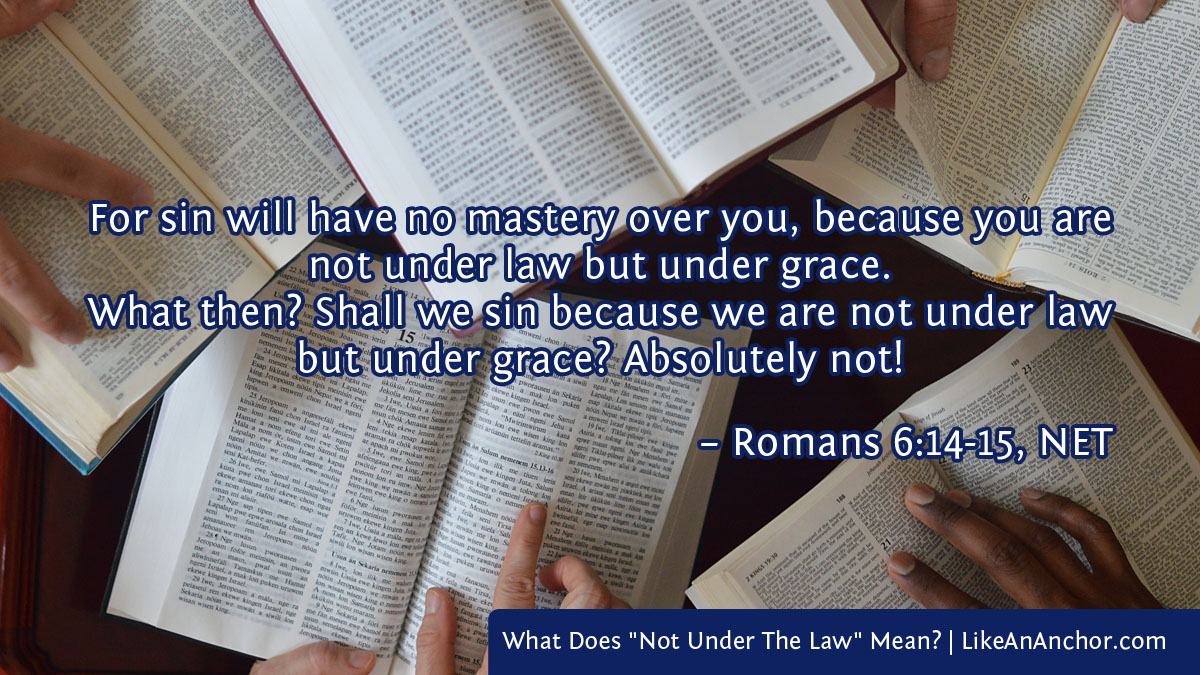
Image of five bibles on a table, with hands touching the pages overlaid with text from Rom. 6:14-15, NET version: "For sin will have no mastery over you, because you are not under law but under grace. What then? Shall we sin because we are not under law but under grace? Absolutely not!"
Image by Inbetween from Lightstock

Freed from Bondage to Sin

In Fill These Hearts, West writes about our desires, saying that we can either deny them and go on a “starvation diet,” indulge them in this life like “fast food,” or direct them toward God and partake in His “banquet gospel.” When addressing the idea of freedom in relation to desire, he says,

The Apostle Paul writes that those who “are led by the Spirit .. are not under the law” (Gal. 5:18). They’re free from the law — not free to break it (that’s license); they’re free to fulfill it because they don’t desire to break it. Christ didn’t come into this world to shove laws down our throats. He came into the world to align the desires of our hearts with the divine design so we would no longer need the laws

West, Fill These Hearts, p. 140

This isn’t just West’s own particularly theory; it’s a solid reading of the Biblical text. Basically, he’s just summarizing in modern English what Paul was explaining in Galatians 5 and putting the phrase “not under the law” in its proper context.

This verse in Galatians is preceded by a discussion of two covenants. The Old Covenant is described as one that “gives birth to bondage” (Gal. 4:24, NKJV). When the people broke that covenant, they bought a death penalty on themselves. Jesus paid the price of that broken covenant and freed us from sin with His sacrifice, then mediated and established the New Covenant (Heb. 8:6).

Stand firm therefore in the liberty by which Christ has made us free, and don’t be entangled again with a yoke of bondage

Galatians 5:1, WEB

Paul is telling us that if we go back to studiously keeping every aspect of the law as if that will save us “Christ will profit you nothing … You are alienated from Christ, you who desire to be justified by the law. You have fallen away from grace” (Gal. 5:2, 4, WEB). We can’t treat the Old Covenant as our way to salvation. That does not, however, grant license to sin.

 For you were called to freedom, brothers and sisters; only do not use your freedom as an opportunity to indulge your flesh,but through love serve one another. For the whole law can be summed up in a single commandment, namely, “You must love your neighbor as yourself.”

Galatians 5:13-14, NET (bold italics mark a quotation from Lev 19:18)

“Love” in this verse is agapao–the divine, selfless love of God. When we start becoming love as God is love, we will keep His laws from the heart instead of by compulsion to an external system.

 But I say, live by the Spirit and you will not carry out the desires of the flesh. For the flesh has desires that are opposed to the Spirit, and the Spirit has desires that are opposed to the flesh, for these are in opposition to each other, so that you cannot do what you want. But if you are led by the Spirit, you are not under the law.

Galatians 5:16-18, NET

That is, we’re no longer held in bondage to a cycle of sin and death. Christ pulled us out of that and set us on a path of walking in the Spirit. If you keep reading verses 19 through 21 you get a list of the “works of the flesh.” All these works are sins under the Old Covenant and under the New Covenant “those who practice such things will not inherit the kingdom of God!” (Gal. 5:21, NET). Someone walking in Jesus won’t act like this. They will shun things prohibited by God’s law because those things are anathema to God’s character. We get a list of God’s character traits and the “fruit” He’s looking for in our lives in verses 22 through 25.

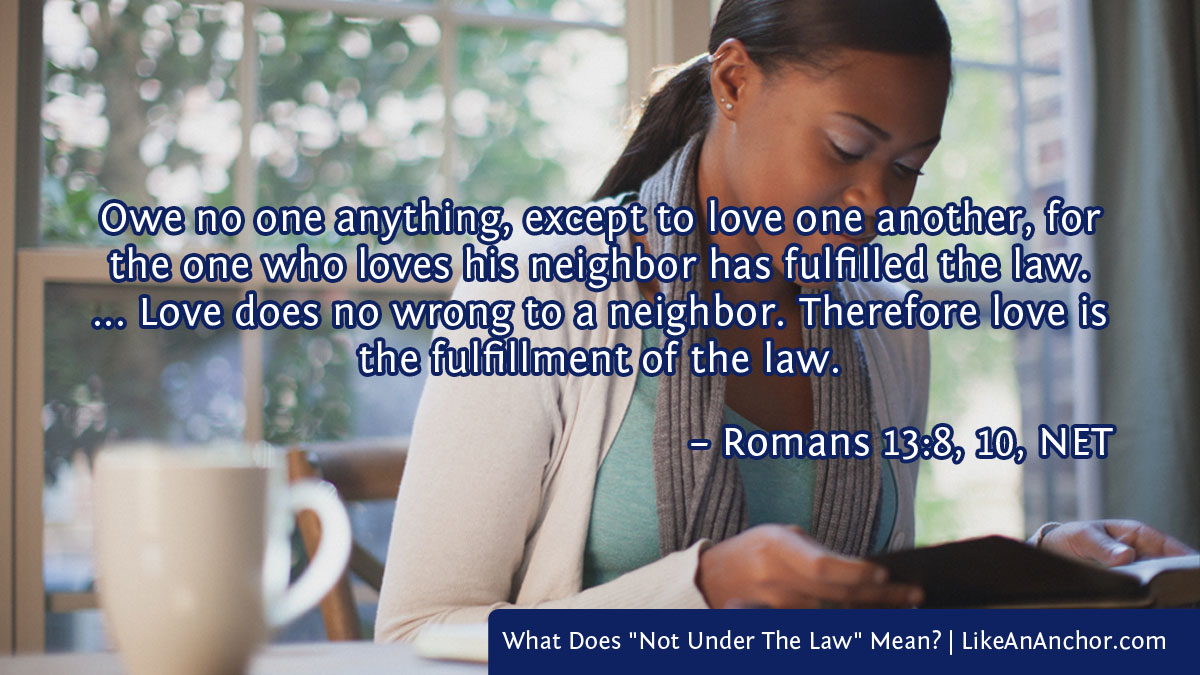
Image of a woman reading the Bible overlaid with text from Rom. 13:89, 10, NET version: "Owe no one anything, except to love one another, for the one who loves his neighbor has fulfilled the law. ... Love does no wrong to a neighbor. Therefore love is the fulfillment of the law."
Image by Pearl from Lightstock

Freed to to Fulfill the Law Through Love

The early chapters of Romans discuss this same subject with slightly different wording. First, Paul sets up a connection between sin and the law. He explains that “all have sinned” (Rom. 3:23), but we wouldn’t know that without the law to tell us about sin (Rom. 4:15; 5:13; 7:7). The law let us know we were enslaved to sin.

We know that our old man was crucified with him so that the body of sin would no longer dominate us, so that we would no longer be enslaved to sin. … So you too consider yourselves dead to sin, but alive to God in Christ Jesus. Therefore do not let sin reign in your mortal body so that you obey its desires.

Romans 6:6, 11-12, NET

When Jesus died, He paid the penalty for all sin, which was exposed by the law. When we accept Him, are baptized, and commit to walking in relationship with God, we also “die” in a figurative sense. We’re freed from sin. It’s not supposed to shackle us anymore, and we don’t have to obey its pulls.

For sin will not have dominion over you. For you are not under law, but under grace. What then? Shall we sin, because we are not under law, but under grace? May it never be!

Romans 6:14-15, WEB

Here’s Paul saying the same thing West was about freedom not being license to sin. Those who are “not under the law” still aren’t allowed to break the law. In fact, the more we become like God the less we’ll want to break His rules.

Image of a man in the woods reading the Bible, overlaid with blog's title text and the words, "We're not freed from the law so we can do whatever our fleshly nature urges, but rather so that we can live-out the fullest expression of God's divine law by imitating His character"
Image by Anggie from Lightstock

In Romans 7, Paul draws an analogy between being under Old Covenant law and a marriage. Marriages end when one of the married people dies (Rom. 7:1-3). The Old Covenant represented the first marriage between God and His people. That Covenant ended at Christ’s death and, through Him, we died to it as well.

So, my brothers and sisters, you also died to the law through the body of Christ, so that you could be joined to another, to the one who was raised from the dead, to bear fruit to God.

Romans 7:4, NET

Now, we are betrothed in marriage to Jesus Christ. We’re being transformed on the inside to become like Him and our heavenly Father. We’re not “under the law” because we’re becoming like the Lawgiver (Is. 33:22; Jas. 4:12; 1 Jn. 3:1-3). We’re marrying the One who fills the law to its fullest extent.

God is love. As we become like God we learn to “be love” as well, and that leads us toward fulfilling the law (Rom. 13:8-10). We’re not freed from the law so we can do whatever our fleshly nature urges, but rather so that we can live-out the fullest expression of God’s divine law by imitating His character. The law isn’t how we receive eternal life, but because we love God we still keep His law on our way to eternity.


Featured image by Chris Mainland from Lightstock

Conversations That Didn’t Happen

I’m staring out the backseat window watching unplanted fields roll by while having a conversation. It’s going pretty well — we’re exchanging ideas, sharing authentic feelings, clarifying anything that was unclear earlier — in short, it’s the kind of meaningful conversation I crave with people I care about. Only one problem: it’s all happening in my head and the guy I’m talking with has no clue we just had this conversation.

From talking with other INFJs and writing my INFJ Handbook, I know thinking through past and potential conversations is something my personality type does. We tend to favor the world inside our own heads and spend plenty of time there. We’re also interested in people, though, so it makes sense that many of our inner thoughts are about how others might respond to us and what they might think about our ideas.

Conversations That Didn't Happen | marissabaker.wordpress.com
Photo Credits: “Daydreaming” by Lóránt Szabó and “Conversation” by Sharon Mollerus

But living inside your head isn’t just an INFJ thing — a preference for the inner world is one of the main ways we define introversion. With that in mind, I asked a group of introverts on Facebook if they related to this and got some interesting responses from several different personality types. I also mentioned that sometimes I forget which conversations I’ve actually had with people and which ones only took place in my head and that resonated with some but, everyone. Here’s a few of the comments I got (used with permission):

  • “That doesn’t sound like something limited to certain personality types, other than introversion itself. I find myself doing it from time to time. I don’t usually think about others’ feelings or intuit what they are thinking, but the conversations always play out in my head way more than they ever do in real life” (anonymous ISTJ)
  • “Yes, I do! It’s getting harder and harder to distinguish which is the “real” conversation. I know too well how you feel … I don’t think it’s limited to any particular personality type” (anonymous)
  • “Yep, all the time. It’s the really confrontational ones that will get me though. I get really angry at scenarios I have dreamed up in my head” (Charis Tippets Branson, INFJ)
  • “90% of the conversations I have are in my head” (anonymous)
  • “I do that. Though I remember if I’ve actually had those conversations because the imaginary ones were full of remarks I’d never actually say” (Mary Menard)
  • “I do this regularly. It’s especially helpful if it’s a hard conversation that needs to happen. The problem is that I have it all figured out and sometimes forget I didn’t actually have the conversation. Last week I told my husband, ‘So, do I really have to call and talk to her or could I just pray and ask God to tell her for me?’ He said I need to call. 😐 I wrote down what to cover or I get into listening mode and have no idea what I was planning to say” (anonymous INFJ)

Read more

Clothed in Holiness

“What do you think dignity’s all about?”

The directness of the inquiry did, I admit, take me rather by surprise. “It’s rather a hard thing to explain in a few words, sir,” I said. “But I suspect it comes down to not removing one’s clothing in public.” (Kazuo Ishiguro, The Remains of the Day)

This quote comes from a delightful little book about a British butler looking back on his life. Much of his reminisces center around this idea of dignity. He connects dignity with “a butler’s ability not to abandon the professional being he inhabits.” A butler who cannot do this is “like a man who will, at the slightest provocation, tear off his suit and shirt and run around screaming.” In short, a good butler keeps himself covered in the role he is committed to no matter how trying the circumstances.

Clothed in Holiness | marissabaker.wordpress.com
Photo: Messianic Dance Troupe by Larry Jacobsen

I would probably not have connected this with the Bible if not for a message I heard on the same day I was taking The Remains of the Day back to the library. The Rabbi at my local Messianic congregation taught on the priestly garments and how we choose to “cover” ourselves with either good or bad actions, words, and character traits. Read more

Evelina: A Darker Look At Courtship

When I first read Evelina, my observation was that Frances Burney’s style “represents a shift nearing the latter part of the 18th century from fiction as a didactic tool to fiction as a pleasurable reading experience.” While I’m good as saving my literary observations (I have copies of everything I wrote in college), I’m apparently not very good at taking my own advice. This is the first time I’ve read Evelina for pleasure rather than analysis

I chose Evelina for a reread on my Classics Club Book List, and it also fits neatly into the Classics Club’s year-long Women’s Classic Literature Event (Tweet about it with #ccwomenclassics). The first time I read Evelina was in Spring 2010 for an upper-level course on The Early British Novel. Though I didn’t hate any of the other 4 books in this course, Burney’s little epistolary novel from 1778 was by far my favorite.

It’s no wonder, then, that when our professor asked me and one other student if we’d like to read more Burney in an independent study I said “yes.” We read Cecelia (1782) and Camilla (1796) – both weighing in at a solid 900+ pages. Then we branched out into Ann Radcliffe with The Romance of the Forest. That lead me to my first undergraduate research project titled “Unmanned Heroes: 18th Century Female Writers and Male Sentimentality. That turned into a 25-page research paper titled “Biblical Answers to the 18th Century Gender Crisis” (click on the title if you’d like to read this), which led me back to reading Evelina academically.

Reading "Evelina" for #ccwomenclassics | marissabaker.wordpress.com
Me at the Denman Undergraduate Research forum in 2012

Now, 4 years later, I’m back reading Evelina and enjoying it more than ever. Frances Burney was a fantastic (and, sadly, under appreciated) writer. Though Evelina was first published anonymously, Burney never hid the fact that she was a female writer. Her novels were quite popular with the general reading public and in artistic circles even during a literary age we often think of as belonging only to “dead white man.” Her style and success paved the way for writers like Jane Austen. In fact, Austen took her title Pride and Prejudice from a scene in Burney’s second novel, Cecilia, and when Austen’s father was seeking publication for that novel he described it as “about the length of Miss Burney’s Evelina.”

Comparing Burney to Austen (another favorite writer of mine), there are clear similarities, especially in Evelina. Both writers focus on a young woman who “marries up” by the end of the novel. Both critique society and social norms with a thinly-veiled sarcastic wit. But the differences are at times even more striking than the similarities. Nowhere in Austen will you find a scene like the one in Evelina when Captain Mirvan impersonates a highwayman and drags Madam Duval into a ditch where he terrifies her for sport. And, though Austen does have her Mr. Willoughbya and Mr. Wickhams, you’ll not find any of her main characters in situations so dangerous as Evelina’s.

Throughout the course of the novel, Evelina is persecuted by a man named Lovel, hounded and even kidnapped by Sir Clement, affronted by a staring Lord (in front of his fiancee), and rudely accosted by strange men at Vauxhall. To quote an essay by Judith Newton that appeared in a 1976 edition of Modern Language Studies, there are few places Evelina can go “without being forced, intruded upon, seized, kidnapped, or in some other way violated.” Newton describes this persecution as a “woman’s fate” once she entered into the marriage market in the 1700s, and points out that Burney “is one of the few writers in the century to take the discomfort of it seriously.”

Indeed, while I’ve frequently thought I might like to visit Jane Austen’s England, Burney’s is much less appealing. It’s populated with aggressive and vulgar people, the public places are unsafe without a large party and/or male protection, and it’s painfully obvious how vulnerable and option-less women were without family and fortune to their name. But it also feels more real. Sense and Sensibility came out in 1811 and Pride and Prejudice in 1813 – a scant 33 and 35 years after Evelina. Things had changed, but not that much. Much as I love Austen, I wonder if Burney was in some ways the braver novelist for calling out her contemporary society on its darker sides.click to read article, "Evelina: A Darker Look At Courtship" | marissabaker.wordpress.com

Click here to get a copy of Evelina. Please note that this is an affiliate link. This means that, at no additional cost to you, I will receive a commission if you click on the link and make a purchase.

 

Bridging The Gap

In the beginning Adam and Eve had a face-to-face relationship with God. They they sinned, creating a gap between them and their creator that was renewed each time a human broke God’s law. God was still there, but we kept moving farther and farther away.

Behold, the Lord’s hand is not shortened, that it cannot save; nor His ear heavy, that it cannot hear. But your iniquities have separated you from your God; and your sins have hidden His face from you, so that He will not hear. (Is. 59:1-2)

Throughout the time period covered by the Old Testament books, it appears few people had a relationship with God. In every case, that relationship existed because God stepped across the gap and initiated the relationship. He called Abraham, Isaac and Jacob into covenant with Him. He spoke to Moses out of the burning bush. He chose David as king over Israel. He called the prophets individually.

Today, God also has to take the first steps in any relationship we have with Him. Jesus said, “No one comes to the Father except through Me” (John 14:6) and also, “No one can come to Me unless the Father who sent Me draws him” (John 6:44). To have a relationship with Yeshua we must be called by the Father, and to know the Father we have to go through Yeshua.

Bridging the Gap | marissabaker.wordpress.com

Several months ago, there was a handout at my Messianic congregation with a “Thought Of The Week” printed on the back talking about just this topic. It started out discussing Jacob’s ladder, then human attempts to bridge the gap between God and man by building things like towers. Such attempts are futile, but

The same might be said of all our religious impulses. The stars are always beyond our reach. God is far distant. Man’s best attempts to bridge the gap fail. … If we are to ascend to God, we must ascend upon a ladder that He Himself has extended to us from above.”

We can’t do anything that will make us worthy of God’s attention. All our “religious impulses” — going to church every week, singing worship songs, preaching, or even doing works like healings — aren’t going to make Jesus let us into the kingdom (Matt. 7:22-23). The only thing we can do is respond when God extends us a way to know Him.

For all have sinned and fall short of the glory of God, being justified freely by His grace through the redemption that is in Christ Jesus, whom God set forth as a propitiation by His blood, through faith, to demonstrate His righteousness, because in His forbearance God had passed over the sins that were previously committed (Rom. 3:23-25)

Jesus is the ladder “extended to us from above” by God the Father. He “came down from heaven” (John 6:38) to pay the price for our sins and “draw all men to” Himself (John 12:32). Because we could not reach Him, he came to us.

The Hebrew word for “bless” also means to kneel. No matter how many good works we climb up on or how hard we stretch toward heaven, we won’t reach God. Yet He blessed us by kneeling down to our level and welcoming us into a relationship through Jesus Christ.

 Therefore, having been justified by faith, we have peace with God through our Lord Jesus Christ, through whom also we have access by faith into this grace in which we stand, and rejoice in hope of the glory of God. (Rom. 5:1-2)

Because of what Jesus has done and is doing, we can reach God. Through Him, we “have access by one Spirit to the Father” (Eph. 2:18). We can come to Them with absolute confidence that They love us and want a relationship with us. They’ve proved that time and again throughout history by making covenants with people, building friendships with men like Abraham (Jas. 2:23), pleading with Their loved ones to come back, kneeling down to die in our place, and now living and walking with us.

Seeing then that we have a great High Priest who has passed through the heavens, Jesus the Son of God, let us hold fast our confession. For we do not have a High Priest who cannot sympathize with our weaknesses, but was in all points tempted as we are, yet without sin. Let us therefore come boldly to the throne of grace, that we may obtain mercy and find grace to help in time of need. (Heb. 4:14-16)

Jesus bridged the gap once and for all with His sacrifice that “perfected forever those who are being sanctified” (Heb. 10:14). He gave us access to God and “boldness to enter the Holiest” by making us holy (Heb. 10:19-22). “Now we are children of God” (1 John 3:2), and we can come to Him just as a child who knows their loving Father always has time to pick them up and listen to their concerns.