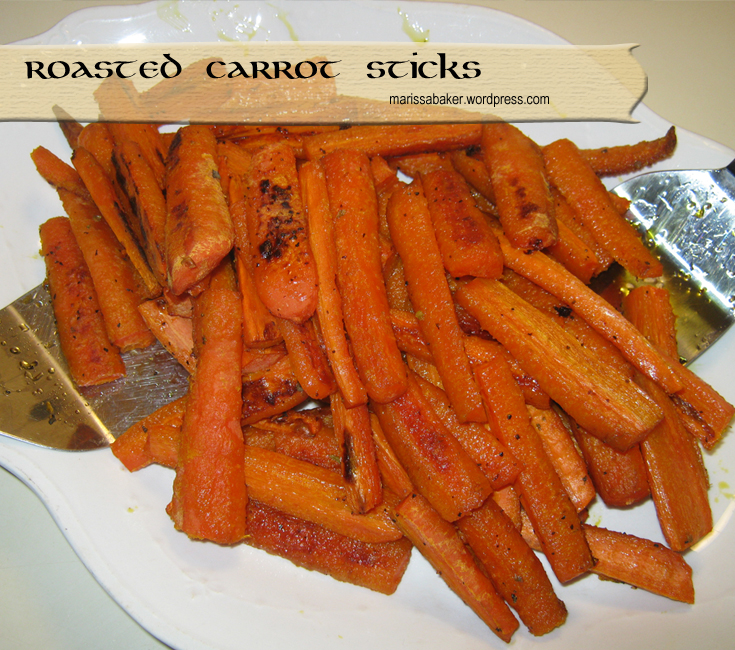
I found this recipe described as “The Best Way to Cook Zucchini and Carrots” on a blog called Voracious Veggie. I haven’t had a zucchini yet to try it on, but my whole family agrees this is the best way to eat cooked carrots. I make the “Asian seasoned” ones as a side dish every time we have Korean Beef, and they also go well with my Thai-Peanut Chicken if the carrots in the sauce aren’t enough vegetable for you. You can vary the spices to match just about anything, so they are versatile as well as easy to make.
Roasted Carrot Sticks
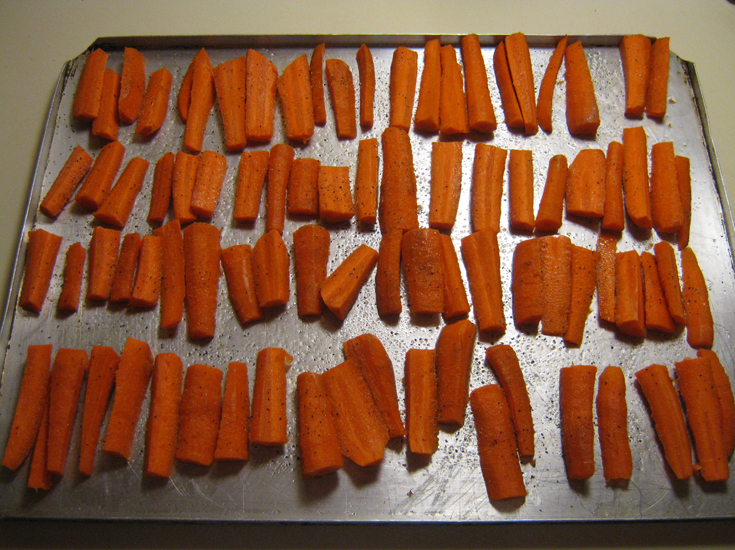
1 pound raw carrots
olive oil
salt and pepper
desired seasonings (see below)
Slice carrots into2 to 3 inch sticks of even thickness. Spread a light layer of olive oil on the bottom of a baking tray. Toss carrots, salt, pepper, and desired spices in the olive oil, then spread them out evenly in the pan.
Roast at 425°F for 10 minutes. Remove from oven and toss. Return to oven and cook another 10-15 minutes, or until carrots are tender.
Seasonings
I vary the spices I use depending on what I’m cooking with the carrots. Ideas include paprika, cumin, cayenne, crushed red peppers, thyme, rosemary, sage, or a premixed spice blend.
Asian: garlic, ginger, cayenne
Today is my 25th birthday. Other than posting this, my birthday plans involve spending time with family and eating cheesecake. My original idea for this post was to write one of those “Letter To Me” things addressed to my 15 year old self (since 10 years is a nice round number). Part of that’s still here, but it’s not the focus. Why? because while a post all about me could be mildly entertaining, I doubt anyone will find it helpful. Instead, I want to encourage you to join me in thinking about how you’ve changed in the past ten years, and what you want the next 10 years to look like.
If you’re like me, looking at a more narrow time frame of your life to inspect how you’ve changed can be disheartening. I don’t usually feel like I’ve made much progress in a week or a month or sometimes even a year on things like personal growth, forwarding my publishing goals, and growing my business. But look at 10 years, and you can see how much you’ve accomplished, some of it in little steps that you probably didn’t notice when you were walking them.
10 Years Ago
I tried to look back at my journal for the year I turned fifteen, but the only entry between November 2002 and June 2006 is an undated poorly-spelled complaint about not having many friends or knowing how to talk to people. It does look like a clump of pages was torn out, but I don’t remember why. Even without a record of my precise thoughts, though, there are plenty of specific things I remember that are pertinent to how much I’ve changed. Setting aside the potential implications contacting your past self might have on the time-space continuum, here are a couple suggestions I’d share with me then:
Dear 15-year-old-me,
Stop reading the Thoroughbred book series right now. I mean it — take that stack beside your bed back to the library immediately. Why? because you’re going to feel guilty when you turn sixteen without having ever been asked out on a date, because some of the characters teased Christina for turning “sweet sixteen and never been kissed.” Which is just plain ridiculous. And speaking of kissing, stop reading the Hardy Boy/Nancy Drew cross-over books as well. You don’t have to be 5′ 3″ and taste like mint for a guy like Joe Hardy to like you (and do you really want him to? this version is kissing a different girl in every book). Honestly, you have poor taste in fictional men. Go read Jane Austen.
Be nicer to your siblings. My brother asked me to include this, but he’s right. They’ll still be some of your best friends when you’re 25, and if you’d treated them as well as they deserved you’re probably all be even better friends. And on the subject of friends, don’t give-up because you can’t seem to make any new ones. You haven’t even met the person who will become your best-friend-who’s-not-a-sibbling yet.
Love,
25-year-old-me
When I was fifteen, I was still convinced that I didn’t need a plan for after high school because within a few years I was going to meet Prince Charming and live happily ever after. Aside from reading and my homeschool work, the only thing I really had interest in was gardening (I ran a little roadside greenhouse selling plants for two years in high school). I hadn’t even started writing yet (I mean, not seriously writing. I would jot down ideas), or really even cooking. Now I list writing and cooking as two things I can’t imagine not doing, largely because I love them so much.
What important aspects of your life now were missing 10 years ago?
Now
One thing I haven’t touched on yet is my spiritual walk. I knew at 14 that I wanted to be baptized, but I couldn’t find a minister who didn’t think I was too young. Which I probably was, but I was pretty sure of my faith when I turned 15. Without getting into too much details, that changed after I graduated high school. While I never actually left “the church,” when I again decided to be baptized at 19 it felt almost like coming back, and I’ve seen tremendous growth since then. Not, like, all the time of course — I have plenty of set-backs and doubts like everyone else, but I also think recognizing the fact that we’re nowhere near perfect and we can’t move toward perfection without God is a huge step towards spiritual growth.
How is your spiritual growth now different than it was 10 years ago?
As you all know if you’ve been reading this blog on any kind of a regular basis, my writing is now a huge part of my life (this blog, fiction, and copywriting). I love to cook and bake. I have an outlet for sharing my faith. I have a few close, stable friendships with dear people who I hadn’t even met 10 years ago and now can’t imagine life without.
Have you met any people who are now your “best friends” within the past 10 years?
Oh, and regarding the whole panic-about-not-having-a-boyfriend thing, I’ve still never been in a serious relationship and I’m actually okay with being unmarried at 25. I still want to get married, but I know that I wasn’t really ready for that kind of commitment during the time frame I was expecting marriage to happen and I’m willing to entertain the possibility that the same thing is true now. More importantly, I’ve actually started turning over my worries about the timing for this and other goals to God.
10 Years Ahead
Where do you want to be in 10 years?
My first impulse to this question is, “I have no idea.” I didn’t plan 10 years ago to end up where I am today, and I don’t really know if having a 10 year plan now would be any more advantageous. But I keep hearing about the importance of having a vision for your future, finding your passion, planning a life mission. And I can see the advantages.
In my life, the time period where I’ve felt most productive was my last three years of college. I had a goal (graduate with Latin honors and research distinction in my major), and I worked toward it. The more focused I got on projects, the more productive I was. For example, November 2011 I was was doing the final editing and writing on my thesis, wrote a 50,000 word novel for NaNoWriMo, and taking a full class load that included French (my hardest subject). I was exhausted by the end of the month, but I felt great (and yes, I met those academic goals next year when I graduated).
That’s kinda missing now, and it’s not a good thing. I don’t like being unfocused and not having a more definite goal to work toward. My faith provides a goal for spiritual growth toward eternal life, but it’s also supposed to be an integral part of my life and keep me moving forward personally and professionally as well. I need a direction on a physical level to go along with my direction on a spiritual level.
For my readers who are MBTI fans, personality type plays a role as well — INFJs like me must have a goal. We hate not having something clear (and preferably world-altering) to work toward. So, yea. Making better goals is next on my list.
What steps can you take now to move forward with focus and purpose into the next 10 years?
At the beginning of this week, I was reading Luke 3 and trying to come up with a topic to guide this week’s study and become today’s post when I came to these verses:
“Therefore bear fruits worthy of repentance, and do not begin to say to yourselves, ‘We have Abraham as our father.’ For I say to you that God is able to raise up children to Abraham from these stones. And even now the ax is laid to the root of the trees. Therefore every tree which does not bear good fruit is cut down and thrown into the fire.” (Luke 3:8-9)
This passage was particularly striking because I’d just heard a sermon about the phrase “abide in Me” from John 15:4 that relied heavily on the vine/branch and tree/root analogies.
What Shall We Do?
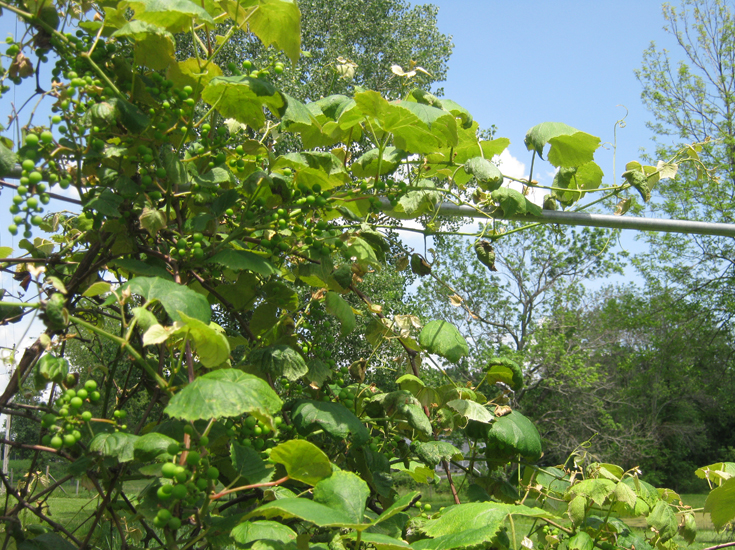
pictures of our grapevines, taken yesterday
Looking closer at the phrase ” bear fruits worthy of repentance,” I wonder if the sense it means to convey is that we should be producing fruits in our lives that show we are sincerely repentant. The word “repentance” (G3341, metanoia in Greek) means, “a change or alteration of mind .. from evil to good or from worse to better” (Zodhiates).
What John calls attention to as he continues speaking is that people who thought their physical descent from God’s chosen people automatically made them acceptable to God were mistaken. We can make the same mistake today if we think that we’re part of God’s family simply because we’re attending the “right” church group. Like the people John was addressing, we must actually being doing something to show that we 1) recognized the need for change, and 2) are sincere about changing.
So the people asked him, saying, “What shall we do then?” He answered and said to them, “He who has two tunics, let him give to him who has none; and he who has food, let him do likewise.”
Then tax collectors also came to be baptized, and said to him, “Teacher, what shall we do?” And he said to them, “Collect no more than what is appointed for you.”
Likewise the soldiers asked him, saying, “And what shall we do?” So he said to them, “Do not intimidate anyone or accuse falsely, and be content with your wages.” (Luke 3:10-14)
The specific responses here are based on principles found throughout the Bible: “Let each of you look out not only for his own interests, but also for the interests of others” (Phil 2.4); “godliness with contentment is great gain” (1 Tim. 6:6), and the two great commandments (Matt. 22:37-40; Mark 12:29-31).
For the commandments, “You shall not commit adultery,” “You shall not murder,” “You shall not steal,” “You shall not bear false witness,” “You shall not covet,” and if there is any other commandment, are all summed up in this saying, namely, “You shall love your neighbor as yourself.” Love does no harm to a neighbor; therefore love is the fulfillment of the law. (Rom. 13:9-10)
Now that we have an idea of the kind of fruits we’re supposed to be producing, lets take a short detour from the discussion in Luke 3 and focus on how we can be spiritually fruitful.
How To Bear Fruit
Abide in Me, and I in you. As the branch cannot bear fruit of itself, unless it abides in the vine, neither can you, unless you abide in Me. I am the vine, you are the branches. He who abides in Me, and I in him, bears much fruit; for without Me you can do nothing. … By this My Father is glorified, that you bear much fruit; so you will be My disciples. (John 15:4-5, 8)
The key to being spiritually fruitful is abiding in Jesus. If you look at a healthy vine, every branch firmly connected to the rootstock and main vine will also be healthy. It can’t be healthy by itself, though. The moment it’s disconnected from the vine it starts to wither and is no longer capable of fruiting. Similarly, we can’t do anything by ourselves — all our fruit is produced because of our closeness to Jesus.
And this I pray, that your love may abound still more and more in knowledge and all discernment, that you may approve the things that are excellent, that you may be sincere and without offense till the day of Christ, being filled with the fruits of righteousness which are by Jesus Christ, to the glory and praise of God. (Phil. 1:9-11)
All the fruit that we produce in our lives is a direct result of Jesus Christ’s involvement in us, and it is all for God’s glory. We’ve talked before in the weeks leading up to Pentecost about how closely Jesus Christ’s work in us is connected with the Holy Spirit indwelling us. This is yet another example — we cannot bear the fruits of the Spirit listed in Galatians 5:22-23 unless we are abiding in Him and keeping His commandments.
Unfruitful Branches
Let’s return to our imaginary healthy vine, and suppose that there are some branches on it that don’t have a good connection to the rootstock. They may be visibly withering and dying, or they might have great showy leaves that can initially hide the fact that they have no fruit. Those kinds of branches need to be trimmed out so they do not impact the overall health of the vine.
I am the true vine, and My Father is the vinedresser. Every branch in Me that does not bear fruit He takes away; and every branch that bears fruit He prunes, that it may bear more fruit. … If anyone does not abide in Me, he is cast out as a branch and is withered; and they gather them and throw them into the fire, and they are burned. (John 15:1-2, 6)
pictures of our grapevines, taken yesterday
Like most of God’s instructions and warnings this boils down to a very simple principle. If you do good things (abide in Jesus, obey the commands), good things will happen to you (a relationship with God, eternal life). But if you do bad things (disobey, become arrogant and distant from God), bad things happen (no relationship with Him, death). This brings us right back to John the Baptist’s words in Luke.
And even now the ax is laid to the root of the trees. Therefore every tree which does not bear good fruit is cut down and thrown into the fire.” (Luke 3:9)
This is a warning, and it was also a prophecy of what Paul addresses in Romans 11. In this letter, Paul writes to the Gentile believers who were “grafted in” after so many of the Jews, like the ones John was talking to, refused to accept Jesus as the Messiah.
And if some of the branches were broken off, and you, being a wild olive tree, were grafted in among them, and with them became a partaker of the root and fatness of the olive tree, do not boast against the branches. But if you do boast, remember that you do not support the root, but the root supports you.
You will say then, “Branches were broken off that I might be grafted in.” Well said. Because of unbelief they were broken off, and you stand by faith. Do not be haughty, but fear. For if God did not spare the natural branches, He may not spare you either. Therefore consider the goodness and severity of God: on those who fell, severity; but toward you, goodness, if you continue in His goodness. Otherwise you also will be cut off. And they also, if they do not continue in unbelief, will be grafted in, for God is able to graft them in again. For if you were cut out of the olive tree which is wild by nature, and were grafted contrary to nature into a cultivated olive tree, how much more will these, who are natural branches, be grafted into their own olive tree? (Rom. 11:17-24)
This is both a sobering and an awesome message. God grafted us into Himself when He called us out of the world! He took something which was once opposed to Him (Rom. 8:7-8) and made us part of His church by attaching us to His Son — the Vine — and making us part of Christ’s body (Eph. 1:22-23).
The sobering part is a reminder of how dangerous it is to let our awe of what God has done for and in us slip away. Arrogance takes it’s place, here in Romans 11 and in Luke 3, with the idea that we’re important in and of ourselves. In reality, any importance we have comes from God. He did not choose us because of our own merit, or because of our heritage, or because of what church group we attend. He chose us because He is in the business of redeeming insignificant people and turning them into something glorious through His boundless grace and mercy (1 Cor. 1:26-31). Our response to that should be to cling ever closer to Him, and to be producing fruits in our lives that show how drastically we have been changed by Him.
This recipe starts out just like the Mushroom-Herb chicken I posted last week, but the end result is very different. We all loved the flavor. I thought it might be similar to my other rice noodle dish, but this one is stronger and more tangy. The final sauce looks so reddish it appears tomato based, and the carrots almost seem to disappear.
4 (6-ounce) skinless, boneless chicken breast halves
1/4 teaspoon salt
1/4 teaspoon black pepper
1 teaspoon olive oil
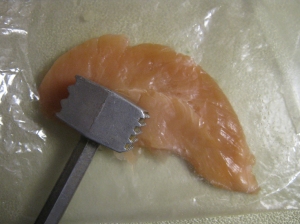
Place each chicken breast in a zip-lock back or between two sheets of heavy-duty plastic wrap. Pound to 1/3-inch thickness. Sprinkle chicken evenly with salt and pepper. Heat olive oil in a large skillet over medium-high heat. Add chicken to pan and cook 5 to 6 minutes on each side or until browned with no pink in the center.
2 Tablespoons sesame oil
3 green onions
1 large carrot
3 cloves garlic, minced
1 Tablespoon grated fresh ginger
1/4 cup honey
1/4 cup creamy peanut butter
1/4 cup soy sauce
2 Tablespoons rice vinegar
2 Tablespoons rice wine
1/8-1/4 teaspoon cayenne pepper
While chicken cooks, thinly green onions and shred carrot. Remove chicken from pan and add sesame oil. Add carrots, green onions, garlic, and ginger to the pan and cook for 2 to 3 minutes, stirring constantly. Add remaining ingredients and mix well. Simmer for2 minute and then return chicken to the pan.
If you’re like me, you have a Facebook friend or two (or three or four) who posts their results from all those “Which *name of a TV show* character are you?” or “What time period should you live in?” quizzes. Even if you aren’t posting the results yourself, you’ve probably clicked on a few of them to see what your results are. It’s fun, it’s harmless, and it’s ridiculously popular. But why?
Several people are writing articles to answer the question Why Online Quizzes Are Taking Over Your Facebook Feed or discuss The Unstoppable Rise Of The BuzzFeed Quiz. Explanations include: we like to believe life can be chategorized, we’re on a search to answer the question “Who am I?”, we want to fit in with something, we want affirmation of how we see ourselves, and we’re looking for a distraction to combat the sense of information overload.
I like quizzes too. On the more respected/serious side, I’m interested in Myers-Briggs personality tests (I’m an INFJ). On the lighter side, I’m just as guilty of wanting to know which sandwich I am as the rest of you.
One of the articles I linked above said none of your Facebook friends really care whether you’re more like Kirk or Spock (I’m Uhura by the way). In part that’s true — we want to find out what result we’ll get far more than we care about your result. But I’ve also enjoyed finding out that one of my former professors “is” Sheldon from the Big Bang Theory (which surprised none of his students, though he couldn’t understand why because he’s never watched the show).
On the whole, though, any connection from taking a quiz like this is superficial. You can’t maintain a relationship based on Facebook posts, and friendships aren’t deepened by learning what kind of sandwich you are. So maybe the larger issue regarding online quizzes is that they’re another way the internet allows us to kill time while keeping up the appearance of interacting with other people. It’s a poor substitute for real conversation though, as I was reminded by spending this past Sabbath in a place with no cell-phone service and no wi-fi. Instead, there was a wonderful group of people to spend time with while we talked, walked up and down steep hills, and made popcorn over an open fire. And I didn’t miss Facebook or quizzes at all.
In 2014, when I was studying the gift of prophecy as related to the role of women in the church, I started wondering about the women that God interacted with in the Bible. How many were there? What did He say to them, and what did they say to Him?
After compiling a list of women who talked with God, I double-checked my list by looking up other bloggers’ articles about biblical women God spoke to and women in authority roles. As I did this research, I came across other questions some people were asking: “Why doesn’t God talk with women the way He does with men?” and even “Why does God hate women?”
I’m sure most of my readers will agree with me right away that God doesn’t hate women–the Bible reveals that God places a high value on women. Sometimes that can be hard to see because of modern preconceptions or extra-biblical church teachings, but it’s there when you look. We can see one of the proofs that God loves women (as He does all people) when we look at how He interacts with women in the Bible.
For purposes of this blog post, I’m including women God spoke to directly, women whose prayers were answered, women God spoke to through an angelic messenger, and women Jesus interacted with. I’m sure I could have missed some “women who spoke with God,” so if you think of any more please leave a comment.
Eve
God interacted with the first woman in a unique way. She was the crowning achievement of His creation. God didn’t make her at the same time as Adam, as He did with both sexes of animals, but created her only after Adam realized how incomplete he was without a wife (Gen. 2:18-23). She and Adam were both instructed by God (Gen. 3:2-3), and God spoke to each of them personally when He had to pass judgement on them for their sin.
Yahweh God said to the woman, “What have you done?” The woman said, “The serpent deceived me, and I ate.” … To the woman he said, “I will greatly multiply your pain in childbirth. You will bear children in pain. Your desire will be for your husband, and he will rule over you.”
Genesis 3:13, 16, WEB
Not a very nice conversation with God, but unfortunately one that Eve deserved, just as Adam deserved his more lengthy reprimand (Gen. 3:8-12, 17-19). I think the main takeaway from this (in terms of today’s post) is that God cared about and respected both Adam and Eve enough to address their sin and it’s consequences with them individually. God didn’t just talk with Adam and tell him to pass the sentence along to Eve (for example).
Sarah
Another woman whom the Lord spoke to directly was Abraham’s wife, Sarah. Their actual conversation was short, but we’ll have to quote a lengthy passaged to get the context since she is eavesdropping on the Lord’s conversation with her husband.
They asked him, “Where is Sarah, your wife?”
He said, “There, in the tent.”
He said, “I will certainly return to you at about this time next year; and behold, Sarah your wife will have a son.”
Sarah heard in the tent door, which was behind him. Now Abraham and Sarah were old, well advanced in age. Sarah had passed the age of childbearing. Sarah laughed within herself, saying, “After I have grown old will I have pleasure, my lord being old also?”
Yahweh said to Abraham, “Why did Sarah laugh, saying, ‘Will I really bear a child when I am old?’ Is anything too hard for Yahweh? At the set time I will return to you, when the season comes around, and Sarah will have a son.”
Then Sarah denied it, saying, “I didn’t laugh,” for she was afraid.
He said, “No, but you did laugh.”
Genesis 18:9-15, WEB
It is worth noting that before having this conversation with Abraham, the Lord made sure Sarah was within hearing range. God had already made this promise to Abraham in Genesis 17:19, and now He reiterated it to Sarah as well.
Hagar
I find God’s interactions with Hagar fascinating. She didn’t go looking for Him (as Rebekah would years later) but when He spoke to her she didn’t react in fear (as Sarah did). She may not have spoken with God directly; the Bible says “the angel of the Lord” was the one who spoke with her. However, “Angel of the Lord” is capitalized in some translations, where it is assumed to be a pre-incarnate appearance of Jesus. Either she spoke to the Word of God Himself, or she spoke to a messenger directly from Him.
He said, “Hagar, Sarai’s servant, where did you come from? Where are you going?”
She said, “I am fleeing from the face of my mistress Sarai.”
Yahweh’s angel said to her, “Return to your mistress, and submit yourself under her hands.” Yahweh’s angel said to her, “I will greatly multiply your offspring, that they will not be counted for multitude.” Yahweh’s angel said to her, “Behold, you are with child, and will bear a son. You shall call his name Ishmael, because Yahweh has heard your affliction. He will be like a wild donkey among men. His hand will be against every man, and every man’s hand against him. He will live opposed to all of his brothers.”
She called the name of Yahweh who spoke to her, “You are a God who sees,” for she said, “Have I even stayed alive after seeing him?”
Genesis 16:8-13, WEB
Not only did Hagar speak with “Yahweh’s angel,” but she also gave God a name — El Roi (H410 and H7210)–that is not used anywhere else in scripture. When I was reading Liz Curtis Higgs’ bookSlightly Bad Girls of the Bible, one of the things she pointed out about Hagar was that she named God. It’s much the same thing the Psalmists do when saying things like, “You are the God who does wonders” (Ps. 77:14, WEB).
This wasn’t the only time God talked with Hagar, either. Years later, after Isaac was born, Abraham sent Hagar and Ishmael away. She found herself lost in the desert with her son dying of thirst.
The angel of God called to Hagar out of the sky, and said to her, “What troubles you, Hagar? Don’t be afraid. For God has heard the voice of the boy where he is. Get up, lift up the boy, and hold him with your hand. For I will make him a great nation.”
God opened her eyes, and she saw a well of water. She went, filled the container with water, and gave the boy a drink.
Genesis 21:17-19, WEB
If we ever feel too insignificant for God to notice, Hagar’s story is a good place to turn. She was an Egyptian slave girl mistreated by her masters, yet God spoke to her more often than to the women who were married to the patriarchs. For Hagar, as well as for us, He is El Roi, the God Who Sees.
Rebekah
Here we come to the first woman on our list who brought a prayer before God that He responded to directly. In this case, she was the one who started the conversation.
Isaac prayed to the Lord on behalf of his wife because she was childless. The Lord answered his prayer, and his wife Rebekah became pregnant. But the children struggled inside her, and she said, “Why is this happening to me?” So she asked the Lord,and the Lord said to her,
“Two nations are in your womb, and two peoples will be separated from within you. One people will be stronger than the other, and the older will serve the younger.”
Genesis 25:21-23, NET
It’s so short you can almost read over it without noticing what’s going on. But what this tells us is that when Rebekah had an important question, she took it straight to God. She didn’t ask her husband, who had prayed for these babies, to inquire for her. She had a personal relationship with her Lord, and He answered when she called.
Deborah
When people start talking about strong women of the Bible, Deborah is usually the first on their list. She was one of the judges–“a mother in Israel”–who delivered God’s words to the people and who rode to battle alongside Israel’s general.
Now Deborah, a prophetess, the wife of Lappidoth, judged Israel at that time.She lived under Deborah’s palm tree between Ramah and Bethel in the hill country of Ephraim; and the children of Israel came up to her for judgment. She sent and called Barak the son of Abinoam out of Kedesh Naphtali, and said to him, “Hasn’t Yahweh, the God of Israel, commanded, ‘Go and lead the way to Mount Tabor, and take with you ten thousand men of the children of Naphtali and of the children of Zebulun? I will draw to you, to the river Kishon, Sisera, the captain of Jabin’s army, with his chariots and his multitude; and I will deliver him into your hand.’”
Barak said to her, “If you will go with me, then I will go; but if you will not go with me, I will not go.”
She said, “I will surely go with you. Nevertheless, the journey that you take won’t be for your honor; for Yahweh will sell Sisera into a woman’s hand.” Deborah arose, and went with Barak to Kedesh.
Judges 4:4-9
We can see why people like her so much. Two whole chapters are devoted to her, while some other judges get only a verse (like Shamgar in Judges 3:31). She had a gift of prophecy shown in Judges 4:6, 9, and 14. She wrote a song of praise recorded in Judges 5 that has much in common with songs of the more famous Moses and David.
Image by Jantanee from Lightstock
Samson’s Mother
We come next to another story in Judges. Though she is named only as “the woman” or “Manoah’s wife,” her interactions with God’s messenger are particularly interesting.
Yahweh’s angel appeared to the woman, and said to her, “See now, you are barren and childless; but you shall conceive and bear a son.
Judges 13:3, WEB
The angel proceeded to give her instruction regarding her child and a prophecy that “He shall begin to save Israel out of the hand of the Philistines” (Jud. 13:5, WEB). She told her husband about this, who prayed, “Oh, Lord, please let the man of God whom you sent come again to us, and teach us what we should do to the child who shall be born” (Jud. 13:8, WEB).
God listened to the voice of Manoah, and the angel of God came again to the woman as she sat in the field; but Manoah, her husband, wasn’t with her.
Judges 13:9, WEB
Manoah came on the scene in the next few verses, but I’m struck by the idea that either the Angel of the Lord had poor timing or there was a reason that He initiated contact with the woman rather than her husband. I don’t know why this was, but I have a couple of theories. It could have something to do with the level-headedness she displays in verses 22-23. Or perhaps she was less skeptical/more faithful than her husband and more likely to accept a message delivered by God. Whatever the reason, God responded to Manoah’s prayer by sending an angel to visit his wife again.
Hannah
In the cases we’ve seen so far where a woman was childless, either her husband prayed for children (like with Isaac and Rebekah) or God told her she would have a child (like Sarah and Samson’s mother) Here in 1 Samuel, we find Hannah herself begging for a child.
She was in bitterness of soul, and prayed to Yahweh, weeping bitterly. She vowed a vow, and said, “Yahweh of Armies, if you will indeed look at the affliction of your servant and remember me, and not forget your servant, but will give to your servant a boy, then I will give him to Yahweh all the days of his life, and no razor shall come on his head.”
1 Samuel 1:10-11, WEB
The Lord answered her prayer and, in accordance with her vow, little Samuel was dedicated as a Nazarite (like Samson) and taken to serve in God’s temple. Hannah’s response to God’s favor and faithfulness was a beautiful prayer of praise, too long to quote here but which I encourage you to read: 1 Samuel 1:27-2:10.
Huldah
Huldah was only briefly referenced in my original version of this post, but she is a prophetesses whom God used to speak to men in power. We can assume the other prophetesses likely spoke with God as well (e.g. Miriam [Ex. 15:20), Isaiah’s wife (Is. 8:3), and Anna [Luke 2:36-38]), but we don’t have direct record of those conversations.
So Hilkiah the priest, Ahikam, Achbor, Shaphan, and Asaiah, went to Huldah the prophetess, the wife of Shallum the son of Tikvah, the son of Harhas, keeper of the wardrobe (now she lived in Jerusalem in the second quarter); and they talked with her.
She said to them, “Yahweh the God of Israel says, ‘Tell the man who sent you to me, “Yahweh says, ‘Behold, I will bring evil on this place, and on its inhabitants, even all the words of the book which the king of Judah has read. Because they have forsaken me, and have burned incense to other gods, that they might provoke me to anger with all the work of their hands, therefore my wrath shall be kindled against this place, and it will not be quenched.’” But to the king of Judah, who sent you to inquire of Yahweh, tell him, “Yahweh the God of Israel says, ‘Concerning the words which you have heard, because your heart was tender, and you humbled yourself before Yahweh, when you heard what I spoke against this place, and against its inhabitants, that they should become a desolation and a curse, and have torn your clothes, and wept before me; I also have heard you,’ says Yahweh. ‘Therefore behold, I will gather you to your fathers, and you will be gathered to your grave in peace. Your eyes will not see all the evil which I will bring on this place.’”
2 Kings 22:14-20, WEB
Huldah delivered God’s message, and King Josiah listened (2 Kings 23:1-30). There was no question of whether or not God could speak through her because she was a woman; He simply did, and that was that.
Mary
No list of this sort would be complete without mentioning Mary. She is probably the woman God interacts with most in the Bible, both in recorded conversations and during the years of Jesus Christ’s life as He grew up with her as His mother (Luke 2:48-49; John 2:3-4, 19:26-27).
Mary was a truly remarkable woman. When the angel Gabriel told her she will be the Messiah’s mother in Luke 1:26-38, she didn’t respond with skepticism, laughter, or protests to this extraordinary message. She simply asked a clarifying question and then said, “Yes, I am a servant of the Lord; let this happen to me according to your word” (Luke 1:38, NET).
She reminds me very much of Hannah. Both describe themselves as the Lord’s handmaid or servant, both are respectful and clever, and both have a song or prayer of praise recorded in scripture. You can read Mary’s in Luke 1:46-55.
Women Jesus Spoke With
An entire book could be written about Jesus’s interactions with women. For purposes of space, I’ll just mention them briefly. Here are the ones I found, in no particular order:
The bleeding woman who was healed by touching His garment (Matt. 9:20-22).
There are a number of important, godly women mentioned in the Bible that this list leaves off. There are no conversations recorded between them and God, but He was clearly working with them and I do want to mention them at least briefly. These include notable names like Rahab, Ruth, and Bathsheba who are counted in the genealogy of Jesus. It includes Ester and Abigail, who stopped bloodshed using their faith and diplomatic skills. It includes the wailing women in Jeremiah 9:17-21, King Lemuel’s mother whose words are recorded in Proverbs 31, and Priscilla whom Paul called a “fellow worker” in the faith. There was also the wise woman who lived in the city Abel of Beth Maachah, and was apparently a leader of the city (2 Sam. 20:15-22).
We can see from God’s interactions with women and the key roles they played in scripture that He places a high value on women, just as He does on men. We’re all made in God’s image, and He includes us in His church, His family, and His plan.
 I found this recipe described as “The Best Way to Cook Zucchini and Carrots” on a blog called Voracious Veggie. I haven’t had a zucchini yet to try it on, but my whole family agrees this is the best way to eat cooked carrots. I make the “Asian seasoned” ones as a side dish every time we have Korean Beef, and they also go well with my Thai-Peanut Chicken if the carrots in the sauce aren’t enough vegetable for you. You can vary the spices to match just about anything, so they are versatile as well as easy to make.
 1 pound raw carrots




 Heat olive oil in a large skillet over medium-high heat. Add chicken to pan and cook 5 to 6 minutes on each side or until browned with no pink in the center.







 Like An Anchor