How To Communicate More Comfortably As An Introvert

Talking can be hard for introverts. Get us in just the right setting and you might have trouble making us shut up, but in most everyday conversations we struggle to come up with anything to talk about. As I wrote about last week, many introverts struggle to talk about personal things. Beyond that, we struggle with knowing what to talk about at all.

We often assume most people don’t want to hear about the things we care about. We think it sounds boring to  answer, “What did you do last weekend?” by saying “Stayed home with my cat and watched Netflix.” Or we worry that we sound uninteresting if we answer, “What do you like to do?” with “Read, contemplate life, hide in a blanket fort … you know, exciting stuff like that.”

The Kind Of Talking We Don’t Like

About 50% of the population is introverted so there’s actually a good chance of you finding other people who think what you enjoy is perfectly normal because they also enjoy similar things. But for those of us in the United States, and other cultures that tend to have more “extroverted” values, we might still feel pressure to not be “weird” and stick with “normal” topics of conversation. Read more

Why It’s So Hard To Talk About Personal Things As An Introvert

If you’re an introvert, do you enjoy talking about yourself? Many of us don’t. We don’t want to share personal details. We’re also hesitant to ask other people personal questions. If they want to share that’s okay, but asking them feels like prying. We don’t particularly want to be pried into so we assume other people don’t either.

But whether we like to admit it or not, sharing personal details and stories is key to building connections with people. Whether we want to have a good business relationship, keep in touch with acquaintances, develop a friendship, or enter a relationship with someone we have to be able to talk about ourselves and ask questions about the other person.

Learning to talk about ourselves and engaging with others on a personal level can be a challenge for introverts. This also means it’s a wonderful opportunity for personal growth. I don’t know about you, but I would love to be a better conversationalist. I don’t want to become “more extroverted” per se, but I do want to learn to communicate well as an introvert. Read more

Just Be Yourself (The Way I Want You To Be)

“Just relax, have fun, and be yourself.”

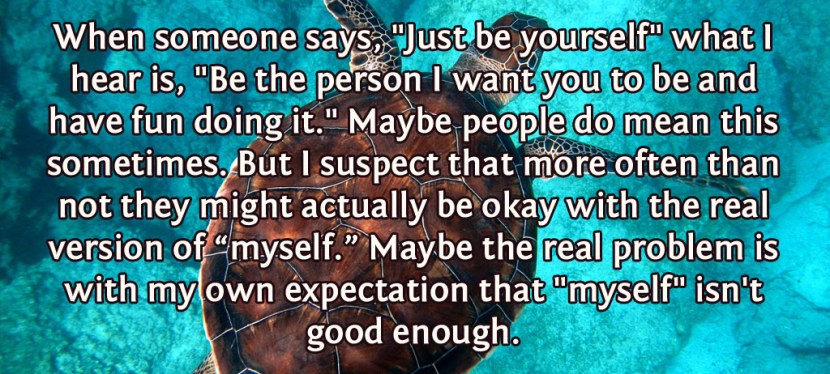
Usually when I hear this phrase someone is trying to talk me out of being anxious about something. I’m sure they mean well. It’s supposed to be reassuring. Maybe they mean it as a promise that I’ll find acceptance and enjoy myself if I just stop thinking too much about things. But when someone says, “Just relax, have fun, and be yourself” what I hear is, “Be the person I want you to be and have fun doing it.”

What if my real self simply can’t relax in that situation? Or “myself” doesn’t have fun with activities like the one you’re trying to talk me into? In that case, I assume that you’ll either judge me for failing at such a simple instruction or you’ll feel bad that I haven’t enjoyed myself. So instead of actually being myself when I hear this, I want to try to be whatever version of myself I think you expect in response to what you said.

To Chameleon or Not To Chameleon

INFJs interact with the outer world using a function called Extroverted Feeling. Personality Hacker calls this mental process Harmony because it’s concerned with creating and maintaining harmonious relationships between people. It’s often (but not always) something that INFJs are tempted to skip developing because it’s more comfortable for us to stay in our introverted side with Intuition and Thinking.

When you pair a Harmony process that isn’t very well developed with anxiety (not all INFJs have anxiety, but I do), you end up with the sort of situation I described above. You try to “chameleon” into what other people want desperately trying to keep things in a comfortable state of non-confrontation. Read more

Fighting Something You Can’t See

Choosing to follow God means we’re walking in harmony with Him. And that means we’ll be walking out-of-step with this world and with “the god of this world,” as Yahweh’s adversary is called (2 Cor. 4:4). In many ways, our Christian walk is one of warfare and struggle.

One of my ongoing struggles is with anxiety. My mind wants to loop through worst-case scenarios and imagine all the “what if?”s in a given situation. I’m often nervous, jumpy, and preoccupied with what’s going on in my head. My anxieties are something I can’t see, and unless I tell people about them or have a panic attack in public most wouldn’t have a clue how much it impacts my life (they call this “high functioning anxiety”).

Scriptures tell us that as Christians, the battles we face have spiritual components. These sorts of battles are difficult whether they’re visible to other people or not; whether they’re internal or external. But even when we feel like we’re battling something we can see — a nasty coworker, a disease, a failing relationship — Paul reminds us that we “do not wrestle with flesh and blood.” There are spiritual forces behind all the battles we face (Eph. 6:12). And we can’t see the full extent of our battles, or fight them effectively, without God’s help.

The Usual Type of Battle

It’s often a struggle for me to answer the question, “How’ve you been?” or “How was your week?” Unless something electronic breaks or someone I care about is going through something, my weeks would usually look pretty good from the outside. And I don’t want to tell most people that I’ve been struggling all week with something that’s only a problem inside my own head.

There’s a stigma against admitting you’re struggling. You might be seen as a saintly example of endurance if you’re facing a physical trial. But in many churches it’s a different story when you’re battling something mental or emotional. So many people see interior struggles as either a lack of faith or something that you could just “get over” if you prayed about it enough. However, there’s a passage in 2 Corinthians where Paul makes it sound like struggles within ourselves are the kinds of battles Christians usually face.

For though we walk in the flesh, we don’t wage war according to the flesh; for the weapons of our warfare are not of the flesh, but mighty before God to the throwing down of strongholds, throwing down imaginations and every high thing that is exalted against the knowledge of God, and bringing every thought into captivity to the obedience of Christ (2 Cor. 10:3-5, WEB)

Our warfare isn’t primarily a physical battle. It’s a spiritual and internal one that can also spill over into our outer lives. Even when the Adversary uses outside attacks it’s still part of a battle for our minds, hearts and spirits. It’s well past time for Christians to recognize this and start supporting each other through the invisible battles we all face. Read more

Anxiety Kitty: The Not-So-Surprising Way Pets Improve Mental Health

Remember that nervous cat I adopted a few months ago who spent all his time hiding under couches and beds or in closets? (click here to read “Lessons From My Nervous Cat”). My plan was to pour as much patience, love, and understanding into his life as I want people to show me when I’m scared. I wanted to show him that he had a safe home now.

Well, it’s working. Flynn is turning into quite the friendly cat, especially with me but also with the rest of the people he sees every day. And he’s even getting better around non-family members. We had several people over for dinner last night for a total of 14 humans around. Flynn hid when they were all in the house together, but after we sat down to dinner (some outside and some in the dining room) he actually wandered around out in the open and let people he didn’t know pet him.

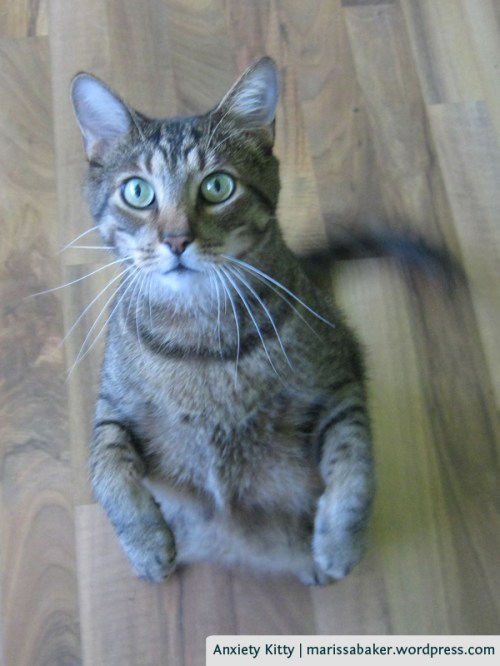
After doing some research, I learned that clicker training is the one thing people have found that helps anxious cats settle down and feel safe. No one knows why teaching a cat to do simple tricks on command combats anxiety, but it does. My theory is that when the cat gets positive reinforcement for certain actions the additional structure helps make them feel secure. Whatever the reason, it’s adorable. It’s mostly about teaching him to do things he was already doing on command (touch my fingers, come when called, jump on and off chairs, and stand on his hind legs). The “stand” command is everyone’s favorite. He’s just so cute!
Anxiety Kitty | marissabaker.wordpress.com

As I’ve helped Flynn with his anxiety, he’s been helping me with mine. Before a lunch date a few weeks ago (the first since my breakup), he spent the whole morning following me around and checking in on me. Every few minutes while I was working at my desk he’d hop out of the window and walk over to “talk” with me and have his head rubbed. And when I walked into a different room he followed. Since then, he’s kept that pattern up most of the days my anxiety has spiked.

I’m honestly shocked how in-tune he is with my emotional state. A few days ago I was working on a guest post sharing my testimony about anxiety (I’ll share a link here when it goes live) and I hit a point in my writings where I just burst into tears sitting at my desk. I went for a walk outside and when I came back Flynn walked around my feet crying until I responded to him. He actually let me pick him up and hold him for a good 30 seconds (he hates being cuddled and usually wiggles as soon as you pick him up). Then a little while later when I was journaling and crying he spotted me, ran into the room, jumped up on the bed with me and stayed there purring until someone else came home. The only other times he sits on my bed with me is late at night, so this was really outside his normal behavior.

We’ve also discovered another shared love: old books. I collect Grosset & Dunlap series books (like Hardy Boys, Nancy Drew, Tom Swift, Rick Brant, and others). I found two bags full of books I needed for my collection at a book sale on Friday and they’re in really good shape. Flynn acted like the bags were full of catnip. He dove into the Hardy Boys bag head first and rolled around on the books until I pulled him out and tied the bag shut so he wouldn’t damage them. Then he climbed into the bag that I’d had Rick Brant books in earlier. He looked almost as happy with the books as I am.

Anxiety Kitty | marissabaker.wordpress.com

There’s just something comforting about sharing my home with a fluffy critter. Cats are my choice, but I’m sure other pet owners can relate whether they love dogs, rabbits, gerbils, or even non-fluffy pets. People are happier and healthier around animals. In fact, one survey found that 74% of pet owners reported mental health improvements from pet ownership.

The Anxiety and Depression Association of America says, “pets and therapy animals can help alleviate stress, anxiety, depression, and feelings of loneliness and social isolation.” That’s so true for me. Adopting Flynn and starting counseling are the two biggest things that have helped me deal with my anxiety this year, as well as my post-breakup grief. I know pet ownership isn’t for everyone, and would never tell you to get a pet if you’re not sure you could take care of it. But for those of us who can have pets, they can be a huge help when you’re going through something.

You don’t need to have a mental health issue to benefit from caring for an animal. For example, I suggested in my post on developing Sensing as an INFJ or INTJ that pets can help ground these personality types in the real world. INxJ types are normally a bit out-of-touch with the physical world and there’s nothing like knowing some other life form needs you in order to stay alive and happy to get you out of your own head for a while. Whatever your personality type, pets can be a huge blessing.

What about you? Do you have an animal friend who helps you when you’re struggling with something?
Making Some New Paths In Our Minds

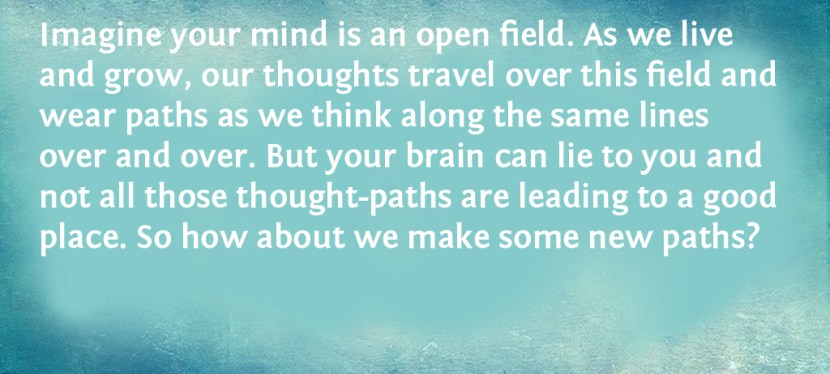
One of the more helpful (for me, at least) analogies that my counselor has used as we work on my anxiety is that we can think of our minds as a big open field. As we live and grow, our thoughts travel over this field and we start to wear-down paths as we think along the same lines over and over.

For example, little Marissa grew up in a safe, cozy home with parents who told her she was loved. So the “I am loved” thought-path got a lot of travel. It became an easy path to go down. But at some point, a conflicting message came in and it shifted the path. No longer “I am loved” without qualifiers, but now “I am loved by my family and God” because those are the ones who haven’t let me down or rejected me. And even though there’s evidence to the contrary coming from many friends, anxiety adds the idea “and no one else” to that thought-path.

Your Brain Can Lie

Your brain can be a dirty, rotten liar (to quote my counselor again). And while anxiety doesn’t look the same for everyone who deals with it, one of the common things it does is push your brain toward overestimating worst-case scenarios. You wear deep paths in your mental field that reinforce all the negative things and push positive ones off somewhere in the tall grass.

And so my mind likes to wander down the “no one will accept you as your full, authentic self” path even though I have plenty of evidence to the contrary. For example, all the comments on the post where I told you about my breakup and anxiety are evidence that my brain is lying when it wants to head down that road. But that’s still what the brain wants to do. And this is also how you can end up thinking things like, “no one appreciates my contributions” when there are dozens of people who love what you’re doing but those one or two people who criticize you become the only voices you can hear. Read more