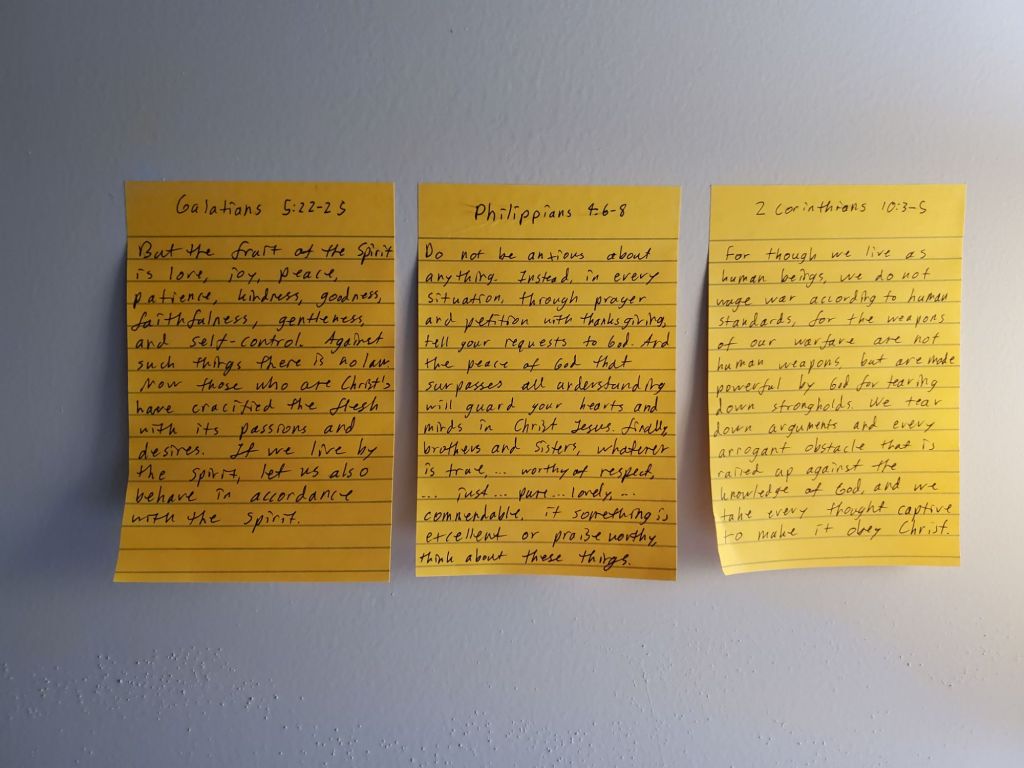
I love having a toddler. For me personally, I think the toddler phase is much easier than the baby phase and it’s amazing to see my daughter’s sweet personality develop as she learns at an astonishing rate. As great as it is, though, toddlers can try your patience. Several weeks ago, I selected three scriptures that I placed on the wall beside my bed so I could see them first thing in the morning as I prayed before starting the day. Those scriptures are Galatians 5:22-25, Philippians 4:6-8, and 2 Corinthians 10:3-5. I thought for today’s post, it would be nice to walk through those three scriptures and think about how they can help us manage our thoughts and emotions in a godly way.
The Fruit of the Spirit
But the fruit of the Spirit is love, joy, peace, patience, kindness, goodness, faithfulness, gentleness, and self-control. Against such things there is no law. Now those who belong to Christ have crucified the flesh with its passions and desires. If we live by the Spirit, let us also behave in accordance with the Spirit.
Galatians 5:22-25, NET
I started out with this verse because it’s a reminder of the type of character we’re supposed to develop as we become more and more like God. When we enter a covenant with God at baptism and become part of His family, He gives us the Holy Spirit as a down payment on our full inheritance in His family (2 Cor. 1:22; 5:5; Eph. 1:13-14; 4:30). God’s spirit inside us transforms us to be like Him, and as we become more and more like Him we will see the fruits of His character more and more prominently in our lives.
Our transformation is a work that God accomplishes, but we are not just passive recipients of that change (Phil. 2:12-13). In fact, we won’t change at all if we don’t take an active part in the relationship. We can’t become like God on our own, but we also won’t become like God if we aren’t working with Him toward that goal. It is our responsibility to “behave in accordance with the Spirit.” Studying the fruit of the Spirit, praying for God’s aid, and cultivating those traits in us is one way to do that.
Taking Thoughts Captive
For though we live as human beings, we do not wage war according to human standards, for the weapons of our warfare are not human weapons, but are made powerful by God for tearing down strongholds. We tear down arguments and every arrogant obstacle that is raised up against the knowledge of God, and we take every thought captive to make it obey Christ.
2 Corinthians 10:3-5, NET
Thoughts often seem like they pop into our heads and there’s nothing we can do about them. It often seems impossible or counter-intuitive to be told that we are in control of what our minds think about. For many of us, thoughts and emotions just happen. For example, we don’t make the conscious decision to get angry when we read a news article or feel anxiety when hearing a strange noise at night.
While our first impulse might be out of our control, we do have the power to direct our thoughts where we want them to go. It’s not easy. That’s why this verse talks about warfare. But we can do it, especially when we are “made powerful by God” and ask Him to help us “take every thought captive to make it obey Christ.”
Peace In Your Mind
Do not be anxious about anything. Instead, in every situation, through prayer and petition with thanksgiving, tell your requests to God. And the peace of God that surpasses all understanding will guard your hearts and minds in Christ Jesus.
Finally, brothers and sisters, whatever is true, whatever is worthy of respect, whatever is just, whatever is pure, whatever is lovely, whatever is commendable, if something is excellent or praiseworthy, think about these things.
Philippians 4:6-8, NET
Anxiety has been a long-time struggle for me. This verse is a challenging one for me to believe because I have so much experience with having anxiety rather than peace even while praying faithfully and following God. But I also have experienced overwhelming peace that can only come from God. And I know that I have less anxiety when I pray for God’s help and do the hard work of taking control of my anxious thoughts.
This verse goes so well with 2 Corinthians 10:3-5 because it gives us specific things to think about when we take our thoughts captive. You can’t push wrong thoughts out and keep them out unless you replace them with something else.
As Christians, we know that we’re suppose to become like God. That often seems like an impossible goal, but impossible things are possible when God gets involved (Matt. 19:26). Inside-out-transformation happens as we cultivate the fruit of God’s spirit in us, fight with God’s power to take our thoughts captive, and dwell in the peace that He guards us with as we think on things pleasing in His sight.
P.S. For 10 years on my blog, I published a year-end review sharing site stats, most popular posts, etc. This year, I decided to move that into the newsletter. If you’re curious, make sure you subscribe so you’ll get that email when it goes out next week.
Featured image by Corey David Robinson from Lightstock
I’m guessing you all know about the fruit of the spirit. You might have them memorized: “love, joy, peace, patience, kindness, goodness, faithfulness,gentleness, and self-control” (Gal. 5:22-23, NET). You might even have done in-depth studies on them, such as spending a month writing scriptures about each trait with my free 30-day scripture writing plans.
There’s another list in Galatians, though. It comes right before the fruit of the spirit passage and details the works of the flesh. We’re meant to read both and notice a contrast between the two because Paul is making a point about how Christians live. When he says you’re “not under the law,” he doesn’t mean God gives you freedom to go out and live a hedonistic, sinful life. Quite the opposite, in fact. We’re given freedom so we can fully follow God from the heart, with all the fruit of the spirit in our lives and none of the works of the flesh.
There’s a lot going on in Paul’s letter to the Galatians. He wrote to correct errors in the Galatian believers’ theology. They were confused, even following what Paul described as other gospels. It seems their main issue involved a too-strict reliance on Old Covenant law and Jewish additions to the law. Paul reinforces the good news he originally preached to them: the Old Covenant ended with Jesus’s death and a New Covenant took its place. Jesus’s faithfulness is what brings us righteousness and justification, not our own efforts. That doesn’t mean we break God’s law (Christ does not encourage sin nor did He do away with God’s law [Matt. 5:17-20; Rom. 3:28-31]), but Jesus didn’t redeem us and give us the Spirit so that we could then try to save ourselves by our own efforts. He saved us, and we’re to reciprocate with faith that involves active, relational loyalty.
For you were called to freedom, brothers and sisters; only do not use your freedom as an opportunity to indulge your flesh, but through love serve one another.For the whole law can be summed up in a single commandment, namely, “You must love your neighbor as yourself.”However, if you continually bite and devour one another, beware that you are not consumed by one another. But I say, live by the Spirit and you will not carry out the desires of the flesh.For the flesh has desires that are opposed to the Spirit, and the Spirit has desires that are opposed to the flesh, for these are in opposition to each other, so that you cannot do what you want. But if you are led by the Spirit, you are not under the law.
Galatians 5:13-18, NET (bold italics mark a quotation from Lev. 19:18)
When we’re baptized into Jesus Christ, we symbolically die to our “old man” and we’re reborn as children of God (Paul covers this extensively in Romans). That transformation has (or should have) a profound effect on our lives. We’re to change, becoming less and less like fleshy, selfish humans and more and more like spirit beings in God’s family. That involves putting off things associated with fallen humanity living in a world influenced by Satan.
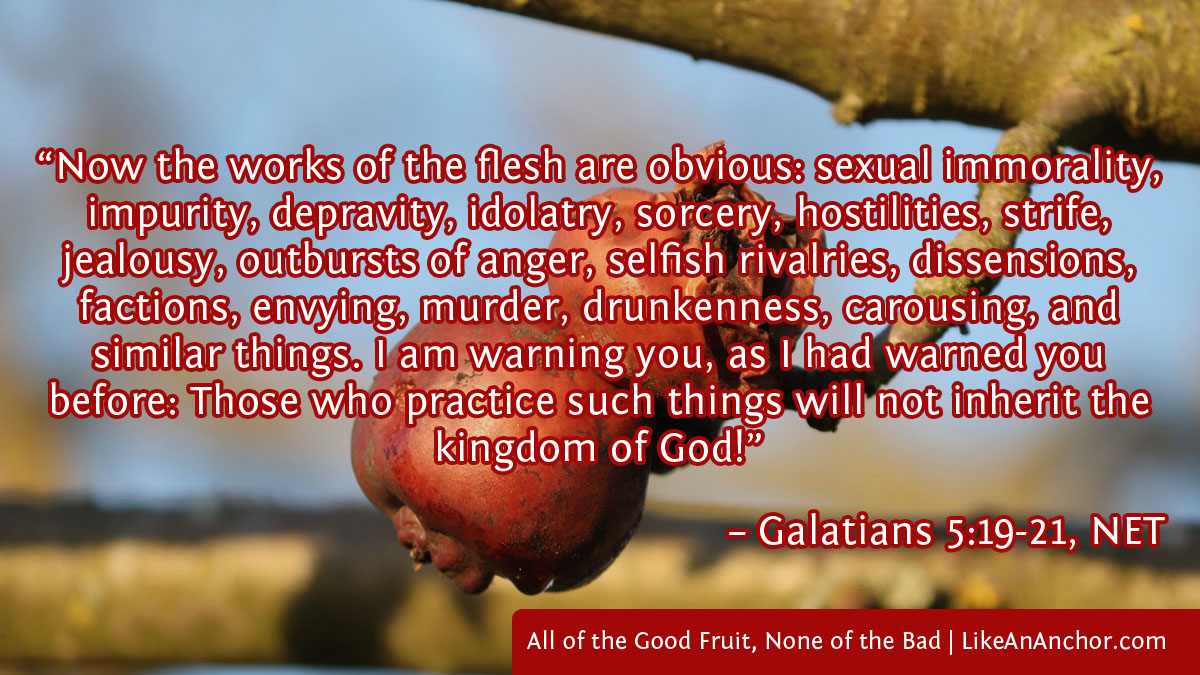
Now the works of the flesh are obvious: sexual immorality, impurity, depravity, idolatry, sorcery, hostilities, strife, jealousy, outbursts of anger, selfish rivalries, dissensions, factions, envying, murder, drunkenness, carousing, and similar things. I am warning you, as I had warned you before: Those who practice such things will not inherit the kingdom of God!
Galatians 5:19-21, NET
This isn’t a complete list (Paul has similar ones in other letters, like 1 Cor 6:9-11; Eph. 5:1-6; Col. 3:1-10), but the message is clear. If we continue to do things that God defines as sinful or unrighteous we will not inherit as His children or be in His kingdom. That’s one of the reasons it’s still important for us to know about God’s law; His law defines sin and acts as a tutor or guardian pointing to Christ (Rom. 3:20; Gal. 3:24).
Image by congerdesign from Pixabay
Live In The Spirit
Cleaning things God hates out of our lives is an important part of our relationship with Him. It’s not the most important part, though. First, Jesus is the one who initially washes us clean; only believing in Him, repenting of our sins, and accepting His sacrifice can make us clean. Then, we’re called to participate in His ongoing work in us. We’re supposed to keep examining ourselves, putting away bad things, and putting in good things as we become more and more like Him. If we don’t take any action, then we’re like the person Jesus warned about in this analogy:
“When an unclean spirit goes out of a person, it passes through waterless places looking for rest but does not find it. Then it says, ‘I will return to the home I left.’ When it returns, it finds the house empty, swept clean, and put in order.Then it goes and brings with it seven other spirits more evil than itself, and they go in and live there, so the last state of that person is worse than the first. It will be that way for this evil generation as well!”
Matthew 12:43-45, NET
If you remove something evil from your life and don’t replace it with something good, then there’s a chance something worse is going to move in. It’s like if you give up eating candy so you can be healthier, but don’t add any good eating habits, then take up smoking on top of going back to eating tons of sugar. Except in this case, we’re taking out works of the flesh and we’re supposed to replace them with fruit of the spirit. If we try to take out something like “outbursts of anger” without putting in things like love, peace, and patience then the anger isn’t going to stay gone and might get worse.
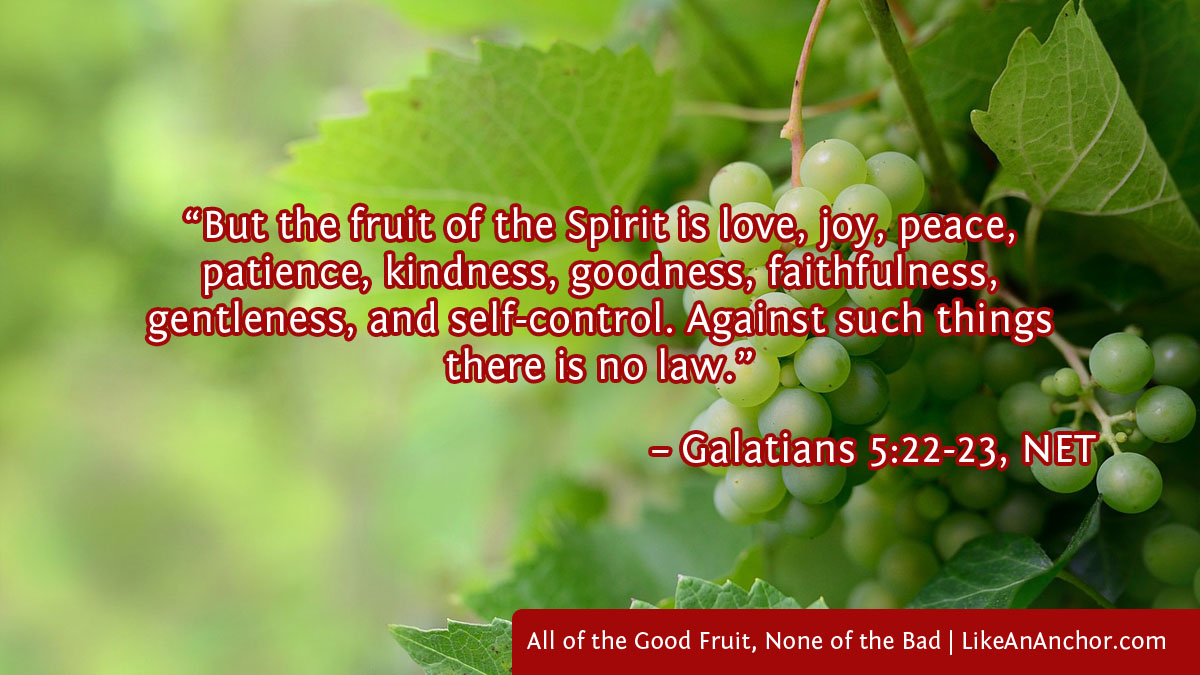
But the fruit of the Spirit is love, joy, peace, patience, kindness, goodness, faithfulness,gentleness, and self-control. Against such things there is no law. Now those who belong to Christ have crucified the flesh with its passions and desires. If we live by the Spirit, let us also behave in accordance with the Spirit.
Galatians 5:22-25, NET
We need to have all of the fruit of the spirit AND none of the works of the flesh. It’ll be a life-long process, but that’s the goal. We can’t be content with getting rid of most of the works of the flesh or having just some of the fruit of the spirit. God’s people shouldn’t look at themselves, shrug their shoulders and think, “Eh, guess I’m good enough now” (Rom. 11:18-21; 1 Cor. 8:2; 10:12). We need to stay faithful, keep learning, humble ourselves and repent as needed, and ask God to guide our growth.
If we just stopped at the end of chapter 5, we might think that removing the works of the flesh and putting on the fruit of the spirit is just an individual, private thing. In some ways it is: we’re each responsible for ourselves and we’re the ones who will answer to God for what we did with the gifts He gives us and the work He does in us. But at the same time, we’re also responsible for how we interact with other people. Christians are not called to isolated, individual walks. God calls us into a family, a collective body of believers who are meant to support each other.
Brothers and sisters, if a person is discovered in some sin, you who are spiritual restore such a person in a spirit of gentleness. Pay close attention to yourselves, so that you are not tempted too.Carry one another’s burdens, and in this way you will fulfill the law of Christ. For if anyone thinks he is something when he is nothing, he deceives himself. Let each one examine his own work. Then he can take pride in himself and not compare himself with someone else. For each one will carry his own load.
Galatians 6:1-5, NET
We’re supposed to help each other put away the works of the flesh and cultivate the fruit of the spirit. Notice that Paul doesn’t say “judge,” “condemn,” or even “correct.” He says to “restore” this person. The Greek word is katartizo, and it means to mend something that’s broken or “to strengthen, perfect, complete, make one what he ought to be” (Thayer’s Dictionary entry G2675). Sometimes, we’ll be the one in need of mending who needs help from other believers. Other times, we’ll be “carrying our own load” well enough that we can be the one who helps another.
Now the one who receives instruction in the word must share all good things with the one who teaches it. Do not be deceived. God will not be made a fool. For a person will reap what he sows, because the person who sows to his own flesh will reap corruption from the flesh, but the one who sows to the Spirit will reap eternal life from the Spirit.So we must not grow weary in doing good, for in due time we will reap, if we do not give up.So then, whenever we have an opportunity, let us do good to all people, and especially to those who belong to the family of faith.
Galatians 6:6-10, NET
The sowing and reaping analogy fits so well with calling godly characteristics “fruit of the spirit.” Right before His crucifixion, Jesus told His disciples that He chose them to bear fruit, that their fruitfulness honors the Father, and that it shows they are genuine followers of God (John 15:8, 16). Our connection with Jesus should be a fruitful one. If we invest or “sow” into the life of the spirit–our life following Jesus and becoming like Him and Our Father–then we’ll produce good fruit to replace the works of the flesh that He’s working with us to remove from our lives.
What do you picture when you hear the words “gentleness” or “meekness”? If you’re like most English speakers, you probably don’t think of controlled anger, strength of character, or calm acceptance of God’s will. But those are connotations of the Greek word used in the New Testament that English translators chose to translate as gentleness or meekness (or occasionally humility, though usually that’s a different word).
A couple weeks ago, I realized I’d never finished my 30-Day Scripture Writing series on the fruit of the spirit. There were three left: peace, faith, and today we’re wrapping up with gentleness. You can find the 30-day scripture writing list at the end of this blog post if you’d like to continue studying this topic.
Putting Gentleness in Ancient Context
I’ve written about the Greek word translated “gentleness” or “meekness” before. I find it fascinating that in English, we associate those traits with weakness but in Greek it’s associated with strength of character. Spiros Zodhiates says that praotetos primarily means “an inward grace of the soul, calmness toward God in particular. It is the acceptance of God’s dealings with us considering them as good in that they enhance the closeness of our relationship with Him” (The Complete WordStudy Dictionary: New Testament, entry 4236). In the sense that the meaning is linked to our relationship with God, it is similar to the Hebrew word most often translated “gentle” or “meek.” Anav (H6035) means humble, often as a result of affliction, but also proper humility when recognizing “absolute dependence on God” (Theological Wordbook of the Old Testament, entry 1652a).
Returning to the Greek word praotetos, there’s another difference between it and the English connotations for gentleness or meekness. It is not something passive, but rather “the activity of the blessedness that exists in one’s heart from being actively angry at evil” (Zodhiates). The idea of anger and gentleness being conveyed in the same word seems contradictory, but we see Jesus called meek and responding with anger to wicked things (Matt. 11:29; Mark 3:5; John 2:13-17; 2 Cor. 10:1). As with other godly character traits, we can model our expressions of meekness/gentleness on Jesus’s behavior.
It can also be helpful at times to remember that the Greek language used in the New Testament was used by other people as well. It’s not just a Biblical language, and we can look to other writings to get a sense for how people in the larger world of the time used words. Aristotle said that “praotes is that virtue that stands between two extremes, the orgilotes (n.f.), uncontrolled and unjustified anger … and aorgistia (n.f.), not becoming angry at all no matter what takes place around you” (Zodhiates, entry 4236 [n.f. stands for ‘not found’ in scripture]). That’s very different than how we think of meekness and gentleness today, but it’s in line with how the Biblical writers would have used the word.
For this study, we’ll be looking at New Testament verses that use the word praotes (G4236) as well as the root word praos (G4235) and the synonyms praus (G4239) and prautes (G4240). These words appear a total of 16 times in the New Testament. There are also a few other words that could be translated meek or gentle (e.g. epios [G2261] and epieikes [G1933]) but since we’re focusing on gentleness as a fruit of the spirit, we’ll stick with the praotes words for now since that’s what’s used in Galatians 5.
Image by Inbetween from Lightstock
Instructions to be Gentle
If you read the New Testament start to finish, the first time you’ll encounter the word for gentleness or meekness is in the Beatitudes. Here, Jesus said, “Blessed are the meek, for they will inherit the earth” (Matt. 5:5, NET). It echoes a verse from Psalms: “the humble shall inherit the land, and shall delight themselves in the abundance of peace” (Ps. 37:11, WEB). A phrase like “inherit the land” in the Old Testament typically meant you’d have an inheritance in the promised land among God’s (Old) Covenant people. Now in the New Covenant, the humble/meek/gentle are promised an even greater inheritance. In the Beatitudes, Jesus is likely looking forward to the New Heaven and New Earth promised to all His faithful followers after His second coming (Is. 65:17; 2 Pet. 3:10-14; Rev. 21:1-3).
But you, man of God, flee these things, and follow after righteousness, godliness, faith, love, perseverance, and gentleness. Fight the good fight of faith. Take hold of the eternal life to which you were called, and you confessed the good confession in the sight of many witnesses.
1 Timothy 6:11-12, WEB
We talked last week about how faith is an active, participatory sort of thing. Here, Paul told Timothy that “fighting the good fight of faith” and taking “hold of the eternal life to which you were called” involves cultivating gentleness in your life (among other things). It’s a very important aspect of our character as godly people. In addition to general admonitions like this to cultivate gentleness in our lives, we’re also specifically instructed to use gentleness in our dealings with other people.
I, therefore, the prisoner for the Lord, urge you to live worthily of the calling with which you have been called,with all humility and gentleness, with patience, putting up with one another in love, making every effort to keep the unity of the Spirit in the bond of peace.
Ephesians 4:1-3, NET
Therefore, as the elect of God, holy and dearly loved, clothe yourselves with a heart of mercy, kindness, humility, gentleness, and patience, bearing with one another and forgiving one another, if someone happens to have a complaint against anyone else. Just as the Lord has forgiven you, so you also forgive others.
Colossians 3:12-13, NET
I think these two passages about “putting up with one another” and “bearing with one another” pair well. Humans aren’t always easy to get along with, but regardless of that we need to be patient, humble, merciful, kind, and gentle in our dealings with everyone. That’s particularly true of those in the church (though we’re to live peaceably with everyone as much as we can), where we should be working to build unity and peace within the body of Christ.
One of the things we need to be careful about as Christians is that we do not judge other people (specifically in the sense of condemning them). At the same time, we need to be able to discern between right and wrong and correct a fellow Christian if need be. That can be a very slippery slope, with a lot of correction sliding too far into judging/condemning. Gentleness is key to appropriately using correction within the church, and the word appears several times in connection to this topic.
Brothers and sisters, if a person is discovered in some sin, you who are spiritual restore such a person in a spirit of gentleness. Pay close attention to yourselves, so that you are not tempted too.
Galatians 6:1, NET
It’s not loving to let fellow believers go on sinning and damaging their relationship with God (Is. 59:2). But we’re admonished to restore them with gentleness and “pay close attention to yourselves” to make sure you’re not sinning as well (Matt. 7:1-5). This is what the Corinthian church should have done rather than being proud of tolerating sin within their congregation (1 Cor. 4:6-5:13). It got so bad there that Paul seemed uncertain if he’d need a “rod of discipline” to correct them or if he could do it with “love and a spirit of gentleness” (1 Cor. 4:21, NET). As a rule, though, correction within the church ought to be done with gentleness. Paul gives that instruction both to church members and to leaders like Timothy.
But reject foolish and ignorant controversies, because you know they breed infighting.And the Lord’s slave must not engage in heated disputes but be kind toward all, an apt teacher, patient, correcting opponents with gentleness. Perhaps God will grant them repentance and then knowledge of the truthand they will come to their senses and escape the devil’s trap where they are held captive to do his will.
2 Timothy 2:23-26, NET
The goal of proper, gentle correction is restoration. We should never want to condemn people, but to see them repent and “come to their senses.” That is, after all, God’s perspective and we’re supposed to become like Him (1 Tim. 2:1-4; 2 Pet. 3:9). It brings us back to the idea of balance that’s inherent in gentleness/meekness (praotetos). This character trait is angry at evil, yet doesn’t lose control. It takes action, yet always trusts and submits to God’s will. When we correct in this way, we’re kind and guide toward restored relationship rather than trying to condemn or prove ourselves right.
As part of the fruit produced by God’s spirit inside us, gentleness should be a product of our lives. As we follow Jesus and live in relationship with Him and the Father, we should become more and more like them and display their character traits and perspectives in our lives. Gentleness is one important aspect of that.
Faith is a huge topic in the Bible, one that whole books have been written about (I reviewed one of those books just last year). Today, I want to look at faith specifically from the perspective of the fruit of the spirit passage in Galatians. In other words, we’re examining faith as something that’s produced in your life when God’s spirit is inside of you.
But the fruit of the Spirit is love, joy, peace, patience, kindness, goodness, faithfulness,gentleness, and self-control. Against such things there is no law.
Galatians 5:22-23, NET
Last week, I mentioned that I realized I’d never finished my 30-Day Scripture Writing series on the fruit of the spirit. The last two remaining topics are “faith” and “gentleness,” so today we’re focusing on faith. I spent this past week reading through the many Bible verses mentioning faith as well as belief (since they’re such closely related words) and looking into the Greek and Hebrew words behind the English translations. My initial “short list” as I started narrowing down which scriptures to include was 78 passages, which gives you an idea just how many verses on faith there are in the Bible. I did eventually get it down to 30 (you’ll find a link to the finished scripture-writing plan at the end of this post).
Faith and Truth
In the Old Testament, you’ll find the word “faithfulness” more often than “faith.” Usually, it’s talking about God’s faithfulness (Deut. 7:9; Ps. 33:4; 89:1; Is. 25:1; Lam 3:23) or humanity’s faithfulness or unfaithfulness to Him (2 Chr. 29:6; 31:20; Hos. 4:12). In these scriptures, “faith” as a concept takes a backseat to the idea of living a faithful life. It’s clear that faith involves action; a change in your entire way of life because of being in a covenant relationship with God.
You are Yahweh, the God who chose Abram, brought him out of Ur of the Chaldees, gave him the name of Abraham, found his heart faithful before you, and made a covenant with him … for you are righteous.
Nehemiah 9:7-8 , WEB
In Hebrew, the word “faith” is typically translated from the root word aman (H539) or one of several other words in this word family (e.g. amen, emuna, emet) (Theological Wordbook of the Old Testament [TWOT], entry 116). Interestingly, this is the same group of words for “truth.” At it’s most fundamental, the “root idea is firmness or certainty” and it “shows that biblical faith is an assurance, a certainty, in contrast with modern concepts of faith as something possible, hopefully true, but not certain” (TWOT 116). It’s something that’s absolutely dependable; something that gives you stability.
Know therefore that Yahweh your God himself is God, the faithful God, who keeps covenant and loving kindness with them who love him and keep his commandments to a thousand generations
Deuteronomy 7:9, WEB
We can rely on our faithful God. This fact is emphasized over and over in scriptures, particularly in the Old Testament. But God also wants to be able to rely on us to act faithfully. It’s a commitment that is supposed to go both ways, as it did with Abraham, David, and Hezekiah (Neh. 9:7-8; 1 Kings 3:6; 2 Chr. 31:20).
Image by Ben White from Lightstock
A Thing and an Action
Faith in the New Testament also involves action and devotion, but it’s a little harder for us to see that in our modern translations. In Greek, “faith” is translated from the noun pistis (G4102), which implies active loyalty and trust. The verb form pisteuo (G4100) is often translated “believe.” Now, that makes things a bit confusing because in English faith and belief aren’t quite the same. The top definition for “faith” provided by Google and Oxford Languages is “complete trust or confidence in someone or something.” For “believe,” the top definition is “accept (something) as true; feel sure of the truth of” and it’s also become synonymous with “think” or “suppose.” So there are overlaps in the definitions, but they don’t have the same connotations.
As I talked about in my newsletter earlier this week, there isn’t a verb (action) form of “faith” in English–it’s always a noun (person, place, or thing)–so translators had to use a different word to translate the action-form of “faith.” We need to keep that in mind when we’re reading the New Testament. When we read “believe” it’s not just an intellectual agreement or an emotional feeling that something is true; it is faith in action. Even when Bible writers use the noun form, they still describe faith as something that you’re supposed to do, not just have.
Woe to you, scribes and Pharisees, hypocrites! For you tithe mint, dill, and cumin, and have left undone the weightier matters of the law: justice, mercy, and faith. But you ought to have done these, and not to have left the other undone.
Matthew 23:23, WEB
We can’t leave faith “undone.” It’s an active thing. When we read that Jesus came preaching, “The time is fulfilled, and God’s Kingdom is at hand! Repent, and believe in the Good News” (Mark 1:15, WEB), “believe” is a command to engage in the activity of faith.
Believe me that I am in the Father, and the Father in me; or else believe me for the very works’ sake. Most certainly I tell you, he who believes in me, the works that I do, he will do also; and he will do greater works than these, because I am going to my Father.
John 14:11-12, WEB
We often think of faith as separated from works in modern Christianity, thinking of verses like Paul saying Abraham was justified by faith rather than his works (Rom. 3:27-4:21) while ignoring James using the exact same example to show that faith without works is dead (Jam. 2:14-26). Faith is absolutely connected to works–a faithful life naturally produces certain fruit. (Paul’s point is that salvation is not dependent on works, but on the faithfulness of Jesus and our active belief in Him.)
Image by Brightside Creative from Lightstock
Cultivating Active Faith
So what does faith do? In other words, if you have faith, what does it look like to turn that into action? For one thing, it leads to growth as a Christian.
For this reason I kneel before the Father,from whom every family in heaven and on earth is named. I pray that according to the wealth of his glory he will grant you to be strengthened with power through his Spirit in the inner person, that Christ will dwell in your hearts through faith, so that, because you have been rooted and grounded in love, you will be able to comprehend with all the saints what is the breadth and length and height and depth,and thus to know the love of Christ that surpasses knowledge, so that you will be filled up to all the fullness of God.
Ephesians 3:14-19, NET
Remember, we’re talking about “faith” in the context of the fruit of the spirit. Here in Ephesians, Paul prayed for those in the church that they would be “strengthened with power through His spirit” so “that Christ will dwell in your hearts through faith.” God’s spirit inside us enables Christ to dwell in us through faith, and then that leads to major spiritual growth. One result of this growth is that faith shifts our mindset about things.
Jesus answered them, “Have faith in God. For most certainly I tell you, whoever may tell this mountain, ‘Be taken up and cast into the sea,’ and doesn’t doubt in his heart, but believes that what he says is happening; he shall have whatever he says. Therefore I tell you, all things whatever you pray and ask for, believe that you have received them, and you shall have them.”
Mark 11:22-24 , WEB
This verse isn’t just about literally picking up mountains (though it certainly isn’t the only verse about faith/believing having tangible effects in the world [Mark 16:15-18; John 14:11-12]). It’s also about actually trusting that God responds when you talk with Him (John 16:24-27). To put it in Old Testament terms, faith on your part means actually trusting that God is faithful to His part of the covenant relationship.
Butmy righteous one will live by faith, and if he shrinks back, Itakeno pleasure in him.But we are not among those who shrink back and thus perish, but are among those who have faith and preserve their souls.Now faith is being sure of what we hope for, being convinced of what we do not see. …
Now without faith it is impossible to please him, for the one who approaches God must believe that he exists and that he rewards those who seek him.
Hebrews 10:38-11:1, 11:6, NET (bold italics mark a quotation from Hab 2:4).
We can’t function as Christians without faith. And we need to make a conscious effort to cultivate that faith in our lives. We need to hold onto faith (1 Tim. 1:18-19), pursue it (1 Tim. 6:11-12; 2 Tim. 2:22), fight for the faith (Jude 1:3; 2 Tim. 4:7-8), and build up our faith (Jude 1:20; Col. 2:6-7). Like the other character traits and inner attitudes described as “fruit of the spirit,” faith isn’t just something we have passively but something we actively cultivate as God works in and with us.
Many people today think that faith in God means simply believing that He exists. But in biblical terms, that head knowledge only turns into faith when we act on it. If it’s just an intellectual acknowledgement of God’s existence and power, then it’s not any more “faith” than the sort of belief in God that demons have.
What good is it, my brothers and sisters, if someone claims to have faith but does not have works? Can this kind of faith save him?If a brother or sister is poorly clothed and lacks daily food, and one of you says to them, “Go in peace, keep warm and eat well,” but you do not give them what the body needs, what good is it? So also faith, if it does not have works, is dead being by itself. But someone will say, “You have faith and I have works.” Show me your faith without works and I will show you faith by my works.You believe that God is one; well and good. Even the demons believe that—and tremble with fear.
James 2:14-19, NET
We need to be cautious about counterfeit versions of faith or things that tempt us to fall away from the faith. About 2,000 years ago, Paul warned Timothy, “Now the Spirit explicitly says that in the later times some will desert the faith and occupy themselves with deceiving spirits and demonic teachings,influenced by the hypocrisy of liars whose consciences are seared” (1 Tim. 4:1-2, NET). That’s no less true today than it was then. Somewhat ironically, navigating a world where people desert the faith and try to lure God’s people away from living faithful lives is one of the trials that can strengthen our faith (James 1:2-3).
… you may have to suffer for a short time in various trials. Such trials show the proven character of your faith, which is much more valuable than gold—gold that is tested by fire, even though it is passing away—and will bring praise and glory and honor when Jesus Christ is revealed.You have not seen him, but you love him. You do not see him now but you believe in him, and so you rejoice with an indescribable and glorious joy, because you are attaining the goal of your faith—the salvation of your souls.
1 Peter 1:6-9, NET
Here, Peter reminds us that the end goal of faith is salvation. It’s not a one-time thing where we have a moment of faith, say we love Jesus, and then salvation happens right there. It’s a life-long process. When we enter a relationship with God, we’re making a covenant with Him that includes an agreement to be faithful to Him for the rest of our lives and on into eternal life (Acts 2:38; Rom. 10:10; Phil. 3:8-15) (and, on His part, He agrees to faithfully grant us forgiveness and salvation, share His spirit with us, and enable us to become like Him).
With God’s spirit inside us, faith reshapes our lives. It becomes a central aspect of us and something that we actively do as well as believe. Living in faith involves what we think, the way we conceptualize the world, how we respond to other people, the choices we make every day, and all of our actions. If you’d like to spend more time on this topic, follow this link to download any of my free 30-day scripture writing plans or click here to download the “faith” PDF directly:
I decided to spend this week studying peace as part of the fruit of God’s spirit. This month in my local church’s lady’s scripture writing group, I shared the topic of “Sing Praise.” When I went to upload it here on my website so all of you could download it if you want, I realized that I never finished my Fruit of the Spirit scripture writing series. I still have “peace,” “faith,” and “gentleness” left to finish.
The Greek word for “peace” is eirene (G1515), a tranquil, blessed state with security and no strife. The Hebrew equivalent is shalom (H7965), wholeness; nothing missing, nothing broken. As I read through the 294 verses containing one of these words, I realized a lot of them aren’t about peace as something we do, or even necessarily as a character attribute that we develop. Most of them (208) are in the Old Testament, and a lot of those verses talk about people asking each other if they have peaceful intentions, or lamenting a lack of peace that’s associated with rebellion against God, or God assuring His people that He can provide them with peace.
I suppose I think of the fruit of the spirit as something we do. When the spirit is in us, then we practice “love, joy, peace, patience, kindness, goodness, faith,gentleness, and self-control” (Gal. 5:22-23, WEB). But the verses about joy and peace at least make it seem more like something you have inside you because of who you are when transformed by the spirit. I suppose rather than thinking about this fruit as something we do, we should think of them as descriptions of who we become as people transformed by God, which will of course influence our actions.
Image by Matt Vasquez from Lightstock
Peace In Relationship With God
Over and over, scriptures on peace link it to our relationship with God. He either promises to “give peace” to those who follow Him, or people following Him speak of the peace that they experience when they love Him and His law.
Speak to Aaron and to his sons, saying, “This is how you shall bless the children of Israel. You shall tell them, ‘Yahweh bless you, and keep you. Yahweh make his face to shine on you, and be gracious to you. Yahweh lift up his face toward you, and give you peace.’ So they shall put my name on the children of Israel; and I will bless them.”
Numbers 6:23-27, WEB
Those who love your law have great peace. Nothing causes them to stumble.
Psalm 119:165 , WEB
Peace is something intimately associated with God. We’ve talked about it before on this blog, so you might remember that in Hebrew, names are intimately associated with a person’s character and reputation. In one Messianic prophecy, Jesus Christ is called the “Prince of Peace” (Isaiah 9:6). In the book of Judges, Gideon “built an altar … and called it “Yahweh is Peace'” (Jud. 6:24, WEB). Those are the only two places in the Old Testament that “peace” is listed as a name for Yahweh or the Messiah, but peace is consistently described as something He provides.
Yahweh, your Redeemer, the Holy One of Israel says: “I am Yahweh your God, who teaches you to profit, who leads you by the way that you should go. Oh that you had listened to my commandments! Then your peace would have been like a river, and your righteousness like the waves of the sea.”
Isaiah 48:17 , WEB
But now in Christ Jesus you who once were far off are made near in the blood of Christ. For he is our peace, who made both one, and broke down the middle wall of partition, having abolished in his flesh the hostility, the law of commandments contained in ordinances, that he might create in himself one new man of the two, making peace; and might reconcile them both in one body to God through the cross, having killed the hostility thereby. He came and preached peace to you who were far off and to those who were near.
Ephesians 2:13-17, WEB
There’s a lot more to godly peace than simply feeling peaceful or being a peacemaker. Thinking about those Greek and Hebrew words I mentioned in the intro, peace involves tranquility, blessedness, security, and wholeness. There’s peace in God leading us in His way of life, in the redemptive work of the Messiah, and in our covenant relationship with the Father and Son.
Image by Pearl from Lightstock
Peace as Something We Do
In the Old Testament, peace is mostly described as something God gives us or which naturally occurs in our lives when we keep covenant with Him and obey His commandments. A few times, though, peace is something we’re commanded to do.
Depart from evil, and do good. Seek peace, and pursue it.
Psalm 34:14 , WEB
These are the things that you shall do: speak every man the truth with his neighbor. Execute the judgment of truth and peace in your gates, and let none of you devise evil in your hearts against his neighbor, and love no false oath: for all these are things that I hate,” says Yahweh.
Zechariah 8:16 , WEB
These sorts of instructions become more common in the New Testament. Peace is still something God gives us (John 14:27; Rom. 5:1-2; 2 Thes. 3:16), but it’s also more often described as something that we choose to participate in.
Do not repay anyone evil for evil; consider what is good before all people.If possible, so far as it depends on you, live peaceably with all people.
Romans 12:17-18, NET
Peace between ourselves and other people is a topic that comes up frequently (Mark 9:50; Rom. 14:19; 2 Cor. 13:11; Eph. 4:1-3). This is especially important to God in our relationships with other people in His church. Unity, peace, and interactions that build each other up are something He repeatedly commands (in contrast to condemning disunity, strife, and tearing each other down).
Flee from youthful lusts; but pursue righteousness, faith, love, and peace with those who call on the Lord out of a pure heart. But refuse foolish and ignorant questionings, knowing that they generate strife. The Lord’s servant must not quarrel, but be gentle towards all, able to teach, patient.
2 Timothy 2:22-24 , WEB
Peace As Part of Our Lives
Image by Jantanee from Lightstock
As part of the fruit of the spirit, peace is something we choose and something we’re gifted from God. His spirit inside us, which is part of our New Covenant relationship with Him, enables us to have peace inside us and to cultivate peace around us no matter what else is going on.
Do not be anxious about anything. Instead, in every situation, through prayer and petition with thanksgiving, tell your requests to God. And the peace of God that surpasses all understanding will guard your hearts and minds in Christ Jesus.
Finally, brothers and sisters, whatever is true, whatever is worthy of respect, whatever is just, whatever is pure, whatever is lovely, whatever is commendable, if something is excellent or praiseworthy, think about these things. And what you learned and received and heard and saw in me, do these things. And the God of peace will be with you.
Philippians 4:6-9, NET
When the God of peace is with us and filling us with His spirit, peace should be a natural fruit of our lives. We’re still human, though, and we need to work on living in the spirit rather than the flesh, including choosing to live lives of peace. That involves cultivating peace inside us and making peace with those around us as much as we possibly can.
But the wisdom that is from above is first pure, then peaceful, gentle, reasonable, full of mercy and good fruits, without partiality, and without hypocrisy. Now the fruit of righteousness is sown in peace by those who make peace.
James 3:17-18 , WEB
As people whose lives are being transformed by God, “peace” should be one of the key characteristics that His spirit produces in us (Gal. 5:22-23). If we lack peace, we can ask God to cultivate it inside us. If we struggle behaving peacefully with other people, and can repent of any associated sins and ask for God’s help to choose peace and make peace. He is the God of peace–Yahweh Shalom–and He is perfectly capable of putting His peace into the lives of people living in relationship with Him.
The Bible uses a lot of agricultural imagery. You’re probably most familiar with this from Jesus’s parables about sowers and fields, or His statement “I am the vine.” These sorts of analogies are rooted both in the culture of Jesus’s day and in the Old Testament writings, and they focus on three types of plants: grain, vines, and olive trees. Those plants are also the three main agricultural products of Palestinian farming: “grain, new wine, and oil” (Theological Wordbook: Old Testament, entry 1040a). These three things figured prominently in scripture, mostly in tithes and offerings (Lev. 23:13; Deut. 14:23; 18:4; 2 Chr. 31:5; Neh. 10:39; 13-12) and promised blessings (Deut. 11:14; Jer. 31:12; Hos. 2:8, 22; Joel 2:19, 24).
Grain, vines, and olive trees were a key part of culture in Bible times and they’re used in teachings that are a key part of our faith. The study I’m sharing today started out with the question, “How can we bear fruit for God?” and the more I looked into it the more fascinated I became with the way God and the writers He inspired use these three plants to tell us about His plan, kingdom, and relationship with people. At first, I planned to divide this up into three posts (one for each type of plant), but the way the Bible talks about them is so intertwined I don’t think that would be useful. That means today’s post is a little on the long side, but I hope you’ll find this study as interesting as I do 🙂
A Brief History of God’s Vineyard
Obviously, grain, vines, and olives are useful for physical things. They were key to food production, they were used extensively for tithes and offerings, and olive wood played an important role in construction. In addition to these uses (and perhaps because these plants were so well-known and widely used), the Bible also talks about metaphors and spiritual parallels for us using these three types of plants and their produce. Hosea offers a great example of this.
Near the beginning of Hosea’s book, God brings a complaint against Israel, His unfaithful wife who “has refused to acknowledge that I was the one who gave her the grain, the new wine, and the olive oil” (2:8, NET). God’s punishment for her idolatry was to “take back my grain … and my new wine,” turning the cultivated land for food production into an “uncultivated thicket” (2:12, 15). That’s not the end of the story, though.
I will commit myself to you in faithfulness; then you will acknowledge the Lord. “At that time, I will willingly respond,” declares the Lord. “I will respond to the sky, and the sky will respond to the ground; then the ground will respond to the grain, the new wine, and the olive oil; and they will respond to ‘God Plants’ (Jezreel)! Then I will plant her as my own in the land.
Hosea 2:20-23, NET
When a new covenant is restored with God’s people Israel, the agricultural blessings return. God’s people are compared to “a fertile vine that yielded fruit” (Hos. 10:1, NET). In this passage, Israel is also counseled to plow up the ground of their lives and bear new crop–righteousness and love rather than wickedness and injustice (10:11-13). Here in Hosea, we see the fruit of grain, grape, and olive plants used to speak of blessings, punishment, and (most relevant to today’s topic) the state of human hearts. Are we planted by God, or growing wild? Are we sowing with a good harvest in mind, or investing in bearing bad fruit?
In the Old Testament, Israel is often compared to a vine. Typically, it’s in a negative context. Israel was a vine that betrayed God and so He withdrew His protection from them (Psalm 80:8-16). It was a vineyard where the grapes went sour, rotten, and foul (Is. 5:1-7; Jer. 2:21). It was a fruitful vine that used its fruit to worship a false god (Hos. 10:1). The consequences of all this unfaithfulness was to be punished, burned like a dried-out vine cut away from a plant (Ezk. 15:1-7; 19:10-14). There is, however, a promise of restoration. The Lord will protect and water His vineyard, and Israel will blossom and thrive (Is. 27:1-6; Hos. 14:4-8).
The way the prophets talked about Israel as a vine would have been very familiar to the Jewish people of Jesus’s day. When He taught parables which compared the kingdom of God to a vineyard (Matt. 20:1-16; 21:33-46), His listeners would have connected it to what they heard read in the temple about Israel as God’s vineyard. And when Jesus spoke of a vineyard where the people tending it betrayed the owner, the “chief priests and the Pharisees … realized that he was speaking about them” when Jesus said, “for this reason I tell you the kingdom of God will be taken from you and given to a people who will produce it’s fruit” (Matt. 21:43-46, NET).
Jesus–as the Word who delivered God’s message to the prophets–knew exactly what He was doing when He compared the kingdom of God to a vineyard, showed that the Lord is the only one with the right to decide how that vineyard is managed, and warned that the unfaithful would not be allowed to grow in the kingdom/vineyard forever (Matt. 15:12-13). Much like the parables where Jesus compares His people and people’s reactions to His word to grain (Matt. 13:18-30), the way Jesus talks about vines shows that the kingdom’s inhabitants are not a group which automatically includes any one type of people based on their background. He’s specifically cultivating a field/vineyard full of faithful people, regardless of where they started out “growing.”
We’ll come back to the idea of fruitfulness, but this last point about a change in the composition of the field/vineyard also connects to an olive tree analogy that Paul uses in Romans. Like vines and grain, olives figure prominently in scripture. Olive oil was used to anoint kings and priests, and as part of the offerings. Olive wood was used to build sukkas (Neh. 8:15) and in the temple construction (1 Kings 6:23, 31-33). Someone who trusts “in God’s loyal love” is “like a flourishing olive tree” (Ps. 52:8, NET). Much like the vine imagery, Israel was also called a once fruitful and “thriving olive tree” that became “good for nothing” through unfaithfulness and was set on fire (Jer. 11:16, NET).
It’s with that background that Paul uses olive trees imagery to show his gentile readers how they relate to the Jews (which represented one tribe of Israel, Judah, though Paul uses them to stand-in for all of physical Israel). Even in the Old Testament, the name “Israel” referred to both a physical nation and to a smaller group of spiritual, faithful believers (Rom. 11:1-4). A similar thing is happening today, only now this faithful remnant doesn’t just include descendants of Abraham, Isaac, and Jacob. It includes those who were once outside Israel as well and who’ve responded to God’s call (Rom. 11:5-16).
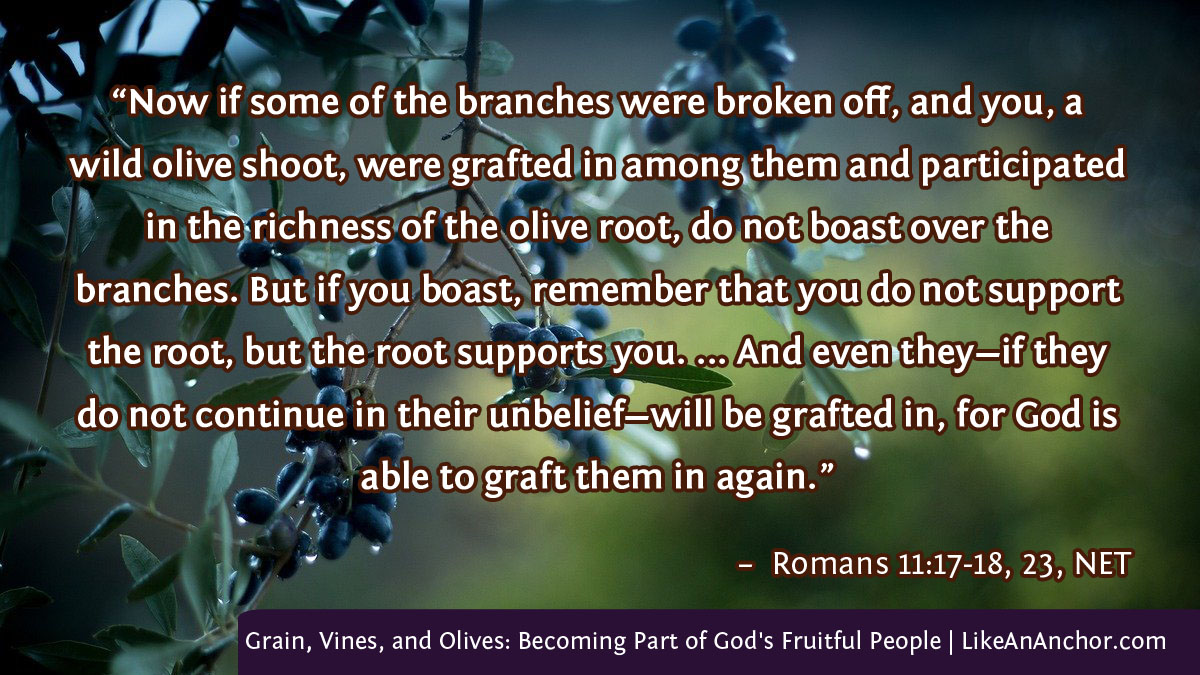
To illustrate this, Paul compares Israel to a cultivated olive tree and the Gentiles (ethnos in Greek; tribes, peoples, nations) to a wild olive tree. Both groups are olives–people made in the image of God–but one has a longer history of being chosen, tended, and cultivated by God for a specific purpose. Now, the Master Gardener is expanding His cultivation project. He’s pruning out those who do not believe and grafting in those who have faith. Which olive tree you came from doesn’t matter; only the state of your heart (Rom. 11:17-24). In other words, God is still working in the same vineyard/field/orchard that He has always had, cultivating a kingdom people, but He is bringing new vines and branches in and grafting them all onto one Root.
“I am the true vine and my Father is the gardener. He takes away every branch that does not bear fruit in me. He prunes every branch that bears fruit so that it will bear more fruit. You are clean already because of the word that I have spoken to you. Remain in me, and I will remain in you. Just as the branch cannot bear fruit by itself, unless it remains in the vine, so neither can you unless you remain in me.
“I am the vine; you are the branches. The one who remains in me—and I in him—bears much fruit, because apart from me you can accomplish nothing. If anyone does not remain in me, he is thrown out like a branch, and dries up; and such branches are gathered up and thrown into the fire, and are burned up. If you remain in me and my words remain in you, ask whatever you want, and it will be done for you. My Father is honored by this, that you bear much fruit and show that you are my disciples.”
John 15:1-8, NET
See how this echoes so many of the prophecies we’ve looked at? Jesus reveals that He is the one we need to have a relationship with in order to be fruitful. Without Him, we wither away like ancient Israel so often did as they strayed into unbelief. The emphasis on being rooted also echoes other prophresies that talk of God’s people being rooted (Is. 27:6; 37:31-21; Jer. 17:7-8). The closer we are to God, the more firmly we’re rooted and the more we thrive. And the more we study what the whole Bible says about the way God’s people are like grain, vines, and olives the better we understand what Jesus is teaching us in passages like this one where He says, “I am the vine.”
God is looking for fruit from the people growing in His vineyard. He exercises patience, encouraging us to grow, but if we refuse to keep abiding in Him, He won’t force us to stay and bear fruit (Luke 13:6-9). We can’t grow and fruit without Him (1 Cor. 3:6-9), but we are also active participants in this fruitfulness and we are free to disconnect from the root and be unfruitful if we choose (as so many Jewish people of Jesus’s day chose to do when they rejected Him as the Messiah). When we choose to abide in Jesus, though, we will abound in the fruits of His spirit (Gal. 5:22-23; Eph. 5:8-11; 2 Pet. 1:5-8). In His grace, goodness, and love, God has opened the way through Jesus’s sacrifice for all people everywhere to become part of His kingdom-garden. Let’s stay close to Him, rooted with faith and trusting Him to supply all we need to grow and thrive and bear fruit that glorifies our Father.













 Like An Anchor