Staying Loyal to Our Core Identity as Children of God, and Using It to Create Unity

Who and what are you?

We can all answer this question a variety of different ways. Our identities are multifaceted things — human, female, Christian, daughter, American, writer, friend, white, Midwestern (to give you some of mine). Some are chosen by us, some are given by God, nature, or other people. The things we identify with, wherever those identities come from, shape who are are.

Sometimes our identities might be in conflict with each other, or with those of other people. We need to be able to handle and resolve those conflicts. On the small scale, it might be something like “student” vs. “friend” (such as finding a balance between needing time to study and finding time to maintain friendships). On a larger scale, it might be something like “national” vs. “religious” (such as wanting to uphold your country’s ideals, but finding some of them at odds with your faith, and needing to choose between them). Or it could be an interpersonal situation where you find yourself interacting with people who have different political affiliations, ethnicities, faiths, and priorities than you do.

How we resolve these inner and outer conflicts says something about who we are and what we value. As Christians, we have an identity that is meant to be first in our priorities and underlie every other part of our lives. But we don’t always live as if this is truly the case. Sometimes we choose to put other beliefs and identities first, and if we do that too often it can damage our relationship with our primary identity as children of God.

Staying Loyal to Our Core Identity as Children of God, and Using It to Create Unity | LikeAnAnchor.com
Photo credit: Claudine Chaussé via Lightstock

The Problem of Conflicting Identities

I recently listened to a podcast episode titled “A First Step Toward Racial Reconciliation,” which was an interview with Mark Vroegop. His book Weep with Me: How Lament Opens A Door For Racial Reconciliation is coming out next month. In this interview, he talks about how the church should be the best place to resolve racial differences because “the gospel creates an identity that gets underneath all other identities.” Read more

The Benefits of Living In Covenant With God

In his letter to believers in Rome, Paul asked, “If God is for us, who can be against us?” He goes on to explain that God, who gave up His own son for us, will freely give us everything we need. And because God is all powerful and the One who has final say in judgement, nothing can separate us from His love even if the trials we face kill us (Rom. 8:31-39).

Is that a contradiction? One moment Paul says nothing could stand against us, then suddenly he’s talking about us being killed? It might seem odd at first, but Paul’s focus isn’t on the people of God avoiding physical trials and suffering. Physical protection and healing can (and often do!) happen, but that is not our main concern.

 Who will separate us from the love of Christ? Will trouble, or distress, or persecution, or famine, or nakedness, or danger, or sword? As it is written, “For your sake we encounter death all day long; we were considered as sheep to be slaughtered.” No, in all these things we have complete victory through him who loved us!

Romans 8:35-37, NET, with  quotation from Ps 44:22

Paul quotes from a psalm that laments the deaths of God’s covenant people and asks God not to reject them forever (Ps. 44:17-26). It seems that Paul would tell the Psalmist, and us, that suffering does not mean God has forsaken us. In fact, we “have complete victory” even in the midst of all that.

Bold, Rational Confidence

I don’t want to deal with trouble (G2347, thlipsis, tribulation and affliction that’s external), distress (G4730, stenochoria, great distress, particularly inner distress), persecution (G1375, diogmos, pursuit, persecution), famine (G3042, limos), nakedness (G1132, gumnotes, total lack of clothing), danger (G2794, kindunos, peril), or sword (G3162, machaira, a sword for slaughter or execution). I dare say none of us do. But Paul makes it sound like it wouldn’t be a big deal. And he should know, considering all he went through (2 Cor. 11:23-28). When Paul talks about suffering as a Christian, he speaks from experience.

For I am convinced that neither death, nor life, nor angels, nor heavenly rulers, nor things that are present, nor things to come, nor powers, nor height, nor depth, nor anything else in creation will be able to separate us from the love of God in Christ Jesus our Lord.

Romans 8:38-39, NET

Paul’s confidence isn’t just based on hear-say. It is based in faith as well as first-hand experience. To quote Adam Clarke’s commentary, “The confidence expressed by the apostle at the end of this chapter is as rational as it is bold.” This section of Romans is a brilliant piece of writing and a glorious affirmation that those who trust God have nothing to worry about. We’ve already more than won the battle through the victory of Him who loves us.

Faithful To The Covenant

That kind of makes it sound like there’s nothing left for us to do, though, and that is not the overall message of Romans. Going back to the Psalm that Paul quotes from, we find a line that reads, “All this has come on us, yet we haven’t forgotten you. We haven’t been false to your covenant” (Ps. 44:17, WEB). Paul’s background was that of a Jewish rabbi, and in their writings they often quote part of an Old Testament passage and assume their readers will connect the present argument to that passage’s larger context. Paul is writing about covenants, and he expects us to understand that.

With that in mind, I think the parallel Clarke draws is a sound one. He writes, “We abide faithful in the new covenant of our God; and He is faithful who has promised to support and make us more than conquerors; i.e. to give us a complete triumph over sin, and death, and hell, not leaving one enemy unsubdued” (commentary on Rom. 8:37). It reminds me of something else Paul wrote in another letter.

This saying is trustworthy:
If we died with him, we will also live with him.
If we endure, we will also reign with him.
If we deny him, he will also deny us.
If we are unfaithful, he remains faithful, since he cannot deny himself.

2 Timothy 2:11-13, NET

There’s a reciprocal aspect to our relationship with God. It’s actually connected to grace, though that’s too big a topic to dive into now (here’s a link to a great booklet on the subject). His faithfulness is a constant, but we can’t reap the benefits of it without being in covenant with Him and remaining faithful ourselves.

Remember to Ask For Help

God is eager to help His people, but we have to be willing to let Him. It seems strange that we’d ever reject God’s help, but a story from one of Judah’s kings shows that it does happen. Asa was one of the good kings who “did that which was good and right in Yahweh his God’s eyes” (2 Chr. 14:2-4, WEB). He demonstrated a reliance on God when his enemies attacked, praying for and receiving deliverance (2 Chr. 14:9-15). After this, God sent a prophet to tell him, “Yahweh is with you, while you are with him; and if you seek him, he will be found by you; but if you forsake him, he will forsake you” (2 Chr. 15:2, WEB). This isn’t anything so crude as a “you scratch my back, I’ll scratch yours” bargain. There’s covenant obligations in relationship, as we’ll see shortly.

The writer of Chronicles tells us “the heart of Asa was perfect all his days” (2 Chr. 15:17, WEB). We also know that he and the people of Judah “entered into the covenant to seek Yahweh, the God of their fathers, with all their heart and with all their soul” (2 Chr. 15:12, WEB). But even so, something happened. In the 36th year of Asa’s reign, he turned to the king of Syria to handle a problem with the king of Israel instead of turning to God. After this happened, God sent a seer to remind Asa where his trust should have been and explain why things didn’t work out so well (2 Chr. 16:1-7).

“Weren’t the Ethiopians and the Lubim a huge army, with chariots and exceedingly many horsemen? Yet, because you relied on Yahweh, he delivered them into your hand. For Yahweh’s eyes run back and forth throughout the whole earth, to show himself strong in the behalf of them whose heart is perfect toward him. You have done foolishly in this; for from now on you will have wars.”

2 Chronicles 16:8-9, WEB

Asa’s heart was perfect, and so God was eagerly looking out for opportunities to act on his behalf. He had already spotted this situation, but Asa decided not to ask for help and instead trust himself, a pattern which continued the rest of this life (2 Chr. 16:10-13). Asa lost the help available from God because he did not ask for the benefits of being in covenant with God.

God is Eager To Hear From You

I wonder how often we miss out on God’s eagerness to show Himself strong on our behalf simply because we don’t think to ask. Maybe the main thing we need to do in order to have Paul’s perspective on life’s extreme challenges is to turn to God and ask Him for help. God has a different perspective on things than we do, and sometimes He sees the things that seem most overwhelming and challenging to us in a completely different way (this is a major lesson of Job).

You don’t have, because you don’t ask. You ask, and don’t receive, because you ask with wrong motives, so that you may spend it on your pleasures.

James 4:2-3, WEB

Just before the “If God is for us, who can be against us?” passage, Paul says that even if we don’t know what to pray the Spirit will fill in the gaps so long as we turn to God. He also assures us, “We know that all things work together for good for those who love God, for those who are called according to his purpose,” and points us to focus on our future glory as children of God (Rom. 8:28-30, WEB).

Nothing can separate us from Christ’s love. Nothing can vanquish us because He has already won the pivotal battle of the war we’re fighting. We need to stick close to Him (i.e. love him with a perfect heart and stay faithful to the covenant) because it’s in Him that “we are more than conquerors” (Rom. 8:37, WEB). Beyond that, all we need to do to have Paul’s confidence is to remember to always turn to God and ask Him to share His help, strength, and perspective with us. Confidence and peace, knowing that God will not abandon you, is one of the chief benefits to living in covenant with God.

Featured image credit: Aaron Kitzo via Lightstock

Don’t Give Up! Keep Running Your Race of Faith Without Looking Back

Do you ever feel stuck in the past and discouraged by how hard it is to move forward? You’re a Christian and you know that’s supposed to give you hope, but somehow that just doesn’t seem to be the case.

It’s disheartening to feel as if you can’t move forward from your past or that there is no way out of your present. Especially if you feel like you’ve done something so wrong or your circumstances are so hopeless that there’s no point trying to fix things. These sorts of worries weigh us down emotionally and spiritually. They can make us feel heavy, foggy, and hopeless (and may lead to other symptoms of depression as well).

Jesus never promised that life as a Christian would be without trials. He only promised to help us through those trials, and since He has all power and authority in heaven and earth this is an incredible promise (Matt. 28:18). It can be easy, though, to lose sight of the big picture and get distracted by all sorts of nasty things that cling to us, weighing us down and making it hard to keep moving forward. We might wonder how to get unstuck, or even if it’s possible.

The Cage Door Is Open

One thing I’ve realized is that most of the things that are holding onto me are also, at least to some extent, things that I’m holding onto right back. Jesus promises to make us free and to wash us clean of any sin. If we stay in a cage or keep rolling in the dirt, then it’s not because He has failed in some way. It’s because we’re still susceptible to the attacks of the enemy and the pulls of the world.

I don’t say this to make us feel guilty or ashamed (that’s another thing that weighs us down, and shame is not a productive emotion). I want to encourage you to shift your perspective. Instead of seeing yourself as a victim trapped in a locked cage made from whatever’s holding on to you (fear, past sins, personal shortcomings, etc), you can picture yourself as someone in an open cage where God is holding the door and asking you to come out. He knows it’s hard. He knows it’s frightening. He knows there are often circumstances outside your control that keep pulling you backwards. But He isn’t giving up and He’ll be there patiently helping you for as long as it takes. Read more

Faces to Faces with God

What face do you bring to God? In the Hebrew scriptures, the word for face, panim (H6440), is always plural. “The face identifies the person and reflects the attitudes and sentiments of that person,” and of course there is no single facet to the self. Our faces are “a combination of a number of features” and so are our personalities (Theological Wordbook of the Old Testament, entry 1782).

God is even more complex, multi-faceted, and wonderful than us. He is the God of all our faces, and He offers to show His faces to us if/when we seek Him.

When you said, “Seek my face,” my heart said to you, “I will seek your face, Yahweh.” Don’t hide your face from me. Don’t put your servant away in anger. You have been my help. Don’t abandon me, neither forsake me, God of my salvation. (Psalm 27:8-9, WEB)

Our God wants to be known. He wants to let us see Him. Whether or not we can see Him partly depends on us, though, because there are things we can do that prompt Him to hide His face. So how do we get into a “faces to faces” relationship with God, and what does it mean if we do?

Faces of Friendship

In Exodus 33:11, we’re told “Yahweh spoke to Moses face to face” (panim el panim) “as a man speaks to his friend.” Being face to face with God is part of being friends with Him. If you’re wondering how to become a friend of God, Jesus gave us a succinct guide when He said, “You are my friends, if you do whatever I command you” (John 15:14). Friendship with God requires mutual interests, goals, and morality. We need to commit to following Him if we want to have a relationship with Him.

Behold, Yahweh’s hand is not shortened, that it can’t save; nor his ear dull, that it can’t hear. But your iniquities have separated you and your God, and your sins have hidden his face from you, so that he will not hear. (Is. 59:1-2, WEB)

Sin separates us from God. There can’t be face to face relationship where there is disobedience. Thankfully, God graciously allows repentance and restoration of relationship. If you “turn away your faces from all your abominations” you can turn your faces toward Zion and “join yourselves to Yahweh in an everlasting covenant” (Ezk. 14:6; Jer. 50:5). He’s happy and eager to have us face toward Him instead of away from Him. Read more

Do I Love God Enough To Obey Him?

The apostle John had a particularly close relationship with Jesus. Though Jesus loved all of “his own who were in the world,” John is identified in particular as a disciple “whom Jesus loved” (John 13:1, 23; 19:26; 20:2, 21:7, 20-24). If we want to know Jesus — and we do, because that’s part of salvation and eternal life (John 17:3; Phil. 3:8) — then who better to learn from than John?

We’re taking a short break from our series on godly wisdom because I really felt like this was the topic I should be studying this week. Love and relationship are so important to God. Knowing Him and being known by Him are central to salvation, Christianity, and our eternal hope. We have to know Him in His way, though. Jesus said there will be people at the end who think they know Him and yet never had a relationship with Him (Matt. 7:21-23). That’s a scary thought, but John makes sure to leave us guides in his writings for how to love Jesus and how to tell whether or not we truly know Him.

Knowing God is Essential to Life

John’s writings are among my favorite in the New Testament. He highlights Jesus’ power and divinity — the things that make Him so much higher than us — more than any other gospel writer, yet He also highlights Jesus’s love and His longing for relationship — the things that make Him closer to us. The way John talks about Jesus and the Father makes it clear that the powerful, eternal, creator God longs for a relationship with us.

In the beginning was the Word, and the Word was with God, and the Word was God. The same was in the beginning with God. All things were made through him. Without him, nothing was made that has been made. In him was life, and the life was the light of men. … The Word became flesh, and lived among us.  (John 1:1-4, 14, WEB)

Jesus came here not just to die for our sins and reconcile us to God, but also to get to know us. He is the good shepherd who knows His sheep and is known by His own, who choose to follow Him (John 10:14, 27). He calls us His followers, friends, chosen, and beloved (John 15:12-16). And He reveals that knowing Him and the Father is key to eternal life (John 17:3). The importance of knowing and being known by God cannot be overstated.

Keeping the Words of the Lord

We often like to think of concepts like love and grace as something with “no strings attached.” If there’s a commitment or reciprocation implied, then we may start to get defensive and resent that it’s not “freely given.” That idea would have been ludicrous to the people of Jesus’ day. Grace is a reciprocal arrangement (we don’t have time to go into that in this post, but click here for an excellent booklet on the subject). Love has to do with commitment and covenants that attach us to God. In a way that seems odd to modern readers, relationship with God is connected to obedience and law.

“One who has my commandments and keeps them, that person is one who loves me. One who loves me will be loved by my Father, and I will love him, and will reveal myself to him.” … “If a man loves me, he will keep my word. My Father will love him, and we will come to him, and make our home with him.” (John 14:21, 23, WEB)

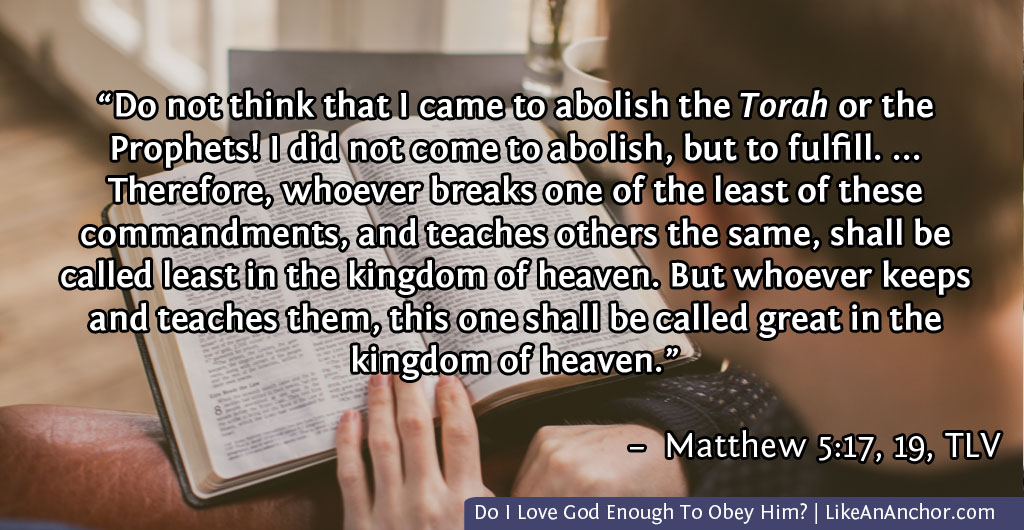
Really knowing Jesus goes beyond saying we believe in Him. It includes letting that belief change the way we live. We demonstrate how much we respect and care about Him by living according to His commandments. And since John points out that Jesus is also the Word — one of two God-beings who’ve been here for eternity — that includes the commands He gave in the Old Testament as well as the New. Jesus stated in no uncertain terms that He wasn’t here to get rid of everything He’d taught before as the Word, but rather to elevate those commands to an even higher level under a New Covenant (Matt. 5:17-48).

Do I Love God Enough To Obey Him? | LikeAnAnchor.com
Photo credit: Anggie via Lightstock

Knowing and Commandment Keeping

John further explores the topic of knowing Jesus in his first epistle. He begins, much as he did in writing his version of the gospel, with Jesus’ eternal existence as the Word of life. Then he shares that “God is light, and in him is no darkness at all,” which means we have to walk in light in order to fellowship with God (1 John 1:1-2:2).

This is how we know that we know him: if we keep his commandments. One who says, “I know him,” and doesn’t keep his commandments, is a liar, and the truth isn’t in him. But God’s love has most certainly been perfected in whoever keeps his word. This is how we know that we are in him: he who says he remains in him ought himself also to walk just like he walked. (1 John 2:3-6, WEB)

As this letter continues, John keeps coming back to themes of love, law, sin, and relationship with God. 1 John is one of those Bible books that it’s good to read in one setting (it’s not that long) to get a better feel for the points the writer is making in-context. As you read through it, one thing he continues to repeat is that we can’t have a relationship with God if we insist on breaking His commandments.

Choosing Righteousness as God’s Children

Whoever remains in him doesn’t sin. Whoever sins hasn’t seen him and doesn’t know him. Little children, let no one lead you astray. He who does righteousness is righteous, even as he is righteous. (1 John 2:1-2, WEB)

If we go back toward the beginning of the letter, we see John has already clarified that the children of God don’t practice sin, but if we slip up we can still repent and Jesus will restore our relationship with God (1 John 2:1-2). He’s not saying a Christian who sins is automatically disqualified for salvation. But he is saying that salvation comes with the expectation from God that we’ll respond to His work in us by starting to live lives modeled after His righteous standards.

We declare by our choices whether we are children of God, who practice righteousness, or children of the devil, who practice lawlessness (1 John 3:8-10). Again and again John emphasizes that children of God keep God’s law, chiefly the two laws that Jesus and Paul identified as the most important  — love God and love others (Matt. 22:36-40; Rom. 13:9-10). All other commands hinge on those two. God is love and we need to love as He does, in deed and in truth (1 John 3:11-24; 4:7-21). That’s just how we do things in the family of God.

How I Love Thy Law

As John wraps-up this letter, he ties what he’s written about loving and knowing God together with what he wrote about loving our brethren. He also addresses a common complaint about how “hard” it is to obey God.

By this we know that we love the children of God, when we love God and keep his commandments. For this is loving God, that we keep his commandments. His commandments are not grievous. (1 John 5:2-3, WEB)

Many people think of commandment keeping as something burdensome, but John tells us that’s far from true. Living within God’s law yields blessings, not hardship. Our attitude toward God’s law should be like that expressed in Psalm 119. This psalmist is in love with the law because it belongs to the God whom he loves. God’s laws are an expression of His character. If we want to be like the Lawgiver and receive the blessings that come from walking with Him, then we’ll respect His word.

Psalm 119 speaks of God’s law as a source of delight, strength, liberty, hope, comfort, life, wisdom, righteousness, peace, and much more. How we keep God’s law is different now — elevated to a spiritual level in the New Covenant — but it still matters (this is largely what Romans is about). God cares about the relationship we have to His words and whether or not we love Him enough to do what He tells us to do. Which brings us to the question of today’s title, “Do I love God enough to obey Him?”

It’s easy to say we love God but it’s harder to follow-through on the things that prove our love is genuine. If we truly love Him, though, obeying His word shouldn’t be a problem for us. It’ll still be a struggle at times to submit our own will to that of our sovereign God, but it’s something worth doing. The blessings of knowing God far outweigh any aspects of obedience that we might find inconvenient. And when we love God and follow His words, continuing to turn back to Him if/when we make mistakes, then we’ll have the assurance that we know Him and are known by Him as well.

Book Review: Reclaiming Our Forgotten Heritage by Curt Landry

Back in February, I read an article on Bible Gateway interviewing Curt Landry about his new book Reclaiming Our Forgotten Heritage: How Understanding the Jewish Roots of Christianity Can Transform Your Faith. As a Messianic believer, I was excited that a book about appreciating the Jewish roots of our faith was being released by a mainstream Christian publisher like Thomas Nelson.

I didn’t get to read the book until recently because I was distracted by other new releases, some of which I had advance reader copies to review, and I was waiting for a library to buy it. I finally got a copy through an inter-library loan program and eagerly sat down to read. Unfortunately, while this book contains some really good content, I felt like it was too much about Curt Landry and not enough about its stated purpose of helping people understand how the Jewish roots of Christianity can transform their faith.

Our Forgotten Heritage

When Jesus arrived here on earth (or Yeshua, to use His Hebrew name), He didn’t come to bring a new religion. Yeshua came as the next stage in God’s plan which He’d laid out from the foundation of the world. What we now call Christianity has its roots in the faith of the ancient Israeli people and the Jews of Jesus’ time. Though this phrasing is mine, this is one of the main arguments of Landry’s book and it’s the part I found most fascinating.

Read more