Trusting God When You’re Confused By Him: A Study of Lamentations 3

A couple of weeks ago, we talked about the practice of lament. It’s something we rarely discuss in modern Christianity, but it makes up more than 1/3 of the psalms and you can find lament throughout the rest of scripture as well. Instead of hiding their pain, people who lament take it to God in prayer. They turn to Him, bring their complaint in an honest, heartfelt way, ask boldly for help and then, equally boldly, choose to trust in God. I ended that first post about learning how to lament with a quote from my favorite passage in Lamentations:

This I recall to my mind; therefore I have hope. It is because of Yahweh’s loving kindnesses that we are not consumed, because his compassion doesn’t fail. They are new every morning. Great is your faithfulness. “Yahweh is my portion,” says my soul. “Therefore I will hope in him.” (Lam. 3:21-24, all quotes from WEB translation)

This passage is lovely and hopeful, but it’s not the whole story of Jeremiah’s lament. It’s not even his concluding thought for this particular poem. Lament isn’t about convincing yourself to be happy. It’s about trusting God even when you’re not sure you want to. It’s about inviting Him to help you deal with hurt, loss, confusion, anger, and other complex, painful emotions. Hope is part of it, a key part, but there’s a lot more going on as well.

Feeling as If God Is Failing You

The third poem of Lamentations (each of the 5 chapters in this book is a separate poem) begins with the words, “I am the man who has seen affliction by the rod of his wrath.” Unlike other poems in Lamentations, Jeremiah doesn’t start by talking about all of the Lord’s people and how their sufferings affect them. This is about him and what God has done to him, personally. Jeremiah begins this poem talking about how it feels to believe that God is targeting him in particular for intense suffering. Read more

Getting Through Affliction With the Help of God’s Law

I was reading Psalm 119 the other day and one of the verses that caught my eye reads, “It is good for me that I have been afflicted, that I may learn your statutes” (Psalm 119:71, all quotes from WEB translation). Most of us don’t think it’s good when we’re depressed, chastened, weakened, oppressed, and bowed down (those are all meanings of the Hebrew word anah, H6031, which this translation renders “afflicted”). In fact, we’re pretty sure those things sound terrible, especially now that we’re all experiencing some of them as a result of the current pandemic. And yet, this psalmist said affliction was “good” because what they endured helped them learn the Lord’s statues (choq, H2706, could also be translated ordinance, limit, or law).

There’s no getting around it. Christianity is tough. When you think about it, though, it’s not any tougher than life outside the faith and if you’re inside you have God’s help so that balances things out in Christianity’s favor. Jesus promised us His help, presence, and protection but He also assured us that we would face trials, persecution, and suffering. Better teachers than I have tried to explain why — The Problem of Pain by C.S. Lewis and Where Is God When It Hurts? by Philip Yancey, for example — but one thing we can’t get around is the fact that pain is a part of life. And that’s true whether you’re a Christian or not.

One of the ways Christianity helps make sense of suffering is by saying it is a product of a world that has gone wrong. God didn’t want things to be this way, but they are now and until He comes back to set things right He’s going to find ways to make good come out of afflictions.

Delight in the Law

Psalm 119 is an acrostic psalm divided into 22 stanzas, one for each letter in the Hebrew alphabet. There are several verses within this psalm that talk about affliction, and we find the first in the zayin stanza.

Remember your word to your servant, because you gave me hope. This is my comfort in my affliction, for your word has revived me. (Psalm 119:49-50)

A later verse in the lamed stanza puts this idea even more strongly:

Unless your law had been my delight, I would have perished in my affliction. I will never forget your precepts, for with them, you have revived me. (Psalm 119:92-93)

It is not just knowing or obeying God’s law, but finding joy in it that helps get us through tough times. All the knowledge of His words we can gather won’t do us much good unless we really care about what He tells us. But when we hold fast to Him — and by extension His word and the things that He cares about — it’s possible to find comfort, joy, and help even in afflictions. The psalmists did, and we can too. Read more

Learning How To Lament

Do you ever feel like maybe God isn’t living up to His promises? That He has abandoned you? Isn’t answering your prayers? Or that He should have done something to fix things and hasn’t?

Those are the sorts of thoughts we often feel guilty for thinking. After all, being a “good Christian” involves trusting God (which we often assume means not questioning Him) all the time no matter what, right? And so we try to ignore these kinds of thoughts and bury them deep where they won’t offend God or make us look bad to the other people in our church. But is that how God wants us to handle our painful questions?

There’s a Biblical practice called lament that models how to deal with anguish, pain, grief, and confusion. People of faith in scripture didn’t bottle up, hide, or ignore these feelings. They took them to God, turning questions we mistakenly think of as a lack of faith (or as a reason to give up on God) into a prayer. Over 1/3 of the Psalms are laments — “a prayer for help coming out of pain” (“Biblical Laments: Prayer Out of Pain” by Michael D. Guinan). There’s also a whole book of the Bible called Lamentations. Lament is found throughout scripture, from prophets, to psalmists, to Jesus. Lament is a good and godly practice and, if we learn how to do it, lament can help us hold on to trusting God even when we can’t figure out what He’s up to.

Praying through a sorrowful mood

My God, my God, why have you forsaken me? Why are you so far from helping me, and from the words of my groaning? My God, I cry in the daytime, but you don’t answer; in the night season, and am not silent. (Psalm 22:1-2, all scriptures from WEB translation)

The feeling of abandonment and despair is one that David felt, most of us can sympathize with, and Jesus echoed on the cross (Matt. 27:46). We know God does not leave or forsake His faithful ones, but that doesn’t stop us from sometimes feeling as if we’ve been forsaken. Last week, we talked about moods of faith in the Psalms, specifically a confident, celebratory mood in Psalm 91. Here in Psalm 22 we get another mood — one that is equally valid for Christians and no less worthy of taking to God in prayer. Read more

Sheltering In The Almighty’s Shadow

I’ve been thinking about Psalm 91 quite a bit since the coronavirus became a world-wide concern. The rabbi at my Messianic congregation recently wrapped-up a six-part sermon series on this psalm, and none too soon since the very next week churches were asked to stop meeting. There are hospitals overwhelmed by patients, non-essential businesses being ordered to close, and “stay at home” orders coming from governments. It’s scary out there. But we don’t have to let fear take over our lives.

Psalm 91 contains some of the most stunning assurances of God’s care and protection in the Bible, and it’s a good reminder that we need not fear no matter how bad the things around us get. And things are going to get bad. None of us know when Jesus will return, but we do know we’re getting closer. As that time approaches, we were warned to expect “wars and rumors of wars … famines, plagues, and earthquakes” before the end comes (Matt. 24:6-8). None of what is happening now (or which has been happening for the past 2,000 years) should be a surprise for Bible-readers.

We’ve also been told how to handle it when things get bad. We should watch, be ready, pray, stay faithful, and fear not. Easier said than done, though, especially in these times when fear and panic are running rampant. One way to keep ourselves from getting swept up in unfruitful anxiety is by holding onto the promises in God’s word, like those found in Psalm 91.

God’s Power To Deliver

He who dwells in the secret place of the Most High will rest in the shadow of the Almighty. I will say of Yahweh, “He is my refuge and my fortress; my God, in whom I trust.” (Psalm 91:1-2, all quotes from WEB)

Hebrew words often have a variety of meanings. The one translated “dwell” (H3427, yashab) can also mean remain, abide, inhabit, and marry. It’s that last one that seems out of place to us English speakers. How can marriage and dwelling mean the same thing? But if you think of marrying someone as giving a dwelling to them it starts to seem a little less unusual (Brown, Driver, Briggs Hebrew lexicon). The connection also makes sense as part of the recurring imagery of the Lord marrying His people and providing dwellings for them (Matt. 22:2; John 14:1-3).

This place spoken of in the psalm is a secret or “covered, hidden” location (H5643, sether) that belong to the Most High God. Dwelling here lets you rest under the shadow of the Almighty. Using these names helps remind us that God has all power and is perfectly capable of living up to the expectations the psalmist will speak of in the lines to follow. In addition, use of God’s personal name, Yahweh, demonstrates the closeness of relationship the psalmist has with Him and reminds us that He is the I AM who delivered Israel (Ex. 3:14-15). Read more

Do I Love God Enough To Obey Him?

The apostle John had a particularly close relationship with Jesus. Though Jesus loved all of “his own who were in the world,” John is identified in particular as a disciple “whom Jesus loved” (John 13:1, 23; 19:26; 20:2, 21:7, 20-24). If we want to know Jesus — and we do, because that’s part of salvation and eternal life (John 17:3; Phil. 3:8) — then who better to learn from than John?

We’re taking a short break from our series on godly wisdom because I really felt like this was the topic I should be studying this week. Love and relationship are so important to God. Knowing Him and being known by Him are central to salvation, Christianity, and our eternal hope. We have to know Him in His way, though. Jesus said there will be people at the end who think they know Him and yet never had a relationship with Him (Matt. 7:21-23). That’s a scary thought, but John makes sure to leave us guides in his writings for how to love Jesus and how to tell whether or not we truly know Him.

Knowing God is Essential to Life

John’s writings are among my favorite in the New Testament. He highlights Jesus’ power and divinity — the things that make Him so much higher than us — more than any other gospel writer, yet He also highlights Jesus’s love and His longing for relationship — the things that make Him closer to us. The way John talks about Jesus and the Father makes it clear that the powerful, eternal, creator God longs for a relationship with us.

In the beginning was the Word, and the Word was with God, and the Word was God. The same was in the beginning with God. All things were made through him. Without him, nothing was made that has been made. In him was life, and the life was the light of men. … The Word became flesh, and lived among us.  (John 1:1-4, 14, WEB)

Jesus came here not just to die for our sins and reconcile us to God, but also to get to know us. He is the good shepherd who knows His sheep and is known by His own, who choose to follow Him (John 10:14, 27). He calls us His followers, friends, chosen, and beloved (John 15:12-16). And He reveals that knowing Him and the Father is key to eternal life (John 17:3). The importance of knowing and being known by God cannot be overstated.

Keeping the Words of the Lord

We often like to think of concepts like love and grace as something with “no strings attached.” If there’s a commitment or reciprocation implied, then we may start to get defensive and resent that it’s not “freely given.” That idea would have been ludicrous to the people of Jesus’ day. Grace is a reciprocal arrangement (we don’t have time to go into that in this post, but click here for an excellent booklet on the subject). Love has to do with commitment and covenants that attach us to God. In a way that seems odd to modern readers, relationship with God is connected to obedience and law.

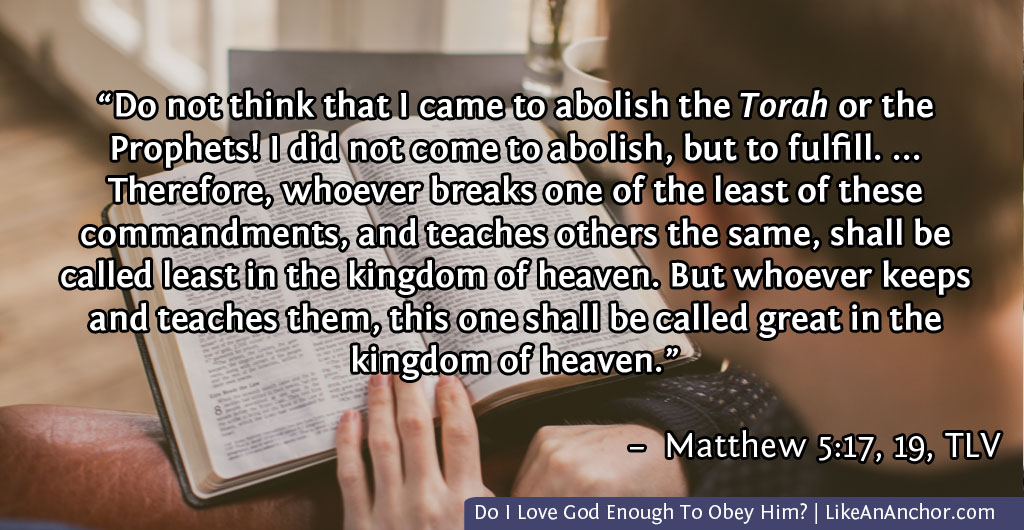
“One who has my commandments and keeps them, that person is one who loves me. One who loves me will be loved by my Father, and I will love him, and will reveal myself to him.” … “If a man loves me, he will keep my word. My Father will love him, and we will come to him, and make our home with him.” (John 14:21, 23, WEB)

Really knowing Jesus goes beyond saying we believe in Him. It includes letting that belief change the way we live. We demonstrate how much we respect and care about Him by living according to His commandments. And since John points out that Jesus is also the Word — one of two God-beings who’ve been here for eternity — that includes the commands He gave in the Old Testament as well as the New. Jesus stated in no uncertain terms that He wasn’t here to get rid of everything He’d taught before as the Word, but rather to elevate those commands to an even higher level under a New Covenant (Matt. 5:17-48).

Do I Love God Enough To Obey Him? | LikeAnAnchor.com
Photo credit: Anggie via Lightstock

Knowing and Commandment Keeping

John further explores the topic of knowing Jesus in his first epistle. He begins, much as he did in writing his version of the gospel, with Jesus’ eternal existence as the Word of life. Then he shares that “God is light, and in him is no darkness at all,” which means we have to walk in light in order to fellowship with God (1 John 1:1-2:2).

This is how we know that we know him: if we keep his commandments. One who says, “I know him,” and doesn’t keep his commandments, is a liar, and the truth isn’t in him. But God’s love has most certainly been perfected in whoever keeps his word. This is how we know that we are in him: he who says he remains in him ought himself also to walk just like he walked. (1 John 2:3-6, WEB)

As this letter continues, John keeps coming back to themes of love, law, sin, and relationship with God. 1 John is one of those Bible books that it’s good to read in one setting (it’s not that long) to get a better feel for the points the writer is making in-context. As you read through it, one thing he continues to repeat is that we can’t have a relationship with God if we insist on breaking His commandments.

Choosing Righteousness as God’s Children

Whoever remains in him doesn’t sin. Whoever sins hasn’t seen him and doesn’t know him. Little children, let no one lead you astray. He who does righteousness is righteous, even as he is righteous. (1 John 2:1-2, WEB)

If we go back toward the beginning of the letter, we see John has already clarified that the children of God don’t practice sin, but if we slip up we can still repent and Jesus will restore our relationship with God (1 John 2:1-2). He’s not saying a Christian who sins is automatically disqualified for salvation. But he is saying that salvation comes with the expectation from God that we’ll respond to His work in us by starting to live lives modeled after His righteous standards.

We declare by our choices whether we are children of God, who practice righteousness, or children of the devil, who practice lawlessness (1 John 3:8-10). Again and again John emphasizes that children of God keep God’s law, chiefly the two laws that Jesus and Paul identified as the most important  — love God and love others (Matt. 22:36-40; Rom. 13:9-10). All other commands hinge on those two. God is love and we need to love as He does, in deed and in truth (1 John 3:11-24; 4:7-21). That’s just how we do things in the family of God.

How I Love Thy Law

As John wraps-up this letter, he ties what he’s written about loving and knowing God together with what he wrote about loving our brethren. He also addresses a common complaint about how “hard” it is to obey God.

By this we know that we love the children of God, when we love God and keep his commandments. For this is loving God, that we keep his commandments. His commandments are not grievous. (1 John 5:2-3, WEB)

Many people think of commandment keeping as something burdensome, but John tells us that’s far from true. Living within God’s law yields blessings, not hardship. Our attitude toward God’s law should be like that expressed in Psalm 119. This psalmist is in love with the law because it belongs to the God whom he loves. God’s laws are an expression of His character. If we want to be like the Lawgiver and receive the blessings that come from walking with Him, then we’ll respect His word.

Psalm 119 speaks of God’s law as a source of delight, strength, liberty, hope, comfort, life, wisdom, righteousness, peace, and much more. How we keep God’s law is different now — elevated to a spiritual level in the New Covenant — but it still matters (this is largely what Romans is about). God cares about the relationship we have to His words and whether or not we love Him enough to do what He tells us to do. Which brings us to the question of today’s title, “Do I love God enough to obey Him?”

It’s easy to say we love God but it’s harder to follow-through on the things that prove our love is genuine. If we truly love Him, though, obeying His word shouldn’t be a problem for us. It’ll still be a struggle at times to submit our own will to that of our sovereign God, but it’s something worth doing. The blessings of knowing God far outweigh any aspects of obedience that we might find inconvenient. And when we love God and follow His words, continuing to turn back to Him if/when we make mistakes, then we’ll have the assurance that we know Him and are known by Him as well.

Book Review: Reclaiming Our Forgotten Heritage by Curt Landry

Back in February, I read an article on Bible Gateway interviewing Curt Landry about his new book Reclaiming Our Forgotten Heritage: How Understanding the Jewish Roots of Christianity Can Transform Your Faith. As a Messianic believer, I was excited that a book about appreciating the Jewish roots of our faith was being released by a mainstream Christian publisher like Thomas Nelson.

I didn’t get to read the book until recently because I was distracted by other new releases, some of which I had advance reader copies to review, and I was waiting for a library to buy it. I finally got a copy through an inter-library loan program and eagerly sat down to read. Unfortunately, while this book contains some really good content, I felt like it was too much about Curt Landry and not enough about its stated purpose of helping people understand how the Jewish roots of Christianity can transform their faith.

Our Forgotten Heritage

When Jesus arrived here on earth (or Yeshua, to use His Hebrew name), He didn’t come to bring a new religion. Yeshua came as the next stage in God’s plan which He’d laid out from the foundation of the world. What we now call Christianity has its roots in the faith of the ancient Israeli people and the Jews of Jesus’ time. Though this phrasing is mine, this is one of the main arguments of Landry’s book and it’s the part I found most fascinating.

Read more