Because INFJs and INTJs both use Introverted Intuition as their favorite mental process, the two types can appear very similar. Quite a few people who take a Myers-Briggs test and get either of these results (or both on different tests) are left wondering, how can I tell whether I’m an INFJ and INTJ?
My personality type is INFJ and my sister’s is INTJ. It would be well-nigh impossible to assume we share a personality type, but if you don’t have that contrast living with you (or if you’re a little less extreme on your T/F preference) I can see how deciding which type is your best fit could be a challenge. INFJs and INTJs lead with the same mental process and they react in very similar ways when stressed out. The main differences between the two types have to do with how they handle their Thinking/Feeling preference.
INFJs use auxiliary Extroverted Feeling as their copilot and support it with tertiary Introverted Thinking. INTJs use auxiliary Extroverted Thinking as their copilot and support it with tertiary Introverted Feeling. The auxiliary process is how they prefer to make decisions and interact with the outer world, but they can slip into their tertiary quite easily. It’s not as well developed or as reliable, but it can seem comfortable since it’s introverted (just like their dominant intuitive function).
How comfortable each INFJ/INTJ is with their thinking and feeling processes depends on a number of factors, including age, environment, and past experiences. You can find INFJs who are very people-oriented and social, or INFJs that seem distant and logical. Similarly, you’ll meet INTJs who are stereotypically blunt and calculating, and INTJs who are comfortable experiencing their own emotions. Even so, the way these functions shows up looks different for each type.
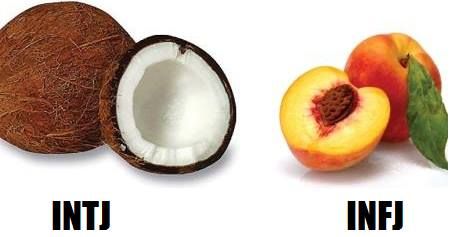
My Cup of T
An INTJ’s Thinking side is focused on the outer world. It’s also the function they’re most comfortable using when making decisions. While mature, well-balanced INTJs will take the human side of a question into consideration, it’s typically secondary to finding the most logical, fact-based solution. Personality Hacker calls this mental process “Effectiveness” and says it “focuses on impersonal criteria for making decisions” and prioritizes efficient problem solving.
INFJs, on the other hand, use an inward-focused Thinking process and they’re not usually as comfortable with it as they are with their Feeling side. Personality Hacker calls Introverted Thinking “Accuracy” and says this function gives users “the ability to reason through a subject or concept within one own’s understanding, even if it doesn’t match ‘outer world’ data.” Basically, this process is trying to work through things until they make sense.
INTJs are much more likely to express their Thinking judgements externally than an INFJ. They’ll often seem more blunt and direct because efficient communication is more important to them than worrying another person’s feelings. INTJs are also more likely to draw on objective, external facts to support their ideas. They want their ideas to work and they want outer world validation for their problem solving. That’s not nearly as important to INFJs, who need things to make sense personally more than to the people around them.
Feeling The Feels
An INFJ’s Feeling side, like INTJ Thinking, is the function they use most comfortably when making decisions. It’s also outward focused, but it’s primarily people-oriented. Personality Hacker nicknames this function “Harmony” because it “makes decisions based on how things are impacting people on an emotional level.” The key thing to remember about this function is that it’s outward focused. INFJs are more in touch with other people’s feelings than they are their own.
INTJs use a Feeling process that’s introverted, which Personality Hacker calls “Authenticity.” While it’s also concerned with how decisions impact on an emotional level, it’s focused on one’s own emotions rather than other people’s. To again quote Personality Hacker, “Introverted Feeling is about checking in with all those inner parts and voices to determine what feels the most in alignment with oneself.” Somewhat ironically, the stereotypically cold and logical INTJs are often much more in-tune with their own feelings than the stereotypically emotional INFJs.
INFJs are more comfortable expressing feelings in the outer world and also more likely to pick-up on what other people are feeling. They’ll typically seem much more empathic and expressive than an INTJ. An INFJ who’s comfortable with their Extroverted Feeling side will also appear more social and “extroverted” than a typical INTJ. But INTJs are far more in-tune with their own emotions than most people (and many type descriptions) will give them credit for.

INxJs In Real Life
Even after you know about the technical differences between the ways INFJs and INTJs use thinking and feeling, you might still wonder they show up in real life. Let me give you some quick examples.
- When making an everyday decision — an INFJ’s first impulse will be finding what makes as many people as possible happy, while an INTJ’s first impulse will be quickly finding the most logical answer. For me and my sister at least, the INTJ has a much easier time making simple decisions without overthinking them than the INFJ does.
- In a stressful/emergency situation — I’m the one who’s in logic mode and my INTJ sister is the one indecisive and unsure. We’re talking something that calls for quick action and is stressful enough to push you out of your most comfortable mental processes (such as deciding to take someone to the hospital), Might not hold true for every INFJ or INTJ, but it’s an interesting observation I’ve made.
- If asked to change their minds — an INTJ is most likely going to stick with what they’ve already decided because they know their idea is based on logic and that it feels right to them. To change their mind, you’ll need to present a fact-based counterargument that matches their deeply held beliefs about what’s right. A confronted INFJ will second-guess themselves because now they know someone isn’t happy with what they chose but they’ll also be reluctant to abandon something that makes sense to them. To change their mind, you’ll need to present an argument that hits emotion as well as logic.
I hope this helps you with telling the difference between these two types If you can’t tell if you’re an INFJ or and INTJ, looking at the differences in Thinking and Feeling functions is a good place to start figuring out your type. You’re not going to be a perfect 100% fit for every description of any one personality type, but there should be one that’s a “best fit” for your personality.
Your Turn: What are some differences and similarities you’ve noticed between INFJ and INTJ types?












 Like An Anchor