There’s a fairly prevalent idea out there in Christianity that our sins separate us from God because God can’t be in the presence of sin. But is it true that God pulls back from us because we’re too dirty for Him, or is there something else going on?
The idea that God can’t be around sin is largely based on a verse in Habakkuk that reads, “Thou art of purer eyes than to behold evil, and canst not look on iniquity” (Hab. 1:13, KJV). When we look at the context, though, we see God just told Habakkuk He planned to work with the vicious Chaldeans, and this verse is part of Habakkuk asking God why He would ever associate with such wickedness.
If we accept the premise that Jesus was and is fully God (as I believe we should), then we know God doesn’t shrink back from sin as if scared to get His hands dirty. Rather, He dives right in among sinners so that He can wipe sin away and replace it with holiness. God gets close to sinful people so He can set things right.
But there are also verses that talk about iniquity separating us from God and revealing that God will not fellowship with evil. While we don’t have to worry that we’re so filthy God wouldn’t touch us, if we want a close relationship with Him we need to figure out what’s going on here. Read more →
I listed Lorna Doone as a re-read on my Classics Club book list, but suspect I hadn’t actually read an unabridged version before. I didn’t remember whole pages worth of conversation written in dialect or so much time spent building John and Lorna’s childhood relationship in the first half of the book. Pretty sure I read a copy that modernized the dialogue and skipped straight to the most exciting action. That’s probably why the book felt so long this time through, though I was thoroughly enjoying it by around the half-way point.
Grounded In History
Lorna Doone: A Romance of Exmoor by R.D. Blackmore is a historical novel published in 1869 and set in the late 1600s. I hadn’t realized before re-reading it how much the novel borrows from real events. My falling apart ex-library copy (published in 1943) even includes pictures of the locations Blackmore references. The brief introduction written by Basil Davenport states, “Blackmore made good use of his schoolboy memories of Devon; the outlaw Doones, the De Whichehalse family, the highwayman Tom Fagus and his mare, and even the mighty John Ridd, have at least some foundation in fact, while the book is full of local historical allusions, like the bales of wool that were used to repel bullets at the siege of Exeter Castle.”
The historical grounding is perhaps the most interesting aspect of this classic novel. It soaks through every page in tiny details, sweeping historical allusions, and our narrator’s word choice. Though I had a little trouble getting really “into” the first half of the story, it’s not because Blackmore isn’t painting an immersive world. Since this is a first-person narrative, we get to see the world through John Ridd’s eyes. And John isn’t shy about sharing his opinions on everything from farming to women to outlawry. It really feels like we’re there listening to John tell the story as he lived it.
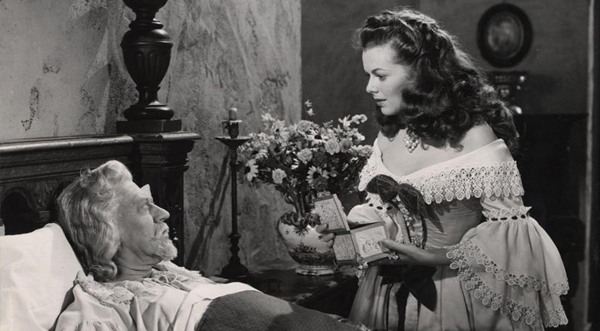
Carl Benton Reid as Sir Ensor Doone and Barbara Hale as Lorna Doone (1951)
Outlaws As Villains
We’ve all read stories where the outlaws are romanticized. Stories with dashing rogues, defensible pirates, and code-following outlaws fill our collective imagination. Not so in Lorna Doone. Even beloved highwayman Tom Fagus must mend his ways and conform to law and order before securing his happy ending. The more prominent outlaws in the story, the Doones, are decidedly cast in the role of the villain. Rather than seeking to romanticize and excuse the outlaws à la Robin Hood, the story focuses on rescuing Lorna (and by extension the romance plot) from them.
Several times, John talks about the Doones as a fixture in the neighborhood. The surrounding people have gotten used to them and they’re willing to put up with certain things. Since the Doones are a noble family, their neighbors consider it their right to steal sheep, run off with a few unmarried women, and even kill people who get in their way. The Ridds and their neighbors even resent external efforts to bring the Doones to justice, partly because they fear pay-back if/when the Doones win and partly because the Doones just seem to belong. But that doesn’t mean they’re happy about having a nest of outlaws in their backyards.
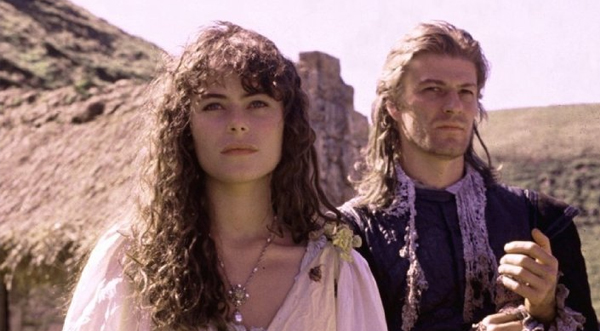
Polly Walker as Lorna Doone and Sean Bean as Carver Doone (1990)
But What Does It Mean?
Though tolerated and occasionally defended, the Doones are viewed as a local plague, not as tragic heroes or admirable figures. They eventually cross a line and are wiped out by the very people who put up with them for so long. Interestingly, all this happens at a time of political unrest in Britain as a whole and there are numerous tongue-in-cheek references to political corruption and the failures of the nobility. I suspect that on some level at least, we’re meant to identify the overtly lawless Doones with the more subtle legalized injustice running through the British government. And we’re to root for the common man of good sense rising up to put an end to his “betters” ruining the country.
On a more obvious level, Lorna Doone really is a simple romance novel. And while there are plenty of romantic novels I enjoy more, I do love the story. John and Lorna aren’t my favorite literary characters, but even the fact that I didn’t like them 100% is in a way a testament to Blackmore’s writing. Though John is telling the story and he worships Lorna, Blackmore manages not to present either as unrealistically idealized “perfect heroes.” It reads like the honest account of two real people navigating romance in a world of outlaws. And that makes for a good story.
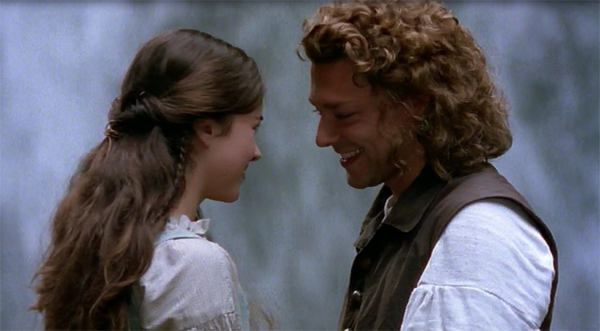
Amelia Warner as Lorna Doone and Richard Coyle as John Ridd (2000)
As the Passover approaches, those of us who believe Jesus intended modern-day Christians to observe it are given a task. Before following Jesus’ instruction to take the Passover symbols “in remembrance of Me,” we’re told to examine ourselves.
For as often as you eat this bread and drink this cup, you proclaim the Lord’s death until he comes. Therefore whoever eats this bread or drinks the Lord’s cup in a way unworthy of the Lord will be guilty of the body and the blood of the Lord. But let a man examine himself, and so let him eat of the bread, and drink of the cup. (1 Cor. 11:26-19, WEB)
Every year I hear these scriptures read, and every year since my baptism in 2008 I ask myself, “How?” What can I do to examine myself and determine if I’m keeping the Passover in a worthy manner?”
Perhaps the reason why I’ve always felt like I was hitting a wall when trying to examine myself is found in a very familiar scripture:
The heart is deceitful above all things, and it is exceedingly corrupt: who can know it? I, Yahweh, search the mind, I try the heart, even to give every man according to his ways, according to the fruit of his doings. (Jer. 17:9-10, WEB)
There’s no way we can successfully examine ourselves without God’s help. Maybe that should have been obvious, but I only connected it with Passover after hearing Len Martin’s sermon on self-examination (which you can listen so by clicking here; I highly recommend it). We need to ask God to examine us, or our self-examination isn’t going to bear much fruit. Read more →
There are 3,310 pairs of socks in the men’s homeless shelter.
This past weekend, I attended a young adult service and enrichment weekend. After a Friday evening and Saturday of discussion questions, seminars, Shabbat services, and good fellowship we spent Sunday on a service project. Nearly 100 of us descended on a homeless shelter to help tackle some of their needs, including wall painting, deep cleaning, window washing, and sorting the donations room.
I spend quite a bit of time trying to figure out what my gifts are and how to use them effectively. That interest in personal growth and development is, in part, why this blog exists. But somewhat surprisingly (to me, at least), this weekend’s focus on filling your role in the body of Christ barely touched on spiritual gifts and individual talents. Rather, the take-away was finding your identity as a servant of Christ and then following His example no matter what.
While I’m a staunch advocate for finding, developing, and using your gifts (that’s why you have them, after all), it doesn’t really take any particular gift to count socks. Perhaps someone with a gift for math could have worked more quickly, or a person with a gift for organization sorted them more efficiently. But really the only thing absolutely essential was showing up and doing the work.
In focusing on where we fit best, perhaps we sometimes close ourselves off to areas where anyone could serve. Maybe we think, “Anyone could do that, so I’ll focus on what I do best.” But that doesn’t mean “anyone” will actually step-up and do it.
During your quest to find the best way to use your gifts, don’t overlook the importance of being the “anyone” who will step in and fill needs. Move from theory to practice. Whether it’s in your family, your church, or your community, let’s look for opportunities to help and then actually take them.
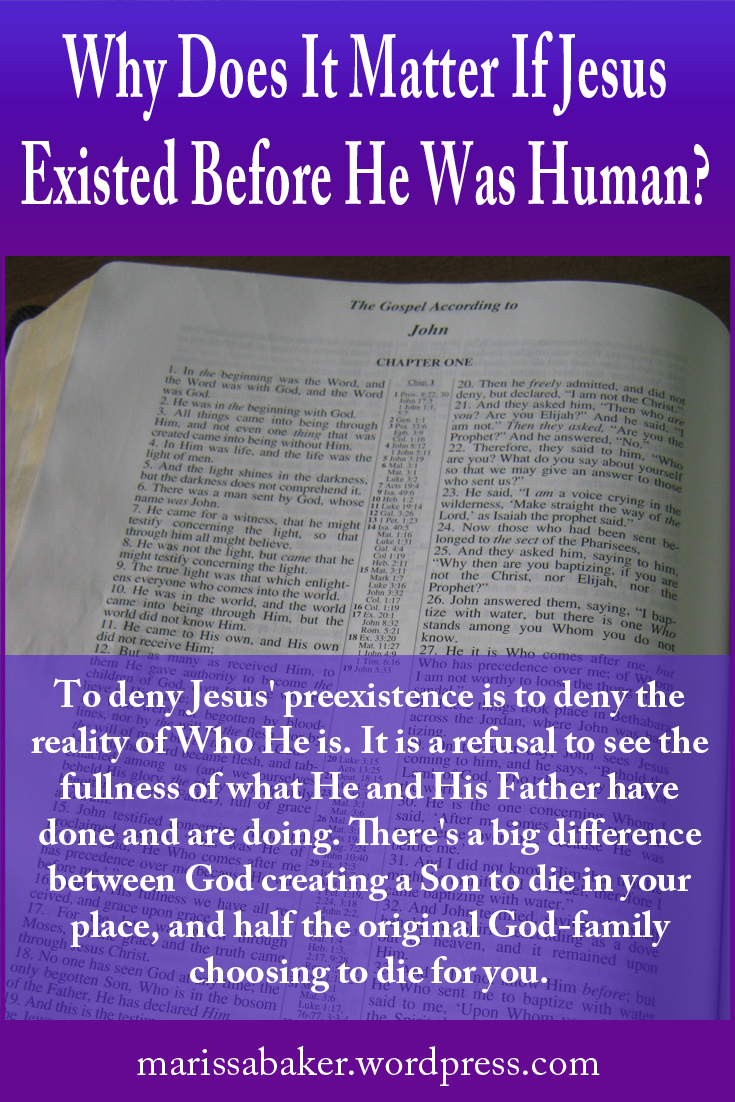
Most of you are probably familiar with a debate between Christians who believe God created Jesus in Mary’s womb and those who believe Jesus preexisted His human life. You might have strong feelings one way or the other, or you might not care. As one of my friends recently asked, why does it matter where Jesus came from as long as you believe in Him as your savior now?
But I think it does matter. Jesus is the foundation for all the foundational truths we learn as Christians. Without His sacrifice, we couldn’t have eternal life or a relationship with God. He’s the Head of the church and we’re constantly told “look to” and “consider” Him. On top of that, our goal is to become like God as part of His family, so understanding what the Father and Son are like gives us greater insight into our future. How we view Christ’s role in God’s plan matters.
Setting The Narrative
I’ll just say right now that I believe Jesus preexisted His incarnation as human. In fact, the main reason I’ve never written about the subject is because I felt the scriptures were so clear on this point. But evidently they’re not, because people I like and respect keep bringing it up. Just a couple weeks ago, I overheard a conversation at church that started something like this: “Do you think Jesus preexisted? I’m not so sure …”
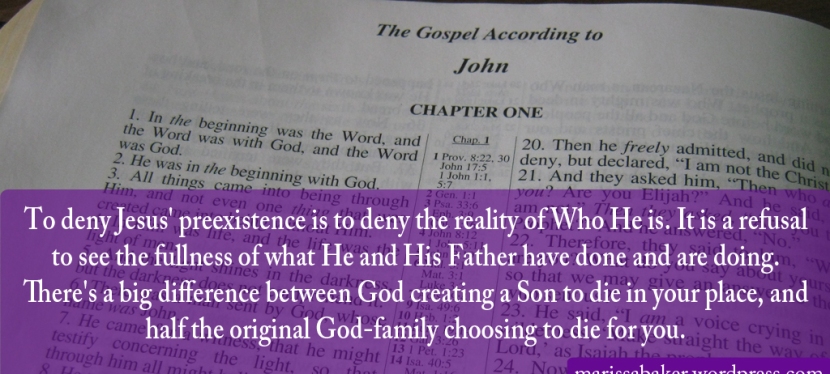
How you answer this question drastically affects how you see Jesus’ relationship with His people and God’s entire plan. There’s a big difference between God creating a Son to die in your place, and half the original God-family choosing to die for you. Read more →
Even five years after graduating with my English degree, I still describe myself as an “English major.” Do non-English majors do that? or do they all switch from “art major,” “accounting major,” or “biology major” to artist, accountant, and biologist? Maybe it’s because the English major can go so many different directions. Writer, teacher, editor, lawyer, journalist … the list goes on. So if you want to connect with other former English majors, you need to describe yourself as an English major.
Whatever the reason, I still think of myself as an English major. And apparently, people I meet do as well. New acquaintances, and even people I’ve known for a while, make certain assumptions when they hear I’m a writer and my degree is in English. With those assumptions comes a few predictable questions and comments that I’m sure other graduated English majors are all too familiar with as well.
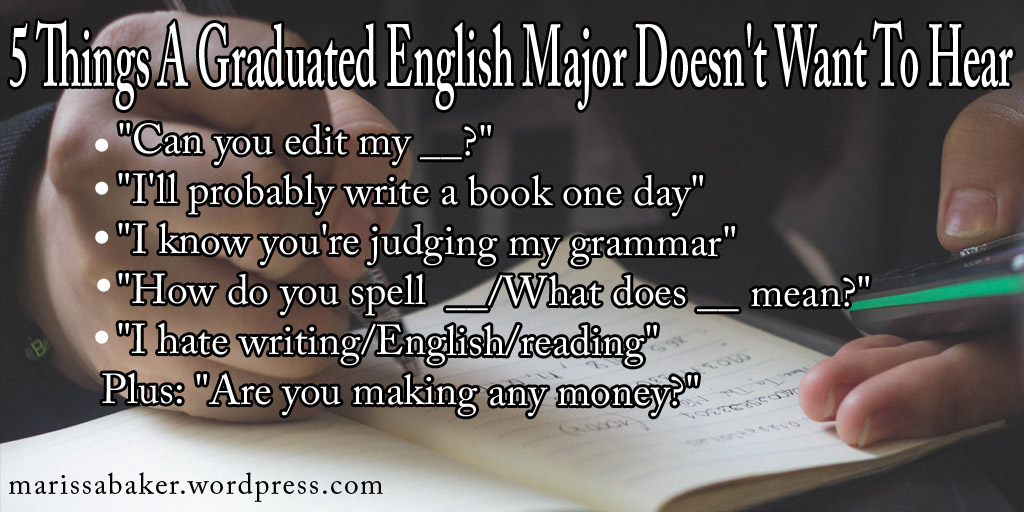
I need to preface this section by telling all the friends who I have edited things for, “No, I’m not mad at you.” I’m perfectly happy to look over the new about page for your blog or proof-read your extremely important email. What I’m talking about is the larger editing projects.
I am a professional writer. That’s how I make money. Just because I like writing doesn’t mean I can do it for free all the time. If someone wants me to read every post on their blog before it goes live, or proof-read their new e-book, or edit a story or novel, we need to talk about compensating my time. Maybe we trade critiques, or you use your website to market my e-book, or maybe it’s a per-post editing fee.
You wouldn’t ask your friend who’s a dentist to clean your teeth for free, or your friend who runs a farm to give away their produce because you’re buddies, or an accountant to do your taxes in their spare time. Ask us for an occasional favor, but don’t put your English major friend in the uncomfortable position of explaining they don’t work for free.
“I’ll probably write a book one day”
Yes, tell me how you’ll just pop out a book some day when you have a little extra time. Go ahead and imply writing is easy or something anyone can do if they cared to bother. I dare you. Because the next person who catches me in a bad mood when they say this is going to get a lecture on how much work it actually involves to draft, edit and re-edit a manuscript, then find good beta readers, edit again, and finally decide it’s ready to publish. And then if they haven’t run off yet they’ll get to hear about how the publishing industry actually works.
“I know you’re judging my grammar”
In-person, on Facebook, here in the comments section …. people are constantly apologizing for their grammar, spelling, or sentence structure. (Strangely enough, it’s not usually the people whose comments are actually hard to read.)
I do think people should make an effort to use good grammar, especially in something they publish, and I am a word nerd. But I don’t just sit around judging and resenting my friends for not proof-reading their Facebook message dozens of times before having the audacity to send it. Am I really such a scary grammar Nazi that you feel the need to make jokes about your terrible writing before communicating with me? That just seems weird.
“How do you spell __/What does __ mean?”
I love words. But I’m not a walking dictionary. This question feels good when I know the answer, but when I don’t it’s usually followed up by some variation of, “So what’s your English degree good for?” *facepalm* Apparently I have failed in my life calling. Here, why don’t I Google the answer for you using a mobile device like the one you’re currently holding in your hand?
… and we have nothing in common. I spent four years of my life reading and writing things in the English language, and most graduated English majors are still doing that at least to a certain extent. But the main reason I don’t like hearing this comment is because it instantly shuts-down avenues of connection. I don’t care so much about the fact that you don’t enjoy these things. What I care about is that you’re basically telling me not to talk about my career because you didn’t like that subject in school.
Nobody likes to be told their passions have no value. Regardless of what your conversation partner majored in or does for a living, it’s generally not a good idea to tell them you hate it. Much better to say something like, “Wow, that’s cool. I have no talent for it. Can you tell me more about why you enjoy it so much?” Now we’re having a conversation.
Bonus: “Are you making any money?”
Or any related questions including “Do you still live with your parents?” or “Do you have a real yet job?” That’s just not any of your business, especially from new acquaintances. I’ll tell you about my living situation and finances if and when I want.
My fellow English majors, what are your other pre- or post-graduation pet peeves? Any questions or comments you’re tired of hearing?

 Like An Anchor