This past week, Boundless.org shared two posts related to Joshua Harris and courtship culture on their Facebook page. One was an NPR interview with Harris and the other was a link to Harris’ call for feedback on the ways I Kissed Dating Goodbye has affected you. It’s a popular topic, since so many people in the churches blame courtship culture for problems in their relationships and hurt in their lives. They say the church’s attitude towards dating and courtship made them feel ashamed of their bodies and their sexual desire, that it set up intimidating expectations for relationships, and it is why they’re still single (or, for some, unhappily married).
The complaints aren’t all directed at courtship culture, either. Another article I saw this week was published by Relevant Magazine and didn’t mention courtship at all. How Christians Ruin Dating is specifically addressing ways that singles in the church feel their fellow Christians are ruining their dating lives. There’s too much obsession with romance, too much gossiping about couples, too much emphasis on marriage. We just need to chill, they argue.
For those of us who are single young adults in the church, there’s no denying that the culture we grew up in influences how we view dating and relationships. But we’re also grown-ups and it’s time to stop blaming the church for all our relationship problems and take responsibility for the choices we’re making. We can’t keep using the argument “Christians ruin dating” as an excuse for not finding relationships. Courtship culture, church gossips, the pressure to get married … those don’t keep us from finding a spouse. We do that when we use the problems surrounding Christian dating as an excuse to not ask someone out, or to turn someone down when they ask us out, or to sabotage potential relationships.Read more →
The people of God are set apart, with different priorities, habits, and festivals than the rest of the world. We may celebrate national holidays of our homelands, such as July 4th for Americans, but those are not the observances that shape our identities as God’s people. The kingdom we belong to under Christ’s authority has a different calendar.
A couple months ago, I read Desiring the Kingdom by James K.A. Smith. In “Chapter 5: Practicing (for) the Kingdom,” he discusses “rhythms and cadences of hope” that Christians observe in weekly and annual practices. For him, this means Sunday, Easter, Lent, Advent, Christmas and others. He connects the observances to a rich history of “a people gathered to worship the Messiah, who does not float in some esoteric, ahistorical heaven, but who made a dent in the calendar — and will again” (p. 157).
However, when you read the Bible, you won’t find the days Smith talks about on God’s calendar. Even the one mention of Easter in the KJV is a mistranslation of pascha, or Passover (Acts 12:4, Strong’s G3957). Rather, we find the church from the Torah to Revelation on a calendar even more unique than the one Smith claims for Christians. I know it puzzles many Christians that I would keep the “Jewish holidays,” but I find it equally puzzling that they would continue a tradition of co-opting pagan holidays and attaching them to Biblical events God gave no instructions to observe. When we search the scriptures looking for God’s version of liturgical rhythms, we find a worship pattern far more richly layered and deeply rooted in God’s plan than what man has invented.
The observance of time in the Bible begins at Creation. On the fourth day, God said, ““Let there be lights in the expanse of the sky to divide the day from the night; and let them be for signs to mark seasons, days, and years” (Gen 1:14, WEB). On the seventh day God rested “from all his work which he had done.God blessed the seventh day, and made it holy, because he rested in it from all his work of creation which he had done” (Gen. 2:2-3, WEB; see also Ex. 20:11; 31:17).
From the very beginning, God set up a world that allowed for marking time in weekly, monthly, and yearly rhythms. The Sabbath was established from the foundation of the world, and there’s no scriptural evidence that it was ever moved from the seventh to the first day (click here for my Sabbath post). The other holy days were set in place as God revealed His plan and established His covenants, but the Sabbath was there since the beginning and will be with us forever (Is. 56:2-7; 66:22-23; Mark 2:27-28; Heb. 4:9).
The months were marked by new moons, making the Hebrew calendar lunar (which is why the holy days “move around” on the Gregorian calendar). Exodus establishes which month begins the year (Ex. 12:2) and calls it Abib (Ex. 13:4). The new moons aren’t counted as Sabbaths and we know very little about how they were observed. We’re told there was trumpet blowing and offerings (Num. 10:10; 28:11-15), we read about people gathering together (1 Sam. 20:5, 18, 24, 27; 2 King. 4:22-23), observance is mentioned in a Millennial setting (Is. 66:23), and once they’re mentioned in the New Testament alongside holy days and Sabbaths (Col. 2:16-17). Most of us aren’t sure what to do with them today and ignore them, and I confess I’m guilty of that as well.
Image by Jantanee from Lightstock
Remembering Our Savior
The first month, Abib, begins the holy day cycle with Passover on the 14th. Originally, the Passover (Pesach in Hebrew) was kept as a memorial of God rescuing Israel from Egypt and sparing their firstborn by passing His vengeance over the houses covered by the blood of a lamb. Jesus Christ fulfilled what was pictured here when He died as our Passover lamb, and He up-dated Passover observance for His new church.
Many churches today keep the Passover, but in many Christian denominations it has been replaced with Easter and the ceremony Jesus instituted on His last Passover is done regularly as Communion. However, Jesus never tells us to mark His resurrection day with a yearly observance. Rather, He says during the Passover ceremony, “Do this in remembrance of me” (Luke 22:19, NET). Even if we did remember Him in communion throughout the year (there are some scriptures you could use to support that practice), it would not eliminate the need to observe Passover the way that Christ did. The resurrection was incredibly important, but Jesus didn’t want us to stop keeping Passover and replace it with Easter.
In his book Surprised by Hope, N.T. Wright laments how little time is spent in celebrating Easter and argues “it ought to be an eight day festival” (p. 256). If he were to step back from Easter and take another look at Passover, he would see God did indeed set up eight days of observance. Passover starts things off, then the following day begins the seven-day festival of Unleavened Bread (Chag HaMatzot). If we look at a timeline of Jesus’ death and resurrection, we find that He rose from the dead when the sun set on Saturday, ending the weekly Sabbath and starting the first day of the week. He ascended to His father the following Sunday morning (John 20:1-17), which corresponds to a special ceremony outlined in Leviticus 23:9-15 called the Wave Sheaf or First Fruits. This ceremony marked the beginning of a 50-day count to Pentecost.
Set back in the context of the Biblical holy days, our remembrance of Christ’s Passover sacrifice kicks-off a week long festival where we remember that because “Christ, our Passover, has been sacrificed in our place” we are being made into a people untainted by the yeast of sin (1 Cor. 5:6-8). It should be a time of rejoicing and appreciation for all that’s pictured in His sacrifice and in His resurrection. When we mark the Wave Sheaf as the day He ascended to His Father following His resurrection and start counting to Pentecost (Shavuot), we have a reminder built into God’s holy calendar that without the resurrection of Jesus the church wouldn’t have the holy spirit. And so we celebrate Pentecost, the day God poured His spirit out on the New Testament church (Acts 2:1-4) as a direct result of the resurrection of Jesus Christ and the work He’s currently doing in and with His church to make us firstfruits.
On the first day of the seventh Hebrew month, the Lord commanded Israel, “you must have a complete rest, a memorial announced by loud horn blasts, a holy assembly” (Lev. 23:24, NET). Many interpret this day as picturing the return of Jesus Christ because “the Lord himself will descend from heaven with a shout, with the voice of the archangel and with God’s trumpet” (1 Thes. 4:16, NET). In Jewish tradition, trumpets were blown the entire month leading up to the Feast of Trumpets (Yom Teruah). Messianic rabbis teach the trumpet calls proclaim, “The Bridegroom is coming! get ready to meet Him.” What could be more relevant for the church today as we draw ever closer to Jesus’ second coming?
Ten days after Trumpets, we cycle through to a solemn, serious holy day called the Day of Atonement (Yom Kippur). This day is marked by fasting, prayer, and a complete Sabbath rest from all work. Judging by the amount of scripture space devoted to its observance (Lev. 16:1-34; 23:26-32, and others), this day was very important to God, and it still is. Atonement was called an “everlasting statute” and Paul was still marking it in the New Testament (Acts 27:9). Unfortunately, it’s been so stereotyped as a Jewish holiday that most Christians don’t even consider the depth and meaning this day takes on following Christ’s atoning sacrifice, His resurrection, and His exaltation to the role of High Priest. Instead, they’re distracted during the fall season of the year by thoroughly pagan Halloween and non-scriptural All Saints and All Souls days.
The holy day cycle, like the plan of God, culminates in a celebration. Every weekly Sabbath looks forward to the time when Christ will reign on this earth as present, powerful, King of kings and Lord of lords, but the Feast of Tabernacles (Sukkot) takes the picture further. We dwell in temporary shelters as a reminder that we are sojourners here on this earth awaiting the return of our Lord and looking forward to a time when His kingdom will be here on earth. Sukkot also looks back, at the children of Israel who God made to live in tabernacles, or “temporary shelters,” when He “brought them out of the land of Egypt” (Lev. 23:42-43, WEB). Jesus kept this Feast (John 7:2-10, 14, 37) and it will be kept in God’s future kingdom (Zech. 14:16). We can’t argue it’s irrelevant to the church today; it hasn’t even been fulfilled yet by God’s Millennial Kingdom. Wrapping up the holy day cycle, the Feast ends with an eighth day, the Last Great Day, pointing to the final judgement day and the New Jerusalem (Revelation chapters 20-22).
Aligned With The Lord
So why aren’t all the Christian churches on God’s calendar? I’ll be honest, this is something I really don’t understand. To be clear, I under stand why people who never learned about God’s holy days and who are members of churches that dismiss these days don’t keep them. Unless you study God’s holy days for yourself, you’re unlikely to hear about them in most churches. But I don’t understand how Bible teachers justify the omission. Why distance yourself from the rhythms of worship God says belong to Him? In Leviticus, before outlining all the holy days, God says, “These are the Lord’s appointed times which you must proclaim as holy assemblies—my appointed times” (Lev. 23:1-2, NET). They are days Holy to our great God, not something just for a specific group or time. So why abandon them for days with observances rooted in pagan holidays like the worship of Ishtar/Astarte (for Easter) and mid-winter Saturnalia (for Christmas)?
I’m not just talking about Christian leaders today. This substitution of man’s days for God’s days goes back centuries–so far that Easter and Christmas are called “Christian” traditions and the days Christ Himself kept are a distant memory. It’s time for the church to ask itself some tough questions. Is God pleased when we use pagan holidays to “worship” Him, even after we pretty them up and associate them with events in the Bible? Or would God be more pleased if we value the holy days He set aside for His people from the establishment of His covenants? The way we live our lives matters to God, and He’s watching to see whether we’ll cling to traditions of men or whether we’ll cling to His word, His kingdom, and His plan.
I hope no one feels like I’m attacking them or their beliefs. I’ve thought long over how to phrase this post, and even debated whether or not to share it. I truly feel, though, that the closer we align ourselves with God’s word, the more He will reveal of His plan and the closer our relationships will be with Him. May God’s blessing rest on you all, my friends.
Featured image by José Roberto Roquel from Lightstock
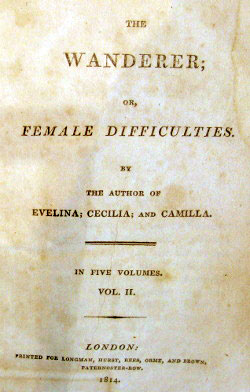
My title for this post is the subtitle for Frances Burney’s final novel, The Wanderer. It was one of the first books I put down when compiling my Classics Club Book List, and I’m reading it this year for the Women’s Classic Literature Event. Finishing this book means I’ve now read all Burney’s major fiction works (that is a grand total of 3,133 pages of text, so it’s a pretty big deal). I am Reader, hear me roar.
Note: spoilers follow for this 202 year old book.
The Wanderer, or Female Difficulties is the tale of a penniless emigree from revolutionary France trying to earn her living in England while guarding her own secrets. Combining the best elements of the gothic and historical novels, this newly appreciated work is an extraordinary piece of Romantic fiction. Burney’s tough comedy offers a satiric view of complacent middle-class insularity that echoes Godwin and Wollstonecraft’s attacks on the English social structure. The problems of the new feminism and of the old anti-feminism are explored in the relationship between the heroine and her English patroness and rival, the Wollstonecraftian Elinor Joddrel, and the racism inherent within both the French and British empires is exposed when the emigree disguises herself as a black woman. (Goodreads summary)
This is probably the Burney novel that I found most frustrating. Evelina, her first novel, is the easiest to read, though it still engages with the darker side of 18th century romance. Her next two, Cecelia and Camilla, are more difficult (especially if you’re expecting an Austen-style romance). The heroines are persecuted relentlessly, in grave danger several times, and the heroes fail to live up to the name. The Wanderer takes these themes a step further. Instead of giving her characters ineffective guardians, Burney doesn’t leave the Wanderer, who goes by the name “Ellis” for much of the book, anyone to turn to at all. Instead of revealing the plight of a young woman having difficulty navigating the marriage market, Burney shows the struggles of a woman completely alone without name or resources to protect and support her.
The Wanderer is a scathing rebuke of society on many different levels. Burney takes full advantage of her lengthy text to discuss the French Revolution, snobbery in the upper classes, gender inequalities, racial stereotypes, modern suspicion of an afterlife, suicide, social perceptions and stereotypes, abusive/coercive relationships, and duty to family (just to name the ones that come to mind within a minute). The amount of ground she covers is really quite impressive. Even more impressive is that she manages to show both sides of most issues. Sometimes you can easily tell where Burney stands, but not always. For several of the ideas discussed, it seems she just wants readers to open their eyes and see that things aren’t always black and white.
What frustrated me when reading The Wanderer wasn’t the issues being discussed or even so much the drawn-out plot line. It was Ellis’ character. The narrative stays with Ellis but maintains a distance that makes it very difficult to sympathize or identify with her. For the better part of the book, we don’t know any more than the other characters about who she is and what her motivations are. We rarely even know what she’s thinking. What’s worse, we seldom hear her say anything. There are a few scenes where Ellis speaks clearly and decisively, but mostly she stands mute. She is silent while other characters misconstrue her motivations, put words into her mouth, accuse her unjustly, and even propose romantic connections. A few words pass her lips, but mostly she stands in acute emotional agony hoping the other characters will understand her inarticulate protests. Even Mr. Harleigh, the heroic figure in this story, becomes so frustrated by this that there are times he is almost violent in his insistence that she give him a straight answer.
Silencing the main character frustrated me, but it also draws attention to the difficulties Burney is discussing. It might be tempting to read the subtitle “Female Difficulties” simply as a critique of the challenges women faced in 18th century society. We could say that it is the other characters who make life difficult for Ellis because society is set-up to be suspicious of a woman alone and to limit her options. But it goes even deeper than that. The type of femininity ingrained the naturally elegant and lady-like Ellis make her situation even more difficult. She is one of her own worst enemies because of her limiting view of her own role as a woman. It’s not seemly for a lady to perform in public, so she refuses to give a concert until she’s shamed into it by a need to pay her debts. It’s not ladylike to accept pecuniary aid from a man, so she becomes entangled in a host of embarrassing situations trying to return gifts that were made anonymously to spare her delicacy. It’s a shame for a woman to run away from her husband, so she conceals the fact that she was forced into a marriage that’s barely recognizable under the law even when it means leading on another man who’s falling in love with her.
Like today, 18th Century culture was struggling with ideas surrounding gender definitions, roles, and expectations. Burney recognized that the problems regarding inequalities between men and women weren’t just external, but also ingrained in prevailing ideas about what constitutes masculinity and femininity. I argued when writing my undergrad thesis about her other novels that Burney countered the gender crisis of her day by advocating for a return to Biblical gender ideals where men and women are recognized as having unique strengths and roles yet also viewed as equally important. In this book, published 18 years after Camilla, there’s little evidence of that hope. Burney seems more cynical about society’s ability to change and points out problems without offering a way to fix things. It’s up to us, the readers, to try and find a solution or to live with the consequences of inaction.
Click here to get a copy of The Wanderer. Please note that this is an affiliate link. This means that, at no additional cost to you, I will receive a commission if you click on the link and make a purchase.
My churches have always taught the importance of Jesus Christ’s resurrection. I’ve even written about resurrection before, as part of the Foundations series. But I only focused on what the resurrection meant for individuals — that Christ’s resurrection makes our resurrections possible. I hadn’t really considered the implication of Christ’s sacrifice and resurrection on the entire world today.
Reading N.T. Wright’s book Surprised by Hope: Rethinking Heaven, the Resurrection, and the Mission of the Church has been eye-opening. He’s not really talking about things I’ve never heard before, but the way he frames his exegesis is making me think about Christ’s resurrection and the church’s mission at a depth I hadn’t pondered until now.
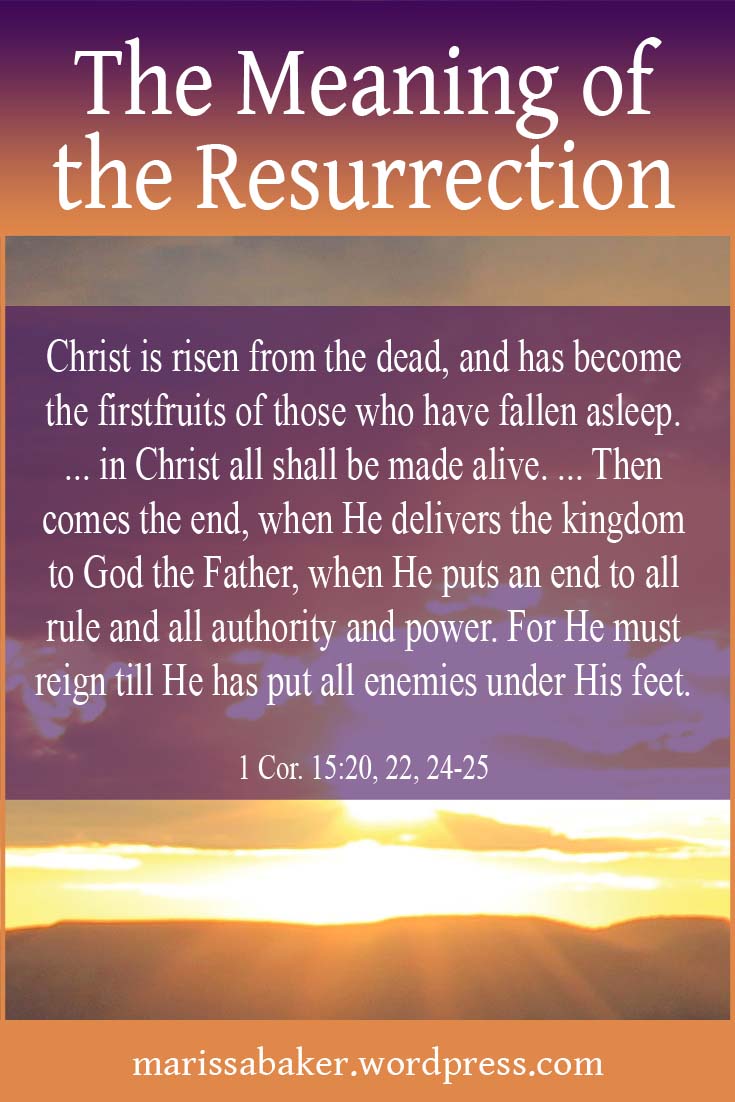
Wright places the resurrection in its historic context to show that what happened when Jesus rose from the grave three days after His Passover sacrifice was truly revolutionary. The Greek and Roman cultures believed in an immortal soul and the Jews believed in a resurrection, but no one was expecting Jesus (or anyone else) to rise from the dead in a renewed spiritual body. The risen Jesus was far too tangible and real to fit Greco-Roman ideas of afterlife and it was unexpected timing-wise from the Jewish perspective. This resurrection was sealed proof that Jesus was indeed the Messiah and that things on earth would never be the same again. Read more →
I’m sitting here thinking, “What does one write on Independence Day when one is rather disappointed in the direction one’s country is headed?” Thousands of babies are being slaughtered, we just had the largest mass shooting in US history, there’s a systematized rejection of gender and acceptance of child abuse … the list goes on and on, and our presidential candidates aren’t making things look any better. I wonder if this is something like how Hamilton felt facing the election of 1800.
Except I’m not sure which of our current candidates is Burr in this analogy and which is Jefferson. I’m probably just going to not vote at all (side note: for some reason I’ve always felt uncomfortable with/guilty for voting, even though my church doesn’t teach against it. Weird, huh?).
Anyway, this isn’t going to be a depressing post! We’re celebrating Independence Day, and I’m quite certain the best way to do that this year is listening to the Hamilton Original Broadway Cast Recording. It’s on Amazon Prime, Spotify, YouTube — you have no excuse not to listen. Nor any excuse not to think about what you’re listening to.
Hamilton didn’t win 11 out of the record-breaking 16 Tony nominations just because it’s a run-away hit with a unique musical approach. The catchiest music couldn’t have sustained this level of success without a story that resonates deeply with fans. One of the many fantastic things about Hamilton is that it presents the founding father’s as real people. They’re not glorified by rose-eyed historical glasses or torn to shreds by an opposing historical perspective trying to vilify them. They’re just real men with a vision for the future and the necessary skills and commitment to found a country that is now celebrating its 240th birthday. Not too shabby a legacy. So what does that mean for us, real people today who have the chance to influence the course of history?
A More Accurate Picture of America’s Ethnic Landscape
The only reason I would ever advocate casting with race in mind is for the purpose of historical or cultural accuracy. Now I’m re-thinking even that. A racially diverse cast works perfectly for Hamilton — America of today telling the story of America’s founding. And even though the individual characters’ casting doesn’t match the race of their historical counterparts, a racially diverse group working together to found our country is more accurate than most people think. Peter Salem (hero of the Battle of Bunker Hill), Prince Whipple (who fought alongside Washington), James Armistead (the double-spy who may have “won the revolutionary war”), Wentworth Cheswell (who rode to say “the British are coming” at the same time as Paul Revere) — they were all black, along with many other key figures in America’s founding.
Leslie Odom Jr. (Aaron Burr), Christopher Jackson (George Washington), Daveed Diggs (Marquis de Lafayette/Thomas Jefferson), Phillipa Soo (Eliza Hamilton), Renée Elise Goldsberry (Angelica Schuyler)
Renee Elise Goldsberry, who plays Angelica Schuyler, says that the most beautiful thing about Hamilton is that “it’s told by such a diverse cast with a such diverse styles of music. … We have the opportunity to reclaim a history that some of us don’t necessarily think is our own” (quote from Times article “Why History Has Its Eyes on Hamilton’s Diversity“).
One of the lines in Hamilton is “history has its eyes on me/you.” The founders knew what they were doing was going to make a mark on history, but this phrase can also be true of us today. Every generation has the potential to make its mark on history. Will future Americans look back on us and see a group of people who wouldn’t stand for white-washing of their history any more? or will they see us as complicit in maintaining the accepted historic narrative that all blacks were slaves and all whites were oppressors, even if that means marginalizing blacks who held influential positions at key points in American history?
Redefining The Moral Climate of Our Nation
One of the things Alexander Hamilton is known for is being involved in our country’s first political sex scandal. Perhaps this is one reason he was so often overlooked — he didn’t fit the squeaky-clean mold of a founding father that was popular in history books until very recently (now we seem to be going the other direction, trying to dig up as much dirt as possible on everyone. No one’s ever accused the human race of being balanced, have they?).
In a post-Clinton age it seems strange to us that when Hamilton’s affair came out the immediate reaction was “Well, he’s never gon’ be President now” (though I’m sure in more historically accurate language). The idea of someone who cheated on his wife and openly confessed it becoming president was unimaginable. Hamilton himself down-played the seriousness of the affair, concentrating on proving he was a virtuous man innocent of the financial crimes he was accused of. Or, as he says in the play, “I have not committed treason, and sullied my good name.” He even wrote that he believed his wife “will approve, that even at so great an expence, I should effectually wipe away a more serious stain from a name, which it cherishes with no less elevation than tenderness. The public too will I trust excuse the confession” (read the full text of Hamilton’s Reynold’s Pamphlet here).
Committed treason he did not, but sully his good name Hamilton certainly did. “Hamilton’s reputation was in tatters,” an article from the Smithsonian says, “Talk of further political office effectively ceased.” Now, 219 years later, can you even imagine living in nation that expects moral behavior from its politicians? Or where the politicians themselves take responsibility for their own behavior? Hamilton was so worried about the possibility of a stain on his reputation that he confessed to an affair. And even though he did down-play its severity in light of the other charges, he still said of the affair, “I bow to the just censure which it merits. I have paid pretty severely for the folly and can never recollect it without disgust and self condemnation.”
It is one of my favorite things about the play Hamilton that Hamilton takes responsibility for the affair, acknowledging that he should have said “no to this.” It doesn’t absolve Maria Reynolds of her role in seducing a married man, but there’s “No Slut Shaming in Hamilton” either (<- that blog post is what prompted me to listen to Hamilton for the first time). Today, we don’t expect people in the public eye to even take responsibility, much less to hold themselves to a certain standard of morality. We’re scandal-hungry and ready to offer judgement on celebrity short-comings, but we don’t expect anything better. Perhaps this trend will continue until there’s no longer any such thing as a socially accepted moral standard, but I hope not. And when history turns its eyes back on us, will they see a generation sliding farther into cultural decay, or one that took a stand and said, “We expect better things of our role-models and leaders”?
There are plenty of other moral, social, and political issues we could discuss. If history’s eyes really are on America today, what would you like to see change for the better in our generation? financial disparity between rich and poor? the foster care system? environmental issues? whether or not to forfeit our second amendment rights? Please share your thoughts in the comments (bonus points for using Hamilton quotes)!
It’s been a year since I first started really digging into 1 Corinthians 11 and began wearing a head covering when I attend church services. I’d been wondering about 1 Cor. 11 for years, but hadn’t really looked into it all that deeply. None of the explanations about why we don’t cover today satisfied me, but I didn’t feel I had a good enough argument in favor of covering to go against my church tradition. I’d discussed it with a few women in my congregation, but they seemed confused by the passage and had decided that your hair is your covering and the “we have no such custom” phrase meant veiling/covering in church wasn’t necessary today.
Then a year ago I stumbled upon The Head Covering Movement through a blogger. Here was a group who took this passage seriously. They were ready to talk about what “because of the angels” might mean. They engaged directly with a variety of arguments against covering in a respectful way solidly rooted in scripture and history. They even had a good explanation for the phrase “we have no such custom.”
How I started covering
Flea market find — head covering for $1!
My first reaction was to talk with my mother, who was suspicious of the whole idea. I then reached out to a friend who’d been sending me “rants” about scriptures that didn’t make sense to him. My own “rant” went something as follows: “should I start wearing a scarf because this makes sense to me? or did I miss something in their interpretation of these verses that I shouldn’t agree with? Maybe my mother’s right that it’s not a big deal and it would be too distracting to people around me in church.”
Even before I heard back from him, I wore a wide headband to church that Sabbath. I thought it was big enough to count as a covering, yet not something I hadn’t worn before so it wouldn’t attract much attention. A few days later, my friend wrote something that helped confirm my decision: “It is good that you’re mindful of not causing a ruffling of feathers among fellow congregants, but we can only control so much of other people. … So, I would just encourage you to follow your conviction wherever that leads you. If people have a problem, it is their Christian duty to confront you about it, and I doubt anyone would still have a problem with you/your apparel upon inquiring about your intent in doing so.”
My friend is a smart man. I’d already taken baby-steps toward covering, but his encouragement was reassurance that I wasn’t just going “off the deep end.” I ordered my first cover from Garlands of Grace on July 15 (pictured in the featured image), and started building a collection of head scarfs. Since then, I’ve only had one person in the United Church of God groups I attend ask about the fact that I cover my head, but at my Messianic group there are a few other women who cover and the topic comes up more often. I’ve received compliments on how I wear them, as well as on the fact that I’m covering. One person said, “I appreciate that you wear a cover when you dance.” I’m not doing this to seek attention of course, but for someone whose love language is Words of Affirmation this support was invaluable.
Support for covering
In terms of scripture, the passage in 1 Corinthians 11:1-16 is the main support for the practice of Christian head covering. A few other scriptures tie in to it (such as Num. 5:18 instructing the priest to uncover the head of a woman accused of adultery), but this is the only place where it’s focused on. You can check out The Head Covering Movement for more in-depth analysis, but here’s what convicted me that covering is for the church today:
God’s created order for headship is the foundational reason for covering (v.2-3, 7-12).
It’s described as a dishonor and a shame for women to “pray or prophecy” uncovered (v. 4-6).
Paul says “nature itself” (including the examples of short hair on men and long hair on women) teach us covering is proper (v. 13-15). I also think this is support for the hair acting as a covering sometimes and an additional cover only being required when “praying and prophesying.”
The “we have no such” custom phrase grammatically refers back to the question in v. 13 of women praying uncovered. No where in scripture does Paul suggest people can ignore a command he writes about simply because they are contentious over it.
On top of those reasons, the arguments most people use against head covering are, for me, an argument in favor of it. They say it was a strictly cultural matter that no longer applies — that in Corinth, only prostitutes went about with uncovered heads and we don’t want to be mistaken for prostitutes. But Paul mentions no such thing and when we start throwing out commands because we think they’re strictly cultural we’re on a very slippery slope. On top of that, historical evidence shows the prostitutes referenced in this argument belonged to a Corinth of about 200 years before Paul’s writings and art of the time shows respectable women both covered and uncovered. The covering Paul talks about wasn’t based on a Greek or Roman practice (or even a Jewish practice, since both men and women covered in Judaism).
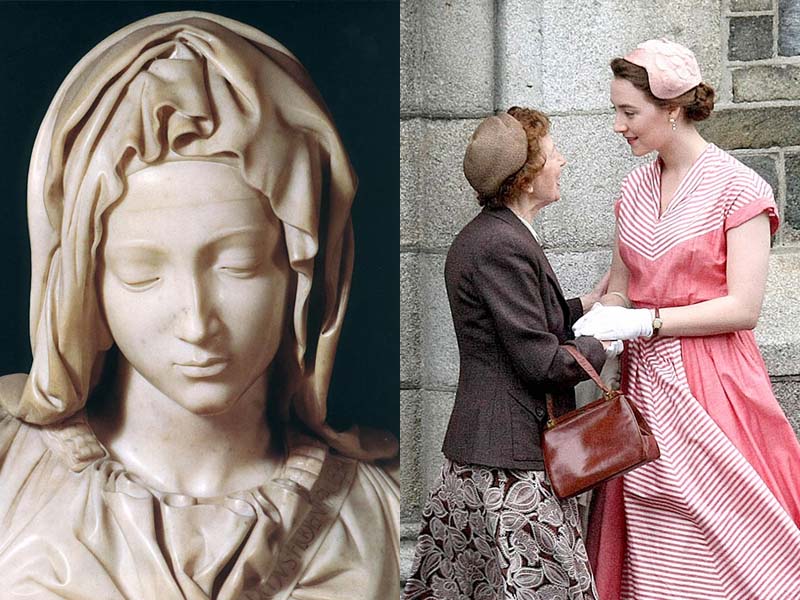
Left: Michelangelo’s The Pietà (1498-1499). Right: film still from Brooklyn (2015, setting 1952)
In reality, history shows us that head covering was practiced unanimously among Christian women for centuries. I hate to cite Wikipedia as a source, but in this case their article on Christian headcovering throughout history is unusually well-researched and more thoroughly cited than many other articles I’ve found online. Until a little over 50 years ago (with the sexual revolution and the feminist movement gaining traction), covering was the norm in church and often in public as well. Even fairly recently, no respectable lady would leave the house without a hat of some kind and she was expected to keep it on during church services. If you’re looking closely, you’ll notice this in well-researched historical dramas. Last year’s film Brooklyn, for example, was set in 1951 and ’52, and you’ll see Eilis removing a veil as she leaves a church in one scene and another scene where she’s wearing a pink cover at church.
While I don’t like to seem as if I’m pushing the notion of headcoverings on other people, I am doing this for a reason and a year of covering has only confirmed my choice. My encouragement to you today is to just take a closer look at this passage of scripture, and not to ignore it because we’re not sure what to do about it. Don’t start covering just because someone tells you to — study it and see if you’re convicted. And if you are, then don’t be afraid to start covering in church. Sure some people will probably think it’s strange, but as my friend said, “we can only control so much of other people.” If you’re convicted that you should be covering at church, then you’re doing it for God and not for what other people think (though you do want to try and avoid offending our brethren by how we practice covering).
Now, I don’t mean to sound like covering has been without its struggles or that it wasn’t a little weird at first or that I don’t still have questions. For example, how often to cover is still something I’m not clear on. I’m convicted of covering at church services (which is all The Headcovering Movement sees as necessary), but “praying and prophesying” could apply to other times as well. Do Bible studies count? What about dance practice, since the dancers pray as a group and sometimes I’m asked to pray aloud? I cover at home when praying in private, but should I cover for blessings on meals? or when writing these Sabbath blog posts, since that’s a sort of prophesying/inspired speaking? I’m not sure.
While thinking these things over, I’m keeping in mind that we can’t turn this into a legalistic thing, and I do think God hears prayers of uncovered women. Covering should be a way of honoring God, never something that stands between us and our Lord. But if it is indeed a command, and I believe it is, then it’s meant for our good, and that has been my experience. I’ve found that covering draws me closer to God and reminds me that I’m here to worship and to honor the Lord.









 . Please note that this is an affiliate link. This means that, at no additional cost to you, I will receive a commission if you click on the link and make a purchase.







 Like An Anchor